GEA Group Aktiengesellschaft
Q3 FY2026 · Earnings Call TranscriptNovember 9, 2026
Operator
Good day, and thank you for standing by. Welcome to the GEA Group AG Q3 2026 conference call.
At this time, all participants are in a listen-only mode. After the speakers' presentation, there will be a question-and-answer session.
To ask a question during the session, you will need to press star 1 and 1 on your telephone. You will then hear an automated message advising your hand is raised.
If you joined via device audio, click the raise hand button on your screen. To withdraw your question, please press star 1 and 1 again, or click the lower hand button.
Please be advised that today's conference is being recorded. I would now like to hand the conference over to your speaker today, Oliver Luckenbach, Head of IR.
Please go ahead.
Oliver Luckenbach
Thank you very much, Madalena, and good afternoon, ladies and gentlemen, and thank you for joining us today for our third quarter 2026 earnings conference call. With me on the call are Stefan Klebert, our CEO, and Alexander Kocherscheidt, our CFO.
Stefan will begin today's call with the highlights of the third quarter. Alexander will then cover the business and financial review before Stefan takes over again for the outlook 2026.
Afterwards, we open up the call for the Q&A session. Please be aware of the cautionary language that is included in our Safe Harbor statement, as in the material that we have distributed today.
With that, I hand over to Stefan.
Stefan Klebert
Thank you very much, Oliver, and a good afternoon, everybody. It's my pleasure to welcome you again to our conference call today.
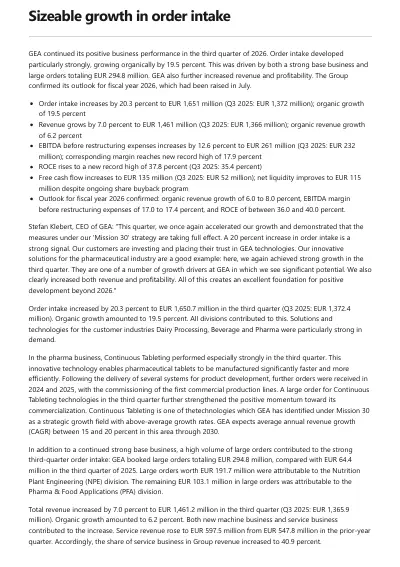
It's again a very good and interesting Q3 which we have to report. After having already reported a strong first half, we made further improvements in all KPIs in the third quarter again.
Year-over-year organic order intake growth even accelerated further from 10.7% in the first half to an outstanding 19.5% in the third quarter. This performance was mainly driven by an increase in large order volume, orders above €15 million.
We secured a total volume of €295 million in the third quarter, while the prior-year quarter contained a large order volume of €64 million. In addition, orders below €1 million, our so-called base orders, showed strong growth, too.
Sales grew markedly by 7% to €1.5 billion, to which all divisions contributed. EBITDA before restructuring expenses increased substantially by 12.6% year-over-year to €261 million.
The corresponding EBITDA margin improved to a new record level of 17.9%. Return on capital employed rose significantly and crossed for the first time the 37% mark.
Cash generation was good in the quarter, so that net liquidity turned from a net debt position at the end of the prior-year quarter into a net cash position of €115 million at the end of the third quarter in 2026. This was achieved despite the cash-out for the ongoing share buyback program.
As we launched our new share buyback program of up to €500 million in August this year. The first tranche of the program, with a volume of up to €250 million, started on August 11 and is supposed to run for 7 months.
As of September 30, we have executed €58 million, or 12%, out of the €500 million program. I can already share with you the latest number as of Friday closing.
We have bought back 1.4 million shares, which represents 0.85% of outstanding shares. We bought this share back at an average price of €66.35, which is already today a very successful investment because Friday's closing price was 4.5% higher.
As you might remember, we presented to you a clear plan for 14 above-average growing verticals under Mission 30 at our Capital Markets Day in October '24. These growth verticals already demonstrated their outperformance in 2025 when they achieved an outstanding growth rate of more than 30% in order intake.
Today, I would like to highlight one out of the 14 verticals, as this vertical is performing even better than we had expected: continuous tablet pressing. While we supplied multiple R&D systems for product development until 2023, we saw follow-up orders and successfully commissioned first commercial production lines in '24 and '25.
We were able to build on this success by securing a large order volume for continuous tableting of more than €100 million in the third quarter. What a remarkable achievement and a fantastic example of how successful innovation offers new growth opportunities.
Continuous tablet pressing is transforming, really transforming, the way tablets are produced. What currently take days to complete is completed in just a few hours.
That's a real, real game changer with significant customer benefits. Let me give you some insights into this technology and its value proposition.
The traditional way to produce tablets is batch processing. This typically involves eight sequential process steps such as blending, granulation, and coating, each conducted in a separate room to avoid cross-contamination.
Before the batch is released, quality checks of the tablets are performed. In contrast, continuous tableting offers an integrated powder-to-tablet process where you basically put powder in and get the tablets out.
Real-time process monitoring and inline quality controls ensure consistent product quality. The benefits for customers are significant, just to mention a few: more than 90% reduction in production time, and as I said, from days to hours; up to 40% lower cost per tablet; and up to 30% less factory space.
Moreover, the implications on time to market are enormous. With continuous tableting, our customers can cut the time to market, so that time from product development over pilot to commercial scale, by more than 60%.
As you can imagine, this is a huge advantage in the pharma industry. The value proposition is strong, but given the conservatism in the pharma industry, adaptation is taking its time.
When looking at the success of the last 2 years and the performance in the first 9 months of '26, continuous tablet pressing is increasingly gaining traction. It has just begun, and we are really and definitely here the frontrunner, far ahead of any other competitors.
This is more to come. I now hand over to Alexander, who will give you more insights into our performance in the third quarter.
Alexander Kocherscheidt
Thank you very much, Stefan, and a warm welcome from me as well, ladies and gentlemen. I will now walk you through our business and financial performance in the third quarter.
Let's have a closer look at the group performance. As Stefan has already highlighted, we had an excellent third quarter throughout all key performance indicators.
Order intake increased significantly by 19.5% organically, with all divisions contributing to this positive development. We have seen growth in almost all customer industries, but particularly in dairy processing, beverage, and pharma.
Dairy processing should come as no surprise considering it has been the case for several quarters already. Translational FX effects turned from a small adverse effect of 1% in the second quarter to a small positive effect of 1% in the third quarter.
Sales grew organically by 6.2%, driven by both new machine and service sales. While the new machine business reported organic sales growth of 4.6% year-over-year, the growth rate in the service business was even higher at 8.6%.
Thus, the growth trajectory in the service business continued. In the last 4 years, we have reported organic service sales growth in every single quarter, an impressive performance.
On the back of the higher service growth rate in the third quarter, the service sales share increased by 0.8 percentage points to 40.9%. EBITDA before restructuring expenses rose by €29 million to €261 million, resulting in a corresponding year-over-year margin expansion of 0.9 percentage points to 17.9%, as Stefan already said, a new record level.
Moving on to the divisional performance. I will start with Pure Flow Processing, which reported strong improvements in all key performance indicators across the board.
Order intake rose organically by 8.3% year-over-year, driven by strong development in orders below €5 million. This performance is even more impressive when considering that the prior-year quarter contained a large pharma order of €16 million.
Where is the demand strength coming from? It was broad-based across different customer industries, but biggest contributions, like in the previous quarter, came from dairy processing, food, and marine.
Organic sales grew strongly by 8.7% year-over-year, driven by almost 10% organic growth in the new machine business and 7.3% in the service business. On the back of the stronger new machine sales growth, the service sales share decreased on a high level from 47.1% in the third quarter of 2025 to 46.4% in the third quarter of 2026.
EBITDA before restructuring expenses rose by €15 million year-over-year to €142 million, driven by higher gross profit because of the strong volume growth. The corresponding EBITDA margin increased on a high level further by 0.5 percentage points year-over-year to 26.9% in the quarter.
Turning to Nutrition Plant Engineering, which was able to build on the positive momentum from the previous quarter. Significant order intake growth and further improvements in sales and profitability.
After having already reported an organic order intake growth of more than 40% for the second quarter, the third quarter demonstrated another outstanding year-over-year organic growth rate of almost 38%. This was mainly driven by an increase in large order volume.
While we booked a large order volume of €192 million from the dairy processing and beverage industry in the third quarter, the prior-year quarter contained a large order volume of €48 million. Once again, dairy processing has been a major growth contributor.
In addition, the customer industry beverage showed good demand. Sales increased organically by 5.8% year-over-year, which was again mainly driven by significant service sales growth.
As a result, the service sales share rose by 2.3 percentage points year-over-year to 33%. The higher service sales share combined with more sales volume led to an increase of the EBITDA before restructuring expenses from €56 million in the prior-year quarter to €61 million in the third quarter of 2026.
The corresponding EBITDA margin rose by 0.4 percentage points year-over-year to 11.8%. Continuing with Pharma and Food Applications, which benefited from a large order volume of more than €100 million and delivered once more an outstanding profitability improvement.
Organic order intake increased significantly by 20.2% year-over-year, which was driven by the customer industry pharma. As Stefan mentioned, the division secured a large order volume of €103 million for our continuous tablet manufacturing lines in the quarter.
That's a fantastic achievement. Sales grew by 3.9% year-over-year in organic terms, mainly driven by strong new machine sales growth of 5.2%.
On the back of the higher new machine sales, the service sales share decreased from 37% in the prior-year quarter to 35.6% in the third quarter of 2026. In terms of EBITDA margin, the division continued its impressive improvement track record in the third quarter.
After having crossed the 16% mark for the first time ever in the second quarter, the third quarter showed, again, a substantial year-over-year improvement of 2.8 percentage points to 16.1%. This is an outstanding achievement, especially when you keep in mind that this division had an EBITDA margin of 10.2% in full year 2024, less than 2 years ago, and now we are reporting 15.3% for the first 9 months of 2026, a very successful turnaround.
Finally, Farm Technologies. Farm Technologies continued to report year-over-year top-line growth, while the EBITDA margin remained at a high level.
Organic order intake growth of 4.1% was solid, given five quarters in a row of double-digit organic growth rates and the respective higher comparison base. Growth was driven by strong demand for service in all regions.
Sales continued their dynamic development in the third quarter and rose significantly by 9.9% in organic terms, with strong contributions from both new machine and service business. New machine sales continued their strong performance since Q4 of last year, with an organic increase of 7.4% year-over-year.
Organic service sales growth accelerated to 12.6% due to good demand for digital solutions. As a result of the higher growth rate in the service business, the service sales share increased by 1.2 percentage points to 49.6% in the quarter.
EBITDA before restructuring expenses rose slightly year-over-year to €37 million, while the corresponding EBITDA margin declined from an exceptionally strong level of 18% in the third quarter of 2025 to 16.4% in this year's third quarter. Main reason were product mix effects.
Let me close the divisional chapter with an overview of the EBITDA growth contribution in the first 9 months and in the third quarter of 2026. There are two points I would like to highlight here.
Firstly, we've been able to increase our EBITDA before restructuring expenses in both time periods considerably. Secondly, all divisions contributed to this strong performance.
This underscores our broad-based operating strength, which is based on top-line growth, price and cost discipline, as well as savings from our excellence programs in procurement and production. Turning now to another important topic: net working capital.
Year-over-year, net working capital declined by €17 million to €449 million. This reduction was driven by a combination of higher trade payables and higher contract liabilities.
The latter reflects the advance payments from large orders. On a quarter-on-quarter perspective, net working capital went up from 7.0% of sales in the last quarter to 7.8% in Q3, placing us comfortably within the guided corridor of 7% to 9%.
While we received more advance payments quarter-on-quarter, higher trade receivables, lower trade payables, and contract assets have triggered the uptick. On a rolling last four quarters basis, which smooths the seasonality, the ratio was at 6.1%.
Free cash flow has been good for the third quarter. Let's have a look at the main drivers.
After a net working capital outflow of €52 million and a €36 million cash outflow for taxes, operating cash flow stood at €180 million in the third quarter. CapEx-related cash outflow was relatively low at €46 million.
As in previous years, we expect CapEx to ramp up in the fourth quarter of 2026. As a result, free cash flow stood at €135 million.
After deducting lease payments and interests paid, net cash flow amounted to €111 million. The solid net cash flow overcompensated the cash-out for our ongoing share buyback program, so that we ended the quarter with a net cash position of €115 million.
Free cash flow generation over the last four quarters has been very strong, reaching €566 million. The corresponding cash conversion ratio, which indicates how much of the EBITDA before restructuring expenses has been converted into free cash flow before restructuring expenses, was exceptionally high or strong at 61%.
With that, I hand back to Stefan for the outlook.
Stefan Klebert
Thank you, Alexander. As a result of the strong development in the first 9 months, we confirm our guidance for the fiscal year '26, which I'm sure you remember we upgraded in July.
We will see organic sales growth of 6% to 8%, EBITDA margin before restructuring expenses between 17.0% and 17.4%, and a return on capital employed in the range of 36% to 40%. Finally, our roadmap for the remainder of '26 and also for '27, so that you can already save the date for our reporting dates in '27 in your diaries.
The next important date will be the release of our full-year results on March 8. In the meantime, we look forward to seeing many of you at the upcoming road shows and conferences.
Alexander, the investor relations team, and I will be meeting investors until the end of January. That concludes my presentation, and I hand back to Oliver for the Q&A.
Oliver Luckenbach
Thank you very much, Stefan and Alexander. With that, also back to you, Madalena.
Please be so kind and open up the Q&A lines.
Operator
Thank you. To ask a question, you will need to press star 1 and 1 on your telephone, or if you have joined by device audio, click the raise hand button and wait for your name to be announced.
Oliver Luckenbach
Hello?
Operator
To withdraw your question,
Oliver Luckenbach
please press... Madalena?
Operator
Hello? I will promote the first participant.
All the speakers can hear.
Oliver Luckenbach
Hello? Hello?
Stefan Klebert
[unclear]
Operator
Please stand by. Your conference will resume shortly.
Alexander Kocherscheidt
Also Katharina sagt, sie kann uns hören.
Operator
Please stand by. Your conference will resume shortly.
Oliver Luckenbach
Hello? Operator, can you hear me?
Madalena, are you there? We can't hear you.
I'm not sure if you can hear us, but we can't hear you. We are working on a solution here, sorry for the delay.
Operator
Please stand by. Your conference will resume shortly.
[unclear] Please stand by. Your conference will resume shortly
Alexander Kocherscheidt
Operator: Good day, and thank you for standing by. Welcome to the GEA Group AG Q3 2026 conference call.
At this time, all participants are in a listen-only mode. After the speakers' presentation, there will be a question-and-answer session.
To ask a question during the session, you will need to press star 1 and 1 on your telephone. You will then hear an automated message advising your hand is raised.
If you joined via device audio, click the raise hand button on your screen. To withdraw your question, please press star 1 and 1 again, or click the lower hand button.
Please be advised that today's conference is being recorded. I would now like to hand the conference over to your speaker today, Oliver Luckenbach, Head of IR.
Please go ahead. Thank you very much, Madalena, and good afternoon, ladies and gentlemen, and thank you for joining us today for our third quarter 2026 earnings conference call.
With me on the call are Stefan Klebert, our CEO, and Alexander Kocherscheidt, our CFO. Stefan will begin today's call with the highlights of the third quarter.
Alexander will then cover the business and financial review before Stefan takes over again for the outlook 2026. Afterwards, we open up the call for the Q&A session.
Please be aware of the cautionary language that is included in our Safe Harbor statement, as in the material that we have distributed today. With that, I hand over to Stefan.
Thank you very much, Oliver, and a good afternoon, everybody. It's my pleasure to welcome you again to our conference call today.
It's again a very good and interesting Q3 which we have to report. After having already reported a strong first half, we made further improvements in all KPIs in the third quarter again.
Year-over-year organic order intake growth even accelerated further from 10.7% in the first half to an outstanding 19.5% in the third quarter. This performance was mainly driven by an increase in large order volume, orders above €15 million.
We secured a total volume of €295 million in the third quarter, while the prior-year quarter contained a large order volume of €64 million. In addition, orders below €1 million, our so-called base orders, showed strong growth, too.
Sales grew markedly by 7% to €1.5 billion, to which all divisions contributed. EBITDA before restructuring expenses increased substantially by 12.6% year-over-year to €261 million.
The corresponding EBITDA margin improved to a new record level of 17.9%. Return on capital employed rose significantly and crossed for the first time the 37% mark.
Cash generation was good in the quarter, so that net liquidity turned from a net debt position at the end of the prior-year quarter into a net cash position of €115 million at the end of the third quarter in 2026. This was achieved despite the cash-out for the ongoing share buyback program.
As we launched our new share buyback program of up to €500 million in August this year. The first tranche of the program, with a volume of up to €250 million, started on August 11 and is supposed to run for 7 months.
As of September 30, we have executed €58 million, or 12%, out of the €500 million program. I can already share with you the latest number as of Friday closing.
We have bought back 1.4 million shares, which represents 0.85% of outstanding shares. We bought this share back at an average price of €66.35, which is already today a very successful investment because Friday's closing price was 4.5% higher.
As you might remember, we presented to you a clear plan for 14 above-average growing verticals under Mission 30 at our Capital Markets Day in October '24. These growth verticals already demonstrated their outperformance in 2025 when they achieved an outstanding growth rate of more than 30% in order intake.
Today, I would like to highlight one out of the 14 verticals, as this vertical is performing even better than we had expected: continuous tablet pressing. While we supplied multiple R&D systems for product development until 2023, we saw follow-up orders and successfully commissioned first commercial production lines in '24 and '25.
We were able to build on this success by securing a large order volume for continuous tableting of more than €100 million in the third quarter. What a remarkable achievement and a fantastic example of how successful innovation offers new growth opportunities.
Continuous tablet pressing is transforming, really transforming, the way tablets are produced. What currently take days to complete is completed in just a few hours.
That's a real, real game changer with significant customer benefits. Let me give you some insights into this technology and its value proposition.
The traditional way to produce tablets is batch processing. This typically involves eight sequential process steps such as blending, granulation, and coating, each conducted in a separate room to avoid cross-contamination.
Before the batch is released, quality checks of the tablets are performed. In contrast, continuous tableting offers an integrated powder-to-tablet process where you basically put powder in and get the tablets out.
Real-time process monitoring and inline quality controls ensure consistent product quality. The benefits for customers are significant, just to mention a few: more than 90% reduction in production time, and as I said, from days to hours; up to 40% lower cost per tablet; and up to 30% less factory space.
Moreover, the implications on time to market are enormous. With continuous tableting, our customers can cut the time to market, so that time from product development over pilot to commercial scale, by more than 60%.
As you can imagine, this is a huge advantage in the pharma industry. The value proposition is strong, but given the conservatism in the pharma industry, adaptation is taking its time.
When looking at the success of the last 2 years and the performance in the first 9 months of '26, continuous tablet pressing is increasingly gaining traction. It has just begun, and we are really and definitely here the frontrunner, far ahead of any other competitors.
This is more to come. I now hand over to Alexander, who will give you more insights into our performance in the third quarter.
Thank you very much, Stefan, and a warm welcome from me as well, ladies and gentlemen. I will now walk you through our business and financial performance in the third quarter.
Let's have a closer look at the group performance. As Stefan has already highlighted, we had an excellent third quarter throughout all key performance indicators.
Order intake increased significantly by 19.5% organically, with all divisions contributing to this positive development. We have seen growth in almost all customer industries, but particularly in dairy processing, beverage, and pharma.
Dairy processing should come as no surprise considering it has been the case for several quarters already. Translational FX effects turned from a small adverse effect of 1% in the second quarter to a small positive effect of 1% in the third quarter.
Sales grew organically by 6.2%, driven by both new machine and service sales. While the new machine business reported organic sales growth of 4.6% year-over-year, the growth rate in the service business was even higher at 8.6%.
Thus, the growth trajectory in the service business continued. In the last 4 years, we have reported organic service sales growth in every single quarter, an impressive performance.
On the back of the higher service growth rate in the third quarter, the service sales share increased by 0.8 percentage points to 40.9%. EBITDA before restructuring expenses rose by €29 million to €261 million, resulting in a corresponding year-over-year margin expansion of 0.9 percentage points to 17.9%, as Stefan already said, a new record level.
Moving on to the divisional performance. I will start with Pure Flow Processing, which reported strong improvements in all key performance indicators across the board.
Order intake rose organically by 8.3% year-over-year, driven by strong development in orders below €5 million. This performance is even more impressive when considering that the prior-year quarter contained a large pharma order of €16 million.
Where is the demand strength coming from? It was broad-based across different customer industries, but biggest contributions, like in the previous quarter, came from dairy processing, food, and marine.
Organic sales grew strongly by 8.7% year-over-year, driven by almost 10% organic growth in the new machine business and 7.3% in the service business. On the back of the stronger new machine sales growth, the service sales share decreased on a high level from 47.1% in the third quarter of 2025 to 46.4% in the third quarter of 2026.
EBITDA before restructuring expenses rose by €15 million year-over-year to €142 million, driven by higher gross profit because of the strong volume growth. The corresponding EBITDA margin increased on a high level further by 0.5 percentage points year-over-year to 26.9% in the quarter.
Turning to Nutrition Plant Engineering, which was able to build on the positive momentum from the previous quarter. Significant order intake growth and further improvements in sales and profitability.
After having already reported an organic order intake growth of more than 40% for the second quarter, the third quarter demonstrated another outstanding year-over-year organic growth rate of almost 38%. This was mainly driven by an increase in large order volume.
While we booked a large order volume of €192 million from the dairy processing and beverage industry in the third quarter, the prior-year quarter contained a large order volume of €48 million. Once again, dairy processing has been a major growth contributor.
In addition, the customer industry beverage showed good demand. Sales increased organically by 5.8% year-over-year, which was again mainly driven by significant service sales growth.
As a result, the service sales share rose by 2.3 percentage points year-over-year to 33%. The higher service sales share combined with more sales volume led to an increase of the EBITDA before restructuring expenses from €56 million in the prior-year quarter to €61 million in the third quarter of 2026.
The corresponding EBITDA margin rose by 0.4 percentage points year-over-year to 11.8%. Continuing with Pharma and Food Applications, which benefited from a large order volume of more than €100 million and delivered once more an outstanding profitability improvement.
Organic order intake increased significantly by 20.2% year-over-year, which was driven by the customer industry pharma. As Stefan mentioned, the division secured a large order volume of €103 million for our continuous tablet manufacturing lines in the quarter.
That's a fantastic achievement. Sales grew by 3.9% year-over-year in organic terms, mainly driven by strong new machine sales growth of 5.2%.
On the back of the higher new machine sales, the service sales share decreased from 37% in the prior-year quarter to 35.6% in the third quarter of 2026. In terms of EBITDA margin, the division continued its impressive improvement track record in the third quarter.
After having crossed the 16% mark for the first time ever in the second quarter, the third quarter showed, again, a substantial year-over-year improvement of 2.8 percentage points to 16.1%. This is an outstanding achievement, especially when you keep in mind that this division had an EBITDA margin of 10.2% in full year 2024, less than 2 years ago, and now we are reporting 15.3% for the first 9 months of 2026, a very successful turnaround.
Finally, Farm Technologies. Farm Technologies continued to report year-over-year top-line growth, while the EBITDA margin remained at a high level.
Organic order intake growth of 4.1% was solid, given five quarters in a row of double-digit organic growth rates and the respective higher comparison base. Growth was driven by strong demand for service in all regions.
Sales continued their dynamic development in the third quarter and rose significantly by 9.9% in organic terms, with strong contributions from both new machine and service business. New machine sales continued their strong performance since Q4 of last year, with an organic increase of 7.4% year-over-year.
Organic service sales growth accelerated to 12.6% due to good demand for digital solutions. As a result of the higher growth rate in the service business, the service sales share increased by 1.2 percentage points to 49.6% in the quarter.
EBITDA before restructuring expenses rose slightly year-over-year to €37 million, while the corresponding EBITDA margin declined from an exceptionally strong level of 18% in the third quarter of 2025 to 16.4% in this year's third quarter. Main reason were product mix effects.
Let me close the divisional chapter with an overview of the EBITDA growth contribution in the first 9 months and in the third quarter of 2026. There are two points I would like to highlight here.
Firstly, we've been able to increase our EBITDA before restructuring expenses in both time periods considerably. Secondly, all divisions contributed to this strong performance.
This underscores our broad-based operating strength, which is based on top-line growth, price and cost discipline, as well as savings from our excellence programs in procurement and production. Turning now to another important topic: net working capital.
Year-over-year, net working capital declined by €17 million to €449 million. This reduction was driven by a combination of higher trade payables and higher contract liabilities.
The latter reflects the advance payments from large orders. On a quarter-on-quarter perspective, net working capital went up from 7.0% of sales in the last quarter to 7.8% in Q3, placing us comfortably within the guided corridor of 7% to 9%.
While we received more advance payments quarter-on-quarter, higher trade receivables, lower trade payables, and contract assets have triggered the uptick. On a rolling last four quarters basis, which smooths the seasonality, the ratio was at 6.1%.
Free cash flow has been good for the third quarter. Let's have a look at the main drivers.
After a net working capital outflow of €52 million and a €36 million cash outflow for taxes, operating cash flow stood at €180 million in the third quarter. CapEx-related cash outflow was relatively low at €46 million.
As in previous years, we expect CapEx to ramp up in the fourth quarter of 2026. As a result, free cash flow stood at €135 million.
After deducting lease payments and interests paid, net cash flow amounted to €111 million. The solid net cash flow overcompensated the cash-out for our ongoing share buyback program, so that we ended the quarter with a net cash position of €115 million.
Free cash flow generation over the last four quarters has been very strong, reaching €566 million. The corresponding cash conversion ratio, which indicates how much of the EBITDA before restructuring expenses has been converted into free cash flow before restructuring expenses, was exceptionally high or strong at 61%.
With that, I hand back to Stefan for the outlook. Thank you, Alexander.
As a result of the strong development in the first 9 months, we confirm our guidance for the fiscal year '26, which I'm sure you remember we upgraded in July. We will see organic sales growth of 6% to 8%, EBITDA margin before restructuring expenses between 17.0% and 17.4%, and a return on capital employed in the range of 36% to 40%.
Finally, our roadmap for the remainder of '26 and also for '27, so that you can already save the date for our reporting dates in '27 in your diaries. The next important date will be the release of our full-year results on March 8.
In the meantime, we look forward to seeing many of you at the upcoming road shows and conferences. Alexander, the investor relations team, and I will be meeting investors until the end of January.
That concludes my presentation, and I hand back to Oliver for the Q&A. Thank you very much, Stefan and Alexander.
With that, also back to you, Madalena. Please be so kind and open up the Q&A lines.
Thank you. To ask a question, you will need to press star 1 and 1 on your telephone, or if you have joined by device audio, click the raise hand button and wait for your name to be announced.
Hello? To withdraw your question, please press...
Madalena? Hello?
I will promote the first participant. All the speakers can hear.
Hello? Hello?
[unclear] Please stand by. Your conference will resume shortly.
Also Katharina sagt, sie kann uns hören. Please stand by.
Your conference will resume shortly. Hello?
Operator, can you hear me? Madalena, are you there?
We can't hear you. I'm not sure if you can hear us, but we can't hear you.
We are working on a solution here, sorry for the delay. Please stand by.
Your conference will resume shortly. [unclear] Please stand by.
Your conference will resume shortly. Ich glaube sie hat...
Oliver Luckenbach
Hear us now?
Operator
Hello speakers, this is the operator. Can you hear me now?
Oliver Luckenbach
Yes, I can hear you well. So...
Operator
Perfect. I'll proceed with the Q&A then?
Oliver Luckenbach
Yes, please. Yeah.
Operator
Thank you. I will promote your first participant.
The first question for today comes from Meihan Yang from Goldman Sachs. Please go ahead.
Meihan Yang
Hi, good afternoon, and thank you for taking my question. I just have two questions.
Firstly, on the continuous tableting projects point of view, just wondering on a unit economics point of view, how does the gross margin and also how does the lifecycle service attachment rates on the new continuous tableting lines versus your legacy batch systems? I'll ask my second question.
Stefan Klebert
I take the first question. Thank you for your question.
I can tell you that, of course, with this really great technology our engineers developed, where we also own significant patents, and we are also ahead of the industry, margins are significantly better.
Meihan Yang
Better than the peers, or better than group? Just to clarify.
Stefan Klebert
There are actually no peers yet because there is no other competitor. This is definitely something where we will make sure that also part of the savings will land in our home, which is not more than fair if you bring this kind of really, really great value to the customers.
That's also, I would say, accepted. Service attachment, I think it's also clear that this equipment also needs service in a similar magnitude.
It's mainly that you can expect that this will help us to really boost our top line because this is an outstanding technology. I really assume that it will change the industry because it has only advantages and significant advantages, like you could see.
This is a fantastic new equipment and machine.
Meihan Yang
Got it. A second question, if I look at your divisional margin targets for 2030 versus where you are now, trading at pretty much year to date.
I think still probably we see the biggest room is to improve is in PFA. Is that a fair assessment that you think there's more measures that you can take to further improve the margins in that division specifically, or is it a more across the group that you still see a lot of cost savings ahead?
Alexander Kocherscheidt
I think it's fair to say that we see potential across all divisions, especially due to group-wide initiatives that you just mentioned, also on the G&A side. The development that we have already taken in all divisions, but also in NPE, if we go back 5, 6 years, where the profitability was back then in the project business, we have already come quite a long way.
We still see improvement potential also in NPE.
Meihan Yang
Got it. Thank you very much.
Operator
Thank you. We are now going to take the next question.
This one is from Sebastian Kuenne from RBC. Please go ahead.
Sebastian Kuenne
Thank you for taking my questions. My first is on the tablet pressing business and the relation you have with GLP-1 pharmaceutical companies.
There's an increased discussion now that, yes, you win business on the tablet side, on the dry tablet side, but you may lose more business on the processing food side. Could you just remind us and explain again to us why you think that you will not lose volume because people are taking more weight-loss medication going forward?
That would be my first question, thank you.
Stefan Klebert
Thanks for your question, Sebastian. I have to say that our customers are not always and to a full extent disclosing what they intend to produce on the tablet presses.
It might be that GLP-1 has an impact here also and is also driving. Think about the huge number of tablets which are consumed all over the world.
GLP-1 is definitely something which comes on top if it is available as a tablet more and more. Think about the huge, huge amount of tablets.
If you look again at the chart which we presented with a significant savings in footprint, in cost, in energy, in speed, I'm very, very convinced that this technology will really change the pharmaceutical tablet market. On the other hand, we don't see any downside, even if it would be used for GLP-1 tablets.
We don't have any downside, let's say, based on that in our existing business.
Sebastian Kuenne
Even if it becomes a mainstream product as a food additive or people taking a daily dose, little microdose of GLP-1 in the Western markets as the new normal, you would not see Yeah, just want to drill down a little bit on this point, sorry. I
Stefan Klebert
I don't know what the average number of tablets is, what is, let's say, consumed by by by people all over the world. I'm I'm quite sure that there are many, many more tablets around than only GLP-1.
If that comes comes on top for a certain amount of of people, that would definitely boost the the the business on top. When it is about continuous tablet pressing, I think this is this is a game changer.
This is what you have to know. It's It's not about a new thing like GLP-1 that that that might come on top and might have, yeah, a positive impact.
Once again, think about the huge amount of tablets which are in the market. If you can produce these tablets significantly cheaper, significantly faster, it has not only an impact on the large research pharmaceutical companies, it also might have a lot of impact to the generica market.
Yeah. That let me also mention that that also this technology offers also some up an additional upside on our freeze-dryer business.
That also could have an impact here. We are very optimistic and see a really bright future here with that technology.
Sebastian Kuenne
Understood. My second question is on the mix effects, both in Pharma and also in FT.
In Pharma, you have machine sales, or OE sales, rising a bit faster than services. You have slight revenue growth, but the margin goes up 280 bps.
It's clearly not the volume. It's clearly some pricing effects or mix effect.
Can you give us a bit more detail? Then the same for FT, where we have very, very sharp increase in the service share, but the margin drops.
You mentioned mix effects, but it's a bit unclear what happened there. Maybe you can shed some light on this, thank you.
Alexander Kocherscheidt
Thanks for the question. Mix effects we already mentioned.
If we look into this, especially on FT, I start with FT. It's also fair to say that, and this is what I mentioned earlier already, we had a really strong margin if you compare the quarterly margin that we had in Q3 '25 with the quarterly margins we have seen in the other quarters.
That was a really strong comparison. That also has to be taken into consideration.
Still, the margin that we achieved this year is quite, quite high also in historic terms. On the PFA side, I think it's also true that we see, yeah, a development in the service share, but also on the new machine margin where we have come through quite difficult times, we have overcome this now to a large extent.
That's why we're also seeing the margin expansions there.
Sebastian Kuenne
It is pricing, is that fair to say?
Alexander Kocherscheidt
It's pricing, and it's also, yeah, it is also execution of projects, yeah, on the PFA side. Yeah.
Sebastian Kuenne
Thank you. Thank you very much.
Operator
Thank you. We are now going to take the next question.
This question comes from Max Yates from Morgan Stanley. Please go ahead.
Max Yates
Thank you. Good afternoon.
Just my first question is on the timing of your backlog delivery. If I go back, kind of going into 2025 and going into 2026, your percentage of your backlog for delivery over the next 12 months was kind of low-80s percent, 81% to 83%.
I'm just wondering, as we sit here today of your €3.7 billion backlog, could you help us understand, has the length of the delivery times, the size of the orders that you've taken, does that really change? Or should we still think about, as we go into 2027, still those kind of numbers, kind of 80%-ish of your backlog will still be for delivery in 2027?
Stefan Klebert
The most important message is obviously, and if you look at the backlog accumulated after 9 months, we are 20% higher than last year, which is not only favorable for the remaining months of the end of the year for sales, but also should give you a lot of trust and that we also will see next year a significant growth, which is, I would say, almost unavoidable now with that backlog and with the projects we have in the air. Of course, larger projects normally have a longer time of execution compared to smaller projects.
It might be that it is, on average, a little bit longer. You also know that we have really huge projects, just to remind you at Balatna, which we booked last year in Q4, which is, of course, a long-running project which runs more than 1 year.
Yeah, 20% higher backlog since last year year to date after end of Q3 is, I would say, a fantastic number, which proves that we are on the right track to continue the growth which we promised in Mission 30, not only this year, also very clearly next year.
Max Yates
Okay. Maybe just as a follow-up, obviously, there's still a lot of inflation out there in the world, and there's a couple of companies where we've started to hear complaints about projects that have been in the backlog for 6 to 12 months, it's difficult to adjust pricing on those.
There's some costs, whether it's kind of semiconductors, freight rates that are still going up very sharply. When you think about some of these, I guess, not your kind of typical big cost buckets that might be sort of steel components, but you think about some of those more niche-y costs, whether that's freight, whether that's memory, should we be worried at all that, yes, it looks like you've got a fantastic year of growth ahead of you in '27, but that may dampen some of the margin expansion as we start to see some of those projects delivered?
Simplistically, are there any costs that are difficult to hedge that concern you?
Stefan Klebert
I know what you mean. If you look at our project business how it was some years ago, I think you can clearly say that we changed significantly here, that we don't see significant overruns or at all overruns on a group level.
This is because of many, many things. We changed the contracts.
We normally calculate for long-lasting contracts the price inflation. We also have, in some contracts, clear formulas what is happening if costs are increasing more than expected.
We have tariffs which are paid by customers, doesn't matter how big they are. We have contingencies.
I'm extremely optimistic that we don't have any risk here in the projects because we learned a lot, and I would say we do a project, a big, big project business completely different like it was 6, 7, 8 years ago.
Max Yates
Okay. One very quick final one.
Just in terms of you've talked about a very healthy large order pipeline. Obviously, we've seen that in terms of the order print that you've had today, nearly €300 million of large orders.
Has that somewhat exhausted the pipeline for Q4 when you look at kind of the large orders still to come? Therefore, will it be very difficult to replicate the order intake that you did in Q4 of last year, or do you still see plenty of large orders on the horizon for Q4?
Stefan Klebert
Yeah. Last year's Q4 was extraordinary, very clear, and this especially because of the large Balatna order, which was in like we phrased it, in the magnitude of €140 million to €170 million.
This was extraordinary, we will definitely not achieve and repeat Q4 last year. However, we are very optimistic that Q4 will be also a very, very good quarter, and that we will end the year '26 with a remarkable increase of orders compared to previous year in total.
I always also tell all of you, a quarter is always quite difficult to predict in GEA because of the nature of the large project. I think I also explained how long it took until we could book Balatna.
We were talking more than 1 year about when can we book it. This is the nature.
Sometimes we even have already signed contracts, but not yet the down payment, and therefore we cannot book it because it simply takes 2 or 3 weeks longer. It's difficult to predict the single quarter.
Q4 is even 2 weeks shorter due to Christmas than any other quarter, let's say, or at least Q2 and Q3. What I can tell you, that we still have a very, very interesting pipeline.
Therefore, we also expect a really good Q4. It will not be on the level like this last Q4, but it will be a good order intake.
I think also Q3 was a good one, and we will do another good one, let's say like that. Then we will also have enough pipeline also to start next year in a good business, in a continuously good business.
Max Yates
That's great to hear. Thank you very much.
Stefan Klebert
Thank you.
Operator
Thank you. We are now going to take the next question.
This one is from Sven Weier from UBS. Please go ahead.
Sven Weier
Good afternoon. Thanks for taking my questions.
The first one is on the revenue guidance. You were, after the first 9 months, closer to the higher end of the full year.
Just wondering on Q4, because I think NPE is the division where you're running most behind the full-year guidance, and you already mentioned Balatna and other big projects you took last year. Are you confident to catch up on Q4 growth rate in the division so that you can also get close to the high end for the full year?
Stefan Klebert
Normally we see in Q4 a certain acceleration of sales, and I'm quite optimistic, not to say very optimistic, that we will see at the end of the year a good organic sales growth, which we guide, and that this will be, yeah, very, very good in line and most likely rather in the upper side than in the lower side.
Sven Weier
Sounds good, thank you. Second question I had is just on the order drivers.
High protein, we're all aware. Was just wondering on how you score on high fiber.
That's going to be another trend, I guess, that's going to be quite important. Would you call that out as something that could be also quite positive for you?
Stefan Klebert
Yes, this also could be an interesting trend for us. I think the reason why we are meanwhile at GEA growing significantly faster than ever before has many, many reasons.
I think we change really many things in sales. We have a much more aggressive sales organization than ever before.
I think I also reported about that. We have also quarterly payouts for the incentives for salespeople, and we steer them completely different.
We have meanwhile also a vitality index which is close to 20%. That means we do about 20% of our sales with products which are not older than 5 years.
That means we really are very, very innovative. We have developed the Add Better product range where we can offer products where our customers can save significantly energy, water, other resources.
Just to also mention that, we have a lot of customers, they spend more for energy than for labor. Think about that.
That means when we can offer solutions, and the Add Better products meanwhile is more than 10% of our total sales. We really, really have solutions how our customers can save energy and other resources.
That's not only for those important and interesting who are let's say partners in crime when it comes about climate change. It's also important for everybody who needs to pay the energy at the end of the month, and this is every customer.
This is also very, very interesting. Then we have the high protein trend, then we have the continuous tablet pressing situation where we are really, really market leader.
Now high fiber comes. There are many, many things which makes me very, very optimistic that this is not only for a short term.
If you look at the backlog, like I just mentioned, 20% higher than last year after 9 months, this will definitely ensure that we also will see next year a growth rate which is fully in line with what we guided at Mission 30. There is no reason to doubt that this will also continue in the year afterwards.
Sven Weier
Can I just ask you also on the pharma side, your new machine on the continuous pressing? Just maybe stupid question from me, but what has changed that enables the process?
Because it sounds like quite intuitive to do it like this, but what was missing in the past that this couldn't be done? What have you solved maybe compared to your competitors, yeah?
Stefan Klebert
It was around, the idea was around since many years. There are two factors, I would say.
It was not always the right quality at the first step, and the pharmaceutical industry is very conservative, they really wanted to wait until it is at a certain level that it really, really works. This is especially important for the research company because sometimes, also that every second tablet for cancer treatment comes from our machine and equipment.
These are very, very precise tablets because the medication itself is sometimes only 1% or 2% of the tablet, and the rest is filling material. While for tablets like aspirin also, it's vice versa.
You need really preciseness, and it needs to have the right granularity. It was a lot of research to be done, and it's really a proven, yeah, how should I say, also the whole market knows that GEA is the only one who is really advancing here and is really ahead of any other company.
This makes me very, very enthusiastic and optimistic that we can also see here in the next year interesting growth rates, not only in the research pharmaceutical industries, also in the genericas, because of the really big, big saving potential with this which is behind.
Sven Weier
The €103 million was just from one customer, or did I understand this correctly?
Stefan Klebert
No. There are various orders behind that.
There are customers who are more frontrunners than others. Others will follow, I'm quite sure, and the market is large, yeah.
Sven Weier
Understood. Thank you, Stefan.
Stefan Klebert
Thank you, Sven.
Operator
Thank you. We are now going to take the next question.
This one is from Akash Gupta from JPMorgan. Please go ahead.
Akash Gupta
Yes, hi, good afternoon. I have a couple as well.
My first one is a follow-up on this continuous tableting. Sounds like quite a novel innovation.
Maybe just to put the addressable market in context of overall tableting market, can you give us any indication? Because I suppose that for some of the more complex medicines, where you have complex formulas, probably old methods may still be appropriate.
Just curious on your thoughts on how much of addressable tableting market can you address through this continuous tableting? My second question is on pharma, food application segment.
I noticed that you have €13 million restructuring costs in this segment, which is unusually large for a segment of this size. Just curious to know what's going on, what is driving this restructuring?
Thank you.
Stefan Klebert
I take the first question. It's quite a new technology, Akash, with the continuous tablet pressing, but we have at the moment no indication that you could not change all the tablets to this continuous system.
It's not only for a very special, yeah, series of tablets or whatever. To our knowledge, our understanding, this is something which could really substitute the whole market, the whole industry.
Alexander takes the next question.
Alexander Kocherscheidt
Yeah. You asked about the restructuring charges in the division.
This is related to a change in footprint. We are looking into changing, let's say, the production footprint in this division, and that drove in this quarter this amount that you just mentioned.
Akash Gupta
Thank you.
Operator
Thank you. We are now going to take the next question.
This one is from Ben Thielmann from Bernstein. Please go ahead.
Ben Thielmann
Hey, good afternoon. Thank you for taking my questions.
I have a follow-up on your PFA division. I think, Stefan, you mentioned it is not always 100% clear what your customers are actually using the tablet presses for.
It could be oral GLP-1, it could be any type of generic drug. I was just wondering about production capacities.
Do you feel confident right now that you can keep up with the demand? Should we expect any expansionary CapEx, ramping up a bit of production footprint, any color on that?
Stefan Klebert
If GLP-1 is available worldwide or in the mature countries in tablet form in solid dosage, that will definitely have an impact on production capacity. The continuous tablet pressing system could also substitute a lot of existing lines, because if you look at the savings which are in this system: footprint savings, energy savings, speed savings, quality savings, then this also might trigger a lot of change and, yeah, and renewal of product line.
Ben Thielmann
Perfect. Maybe on CapEx -- go ahead.
Stefan Klebert
Production capacity, that's a good question. We anticipated also this growth, and we are at the moment to enlarging and doubling our capacities.
We are also building additional factory in Belgium where we produce this tablet presses, to be able to ramp up very, very fast as the demand is growing.
Ben Thielmann
Very interesting. Maybe another question on the particularly strong organic order growth that you have had in the NPE division.
You mentioned it was particularly driven by dairy, but also partly by beverage, and so I'm not necessarily surprised about dairy going well, but a bit about beverage, to be honest. Beverage CapEx spending hasn't been great year to date.
Is there any color that you could give, what types of machines was that, or what exactly was it? Because we have seen the filling and bottling equipment spending was particularly soft over the last couple of quarters.
Any color on that?
Stefan Klebert
That's a good question, thank you very much for that. Dairy is an interesting market, also growing, but also various segments in the beverage industry are growing.
For instance, one example is nonalcoholic beer, where we also got a significant order. This is which gives you here a bit more shades of gray.
Ben Thielmann
Interesting. Then maybe one last question, then I go back into the queue, is on pricing power.
We see lots of cost inflation across different types of industries. How comfortable do you feel that you can at least maintain the current price levels that you have over, let's say, the next 12 months?
Stefan Klebert
We are quite optimistic because pricing also has something to do with market power, with technology, with speed. When we talk about service pricing, for instance, convenience is much more important than price for many customers because it's important that you really have the right process in place, that you can deliver on time, that you give good service.
At the end, we have a very clear guideline: the inflation which hits us needs to be passed on to our customers. We are also working together with suppliers and with also external consulting firms to optimize products, to really do value engineering.
Sometimes we can even increase margin despite the price might drop because we are working on, like I said, value engineering. We are substituting suppliers.
We have a lot of programs in place here. You also know that we gave clear guidance for COGS savings with our Mission 30, and we are fully in line here.
Don't expect that our margins will decrease. We will increase the margins further, like we promised and like we deliver since many years now.
Ben Thielmann
Very clear. Thank you, Stefan.
Stefan Klebert
Thank you.
Operator
Thank you. We are now going to take the next question.
This one is from Vitushan Vijayakumar from AlphaValue. Please go ahead.
Vitushan Vijayakumar
Good morning, everyone. Thank you for taking my question.
Just coming back on the continuous tableting topic. Is it possible to give us some indication of how much revenue does it generate today against the 15% to 20% annual growth targeted to 2030?
Also, you said that you have no real peers in this market. How is that showing up also in terms of pricing and also in terms of margin?
Do these lines carry a higher gross margins than the PFAs batch equipment? Or can you help us understand on that, please?
Stefan Klebert
Yeah. We expect here a significant CAGR.
What we guided under Mission 30 was 15% to 20% in a range of €50 million to €150 million in 2030. From today's perspective, this might be too conservative.
We definitely expect that this, like I said before, can be a really game changer. Of course, like I said, pharmaceutical industries even more conservative than the food industry, beverage industry.
Now we have clear indication that customers are understanding the big value, that they like it, and like I said before, we already made a decision to double our production facility here for tablet pressing to be prepared for this interesting technology. We are frontrunner, yeah, there is nobody else who is really at the same level like we, and this is also proven by many sides.
This is really interesting, and therefore also, we would make something wrong if our margins would not be better here than on average.
Vitushan Vijayakumar
Thank you. Also coming back on your strong performance in order intake.
Excluding the large orders, obviously, it was lower. How do you read the momentum in the base business?
Can you give us some color on the fourth quarter pipeline? Also for the 4Q large order pipeline, maybe we expect something kind of similar to what we've seen in the third quarter or not?
Can you just help us understand on this, please?
Stefan Klebert
Like like I said before, it always very difficult to predict the order intake, especially for large for large orders in a quarter. The most important message for today is definitely we have a very solid, very interesting, very strong pipeline also for large orders, and it's difficult to say what can we book in Q4, what in Q1, what in Q2 next year.
There is a very interesting pipeline. I and I think you you just mentioned that it it Q4 might might be in a similar similar range like Q3 now in that magnitude.
Like I said, there is always some risk and some opportunity, which is close together. If we get a order of €100 million or if we get one less, then it then it might be immediately a change of €100 million or €200 million.
This this is this is this is what what I can say. It even if if it would be lower, that would not mean that our business is declining, then we would book it in Q1.
This is the most important message: the project pipeline is is full, is interesting. We see a lot of demand.
I also mentioned many, many of the drivers which which which make us which which help us to grow, yeah: market trends, innovations, sales organizational change. We have many, many good, good reasons to really explain why we grow.
It's not a not a miracle. We can really explain it very well.
Vitushan Vijayakumar
Thank you very much.
Operator
Thank you. We are now going to take the next question.
This one is from Sebastian Kuenne from RBC. Please go ahead.
Sebastian Kuenne
Thank you for taking my follow-ups. My first is on SG&A and the cost savings and efficiency efforts that you have there.
I think you had planned to reduce sales costs to the amount of 100 to 150 bps as percentage of revenues, quite substantially. Could you give us an update on the progress here?
Secondly, on IFRS 18, you had previously mentioned that you probably don't expect a big impact, but maybe something has changed since then. Could you just give us an update on the expected impact on P&L?
Thank you.
Alexander Kocherscheidt
Thanks, Sebastian. First, the question around the SG&A.
I think the guidance that we gave in the capital markets in '24 was that we want to reduce G&A to below 10% by 2030. That was the guidance, and then it corresponded in a reduction of an absolute number of around €100 million.
We are well on track on the G&A side here, the direction is the right one. We are going down in the G&A ratio, so that's on track.
Selling has gone up slightly, but, of course, this is, yeah, a little bit a reflection also on our high efforts on the selling side, as Stefan already said. As you can see in the order intake growth, there is a strong correlation of this.
In total, I think the SG&A are on track and are heading there where we want them to be. The second question was around IFRS 18 and the impact.
We maintain our position that we don't see a big impact. We will also still continue reporting and guiding the same KPIs that we have today, we will not switch to the new KPIs which are mandatory under IFRS 18.
Of course, they will be shown in the annual report, and we will report them and provide you with bridges then, of course, to understand the dynamics there. We do not see major impacts coming from this change going into next year.
Sebastian Kuenne
Understood. Thank you very much.
Alexander Kocherscheidt
Thanks, Sebastian.
Operator
Thank you. There are no further questions for today.
I will now hand the call back to CEO Stefan Klebert for closing remarks.
Stefan Klebert
Thank you, operator, and thank you, everybody, for your interest in our fantastic company and sharing your questions with us. Just to sum it up, we had another very strong Q3.
All numbers are going in the right direction. Order intake was fantastic, further increase of EBITDA margin, ROCE.
We also see a continuous, good order pipeline, including large projects. We have a fantastic order backlog, which is 20% higher than the previous year.
That makes me very, very optimistic that we will see not only this year already fully in line with what we promised in our Mission 30 for the year 2030, we will be already in 2026 there. It's also very very foreseeable, let's say, if nothing very special happens, that also '27 will be the second year where we will be in the corridor of Mission 30.
I think that is a good news. We are very optimistic that this continues, and I hope you share the same opinion with us.
Thank you very much for your interest, and have a nice day and a good week.
Operator
Thank you. This concludes today's conference call.
Thank you for participating. You may now disconnect.