Skanska AB Class B
Q3 FY2026 · Earnings Call TranscriptNovember 5, 2026
Antonia Junelind
Good morning, and a warm welcome to the presentation of Skanska's third quarter report for 2026. I'm Antonia Junelind, Senior Vice President for Skanska's Investor Relations.
Here on stage today, I have our President and CEO, Anders Danielsson, and our CFO, Pontus Winqvist. Shortly, they will take you through the quarterly results, including a business, financial, and market update.
After the initial presentation, we will open up for questions. If you're watching online, please join us via the telephone conference number, and that will allow us to answer your questions here in the studio.
Of course, if you are here in the audience, you can just raise your hand when we start the Q&A session. We will come back with the instructions once more when we're opening up for the Q&A session.
With that, I will hand over to you, Anders, to start the presentation this morning.
Anders Danielsson
Thank you, Antonia. Welcome, everybody.
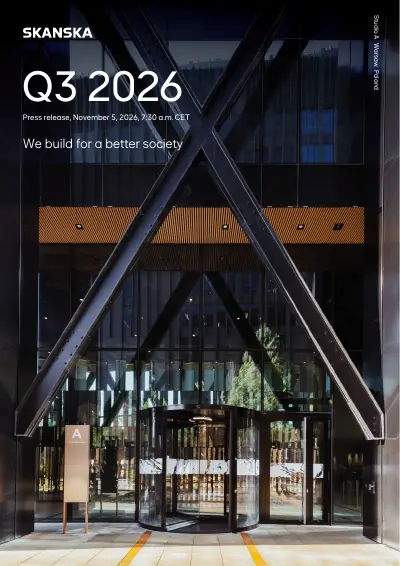
Good to see you. Before we start with the figures, I want you to look at the picture here on the screen.
It's the entrance of Studio A in Warsaw. That's a commercial property development project that was constructed and developed by Skanska, and also divested back in 2024.
We also, in the third quarter, divested our second building next to this one, Studio B, to the same investor. We also divested a building in Budapest, H2Offices, in the third quarter.
I can just to start with say that the market for both residential development and commercial property development is continue to be good in Central Europe. Now let's look at the figures.
The third quarter 2026, solid performance overall, very strong performance on the construction, operating margin were very good, and also record-high order backlog, coming back to that. In the third quarter, the project development were negatively impacted by impairment charges for some land, goodwill, and completed projects.
We had good results from sales, both when it comes to commercial and residential properties in Central Europe. The investment properties portfolio delivered stable result in the quarter.
We had good strong cash flow from operations. The operating margin in construction 5% in the third quarter, very strong, and also when you look at the rolling 12 months margin of 4.5%, well above our target of 4%.
Return on capital employed in project development 1.6% on a rolling 12, on the same rolling 12 on investment properties 4.1%, and that gives us a return on equity on a rolling 12 11.4%. We have a robust financial position that is maintained and very important for us.
We also managed to reduce the carbon emission with 65% in our own operations since the baseline year 2015. If I go into each and every stream here, starting with construction, we increased the revenue to 46 billion, and that increase with 7% in local currencies.
Order bookings were on record-high level, 68 billion, same level as we had in Q2, very strong, and that gives us a book-to-build of 128% on a rolling 12 months basis. As I said, record-high order backlog of 328 billion.
Operating income 2.3 billion, and again, operating margin in third quarter 5%. The encouraging thing here is, and the positive, is all geographies deliver good results, and that's very, very critical for the success, and that's something I'm really really satisfied with.
We are well above our target, and we have a backlog at all-time high. Residential development, revenue 1.5 billion, slightly lower than same period last year.
We also sold less home than last year. We started basically two projects.
We are selective when we start projects, but we do want to start projects where we see that we have the right location and that the business case supports the targets, of course. We started one in Central Europe, a big one, close to 200 homes, and also a smaller one in Norway.
We have overall solid sales and strong profitability in Central Europe, and the Nordic operation is slower. We see that we're selling in low-margin projects, older low-margin projects.
We also have impairment charges in the quarter of non-strategic land and also goodwill. Moving on to commercial property development, operating income 171 million, and we have a gain on sale of five over 500 million here in the quarter.
We have divested two projects, as I said, one in Warsaw, one in Budapest, on good margins, good solid gains. The return on capital employed 2.5%.
We have 17 ongoing projects, and that corresponds to close to 13 billion in investment upon completion. We also have 17 completed projects, 19.5 billion in total investment.
The good thing here that we see the leasing rate is 82%, we do have a positive cash flow. It's high-quality building, good location, and attractive amongst our tenants.
Of course, the asset impairment charges negatively impacted. We also started one new project, and that in Central Europe, Nowy Format.
Investment properties, operating income 87 million, stable result. Economic occupancy rate at 80%, slightly lower than the last quarter.
We have a churn in the portfolio that 5, 6 years has been completed for 5, 6 years. That's natural, but I'm confident that we have good discussions with potential tenants and also the current one.
The portfolio consists of seven very high-quality office building in three large cities in Sweden, and the value is currently 8.3 billion. I'm moving back now to construction and look into the details in the order bookings and the development.
Here you can see five years back, the development on the order backlog, the blue bars here. You can see, as I said, record-high level we have currently.
We have been successful in selecting the right projects and also project where we see a competitive advantage and where we can see that we have the right team in place, we can also increase our margin over time. That's also what we have seen the last few years.
You can say the strategy we have working with for many years now really pays off now. It's very encouraging to see.
Here you can see also the order bookings per quarter, the orange line here, and the book-to-build ratio that's well above 100% now, 128. Really good, and if I look into each and every geography on the order bookings, you can see to the left here the quarter, single quarter, 68 billion.
Of course, as you can see, the US operation is really driving this. Close to 70% of order bookings in the single quarter is in US.
It's also good if you look at the Nordics. If you look at the book-to-build here, 107% for the whole Nordics, very strong in Sweden, 123%, and very fantastic figure, 160% in US.
That gives us the overall book-to-build of 128%, which corresponds to 22 months of production. We are in a very good place.
We can continue to be selective. The market is still good in many places, we have a really good position for the future.
With that, I hand over to Pontus to look more into the figures.
Pontus Winqvist
Thank you, Anders. Then if we look a little bit further into construction, you can see that the third quarter revenue came in at 46 billion.
It's an increase on 7% in local currencies, 9% in Swedish kronor. You might also remember that when we were presenting the first and the second quarter, we had a little bit slow start, but we also saw that it's likely that we will see revenue increase going forward, and now you can see that it's actually coming here in the third quarter.
When it comes to operating income, it's also quite an increase, actually 28% between the last third quarter and this third quarter. We are ending at 2.3 billion in an operating income.
Following then quite a strong margin, you heard we have 5% in the isolated quarter, and on a rolling 12 months basis, we are on 4.5%. Looking then into the different geographies, it's actually an improved both results and margin in all of our geographies.
I think that's really a strong sign. If you're looking into the US result here, it's actually up 40% compared to the third quarter last year.
As Anders said earlier, really good performance here from construction. Going then into residential development, it's slightly lower revenue because we are selling a little bit less than what we did last year.
The SG&A here, you see, is going up quite a lot, from 118 to 244, and the reason for that is that goodwill impairments, it's hitting the SG&A row, goodwill impairment for the residential business in Norway of 143 million. We also had other impairments, mainly for non-strategic land, of 340 million.
All in all, this, you see, takes us down to a negative result and a negative operating margin. If we then look into the different geographies, you see that this negative results and the impairments mainly coming from the Nordics.
You see we have a 408 negative result in the Nordics, while the Central European business here continues to deliver a very solid result, 111 million and a operating margin of 23%. We continue to see the pattern that we have seen the last number of quarters with a very strong Central European performance, while we have a weaker margin and result in our Nordic operations.
Regarding number of started and sold units, you can see that it is a little bit slower when it comes to both started and sold units. Here the important thing is, I think Anders said that in the beginning also, that we are starting project when we have the right financial fundamentals in place, then we are ready to start.
If we don't have that, we are not starting it. Of the number of homes in production, you can see that we are basically on the same level as we were last year, a little bit shy of 3,000 units.
It's under production. We are increasing our sales rate, coming from 51 to 56%.
The absolute majority now of the ongoing projects that we have, they are in the Central European business. The unsold completed homes are continue to be reduced and are now 298 units.
Commercial property development, you see that here we were divesting two projects, we have an increase in the revenue to 3 3.2 billion, gives us in total an operating income of 171 billion million, and we also saw a handsome profits from those two divestments, in total we had gain of divestments of 513 million. We also had writedowns in this quarter, 378 million, and most of those writedowns are connected to our completed US properties.
Looking into the unrealized gains in our commercial property portfolio, you see that that is going down somewhat compared to the second quarter, and that's mainly because we have divested two properties then, as you saw, with a good gain coming out from those. If you look into our completion profile of the properties that have been completed in the third quarter, you can see that we're now at 82% occupancy rate on those, coming up a little bit from the second quarter where we were at 77 for the completed portfolio.
Then you see here over the coming years that we are not foreseeing to complete any projects during the coming two quarters, and then after that we have some time for those that are not fully leased to continue to work with the leasing. Then talking about leasing, leasing is always a little bit lumpy between the different quarters, and in this quarter we were able to lease out 22,000 square meters.
We have a leasing ratio of 54% compared to the completion ratio that was 57% by the end of this quarter. Going then into our own properties, investment properties, it was a very stable quarter here.
You can see that we had an operating income of 87 million, roughly the same that we have had the last quarters. If you look into the comparable quarter, you see that it's a higher number there, 143 million, and that's because we had a revaluation in the third quarter last year.
That's the difference. The underlying result is the same basically, and we have a stable market values.
We haven't done any changes to those, and we have an average evaluation yield of 4.7% on those, and the economic occupancy rate are 80%. If we are summarizing up the group result here, you see the operating income coming from the businesses of 2.2 billion.
Then we have central costs of 116. It's a little bit higher than what you see during the third quarter last year, and the reason for that is that we had some release of provision from our PPP portfolio within central in the comparing quarter.
Otherwise, I think we have good control of our central costs, and so the underlying costs are actually going down. If you then look into the taxes, you see that we have a tax cost of 541 million, representing a tax rate of 24%, and that's quite representative, I would say, for the structure that we have for the business right now.
The lower tax rate in the comparable quarter was because we had some changes in our forecasting from where the profits actually was to be generated from. Cash flow, we are delivering a strong cash flow, I would say, from the business operations.
You see that 2.8 billion is coming in and supported by a positive development from the working capital within construction. Also we had net investments in the quarter because we didn't had anyone properties that were delivered during the quarter.
Then, of course, we are continuing to produce within our existing projects, which means that then are net investing in this. Anyway, you see that it came out with a positive cash flow of 2.8 billion.
When it comes to the working capital, you see that we are on, I would say, most likely all-time high levels. We have 37 billion in working capital, and we have a positive currency impact of 1 billion, but you can also see that the underlying cash flow coming in from our construction operations are continue to be very strong.
Regarding investments and divestments, I just said that we are having some net investments during this quarter because not delivered any CD properties. Therefore, you also see that we have slightly increase in the capital employed because of those net investments.
The available funds within the group is then also very strong, I would say. You see that we have 26.3 billion, of which unutilized credit facilities is 7.2 billion.
It's continuing to be strengthened through the good cash generation that we have within the business. That adds up in our financial position.
You see here that we have our adjusted interest-bearing net receivable is coming up with around 3 billion since the second quarter, and is now ending at 11.6 billion. You can also see on the graph here that we have had a very stable situation when it comes to our financial position over the last number of quarters.
By that, I leave over to you, Anders, to talk a little bit about the market.
Anders Danielsson
Of course. If I look into the market, and starting with construction, we see strong market on the civil operation, both in US and in Sweden, so that's very encouraging.
You also see stable market in most of the other countries. One exception is UK.
The willingness to invest is there, but that's some lack of funding currently, but look forward to that. On the building side, we see good demand, stable market in US, and mostly stable also in the European countries, except for Norway and also I hear UK.
It's driven by a high demand of infrastructure investments, both traditional, but also energy, water. We see strong demand in defense investments, and also on the tech side, both data center and semiconductor facilities.
Residential development, strong market in the Central Europe, continue to be strong, very high demand on apartments in the cities where we operate. We also see weaker market continue to be weak in the Nordic countries.
Some signs of improvement in Sweden, I would say. We can see we're selling a bit more, but it's too early to say that it's normalized market in our view.
We continue the next 12 months a bit slow. On the commercial property development, stable market in Central Europe and in the Nordic.
We see slower market in the US, driven by the transaction market is still slow. We see that the leasing market is more activity on, we're leasing out.
We continue to lease a good leasing ratio, as you have seen previously. Also definitely more activity on the transaction market in both Central Europe and in the Nordics.
Investment properties, the market is stable. We have a healthy occupancy rate, and we can see that our office building in Swedish market is really attractive.
If I summarize the quarter here, very strong construction operation, very strong profitability, cash flow, and order intake. In the third quarter, the project development were negatively impacted by some impairment that we saw that were talked about.
Good result from the sales, both in commercial and residential development in Central Europe. Again, the investment property portfolio delivered stable result.
Cash flow from the business operation is very strong, and we have managed to maintain the very strong financial position in the company. With that, I hand over to Antonia to open up the Q&A.
Antonia Junelind
Thank you very much. Now it's time for your questions.
If you are joining us here in the room and you have a question, I will just ask you to please raise your hand, and we will bring over a microphone so that everyone also joining us online can hear your question. If you're watching, then I will ask you to join us by utilizing the telephone conference number, because that will allow us to put you through to us here in the studio so that we can hear your question.
I will start with the online audience, and I will ask our operator, George, if you can please provide some instructions and also introduce the first caller.
Operator
Absolutely. Thank you.
We will now begin the question and answer session. Anyone who wishes to ask a question may press star and one on their telephone.
You will hear a tone to confirm that you have entered the queue. If you wish to remove yourself from the question queue, you may press star and two.
Anyone who has a question may press star and one at this time. Our first question over the phone comes from Julia Sundvall with ABG.
Please go ahead.
Julia Sundvall
Yes. Hi, and good morning, everyone.
A few questions from my side, and I would, of course, like to start with a super strong construction margin. Could you please give us some flavor on the year-on-year improvement?
What's the driver behind this, and is it any one-off effect or how should we think?
Anders Danielsson
Hi, Julia. I can start with that.
It's a strong improvement, of course, but we don't have any one-off effect in the construction margin in the third quarter. I think you should look more on a rolling 12 months basis, which is also very strong, 4.5%.
In the quarter, we have completed or maturing large, very profitable projects. Since we have a conservative profit take-out in the early days of a project, we get this boosting the margin somewhat in a single quarter, but it's representative for the underlying performance.
Julia Sundvall
Perfect. Thank you.
On the order backlog, it's on a very high level now. Are you still disciplined within the order backlog, and can you say anything about the margins in the backlog?
Is it at levels we see now, or is it higher, or how should we view it?
Anders Danielsson
It's very high quality in the backlog. We don't tell the market about the exact margin, but I can say that I'm very confident in the quality and the margin in the backlog definitely support the target we have for the construction operations.
I'm confident in that.
Julia Sundvall
I don't know how much you can say about it, but you talked a little bit earlier in the quarters about a high burning rate in the data center orders. Do you see this kind of effect now, or how should you think about the data center orders in the order backlog?
Anders Danielsson
If we look at the first couple of quarters in the US where we're most of the data center, but it was also a bit slow, but it definitely has taken off now in the third quarter. In general, the data center has a higher burn rate because they are shorter project, quite large project, but in a shorter time compared to the average.
Julia Sundvall
Perfect. That was all for me for now.
I will jump back in the queue. Thank you.
Antonia Junelind
Thank you. I will ask that we continue with the online queue.
Operator
Our next question comes from Keivan Shirvanpour with SEB. Please go ahead.
Keivan Shirvanpour
Good morning. I have a couple of questions.
Maybe first off, a follow-up question on the construction margin. Would it be possible to get a sense of how much of operating profit in the quarter that comes from this project that have reached this critical milestones?
Anders Danielsson
That's nothing we go into, but I say if you look at the rolling 12 months basis, 4.5%, that sort of represent the performance over time. That's gives you some sort of guidance.
Keivan Shirvanpour
Okay. Then my second question is on the cash flow impact from the sold but not transferred properties, it's 3.9 billion.
Can you say something about the timing, for instance, how much is it this year and how much is beyond 2028?
Anders Danielsson
I don't have the exact number of that in my head, but we will see some cash flow during the fourth quarter and some of the cash flow from the sold coming into next year, depending on when they will be delivered.
Keivan Shirvanpour
I think I calculated it's around 1.5 or so in 2029. Is that a rough estimate for you, or how do you see that figure?
Anders Danielsson
Now I'm not sure if I was following the question. You mentioned a number here.
What was that number?
Keivan Shirvanpour
I calculated it's about 1.5 that is due in 2029 of the cash flow that you receive.
Anders Danielsson
I can't answer that because I don't really know what that 1.5 is coming from.
Keivan Shirvanpour
Okay. I maybe could Yep.
Antonia Junelind
Keivan, can you still hear us?
Keivan Shirvanpour
I can hear you now.
Antonia Junelind
Yep. Would you like to continue with an additional question?
Keivan Shirvanpour
I could. Just a final question, and that is also a follow-up on the revenue growth in construction, mainly in the US.
You said that revenue has started to pick up quite a bit. Can you say something about the backlog conversion rates in the coming quarters, as you mentioned, it's a higher share of projects that are quite large, that have a shorter duration.
Could we assume some type of similar increase in revenue given that?
Anders Danielsson
I would say that it's a mixed picture in US how long the duration is of the order we have in the backlog. On the civil market, because we have been successful on traditional infrastructure market as well in US, we have a diversified portfolio.
Yes, data center has been and semiconductor has been strong big part of the single quarter order intake, but if you look at the whole backlog, we are quite diversified. Generally, the civil infrastructure projects are much longer than the data center, it's a mix definitely.
We have a high burn rate on the building right now, and they have picked up. Don't give any forecast.
Keivan Shirvanpour
Thank you. Yep, perfect.
That was all my questions. Thank you.
Antonia Junelind
Thank you. Let's continue with the next caller, which I believe is Graham Hunt from Jefferies.
Graham Hunt
Thanks very much for the questions. I've just got two, also on construction.
Just in terms of the very strong order intake in Q3, I suppose just wondered if you had any color or insight into sort of what drove that. Was it just timing of certain bids coming through?
Was it sort of the end of sort of a series of tenders, just trying to understand kind of how we should think about that, or if there's been any pull forward from Q4. In that context, obviously, just had the midterm results, any kind of commentary there in terms of how you're seeing the US market in the light of the Democrats' success yesterday?
Then, last question on data centers in the Nordics. Could you give us any comment on the pipeline that you may be seeing or not seeing in the Nordic countries for data centers at the moment?
Thank you.
Anders Danielsson
All right. Thank you, Graham.
The construction operation, very high order intake, of course, and I would say that's a lot of those projects we have been working with for a long time. It's also coincident that we boost the third quarter with that, but we saw the same level, as on the second quarter.
It's definitely a good hit rate on the project we have been working for a long time. The second question about the Democrats and the Congress, it's early to say and the impact.
I can say that we have been working in US for over 50 years, and we have been working for a lot of administration and different Congress, and the majority in the Congress. We're used to that, and my experience is definitely that the willingness to invest in traditional infrastructure is definitely on both sides.
We will watch it carefully, but I don't expect any dramatic changes in a short term. Data center in the Nordics, we have a few in Finland, but we also have been building in Sweden and also in Norway.
It's on a lower level, of course, than we see in the US, but we can see that a lot of our customers wants to invest in data center in the Nordic as well. They need permits, takes some time in our countries here in the Nordics.
They also need access to power, land, of course. That's something that takes some time, but I would expect it to increase.
Graham Hunt
Got it. Thank you very much.
Antonia Junelind
Very good. We're moving to next person in line, which is Arnaud Lehmann from Bank of America.
Arnaud Lehmann
Thank you very much, and good morning to everybody. I have three, if I may.
Firstly, on construction sales growth, you delivered high single-digit at group level, I think 7% excluding currency, and obviously double-digit for the US. Do you believe that that could be the new run rate based on the order bookings and the level of the order book into 2027?
That's my first question, please.
Anders Danielsson
We don't give any forecast, but we have seen pick-up in the revenue now, as you say, and the order backlog definitely support the revenue going forward, but I will not give you any figures on that.
Arnaud Lehmann
Fair enough. Coming back on the construction margin, some of it is, well, you have higher sales, but your SG&A are stable, they go down a little bit as a percentage of sales.
Are there any specific impact to mention there, or it's just steady cost management and just higher revenue?
Anders Danielsson
I would say it's the latter. It's nothing special that is happening.
Of course, SG&A percentage, it's easier to hold on good level if you see an increase in the revenue, but we are focusing on managing the costs in all our businesses and on central level, I think it's cost management. It's nothing else.
Arnaud Lehmann
Okay. Thank you.
Last one, if I may, sorry. Just on the cash performance, pretty good in the quarter.
Is it all related to order bookings in construction, or are there any other effect you'd like to highlight?
Anders Danielsson
No, I think the majority of the improved cash flow is coming from the working capital development within construction. That's that we continue to see that we have favorable payment plans, etc., when it comes to our new and existing construction contracts.
Arnaud Lehmann
Very good. Thank you so much.
Antonia Junelind
Thank you very much. I believe that that was our final question, and I will just turn to our operator, George, if you can please confirm that.
Operator
Absolutely. This was our last question.
Antonia Junelind
Thank you very much. That means that we have answered all the questions that you had for us here today.
I would like to say thank you for joining us. Our next earnings call will actually not be aired from here.
We are moving head offices, next time you can come and see us in our new head office, the beautiful project that we have developed ourselves called Olivin here in Stockholm. Hope to see everyone there.
Thank you very much, Anders, Pontus, for your presentations and answers here today. As I said, thank you for joining us here in the studio.
Lastly, I would like to say thank you for everyone joining us online. I wish you a lovely rest of the day.