Slide Insurance Holdings, Inc.
Q3 FY2026 · Earnings Call TranscriptOctober 28, 2026
Operator
Greetings, and welcome to the Slide Insurance third-quarter 2026 earnings call. At this time, all participants are in a listen-only mode.
A brief question-and-answer session will follow the formal presentation. Should anyone require operator assistance during the conference, please press *0 on your telephone keypad.
As a reminder, this conference is being recorded. I will now turn it over to Slide.
Garrett Edson
Thank you, and good morning. With us today are your hosts: Bruce Lucas, Chairman and Chief Executive Officer of Slide, and Andy Omiridis, Chief Financial Officer.
By now, everyone should have access to our earnings release, which was published yesterday after the market closed and can be found on our website at ir.slideinsurance.com. Before we begin our formal remarks, I need to remind everyone that part of our discussion today may include forward-looking statements, which are based on the expectations, estimates, and projections of management regarding the company's future performance, anticipated events or trends, and other matters that are not historical facts.
The forward-looking statements in our discussion are subject to various assumptions, risks, uncertainties, and other factors that are difficult to predict and which could cause actual results to differ materially from those expressed or implied in the forward-looking statements. These statements are not guarantees of future performance, and therefore, undue reliance should not be placed upon them.
We refer all of you to our earnings release and recent filings with the SEC for a more detailed discussion of the risks and uncertainties that could impact the future operating results and financial condition of Slide. Our statements are as of today, October 28th, 2026, and we undertake no obligation to update any forward-looking statements we make, except as required by law.
In addition, this call is being webcast, and an archived version will be available shortly after the call ends on the Investor Relations portion of the company's website at www.slideinsurance.com. With that, I'd now like to turn the call over to our founder, Chairman, and CEO, Bruce Lucas.
Please go ahead.
Bruce Lucas
Thank you, and welcome to our third-quarter 2026 earnings call. Once again, we executed at a high level this quarter, reinforcing the strength of our tech-enabled model and its ability to produce industry-leading top- and bottom-line results.
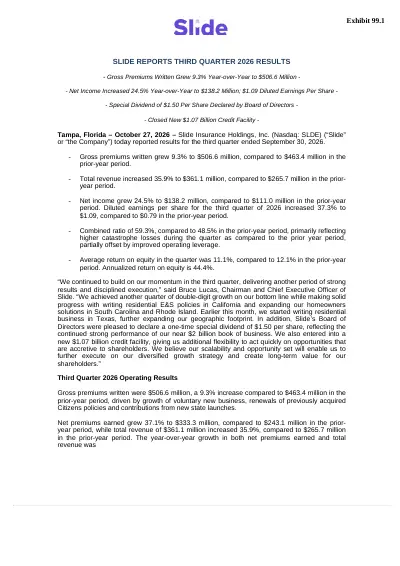
For the quarter, we grew gross written premiums by 9% year-over-year to $506.6 million, driven by continued growth in voluntary sales and the early contributions from our expansion markets. In addition to our top-line growth, Slide grew net income by 25% year-over-year to $138.2 million, with diluted earnings per share of $1.09.
Third-quarter return on equity was approximately 11%, which equates to an approximate annualized return of 44%. Our combined ratio was 59.3%, reflecting continued underwriting discipline even with catastrophe losses.
On an accident-year ex-catastrophe basis, our combined ratio was an outstanding 54.4%. Our third-quarter results provide further testament to our ability to deliver meaningful value creation to our shareholders.
We continued to make meaningful progress in expanding our footprint. California continues to ramp up following our May launch of the residential property E&S program, and we expect to accelerate growth there through the remainder of the year and into 2027.
We also began writing residential business in Texas this quarter and remain on track to roll out New York and New Jersey in the coming quarters. Our expansion outside of Florida further reflects the scalability of our platform and our ability to identify and act on attractive opportunities where we believe we can produce significant growth coupled with attractive returns.
We remain confident in our ability to execute on our diversified growth strategy, creating long-term value for our shareholders. We have built our program around one of the strongest balance sheets in the sector, giving us the financial flexibility to pursue this kind of expansion.
In October, we closed a $1.1 billion credit facility, the largest facility ever issued to a coastal property insurer, which further enhances our capital flexibility to fund accretive growth opportunities. We see a shift in the market taking place and are excited about the ability to move quickly should the right opportunity arise.
Turning to capital management, we continued our disciplined approach to returning capital to shareholders. In addition to our regular quarterly cash dividend of 7 cents per share, I am pleased to announce that our board of directors has approved a special cash dividend of $1.50 per share.
This decision reflects the consistency and durability of our earnings power, the strength of our free cash flow generation, and the robust capital position we have built. The special dividend complements our share repurchase program and regular dividend, underscoring our confidence in the long-term trajectory of the business.
There are several reasons why I believe a special dividend is warranted at this time. First and foremost, I have a high degree of confidence in our business model and growth initiatives.
Slide's ability to generate net income and free cash flow is unmatched in the coastal specialty market, and I believe that we will continue to be the market leader for the foreseeable future. The board has carefully reached the decision to issue a special dividend because the company continues to outperform virtually every financial metric, generating capital in excess of what is needed to fund our growth initiatives.
I am always looking for ways to enhance shareholder returns, and to date, that has been in the form of share repurchases and dividends. Since our IPO in June of 2025, Slide has returned approximately $423.1 million in capital to our shareholders.
Slide repurchased $230.9 million of stock at an average weighted price of $17.28 per share, which equates to an approximate return on investment of 56.8%. Slide has also paid approximately $192.2 million in dividends, which translates to a yield in excess of 5%.
We will continue to use our capital thoughtfully to enhance future shareholder returns, and I strongly believe that both of our initiatives are accretive to our forward ROE. In the fourth quarter, Hurricane Isaias made landfall near the Florida-Alabama state line as a Category 2 hurricane.
Our thoughts are with all of our impacted policyholders, and we are here for them in their time of need. Slide is not heavily concentrated in the Florida Panhandle, and we do not expect the storm to generate significant retention losses.
It is too early to state the exact dollar amount of the retention, but we believe the hurricane will result in approximately $50 million of pretax retention. Despite the hurricane, we believe Slide will end the year with over $500 million of net income, which translates into an annual ROE in excess of 40% for 2026, marking the fourth consecutive year of annual ROEs above 40%.
Finally, our results this quarter reflect the dedicated work of our entire team. I want to thank all of our employees for their relentless effort and the important role they play in Slide's performance.
I'm proud of what we're accomplishing together, and I appreciate all of you. Thank you for your continued support of Slide, and with that, I'll now turn the call over to Andy Omiridis to provide some color on our third-quarter results.
Andy Omiridis
Thank you, Bruce, and good morning, everyone. For the third quarter, net income increased 24.5% to $138.2 million compared with $111 million in the prior-year period, resulting in diluted earnings per share of $1.09.
Our results demonstrate the continued strength of our earnings profile supported by sustained top-line growth and disciplined expense management. Gross written premiums increased 9.3% to $506.5 million compared with $463.4 million in the third quarter of 2025.
Growth was driven by continued momentum in voluntary new business, including expansion into new states, as well as policy retention. Total revenue increased 35.9% to $361.1 million compared with $265.7 million in the prior-year period.
Net premiums earned grew 37.1% to $333.3 million compared with $243.1 million, reflecting the continued earning of premiums generated by our expanding portfolio. As a reminder, the quarterly progression of net premiums earned is not necessarily linear given the timing and volume of Citizens takeouts completed in prior periods and their respective positions within the policy earning cycle.
Turning to our underwriting performance, net losses and loss adjustment expenses totaled $101.3 million during the quarter, including $34.2 million of catastrophe losses associated with convective storms in Florida. These losses represented a 10.3% catastrophe loss ratio compared with no catastrophe loss ratio in the prior-year quarter.
We also recognized $18 million of favorable prior-period reserve development compared with $32.5 million in the prior-year period. Importantly, our accident-year loss ratio, excluding catastrophe losses and prior-period reserve development, improved to 25.5% from 27.5% in the prior-year quarter.
This 200-basis-point improvement reflects favorable underlying loss experience and the continued effectiveness of our disciplined underwriting approach. Policy acquisition and other underwriting expenses increased to $46.2 million compared with $36.4 million in the prior-year period, primarily reflecting higher acquisition costs associated with our growth.
General and administrative expenses totaled $48.8 million compared with $45 million in the prior-year quarter, primarily reflecting investments in personnel and infrastructure to support our continued growth and geographic expansion. Despite these investments, we continue to realize meaningful operating leverage as our platform scales.
Our expense ratio improved to 28.9% compared with 34.8% in the prior-year period, representing a 590-basis-point improvement. Our reported combined ratio was 59.3% compared with 48.5% in the prior-year quarter, primarily reflecting higher catastrophe losses, partially offset by improved operating leverage and lower underwriting loss experience.
More importantly, our accident-year combined ratio, excluding catastrophe losses and prior-period reserve development, improved to 54.4% compared with 62.3% in the prior-year period. Turning to our balance sheet and capital position, as of September 30th, 2026, we held $700.6 million in cash and cash equivalents and $849.8 million in total invested assets, consisting primarily of available-for-sale fixed maturity securities.
Our strong liquidity position and continued earnings generation provide substantial financial flexibility to support our strategic priorities. Turning to capital management, as Bruce mentioned, during the quarter, we successfully closed a $1.1 billion credit facility, replacing our previous credit agreement and significantly enhancing our financial flexibility.
This financing represents an important milestone in Slide's continued evolution, providing additional capacity to support strategic growth opportunities while further strengthening our capital management capabilities. Importantly, our capital management strategy remains balanced and disciplined.
We're committed to delivering meaningful shareholder returns while maintaining the financial flexibility to pursue attractive organic and inorganic growth opportunities. Turning to our updated full-year 2026 outlook, given our strong year-to-date performance and continued momentum across the business, we're pleased to raise the lower end of our full-year gross written premium guidance.
We now expect gross written premiums of $1.9 billion to $1.95 billion compared with our previous guidance of $1.85 billion to $1.95 billion. This upward revision reflects our confidence in the underlying trajectory of the business, with continued premium growth expected to be driven primarily by sustained organic expansion, including voluntary new business production, geographic diversification, and ongoing execution of our growth strategy.
We also now expect to deliver full-year net income between $500 million and $520 million compared to our prior range of between $455 million and $470 million, which would result in a full-year return on equity above 40%. Our full-year net income expectations are inclusive of up to $50 million of expected pretax losses related to Hurricane Isaias.
Thank you for your time. Operator, we now are ready to open the line for questions.
Operator
Thank you. We will now be conducting a question-and-answer session.
If you would like to ask a question, please press *1 on your telephone keypad. A confirmation tone will indicate your line is in the question queue.
You may press *2 if you would like to remove your question from the queue. For participants using speaker equipment, it may be necessary to pick up your handset before pressing the star keys.
One moment, please, while we poll for questions. The first question is from Alex Scott from Barclays.
Please go ahead.
Alex Scott
Hi, good morning. This is [unclear] for Alex.
First, a question on the hurricane. Can you help us unpack the roughly $50 million of estimated pretax losses?
What drove the magnitude of the loss, and how should we think about your underlying exposure in the affected regions?
Bruce Lucas
Absolutely. Isaias hit in a very low-populated area of Florida.
It's just east of the Alabama-Florida state line. We have a very small concentration up there.
We do have some commercial residential business up there. We do have affected policyholders.
It is way too early to understand the magnitude of the storm, but everything we do here is extremely conservative from a reserve philosophy, we've picked a very conservative $50 million pretax loss to just message the market, but at this time, it's impossible to tell if it's going to be $50 million or a number below that. Then in terms of what drove the loss, it's a hurricane, and houses get impacted and get damaged, and this is pretty routine in Florida, this was a pretty minor one by all accounts.
I don't think this is a real industry-moving event. It was, I don't want to say a nothingburger, but in terms of a hurricane, it was pretty miniscule.
Alex Scott
That's helpful. Thank you.
Second, can you discuss how you're thinking about the $1 billion or over $1 billion of available credit capacity? To what extent could that be used to support organic growth versus capital deployment to shareholders or other
Bruce Lucas
uses? We could use the credit facility for just general corporate purposes, it is designed to be very flexible.
We can use it in a number of ways, but one of the primary reasons for the credit facility is to pursue ex-Florida growth and potentially strategic M&A.
Alex Scott
Thank you. That's helpful.
Operator
The next question is from Tommy McJoynt from KBW. Please go ahead.
Tommy McJoynt
Hey, good morning. Thanks for taking our questions.
The first one is a sort of a modeling one, and it's around the operating leverage on the expense side, specifically looking at the G&A line on the income statement. Looks like you guys got some nice operating leverage there in the third quarter with it coming down sequentially.
Was surprised to see that Q-over-Q step-down, and frankly, it being barely up year-over-year. Was there anything unusual in the third quarter, and going forward, would you expect that to continue to increase as you expand into other states and have some build-out costs associated with that?
Bruce Lucas
I'll just say that we're extremely cost-conscious on all of our spend here at Slide. I don't like to waste money, and so we run a pretty tight ship.
In terms of the G&A ratio and the fact that it's coming down, it really reflects the fact that we invested in prior quarters into technology, our staffing, etc., for this multi-state expansion. Some of those expenses kind of get front-loaded, and then as you grow your top-line GWP, those numbers start to come down some.
It just kind of reflects the seasonality of where we are in the business cycle. As we go forward, I would think that this is pretty consistent number.
I don't know, Andy, if you have any opinion.
Andy Omiridis
I totally agree with Bruce. I think what you're seeing is the organization scale up, and as there's always expenses that are front-loaded.
We assume that as we achieve scale that we should start to flatten out the expense ratio, therefore it'll be favorable moving forward. I think we've given guidance as far as that we assume to be around a 29%, maybe a 28.5% for the year, but I think that's the right run rate for us.
Bruce Lucas
Yep.
Tommy McJoynt
Got it. Thanks for that color.
Then, as you started thinking about the top-line growth opportunity into 2027, do you have some early sort of indications or milestones that you'd look for in terms of the size of your growth, both in Florida and on an ex-Florida basis, relative to your premium dollar size this year, which looks like it's going to be about $2 billion? What would be considered a sort of a good growth year in '27 relative to the size of the book this year?
Andy Omiridis
I think consistent with this year, I think right now, if we look at where we're sitting today, we're roughly around 8% or 9%. I think with the new markets, we like to be conservative because we want to make sure that we deliver what we commit to, but I think at a minimum, we should see 8% to 9% and then probably layer something in for the new territories, but again, Tommy, the only thing with the new territories is the ramp-up time, which comes from the regulatory side.
Sometimes ramp-up can take a little bit longer than expected, but I would assume probably an 8% to 9% growth rate for the next year as we're trended for this year.
Tommy McJoynt
Thank you.
Operator
As a reminder, to ask a question, please press *1. The next question is from Paul Newsome from Piper Sandler.
Please go ahead.
Paul Newsome
Just a quick follow-up to that thought on growth next year. If you could maybe talk a little bit more about the timeline that as we roll off these states expect the 8% to 9% necessarily isn't quarter-by-quarter-by-quarter.
Should we expect an acceleration of growth as we get through the year because of what's happening from a distribution perspective, and I think, on top of that, maybe what's going on with some of those Citizens adaptations too? Just obviously not quarter-by-quarter guidance, but just in general, how do you think that evolution will happen over the course of the year?
Andy Omiridis
Paul, it's good to hear from you. I would consider it to be more back-end loaded.
In other words, I think you'll see Q1 to be a fairly decent quarter. All the quarters are assumed as we're starting our planning process right now to be, and we can talk about it later after we're done our planning process, but when we look at the 8% or 9%, it is back-end loaded next year because the quarters aren't linear.
As the states ramp up, we're waiting to hear about New York. New York will then require a bit of a ramp-up.
There's attributes that I just think it's more back-end loaded for next year.
Bruce Lucas
You have to also remember that we're out in market buying our catastrophe reinsurance program, and that actually starts for us early February. At that point, we have to get projections out to 9/30, and you don't want to blow through your projections.
Reinsurers don't like it. It can be very expensive on a true-up.
We're going to have meaningful growth throughout the year that we're going to model into our projections, but there is a ramp-up cycle, there's a reinsurance allocation that has to be done, but I do think that if I were to say what half of the year is going to be more robust, it's probably second half.
Paul Newsome
That makes sense. How sensitive are you think the growth expectations as well to the current market environment?
Lots of conversation about competition both in and out of Florida, and so any thoughts on what you think is happening with the competitive environment and how you're structuring your business around that?
Bruce Lucas
Sure. There's competition everywhere, and that just never seems to change.
Been doing this for about 15 years, I'm going to say. There's always been robust competition everywhere I've launched a state.
We're not seeing anything that's outsized or problematic or big headwinds. What we see is a tremendous amount of opportunity still.
As we launch new products, new states, we've done our research there, and the team has a lot of experience, we have a pretty good idea where our products are going to land and how competitive they're going to be, and we're pretty bullish on what we see. As we expand our footprint out of Florida, we're picking up reinsurance synergies along the way that help fuel that expansion model, but right now, I'd say we're pretty bullish.
I'm not seeing anything that's really changed over the last two, three quarters.
Paul Newsome
Great. Thank you, folks.
Appreciate the help.
Bruce Lucas
Thanks, Paul.
Operator
The next question is from Randy Binner from Texas Capital. Please go ahead.
Randy Binner
Hey, thanks. Good morning.
The 8% to 9% seems better than expected, glad to hear you're still competitive in the Florida market. Bruce, you said something in your comments about kind of a shift in the market and you also mentioned strategic M&A.
Are those two things related, and can you elaborate on kind of what you're seeing with the shift in the market and obviously a lot more flexibility with the new credit facility?
Bruce Lucas
I think the market shift that we're seeing is kind of driven by forward reinsurance price expectations, and I won't comment on what that will look like, but I don't think Isaias is going to move the needle on reinsurance pricing at all. For example, Slide will not even cede a loss to our reinsurance panel.
I do think that that is bullish for the future. It's bullish for growth.
It allows us to take on more capacity on the underwriting side because our reinsurance costs aren't going to be in a place where they're volatile next year. That's one big one.
Then the other thing I'll note on the M&A and kind of, part of our thinking around the credit facility is get it in place in case there's a good M&A transaction. We have seen an uptick in M&A activity.
Whether these are publicly traded, privately traded, we've seen it kind of across the board, and I do think that there is M&A activity out there that could be promising, but again, it comes down to the right price. I've done arguably more M&A than anybody in the coastal specialty sector over my career, never done a bad deal, never lost money, you have to be disciplined on the price side, and as long as that's there, I think that there is a good prospect for something transformative into 2027.
Randy Binner
Great. Thank you.
Then I just had a detailed question about the model, or really your tax rate, and it was a little bit lower than we expected this quarter. I think we've been using kind of a mid-20 tax rate, 20% rather.
Is that the right tax rate to use going forward? Is there going to be a true-up for this lower tax rate in the fourth quarter?
Just curious how that is going to extend out more into '27.
Andy Omiridis
I think it's a great question, Randy. Good morning to you.
No, we have put together a tax strategy, and we do assume that our ETR was 24.5% when we started the year. It is now effectively around 21.5%.
We assume that will stay around 21.5% to 22% with the tax strategy that we have put in place. We consider that and we're always going to strive to do better, but I think we can sustain the 21.5% to 22% ETR, effective tax rate, moving forward.
Randy Binner
Thanks, Andy. Was there a reason why it was lower in the current quarter?
Andy Omiridis
It was the catch-up. In other words, the 21 and a half that we have right now, in order to smooth out because remember, taxes are year-to-date, it's a 14% for the quarter, to true up, but 21 and a half is the ETR year-to-date.
Randy Binner
Got it. Perfect.
All righty, I'll leave it there. Thanks.
Bruce Lucas
Great, thanks, Randy.
Operator
There are no further questions at this time. I'd like to turn the floor back over to Bruce Lucas for closing comments.
Bruce Lucas
I would like to thank everyone for joining our third-quarter 2026 earnings call.
Operator
This concludes today's teleconference. You may disconnect your lines at this time.
Thank you for your participation.