Solid Power, Inc.
NNASDAQ:SLDPQ1 FY2026 · Earnings Call TranscriptMay 5, 2026
Operator
Good day, and welcome to the Solid Power Q1 2026 earnings conference call. All participants will be in listen-only mode.
Should you need assistance, please signal a conference specialist by pressing the star key followed by zero. After today's presentation, there will be an opportunity to ask questions.
To ask a question, you may press star, then one on a touchtone phone. To withdraw a question, please press star, then two.
Please note this event is being recorded. I would now like to turn the conference over to Charlie Vandgert, Investor Relations.
Please go ahead.
Charlie Van Gucht
Thank you, operator. Welcome everyone, and thank you for joining us today.
I'm joined on today's call by Solid Power's President and Chief Executive Officer, John Van Scoter, and Chief Financial Officer, Linda Heller. A copy of today's earnings release is available on the Investor Relations section of Solid Power's website, www.solidpowerbattery.com.
I'd like to remind you that parts of our discussion today will include forward-looking statements as defined by US securities laws. These forward-looking statements are based on management's current expectations and assumptions about future events and are based on currently available information as to the outcome and timing of future events.
Except as otherwise required by applicable law, Solid Power disclaims any duty to update any forward-looking statements to reflect future events or circumstances. For a discussion of the risks and uncertainties that could cause actual results to differ materially from those expressed in today's forward-looking statements, please see Solid Power's most recent filings with the Securities and Exchange Commission, which can be found on the company's website at www.solidpowerbattery.com.
With that, let me turn it over to John Van Scoter.
John Van Scoter
Thank you, Charlie, and thank you all for joining us today. We delivered a productive first quarter, marking steady progress across our key operational and strategic priorities.
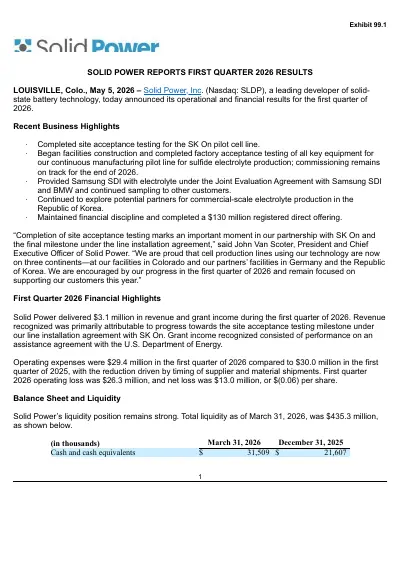
Starting with our partnership with SK On, we completed site acceptance testing in early April, marking the final milestone of the line installation agreement for SK On. We believe achieving this milestone underscores our commitment to supporting our partner's ASSB efforts.
With this accomplishment, we're very pleased that there are now [cough] cell production lines using our technology on three continents: here at our facilities in Colorado, BMW's facility in Germany, and SK On's facility in Korea. We also continue to support our customers and partners in their development efforts through delivery of our electrolyte.
We provided Samsung SDI with electrolyte under our three-way joint evaluation agreement with BMW and continued sampling with other customers during the quarter. Turning to our electrolyte development roadmap, we believe installation of our continuous electrolyte manufacturing pilot line will represent a critical inflection point in our path to commercialization and a clear differentiator for Solid Power.
With factory acceptance testing for all key equipment complete and construction underway, we are laying the groundwork for commercial-scale production. Once installed, this line will enable our transition from batch to continuous processing, supporting near-term customer programs and driving expected cost savings relative to today's processes.
The line is designed to allow us to de-risk and optimize processes in advance of full commercialization. Importantly, we believe our wet processing methodology for electrolyte production offers scalability, yield, and capital efficiencies relative to traditional dry process methods.
We also continue to explore potential partners with processing, scaling capabilities, and capital to support construction of a 500-metric-ton electrolyte production facility. We anticipate additional demand for sulfide electrolyte in Korea and are considering a potential partnership for commercial-scale production in Korea.
We're evaluating multiple potential partners and are pleased with our progress to date. With respect to our final development goal, we continue to leverage our Electrolyte Innovation Center, or EIC, and cell capabilities for product and process development during the quarter.
Through this development work, we're executing against our objective to continually deliver differentiated electrolyte products and secure long-term customers. With that, I will turn it over to Linda to review our financial results and provide an update on our financial discipline goal.
Linda?
Linda Heller
Thank you, John. I'll start with our first quarter results, beginning with revenue.
During the first quarter of 2026, we generated revenue and grant income of $3.1 million, driven primarily by the progress towards the site acceptance testing milestone under our line installation agreement with SK On and performance on our assistance agreement with the US Department of Energy. Operating expenses were $29.4 million for the quarter, compared to $30 million in the first quarter of 2025.
This decrease was driven by timing of supplier and material shipments relating to our development activities. Operating loss was $26.3 million and net loss was $13 million, or 6 cents per share.
Capital expenditures totaled $1.7 million during the quarter, primarily representing costs for construction of the continuous electrolyte production pilot line. Turning to our balance sheet and liquidity, Solid Power's liquidity position remains strong.
We ended the quarter with total liquidity of $435.3 million, due to the net proceeds after fees and expenses of $121.3 million raised through a registered direct offering in January. In addition, contract assets and accounts receivable were $12.7 million and total current liabilities were $17.1 million.
Overall, we remain focused on maintaining financial discipline while continuing to invest appropriately in our technology development and process improvements, and we believe we are well-positioned to support our strategic priorities throughout the year. I will now turn the call back to John.
John Van Scoter
Thank you, Linda. In closing, I want to thank our employees, partners, and stakeholders for the continued commitment and support.
We're executing on our objectives with focus, and I'm confident we're well-positioned to deliver meaningful progress through 2026. We'll now take your questions.
Operator?
Operator
Thank you. We will now begin the question-and-answer session.
To ask a question, you may press star, then one on your touchtone phone. If you are using a speakerphone, please pick up your handset before pressing the keys.
If at any time your question has been addressed and you would like to withdraw your question, please press star, then two. At this time, we will pause momentarily to assemble our roster.
The first question comes from Colin Rusch with Oppenheimer & Co. ):
Colin Rusch
Thanks so much, guys. Could you talk a little bit about the potential for partnerships in North America that you're starting to see move forward, given the amount of capacity that's underutilized right now for the auto space, and a substantial amount of legislation and kind of government involvement in terms of tariffs and the NDAA compliance for military applications that I'm sure you're seeing some level of demand for at this point?
Just curious about the potential for you guys to look at partnerships and potentially start bringing something forward that we may not be thinking about just yet.
John Van Scoter
Good afternoon, Colin, and thank you for that deep question. I'll be honest with you, the demand that we see right now is really coming off the peninsula in Korea.
We have yet to see, despite all the things you described, anything really substantial here in the States. If we go back a couple of years, that was very different.
We actually planned to do our original DOE plant here in North America, but with the changes in the landscape here in North America, we shifted to just the 2.5 SP2.5, and then shifted to partnerships in Korea. We certainly are well-positioned, should that change, to come back and revisit that.
We'd very much like to invest here in North America, but right now, we just don't see the demand. ):
Colin Rusch
Perfect. Then, can you talk a little bit about the capital efficiency that you guys are enabling for your customers at this point?
I know it's substantial, but would love to get any detail you guys might be able to share on that.
Linda Heller
Hi, Colin, it's Linda. On the capital efficiency, there's really a two-pronged approach to that.
There is, first and foremost, on SP2.5, that's bringing the continuous processing, which is necessary for commercialization scale. We are shifting from batch to the continuous processing.
We expect that line to be commissioned by the end of the year and are on track for that. The second is the actual processing technology that you use for electrolyte.
We use something known as wet process technology. There's a variety of advantages to it, from dry room utilization to size of the equipment, that all leads to a very significant capital expenditure reduction by using that, as well as yield and other improvements to that as well.
Between that and with the electrolyte production versus cell production, that in itself has tremendous capital efficiencies. Amongst those three, we feel like we're very well-positioned to be able to drive costs at the commercial scale.
John Van Scoter
The only thing I would add, Colin, is around the wet processing, that's one of the reasons we're getting, I think, such a strong uptake with potential JV partners in Korea. They see the advantage that Linda just described in terms of the capital efficiencies and so forth.
It's just, I think, a leading indicator of the advantage we have with our process. ):
Colin Rusch
Perfect. Thanks so much, guys.
Operator
The next question comes from Amit Dayal with H.C. Wainwright.
Amit Dayal
Hi guys, good afternoon. Thank you for taking my questions.
Linda, sorry if I missed this, but can you maybe walk us through the CapEx for 2026?
Linda Heller
We actually don't break out in our guidance the CapEx individually. We did for Q1, for our CapEx, on terms of that, we had $1.7 million on that, but that also includes the amount of the reimbursement from DOE that would be considered.
It's actually larger, but the net impact would be $1.7 million. The largest capital expenditure that we are making in 2026 is our 2.5, which we do have the grant money goes against that on financial statements.
Amit Dayal
Understood. Thank you for that.
Then what are the next steps with SK On from here, this post site acceptance? How should we expect things to proceed from this point?
John Van Scoter
Good afternoon, Amit. John here.
We view our relationship with SK as a long-term relationship like our others with BMW and so forth. I think it's a multi-year as we go forward, but we'll be transitioning, supporting them running the line from this point forward.
To this point, prior to SAT completion, we were running the line in their facility. Now they've taken that over and they are running the line, but we'll bring in our experts as we need to, to support their development efforts on their cell moving through this year and on into next.
Then transition to, ultimately, a electrolyte supplier agreement with them. We do have an R&D electrolyte supply agreement as part of the three-part agreement we did in 2024, but we would expect, once that's completed, that we'll transition to a long-term supply agreement with SK.
Amit Dayal
Okay. Then on the electrolyte supply agreement, John, what is the timeline?
Is it 6 to 9 months or is it a bit sooner than that?
John Van Scoter
It's multi-years. It actually goes out through 2027.
It's for a total of 8 metric tons. However long it takes them to consume that, I guess, is the way I would encourage you look at it as opposed to a timeframe.
Amit Dayal
Understood. Thank you for that.
That's all I have for now. I'll take my questions offline.
Thank you so much. Thank you.
Once again, if you have a question, please press star, then one. This concludes our question-and-answer session.
I would like to turn the conference back over to John Van Scoter for any closing remarks.
John Van Scoter
Thank you for joining the call today and for your interest in Solid Power. We look forward to updating you again next quarter.
Operator
Thank you. The conference has now concluded.
Thank you for attending today's presentation. You may now disconnect.
Thank you.