Sylvamo Corporation
Q3 FY2026 · Earnings Call TranscriptNovember 6, 2026
Operator
[unclear] earnings call. All lines have been placed on mute to prevent any background noise.
After the speakers' prepared remarks, you will have an opportunity to ask questions. If you would like to ask a question, press star one to raise your hand.
To withdraw a question, press star one again. As a reminder, your conference is being recorded.
I'd now like to turn the call over to Hans Bjorkman, Vice President, Investor Relations. Sir, the floor is yours.
Hans Bjorkman
Thanks, Rebecca. Good morning, and thank you for joining our third quarter 2026 earnings call.
Our speakers this morning are John Sims, Chief Executive Officer, and Don Devlin, Senior Vice President and Chief Financial Officer. Slides 2 and 3 contain important information, including certain legal disclaimers.
For example, during this call, we will make forward-looking statements that are subject to risks and uncertainties. We will also present certain non-U.S.
GAAP financial information. Reconciliations of those figures to U.S.
GAAP financial measures are available in the appendix. Our website also contains copies of the earnings release as well as today's presentation.
Before I turn the call over to John, an important note on how we are presenting our results on slide 4. Following the announcement we made earlier this morning, our Europe business is now reported as discontinued operations.
Unless otherwise noted, all figures in this presentation for current and prior periods are for continuing operations and exclude Europe. Prior period results for our Latin America and North America segments have been recast to include certain corporate costs previously allocated to Europe, approximately $6.5 million per quarter, split roughly 60% North America and 40% Latin America.
Recast historical information is also available in the appendix. With that, I'd like to turn the call over to John.
John Sims
Thank you, Hans, and good morning, everyone. I'm glad that you are joining our call.
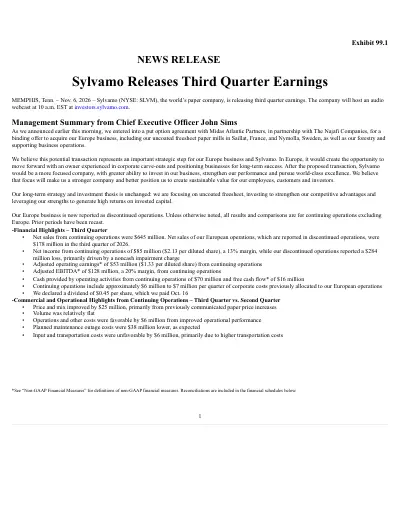
I'm on slide 5. This morning, we announced that we entered into a put option agreement with Midaspack Partners, in partnership with the Najafi Companies, for a binding offer to acquire our European business.
We believe this potential transaction represents an important strategic step for our Europe business and Sylvamo. In Europe, it would create the opportunity to move forward with an owner experienced in corporate carve-outs and positioning businesses for long-term success.
After the proposed transaction, Sylvamo will be a more focused company, with greater ability to invest in our business, strengthen our performance, and pursue world-class excellence. We believe that focus will make us a stronger company and better position us to create sustainable value for our employees, customers, and investors.
Our long-term strategy investment thesis is unchanged. We are focusing on uncoated freesheet in attractive markets, which we believe North America and Brazil both represent.
We are investing in low-risk, high-return projects that strengthen our competitive advantages, which is what we're doing at our Eastover mill. We are leveraging our strengths to generate high returns on invested capital.
Slide 6 is a summary of the proposed transactions. We need to complete the required consultation processes with the works councils and employee representatives in accordance with local laws before signing a share purchase agreement.
We expect the consultation period to be completed and the transaction to close by the end of the first quarter of 2027, subject to closing conditions, including regulatory approvals. At closing, we'll transfer our Europe business, which includes our mills in Saillat, France, and Nymölla, Sweden, along with supporting forestry and business operations, with working capital of approximately €50 million and net cash of approximately €35 million.
In exchange for the Europe business, Sylvamo will receive a right to 20% of any future distributions. Throughout this process, we will remain focused on operating safely and reliably serving our European customers.
Let's move to slide 7 and discuss our third quarter results. Our third quarter reflects solid execution on what we said we would do.
First, we continued to implement the uncoated freesheet price increases we had previously communicated to our customers across all regions. Second, operational performance improved across all our mills.
Sound execution of our planned maintenance outage work and our lean transformation helped drive operational improvement in the quarter. Third, like much of the economy, we faced higher input and transportation costs.
Don's going to go into more detail on this later on the call. Let's move to the next slide.
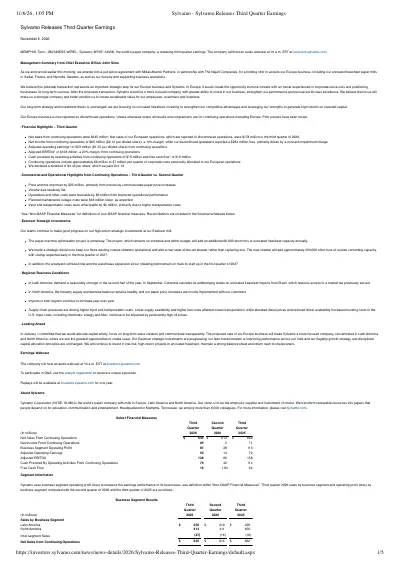
Slide 8 shows our third quarter key financial metrics. Adjusted EBITDA nearly doubled from the second quarter to $128 million, a 20% margin.
Adjusted operating earnings were 1.33, sorry, $1.33 per share. Free cash flow was $16 million, a $32 million improvement from the second quarter.
With that, I'll turn it over to you, Don.
Don Devlin
Thank you, John, and good morning, everyone. Slide 9 contains our third quarter earnings bridge versus the second quarter.
In the third quarter, we earned $128 million of adjusted EBITDA compared to $66 million in the prior quarter. Price and mix were favorable by $25 million, reflecting the implementation of paper price increases and better mix in both regions.
Volume was roughly flat as seasonally stronger demand in Latin America was offset by lower volume in North America due to the loss of supply from International Paper's Riverdale mill. Operations and other costs were favorable by $6 million, driven by improved operational performance.
Planned maintenance outage costs were favorable by $38 million as we had no scheduled outages in the quarter. Input and transportation costs were unfavorable by $6 million as transportation costs were higher in both regions.
Let's move to slide 10 to walk through the industry conditions. In Latin America, demand is seasonally stronger in the second half, which supports our volume and geographic mix.
During the quarter, we implemented most of the price increases we had previously communicated to our export customers in other Latin American countries and in the Middle East and Africa. In September, Colombia canceled its antidumping duties on uncoated freesheet imports from Brazil, which restores access to a market we previously served.
In North America, industry supply and demand remain healthy. The Riverdale paper machine conversion removed about 7% of annual industry supply, and our extended Eastover outage of about 50 days is currently underway.
We realized most of our price increases previously communicated to our customers during the quarter. Lastly, imports continued to increase year over year in both regions.
The chart on slide 11 shows the New York Fed's Global Supply Chain Pressure Index. This index measures how far global supply chain conditions are from normal.
It moved from about normal a year ago to well above its long-term average today. We're seeing this directly in our costs in both regions in three main areas: ocean freight, with tighter vessel availability and higher fuel prices; inland transportation costs, higher diesel prices and fewer available truck drivers in the U.S.; inputs, chemicals, energy, and fiber, all affected by persistently higher oil prices.
In the third quarter, our input and transportation costs were $6 million unfavorable compared with the second quarter, and we expect a similar unfavorable amount when comparing the fourth to the third quarter. These pressures are industry-wide, not specific to Sylvamo, and we're pulling many levers to mitigate these costs, such as our lean program, our supply chain initiatives, and fuel surcharges in North America.
Let's move to slide 12. We're making good progress on our strategic investments at Eastover, our flagship mill in North America.
We are about 60% through the execution of the paper machine optimization, and it remains on schedule and on budget. Once complete, it will add 60,000 tons of uncoated freesheet capacity per year, with the ramp-up starting early next year.
Let's go to slide 13. After a strategic review, we changed the investment plans for our converting facility in Sumter, South Carolina, which serves our Eastover mill.
We decided to expand our converting capacity, enabling us to internalize most of the currently outsourced converting and replace cut-size imports from our Brazil operations, which are no longer economically viable due to tariff changes. Our Sumter converting plant currently has three sheeters.
The previous plan included replacing one existing sheeter with a new state-of-the-art sheeter. We now plan to keep three existing sheeters operational and add the new sheeter to the facility.
When completed, Sumter will have four sheeters with a total of 500,000 tons of annual cut-size converting capacity, which is an increase of 200,000 tons from its current capacity. This capability will lower our converting and transportation costs and enhance our mix while improving service to customers.
The new sheeter is planned to start up early in the third quarter next year. This change will require us to invest about $25 million more to upgrade the infrastructure of the facility in 2027.
However, it will also result in a higher projected annual earnings benefit. The overall investments for the paper machine optimization and new sheeter are still expected to generate higher than 30% IRR.
I will now turn it back over to John to conclude prepared remarks.
John Sims
Thank you, Don. In my letter to shareholders in January, I committed that we would allocate capital wisely, focus on long-term value creation, and communicate transparently.
We evaluated our position in Europe and have decided to focus our resources and capital on Latin America and North America, where we believe we have the best opportunity to earn returns above cost of capital and generate strong cash flow. We will be focusing on setting a new standard for customer experience and loyalty, executing our strategic investments at Eastover, embedding lean continuous improvement across our operations and business, achieving best-in-class levels of efficiency, reliability, and performance in our mills and supply chain, adhering to our disciplined capital allocation principles, improving our social and environmental impacts every year.
Our flagship growth strategy has not changed. We will continue to invest in low-risk, high-return projects that strengthen our uncoated freesheet capabilities and grow earnings and cash flow over time.
I would like to close by recognizing that today we announced a big change for Sylvamo, and I want to thank all our employees for their hard work and commitment, especially our teams in Europe. With that, I'm going to turn it back to Hans.
Hans Bjorkman
Thanks, John, and thank you, Don, as well. Rebecca, we're ready to take questions.
Operator
We will now begin the question and answer session. Please limit yourself to one question and one follow-up.
Should you have further questions, you are welcome to re-enter the queue. If you would like to ask a question, please press star one to raise your hand.
To withdraw your question, press star one again. We ask that you pick up your handset when asking a question to allow for optimum sound quality.
If you are muted locally, please remember to unmute your device. Please stand by while we compile the Q&A roster.
Your first question comes from Mike Roxland with Truist Securities. Please go ahead.
Mike Roxland
Thank you, John, Don, and Hans for taking my questions and congrats on the announcement. John, just wanted to follow up with you.
You mentioned the letter in your closing remarks here they had earlier this year. You mentioned $300 million of free cash flow on a normalized basis, at least $300 million.
Once the sale of Europe is done, how do you think about that target? I realize the target is a floor.
You didn't provide a range, obviously there's upside for starters. Could free cash flow be at least $400 million, $450 million, particularly once you get rid of Europe?
That's the first part. The second piece is, now that you're approaching your target of $300 million plus, what do you intend to do with your free cash flow?
Is it all going to head towards repurchasing stock?
John Sims
Thanks, Mike. The proposed sale of our European business was going to make Sylvamo a much more focused company, concentrated in the attractive North America and Latin America regions, where we see the greatest opportunities to grow earnings and cash flow.
Our Eastover investments are progressing. Our lean transformations improving performance across our mills, and our flagship growth strategy and disciplined capital allocations are unchanged.
We're confident that we can continue to develop strong cash flow and grow that as we complete the transaction of our footprint change. I'm going to tell you that we're going to share more about the long-term potential of our stronger Sylvamo at the appropriate time once we complete the proposed sale of the European business.
To your second question, our focus on our capital allocation strategies unchanged. First and foremost, we're going to maintain a strong balance sheet so that we can invest and continue to invest through the cycle.
We will invest and continue to operate or invest where we think there's opportunities to generate well above cost of capital returns and grow our cash flow. Then we're going to return the balance to shareholders.
We'll do that, we do believe that the dividend is important to have that as a foundation. We also believe that where there's opportunities, we'll be buying back our shares and we'll prioritize that.
Mike Roxland
Gotcha. Just one quick follow-up.
Can you help us frame actually an early bridge to maybe 2027 EBITDA, some of the larger bookends, and given some of the moving pieces this year? The way I think about it, it looks like you'd be at around $340 million of EBITDA roughly, give or take, in 2026.
You have that once Europe is out, it's an add back of roughly $75 to $90 million. Eastover, $35 million benefit.
You have fewer imports from Europe and Brazil, $65 million benefit. Then you have some of these one-offs that you incurred this year from weather, debarking at Nymölla, and reliability.
When you think about the progression from EBITDA this year to '27, are you looking at a starting point of around $525, $550 million or so?
John Sims
Well, [laughter] to answer your question, we don't want to project out. Of course, there's a lot of unknowns between now and then, beginning of 2028, in terms of the global economy's costs and inputs and things like that.
I would think directionally, the way you've outlined it, those all make sense. What's unknown is what's going to occur in 2027, even from a geopolitical perspective.
Mike Roxland
Awesome. Thank you.
Don Devlin
One thing I'll add, Mike, is relative to Eastover. I know as you were going through those numbers, the 75, 35, and 65, I think you referenced the 65, which we've talked about in the past as a non-repeat.
The way we're thinking about that, we had a couple of components of that. We originally said 85 was a non-repeat, if you remember back in one of our previous earnings calls.
That had several components. Europe was a component, for example.
The volume was a component. The Eastover extended outage was a component.
Then we had another component for purchasing outside converting services. The way we think about next year given what we're doing with the fourth sheeter, volume, first of all, will be relatively flat for North America next year, we don't see that $20 million component not repeating.
Then our Eastover extended outage was $25 million of that. That would be something that we would expect as a one-time that won't repeat next year.
We think our converting cost, as we work to the third quarter to start up this fourth sheeter, will still incur some higher than normal converting costs well into 2027. In a summary, I'd say we expect about $25 million of that 80 originally 85, take Europe out, 65, 25 of the 65 to not repeat next year.
Mike Roxland
Very clear, Don. Thank you.
Operator
Your next question comes from George Staphos with Bank of America. Please go ahead.
George Staphos
Hi, everyone. Good morning.
Thanks for the details. Question and congratulations on the news.
Good luck with the process. The sheeter expansion in Sumter, can you talk to what the incremental costs will be?
I think you just mentioned directionally it's going to be an incremental negative. Can you talk about what that cost will be in '27?
As I understood it correctly, this is all part of question one. You at one point in time thought you'd be bringing in tons from Brazil.
You can't do that now because of policy. What are you going to be doing with those Brazilian tons that have been displaced by the incremental converting that you'll be able to do at Sumter?
Then I had a follow-on.
John Sims
Yeah. George, just to be clear, the $25 million is additional CapEx.
Originally, we had planned to shut down and replace the sheeter. Now, we're adding a fourth sheeter to a Sumter facility.
We've got to add infrastructure. You think about in terms of fire protection, dust systems, air, electrical.
That's what the $25 million is. We expect that then to delay the start up of that new state-of-the-art sheeter until mid-year next year.
What we were referring to is that we'll have to continue to outsource converting. We have those customers now, the cut-size, we're providing those customers today, but we're providing it cut-size using outsourced converting, which is expensive.
That's where the additional benefit comes from once that sheeter is up and running. We'll avoid those outside converting costs.
We'll be much more efficient internally to do that. For the Brazilian question you asked is, we're doing that today.
We've stopped, we were just able to briefly bring in cut-size from Brazil to support this transition with Riverdale going down. Then when the additional tariffs were applied, that shut that off.
That volume that we were importing in from Brazil is now going into other markets, other LatAm markets. We're exporting that, and we're seeing that today in our Brazilian business.
Did that answer the question, George?
George Staphos
It did. I guess just point of clarification before I get to the other question.
I understand the $25 million is capital. Would it be fair to say initially as you're building out what you need for the new sheeter and the capacity there and the incremental costs you're going to have there, that's initially a negative?
At some point, obviously, you're doing this because you become more efficient on converting. Is there a way to size what the negative is initially from a P&L standpoint and what the positive is on the flip side once it's up and running?
Then my second question is, aside from the ongoing 20% that will go to you on any cash outflows from the European operations, is there anything else in terms of economic interest you gain or any other things we need to be mindful of that could be a negative for you in terms of the deal on Europe? Aside from the 20%, what else do we need to be mindful of on the economics there?
Thank you.
Don Devlin
Yeah. George, it's Don.
Good morning.
George Staphos
So— Hi, Don.
Don Devlin
Good morning. To your first question around the additional cost, I'll go back to what I was describing to Mike earlier.
In 2026, we estimated our outsource converting costs due to the Eastover change to be about $20 million. That's about the same that'll occur in 2027.
That's why what we originally thought was a one-time would not go away. Incremental converting in '27, approximately $20 million to continue.
Then the rest is capital that John described.
John Sims
To be clear with that, George, that it will go away when the new sheeter is up and running. That's the size of the prize for installing the new sheeter, is exiting—
Don Devlin
We see that this project collectively, everything we'll spend on it, even including the incremental 25, will have above a 30% return.
John Sims
Then to your second question around the 20% economic interest, just to be clear, we have no equity ownership. We have no voting position.
The 20% interest on any cash distributions, but it also would be if the company does any type of joint venture or something, then we'll get an appropriate economic interest in the joint venture. Also, any future sales, we would get 20% of the proceeds from that.
That's what the 20% means. It is also indefinite, it's part of the deal.
George Staphos
You don't have a cash call as well. If they need capital for whatever reason, they don't come knocking on Sylvamo's door and say, hey, we need 20% of it or something like that.
Would that be fair?
John Sims
That's correct.
George Staphos
Okay. Thank you.
John Sims
Appreciate it. Also it can't be diluted as well, the 20% position.
George Staphos
Thank you, John.
Operator
Your next question comes from Matthew McKellar with RBC Capital Markets. Please go ahead.
Matthew McKellar
Hi, good morning. Thanks for taking my questions.
Just wanted to follow up on that last one and I guess confirm my understanding as well around what I heard. Are there any meaningful constraints placed on the buyer and how they run the assets as part of the transaction?
Maybe specifically, do they have the option to close those mills? Thank you.
John Sims
Yes, there's no restrictions from Sylvamo's perspective. No, they will be fully in control of the operations of the business once it does get approved and we do close on it.
I guess the short answer is no, no restrictions.
Matthew McKellar
Okay. Then as a follow-up, are you reasonably confident that the buyer and its partner are well positioned to fund any mill site liabilities that may have to be resolved in the future, and that your liabilities around those mills would be completely severed by the transaction?
John Sims
Yes, we are really confident. We ran a competitive process.
There was actually a lot of interest. These assets that we have, the teams that are there, the brands that we have, are very good, and I think that we made a selection with Midas because of their track record, because of their financial backing, but we also had other also very attractive potential buyers as well.
To make a choice with was actually a difficult choice because they all had their strength, and we believe that Midas does have the financial backing and also the know-how and the wherewithal to be able to be very successful long-term with our European business.
Matthew McKellar
Thank you. If I could just sneak one more in.
Regarding Section 338 tariffs, recent scope revisions, could you maybe just confirm the approximate share of volumes you'd expect to be affected by tariffs at this point as it relates to the industry in North America? Maybe speak to any opportunities for Sylvamo that you might be seeing following that announcement.
Thank you.
John Sims
The U.S. did impose another HTS code on 338, which impacted about 82,000 tons of cut-size that was imported in 2025 from Canada, we're thinking that's about the same volume.
If you look at that volume, it is so I'm going to say somewhat immaterial to the overall volume. We don't see a lot of impact, and it's also not clear as to what options the supplier of those tons may have in terms of converting those into rolls or to other offset business and supplying that cut-size domestically.
We don't see much of impact from the recent addition of this HTS code to the 338 tariff, Matthew.
Matthew McKellar
Thanks very much. I'll turn it back.
Operator
Please limit yourself to one question and one follow-up. Should you have further questions, you are welcome to re-enter the queue.
If you would like to ask a question, please press star one to raise your hand. To withdraw your question, press star one again.
Your next question comes from Daniel Harriman with Sidoti & Co. Please go ahead.
Daniel Harriman
Hey, guys. Good morning.
Thanks so much for taking my questions. Just two quick ones from me today.
The first is on working capital. Our expectation from August was that the build would mostly unwind by year-end '26, with the 50,000 tons in North America coming down in the second half.
It looks like in the third quarter, it consumed about $42 million in working capital, I'm curious how much now comes out in the fourth quarter versus next year. Then just regarding the $6 to $7 million a quarter in costs that were previously allocated to Europe, do you think any of that is addressable once the transaction closes, and if so, over what timeframe?
Thanks a lot.
Don Devlin
Hi. Good morning, Daniel.
It's Don. On your first question on working capital, I expect that we'll be close to our plan in the fourth quarter.
Most of that working capital was inventory build in North America, which was related to getting us through the Eastover outage, and with the sales plan we have, we'll be close to that target by the end of December. Then for the $6 to $7 million quarterly cost that was previously allocated to the Europe business, if you step back, when, over time, we've gone through changes with Sylvamo, we've looked at what our appropriate cost structure is from an overhead standpoint.
We'll do the same thing here. We'll look at what's the right blend of resources that we need to execute our strategy, and so I think you can expect costs will come down over time.
We've got the right resources aligned with our new Americas business, if you call it that.
Daniel Harriman
That's helpful. Thanks,
John Sims
Daniel, from the timing expectation, that will start probably as soon as we are able to complete the deal once we get through that process.
Operator
Your next question comes from George Staphos with Bank of America. Please go ahead.
George Staphos
Hi, everyone. Two questions.
First, can you talk to what you think shipments and consumption might look like in North America in 2027 based on your views, what your customers are saying, market forecasts, whatever you want to throw into the pot? Then secondly, on the I think you said $6 million of unfavorable costs with inputs and transportation, if you can affirm or correct that, how do you ultimately, whatever the number is, expect to offset that over time?
Is that going to be purely on surcharges and the like, or do you have other mechanisms? Thank you.
Don Devlin
Yeah. George, to your first question on shipments, we expect North America, our North America business, to be relatively flat from volume this year to next year.
I think the industry this year is closer to -2%. Then on your second question, the input costs, we expect the fourth quarter to see also from the third to the fourth about the same, and I think we said $6 million of negative.
A lot of that is fuel-related, oil-related, diesel-related, and it impacts things like chemicals, distribution costs, things I referenced earlier. What do we do about it?
There's no one answer, and really the teams are looking at really every lever we have. Think about starting from revenue, what are we doing?
Surcharges is an element. It's difficult to do.
You can't do it in all regions. That is a lever that we've pulled and we're moving.
Teams also looking at the mix, geographic mix and customer mix, how do we improve that, and then further price as we can push it later into or earlier into next year. Then on the cost side, it's a lot of things as well.
There's teams looking at distribution costs and how do we get the best mode and reduce our exposure to the higher freight costs, the spot freight, if you will. Fiber, energy, chemicals, same thing, how do we reduce those things and reduce consumption or even how we buy.
Then on the productivity side, our lean initiative is gaining momentum. It's a long long process to build those capabilities, but we're seeing some early early indications of success.
We've identified approximately $15 million of annualized benefit in some specific projects. We've got a lot of people engaged in it, and so I think the answer is it's not one lever, it's many levers, and it's across the spectrum of revenue, distribution, manufacturing costs, and productivity.
George Staphos
Thanks. I'll turn over.
I'll be back.
Operator
Your next question comes from Mike Roxland with Truist Securities. Please go ahead.
Mike Roxland
Thanks. Just one quick follow-up.
I was just wondering if you guys have any update on the poison pill, which I believe expire sometime next week.
John Sims
Yes, we do have an update on that. Right now, as you said, the shareholder rights plan that the board had adopted last November does expire this Monday, November 9th, and our board has decided to let this plan expire, and so it will not be renewed.
Mike Roxland
Thank you.
Operator
Your next question comes from George Staphos with Bank of America. Please go ahead.
George Staphos
Thank you. Hey, Don, just following up on the earlier question I had on input costs and the like.
You said $6 million was the increase, and then there was another $6 million fourth quarter versus third quarter. Is that a consistent year-on-year $6 million you've got to manage against, or what you're saying is costs have now moved up $12 million because it's 6 plus 6?
How would you have us think about that? I had a quick follow-on.
Don Devlin
George, first, you're right. It is incrementally 6 more in the fourth quarter, and we are expecting that we carry that annualized cost into 2027 at this point in time.
Of course, we'll have things that we'll do to mitigate it as much as we can.
George Staphos
Okay.
Don Devlin
Annually, George, just—
George Staphos
Go ahead.
Don Devlin
Sorry. For perspective in 2020—2026 versus '27, costs are up approximately $50 million, and distribution is most of that, and the other things, chemicals, energy, things like that, over 2025.
George Staphos
Thank you for that. Other question, I know you've got a lot going on right now.
It's not going to happen next month. There had been some thought, I think, maybe I was mistaken, that when you had the right window, you'd have an opportunity to do an investor session, kind of a capital markets day, something like that.
Do you have any thought in terms of when that might occur, if that's a correct assessment?
John Sims
That's right, George. Actually in my letter, I said we would have one.
Then, when we started thinking about Europe and what we were going to do with Europe, and then we got into the process, we pushed that off because just we didn't want to be going in front of investors saying one thing and actually working on something else. We have pushed that off, and we'll probably be re-looking at that probably now sometime next year.
George Staphos
Sure. Do you think maybe second quarter, would that be fair or too hard to call at this juncture?
John Sims
Too hard to call at this juncture. It certainly won't be in the first quarter [laughter], but yeah, it could be sometime second, third quarter, yeah.
George Staphos
We understand. All right.
Thank you very much. Good luck in the quarter.
John Sims
Thank you.
Operator
We have reached the end of the Q&A session. I will now turn the call back to Hans Bjorkman for closing remarks.
Hans Bjorkman
Thanks, Rebecca. I'm just going to let John give a couple closing thoughts to wrap up, and then we'll let you guys go into the rest of your day.
John Sims
I just want to reiterate the proposed sale of our European business will make Sylvamo a more focused company, concentrated in North America and Latin America, where we see the greatest opportunities to create value. Our flagship growth strategy and disciplined capital allocation principles are unchanged.
We're currently executing our most significant investment at our Eastover mill that will drive a lot of value in the years to come, and that is progressing well. We're very pleased with what we're seeing so far.
We'll continue to invest in low-risk, high-return projects in uncoated freesheet and maintain a strong balance sheet and return cash to shareowners. We're focused on long-term value creation, are confident in ability to generate strong EBITDA and free cash flow through the cycle.
As we complete this transition of our footprint, we're going to share more about the long-term potential of a stronger Sylvamo at the appropriate time. Thank you for joining this call.
Operator
Thank you for participating in Sylvamo's second quarter 2026 earnings call. You may now disconnect.