SM Energy Company
Q3 FY2026 · Earnings Call TranscriptNovember 4, 2026
Operator
Greetings. Welcome to the SM Energy third quarter 2026 earnings call.
At this time, all participants are in a listen-only mode. A question-and-answer session will follow the formal presentation.
If anyone should require operator assistance during the conference, please press *0 on your telephone keypad. Please note, this conference is being recorded.
I would like to turn the call over now to Megan Hays, SM Energy's Vice President, Investor Relations. Thank you, Megan.
You may begin.
Megan Hays
Thank you, and good morning. On the call with me this morning are Beth McDonald, President and CEO; Blake McKenna, Chief Operating Officer; and Wade Pursell, Chief Financial Officer.
Before we begin, I will remind you that we will be making forward-looking statements and our actual results may differ materially. Please refer to the cautionary statements in our earnings release, our presentation, and our filings with the SEC.
We will also reference non-GAAP measures. Reconciliations are in the release.
With that, I'll turn it over to Beth.
Beth McDonald
Thank you, Megan, and good morning. I want to start with the commitments we made for 2026.
We set out to integrate two companies, capture the value of the merger, optimize the portfolio, and strengthen the balance sheet. We are delivering against those commitments, and in several areas we have exceeded what we originally set out to achieve.
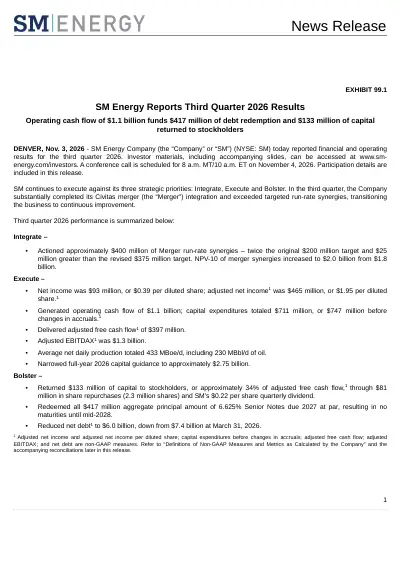
At the merger announcement, we established a $200 million synergy target. Today we have actioned approximately $400 million, twice the original target and surpassing the previously raised $375 million target.
We also set a goal of at least $1 billion of divestitures within one year of closing, and substantially achieved that objective with the $950 million Galvan sale, directing the proceeds to debt reduction. We established a goal of low 1-times leverage at mid-cycle prices.
We remain on track to reach that level by year-end 2026, more than a year ahead of our original expectations. With the key integration work streams largely complete, the focus now shifts from integration and execution to execution and optimization, using our lower cost structure and stronger balance sheet to improve capital efficiency, generate durable free cash flow, and continue creating value for stockholders.
Our 80/20 framework remains the mechanism for balancing debt reduction and share repurchases as we move toward low 1-times leverage at mid-cycle prices. Blake will now walk you through our operating performance and the work underway across the portfolio.
Blake?
Blake McKenna
Thanks, Beth. Third quarter production was in line at 433,000 barrels of oil equivalent per day.
Oil was within guidance at 230,000 barrels per day, but about 2% below the midpoint. The oil variance primarily came from two areas.
In the Permian Basin, downtime ran higher than planned as we completed compliance work on acquired assets and temporarily shut in producing during high-risk simultaneous operations. Those actions are now complete, and the related downtime is behind us.
In the Uinta, our production was limited by takeaway. An unplanned outage at an in-basin refinery redirected incremental barrels to rail when terminal capacity was already fully utilized ahead of the planned expansion.
Together, these constraints reduced third quarter oil volumes by approximately 4,000 barrels per day. Absent them, oil production would have been approximately 234,000 barrels per day.
The refinery is back online. Rail capacity remains constrained until the terminal expansion enters service, currently expected in the first quarter of 2027.
We've reflected that limitation in our fourth quarter and early 2027 expectations. For the fourth quarter, we expect oil production of 229 to 239,000 barrels per day, which reflects the Uinta constraint, and capital of approximately $610 million.
Operationally, we have solid updates across the portfolio, and I'll highlight three. First, in the Delaware Basin, the 21 wells we brought on this year across five pads, which is in our core stacked pay area, are producing about 40% more oil per foot than our 2024 wells, and they're running about 24% ahead of our 2025 wells at six months.
Compared to last year, we have drilled roughly twice as many wells in the Delaware Basin. Second, the Woodford Barnett program in the Midland Basin continues to show encouraging economic and technical potential.
The eight wells online to date are delivering above the area average. We continue our delineation work to define the resource and development potential.
Third, in the Uinta, the first SM fully designed and executed pad came online in August with optimized spacing and enhanced completions on 15,000-foot laterals. On a normalized basis, the first 30 days are the highest rates we've delivered in the basin.
The next pads that come online in the fourth quarter are 20,000-foot laterals. Stacking these innovations and leveraging our subsurface expertise is beginning to show in per-well productivity.
Turning to costs, our Uinta completion costs per lateral foot fell from $475 in the first quarter to about $400 in the third. On the same lateral length and target zone, simul-frac increased completion efficiency from about 1,000 feet per day to 2,800.
Those efficiencies are a large part of what our operation synergy program delivered: $215 million against a raised $200 million target. The majority of what we actioned is structural, including completion design, simul-frac, and drilling performance.
In the Permian, third quarter drilling footage per day was up about 15%, and completion footage about 23% compared to our 2025 average. On inflation and capital, we have narrowed full year capital guidance to approximately $2.75 billion, the midpoint of our prior range.
Our synergies and sustainable efficiency gains have largely offset inflation related to higher diesel unit costs, fuel-related transportation costs, and other consumables, including OCTG. We're finishing 2026 with momentum and heading into 2027 from a position of strength.
Scale, consolidated procurement, simul-frac, local sand, are all yielding a lower-cost model. We intend to keep building on it into the new year.
Wade will now take you through the financial performance.
Wade Pursell
Thanks, Blake. Good morning, everyone.
We generated $1.1 billion in operating cash flow and $1.3 billion in adjusted EBITDAX in the quarter. Capital expenditures before changes in accruals totaled $747 million, within our guidance range, and adjusted free cash flow was $397 million.
We returned $133 million to stockholders, representing 34% of adjusted free cash flow through $81 million of repurchases and $52 million of dividends. Repurchases were about 24% of post-dividend free cash flow.
Year to date, we've repurchased $165 million of stock. We continue to view buying our stock as one of the best uses of our capital.
The rest went to the balance sheet. We redeemed the $417 million 2027 notes at par, and net debt ended the quarter at $6 billion, and that's down from $7.4 billion at the end of the first quarter, our first quarter after the merger.
We have no senior note maturities until mid-2028, and we remain on path to low 1-times leverage at mid-cycle prices by the end of this year. A quick word on cash taxes.
We previously provided full year cash tax sensitivities, including approximately $50 million at $85 oil. With the strength in commodity prices, we now expect full year cash taxes of approximately $100 to $120 million.
The primary driver of that is the annual tax attributes that offset taxable income earlier in the year have largely been utilized. Incremental taxable income at current commodity prices is now largely subject to cash taxes at the full applicable rate.
To wrap up on synergies, $400 million actioned, every bucket ahead of its original target, and the company's structural cost basis reset. Third quarter recurring G&A of $52 million is the run rate.
The step-up implied in the fourth quarter reflects normal year-end items, not a change in that base. From here, we manage efficiency through continuous improvement, which will show up in unit costs.
We enter 2027 with a meaningfully stronger financial foundation: a lower structural cost base, lower interest expense, lower leverage, and the full run-rate benefit of the merger. That combination improves the durability of free cash flow and gives us greater capacity to compound value per share through disciplined capital allocation.
With that, I'll turn it back over to Beth. Beth?
Beth McDonald
Thank you, Wade. Since January, we've integrated two companies, actioned more than double our original synergy target, substantially achieved our divestiture target, and reduced net debt by $1.3 billion since the first quarter.
SM is a materially stronger company than it was at the beginning of the year. As Wade said, our lower cost base increases the free cash flow available to create value for stockholders, while share repurchases compound that value on a per-share basis.
Importantly, capital will continue to compete for the highest risk-adjusted returns, with free cash flow and capital efficiency prioritized over volume. Integration reset the platform.
The next phase is about compounding the advantages created by that work. Our priorities are clear: execute the plan with greater capital efficiency and continue lowering SM's corporate break-even; deepen the quality and duration of our inventory through organic delineation in the Woodford Barnett and Uinta and disciplined ground game activity; continue strengthening the balance sheet toward low 1-times leverage at mid-cycle prices while executing our plan of returning capital to stockholders through our 80/20 framework.
That is how we intend to translate a stronger operating platform and balance sheet into durable per-share value. With that, I'll hand the call back to the operator for Q&A.
Operator
Thank you. We will now be conducting a question-and-answer session.
We ask that you please limit yourself to one question and one follow-up. If you would like to ask a question, please press *1 on your telephone keypad.
A confirmation tone will indicate that your line is in the queue. You may press *2 if you would like to remove your question from the queue.
For participants using speaker equipment, it may be necessary to pick up your handset before pressing the star keys. One moment please while we poll for questions.
Our first question is from John Freeman with Raymond James. Please proceed with your question.
John Freeman
Thank you, good morning. Appreciate it.
Regarding the Uinta constraints, you mentioned that the refinery is back online and the terminal expansion will be done in early '27. I know there's another operator that's got a commitment for the majority of that incremental capacity.
Just as we sort of think about it, is it more like this just relieves the bottleneck as opposed to maybe dramatically increasing kind of your takeaway capacity or said differently, should we continue to assume that y'all are kind of 20% local refineries and 80% rail?
Beth McDonald
Thanks for the question, John. When we look at our terminal, it's really just us and one other operator, and through the expansion that was planned with them, it more than doubled the capacity, which is much further than either one of us committed to that.
We have the ability to expand in the basin beyond just what our original plan said. We know that after this expansion hits, we have the ability to shift capital around or do what we need to do to make sure that cash flow continues to hit market.
John Freeman
Great. Then my follow-up, y'all last quarter you had kind of indicated that second half '26 kind of average production was kind of a good kind of baseline for us to use for 2027, just sort of given some of the downtime in the Permian, the takeaway constraints in the Uinta that kind of impacted second half and maybe early '27.
Just didn't know if y'all wanted to sort of elaborate if that kind of impacts those prior comments from last quarter.
Beth McDonald
Let me give a little clarity on the second half run rate. I know that that's moving around a little bit, and I want to be clear about what that means for a good framework for 2027.
When you think about it, we talked about total production being 435 to 440 MBOE per day, with approximately 238,000 barrels of oil a day as the oil production rate. That baseline still holds as a good baseline.
Really when we think about formalizing our 2027 budget, which we'll present early next year, we're evaluating the puts and takes of the Uinta takeaway constraints that are going to occur early in 2027 against the potential of temporarily shifting activity to other basins. That interplay and those factors will play a role in where we finalize our '27 guidance.
More to come in February.
John Freeman
Great. Thanks, Beth.
Beth McDonald
Yep. Thanks, John.
Operator
Our next question is from Gabe Daoud with Truist. Please proceed with your question.
Gabe Daoud
Thanks, operator. Morning, Beth and everyone.
Thanks for the time. Hey, Beth.
Maybe could go back to '27 again, just higher-level thoughts around capital requirements to hold that second-half run rate, I guess, at least flat into '27. Just how do we think about that number against the inflationary pressures that the industry is seeing?
I know you guys have been doing a good job with synergy capture and efficiency gains, but curious if the inflationary pressures will just be too much to offset.
Beth McDonald
The 2026 average and our midpoint of 2.75 is, in general, how we've guided 2027 less one-time costs. We continue to look at oil prices and activity, and it's not unreasonable to say that inflation could hit this sector at this point.
We'll continue to watch it. At SM, we benefit from the tailwind of a full year of merger synergies that we've actioned that have exceeded expectations, and we'll continue to find efficiencies across the different basins.
More details as we formalize what that 2027 budget looks like in the beginning of the year, but you can still think of 2026 CapEx excluding one-time costs as a good starting point.
Gabe Daoud
Great. Thanks, Beth.
Then, maybe a follow-up for Wade, just wanted to go back to the taxes again, the cash taxes. What should we be using for '27?
I think if I heard you right, fully exposed now for at least the rest of '26, and I guess I'd imagine that's the case for '27. Just wanted to make sure I heard that right and, again, thoughts on '27 cash taxes.
Wade Pursell
Sure. Great question.
You using the words 'fully exposed' for the rest of '26 is a good characterization. We have a lot of attributes, a lot of carryforward NOL stuff from the merger that we're able to use on an annual basis with limitations.
As I said, we've kind of used those up for this year. Having a fourth quarter where oil runs up into the $95, $100 area, that's driving that increase.
The assumption for next year, we'll have attributes to use next year, just like we did this year. I guess I would say, if you want to assume an oil price that's kind of in this area, an elevated area, I think it'd be a good modeling thing for now to just kind of assume something similar to the numbers I gave for 2026.
Obviously if you assume a lower oil price, you'll get back down to those levels that we thought we were going to be at, in the $80, $85 oil area, if that makes sense.
Gabe Daoud
Yeah. No, that's very helpful.
Thanks, Wade. Thanks, everyone.
Beth McDonald
Thanks.
Operator
Our next question is from Scott Hanold with RBC Capital Markets. Please proceed with your question.
Scott Hanold
Good morning. Thanks.
Blake, we've seen some pretty strong improvements on your Delaware Permian wells. Can you walk through some of the key changes or things you all have done to see that size of an uplift?
Blake McKenna
There's a little bit of secret sauce in that. A lot of what we've seen great improvements on is the completions side of things.
That's an area that we're going to lean into. The combined win from both teams being in the Permian as we've merged up together has led to a lot of shared learnings.
Again, kind of going into synergy capture, we talk a lot about capital for what we capture through synergies is how we can reduce costs, but the technical learnings has been a big win. Taking some of that in the combined team has been huge.
Scott Hanold
Would you say you all are doing something different say than the industry is, or are you just bringing up the completions more consistent with what offset operators are doing?
Blake McKenna
What I would say is we've got great technical knowledge, which has been in the SM DNA for a while. We are heavy leveragers of looking at offset data and utilizing our internal skill sets to go after these wells and think about them differently.
I think that's a differentiator for SM Energy. I would say, yes, I think there's going back to that secret sauce within SM that I think is a technical differentiator for us and something we've always leaned on here at SM.
Scott Hanold
Got it. Okay.
Then, obviously, you guys have captured a lot more on the synergy side and I think now are more so pivoting to broad continuous improvement. Could you maybe take a step back and as you look at the business over the next say 12 to 18 months, what's the opportunity set that you have?
Specifically, what are some of the line items you're looking to further improve in the business model?
Blake McKenna
Great question. A quote we'll use is 'Pleased, but never satisfied.'
To your point, synergy capture just translates to driving costs down. I think naturally you start with your larger costs, right?
You're going to go after big-ticket items that are generally specific more to D&C. Then after that, it's the operational and cultural efficiencies within the company, and then you go to the part of vacuuming up nickels and chasing all the little things.
We've high-graded that. Instead of going after the big-ticket items, it's going to be a lot of focus on the little ones, right?
We'll be shifting our efforts towards a lot of that. That'll be across D&C.
It'll also include LOE. It's just going to be everywhere.
You're going to have higher effort to smaller items, and that's just a natural part of chasing cost savings down.
Beth McDonald
Scott, just to add on in the other two buckets that we've either met or exceeded expectations in. From a G&A perspective, we're getting close to one year from the closing, and we'll be there by February.
Through that we continue to have contracts that roll off on different software packages, different contractors, that kind of thing. That will continue to improve.
On the cost of capital side, as we generate more free cash flow under our 80/20 framework, we'll be able to deliver more on the interest savings perspective as well. There's more in every single bucket.
Scott Hanold
Got it. Appreciate the context.
Thanks.
Beth McDonald
Yep. Thanks, Scott.
Operator
Our next question is from Tim Rezvan with KeyBanc Capital Markets. Please proceed with your question.
Tim Rezvan
Good morning, folks, and thank you for taking our questions. Some have been addressed, but I thought I would start here maybe on the DJ Basin.
It's probably the most overlooked asset you have today. In the release, you mentioned investing in a local sand mine and it could maybe lower proppant costs by 40%.
Can you provide more context on the project and maybe remind us what percent of well costs proppant represent, just to understand sort of what the uplift is here?
Blake McKenna
Absolutely. We've taken two approaches to going after sand.
In the Uinta, we operate our own sand mine, and we've partnered with a great company to help us operate that. Here, we've found another great operator in the basin that already is successfully operating a sand mine, and we've invested alongside them for them to operate and move that sand into basin for us in the DJ.
It's dependent on frac design, what percentage of your proppant is there, but we think it'll generate some meaningful savings coming into Q1, Q2. You'll see some of that reflected in our results as we go into next year.
Sand is a very substantial portion of our costs when it comes to frac. As far as inputs go, it's our number one.
Tim Rezvan
Thanks. We'll stay tuned for updates, I guess.
As my follow-up, maybe this is for Wade or Beth. I want to ask on hedging a bit.
We all see the free cash flow and the deleveraging that's coming, but we also see a lot of volatility in the strip. In 2027, I think today is around $85 for the calendar year.
You have some hedges that are out of the money today. How do you think opportunistically about taking advantage of that mid-$80s price going forward?
Is there a thought on being opportunistic at all with incremental hedging in '27? Thanks.
Wade Pursell
Tim. That's a good question.
My short answer is our hedging strategy, we're just methodically executing it the way we have been for over a decade. I wouldn't call it opportunistically.
I would just call it taking advantage of some of those higher oil prices as we look out over the next year, year and a half or so, and just layer in incremental hedges. Tied to the balance sheet, I just remind everyone, that's how we hedge.
With the balance sheet becoming so much stronger, the targeted percentages are lower for our hedging profile. They're no longer 50%, which is where they were when we came out of the merger with higher leverage.
They're closer to 30%. When we're looking out a year from now and a little bit beyond, those are kind of the targeted levels, but short answer is we continue to hedge.
We're happy to take some of these higher prices right now.
Tim Rezvan
Okay. Thank you.
Wade Pursell
Thanks.
Beth McDonald
Thanks, Tim.
Operator
Our next question is from Oliver Huang with Tudor, Pickering, Holt & Co. Please proceed with your question.
):
Oliver Huang
Good morning, Beth, Wade, and team, and thanks for taking our questions. Wanted to start on the Uinta.
Just could you all talk a bit more on the first SM-designed pad that's recently online? Maybe initial takeaways beyond the strong 30-day rates.
Maybe also what changes occurred from a spacing optimization perspective and the magnitude of the enhanced completion that you all call out in the slides?
Blake McKenna
I can take a stab at that one. The Uinta is extremely complex.
I think, similar to the Permian and Delaware, you have a lot of stacked formations, and we have a lot of oil down there. We've looked at all of this data from the previous operators, offset operators.
For us, it's taking in that large amount of data and using it to create optimization within the Uinta. All of those inputs have been what we as a team have been using to go and create and build this to optimize spacing not just horizontally, but vertically as well, and find the right fracs for the right portions of those oil-bearing zones.
Going back to that point I made earlier, and SM has got really good technical knowledge in its DNA. The leverage is used towards this in a way that allows us to go delineate between each of these and figure out where we want to put our wells.
That's been the bulk of the work from the team is putting that into place, and then utilizing our low costs in the Uinta Basin thanks to all of our integrated sand and water delivery systems to bring these wells online. Again, we really liked its performance.
We were very encouraged by them. As time goes on, we'll start to see those results go, but, again, a little bit of secret sauce that goes into it, and we're really excited for what we have going on in the Uinta in the future.
):
Oliver Huang
Awesome. Just to kind of clarify on the spacing side, is that just more optimal landing zone placement versus just up-spacing relative to what you all been doing over the last call it couple years?
Blake McKenna
It's three-dimensional. You're basically just trying to optimize all the little distances vertically and horizontally between them.
That's more of what it is fine-tuning. We get a lot of really good technical results coming out of different testing that we do on each of those benches, and that's what allows us to kind of tune that three-dimensional spacing.
It's a little bit here, a little bit there. That's what we chase.
):
Oliver Huang
Makes sense. For my second question, just on LOE trends, trying to understand a bit better of what we're seeing here in Q3.
It looks like there were decent upticks in the Permian and also South Texas, just looking at that asset breakout. Just trying to understand how much of this is structural versus any one-offs in the quarter that we should be aware of as we just kind of think about where this line item could directionally move over the next year.
Blake McKenna
Yep, appreciate that. Third quarter LOE was elevated by the compliance work on the acquired Permian assets, and fourth quarter guide of $6.60 to $6.80 reflects that work being complete.
With a more oil-weighted portfolio in the cost environment we are in, that third quarter level is reasonable run rate to use into 2027 as well. We're going to continue to use our synergies to work to offset.
We see it as more one-time, not structural. ):
Oliver Huang
Perfect.
Operator
Our next question is from Jack Kindregan?] with BMO Capital Markets.
Please proceed with your question.
Jack Kindregan
Hi, good morning. Thanks for having me on.
I was hoping you could touch on the basin production trends heading into the fourth quarter given the various impacts. I'm assuming that Permian should drive most of the oil and BOE growth that you have guided to, but curious for any comments there.
Then given the high number of TILs, I think it's 80 for the fourth quarter, I was wondering if that would help to offset any of the typical 1Q seasonality that we've seen from both SM and Civitas in prior years.
Beth McDonald
All right. Thanks, Jack.
I'll start and then hand it over to Blake. When you look at Permian activity or our activity as a whole, we started the year with much higher activity and it's come down where kind of a new baseline was established in that July, August timeframe.
Some of that drop in production that you're seeing quarter-over-quarter specifically in the Permian was planned. That came in line with what we expected.
Then it should be flat to go up a little from this quarter moving forward. I think that's in line with what you mentioned on your question.
I would start there. Then on top of that, as you look at our production profile and what we've generally done every year, it's just a useful reminder that we've had activity levels changing throughout the year, which impacts what that profile looks like and it's not really linear.
We would expect that pattern to continue in '27, but we'll have more formal guidance in February. I don't know if you want to add anything, Blake, to that.
Blake McKenna
No, and on TIL counts, we feel good about what we have going into fourth quarter and there's always little tiny straddle ones that might be on the edge of the quarter that bump here to there, but we feel good about the plan that we've delivered to y'all.
Jack Kindregan
Great, thank you. Then to follow up, you guys described the divestiture target as substantially complete following the South Texas sale.
Should we still expect you guys to meet the $1 billion goal within one year, or the landscape shifted enough with the macro to warrant a little bit more patience to realize full value?
Beth McDonald
This answer hasn't really changed for us. We're substantially there, but we're not rounding up.
The Galvan sale got us meaningfully close to that $1 billion target and strengthened our company really for short term, but we look across our expanded scale, we have a larger candidate set for accretive non-core divestitures, we continue to look at transactions and those prices, and we'll always review our portfolio and consider these trends. Uh-huh.
Jack Kindregan
Great. Thank you very much.
Beth McDonald
Thanks.
Operator
Once again, if you would like to ask a question, please press *1 on your telephone keypad. Our next question is from Peyton Dorne?]
with UBS. Please proceed with your question.
Peyton Dorne
Hey, good morning, everybody, and thank you for having me on. Peers this quarter have highlighted the benefits that they're seeing from utilizing both chemicals or surfactants on their existing Permian wells.
I just wondered if you can maybe touch on your own experience there and whether it's a technology you've tested broadly so far on the Midland assets. Thanks.
Blake McKenna
We're seeing initial encouraging results with that. I think the rest of the industry is as well.
I keep using the word 'secret sauce.' This is something that we think has merit, and it's something that we are step by step working our way through.
I think we would agree with what is broadly out there, but more testing needs to be done as we do see it is certain formation and area specific, which I won't go into detail on, but we do think this is an encouraging development. We are actively chasing and testing this.
Peyton Dorne
Great. We'll stay tuned to see more.
Then just as a follow-up, I thought the gas and NGLs realizations were notably stronger the period. I'm guessing a lot of this on the gas side had to do with the expanded Permian pipeline capacity, but I just wondered if you could kind of touch on where you see pricing shaping up for y'all heading forward, and if this is a level that we can kind of expect, especially on the gas side, as we look out to 2027.
Thank you.
Beth McDonald
I think that's one component of it, Peyton, that you mentioned there in the Permian. We've seen relief at Waha and more pipes are to come.
We did have NGL outperformance in South Texas, which was great, and as we march kind of toward the west, the wells get more liquids rich, we would expect that trend to continue and that's in our forecast. Then at the same time, we still have those Uinta constraints on the oil side that will continue forward into early 2027, but all that's been taken account into our outlook.
Peyton Dorne
Great. Thanks for giving me on.
Beth McDonald
Thanks, Peyton.
Operator
Our next question is from Oliver Huang with Tudor, Pickering, Holt & Co. Please proceed with your question.
):
Oliver Huang
Good morning, all, and thanks for letting me back in the queue. Just had one more follow-up on the synergy side, just thinking about the $400 million actioned.
A lot of that's intra-year capture. How much of this total would you say is being felt in the 2026 financials before we get the full run rate for 2027?
When we're thinking about the D&C bucket specifically, just how much of that was fully captured in 2026 before we get the full $200 million run rate in '27?
Beth McDonald
Thanks for that. When we rolled out our budget at the beginning of the year, we included $50 million of the synergies into our budget.
That's what's included in 2026, but I think to the credit of the team, the additional synergies are being felt in the run rate because we've been able to offset inflation that we've seen through diesel and fuel-related charges just like what Blake said there, and I'll let Blake add more.
Blake McKenna
Yep. We've seen even with the fuel rise, which started early, we've been able to offset that.
That's been a big win for us. Coming with that original 50 million in the budget, the team has definitely been exceeding that to hold back inflationary pressure, and we'll see that trickle into our 2027 budget as we work into the year.
I would say that has definitely gone better than we anticipated in being able to action 2026, and we think that'll be a real positive story going into the continued value savings and full run rate in '27. ):
Oliver Huang
Just to clarify, the $50 million in the budget for 2026, that's relative to the $400 million actioned?
Beth McDonald
Yes, that's 50 of the $400 million. We laid that out in the beginning.
In CapEx.
Oliver Huang
In CapEx. ): Makes sense.
Thank you so much.
Operator
We have reached the end of the question-and-answer session. I would like to turn the call over to Beth McDonald for closing comments.
Beth McDonald
Thank you all for joining us this morning and for your continued interest in SM. We really appreciate your time today and look forward to speaking to many of you soon.
Have a good day.
Operator
This concludes today's teleconference. You may disconnect your lines at this time.
Thank you for your participation.