Sandisk Corporation
Q1 FY2027 · Earnings Call TranscriptOctober 29, 2026
Operator
Good afternoon and welcome to SanDisk's first quarter fiscal year 2027 earnings conference call. All participants will be in a listen-only mode.
Should you need assistance, please signal a conference specialist by pressing the star and then zero on your telephone keypads. After today's presentation, there will be an opportunity to ask questions.
To ask a question, you may press star and then one on your telephone keypad. To withdraw your question, you may press star and two.
Please also note today's event is being recorded. At this time, I'd like to turn the floor over to Ivan Donaldson, Vice President of Investor Relations.
Please go ahead.
Ivan Donaldson
Before we begin, please note that today's discussion will contain forward-looking statements based on management's current assumptions and expectations, which are subject to various risks and uncertainties. These forward-looking statements include expectations for our technology and product portfolio, our business plans and performance, our capital allocation priorities, market trends and opportunities, and our financial results.
We assume no obligation to update these statements. Please refer to our annual report on Form 10-K and our other filings with the SEC for more information on the risks and uncertainties that could cause actual results to differ materially from expectations.
We will also make references to non-GAAP financial measures today. Reconciliations between the non-GAAP and comparable GAAP financial measures are included in the written materials posted in the Investor Relations section of our website.
With that, I'll turn the call over to David.
David Goeckeler
Thanks, Ivan. Good afternoon and thank you for joining SanDisk's fiscal first quarter 2027 earnings call.
We began fiscal year 2027 with another strong quarter, creating value for customers and shareholders and delivering results above guidance. Our strategy is working, and our execution is delivering strong results.
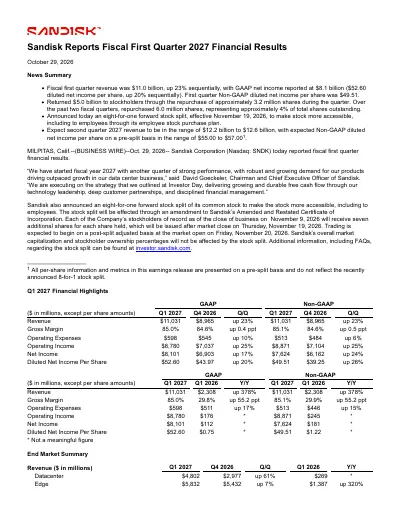
Revenue for the quarter was $11 billion, non-GAAP gross margin was 85.1%, and non-GAAP earnings per share was $49.51. We generated $5.7 billion of adjusted free cash flow and returned $5 billion to shareholders through share repurchases.
Our confidence in the long-term trajectory of the business is grounded in three enduring strengths: technology leadership, deep customer partnerships, and disciplined financial management. These strengths are reinforced by a structural increase in NAND demand, driven particularly by AI, and by customer signals now extending beyond fiscal year 2030 through our new business model, our NBM partnerships.
Together, they position us to invest with confidence in our technology roadmap, strengthen and expand our customer relationships, and deliver growing, enduring free cash flow while returning capital to shareholders. It starts with our technology leadership.
BiCS8 is the backbone of our current production portfolio and the industry benchmark for performance and density across TLC and QLC. BiCS8 introduced our CMOS directly bonded to array, our CBA architecture, enabling the performance required by AI data center customers and establishing the framework for future generations.
BiCS9 pairs the proven BiCS8 cell array with next-generation CMOS, significantly increasing interface performance while retaining a mature memory architecture. BiCS10 advances the full node architecture across both TLC and QLC, with a 1-terabit TLC die designed for performance-intensive workloads and a 2-terabit QLC die delivering industry-leading density and twice the read and write bandwidth of BiCS8.
Together, these technologies will extend the BiCS8 foundation to meet the evolving performance and capacity requirements of next-generation infrastructure. Beyond the core roadmap, high-bandwidth flash, or HBF, reached an important milestone in the fiscal first quarter with the tape-out of our first HBF memory die, with fabrication now underway.
As we outlined at Investor Day, HBF is a new memory architecture for inference that targets HBM-class read bandwidth with substantially greater capacity to support larger models, longer context lengths, and growing KV caches. It is designed to complement HBM by bringing NAND-class capacity closer to the processor, and we remain on track to deliver samples of our first HBF-based products next calendar year.
HBF remains a future innovation and is not included in the long-term financial model we introduced at Investor Day. As customer adoption, product requirements, and manufacturing readiness become more clearly defined, we expect to provide further perspective on the market opportunity.
Customers recognize the strength of our innovation and increasingly view SanDisk as an important partner in achieving their growth objectives. Through our NBMs, we continue to evolve customer relationships into long-term partnerships grounded in innovation, collaboration, and shared commitment.
Our most recent customer engagements with the world's leading AI companies indicate further upside in demand for our technology. Our market-leading technology product portfolio and customer partnerships are the backbone of our strong financial position, which allows us to reinvest to maintain our technology leadership and expand supply through R&D-focused capex.
Each of these strengths is reinforced by tailwinds from AI. The need for scalable memory and storage is expanding as inference workloads grow, making NAND increasingly integral to AI infrastructure.
During inference, each generated token must reference the context that precedes it, creating a growing KV cache that serves as the model's working memory. Longer prompts, more complex reasoning, multimodal inputs, and persistent user context materially increase these storage requirements.
HBM and DRAM support the highest performance tier, while flash provides the capacity required to retain broader context efficiently and avoid costly recomputation. We believe this is a secular dynamic that is expanding NAND's role across the AI stack.
The memory hierarchy defines the role of each NAND architecture. TLC provides the lower latency, higher write performance, and greater endurance required for active datasets, checkpointing, and latency-sensitive KV cache workloads.
In our AI lab comparison, we presented an Investor Day, systems utilizing SSD delivered approximately three times the token throughput while using approximately 75% less energy than comparable systems relying on volatile memory alone. QLC further increases storage density for capacity-intensive applications, such as data lakes, vector databases that power AI search, and retrieval repositories.
Between these layers, a growing, persistent context tier establishes data to be retained and recalled rather than regenerated. As inference costs decline, we expect the adoption and usage to expand, supporting our view that KV cache will represent approximately one-third of the AI data center flash market by the end of the decade, and that the AI data center opportunity will approach the size of the NAND industry today.
Turning to our end markets. In data center, our portfolio addresses the full range of AI infrastructure requirements, from performance-intensive enterprise SSDs to high-capacity platforms.
Demand remains strong and continues to grow, and we estimate that data center has expanded from approximately 20% of industry bits early in the decade to roughly half of the industry bits today. This structural shift in customer mix is reshaping industry economics and is central to the transformation underway at SanDisk.
This quarter, data center again delivered strong growth and continued to outpace the broader market as we allocated more supply to address the growing demand from this end market. Edge is a large and strategically important market for SanDisk, spanning smartphones, PCs, automotive, tablets, and an expanding range of physical AI applications.
Automotive is becoming an increasingly important growth vector in our edge business and a meaningful long-term growth opportunity. We have deepening engagements with leading customers, reinforcing our confidence that automotive can become one of the largest markets within edge over time.
Our consumer business remains a differentiated strategic asset, combining direct brand engagement with hundreds of millions of end users and broad shelf presence across the world's leading channel partners. The consumer end market provides a durable foundation for our business, while its direct connection to the market informs product development and provides early insight into shifts in end user demand.
Taken together, these results reinforce the durability of the model we outlined at our Investor Day. We have established a strong level of profitability and cash generation, and our focus from here is consistent execution across the portfolio.
With that, I'll turn the call over to Luis for a detailed update on our business and outlook.
Luis Visoso
Thank you, David. We're executing the strategies and plans that we outlined at Investor Day, and we're delivering attractive financial results.
In the first quarter, we closed two NBMs. Because both deals closed before our fourth quarter earnings call, we announced these partnerships on that call.
We're in active conversations with existing NBM customers that are evaluating extending existing agreements, and with new customers that are evaluating new NBMs. These long-term partnerships provide greater visibility into demand and financial performance, supporting a more durable financial model.
We will remain patient and disciplined in selecting the right long-term partners as we define the optimal percentage of our bits that we allocate to NBMs, which is likely higher than our current levels. Revenue for the first quarter was $11 billion, up 23% sequentially and 378% year-over-year.
This compares favorably with our guidance range of $10.3 to $10.8 billion. Both volume growth and higher pricing contributed to revenue growth, with approximately 60% of the increase attributable to volume growth and 40% to higher pricing.
Data center revenue was $4.8 billion, up 61% sequentially, outpacing estimated market growth for the quarter. Our leading products and strong customer partnerships, including three US hyperscalers, underpin our continued expansion in this fast-growing end market.
Edge revenue was $5.8 billion, up 7% sequentially, reflecting resilience in premium and mainstream markets, partially offset by contraction at the lower end. Within edge, we saw strong growth with automotive and IoT customers.
Consumer revenue was $397 million, down 29% sequentially, as the market adjusts to higher pricing. We remain committed to serving all three end markets with a diversified portfolio that optimizes our performance over time.
Non-GAAP gross margin for the first quarter was 85.1%, up from 84.6% in the prior quarter, driven by higher volumes and pricing. This compares favorably with our guidance range of 83% to 85%.
Non-GAAP operating expenses were $513 million, representing 4.7% of revenue. Non-GAAP operating margin was 80.4% compared to 79.2% in the prior quarter.
Non-GAAP EPS was $49.51, up from $39.25 in the prior quarter and $1.22 in the same quarter of the prior fiscal year. This compares favorably with our guidance range of $44 to $46.
We closed the quarter with 154 million diluted shares outstanding. Key GAAP to non-GAAP reconciliation includes $91 million in stock-based compensation, representing 0.8% of revenue, and $513 million gain on equity securities, primarily attributable to our investment in Nanya.
During the quarter, we repurchased approximately 3.2 million shares of our common stock for $5 billion. Over the past two quarters, we have repurchased 6 million shares, representing approximately 4% of our total shares outstanding.
Our repurchases reflect our conviction in the long-term value of the business and our disciplined approach to capital allocation. We continue to invest appropriately in the business while returning 100% of excess cash to shareholders.
Moving on to free cash flow, cash flow from operations was $6.4 billion. Gross capital expenditures totaled $378 million, representing 3.4% of revenue.
We expect gross capital spending to increase during the balance of the year and represent mid-single-digit percentage of revenue for fiscal year 2027. During the quarter, we generated $5.7 billion in adjusted free cash flow, representing approximately 52% margin.
We closed the quarter with $5.1 billion in cash and cash equivalents and no debt. Moving on to guidance.
Our confidence in the long-term health of the market is reinforced by the structural growth of the AI infrastructure and the expanding role of NAND across inference workloads. Before turning to our second quarter outlook, I will announce that the SanDisk Board of Directors has approved an 8-for-1 stock split of the company's common stock.
The additional shares are expected to be distributed on November 19, and trading on a split-adjusted basis is expected to begin on November 20. For the second quarter of fiscal year 2027, we expect revenue between $12.2 billion and $12.6 billion.
We expect non-GAAP gross margin between 84.5% and 85.5%, which includes modest like-for-like price increases. On a pre-split basis, we expect non-GAAP EPS between $55 and $57, assuming 151 million fully diluted shares.
On an 8-for-1 split-adjusted basis, this equates to non-GAAP EPS between $6.88 and $7.13, assuming approximately 1,208 million fully diluted shares. For context, we expect a strong market in calendar year 2027.
Data center is expected to be, again, the engine of growth and represent over 55% of the market, with bit demand growing about 40% year-on-year, enabled by higher AI-driven capital spending. This is after more than doubling in 2026.
Our NBM pipeline exceeds our supply through the end of the decade. With that, let me turn the call back to David.
David Goeckeler
Thank you, Luis. We continue to execute on the strategy we outlined at Investor Day, reinforcing our confidence in SanDisk's long-term trajectory.
Our technology leadership, deep customer partnerships, and disciplined financial management, supported by a structural increase in NAND demand driven by AI, position us to serve our customers, deliver growing, enduring free cash flow, and return capital to shareholders. Over the past year, we have transformed the earnings and cash generation power of the business and established a strong foundation for durable performance.
We remain focused on disciplined execution, sustained value creation, and delivering against our long-term financial objectives. With that, Ivan, let's open it up for questions.
Operator
At this time, we will begin the question-and-answer session. To ask a question, you may press star and then one on your telephone keypads.
If you are using a speakerphone, we do ask that you please pick up the handset before pressing the keys. If at any time your question has been addressed, you would like to withdraw your question, you may press star and two.
At this time, we will pause momentarily to assemble the roster. Our first question today comes from Ben Reitzes from Melius.
Please go ahead with your question.
Ben Reitzes
Hey, guys. Thank you very much.
I appreciate it. Hey, David.
Wanted to ask two if I could. One on the NBMs.
You signed two before the last call. I'm just wondering if we're going to have a lot more of them because it seems like you're already capacity-constrained to agree to them.
Then do you mind reminding us what the bits under contract will be the next few years if that's changed at all? Then I have a quick follow-up.
Thanks.
David Goeckeler
I'll make a few contra- Thanks, Ben. We appreciate it.
Always good to hear from you. I'll make a few comments on NBMs, and then Luis will will fill in.
We've got, we've got a very strong pipeline of NBMs and you you kind of hit on all the issues there. As the portfolio gets more subscribed and more committed, and we're at half the bits for this fiscal year and two-thirds for next year.
It's a fitting exercise to get the the next tranche of them in there. The pipeline is very strong.
I think we said last quarter, I know we said last quarter that we're going to be patient and consider the next set of customers, and that's exactly what we're doing. We expect more of them over the next, several months, several quarters as we continue to allocate the rest of the the rest of the portfolio.
The pipeline is very strong and growing, quite frankly, and it's become the predominant way we deal with our customers. I expect that the percent of the portfolio committed to to continue to go up over the next couple quarters.
Luis?
Luis Visoso
Just a few things because I think David covered most of it. We feel very good about where we are with the NBMs.
As we've been very selective, very strategic in who we chose to sign this deals with. We're looking at the companies we have, and the 95% of our NBMs are with companies that are investment grade, and they generate about $130 billion in operating cash flow.
We feel that we made the right choices and as David just mentioned, we'll continue to be patient. We'll continue to be selective, and the pipeline is terrific.
You should expect us to continue to make progress. I think in my prepared remarks I said that we expect the bits to continue to grow.
We had shared with you that 50% about 50% of our bits are under NBM for '27 and about two-thirds for '28, and we expect that number to continue to go a little bit higher from the two-thirds.
David Goeckeler
Hey, Ben, I'll just make one more comment. You got to ask two questions, I'll make two comments.
We're also balancing customers that are coming back for more. That is a real thing, and in general, we're hearing from our customers that they have underestimated the amount of NAND they need to run their infrastructure.
We have multiple customers coming back for a second round. Then balancing that against bringing new customers into the portfolio.
There's a lot to sort out, and these are big, complicated agreements, but we feel very, very good about where the pipeline is, where the portfolio is at, the products are resonating. We'll continue to update you as we build out the portfolio of NBMs over the next couple quarters.
Ben Reitzes
Great. Just a quick follow-up.
You may have seen that Intel guided down for the next quarter due to PCs, and the impact of the memory is more than anybody thought, at least with their guidance. Don't know about anybody else.
Just wondering if you are seeing NBM interest from those in the PC market more, and if that market, with regard to some of the device makers is something that will become an NBM or is actually now getting more attractive because they're willing to pay more? How should we think about that as it looks like they're starved for product and missing numbers in that segment?
Luis Visoso
Ben, we cannot talk about specific customers. What we've said in the past is we do have NBMs in the data center business.
It's data center-centric, but we also have customers on the edge, and we've offered this construct to any customer that wants it and start a process where it makes sense. We're not trying to restrict it from any customer.
We're open for business.
David Goeckeler
Ben, the other thing I'll say to this, we were looking this in our own reviews. We know that units were down this year.
They're going to be slightly down next year, low single digits. These two calendar quarters right now are really the trough of the year-over-year compares, where they're the most negative.
This is where we're feeling the biggest amount of change in that market on a unit basis, on a year-over-year basis. All that said, we expect the PC exabytes to grow next year.
In fact, we think our internal models are every segment in the NAND market, PC, smartphones, data center, will all show positive growth next year because of content per device continues to go up as part of that is mixing to premium. There's no doubt there's been a market adjustment.
In many ways, as I said, from unit basis, we're in the teeth of that on a year-over-year basis, but we see improvement from here.
Ben Reitzes
Thanks, guys.
David Goeckeler
Thank you.
Luis Visoso
Thanks, Ben.
Operator
Our next question comes from Joe Moore from Morgan Stanley. Please go ahead with your question.
Joe Moore
Great. Thank you.
It seems like the underlying story here in addition to just how good the market is is your presence in data center. You're up almost 20x year-on-year, up 61% sequentially.
Can you talk about, obviously, the market's good, but it seems like your participation is also a lot better. Is that because of BiCS8?
Is that just because the market's different? Just what is it that's allowing you to get to those levels of penetration?
If data center is half of bits at some point, will you get to that in your own mix as well?
David Goeckeler
Joe, thanks for the comment. We feel very good about where we're at in data center.
Anything where you see the kind of numbers we've posted year-over-year is a combination of things. It starts with the fundamental NAND node.
BiCS8 is a very good node. CBA gives you very very clean CMOS, which is very good interface speeds, all those kinds of things.
We built the right products. We've had a TLC product in the market for several years now.
It was just a couple of quarters ago that we started selling our QLC product for revenue, and we expected that to ramp, and that's happening. We got the right product at the right time based on the right technology.
Then, over the last quarter or so, there's been a lot more refinement of the AI inference architecture, is what I would say. When I look at the market and we kind of decompose it internally, customers are just getting more refined about how they're using NAND: where they're using TLC, where they're using QLC, all different phases, from KV cache to staging, to fast data lakes and all the subparts of those markets, inference and agent orchestration, model pre-training, model post-training.
We're seeing NAND be applied in a more, I would say, nuanced way than the past. QLC is being used in the right places, and you're even seeing some customers even move into KV cache where it can be supported.
On the other side of the spectrum, we're seeing SLC being pulled into the architecture. It's not really in sales yet.
It's more in architectural conversations. It's not a performance type of conversation, it's more endurance.
Like during agentic workloads, the amount of endurance required, and in that place, it's kind of where can we substitute NAND for DRAM? We think those kind of architectures will be very sticky over time.
Once you make that transition, you're going to stick with it given the price differential. We see all of these things working together.
I think these NBMs set us up for these very deep and strategic level conversations with our customers about how they're using our product, deep discussions with our engineers about how they could use our product to solve different use cases, and all of that is leading to a tremendous pull on our portfolio. Like I said, our biggest customers, we've already signed one second tranche of an NBM and we're in discussions in others.
The whole setup is very strong and we feel good about it, and we appreciate your recognition of the performance on a year-over-year basis. It really is quite outstanding.
Joe Moore
It is surprising. Where do you think the mix goes long-term in terms of could it go over half
David Goeckeler
of [unclear]? Oh.
Oh, yeah. We're we're working hard to catch up to have our portfolio mix equal what the what the market bits are, and we're going to continue to make progress throughout calendar year '27.
We'll see if we actually catch up by the end of the quarter, but I think we'll get to a substantially higher number on mix than we are if we look back at calendar year, our fiscal year '26. We'll continue to make progress here.
Joe Moore
Thank you.
Operator
Our next question comes from Mark Newman from Bernstein. Please go ahead with your question.
Mark Newman
Hi. Thanks so much taking the question.
If I could just first of all talk about price and volume in the guidance. You talked about in the fiscal Q1 that you just reported, I think you said 60% of the revenue growth from volume and 40% from pricing.
Baked into your guide, how do you expect that mix to progress? Any comments on pricing?
Appreciate that you've got a very high portion of volumes on these NBMs, but still wanted to get some clarity on pricing. I think there's a comment that modest improvements in pricing in FQ2.
Any further clarity on that? Then I have follow-on question on HBF and some of the new NAND technologies as well.
Luis Visoso
Let me take the first one. Yes, you're right.
We reported 60 about 60% of the revenue growth came from volume and 40% from pricing in Q1 roughly. We do expect both to contribute in the next quarter.
We normally don't break this, Mark, into its pieces, but we do expect some modest pricing as we put in our prepared remarks. We do expect both to contribute during the quarter, and we expect pricing to continue to increase modestly throughout the year.
Mark Newman
That's helpful. Clear enough.
Follow-up question is on HBF and other new NAND technologies in the data center. There was a comment about some progress on HBF which was great to hear.
Wondered if there's any more comments on progress and discussions with partners and customers, anything there? The other thing David, you mentioned about some of the other new NAND technologies in the data center, StorageNext and then there's also this CMX context memory.
Just what's your view on all these types of new NAND tiers in the data center? Do you think they all win?
Just any kind of comments on the interplay of all these and the roles for each, and how SanDisk plays in them, and the timing would be really appreciated. Thanks.
David Goeckeler
Sure. Mark, no, the conversations with potential customers on HBF are robust and continue to be.
We'll continue to have those conversations as we go into putting product samples in their hands so they can start to use and understand how it's going to fit in their system. We'll continue to update on that, but it's a kind of an always-on conversation.
Your second question, I think this is very, very healthy for where AI inference is, which is as it scales out, the architecture is just being relentlessly refined for economics. That's a very good thing, because if it's going to scale, the more economic it is, the better.
That's pulling NAND into more parts of the architecture because NAND is the most scalable semiconductor technology, right? We're seeing, like I said, if you would go back a couple of years ago, it was all about going for more density again, going from TLC to QLC.
We're still doing that, right? That's still a big part of the strategy.
Now there's some of it even going in the other direction. How do I get more endurance in specific parts of the architecture?
Is the endurance in the performance I get out of NAND good enough to solve the use case at a part of the architecture where I can use it over competing technologies that may be significantly more expensive and difficult to acquire? I would say this is a very, very dynamic discussion.
There's a lot of ideas on the table. I think there should be a lot of ideas on the table.
I think they'll all be pursued. I think that the most important thing is to stay close to the people that are spending the money to scale the infrastructure, because in the end, they'll make the decisions of what's right for them based on the use cases they're trying to solve at scale, and where they're putting all this money behind it.
We're deeply engaged in those conversations, and I expect them to continue to be very robust and have a lot of different ideas about how we could stretch our technology in different directions to fit more and more use cases. In building a product, it's always the same thing.
I want the right technology at the right time in the right intensity at the right cost, and really not anything less or anything more. That's what building a product is all about, because you can deliver it at the right price, and then you can get the right return on it.
That process is full on in AI inference architecture working with our customers.
Mark Newman
Fantastic. Thanks for the color.
David Goeckeler
Sure.
Operator
Our next question comes from David Gibson from MST Financial. Please go ahead with your question.
David Gibson
Thanks, guys. Really great quarter.
Done. I'm just curious.
Can you hear me? Sorry.
David Goeckeler
Yes, yes. Hi, David.
David Gibson
Hi. Thanks very much for your time today.
Just quick one. Just wondering whether you're looking to accelerate the BiCS transition from 8 to 9, 10, and so forth as a way to accelerate the bit growth in the short term, and then satisfy some of that very strong customer demand?
David Goeckeler
No, we're committed to the bit growth we talked about, mid to high teens. Those nodal transitions require a lot of planning and tool purchases and where lines are set up.
We have that fab plan set up for the kind of bit growth we've been talking about for a long time. No plans to change that at this point.
David Gibson
Thank you. Just one follow-up.
You talked about earlier about allocating more supply to the data center in Q1. Are there any limits to increasingly allocating your bits to data center?
David Goeckeler
In some ways, yes. Out of the fab, you come out with a certain mix of TLC, QLC, certain die mix, all these kinds of issues.
It's a constant fitting exercise of getting the right product to the right customer. Then there's a lot of magic that goes on in the organization.
Luis's organization is a big part of that, working with our sales teams of what is the available inventory, what's coming out of the fab, what's the mix, and where is it all going to go? Do you want to say a little bit more about that, Luis?
Luis Visoso
The only thing I would add, obviously, it changes depending on the time frame you're looking at. Over the short term, it's almost impossible to do anything.
It takes 120 days or so to produce a wafer. Obviously, as you look for further out, there are more degrees of freedom.
David Gibson
Okay. That's great.
Thanks very much.
David Goeckeler
Thank you, David.
Operator
Our next question comes from C.J. Muse from Cantor Fitzgerald.
Please go ahead with your question.
C.J. Muse
Good afternoon. Thank you for taking the question.
I guess a question on the comment around your NBM pipeline exceeding supply through the end of the decade in the slide deck. I guess, can you elaborate on that, and how is that changing kind of your thought process around what bit supply will look like for the industry over the next handful of years?
How are you adjusting, if at all, your capex plans? I know you talked about mid-single digits, which implies roughly 2.5 to 3 billion gross capex.
Fairly low kind of numbers. Would love to hear kind of your thoughts on how the visibility is impacting your thoughts around bit growth and supply.
David Goeckeler
I think my first thing I'd say about it, C.J., is the process is working. It was only two or three quarters ago we talked about even instituting this kind of business model, and we had some customers that were like-minded, and we made some very good progress.
Here we are a couple quarters later, and we talked about this after our Investor Day. We had customers coming to us offering NBMs, and it's not the only way we do business.
There's lots of customers with lots of different volume levels and different products, and we want to meet our customers where they are. There's no doubt about that.
It's very good to see that we have a robust pipeline now through 2030, and we're even getting beyond that as we talked about, of customers that are really willing to give us their demand signals and financial commitments. To the question earlier, those kinds of things will allow us, if we choose to, to eventually start changing supply and demand and all those kinds of things.
We're just not there yet, right? We've got to go through negotiations on all of those.
We've got to get commitments. We've got to get everything all aligned.
I would say that the process is working well, and we're very happy with where it's at, and it gives us a lot more visibility into how we plan. The process is still underway, right?
It's still underway, and as I said, we'll continue to update you over the next couple quarters as we make progress.
C.J. Muse
Just a quick follow-up for Luis. On these contracts and considering some have deposits, are you able to use those deposits for buybacks, or is that cash restricted?
Thanks so much.
Luis Visoso
In theory, we could, C.J. As we explained at Analyst Day, the vast majority are financial guarantees, which are held by third-party financial institutions.
They're not in my balance sheet. The only thing that's in the balance sheet is prepayments, and though that's by far the smallest amount.
There is no legal restriction on that.
C.J. Muse
Great. Thanks so much.
Luis Visoso
Thank you.
David Goeckeler
Thanks, C.J.
Operator
Our next question comes from Karl Ackerman from BNP Paribas. Please go ahead with your question.
Karl Ackerman
Yes, thank you. It's encouraging to see increasing NAND content per XPU in AI servers to support KV cache demand, which I think compares to reductions in memory content in some server SKUs.
David, could you discuss how you see enterprise SSD content per server progressing in 2027 in the context of this agentic AI proliferation, because it's certainly becoming a larger portion of your portfolio?
David Goeckeler
That's a big question, Karl. Look, what we're doing is, there's no doubt in inference and agent orchestration that our product is tied to kind of CPU demand for those type of applications.
We know at a pretty granular level the amount of demand that we expect per CPU. Something 60 to 90 GB per CPU is what we see in those kind of applications.
I haven't run the math against what the server TAM is and kind of what the elasticity is between those two, but we can follow up on that. As I said earlier, we continue to see more NAND being pulled into the inference architecture in all parts of the architecture and in very different ways, right?
TLC, QLC, and as they said earlier, now people looking for high endurance solutions that'll fit parts of the workload where they don't need to use DRAM and they can use that type of NAND. It's all very encouraging and we'll continue to stay close.
We'll do some work on the two two TAM analysis and what the trade-offs are between them.
Karl Ackerman
Sure. If I may, a quick follow-up.
Do you have an updated view or progress on your goal for enterprise SSD share? Can you achieve perhaps that low to mid-teens share in 2027, because you're seeing quite success right now?
Thank you.
David Goeckeler
In the past, many, many years ago, we put some share goals out there, and I've tried very hard not to put share goals out there because sometimes it leads to kind of perverse choices in the portfolio. We want to maximize the value of the portfolio across all time horizons: near term, midterm, long term.
We want to keep some balance into it. Clearly, we're going to mix higher into data center.
You see that. We talked about that earlier.
I think 17x growth year-over-year. You don't see a 17x very often in a business at this scale.
As I said, I expect that to go higher as we go through '27. The balance point in some ways will depend quarter-by-quarter what we see, and then what NBMs we sign,
Karl Ackerman
right?
David Goeckeler
Those will give us a lot of visibility over the next couple of years where we see that mix going. It's going higher, but I'm not going to put a specific target out there.
Karl Ackerman
Thank you.
Operator
Our next question comes from Vijay Rakesh from Mizuho. Please go ahead with your question.
Vijay Rakesh
Hi David and Luis. Just a great quarter and guide.
Just a quick question. As you look at data center, your 2027 looks like you mentioned 40% demand bit growth, which is massive.
As you look at this BiCS8, BiCS9, BiCS10 transition, do they help you drive some bits to meet that demand? How is the supply on that side, I guess?
I have a quick follow-up.
David Goeckeler
Look, BiCS8, BiCS9 BiCS9 is a big part of the data center strategy of being able to get faster interface speeds with the same cell and kind of what CBA gives us that flexibility. We talked about that at Investor Day.
In that sense, yeah, those are big parts of the strategy. There's no doubt about it.
As I said earlier, it's about getting the right product to the right customer. The TLC product has been performing very, very well for quite some time now, and now we're seeing the ramping of of QLC.
We'll see some ramp of BiCS9, but BiCS10 is still a little ways out, right? We announced BiCS10, but we're still ramping BiCS8.
We've got a ways to go before we get out to some of those future BiCS nodes.
Vijay Rakesh
Got it. Then on the endurance side, as you mentioned, some of your peers and so are talking about SLC NAND out there.
Any thoughts how that plays out next year? Obviously, that could tighten up the NAND market as well in addition to what you're seeing in just overall demand growth, I guess.
Thanks.
David Goeckeler
I think it's a little early to have a very strong view on that, right? We are talking to some customers that are giving us some signals of demand for SLC.
Clearly, you start mixing SLC in, there's a clear trade ratio, 3:1, 4:1, whether it's TLC or QLC. It will impact the overall supply in the market depending on how much SLC is used and how much really gets deployed.
It's a little early to put a specific forecast on it right now. What I would say, it's an architectural discussion and a request from customers of better understanding the technology and how it could fit parts of the use case of as they build out their inference architecture.
We'll update you as we go over the next couple of quarters and we'll see how this develops, but definitely something to keep an eye on.
Vijay Rakesh
All right. Thank you.
Operator
Our next question comes from Jim Schneider from Goldman Sachs. Please go ahead with your question.
Jim Schneider
Good afternoon. Thanks for taking my question.
I was wondering maybe on more tactical basis, your consumer business obviously has seasonality in Q1 historically and obviously the PC business does too, but data center is in sort of secular growth mode. Luis, based on your visibility at this point, I'm just wondering if you could maybe give us any kind of color on whether you'd expect Q1 to be sequentially up, down, or sideways roughly?
Luis Visoso
Fiscal Q3, you mean?
Jim Schneider
Yes, fiscal, the March quarter.
Luis Visoso
If you look at historically, right, our Q3 is normally our weakest sequential quarter. Last quarter, for example, our bits were down 19% sequentially.
We're not guiding Q3, but for modeling purposes, I would be conservative in your sequential growth from Q2 to Q3.
Jim Schneider
Thank you. Then just as a matter of principle on the buybacks, good to see the continued execution there.
I'm sort of curious, as you sort of start to run down the authorization, would you expect the board to re-up their authorization on a quarterly basis, or maybe you could provide us any more color on how you're thinking about executing on the actual buybacks, given the much lower stock price today? Thank you.
David Goeckeler
We're we're we have a very clear strategy: 100% of excess cash is going to go back to shareholders. We're going to execute that aggressively or appropriately, and, we know how to get rid of get a hold of the board.
We have meetings every quarter. I don't expect any impedance on on that side of the on on, from from us about how we execute.
I I expect us to continue to be I don't expect us to be. We will be continue to be faithful to our strategy, which is we're going to return 100% of of excess cash to shareholders.
We're off to a good start, I think, over the last couple quarters. I think we've bought back 4% of of the market cap of or of the shares outstanding of where we started, and and we're going to continue to to execute that program appropriately.
Jim Schneider
Thank you.
Operator
Our next question comes from Krish Sankar from TD Cowen. Please go ahead with your question.
Steven Chin
Hi, thanks so much for taking my questions. This is Steven calling on behalf of Krish.
First question I have for David. I guess looking at your CSP customer base, kind of wanted to get some color on what the prevailing demand currently is between TLC versus QLC bits, and kind of going forward with the NBMs in place, does that TLC versus QLC mix shift meaningfully later this decade?
David Goeckeler
We're still at that 70-30 number on TLC to QLC. TLC has been a big driver of the portfolio.
We are hearing more from our customers about a reacceleration of QLC in different use cases, and so we'll see how that plays out, as you said, through the end of the decade. That's where it is.
That 70-30 number is a pretty good number. Of course, there's some fluctuation quarter-to-quarter, a little bit up and down here and there, but that's where it's been and that's where we expect it to be at least for the rest of this fiscal year.
Let me put that time horizon on it, and then we'll see what customers are thinking about QLC as we continue to have those discussions.
Steven Chin
Okay. Understood.
David Goeckeler
I will say the Stargate product has been, which is our QLC product, I won't use too many internal names here, but has been very well-received. It was not that many quarters ago that we were talking about going through qualifications.
That's all 100% behind us. Customers are ramping.
It's been a very, very well-received product and a very key part of the portfolio.
Steven Chin
Gotcha. As a quick follow-up, a question on the mobile edge market.
Just given the double-digit unit declines in that market this year as well, but albeit concentrated in the kind of entry and mid-tier of the market, I'm kind of curious from the demand signals that some of your customers in that market are giving you, can your mobile bits still grow next year overall? I think,
David Goeckeler
well, let's talk about the market first. You got it.
The low end is under pressure, but that leads to a unit decline, but a content-per-unit increasing. When you add it all up, we expect growth of exabytes in that market next year on a slightly declining unit count.
As far as our portfolio, it's kind of like data center. I don't want to make projections on individual markets.
We will manage the portfolio with agility and flexibility. We've been very clear that we want balance in the portfolio, but we're going to optimize the financial outcome over the short, mid, and long term, kind of integrate those to get the best outcome, and we'll update you on what the mix of mobile is as we go forward.
Steven Chin
Perfect. Thank you so much.
David Goeckeler
Thank you.
Operator
Our next question comes from Wamsi Mohan from Bank of America. Please go ahead with your question.
Wamsi Mohan
Yes, thank you so much. In your slide deck you say leading AI companies could indicate further demand upside.
I was wondering if these are AI labs or neoclouds, and are any of the credit concerns around the neoclouds filtering back to you in any way that you can see at the moment? I have a follow-up.
Luis Visoso
We haven't seen any of that. To the contrary, we're seeing very strong demand from our customers.
As I said, if I look at our largest customers, they're basically all investment-grade companies, right, generating very strong cash. We're not seeing any impacts from any credit issues whatsoever if they are out in the market.
Demand from our customers is, if anything, strengthening versus what it was a quarter ago.
Wamsi Mohan
To clarify there, Luis, when you say leading AI companies, are you referring to AI labs over there?
Luis Visoso
We sell to everybody in our business. We sell to hyperscalers.
We sell to model makers. We sell to everybody.
Wamsi Mohan
Thanks, Luis. Then just on linearity in the quarter, it seems like receivables picked up a little bit.
Is that something that we should expect because of payment terms as more bits go under NBM, or was there something else in the quarter?
Luis Visoso
No, we basically saw a little bit of a change in customer mix, and that has a little bit of an impact on our receivables, a little bit on linearity, but it's mostly customer mix.
Wamsi Mohan
Thank you so much.
David Goeckeler
Thanks, Wamsi.
Operator
Our next question comes from Amit Daryanani from Evercore. Please go ahead with your question.
Amit Daryanani
Yep. Thanks.
I'll have two as well. I guess, David, just to start with on the capital allocation side, as you transition towards becoming a more predictable NBM-driven business model, does that change how you think about your capital structure?
Historically I think memory is perceived to be more cyclical, balance sheet flexibility has been important. As you become structurally I think less cyclical, would that support a willingness to take on leverage and potentially accelerate the capital returns, or is the comfort still with the 5 billion a quarter buyback, which is fairly impressive?
I'm just wondering, at what point do you say we can take on more leverage and take advantage of the fact that we're less cyclical?
David Goeckeler
We put a financial model out. We just spent 3.5 hours talking about this in our Analyst Day, and we committed to a financial model through 2030, which I think was pretty impressive, and we plan to execute that.
We're very comfortable with the strategy we have of staying debt-free, very strong balance sheet, and then investing in our business. We have a growing business and lots of opportunities for internal innovation, which we're going to continue to invest in, like HBF and 3D matrix memory in addition to the BiCS roadmap and all the great products we build.
After we do that, we're going to return 100% of the cash flow to shareholders, and that's the plan. We're going to go execute that for the foreseeable future, until we get up at another point and tell you we're going to change it.
I don't anticipate that happening in any kind of near-term timeframe.
Amit Daryanani
Fair enough. Then maybe just on HBF, and rather try to ask you to frame how big is TAM could be, could you just talk about what the scaling variable really is over here as inference models and context windows expand?
Should we think HBF capacity will grow in line to GPU compute or potentially faster? I think you said you'll start initial sampling in '27.
What are the key milestones from there to becoming a meaningful revenue ramp as well? Thank you.
David Goeckeler
It's a little early for your first question. On the second question, we get the die back, we have the base die, which we'll tape out, which is the controller.
We'll put them together, put it in customer's hands, and then they start to see how the product's going to work in their infrastructure. We've obviously done a lot of modeling on that, but actually having the actual product and then doing the integration work, that kind of feedback from the customer will then lead to be able to start to answer some of the questions that people have, like what's the market opportunity, how fast is it going to happen, what's the TAM, where exactly is the architecture going to fit?
We're going to follow our customers on that. The big step is to actually put a product in their hands, and then that leads to a whole another set of conversations with them where we actually have the device that instead of running simulations, we're seeing exactly how it performs in their infrastructure, and does it deliver the results of what they're expecting.
That also helps you continue to expand the set of use cases, right? At this point in the development process, you want to be a little bit careful you don't engage too much because you'll overwhelm your engineering team with a thousand ideas of how the product can be used.
As we get an actual device that we can put in people's hands, we can open the aperture on those kind of conversations, which I think will lead to more use cases for the product. That's still TBD.
I think a lot of things start to happen when you get to that next milestone of actually having a real product that they can start to use and understand how it impacts what they're trying to do, which is deliver a world-class inference architecture at the best cost point possible. We think this is a fantastic technology for doing that.
We'll see when we get there when we produce it.
Amit Daryanani
Perfect. Thank you very much.
David Goeckeler
Thank you.
Operator
Our next question comes from Mehdi Hosseini from SIG. Please go ahead with your question.
Mehdi Hosseini
Yes, sir. Thanks for taking my question.
David, I want to go back to what you said earlier. You said that AI inferencing is being refined, having an impact, and more SLC needed.
My question to you is, is this having an adverse impact on adoption of TLC or the growth of TLC or SLC is additive to the bit demand by TLC and QLC?
David Goeckeler
No, I don't think it's a cannibalization of other NAND products. I think it's an expansion of the TAM into areas that you need different attributes of the technology.
You need different endurance, you need different performance. We can take our product and we can run anything out of the fab in an SLC mode.
There's a lot of flexibility in the product, and I think our people are discovering that and starting to understand how can I apply this in ways where I get the attributes I want for the problem I'm trying to solve. It's just a more refined view of the architecture.
I don't see it as cannibalizing other parts of the NAND stack. If anything, I see it as, and I want to be careful on this because it's still early, but is it good enough to replace places where I'm using DRAM, right?
Can I get enough endurance? Can I get enough performance if I run NAND in an SLC mode?
Because the cost differential is huge, 20 to 40x. I take it as a very healthy sign on many ways, Mehdi.
One is that very, very real about how do you scale an architecture. When you scale an architecture, you got to do it in the most cost-effective way possible.
Mehdi Hosseini
Again,
David Goeckeler
NAND is the most scalable semiconductor technology, and so it doesn't surprise me that people are finding more ways to use it. In many ways, I think scalable technologies kind of attract TAM, and I think that's what's happening here is as these architectures are getting more detailed and more refined.
Mehdi Hosseini
Okay. Let me come at it from a different angle.
If there is this demand for more enduring SLC and as customers wait for commercialization of HBF, what is the JV's flexibility in adding some SLC capacity to meet that short-term demand? No,
David Goeckeler
I wouldn't think of it as SLC capacity. Our cells are flexible enough that we can run them in whatever mode we want: SLC, MLC, TLC.
We can supply the market with the wafers we have, right? That's how we think about it.
I understand the question of wanting to go to the supply question right away, but it's just super early for that. These are just conversations at this point and customers exploring how they can use the technology, starting to get some idea of what their demand would be if they use it this way.
Something to keep your eye on. It will impact the market.
There's no doubt about that, because a little bit of SLC is a lot of QLC. I guess more to come, Mehdi.
Mehdi Hosseini
Okay. Got it.
Thank you. Thanks for all the details.
Operator
At this point, ladies and gentlemen, we'll be ending today's question-and-answer session. I'd like to turn the floor back over to management for any closing remarks.
David Goeckeler
All right. Everyone, thanks for joining us on the call.
We appreciate it. Great conversation, and we look forward to seeing you throughout the quarter.
Thank you.
Luis Visoso
Thank you.
Operator
With that, we'll conclude today's conference call and presentation. We do thank you for joining.
You may now disconnect your lines.