SANUWAVE Health, Inc.
NNASDAQ:SNWVQ1 FY2026 · Earnings Call TranscriptMay 13, 2026
Operator
Hello, and welcome everyone joining today's SANUWAVE earnings call. At this time, all participants are in a listen-only mode.
Later, you will have the opportunity to ask questions during the question-and-answer session. To register to ask a question at any time, please press *1 on your telephone keypad.
Please note, this call is being recorded. We are standing by if you should need any assistance.
It is now my pleasure to turn the meeting over to Morgan Frank, Chairman and CEO of SANUWAVE. Please go ahead, sir.
Morgan Frank
Thank you, Nikki. Welcome to SANUWAVE's first quarter 2026 earnings call.
Our Form 10-Q was filed with the SEC last night along with our earnings release, and our updated presentation was made available on our website in the investor section. Please refer to that during the presentation.
Joining me on the call is Peter Sorensen, our CFO, and after the presentation, we will open up for Q&A. Let's begin with the forward-looking statements and disclosures.
This call may contain forward-looking statements such as statements relating to future financial results, production expectations, plans for future business development activities, and expectations regarding the impact of changes in reimbursement levels and tariff rates. Investors are cautioned that any such forward-looking statements are not guarantees of future performance and involve certain risks and uncertainties, many of which are beyond the company's ability to control.
Description of these risks and uncertainties and other factors that could affect our financial results is included in our SEC filings. Actual results may differ materially from those projected in the forward-looking statements.
The company undertakes no obligation to update any forward-looking statement. Certain percentages discussed on this call are calculated from the underlying whole dollar amounts and, therefore, may not recalculate from the rounded numbers used for disclosure purposes.
As a reminder, our discussion today will include non-GAAP numbers. Reconciliations between our GAAP and non-GAAP results can be found in our recently filed 10-Q for the period of March 31st, 2026.
Okay. As we mentioned in our press release, Q1 basically started out with sort of a shock pause in January in which the whole advanced wound care market seemed to sort of lock up for a moment and basically freeze solid.
It was pretty dramatic, and in essence, it seemed like a great many market participants were not expecting the new CMS pricing for skin subs to actually be applied and were confident in some sort of kind of 11th-hour rescission or modification. Obviously, this did not come.
It took the market a little time to come to terms with this, but at least from where we sit, it seems to have started doing so in February, and we saw improvement all quarter with each month being better than the one before. Despite a very slow first 30 days and some ongoing elevated churn rates due to financial stress at practitioners, the company sold 97 systems in Q1, and our active systems number rose to 1,382, up from 1,292 at year end.
Quick reminder on our methodology here. Active systems is a measure of systems owned by customers who have ordered applicators in the trailing six months or according to a specific schedule in a few corner cases.
This figure includes churn, customer loss, customer reactivation—which is to say churned customers who began ordering again—new customer acquisitions of machines, and then sell-through out of resellers while netting out sales into reseller inventory. Because channel inventory obviously are not systems that are in use.
The goal here is to give you as good a sense as we can of how many systems are actually being used in the field. Essentially, this change in active systems number is a flow number, and it's just showing you the number of systems in the market whose owners are actively ordering.
Net change in active systems during Q1 was +90. This increase and a bit of recovery in usage rates from some existing customers drove Q1 to an all-time record in applicator unit sales.
This did not translate into an all-time record for applicator revenues owing predominantly to a greater quantity of sales going through resellers who buy at wholesale price. This trend was accentuated by the transition of a couple of our long-standing distributors becoming resellers, and therefore the customers they serve moving to wholesale pricing from what was previously retail with commission paid on the back end.
This works out pretty similarly for us on the operating line, but obviously that does affect revenues and ASPs. There was a bit of a step function there, but one that's also behind us.
We take this record unit volume as a good sign for the market, and after some suppression over the last six to seven months, a sign that patient counts are starting to trend better again. Many have asked about a number of markets for us and sort of where our current focus lies.
We remain committed to serving all of advanced wound care and are expanding our presence in hospitals, wound centers, physicians' offices, and in particular, we're seeing a lot of renewed interest in long-term care and nursing facilities seeking to perform their own wound care. The hospitals are showing a particular strength as well.
We're also seeing some meaningful and encouraging progress in mobile wound, a space that a number of folks seem to have had a lot of questions and concerns about. There seems to be a misconception that mobile wound is going away or would need to be deemphasized.
From where we sit, we simply don't believe this to be the case. As with the market as a whole, the patients and the wounds there are not going away, and most of them are neither interested in nor, in many cases, capable of sort of jumping up and heading to a wound center.
The care-to-the-edge philosophy of CMS remains very much alive, and mobile wound care will remain an important part of that. Like a lot of this industry, mobile wound care is changing because the needs of the market have changed, and we're seeing sort of a reevaluation and a consolidation.
CMS and MAC standards for documentation have tightened. This is selecting for more sophisticated providers.
This issue is compounded by the expense of the significant back-office staff that's required to run a mobile wound care system properly. That takes scale, and revenues dropping from mobile wound as a result of lower allograft reimbursement models that once worked, these models can no longer support themselves.
The new reality is that you need enough revenue to cover the back-office nut, and you need a high enough route density so that you can cover the expense of practitioners, and that's driving consolidation. You need more revenue and more patients per practitioner.
Look, I'm making these numbers up, but if you have 30 patients being covered by 10 mobile wound care companies, now perhaps you're going to have those 30 covered by five or maybe even three companies. The patient count stays the same, but the market adapts.
In many ways, this is favorable to SANUWAVE, both because UltraMIST remains such an effective treatment modality that generates strong clinical outcomes, and for SANUWAVE as a company because working with a smaller number of larger, more sophisticated companies is actually easier for us, and this allows us to provide more engagement and more individual attention. The one place where we have some concern is rural, where the patients are far apart and the pay rates are often paradoxically lower.
Pay rate in rural areas gets indexed to the low local wages, and so, the reward for 90 minutes of windshield time to reach a patient in an underserved community with no other healthcare options is often lower payout, and something's going to need to give around that. We suspect that a re-indexing or a payment for travel time may be required, and that the payer system has a great deal of incentive to figure this out because, honestly, the cost of not treating these wounds would rapidly swell to many multiples of any costs to provide care.
Overall, the market freeze seems to be beginning to thaw out, and we expect this ice to sort of break up further as we get temporally further from the aggressive CMS skin sub audits and clawbacks of claims made in Q4, which have been freezing capital budgets as providers sort of play it cautious until they're sure they're not going to face large recoupments. We've been seeing some more movement there, and we've been seeing a lot more movement around requests and inquiries, but sales cycles do still remain a bit extended.
We expect this to improve as customer clarity into their own finances improves. As we mentioned in the past, we had a very successful SAWC in April, and we really started to sense that the question in the industry is shifting from "Is the sky falling?"
to "So what now?" An increasing move to thoughts of kind of more holistic and unified patient care, the development of more rigorous wound care protocols, and a general focus on evidence-based medicine, all of which we see as incrementally very positive developments that will be beneficial to SANUWAVE in the long run.
With that, I'll now turn you over to Peter Sorensen, our CFO, who can walk you through the quarter's financials.
Peter Sorensen
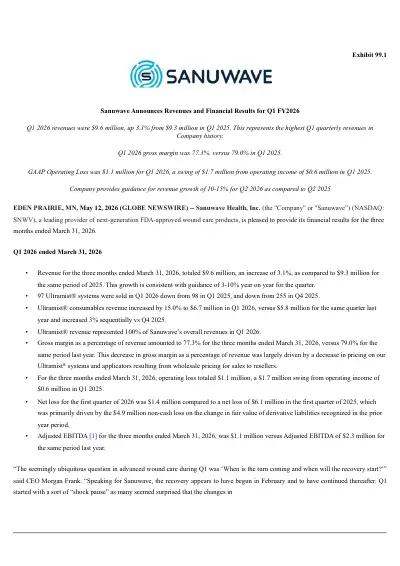
Thank you, Morgan. We delivered the highest Q1 revenues in company history, surpassing last year's previous record by 3%.
We're encouraged by consumable utilization, which grew 22% year-over-year and 4% sequentially from Q4 2025. Before turning to the financials in more detail, I want to provide an update on the sales tax issue as discussed in the 10-K and our prior call.
We've entered into voluntary disclosure agreements with almost all the applicable states. The benefits of these VDAs are limiting the look-back period of potential tax exposure and abating potential penalties in some states.
We continue to push forward in this process at full speed and have made meaningful progress through remediation activities with our third-party tax advisors. With that, let's take a closer look at the financial results for the quarter.
Revenue for the three months ended March 31st, 2026, totaled $9.6 million, an increase of 3% as compared to $9.3 million for the same period of 2025. This growth was on the low end of our guidance for the quarter of 3% to 10%.
Gross margin as a percentage of revenue for the three months ended March 31st, 2026, came in at 77.3%, a decrease of 177 basis points year-over-year, driven by a decrease in pricing on UltraMIST system and applicators resulting from wholesale pricing to resellers. For the three months ended March 31st, 2026, operating loss totaled $1.1 million, which was a $1.7 million swing compared to the same period last year, which had operating income of $0.6 million.
Operating expenses for the three months ended March 31st, 2026, amounted to $8.6 million compared to $6.8 million for the same period last year, an increase of $1.8 million. The change in operating expenses was driven by several key factors.
Non-cash stock-based compensation increased by $380,000. Payroll-related headcount expenses were $384,000 higher in Q1 compared to Q1 2025 due to increased headcount.
In R&D, non-personnel expenses increased by $346,000, reflecting investments in ongoing product development initiatives. We also had non-recurring expenses of about $300,000 in restatement work on the 10-K for tax, legal, and audit fees in Q1 2026.
Sales and marketing costs increased by about $400,000 year-over-year as well to support increased outreach of UltraMIST. Despite these expense increases, we remain focused on disciplined cost management and expect operating leverage to improve as revenues scale throughout the year.
Net loss for the three months ended March 31st, 2026, was $1.4 million compared to net loss of $6.1 million for the same period in 2025, an improvement of $4.7 million. The improvement was primarily attributable to the $4.9 million non-cash loss in the change in fair value of derivative liabilities that did not recur in Q1 2026.
Interest expense was also $1.4 million lower year-over-year, primarily reflecting the senior debt refinancing with JPMorgan at the end of Q3 2025. EBITDA for the three months ended March 31st, 2026, was -$0.6 million.
Adjusted EBITDA was positive $1.1 million versus $2.3 million for the same period last year. The year-over-year decline reflects planned investments in headcount, R&D, and commercial expansion.
Total current assets amounted to $24 million as of March 31st, 2026, versus $24.6 million as of December 31st, 2025. Cash and cash equivalents totaled $10.8 million as of March 31st, 2026.
We're grateful for the continued trust and support of our stakeholders. Q1 2026 was a record start to the year for SANUWAVE, with all-time Q1 revenue, continued momentum in consumable utilization, and growing traction across our commercial channels.
As we move through the balance of 2026, we remain focused on operational discipline, expanding adoption of UltraMIST, and positioning SANUWAVE for sustained, profitable growth. With that, I'll turn the call back over to Morgan.
Morgan Frank
Thanks, Peter. Our guidance for Q2 is 10% to 15% year-on-year growth, which represents $11.1 to $11.6 million for the quarter.
We are maintaining our guidance of $51 to $55 million for the year. We've been seeing a great deal of engagement from some large systems right now.
We have several evaluations ongoing that we hope will flower into bigger opportunities as the year goes on. These things take some time to bring to fruition, but this is what's making us optimistic about the second half.
As ever, I want to express my gratitude to the SANUWAVE team for all the hard work and the commitment and the trust. This is just an incredibly steady crew to take into the recent rough seas, and I really look forward to seeing what it can do once the waves calm down a little bit.
Thanks, team, really. That's it for the prepared remarks.
Can we please open it up for questions?
Operator
Absolutely. If you would like to ask a question, please press *1 on your keypad.
To leave the queue at any time, press *2. Once again, that is * and 1 to ask a question.
We will pause for a moment to allow everyone a chance to join the queue. We will take our first question from Ian Cassel with IFCM.
Please go ahead, your line is open.
Ian Cassel
My question is kind of relates to your closing remarks there. You grew 3% year-over-year in Q1, expecting to grow 10% to 15% in Q2, and you obviously have seen a nice rebound in activity.
You kept your guidance the same, I think it was 16% to 25% growth for the year, but you obviously expect some significant growth in the back half of the year. Can maybe you give a little bit more color on what you're seeing and what gives you that confidence in the back half?
Morgan Frank
Okay. Fair enough.
Thanks, Ian. It's a good question.
One, this is traditionally a fairly seasonal business, and so, excepting last year where the back half was unusually affected by this slowdown in the industry, if you look at sort of the average difference between the first half and the second half of a year for SANUWAVE, going back so 2021, '22, '23, '24, the second half is usually up about 48%, averages an increase of 48% versus the first half. In general, we have a seasonal trend that's favorable to us.
That's the average. Obviously in a year like this where we're seeing significant suppression in the first half, as we kind of come out of the skin sub market challenges, I think there's a possibility that we do better than typical in terms of that back half versus front half growth rate.
Right? That's sort of the top-down.
The bottom-up is we're seeing a larger amount of sort of large account, national account engagement than we've ever had. We're getting first placements and first demos with a lot of very large systems.
Traditionally, we've had great success with evaluations and sort of early trial purchases where, once systems kind of get a look at UltraMIST and get a chance to use the product, see the results, they tend to gain confidence and come back. Internally, we sort of refer to this as the magic phaser gun problem where people think you're trying to sell them a magic phaser gun, and then, once they've used it and gained some confidence with the actual results that the product can deliver, they tend to become a lot more enthusiastic and want to spread the system through their practices.
Both kind of from a top-down standpoint and from a bottom-up standpoint, we're seeing a lot of progress that we think should drive a significantly better second half.
Ian Cassel
Thanks for the color on that. I have kind of a combination of two questions, but kind of the same type of trajectory with both of them.
When you're looking at UltraMIST today, are you excited about any advancements you're making to the product itself over the next 24 months, first question. Second question, are there any kind of evidence-based trials you're doing with perhaps large customers or groups that kind of will give more evidence to entering into new areas of the market?
Morgan Frank
Sure. The answer to sort of all of your questions is yes.
As you probably saw, we're starting to get to a more normalized spend on research and development, and that flows in a number of directions. Some of what we're doing involves incremental improvement to the existing product.
Some of what we're doing involves some line extension and some work into some adjacent areas. We're not really at a point where we want to talk about that publicly right now.
From a data standpoint, yeah, we're working with a number of our users to generate some data about cost effectiveness and then to sort of push and validate into additional use cases. UltraMIST has a very broad label.
It has a lot of use cases in virtually any sort of wound. I don't want to steal people's thunder, but I think you can probably expect to see some papers and white papers over the coming quarters that will outline some interesting use cases for UltraMIST that I think could be an expansion as compared to existing use.
Ian Cassel
Thank you.
Operator
Thank you. Once again, that is *1 on your telephone keypad if you would like to join the queue.
We will pause for another moment. Once more, that is *1 to join the queue.
It appears that we have no further questions in queue at this time. I would now turn the meeting back to Morgan for closing comments.
Morgan Frank
Great. I'll take that as a sign that we covered most of the concerns.
Thanks, everyone. We appreciate your continued interest and support, and we will speak to you next quarter.
Operator
Thank you. This brings us to the end of today's meeting.
We appreciate your time and participation. You may now disconnect.