SOPHiA GENETICS SA
Q3 FY2026 · Earnings Call TranscriptNovember 3, 2026
Operator
Good morning. My name is Jenny and I will be your conference operator today.
At this time, I would like to welcome everyone to the SOPHiA GENETICS Third Quarter 2026 Earnings Conference Call. Following the presentation, we will conduct a question and answer session.
If at any time during this call you require immediate assistance, please press star zero for the operator. I would now like to turn the conference call over to Kellen Sanger, SOPHiA GENETICS Head of Strategy.
You may begin.
Kellen Sanger
Thank you, and good morning, everyone. Welcome to the SOPHiA GENETICS Third Quarter 2026 Earnings Conference Call.
Joining me today to discuss our results are Ross Muken, our Chief Executive Officer, and George Cardoza, our Chief Financial Officer. I'd like to remind you that management will make statements during this call that are forward-looking statements within the meanings of federal securities laws.
These statements involve material risks and uncertainties that could cause actual results or events to materially differ from those anticipated, and you should not place undue reliance on forward-looking statements. Additional information regarding these risks, uncertainties, and factors that could cause results to differ appears in the press release issued by SOPHiA GENETICS today and in the documents and reports filed by SOPHiA GENETICS from time to time with the Securities and Exchange Commission.
During this call, we will present both IFRS and non-IFRS financial measures. A reconciliation of IFRS to non-IFRS measures is included in today's earnings press release, which is available on our website.
With that, I'll now turn the call over to Ross.
Ross Muken
Thanks, Kellen, and good morning, everyone. Q3 was another strong quarter for SOPHiA.
We delivered 25% year-over-year revenue growth as demand for our platform continues to expand. Growth in the US market remained robust.
New products in liquid biopsy and solid tumor continue to gain adoption, and new biopharma collaborations are establishing SOPHiA as the trailblazer in bringing clinical intelligence to patients around the globe. In addition to the strong growth, we also improved adjusted EBITDA materially in the third quarter by again dropping nearly 60% of our incremental revenue growth down to the bottom line, bringing us closer to profitability.
Today I'll update you on each of these areas and provide more details on the exciting path ahead. SOPHiA was founded with a vision to transform the world's healthcare data into actionable clinical intelligence for providers and patients.
We started in genomics, where we've established ourselves as one of the largest diagnostic companies in the world. In Q3, the SOPHiA network performed 118,000 analysis on our platform, up 19% since last year.
In other words, we analyze roughly 40,000 patients per month across a network that spans 75 countries and 551 connected institutions globally. That network, and the data flowing through it, has allowed us to build one of the most sophisticated intelligence engines in healthcare.
Every analysis run on our platform teaches our AI something new. It learns from a real-time, real-world data set that is unmatched in its breadth and diversity, including thousands of clinical contexts from patients in over 75 countries.
The learning doesn't stop with the data. Every day, pathologists, oncologists, and scientists across our community review insights, flag cases, and feed their expertise back into the platform.
The result is something no institution could build on its own. We call it collective intelligence.
Over the last several months, demand for our intelligence tools has been accelerating. Today, I'll touch briefly on two areas where we're seeing outsized growth: the US market and liquid biopsy.
In Q3, we delivered 41% revenue growth in the US market. The growth has been especially impressive given the scale of our US business, which is now our largest market globally.
Based on the strong demand we're seeing, that growth is well-positioned to continue. Recently signed major accounts, including North York, igenomix, and a major West Coast health system, are scheduled to ramp significantly in the fourth quarter and into 2027.
New signings also remained strong. In Q3 alone, we signed PathGroup, one of the largest physician-led pathology providers in the US, to solid tumor and heme-onc applications.
We also signed the University of Arkansas, the state's only health sciences university, for heme-onc. Beyond landing new accounts, our expand engine was strong as well.
In Q3, the University of North Carolina Medical Center, a longstanding partner of SOPHiA, added additional applications across heme-onc, hereditary cancer, and rare disorder testing. These wins, along with our strong momentum in the US, reflect a broader trend.
Over the past 12 months, we've seen an inflection in US growth. Reimbursement rates are rising, denial rates are improving, and sequencing costs continue to drop.
These dynamics have created favorable economic conditions for hospitals and labs to launch their own testing capabilities. Large central labs have proven that genomic testing is highly profitable, and now providers want to participate.
SOPHiA makes that possible. We enable institutions to launch their own testing in-house.
We also empower institutions to retain control of their patient data, an increasingly valuable asset in the care ecosystem. Together, these trends are driving significant demand for our platform in the US and beyond, as institutions look for intelligence tools to help them transform their data into actionable insights while also driving beneficial economics.
The second major growth driver in the third quarter was new products. Bringing compelling products to our customers is critical for the widespread adoption of our platform.
However, building products that work in labs across the globe is not easy. In 2023, we launched a revolutionary new liquid biopsy test, MSK-ACCESS, which allows any institution in the world to bring liquid biopsy testing to their institution.
Making this test perform reliably required innovative new AI techniques to ensure accuracy and consistency. That investment is now paying off.
In Q3, we performed 4,200 liquid biopsy analysis globally, up more than 100% year-on-year and 41% sequentially versus Q2 levels. Looking ahead, we expect the liquid biopsy business to continue ramping, offering a meaningful catalyst for future growth.
To date, we have signed more than 85 institutions to the application, including six in the third quarter alone. Of these new signings, a large number are currently implementing the platform and ramping usage.
Unlike the US, liquid biopsy is an emerging technology in the rest of the world. As a leader in liquid biopsy outside of the US, SOPHiA and its growing network are well-positioned to capture this growth as adoption increases.
To accelerate the ex-US adoption trend, we are making a series of strategic investments. This includes adding a new medical affairs function focused on generating evidence, demonstrating clinical utility, and advocating for the adoption of liquid biopsy testing across Europe, Asia, and Latin America.
I look forward to sharing more on the team's progress and the growing demand for liquid biopsy in the quarters ahead. As our genomics footprint continues to expand and our network becomes larger, biopharma companies increasingly have come to recognize the value of our unique global reach and the data being streamed through our platform.
This has resulted in a series of large signings with biopharma over the past nine months, covering areas such as patient selection and stratification, companion diagnostics, foundational model building, real-world evidence, and the sponsored deployment of our tests. This quarter, I'm proud to announce that the success is continuing.
During the quarter, we signed a major new collaboration with a top 10 biopharma company to develop a multimodal AI predictor to help identify which bladder cancer patients are most likely to benefit from immunotherapy. The project leverages SOPHiA's deep expertise in clinical intelligence as well as our proprietary data to build two complementary predictive models aimed at understanding patient response to a targeted therapy.
Congratulations to the team on this win. This new business builds on the progress discussed last quarter when we announced the signing of not one, but two diagnostic programs with AstraZeneca, the first in SOPHiA's history.
The first CDx program aims to develop a key solid tumor application into a decentralized companion diagnostic for patients with prostate cancer. We announced additional details on this program last month, including that the test will incorporate Myriad Genetics' novel prostate cancer-specific genomic instability score capability into the technology.
The second CDx program will leverage a hematological oncology application to support a therapy for patients with blood cancer. Together, these CDxs demonstrate the value of SOPHiA's network.
For biopharma, the hardest part of a companion diagnostic isn't proving the biomarker works, it's getting the test to patients who need it everywhere they are at the moment a treatment decision is being made. That's the problem SOPHiA was built to solve.
Our platform already sits inside hundreds of hospitals and laboratories across more than 70 countries, analyzing genomic data locally and consistently. This means that a CDx developed with us doesn't depend on shipping samples to a single central lab or waiting weeks for a result.
It launches where oncologists are already working. Because the same platform brings together genomic, radiomic, and clinical data on one patient, you aren't limited to a single analyte test.
You can build software as a medical device that reflects how disease actually behaves across modalities and, over time, refine it with real-world evidence that flows back from the same network. The result is a diagnostic that reaches more patients faster, generates evidence continuously, and travels with your therapy into every market you enter.
That is what clinical intelligence means in practice, and it is why partners who want their drugs to reach the right patient on day one are choosing to build with SOPHiA. To conclude, our commercial momentum keeps building.
New geographies, exciting new products, and expanded relationships with biopharma offer meaningful catalysts for future growth. Given these factors, along with the dynamics we are seeing in our end markets, we now expect our full year 2026 revenue to be at the upper end of the previously issued guidance range of $94 million to $96 million.
The updated outlook reflects strong business performance, partially offset by the impact of foreign exchange. Furthermore, as we continue to grow, it is critical that we do so in a sustainable way.
In the third quarter, we improved adjusted EBITDA by an impressive 31% year-over-year, dropping nearly 60% of our incremental revenue down to the bottom line. This performance represents the natural operating leverage of our business.
Our tech-first, AI-native approach, built on a highly efficient intelligence platform, scales quickly without a proportional increase in cost. We remain fully committed to profitable growth.
As previously stated, we expect to keep converting growth into further improvement in adjusted EBITDA in the fourth quarter and to crossover to positive adjusted EBITDA in the second half of next year. Underneath it all is a growing network of institutions relying on SOPHiA to turn complex data into clinical intelligence.
The more data that flows through our platform, the smarter it gets and the more value we deliver to our customers. With that, I'll turn the call over to George, who will take you through the results in more detail.
George Cardoza
Thank you, Ross. As mentioned, Q3 results were strong, and our outlook remains positive.
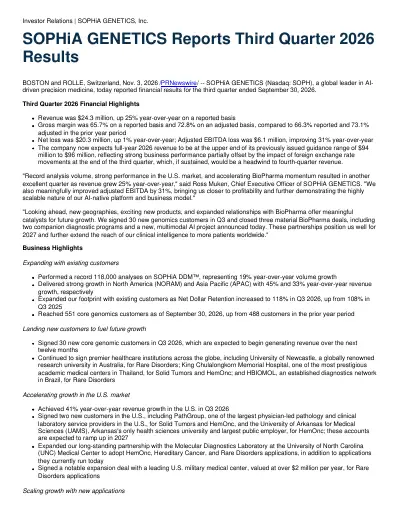
Revenue and volume grew once again, and our new business momentum continues to build. Total revenue for Q3 was $24.3 million compared to $19.5 million in the third quarter of 2025, representing year-over-year growth of 25% or 26% on a constant currency basis.
Platform analysis volume was a record 118,000 analysis in Q3, representing year-over-year growth of 19%. From a regional perspective, we delivered strong growth across geographies.
North America, and specifically the US market, continue to be a primary growth driver. North America delivered 45% revenue growth in Q3.
Asia Pacific outperformed as well with 33% revenue growth, and Latin America continues to pick up as more wins come online and ramp, with strong growth in Brazil and Colombia. In EMEA, we continue to outperform in relatively underpenetrated regions.
Revenue grew over 200% year-over-year in Norway and over 100% in the UK. From an application standpoint, solid tumor, heme-onc, rare disorders, and liquid biopsy all outperformed.
Heme-onc volumes were up 28% year-over-year in Q3, and rare disorders were up 29%. Solid tumor testing grew 30% year-over-year, largely driven by new applications like our CGP test, MSK-IMPACT Flex.
In Q3 alone, we signed multiple new customers to MSK-IMPACT Flex, including AOU Pisana, a leading university hospital in Italy; Gentidose, an emerging genomics company in Mexico; and Ruhr University Bochum, a large academic pathology institute in Germany. As Ross highlighted, liquid biopsy volumes were up over 100% year-over-year in Q3 as MSK-ACCESS customers continue to come online and ramp usage.
This quarter, we signed the University Hospital Augsburg, one of the largest university hospitals in Germany; Agilus Diagnostics, one of the largest diagnostic laboratory networks in India; and Hanusch Hospital, a leading hospital in Austria, among others, to the MSK-ACCESS application. Beyond ACCESS and IMPACT, we landed many other exciting customers in this quarter.
Among our 30 new logos signed in Q3, these include King Chulalongkorn Memorial Hospital, one of the most prestigious academic medical centers in Thailand, for solid tumors and heme-onc; H.Biomole, an established molecular diagnostics network in Brazil, for rare disorders; and the University of Newcastle, a globally recognized research university in Australia, for rare disorders. Outside of the core genomics business, biopharma contributed nicely to overall growth as recently signed projects continue to deliver.
As we've previously stated, biopharma is now an accelerator to our growth rate, and we believe it will continue to be so in future years. Core genomics customers were 551 as of September 30, 2026, up from 488 in the prior-year period.
Bookings remain strong, and despite strong conversion, pipeline remains healthy. Both clinical and biopharma businesses carry net new business pipelines of over $100 million as the number of large opportunities continues to expand.
We believe the market is moving in our direction, and we are excited to continue capitalizing on our opportunities. On the expand side, we continue to grow nicely within existing customers as they add more and more applications.
Our net dollar retention for the quarter was 118%, up 950 basis points from the 108% in the prior-year period. In addition, annualized revenue churn remained world-class at less than 1% in the third quarter, demonstrating the stickiness of our platform once customers join.
Gross profit was $15.9 million compared to $12.9 million in the prior-year period, representing growth of 23%. Gross margin was 65.7% compared with 66.3% for the third quarter of 2025.
Adjusted gross profit was $17.6 million, an increase of 24% compared to the prior-year period. Adjusted gross margin was 72.8% as compared to 73.1% in the third quarter of 2025.
Total operating expenses for Q3 were $33.8 million compared to $30.8 million in the prior-year period. Adjusted operating expenses, or opex, excluding the items in the adjusted EBITDA table, was $23.7 million in Q3 compared to $23 million in Q3 of 2025, relatively flat year-over-year.
In Q3, R&D expenses were down 18% year-over-year, and G&A was roughly flat on an adjusted basis, representing strong cost discipline of the team and the natural operating leverage of the business. Sales and marketing was up slightly as we continue to invest in growth.
Specifically, we added a few additional headcount in North America to support the strong growth we are seeing in that market. Operating loss for the third quarter was $17.8 million compared to $17.9 million in the prior-year period.
This figure, of course, includes the social charge accrual increase due to our stock price increase, Guardant litigation, and the restructuring cost impacts. On the Guardant litigation front, we remain confident in our position both on non-infringement and on the validity of Guardant's patents.
As previously mentioned, the Unified Patent Court in Paris rejected Guardant's request for provisional measures in January and ordered them to pay us to reimburse legal fees. In July, the UPC issued its final decision rejecting Guardant's appeal in full.
The court confirmed that there will be no injunction and that we can continue to commercialize MSK-ACCESS without restriction. In addition, Guardant was ordered to pay us further to reimburse costs.
Beyond the Paris court, UK proceedings are still ongoing. In Q3, we incurred approximately $931,000 in related net legal expenses, which is reflected as a litigation adjustment in our adjusted EBITDA reconciliation.
In October, Guardant filed a notice of discontinuance in the UK proceedings with respect to some of its infringement claims. Guardant's remaining UK infringement claims remain pending, and we will update you more in future quarters.
Adjusted EBITDA loss was a loss of $6.1 million compared to the prior-year loss of $8.8 million, improving 31% year-over-year. As Ross mentioned, we are proud of the team for the discipline behind this achievement.
Our cash position at the end of the quarter was $94 million, which is sufficient for us to meet our long-term goals. We remain confident in our path to profitability and expect to crossover to positive adjusted EBITDA in the second half of 2027.
I'll now turn to our 2026 outlook. Given the continued strength of our performance in 2026, SOPHiA GENETICS now expects our full year 2026 revenue to be at the upper end of the previously issued guidance range of $94 to $96 million.
The updated outlook reflects strong business performance, partially offset by the impact of foreign exchange rate movements at the end of the third quarter, which, if sustained, would be a headwind to fourth quarter revenue. Beyond revenue, we are reaffirming our full year adjusted EBITDA loss guidance of $29 to $32 million compared to $41.5 million in fiscal year 2025.
As previously mentioned, we took a series of cost actions earlier this year and have realized the benefits of adopting AI across our teams. These actions reinforce our conviction to grow revenue without increasing headcount.
They also give us confidence that we will be able to continue holding the line on operating expenses and reaching our profitability commitment. With that, I would like to turn the call back over to Ross for the closing remarks before we take your questions.
Ross?
Ross Muken
Thank you, George. To summarize, Q3 was a great quarter.
We continued to deliver strong revenue growth, improve our bottom line, and fuel future growth with a strong business momentum across clinical and biopharma. The SOPHiA mission remains strong, and I couldn't be more excited to lead the company in its next phase of growth.
Thank you to our employees, our partners, and our shareholders for the trust you've placed in this next chapter. With that, operator, please open the line for questions.
Operator
Thank you. Ladies and gentlemen, we will now begin the question and answer session.
If you have a question, please press the star followed by the one on your touch-tone phone. Should you wish to cancel your request, please press the star followed by the two.
If you are using a speakerphone, please lift the handset before pressing any keys. Once again, that is star one should you wish to ask a question.
Your first question is from Mark Massaro from BTIG. Your line is now open.
Mark Massaro
Hey, guys. Thank you for taking my questions and congrats on a good quarter.
I wanted to start with some of the applications. I think you talked about solid tumor growing 30, rare growing 29, heme-onc growing 28.
Those are all kind of moving in a similar band. Can you just speak to your confidence about the sustainability of these growth rates as we think about 2027?
I'm not asking for guidance, but I'm just curious when you're growing this quickly in the US, I would think that these are still relatively small numbers as a percentage of your overall base. Just maybe walk me through how you're thinking about the sustainability of similar levels of growth in the US going forward.
Ross Muken
Thanks, Mark. Obviously, as you said, we're quite excited about the breadth of the growth we're seeing across the portfolio, and obviously this has been quite planned on our side in terms of some of the new product introductions we've had over the last two years, plus the amount of commercial attention we've paid to a number of these markets.
To kind of unpack a few of your comments: so one, on the solid tumor side, certainly with the MSK-IMPACT Flex product, we are, I would say, quite optimistic that we will continue to take share in that arena. Actually, this last quarter, and you could see that bit in the spike in S&M costs, we did have some continued key wins in that market that are competitive.
I think the momentum we will see on the solid tumor side will continue into next year. We've also had a really strong trajectory in kind of the HRR and HRD market where obviously we also had a CDx win, and so I would say overall there quite confident in sort of even potentially accelerating our growth rates in solid tumor, which remains for us a real focus.
On the hematology side, this is one area, particularly in the US, where we've had really great strength for some time, and I don't see that changing. We've got some fantastic new product introductions coming with our comprehensive heme product, think of that almost as kind of heme CGP, as well as some of the monitoring technologies we have, such as MRD AML.
I would say there we continue to innovate. It's not as competitive a market as solid tumor, and I would say there we're looking for the kind of growth rates to probably sustain themselves.
Then on the rare and inherited side, obviously there's been some real developments in that market as a number of entities have moved to exomes and now obviously you're seeing folks move to genomes. I'd say overall, certainly on the exome side, we're quite well-positioned, and we've highlighted a number of competitive wins there this year that again we expect to ramp into the fourth quarter and then into 2027, and so I would expect certainly volume and revenue growth for that product line to continue.
I think on the whole genome side, for us, still early days, but that is probably a lesser impact in '27 and probably a bigger impact in '28 just given kind of our customer base and portfolio. Generally overall, I would say what you're seeing today we expect to continue and maybe even improve into next year.
Overall, I'm super pleased with the momentum, and I'm super pleased with the execution of the team.
Mark Massaro
Great. Second question, I wanted to ask about biopharma.
Obviously, you recently signed two companion diagnostics programs with AstraZeneca. Can you just speak on where you are with those programs in particular?
Then more broadly, how would you characterize your biopharma funnel and your organization's ability to continue to meet the timelines for what you have on your plate versus going out and winning additional business?
Ross Muken
Great, Mark. Thanks.
On biopharma, I would say we've really started to see a pretty material acceleration in our core business, and then I would say we've really found our product market fit in a number of key areas. As you mentioned, the CDx wins were obviously pretty monumental for us in terms of a signal to other biopharmas in terms of their risk profile to work with us and showing that we can execute on these highly strategic and important programs.
Today, we're obviously still early stages in both of those, and so they will go on for some time, but I'm incredibly optimistic, particularly coming off of ESMO, that we will continue to show progress and broaden out our portfolio of entities we work with, as well as the diversity of types of projects we can serve on. I'm really pleased with on the diagnostic side the momentum.
Then, you also saw this quarter for us in kind of the multimodal or AI space a really nice win. Again, that side as well is really finding its way, and I think pharma's kind of openness and interest in adopting AI into their drug development process is increasing, and no one is better positioned, particularly on a global basis, to serve them than us.
Again, I think a lot of the story this year has been sort of our gaining momentum across the biopharma business. I think this will continue to be a nice upside driver into '27.
At the moment, right now, I'm really optimistic of where the pipeline sits, and obviously we still have a lot to execute on to make sure we deliver on that promise, but at the moment and coming off of ESMO again, the momentum and the excitement in that business continues to grow.
Mark Massaro
Fantastic. Last one for me: it looks like you did add a few people in North America, I believe either in the sales or marketing function.
I think you talked about adding a resource in medical affairs, I believe OUS. Can you just speak to how you're thinking about investment in 2027?
Are there any areas where you think you can turn the crank just a little bit more, or do you think you're in a good position as is?
Ross Muken
I want to be careful not to give too much color on next year, but I would say, look, we're trying to sort of lean into our strengths at the moment. Obviously this quarter, you saw the US again outperform, and that business is getting much larger, and we need to make sure in what's a very competitive market that we stay, I would say, at the forefront and make sure again, in terms of feet on the street, we are aggressively postured, given I think we can continue to take share in the market.
There we did add, but again just to reassure you, it's pretty selectively. The headcount numbers versus maybe others you cover would be modest, but for us, obviously where we've kept headcount relatively flat for some time, is still additive.
Then, as you mentioned, particularly on liquid biopsy, where again you saw very impressive sequential improvement and year-on-year growth, we want to make sure that the adoption continues, right, and maintain or greater rates. One of the learnings we've had is that there's still education that needs to happen at the oncologist ex-US.
You look today and, interestingly, a lot of our liquid cases are prostate, and this probably wouldn't be the first guess. You'd have thought lung or even maybe now with the ESR1, breast.
I think there's still a lot of use cases for us to kind of educate the clinician on ex-US, and so we're going to have an extra effort on that to make sure that we're also help creating this market that obviously today is very well established, and other players have done a great job of priming the US, but ex-US, it's still very nascent stages, and so we want to make sure we don't underinvest again.
Mark Massaro
Fantastic. Thanks for the time, guys.
Operator
Thank you. Your next question is from Subbu Nambi from Guggenheim Securities.
Your line is now open.
Hey, good morning. This is Ethan on for Subbu.
Congrats on the quarter and thanks for taking our questions. Just to start, really impressive quarter for liquid biopsy.
Can you talk about some of your efforts in building clinical and operational infrastructure that got you there and how that might continue to, I guess, materialize as revenue moving into 2027, especially with the strategic investments in the medical affairs?
Ross Muken
Thank you. Obviously, as you mentioned, liquid for us remains a really nascent but incredibly exciting opportunity.
Over the last 12 months, we've put a lot of organizational effort into sort of the adoption, right, and making sure that folks obviously became aware that the solution is available and that you can now bring this in-house, as well as the fact that we obviously had to implement these labs and bring them online. Now you're starting to move out of sort of the awareness and implementation phase to, I would say, the scaling and adoption portion, right?
Here, again, given liquid is typically an oncologist, not a pathologist-driven product, we really need to again create kind of the clinical evidence that exists today in the US in these ex-US markets, and really also help frame some of the reimbursement conversations as well. I would say we're moving to kind of the next phase of the adoption cycle here.
Obviously, we're still at very early penetration levels even of the accounts that we've entered. We just want to make sure that we fully maximize this and really, again, bring the ex-US demand and the ex-US clinical understanding to the same levels you see here in the US.
I think it's, again, an exciting period, but we still have quite a lot of work to do.
Thank you. Then on MSK-IMPACT Flex, can you just dig into, I guess, what's resonating with these customers?
Is that opening any doors to labs that maybe wouldn't have adopted the full panel, like a larger community practice, somebody who doesn't or who has the infrastructure to bring testing in-house, but maybe is still cost-sensitive?
Ross Muken
Sure. I would say one, obviously, the product is available on multiple platforms, right?
When you look at many of the newer platforms versus the legacy platform, the cost is materially different, sometimes as much as 50% cheaper. Now you can run a comprehensive genomic profile sometimes at a level of what it cost you to run a small panel, right?
You're seeing a major shift in the cost infrastructure to run these assays, which I think is really important and will continue to drive folks to more and more complex solutions like this. I would also say with all of the new approvals on the drug side, the number of actionable mutations and markers that exist on the larger panels argue for a more broad genomic scope than what was done previously, right?
I think, again, all of the factors of what are happening in the ecosystem are all pushing folks to these more complex technologies, which again for us is great given how our platform is situated. I would also say that, versus some of the legacy capabilities, our ability to detect certain highly complex mutations is also superior.
You look at a new area that's going to be super hot like MTAP, and we just had a player run a head-to-head—it was actually us against both centralized and decentralized players—and we came out number one, right, in terms of sensitivity and specificity. I think the ability to outperform both from a, I would say, accuracy and quality perspective, but also do so at an increasingly lower cost, that combination in the market with the flexibility of the product has really resonated.
I think also the concept of owning your own data and retaining access to that is become critical, particularly given what you're able to do with AI. All of these factors coming together, I think, will continue to drive that product line forward.
Thank you.
Operator
Thank you. Your next question is from Dan Brennan from TD Cowen.
Your line is now open.
Kyle Boucher
Hey, good morning, guys. It's Kyle on for Dan.
Thank you for taking our questions. I just wanted to ask a question about the backlog.
I think you had a notable backlog coming into this year, just given the strong new customer adds you saw in 2025. I think this year you've signed just over 70 new customers to date.
I guess, can you discuss your backlog of customers waiting to be implemented in the platform? Then I guess, knowing that a customer has to be a user of DDM for a year before they're included in the core genomics customers number, how many total customers are using the platform at the moment?
Ross Muken
Sure. Thanks, Kyle.
I would say in general, and you can take it positively or not depending on how you want to think about it, but the backlog actually still remains quite high. We've done a good job of obviously working down some of the legacy signings and getting a bunch of new logos live and new applications live, but at the same time, bookings have been incredibly strong.
We actually just came off of one of our best quarters ever in terms of bookings. As quickly as we've tried to get things into the revenue, new things are coming into the backlog.
We're still seeing a bit, I would say, of growth there. I guess the positive would be it gives us very good visibility into '27, but obviously we would like to see things continue to convert faster.
George, I don't know if you want to comment on sort of how that positions us in terms of visibility going forward, etc.
George Cardoza
No, like Ross said, really the nice part of this is we know these clients are going to start. They're actively working with our MaxCare team on their validation.
It's really the timing of when they're going to start. The nice part of that is when you look at our 2027 numbers, 95% of that growth is basically already covered or signed up.
Really when you look at the revenue growth you're going to see in 2027, it's from the closes that we've made in 2026. Like Ross said, our MaxCare team, they're flat out, they're working very hard, but as fast as they get accounts out, our sales team's been very good about putting new accounts into their bucket.
No, I think this is generally a very positive quarter in terms of the bookings. The backlog, I guess it's a good problem to have, but we continue to migrate accounts out and it increases our confidence in our visibility in our 2027 numbers.
Kyle Boucher
Got it. Thank you.
Then maybe just one more: you mentioned in the press release that you signed an expansion deal in the US valued at over $2 million per year for rare disease applications. Can you just give us a little bit more detail on the quantification of that $2 million?
I guess meaning how long would it typically take for a customer to ramp into that $2 million per year opportunity?
Ross Muken
Historically, I would say to go from signature to actively generating revenue in the early phases of scale up, it could be 6 or 9 months. In this case, it's an existing customer adding a new or a second or third application.
I would say they're familiar already with the platform, it could be a bit faster. Certainly, I think this will again, as well as with the others we've discussed, kind of give confidence to the sustainability or even potential acceleration of that US growth rate.
This was a really nice competitive win for us. Again, it's a proof point in an area that remains, I would say, very competitive in terms of type of business that was done through send-out versus today that's coming in-house.
Again, I would say we're very pleased with this expansion, and we're looking forward to it contributing at some point in 2027.
Kyle Boucher
Got it. Thanks, guys.
Operator
Thank you. Your next question is from Swayampakula Ramakanth from H.C.
Wainwright. Your line is now open.
Swayampakula Ramakanth
Thank you, thanks. Good morning, Ross and George.
First question is just trying to understand your guidance. You now expect in revenue towards the upper end of your annual range, despite having a FX headwind.
At $96 million, which roughly gets to 26.7 million in the fourth quarter, what are you estimating into this or what are you anticipating, especially regarding FX headwind, and also what are the pushes and pulls on that range that you're anticipating for the year
Ross Muken
end? Obviously, what we were trying to signal with the guidance is that the underlying performance remains strong and continues to, I would say, improve, albeit and George will give you more detail, we did, just given some of the changes in the FX environment, see a fairly, I would say, quick reduction in the euro and franc, which has been a headwind to our reported top line, particularly for the fourth quarter, right, which was not originally contemplated in that guide.
I think the overall point is the underlying is quite healthy. Now if you think about sort of pushes and pulls, I'll let George go into more detail, but I think the main point, if you think about our business, right, outside of the typical usage of the platform, the pieces that tend to sort of move are biopharma-related milestones, and then as well the ramp of new starts, right?
Obviously we've got a few material things happening in the fourth quarter. We tend to be conservative, but, George, I don't know if you want to give a bit more detail of kind of what's contemplated.
George Cardoza
No, as Ross said, we don't want to pretend that we can predict the foreign exchange markets, but you did see a significant drop, relative to the euro, relative to the US dollar, in September, and that's carried over into October and early November. We're really just assuming that foreign exchange rates pretty much stay where they are rather than move dramatically in either direction.
That will be a slight headwind to our revenue growth, our actual constant currency growth will be a little bit higher than what we actually will report. Then as Ross said, our tone is to be conservative, and we continue to want to do that.
That's why I think we've guided where we've guided to. Business remains very, very strong.
Our clinical bookings are strong, and our pharma business continues to just continue to do very, very well. We're confident, but I think overall, we just want to be conservative on the overall guide.
Swayampakula Ramakanth
Ross, one one more question on the financials. The gross margin improved sequentially, which is nice, but how much of that improvement reflects operation scaling versus I remember you stating some of the initiation and implementation costs were a little bit higher?
How much of that is normalizing now as you have been doing this for a longer time in the United States?
George Cardoza
No, we believe our platform is highly scalable. That's why over time we do believe our gross margins will continue to improve sequentially.
Now pharma projects may come on board, and typically pharma projects at the start of a project may have a little bit more on the cost side, and even companion diagnostics again, you're going to probably have frontloaded costs. You saw the margin sequentially improve, and that's obviously a very positive sign.
Again, our platform is scalable. Again, if you think of our revenue doubling, that incremental revenue actually will come in at higher margins than what we see currently.
Over time, we do expect gradual improvement at our gross margin percent.
Swayampakula Ramakanth
Thank you. Thanks for taking my questions.
Operator
Thank you. Your next question is from John Wilkin from Craig-Hallum.
Your line is now open.
John Wilkin
Hi, guys. Thanks for taking the questions.
Wanted to dive a little bit more into the PathGroup customer signing. I know you guys mentioned it's for solid tumor and heme-onc, but was wondering if you're able to quantify the size of what you think that customer can look like once they're fully ramped, and if there's any caveats to their initial use of the platform?
Like if it's going to be their full amount of heme-onc and solid tumor volume running through you guys right off the bat, or if it's some subset of that?
Ross Muken
Obviously, we don't tend to always comment specifically on customers for obvious reasons, but obviously on this one, we're quite excited around bringing them online. This helps be a fantastic, long-existing pathology franchise in the US, and a really marquee win for us, I would say, on bringing another more centralized player that serves kind of a fairly broad community on board.
It is a really nice win for us. Again, I'm not going to give you the dollar amounts, but it's notable.
I would say, in general, typically we will start with a good percentage of someone's volume, and then we will expand over time. We expect to sort of, I would say, win the remainder of business that they're doing with other vendors there, but certainly this is one where the expansion potential is very material.
We're super excited to be working with them. We're proud of the US team for winning this, and we're looking forward to updating you on it as it ramps.
John Wilkin
Perfect. Thank you.
That was helpful. Then, I know you guys aren't guiding to 2027, but wanted to ask just on more of a philosophical level, just given the size of the pipeline you guys have, but also with this commitment to grow profitably and reach that EBITDA break-even mark, how are you thinking about balancing the investments that might unlock some of the bottlenecks in that large pipeline versus trying to stay on track with the profitability targets?
Ross Muken
John, it's the question I deal with every day. I appreciate you asking it because, practically, it's probably one of the more underappreciated things of what we're doing here.
You can see the revenue momentum we are driving despite sort of what is not sort of grown on the opex side, and so I'm really proud, and we didn't talk a lot about it, but I'm really proud about the EBITDA improvement we showed this quarter, and obviously we've been very committed to getting to break-even. Now, you heard it more in the script, we didn't talk about it in the Q&A, but obviously if you think about where clinical intelligence is going and the power of our network in that context, there are some select investments we will want to make just to make sure that we remain at the forefront of some of these new emerging trends, because I think, and you see it in some of the very large IPOs coming, this concept of really having unique value and diverse, smart, global intelligence, this is going to be a real theme.
We are one of, if not the only player within our universe that can play in this arena, right? We want to make sure we don't lose that positioning as most others are very localized in terms of the data sets that they have access to.
We will make some investments in 2027 related to kind of our push into clinical intelligence, but they're going to be quite measured. What we're trying to do is fund areas where we see, I would say, force multipliers of growth and really high upside potential where we have unique competitive positioning, similarly on the commercial side, but then use some of the efficiency efforts we've made using AI and other tools internally to sort of scale processes to make sure that we can pay for some of those investments vis-a-vis our existing cost base and not really, again, materially increase the opex.
I would say 2027, again, is a critical year for us. We've made our commitments.
We are making, I would say, bigger bets in some areas just given the momentum we have and the excitement we see from our customer base in a number of key areas where we're differentiated, but we're certainly not backing off the trend. Again, I think this quarter, if anything, showed you that we're willing to do the hard work, right?
We're willing to continue to try to grow this business well north of 20% or 25% and make sure we continue to drop that down to the bottom line, which has been our commitment and remains our commitment.
John Wilkin
Awesome. Very helpful.
Thanks, guys.
Operator
Thank you. Your next question is from Bill Bonello from Craig-Hallum.
Your line is now open.
Bill Bonello
Hey, guys. Sorry, John asked all my questions.
I just didn't know how to withdraw.
Ross Muken
It's okay, Bill. We're always happy to hear from you.
Operator
Thank you. There are no further questions at this time.
I will now hand the call back over to Ross Muken, CEO, for the closing remarks.
Ross Muken
Thank you. Obviously, we're incredibly optimistic coming off another solid quarter here at SOPHiA.
I want to thank certainly all of our employees and partners and our shareholders for their support. I just want to note we're going to be participating in a few upcoming conferences.
We'll be at UBS, at Craig-Hallum, at Jefferies in London, Citi Group, Evercore, and Piper Sandler. We look forward to engaging with folks at those upcoming events if you would like to sit down with us and discuss more.
Otherwise, I wish everyone a good election day here in the US and then a good day around the world. Thank you so much.
Operator
Thank you. Ladies and gentlemen, the conference has now ended.
Thank you all for joining. You may now disconnect your lines.