SiriusPoint Ltd.
NNYSE:SPNTQ3 FY2026 · Earnings Call TranscriptNovember 6, 2026
Operator
Good morning, ladies and gentlemen, and welcome to the SiriusPoint third quarter 2026 earnings conference call. During today's presentation, all parties will be in a listen-only mode.
Following the conclusion of prepared remarks, management will host a question-and-answer session and instructions will be given at that time. As a reminder, this conference call is being recorded, and a replay is available through 11:59 p.m.
Eastern Time on November 20th, 2026. With that, I would like to turn the call over to Liam Blackledge, Investor Relations and Strategy Manager.
Please go ahead.
Liam Blackledge
Good morning, and thank you for joining us for SiriusPoint's third quarter and nine months 2026 earnings call. Last night, we released our earnings press release, Form 10-Q, and financial supplement, all of which are available on our website at investors.siriuspt.com, along with the slides that will accompany today's discussion.
Joining me on the call are Scott Egan, our Chief Executive Officer, and Jim McKinney, our Chief Financial Officer. Before we begin, I'd like to remind you that today's remarks contain forward-looking statements based on current expectations, and actual results may differ materially.
We will also reference certain non-GAAP financial measures, which we believe are useful in evaluating the performance of the business. Reconciliations can be found in the presentation and our SEC filings.
Please refer to our earnings release and accompanying materials for a more complete discussion of forward-looking statements and non-GAAP measures. With that, I'll turn the call over to Scott.
Scott Egan
Thanks, Liam, and welcome, everyone, to our third quarter and nine months results call. Before I turn to the results, I want to welcome John Sauerland to our board of directors.
John brings more than 35 years of insurance industry experience, and I'm sure many of you will know him from his time at Progressive, where he most recently served as Chief Financial Officer. John will be a strong addition to the board, and his appointment speaks to the quality of the business we are building and our ambitions for the future, and I'm really looking forward to welcoming John to SiriusPoint.
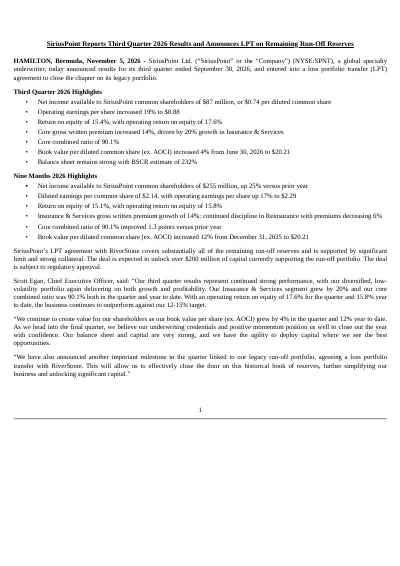
Turning to the results now, the third quarter saw SiriusPoint deliver another strong performance with attractive underwriting margins, disciplined growth, and returns above our 12% to 15% ROE target range. We continue to demonstrate the strength of our diversified specialty underwriting portfolio, which is increasingly important as pricing becomes more competitive in multiple lines of business.
Our business model and approach to the market is delivering strong premium growth in the places we want it and where we see attractive underwriting margins. The performance this quarter is further evidence of our portfolio mix and deliberate low-volatility strategy delivering for our shareholders.
Our stated aim is to deliver a 12% to 15% return across the cycle, and this is another quarter where we have exceeded that target and created strong shareholder value. At the nine-month mark, our key takeaways are unambiguous: the business is performing strongly; we are committed to underwriting discipline; we actively and carefully manage our portfolio mix and volatility; we are growing and have a healthy pipeline of business opportunities; and we have a strong balance sheet and can be agile in our deployment of capital.
Jim will take you through the full financials later in the call as usual, but as a brief overview, the third quarter saw us deliver 20% growth in Insurance & Services and a core combined ratio of 90.1%. Our operating return on equity was 17.6%.
Year to date, Insurance & Services had grown by 14%, while overall core growth of 7% reflects our disciplined approach to reinsurance, where we have shrunk premiums by 6%. On a year-to-date basis, our core combined ratio was also 90.1%, and our operating return on equity is 15.8%, above our 12% to 15% target range.
Book value continues to compound at a strong rate. Excluding AOCI, our diluted book value per share increased by 4% in the quarter and is now up 12% through the first nine months.
Core operating return on equity, which excludes the run-off portfolio results, was 18.1% for the quarter and 17% for the first nine months. This metric becomes increasingly important given today's announcement that we have entered into a loss portfolio transfer agreement with RiverStone that will substantially cover our remaining run-off exposures.
The transaction is subject to customary regulatory approvals, and following completion, our run-off exposures will be at de minimis levels. Put simply, this transaction allows us to effectively close the chapter on the legacy book once and for all.
The transaction is supported by significant limit and strong collateral, while SiriusPoint will retain some responsibility for claims administration. As I have previously discussed on these calls, the run-off reserves relate to business written before 2023, prior to when the organization pivoted to its new underwriting strategy.
We have been running off and reducing over the past two years, but carry the potential to cause reserve volatility along the way. Since 2024, pure underwriting losses, excluding claims administration expenses, have totaled approximately $60 million for the run-off portfolio.
Therefore, we see the mitigation of this uncertainty as a further positive step, and one we hope reinforces the earning strength of our go-forward core portfolio, which, as I said earlier, is operating well above our 12% to 15% return on equity target. We feel that our reserve position was strong prior to the LPT, reflecting our approach to initially reserving MGAs above pricing projections and our track record of 22 consecutive quarters of favorable prior year releases.
Following the transaction, we feel we are in an even stronger reserving position as we have removed what we believe is the greatest element of uncertainty. Jim will discuss the expected accounting impact, but importantly, it also frees up capital tied to these legacy reserves of over $200 million on completion, and will increase our BSCR ratio by around 20 points.
I am sure I will get asked what we plan to do with this capital, and our prioritization remains unchanged. We want to deploy it to support our organic growth where it meets our strict underwriting targets.
Beyond that, we will continue to be thoughtful and dynamic in our approach to capital management, returning excess capital to shareholders when appropriate. This can be seen by our track record, where we have returned $300 million of capital in 2026 alone, on top of the $1 billion of capital returned from strategic capital actions between 2024 and 2025.
In line with the established practice we have set out, we expect to provide an update on our capitalization levels and capital return program in the fourth quarter earnings call following the closeout of 2026 and the completion of our 2027 planning process. In the meantime, we will continue with our current buyback program, which we set out earlier in the year.
What is clear is that our balance sheet, capital strength, and agility have never been higher or stronger, and that's a good thing for all stakeholders. Looking at slide 11, where we show our core operating ROE metric, as I noted earlier, this becomes a more important metric as we think about the business performance going forward post the LPT, and one that we introduced at the beginning of this year with this evolution in mind.
By reducing the earnings drag associated with the legacy book, the LPT should drive greater alignment between our core operating ROE and operating ROE on a go-forward basis. There will still be claims administration and related expenses for a period while it runs off.
Our core operating ROE has exceeded our 12% to 15% target for the past two years and is above again for the first nine months of this year. The LPT transaction reinforces the company's ability and confidence to meet or outperform that range going forward.
Looking briefly at slide 7, our track record for both earnings and value creation is strong and consistent. Operating earnings per share continued to grow and are up 19% in the third quarter and 17% year to date versus the prior year.
On the back of this, our book value per share continues to compound at a healthy rate, with a compound annual growth rate of 19% over the last three years. We have grown book value per share by 12% just in the first nine months, reinforcing that trajectory.
These numbers demonstrate a momentum and a consistency which I believe validates our strategy and approach to building a diversified portfolio that targets disciplined and sustainable growth. Slide 12 talks to this portfolio and illustrates the scale and breadth of our specialty platform, the meaningful positions we have across multiple lines, and our active management of the various pricing cycles.
Importantly, where we are growing and where we are reducing exposure is consistent with the market conditions we have been describing to you and those evident across the broader market. We do not need to maintain positions in lines where returns do not adequately compensate for the risk taking.
We have other opportunities to deploy our capital more attractively. You can see this in action with solid growth in Accident and Health, Surety, and pockets of P&C insurance lines, while we are reducing premiums in Aviation and Property Cat reinsurance.
We are not afraid to either lean in or lean out in specific markets, and Jim will provide more color in each of the specialties later in the call. We also want to outline our plans today to update our segment reporting beginning in the fourth quarter.
Since 2022, we have changed significantly and have evolved from our roots as a Bermudian reinsurer into a specialty underwriter with a strong insurance focus anchored around key specialty lines of business. Increasingly, these specialties reflect how we discuss and manage the portfolio today, dynamically balancing market conditions and mix to deliver low-volatility outcomes for the total portfolio, which we are clear drives the best value creation for shareholders.
We think our financial reporting should reflect that evolution, beginning in the fourth quarter, we expect to update our financial reporting segments to better reflect the evolution of the business and how we manage the company. Accident and Health, our largest specialty line, writing over $1 billion of premium, becomes a stand-alone segment.
A&H is strategically important to SiriusPoint given its track record of profitability, low correlation with P&C market cycles, and relatively low capital intensity. These are attributes we regularly highlight to investors and that generate significant interest.
Reporting A&H separately will make its importance and performance more transparent beyond just words. The remaining nine specialties form a new segment called Specialty P&C.
For clarity, our core results remain unchanged and is comprised of the combination of these two proposed segments. Both segments currently operate at combined ratios in the low 90s, and we plan to publish unaudited recast financials prior to the issuance of the Form 10-K.
We will continue to provide supplementary premium growth trends on an insurance and reinsurance basis for continuity. We believe this change will demonstrate more clearly to all stakeholders how our business has changed, as it is more congruent with how we manage the business internally and aligns with how we talk and describe ourselves externally.
It will also help investors evaluate our performance against our US specialty peers who report in a similar manner as we continue our market education on the evolution of our business. It will position us more appropriately alongside peers that better reflect our business mix, performance profile, and valuation potential.
Before I hand over to Jim, let me close with some key takeaways as we reflect on our performance through the first nine months and look to close out another strong performance year. The third quarter is yet another strong, low-volatility quarter operating above our return on equity guidance.
Our track record continues to demonstrate the consistency and predictability between what we say and what we deliver. This matters.
The continued disciplined growth of our insurance business is creating real shareholder value, and our pipeline remains strong. Our capital position, balance sheet, and ratings are strong, coupled with an ability to deploy capital quickly where we see opportunity.
Our LPT announcement today with respect to our run-off reserves removes the last part of our legacy portfolio and highlights unambiguously the strong performance of our core business. Finally, we are not standing still.
We are not a team who are complacent in any way. Our ambition runs deep, and we are determined to continue to improve the business, providing attractive underwriting returns across the cycle and continue to compound shareholder value.
Our track record on all of these points is there to be seen. With that, I'll pass over to Jim.
Jim McKinney
Thank you, Scott, and good morning or good afternoon, everyone. I'll provide a bit of additional detail to our third quarter and nine months financial results, then cover underwriting, investments, capital, and the balance sheet.
Turning to our financial results, the quality and diversification of the portfolio Scott described are reflected in another quarter of solid operating performance. Gross written premium growth accelerated in the third quarter, driven by continued strong growth in insurance and a return to modest growth in reinsurance.
Core gross written premium increased 14% to $991 million, while net written premium increased 2%, reflecting growth in lower retention lines, such as surety, as well as changes in business mix. Earned premiums increased 19%, including the impact of changes in premium earning estimates recognized in the quarter.
The core combined ratio was 90.1%, resulting in underwriting income of $76 million, a 9% increase from the prior year period. The results reflect a combination of current period underwriting performance and favorable prior year development, which I'll discuss in more detail shortly.
Our diversified earning engines also contributed to the quarter. Net services fee income increased 21% year-over-year to $12 million.
Growth was 44% on the adjusted go-forward MGA basis. Total investment income was $69 million, including $66 million of net investment income.
Operating net income was $103 million for the third quarter. Operating earnings per diluted share were 88 cents, up 19% year-over-year.
As Scott noted, diluted book value per share excluding AOCI increased by 73 cents during the quarter to $20.21. Together, our operating performance and disciplined capital management continue to support growth in per-share value.
The quarter's key takeaway is that diversified underwriting, services, and investment earnings translated into consistent operating performance, attractive returns, and growth in shareholder value. Turning to slide 19, the first nine months results reinforce the broader themes evident in the third quarter: strong underwriting profitability, growing fee base, earnings, and a meaningful contribution from investments.
Core gross written premium grew 7% to nearly $3 billion, with net earned premiums also growing at 7%, our growth remaining subject to attractive underwriting conditions and our continued focus on profitability. Core underwriting income increased 22% to $202 million, with the combined ratio improving 1.3 points to 90.1%.
The improvement was led by reinsurance, where the combined ratio improved 4.3 points to 87.4%, benefiting from lower attritional loss experience and significantly lower catastrophe losses. Insurance & Services underwriting income remained broadly stable, while favorable prior year development across both segments continue to support the overall result.
We continue to see strong contributions from both our fee-based and investment earning engines. As a result, operating earnings per share increased 17% year-over-year to $2.29, and diluted book value per share excluding AOCI increased by $2.11 to $20.21.
Overall, the first nine months demonstrate the quality of our franchise, reflected in strong underwriting profitability, increasing diversified earning streams, and continued growth per share of value. Our strong performance and robust balance sheet provide us with substantial flexibility in how we deploy capital and maximize shareholder value.
Turning to segment performance on slide 20, the results continue to reinforce the themes Scott and I have discussed today: growth driven by our Insurance & Services business and continued discipline in reinsurance. Gross written premium in Insurance & Services grew 20% in the third quarter, driven by credit, surety, and increases in premium estimates for FinPro.
This was partly offset by lower A&H premiums following the non-renewal of a specific large program. We expect A&H premiums to return to low single-digit growth in the fourth quarter, while the pipeline entering 2027 remains encouraging.
The segment produced a strong combined ratio of 92.8% for the quarter and 92% year to date. The higher acquisition costs include profit commissions associated with favorable underwriting performance across multiple accident years.
Those commissions should therefore be considered together with the corresponding improvement in loss experience when assessing the overall underwriting result. The combination of strong growth and underwriting performance reflects both the quality of opportunities we are pursuing and the discipline with which we are deploying capital.
Reinsurance gross written premium returned to growth, increasing 3% in the quarter, while year-to-date premiums declined 6% as we maintained our focus on profitability over volume. The combined ratio improved 1.9 percentage points in the quarter and 4.3 points year to date, primarily due to lower catastrophe losses.
The acquisition ratio increased as favorable loss experience drove higher variable commissions, and business mix shifted toward more stable, structured business, partly offset by lower attritional losses. Across both segments, losses recognized to date in relation to the Middle East conflict remain limited.
Overall, these results reflect the quality of the portfolio we have built, with strong growth in attractive areas of the market, active portfolio management, and continued discipline where risk-adjusted returns are becoming less compelling. Circling back and double-clicking into our core specialty lines shown on page 12: Accident and Health, our largest line at 26% of premium mix, combines attractive profitability with relatively low capital intensity.
Employer stop loss continues to show signs of firming, and we remain well positioned to capitalize on improving market conditions. Within US medical excess of loss, we are seeing rate expectations in excess of 20%.
As Scott mentioned earlier, we plan to update our underwriting segments in the fourth quarter. Under the contemplated structure, Accident and Health will become a stand-alone segment, with our remaining nine specialties comprising a new Specialty P&C segment.
General liability continues to benefit from disciplined pricing, with rate broadly keeping pace with loss trends, despite some moderation in the pace of increases. We remain selective, focusing on areas where our underwriting expertise and market position support attractive risk-adjusted returns.
Financial and professional lines remain competitive, particularly in D&O and professional liability. While market conditions are showing signs of stabilization, we continue to prioritize margin over growth.
Other property remains mixed. We have reduced participation where reinsurance pricing has softened, while selectively pursuing insurance opportunities where returns remain attractive.
Surety pricing remains stable and continues to provide attractive diversification. While we are monitoring emerging loss trends, our portfolio remains differentiated, with an emphasis on commercial surety and limited exposure to larger project-related risks.
In aviation, we continue to expect double-digit rate increases for major airlines during the fourth quarter renewal season. Despite the improving rate environment, we remain disciplined in our deployment of capacity.
Credit remains well priced and delivered strong growth in the quarter, supported by favorable market conditions. Within other casualty, we continue to reduce auto exposure in response to unfavorable loss cost trends, while environmental continues to deliver strong growth and performance.
Marine and energy remains mixed. We continue to see attractive opportunities in selected energy and specialty niches, while competitive pressure persists in ports and terminals and upstream energy.
Marine war pricing remains elevated amid continued regional geopolitical uncertainty. Finally, in property catastrophe reinsurance, which now represents approximately 4% of the portfolio, we expect continued pricing pressure.
Consistent with our strategy, we have reduced participation and reallocated capital towards more attractive opportunities across the portfolio. Overall, market conditions vary across our specialties, but our approach remains consistent: maintain underwriting discipline, prioritize the opportunities offering the strongest risk-adjusted returns, and continue improving the quality and resilience of our earnings.
Looking specifically to the fourth quarter, the non-renewal of a FinPro program, together with certain one-off premium in the prior year comparison, is expected to result in Specialty P&C premiums being modestly lower year-over-year. We expect growth to resume in 2027 as these comparison effects normalize.
Turning to slide 21, we recorded our 22nd consecutive quarter of favorable prior year development. We believe that track record is consistent with the disciplined reserving approach we have maintained while recognizing the inherent uncertainty in reserve estimates.
Favorable development in the third quarter came from multiple lines of business, including Accident and Health, energy, credit, and property. The consistency of our reserving approach supports confidence in the quality of our balance sheet and our ability to manage capital through the cycle.
Turning to slide 22, our investment portfolio continues to perform as intended, providing a stable and predictable contribution to earnings alongside our underwriting and fee income. For the first nine months, net investment income was $198 million, and total investment income was $220 million.
Portfolio credit quality remains unchanged; average credit quality is AA-. Approximately 99% of the portfolio is investment grade, private credit exposure remains limited, and there were no fixed income defaults during the period.
Our reinvestment rate exceeded 5% during the quarter as interest rates have risen globally. Together with strong liquidity and a short duration profile, the investment portfolio remains well positioned to support durable earnings.
Focusing on slides 23 and 24, our strong performance and balance sheet provide flexibility to allocate capital across attractive growth opportunities and shareholder returns. Our estimated BSCR ratio was 232%, providing a meaningful buffer against severe stress scenarios.
The LPT transaction Scott mentioned earlier further strengthens our well-capitalized balance sheet. We estimate that the LPT will increase the BSCR ratio by approximately 20 points on a pro forma basis upon close.
Touching briefly on the LPT: on a go-forward basis, we expect run-off losses to have a negligible impact. That expectation should be distinguished from the retained claims administration responsibilities.
The expected day-one cost of the LPT is approximately $60 million, and the structure of the transaction provides SiriusPoint with potential future upside. We view that upfront cost in the context of the transaction's broader benefits, including reduced legacy volatility and the expected improvement in our capital position.
Following $27 million of common share repurchases in the quarter, $74 million remains under our authorization. With the announcement of the LPT, we plan to resume share repurchases while continuing to prioritize capital required to support profitable growth and maintain our strong balance sheet.
We will continue to return excess capital to shareholders when appropriate. Our debt-to-capital ratio remains historically low at 23%.
With $1 billion in liquidity, we have significant flexibility to fund the business, pursue market opportunities, and deliver on our strategic priorities. Importantly, we continue to believe our current valuation does not fully reflect the value of our consolidated MGA platform, particularly IMG, or the quality and earnings power of the broader franchise.
Our focus remains on demonstrating that value through consistent execution and disciplined capital allocation. To conclude: underwriting excellence, volatility reduction, and balanced capital management continue to drive strong results.
We are proud of what we have delivered in the third quarter and across the first nine months. This quarter, we once again delivered disciplined yet attractive premium growth, strong underwriting profits, and healthy margins with a continued focus on sustaining profitability; net investment income well supported by portfolio yields; returns comfortably meeting across-the-cycle targets; and continued capital strength and balance sheet flexibility.
Subject to customary regulatory approvals and completion, the announced LPT transaction is expected to unlock capital and further improve the group's capital flexibility. We enter the fourth quarter with a strong balance sheet and a well-positioned underwriting and investment portfolios.
Building on the quality of our franchise and our track record, our priorities are to maintain underwriting discipline, complete the legacy portfolio transfer, and allocate capital to compound shareholder value, supporting profitable growth and returning excess capital to shareholders when appropriate. With that, I'll turn the call back to the operator, and we'll open the lines for questions.
Operator
Thank you. We will now be conducting a question-and-answer session.
If you would like to ask a question, please press star one on your telephone keypad. A confirmation tone will indicate your line is in the question queue.
You may press star two if you would like to remove your question from the queue. For participants using speaker equipment, it may be necessary to pick up your handset before pressing the star keys.
One moment, please, while we poll for questions. Our first question is from Michael Phillips with Oppenheimer & Co.
Please proceed with your question. ):
Michael Phillips
Thanks. Good morning, everybody.
I guess first question on the top line on the insurance segment, the international A&H, can you talk about that a bit, why was it exited, the size of it? Was there any prior year development in that?
You mentioned PYD as A&H, was there any in that international? Just was it a profitability issue that you exited that business, and how big was it?
Hey,
Scott Egan
hi, Mike. Thanks for the question.
Good to hear from you. Look, I wouldn't over-index, Mike, if I'm honest, in any one specific thing.
Look, we're always going to have accounts and relationships that we exit, etc. I think the overall message in A&H is it had positive PYD again, and that's a long track record of PYD that it's had.
We exit relationships for a multitude of reasons: sometimes it's performance; sometimes they choose to exit and go other places. For us, this was a performance reason.
We weren't getting the traction that we wanted on the underwriting actions. I think the thing you should take from it is the A&H segment has performed again really strongly in the quarter, really strongly year to date.
We've been very transparent in calling it out, but it's not really a huge deal. ):
Michael Phillips
Okay. Thank you.
A couple of questions around the LPT. The claims administration that you'll do, it looks like mid-teens, I guess, millions of claims administrative costs.
Does that feel about right for that?
Scott Egan
Jim, do you want to give the guidance on the claims handling?
Jim McKinney
Sure. In terms of, I guess, when you say mid-teens, could you just help me clarify what you're looking at?
):
Michael Phillips
Jim. I'm just looking in your corporate section if you look at the other underwriting costs, it's around $15 million, $16 million a year.
Is that the right number to use?
Jim McKinney
Okay. That's relatively the right number to consider.
That is correct. ):
Michael Phillips
Can you talk about the tail of that? It's business written before 2023, I don't know what's in that, how long...
Jim McKinney
I would generally expect that, Mike, to amortize over roughly a three-year period. Or when I say amortize, it'll come down somewhat—I wouldn't say exactly linear because it follows obviously the settlement of claims, but it basically has about a three-year, two-and-a-half to three-year tail with it.
You'll see on a year-over-year basis, I would expect that number to come down correspondingly with claims and settlements as they occur. ):
Michael Phillips
Okay. Thanks, Jim.
Then maybe last one, just a little more higher level, I guess. With the recast of your segments, Scott, you've talked about the strategic value of continuing with reinsurance, and you said you'll continue to provide reinsurance.
Does this recast say anything about the strategic rationale or the way you view reinsurance with your MGA business?
Scott Egan
No, definitely not, Mike. I will reinforce a few really important messages.
Look, we are leaning out in parts of reinsurance, which we've trailed really clearly in the first half of the year, but that shouldn't be seen as strategic. That is normal cycle management for segments within reinsurance.
I think we're happy to deploy capital in reinsurance where we see attractive returns, and we are, and you saw that in Q3. For us, and I've mentioned this before, we actually see the way that we approach clients and customers, for example, MGAs, it's often a blend of both reinsurance and insurance solutions.
You should see the strategic importance of reinsurance in that regard as well. I would not read that reinsurance in any way is not strategically important to the business.
Hopefully that answers your question. ):
Michael Phillips
It sure does. Thank you.
Thanks both, and congrats again.
Scott Egan
Okay. Thanks, Mike.
Appreciate the questions.
Operator
Our next question is from Rowland Mayor with RBC Capital Markets. Please proceed with your question.
Rowland Mayor
Hi, good morning. Scott, this LPT transaction sounds like it's the culmination of the underwriting turnaround.
You've also been active in cleaning up your various financing vehicles. Is there any further balance sheet optimization going forward, or should we think about the capital decisions now as largely purely forward-looking options?
Scott Egan
Yes, I'll pass across to Jim in a second, Rowland. There's definitely a little bit more work that we probably do in the debt stack, but Jim can explain that.
Look, I think you absolutely should see the LPT as the sort of closure of the past. As I said, for me when I came in, we repivoted the business from an underwriting perspective.
Doing an LPT on that sort of three years ago, Rowland, wasn't really an option. We think this is an optimal time to do it.
It's one of the reasons why we've been sort of trailing the information and some of the metrics like the core operating ROE, and hopefully you can see the earnings power and potential of that business. For us, this allows us to close off the past from an underwriting perspective, and you should definitely see it as the closure of that.
I think it also allows us to redirect capital backing what I would call historical strategy and repoint it towards future strategy and other capital actions. We're really pleased to get it done, Rowland.
We think it's optimal at this point in our journey. Jim, why don't I pass across to you for just some balance sheet?
I would say, Rowland, at a high level before Jim answers, there's nothing significant. All the big work, obviously we did things like China Re and CMIG in our past and other bits and pieces.
There's nothing of that type of significance anymore, and 99% of our efforts are in the go-forward potential of the business. Jim, do you want to give a bit of color?
Jim McKinney
Happy to. I think I'd break it down into a couple of components.
I think when you look at our balance sheet, you're going to see that there are still some strategic minority interest MGA elements that we hold, and that those are anticipated to kind of monetize at what would be their normal portfolio of events. That will give us an opportunity, as we work through there, to have additional components of our funds deployed to NII, consistent NII as we go forward.
Again, relatively immaterial in terms of where we started this. I think about a balance sheet that has less than kind of $100 million of it deployed relative to those activities.
As Scott indicated, the second piece that I think will be more meaningful through time is we do have the ability, and we'll take that ability as we go forward, to further optimize the debt stack of the company. It was put on with credit spreads and that, prior to reaching kind of the financial status and the strength that we have today.
I think with the natural components, as you see elements come to their natural maturity, we'll be able to take advantage of that and further optimize our balance sheet and the cost of capital that's coming through to essentially maintain more of the earnings that we generate for effectively the equity holders versus where we're paying out a higher percentage of those today from a debt perspective and an interest cost perspective.
Rowland Mayor
Thank you. That's very helpful.
Then, Jim, I believe you said you plan to resume repurchases. Was the $27 million in the quarter impacted by the LPT, and do you still expect to complete the authorization this year?
Jim McKinney
The answer to both of those questions is yes. Whenever you have material non-public information, and as we got to a level of kind of certainty on kind of where we're headed, that obviously plays an impact in terms of what we're able to do from a market perspective.
That did impact our ability to execute the program in the quarter to the extent that we want. In terms of the end of the year and where we're at, we intend to effectively restart the program and would expect to at least—whether it's a meaningful component or all of it—to execute that component between now and the end of the year.
If there's a component of it that trickles over into 1Q, that's more about market conditions and other limitations that we would have versus what do we think is an attractive place for us to be in the market from an economic perspective.
Rowland Mayor
Thank you. That's very helpful.
Then this might just be a housekeeping item and I might have missed it, but I didn't see an expected close on the LPT. I assume it's fairly quick and the $400 million of assets transfer at close?
Scott Egan
Yeah. Look, we never try and forecast regulatory approval, Rowland.
We're not trying to be evasive. In an ideal world, we would get it done in Q4.
Could it slip into Q1? Maybe.
We'll obviously keep you posted on that. I promise you I don't control that part of it, but we'll do our absolute best to get it done in this year.
Rowland Mayor
Thank you, and congrats again.
Scott Egan
Okay. Thank you, Rowland.
Appreciate the questions.
Operator
Our next question is from Andrew Andersen with Jefferies LLC. Please proceed with your question.
Andrew Andersen
Hey, good morning. You had described the '27 pipeline as encouraging.
Maybe you could just talk a bit more about which businesses are contributing most to that pipeline, how you think about level of organic premium growth into next year. I suppose I'm particularly looking at just the nine-month core GPW of about 7%, but net was down about 1%, I think, because of some new reinsurance.
Maybe just some thoughts on net premium opportunities into next year.
Scott Egan
Good question, Andrew, and thank you. Look, I think one of the things I'd say is we're right in the midst of our '27 planning.
In fact, we've been through it with the board this week. I would probably highlight our MGA global programs business as having a very strong and healthy pipeline.
As we're very selective about who we work with and what that looks like, but we've got plenty of opportunities to work through, we do feel encouraged by that pipeline. We don't obsess about that on a quarter-by-quarter basis.
I know we have to stand in front of you guys in the market and talk about it, but we actually look at growth over a year, and we think that sort of irons out any anomalies, etc. I think our A&H business, we're feeling quite upbeat going into 2027.
We think we've got good opportunities driven by many of the portfolios there: IMG; we're seeing things like employer stop loss, where capacity has reduced in the marketplace. I wouldn't say the market's hard or hardening, but we're starting to see green shoots in that regard.
Actually we're seeing A&H as encouraging as well. I think the market that's probably harder for us is reinsurance, where we're definitely seeing the trends that you guys are seeing right across the marketplace.
We think property cat, which obviously is not as material for us as it was, roughly 4%, we think that will be another tough set of renewals at 1/1. We are seeing opportunities in the structured markets, which we like.
We're very selective, and obviously David Govrin and the team work them through very selectively. We might see some opportunities, but I would highlight reinsurance as probably the area that is tougher in terms of market conditions.
Look, in terms of our London market business, we had our stamp capacity increased for, I think, either the fifth or the sixth time by Lloyd's. That's a continuation of a journey that we've been on for several years.
The early part of that was very much remediation, Andrew, but I think we're really getting into our stride now with our Lloyd's syndicate. Obviously, we're actually attracting, as I think we touched on the last call, we're attracting individuals to SiriusPoint that we believe over time will bring good-quality business to the organization.
That would be my pen picture at the moment. I'm afraid we're still in the midst of our plans, and we'll give a bit more color, Andrew, when we stand up at our full-year results at the beginning of the year.
Jim McKinney
Andrew, what I would highlight in terms of, or add to what Scott's indicated, the mix shift that has come across this year has led to essentially kind of that difference or it's kind of more accentuated in terms of the difference as it relates to, would you expect generally the gross written premium growth to then come in on the same element from the net written premium. I'd say this year there was a little bit of a normalization kind of with the changes at the earlier component of the year relative to renewal cycles, the reinsurance market, and other components as we essentially pivoted more of the business towards the insurance side and what we saw were attractive opportunities within that space.
An example of that would be surety. Surety is a line that we tend to hold a little bit less of in terms of the total amount when you're looking at just kind of what the average ratios are coming across.
I would just say that that normalization has largely played out this year based on what I would expect, and then as we go into 2027, there's an opportunity there such that you'll see more of our gross premium written essentially work its way into the net written premium on a go-forward basis. Again, kind of assuming that we don't see the same type of mix change that we saw this year, which is starting to play out.
Scott Egan
Andrew, I would say that's an important principle for us that I think we've talked about in a few of our investor meetings, which is we take our time when we bring on relationships and we mature into them. We're always asking ourselves the question as to whether we can take more net risk, and certainly the answer is we can, and it's a question of timing.
That's some of the evaluation that's going on at the moment, as Jim alluded to, as we work through and finalize and sign off our '27 plans. Look, a fullsome answer, but I hope that gives you some additional color, Andrew.
Andrew Andersen
Yep. Thank you.
Just on employer stop loss, it sounded like you're seeing rate around 20%. How does that compare with your view of underlying medical or pharmacy trends, and how could that impact kind of the combined ratio profile on employer stop loss, but A&H more broadly?
Scott Egan
Look, I think we're not getting ahead of ourselves with employer stop loss. I think I would pause and say, look, I think the time to give you a further update will be our results when we give you them, our full-year results.
We'll know a bit more by then. As I say, I'm a bit reticent to say too much because I think it's early days, but we probably feel more hopeful given some of the capacity changes in the market.
As a reminder, we've outperformed the market on a profitability perspective in employer stop loss by about 10 points. It's there for people to sort of read and see.
We've done that because we actually didn't grow, unlike others. That was a very deliberate sort of cycle management by us in employer stop loss, we feel pretty primed if the market starts to harden.
In terms of the wider A&H portfolio, I would say, Andrew, we are broadly carrying rate in line with claims inflation. Where we have to, we're happy to lean in.
There's been moments in our past where we've had to carry more rate, and we've seen examples of that obviously particularly post-COVID, etc. I would say we're carrying rate at least in line, and in some cases slightly more than claims inflation.
Obviously the starting point of the overall A&H portfolio is one of high profitability. Look, those are some of the dynamics that we're seeing across our A&H book, which is also well diversified.
Andrew Andersen
Thank you.
Scott Egan
Super. Thank you, Andrew.
Appreciate the questions.
Operator
Our next question is from Timothy D'Agostino with B. Riley Securities.
Please proceed with your question.
Timothy D'Agostino
Hi, good morning. Thanks for taking the questions and all the color today.
I guess just on my end, stepping back, the business today looks more like a specialty insurer than maybe a Bermuda reinsurer. As we think about the recast, how do you think about the corporate structure going forward?
I guess one area there that I'd be interested to hear about is your Bermuda domicile. Is there benefits to potentially re-domiciling, or does it make sense to continue to be domiciled in Bermuda?
Kind of think how you position SiriusPoint to investors over the next few years as, again, the business just continues to look more like a specialty insurer. Thank you.
Scott Egan
Tim, listen, very good and very fair question, and I'm not going to get drawn on details and specifics, but what I would say is obviously we've very deliberately pivoted our underwriting strategy, which is really what I'm focusing on when I say we're moving away from being a traditional Bermuda reinsurer to a specialty underwriter. We've been doing that both in action within the company, and obviously some of the data and information that we give and present to you guys hopefully gives you the tangible evidence that we're doing that.
We think the segmental change that we're announcing today, which I should also say, Jim and the team will be as helpful as we possibly can be in Q4 and giving you as much help. We appreciate these things can be an annoyance sometimes, I promise you the team will do everything they can to help.
Look, in terms of our legal entity structure, that's something that we'll continue to evaluate and look at over time. Obviously all of our legal entities are really important to us, and they all work incredibly hard for us.
I think if anything changes, we would obviously talk to the market. We're happy with our structure as it stands at the moment, and it's enabling us to perform strongly as a business and grow the business, Tim.
Timothy D'Agostino
No, that's super helpful. I appreciate you taking the question today.
Jim McKinney
Tim, I think the key takeaway that I would have is—and I think you're highlighting it—is the composite of the business and where we're focused is aligned with a specialty insurer, and that is what we are relative to the legal entity structure that supports that. I would not overly focus on whether that is US or Bermuda or another.
I think the key element is: what is the mix of the business going on or what are the specialty underwriting capabilities that we bring to the forefront, and what's the competitive advantages that we have to delivering that? I think when you look at that across and in comparison to other specialty insurers, that we're going to compare in a favorable way.
Operator
Once again, if you would like to ask a question, please press star one on your telephone keypad. Our next question is from Gregory Peters with Raymond James.
Please proceed with your question.
Gregory Peters
Good morning or afternoon, depending on where you are. Most of my questions have been asked.
I guess you put a lot of effort into slide 21 on your prior year development. Obviously, you've done a lot of work with the LPT.
Can you speak to what lines of business you're getting favorable development from? It just feels like with accelerating price competition in the marketplace that the opportunities to continue to book favorable development are going to be diminishing, but maybe you have some different perspectives.
Scott Egan
No, Greg, listen, good question. Thank you.
Appreciate it. Look, I'll say a few overarching remarks and happy, Jim, if you then want to come in.
Let me make a couple of points here, Greg, which I think are really important. One is we manage our reserves and balance sheet prudently, and we're very deliberate about that.
I think we've talked about it on these calls before. I want to give you a very clear example.
In some of our MGAs, particularly our newer relationships, we actually reserve above our priced loss ratios. Inherently we carry reserves in excess of what our pricing is, and so we do that very deliberately because we want to be cautious.
We want to make sure that if there's any bumps as we go through and mature those relationships that we've got adequate reserves to cover them. Therefore, I do think that you should see the PYD track record has been linked to some of those actions.
That's the first thing I'd say. Second thing I'd highlight, and both Jim and I touched on it, which is the LPT transaction and the removal of those reserves and the uncertainty associated with them actually improves the strength of our reserves.
We see that as additive and a tailwind as opposed to a headwind. Look, nothing is going to change in terms of our reserving approach even with tougher market conditions.
As I say, I think a 22-quarter track record is something that we can point to and say isn't an accident. It's a fundamental way that we manage the company and the way that we manage the balance sheet.
Jim, anything you want to add to that?
Jim McKinney
Just a couple of things that I would highlight. One, I 100% agree with you and would double down.
We have a very prudent approach, we think, in terms of how we establish our reserve position, which starts with a prudent pricing precision, and then depending on risk, time, other components, it either gets basically one additional kind of reserve load or two. That is a meaningful element, and it's an amount that we hold until and up through the points that we kind of hit the top end of the confidence intervals that we see from a US accounting and other perspective that's appropriate.
The second element to answer your question more directly in terms of the areas of that, I would say in general, we're seeing favorable development across the portfolio. I think that's as much about kind of the reserving philosophy that we have and that we try to be prudent and thoughtful, not just in terms of what the total number is, but at a reserving class level, we try to be very thoughtful there as well.
That is really playing out across the portfolio and gives us a really strong balance sheet.
Gregory Peters
Thank you for the additional detail.
Scott Egan
Super. Thanks for the question, Greg.
Operator
We have reached the end of the question-and-answer session. I would like to turn the floor back over to Scott Egan for closing comments.
Scott Egan
Super. Thank you very much, operator.
Just really a quick wrap-up from me. Look, thank you as always for your questions.
Thank you for joining the call. I'd probably end with four key takeaways.
One, we believe Q3 is again strong evidence of a low-volatility, high-performing approach to our underwriting discipline, and I think the numbers and the evidence I hope speaks for itself. The second thing today is the LPT, which we've touched on throughout the questions.
It really does, for us, close off the past, and I hope emphasizes the strong performance of our go-forward book and in particular core operating ROE. Our balance sheet, which we've touched on with some of the questions, is strong, and I believe after the LPT even stronger, and really well positioned both in terms of strength and agility to take advantage of the opportunities.
We look forward as a team to ending the year strongly and updating you at our full-year results. With that, I'd like to thank you very much for joining and appreciate all your questions and support.
Thank you.
Operator
This concludes today's teleconference. You may disconnect your lines at this time.
Thank you for your participation.