ARS Pharmaceuticals, Inc.
NNASDAQ:SPRYQ1 FY2026 · Earnings Call TranscriptMay 15, 2026
Operator
Good morning and welcome to ARS Pharmaceuticals first quarter 2026 earnings conference call. At this time, all participants are in a listen-only mode.
After the company's prepared remarks, we'll open the line for questions. Please be advised that today's conference is being recorded.
I will now turn the call over to Justin Chakma, Chief Business Officer. Please go ahead.
Justin Chakma
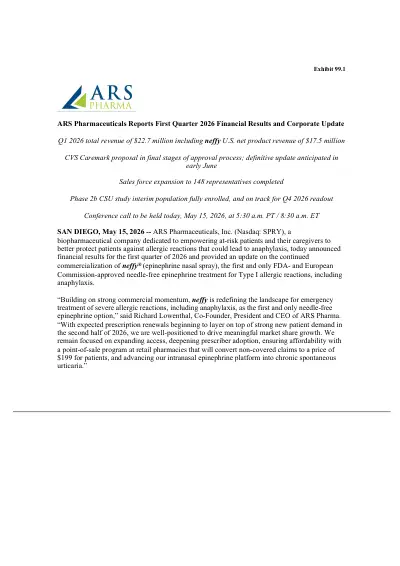
Morning and thank you for joining our first quarter 2026 earnings conference call. With me on the call are Richard Lowenthal, our Co-Founder, President and CEO; Eric Karas, our Chief Commercial Officer; and Kathy Scott, our Chief Financial Officer.
Earlier this morning, we issued a press release detailing our financial results and commercial highlights for the first quarter of 2026. That press release and our slide presentation are available in the Investors and Media section of our website.
Before we begin, please note that today's remarks may contain forward-looking statements. Actual results may differ materially.
Please refer to our press release and SEC filings for further risk disclosures. With that, I'll turn the call over to Rich.
Richard Lowenthal
Thank you, Justin, and good morning, everybody, and thank you for joining us on the call. We're off to a strong start in 2026 following our first full year as a commercial company and building momentum across the business.
During the quarter, we continue to focus on key drivers of growth, which are expanding access, making neffy more affordable to patients and caregivers, increasing prescriber adoption, and strengthening consumer awareness. We have made progress in further positioning neffy as a differentiated and increasingly scalable treatment within a large market of Type I allergic reactions, including anaphylaxis.
In the first quarter, we generated $22.7 million in total revenue. This includes $17.5 million in US net product revenue for neffy, which represents three times the volume of neffy prescriptions year-over-year and more than double the revenue.
Our sales growth in the first quarter is a positive achievement, given that the first two months of the year are typically the lowest volume period for epinephrine. This is due to the reset of health insurance deductibles on January 1st.
As additional context, epinephrine is in a mature, refill-driven market where approximately half the prescriptions are renewals typically written electronically without an office visit. As a new entrant, neffy has largely relied on new in-office prescriptions to date.
We are now beginning to see shifts in the underlying market dynamics with improved payer access, reduced prescribing friction, and maturation in the refill cycles for our installed base. These factors, alongside the growth we've seen in demand, prescriber engagement, and patient uptake, provide the foundation for more consistent and scalable long-term growth going forward.
Our neffy priorities remain focused on three areas: access, affordability, and adoption. Starting with access, the primary barriers influencing prescriber adoption in this category are the prior authorization process and perceived misperceptions about out-of-pocket costs.
Even when prior authorization approval is obtained, the process creates friction that can delay or deter prescribing. Addressing these barriers is critical focus for this year.
We ended the first quarter with approximately 90% commercial coverage, of which 57% was without prior authorization. At the state level, Florida, a bellwether Medicaid state, has added neffy to its unrestricted formulary effective July 1st, with many additional states progressing towards adding neffy to their preferred drug lists.
This brings us to a total of nine states covering neffy under Medicaid. The most consequential recent development is at CVS/Zing, which covers Caremark, Aetna, and Anthem.
Based on feedback from CVS in late April, we submitted an updated proposal to add neffy to their commercial formularies, removing the PA requirement and targeting a July 1st effective date. This proposal is now in the final stages of the formulary approval process.
Based on the anticipated timeline to approval, we should be able to provide more definitive updates within the next few weeks. This timing has been extended beyond the original expectations due to the focus of PBMs on new legislation and the ongoing FTC-related interactions.
Given Caremark's coverage and the typical alignment of Aetna and other Zing-related plans, a neffy formulary addition would meaningfully expand access for patients this summer and bring the proportion of covered lives without prior authorization in line with other epinephrine auto-injector products. In addition to our work with Caremark, we recently launched a new initiative to help make neffy more affordable for patients.
We anticipate this will further improve healthcare provider willingness to prescribe neffy by addressing the misperception of high out-of-pocket cost for patients. This new system gives patients the ability to get the neffy $199 cash price directly through retail pharmacies.
Historically, the $199 cash price was available only through our specialty pharmacy and telehealth channels. Patients whose prescriptions were not covered by commercial insurance and who filled neffy at retail pharmacies could be quoted the product's WAC price plus pharmacy markup fees, in some cases resulting in out-of-pocket costs of over $1,000.
These high retail prices created confusion and impacted prescribing decisions. Under the new program, our patients with rejected commercial claims who fill their prescriptions at retail pharmacies will pay no more than a $199.
We expect this program will increase the number of neffy prescriptions that are purchased by the patient and will help align healthcare provider perception with the reality of neffy's maximum $199 cash price. This is completely in line with other epinephrine auto-injector products.
With the introduction of the $199 retail pharmacy cash option and CVS progressing through the final stages of its approval process, we believe that the proportion of covered lives with access to neffy without prior authorization is positioned to expand meaningfully over the coming months. As payer access continues to improve, prescribing patterns should strengthen, particularly as we approach the back-to-school season.
Together, these initiatives are expected to support sustained, broad-based adoption with the commercial impact building progressively through the second half of 2026 and 2027. Turning to adoption, we intend to deepen our reach within the highest-volume prescribing practices and to build a durable patient base.
In May, we expanded our sales force to 148 people with a focus on prioritizing accounts that drive the greatest prescription volume. As the patient base matures and product reaches expiration cycles, we expect refill contributions to scale later this year and into 2027.
At the end of March, the minimum age restriction was removed from the neffy label by FDA, enabling pediatric patients who are greater than 33 pounds and under four years of age to get access to treatment. We believe pediatric adoption will accelerate further as the recently approved broadened FDA label takes hold and real-world evidence of effect continues to build.
Further, through our growing neffy in schools program, there have been over 200 successful uses of neffy in treating anaphylactic episodes reported by school nurses with very positive feedback. These experiences are helpful in building greater comfort and familiarity with neffy among patients and caregivers, who often consult their school nurses, as well as with prescribers.
Beyond the US, our partners continue to position neffy for market adoption in other geographies. Most recently in April, Health Canada approved neffy as the first and only needle-free emergency treatment for allergic reactions, including anaphylaxis, with commercial launch by our partner ALK later in 2026.
Just before that, in March, the European Commission granted marketing authorization for EURneffy 1 mg, further extending the neffy access for younger children at risk of anaphylaxis in the European region. Overall, we are well positioned heading into the important summer months and second half of this year to take full advantage of expanded access and improved affordability for neffy.
Let me now turn the call over to Eric to share more details of our commercial execution.
Eric Karas
Thanks, Rich. In 2026, we continue to evolve our commercial execution in response to market dynamics.
We are confident that these efforts will help us increase neffy market share. There are currently about 120,000 patients using neffy in the US.
29,500 of them were added in the first quarter. However, there are still many patients with suboptimal care and significant opportunity to grow the market as we implement our commercial strategy focused on access, HCP adoption, and consumer engagement.
The biggest takeaway from our first full year in the market is that commercial success is driven as much by ease of prescribing as it is by product differentiation. We know that the biggest way to enhance the ease of prescribing is to address prior authorization requirements.
This is crucial not only because many PAs are denied, but also because the process disrupts prescribing patterns in a high-volume category with millions of prescriptions written each year. Since many of those prescriptions are written quickly and often electronically, even small amounts of friction can disproportionately impact prescribing behavior.
We have implemented additional support programs to help doctors complete prior authorizations more efficiently, without disrupting their existing office workflows. By doing so, we can ensure that patients do not arrive at the pharmacy only to find that their claim has been rejected and that a PA needs to be written after their visit.
The goal is to minimize prior authorizations and simplify prescribing. We are building our commercial plans around the current view and evolution of the access environment.
As Rich noted, our CVS Caremark proposal is in the final stages of the approval process, and we expect to share more in the weeks to come. In addition, our new retail conversion program works at the point of sale to reduce abandonment when a commercial claim is rejected.
This program converts a denied claim into a cash price of $199. We believe this will reduce the burden on healthcare providers and their patients, while increasing prescriptions due to the simplicity of directing patients to retail.
We expect to see an important cyclical effect here. As HCPs prescribe neffy more, there will be more claims covered by insurance, which will help establish a solid base of patients who benefit from becoming neffy users, who then become a patient base for future refills.
All of this is well-timed ahead of the back-to-school season, which is typically the busiest period for prescriptions. We stand well-prepared for that season this year.
On the Medicaid side, we have secured unrestricted coverage for patients in nine states, most recently in Florida, which is among the top five states in the epinephrine market. In other states where Medicaid coverage still requires prior authorizations, we are collaborating with state-level decision makers to gain agreement on preferred formulary coverage.
Updated proposals, similar to the one approved by Florida Medicaid, have been well received. We are in active discussions with multiple states and state pooling groups, and expect to achieve unrestricted coverage in the majority of Medicaid programs by early 2027.
Given Medicaid currently accounts for roughly a quarter of the overall epinephrine market, this will be a meaningful expansion. As we gain preferred drug status in more states, we expect to increase our market share and grow the segment simultaneously.
This growth is driven by unmet needs and undertreatment in the Medicaid population, with affordable copays ranging from $0 to $5. Our goal is to translate the improvement in access into increased prescribing amongst the highest decile HCPs.
In high-volume practices, prescribing is driven by workflow as much as clinical preference. Over the quarter, we had strong engagement with prescribers.
More than 28,000 HCPs have prescribed neffy, and approximately half demonstrate repeat use. Our metrics show that prescribing continues to be concentrated amongst the highest decile accounts, reinforcing that adoption is occurring where it matters most.
To ensure that neffy is consistently at the forefront of decision makers and awareness is high across targeted practices, we have expanded our sales organization to 148 representatives and area sales managers, enabling more frequent engagement and deeper interactions with office staff. This support includes assistance with prior authorizations and the conversion of electronic refill requests, resulting in tighter alignment between access wins and field activities.
Our representatives have also established stronger relationships with HCPs and their staff to address back-to-school questions, and we're providing more information about neffy in waiting rooms and exam rooms to help healthcare providers educate their patients and encourage inquiries about neffy. We are implementing significant awareness strategies targeting parents, particularly mothers, through our direct-to-consumer efforts and social media campaigns.
Our media efforts have been aimed at the best targets across various media, and we understand they are effectively reaching our target audience. To maximize patient adoption and requests for neffy, this will continue to be an important area of strategic investment.
Our virtual Get neffy program is also helping to grow our market share by reducing obstacles for patients. It allows them to take action without needing a traditional office visit and provides us with valuable data about our customer base.
We've learned that these patients tend to be older than our overall demographic, we are implementing targeted direct-to-consumer marketing to effectively reach this audience and simplify their access to neffy. Over time, another primary driver of scale will be the participation in refill behavior.
Starting this summer, families will begin renewing their neffy prescriptions to make sure they do not have a product that expires midway through the school year. This annual market aspect will continue to expand and is a key driver of neffy's volume and market share, as well as establishing a self-sustained model to grow the patient base.
We're better positioned this year to take advantage of the increased summer volume, as this is our second back-to-school season and our execution continues to sharpen. In summary, for prescribers, our sales force is in the field working to drive market growth, improve patient access, and capitalize on market access wins.
We're introducing more solutions to simplify the process for healthcare professionals and their staff, ensuring patients can obtain neffy at retail pharmacies. For patients and families, we have increased targeted direct-to-consumer media for the back-to-school season, including linear and connected TV, digital platforms, social media, and testimonials designed to drive greater awareness and direct requests for neffy.
For payers, we believe the CVS Caremark process is nearing completion, and we've continued to expand access through Medicaid initiatives and favorable decisions. I'll now turn the call over to Kathy to cover the financials.
Kathy Scott
Thank you, Eric. I'll focus my comments on how our financial performance in Q1 reflects the continued evolution of our business, particularly as improvements in access and execution begin to translate into greater visibility, predictability, and operating leverage.
For the first quarter of 2026, total revenue was $22.7 million, including $17.5 million in US net product revenue for neffy. We had $2.5 million in revenue from collaboration agreements and $2.7 million in supply revenue from our international partners.
The $2.5 million in collaboration revenue from international partners was part of a total $5 million milestone payment from ALK triggered by the approval of EURneffy 1 mg in the EU. The majority of the balance, of $2.5 million, was recorded to the financing liability on the balance sheet.
US net product revenue remains the clearest indicator of neffy demand. As access improves and pending the outcome of the CVS Caremark process, we would expect more consistent prescription capture and improved revenue through the second half of the year.
R&D expenses were $4.3 million, reflecting continued investment in our development programs, including our chronic spontaneous urticaria study. SG&A expenses were $72.2 million, reflecting our commercialization investments across DTC and field execution.
We are continuing to refine how we allocate those resources. As we move further into 2026, the focus is shifting from infrastructure build to optimizing spend toward the highest-return commercial activities.
This is reflected in the expansion of our sales force in May, which is being funded through reallocation of existing resources. We continue to expect our overall SG&A run rate for 2026 to be slightly higher than the run rate for the second half of 2025.
Turning to gross-to-net, we remain in the low-to-mid 50% range and continue to target approximately 50% at a steady state. Importantly, the economics underlying our CVS Caremark proposal are in line with our overall long-term gross-to-net retention target.
We ended the first quarter with $201 million in cash, cash equivalents, and short-term investments. This provides flexibility to support commercial execution, pipeline advancements, and progress toward cash flow break-even.
As a reminder, this is a refill-driven category where adoption builds over time. Accordingly, we expect revenue to be weighted toward the second half of the year as we start the back-to-school season, prescribing patterns evolve, and early refill dynamics begin to contribute.
In summary, we are building a more predictable commercial franchise with neffy, with disciplined spending and a clear path to profitability. We remain focused on sustained, durable growth.
Let me pass the call back to Rich for closing remarks.
Richard Lowenthal
Thank you, Kathy. It's been a strong start to 2026, and we're underway on multiple workstreams to continue to build and grow our neffy business.
We expect neffy prescription growth to expand with the new initiatives we discussed that reduce provider and patient friction, and which support current analyst consensus. A favorable CVS Caremark decision would only further accelerate our trajectory.
I'm encouraged by the progress we've made and confident in our ability to execute in the months ahead. Thank you for joining us.
Operator, please open the line for questions.
Operator
Thank you. Ladies and gentlemen, if you have a question or a comment at this time, please press *11 on your telephone.
If your question has been answered or you wish to remove yourself from the queue, please press *11 again. We'll pause for a moment while we compile our Q&A roster.
First question comes from Roanna Ruiz with Leerink Partners. Your line is open.
Roanna Ruiz
Hey, morning, everyone. I have a few questions for me.
First one, just on the CVS coverage front and the goal of removing prior auths, can you talk a little bit more about your level of conviction there going into the July 1 effective date? Could you explain a little bit more about how that could tie in with the back-to-school surge expectation later this summer?
Operator
Rich, could you check your mute button? We can't hear you.
Eric and Kathy, are you guys still there? Oh
Eric Karas
yes, I can hear you.
Operator
Okay.
Kathy Scott
Eric, do you want to take that until we hear back from Rich?
Eric Karas
Sure. Roanna, good morning.
As Rich mentioned and in my comments as well, we are nearing the approval process with CVS Caremark. When we look at what they represent in terms of the number of covered lives, CVS is 15%, Anthem is 5%, and Aetna is 4%.
We do feel confident on the conversations that we've had with them. As Rich said, the updated proposal that we provided back in April, this would align nicely with kind of that July 1st start and all the initiatives that we have going on through marketing, through our DTC campaign, as well as our field force in terms of messaging and focusing on the top 12,000 physicians out there that really represent about 50% of the overall prescriptions.
Roanna Ruiz
That helps. I noticed you were talking a bit about the refill contribution in the prepared remarks.
Can you talk a bit about what magnitude of lift we might expect from refills going into later this year, and potentially how should we think about that trend in 2027?
Eric Karas
Rich, are you on yet?
Richard Lowenthal
I was on, but it wasn't working.
Eric Karas
Can you hear me now? You can take this.
Richard Lowenthal
Okay. We would expect that our lots expire kind of at the end of the year, beginning of next year, the initial launch lots.
However, many parents are going to need to get renewal prescriptions over the summer to have a prescription that lasts for the full school year. We would expect that to start to contribute over the summer period for the peak season.
Roanna Ruiz
Got it. The last question for me, it sounds like a lot of the high-decile accounts are prescribing neffy.
When would you expect a little bit more broadening of prescribing to the lower-decile accounts, thinking about all your initiatives that are going on right now and how that could progress into the future?
Richard Lowenthal
Eric can speak to this more, but I think that's already happening with the expansion of the base of physicians that have prescribed. As we've described in the past, typically there's a period of time where they're adopting a product, they try it out, they trial it, and then after they get comfortable they become more of a frequent prescriber.
By seeing that very broadening of the prescriber base, I think we're already seeing that type of action.
Eric Karas
I would just add, Roanna, to the point Rich was making too, we have over 28,000 physicians that have prescribed the product. Obviously we're focused on about 12,000.
Our partnership with ALK in the US is focused on about another 8,000. I think a lot of our non-personal promotion, DTC, is also getting to those physicians.
We do a significant amount of advertising through HCP media as well at various conferences. We do see higher shares as I mentioned in our high-volume decile accounts, but we're also seeing traction with some of the lower decile, which they're not seeing as many patients on a monthly basis, but we are seeing some share growth in those groups as well.
Roanna Ruiz
Makes sense. Thanks a lot.
All right.
Richard Lowenthal
Thank you.
Operator
One moment for our next question. Our next question comes from Lachlan Hanbury-Brown with William Blair.
Your line is open.
Lachlan Hanbury-Brown
Thanks for the question. Maybe just building off on that last point there, Eric.
How should we think about market share growth sort of now into summer? Obviously, getting more coverage will probably be a big factor in that, but even before that, with the expanded sales force in the field, should we expect to see market growth or market share growth over the next couple of months
Richard Lowenthal
for [unclear]? Lachlan.
We are expecting to see meaningful market share growth, and our projections at least are that we would be on track with current consensus, even without Caremark. Caremark would add to that, of course, but we're fairly confident that we're going to be seeing the necessary market share growth week-over-week, month-over-month.
One thing I will add as we kind of speak about through analyst consensus, not necessarily the year numbers, but our proportions of the allotments to various quarters, because based on press releases for example, if we compare to last year, the back-to-school is probably a little bit on the high end, and third-fourth quarter is probably a little bit on the low end. That will probably be adjusted as guidance on how to proportion the consensus numbers into the different quarters.
Eric Karas
Lachlan, I'd just add to Rich's comments there. I think when you think about the programs that we mentioned in terms of streamlining prescribing, simplifying it, we believe there's definitely a halo effect there of making it easier for the doctors, for staff, and for patients to get this.
Our existing sales team is well-trained. This is the second season for back-to-school, really strong relationships, tightening the messages as well and making sure we're pulling through the market access wins.
Then when you think about the new team, they've been trained, they've been out in the field for a couple weeks now, and they have all the same materials and approaches and strategies for the office. We feel confident again going into the back-to-school season.
Great, thanks.
Lachlan Hanbury-Brown
Maybe I realize it's probably still early, but have you seen any sort of traction or positive metrics in the efforts you're making to try to penetrate the electronic refill market?
Richard Lowenthal
Eric, you want to take that?
Eric Karas
A lot of this really has to do with each office and what the representative can establish with the folks that deal with electronic refills in the office. We are focusing on that to make sure that we can interrupt that process.
Often it is messaging from one of the nurses or somebody that is in the office that takes those calls or takes them electronically. We have implemented certain things into EHR systems, smart phrases, when the prescription comes in, there's some advertising and some information about neffy that pops up and kind of interrupts that process as well.
We'll continue to do that, but I think the combination of the other things that we talked about, access, these programs that make it even easier where again they can send it to retail, if there is any type of rejection, it flips over to 199, is going to help us get more of those prescriptions.
Lachlan Hanbury-Brown
Great, thanks. Maybe a final one, I know we've talked a lot about CVS and there's been a lot of focus on that, but I think Rich, you'd also mentioned in the past a few other smaller plans that you were maybe expecting wins in the first half.
Is there any updates there on those sort of smaller commercial plans outside of CVS Caremark?
Richard Lowenthal
Yes. The smaller ones we're focused on are mainly the Blue Cross companies, and of course we're also working very hard with Medicaid, and that's progressing very, very well.
We will still be working to get additional state Blue Cross companies across the finish line coming into the summer season.
Operator
Thank you. One moment for our next question.
Our next question comes from Ryan Deschner with Raymond James. Your line is open.
Ryan Deschner
Thanks for the question. Can you walk us through your strategy for raising awareness among physicians and pulling through to sales after the point you're able to potentially close on the deal with Caremark, and then have a follow-up question.
Richard Lowenthal
I can talk a little bit to that and Eric can follow up with additional, but so we are positioned with our sales force and also marketing teams to make sure we get out there ahead of the summer, ahead of when it goes on formulary, to inform doctors that the coverage will be changing and exactly where. We have a lot of also tools for the doctors that we already have implemented or we are implementing, which will help not only with them prescribing so that they know who's on formularies that are covering neffy, but also with those formularies that are still not covering neffy to help with prior authorizations.
The marketing and sales team are pretty much aligned and ready to go with that once we get final confirmation from CVS Caremark, we will be able to implement that very quickly and get ahead of it so that doctors are aware that the formulary will change as of July 1.
Eric Karas
Just to build on that to Rich's comments, as I mentioned, we're more focused on 12,000 physicians plus about another eight or nine on the ALK side. Ryan, to all the points around messaging and resources, we have the materials ready to go, we can just press the button and hit that switch.
A lot of it is really focused on the prominence of majority of commercial patients are covered, $0 copay, send it to retail, this is a smooth and easy process for you and your staff and for your patients. In addition to that, the marketing team also has broad media, whether it's online search, banners, education online, and the prominence of the coverage is going to be a focal point.
We still want to make sure that we're selling on all the attributes that make neffy a better option in terms of safety, size and portability, temperature excursions and shelf life, but that front and center around the coverage is going to be critical. Then we also implemented, in addition to traditional speaker programs with healthcare providers, speaker programs for staff members that do a lot of the operations in the office, whether back to the point around electronic refill, any back-to-school stuff, handling anything, we want to make sure that they're on board with everything around the product and how to easily get it for their patients.
Ryan Deschner
Got it. Thank you.
The other question, a few parts to the automated conversion process for denied claims. Curious kind of how this works operationally.
Is it still being rolled out or is it already rolled out, and what proportion of scripts are currently being abandoned, and how big of a impact do you think this will have on those script volumes in the near term?
Richard Lowenthal
Again I'll start out and then Eric can add in on some of the statistics, but we've already implemented, actually just recently, just in this week it's been implemented at the pharmacy level. Right now, we think that will have a significant impact, and a lot of it is just the noise.
We've always had the $199 option and we've made doctors well aware of that and how to get the $199 option, but when you think about it, if a patient gets a prescription, goes to the pharmacy, they don't know if they're covered yet or not at that point, and they get a very high retail price from the pharmacy, it's very negative, and it comes back to the doctor as a negative situation, right? This would at least convert that immediately at the pharmacy level to a $199 price, which doctors feel is very reasonable.
It's consistent with cash prices for auto-injectors, and even less than Auvi-Q's cash price. That would expected to temper a lot of that negative noise to the doctors about the price, but it would be automatic at the pharmacy level.
Patient would never see that retail price. They would automatically at most see a $199 price.
They would still in some cases come back to the doctor and ask for the prior authorization, but at least they're not getting those very high retail prices, which could be as high as $1,000 at some pharmacies.
Eric Karas
Rich, I could just add a few points to that as well. Yeah.
Ryan, there's three main vendors that do this type of work, as Rich said, at point of sale, it's done instantaneously. If the prescription comes in, it's a covered claim, they get their copay, "Hey, it's $10."
If it's anything on the back-end rejection, it doesn't even go through that, it just says, "Here's the price." These three vendors, we already work with them for our copay program, these are well-established programs, they work smoothly, there's no interruption where the pharmacist says to the patient, "Hey, you're not covered in this, and we can do that."
This makes it a lot easier. They cover about 90% of pharmacies, it's a pretty good coverage.
About 55% of our prescriptions right now are going through retail; the other 45% are going through our Blink program, but we anticipate that to go up as we get more coverage and make this easier for doctors where they could just send their patients to retail. The abandonment that we see in the category overall is very similar for neffy.
It's in the mid 22%, 23%, but then you also have patients that when it is a rejected claim, there are a lot of patients that are lost to follow-up where nothing really happens or they go back to their treatment. We think this is a really simple solution.
It's something that is easy to implement, and again it's all about making the prescribing process to simplify it, but making sure when a doctor writes this that the patient gets it, and making it easy for their staff as well. It's a really simple message that our reps and through our other promotion we're obviously directing to healthcare providers and their staff.
Ryan Deschner
Thanks, Eric. Thanks, Rich.
Operator
One moment for our next question. Our next question comes from Josh Schimmer with Cantor.
Your line is open.
Josh Schimmer
Great. Thanks for taking the questions.
First, for the comment about being funded to break-even, maybe you can help us with some of that math given the burn this quarter and cash position. It doesn't seem entirely obvious to me how you get there.
Then second, what was the royalty payment from ALK in the first quarter? I was unable to find that in the 10-Q.
Thank you.
Richard Lowenthal
I I think we we in our projections we'll get to cash break-even by mid 2027. We expect our our, loss to go down over time.
First quarter, as I mean looking at this quarter is the worst quarter of the year historically for epinephrine, in our case last year it was 11% of our annual sales. I think we we believe that through the second half of this year the loss will be significantly less, giving us runway into into next year, and we'll have break-even sometime before the before the middle of next year, first half of the year.
That's our projections right now. Again, I think it depends on that allocation of how you're looking at funding across the quarters.
We are also, Josh, looking at our burn. Dawn Casale will be coming in soon, and we're having a lot of discussions about how to reallocate funding to what's giving us better return on investment.
We now have a lot of experience with our DTC campaign, and we may end up moving some of that money around and even cutting some of the expenses. That will be something that's ongoing, and will also help us achieve that goal.
Kathy Scott
Josh, with respect to the ALK payment, it was less than $100,000 for the quarter. Which is the reason we didn't call it out in the quarter.
ALK is really just getting up and running with multiple countries, and so they're just starting their run rate, we do expect that to grow going forward.
Josh Schimmer
Got it.
Operator
Thanks. I am not showing any further questions at this time, and as such this does conclude today's presentation.
We thank you for your participation. You may now disconnect and have a wonderful day.