SPX Technologies, Inc.
Q3 FY2026 · Earnings Call TranscriptOctober 29, 2026
Operator
Good day, and thank you for standing by. Welcome to the Q3 2026 SPX Technologies earnings conference call.
At this time, all participants are in listen-only mode. After the speakers' presentation, there will be a question-and-answer session.
To ask a question during the session, you will need to press *11 on your telephone. You will then hear an automated message advising that your hand is raised.
To withdraw your question, please press *11 again. In the interest of time, we ask that you limit yourself to one question and one follow-up.
Please be advised that today's conference is being recorded. I would now like to hand the conference over to your first speaker today, Johann Rawlinson, Vice President, Investor Relations.
Johann Rawlinson
Thank you, operator, and good afternoon, everyone. Thank you for joining us.
With me on the call today are Gene Lowe, our President and Chief Executive Officer, and Mark Carano, our Chief Financial Officer. A press release containing our third quarter results was issued today after market close.
You can find the release and our earnings slide presentation, as well as a link to a live webcast of this call, in the Investor Relations section of our website at spx.com. I encourage you to review our disclosure and discussion of GAAP results in the press release and to follow along with the slide presentation during our prepared remarks.
A replay of the webcast will be available on our website. As a reminder, portions of our presentation and comments are forward-looking and subject to safe harbor provisions.
Please also note the risk factors in our most recent SEC filings. Our comments today will largely focus on adjusted financial results, and comparisons will be to the results of continuing operations only.
You can find detailed reconciliations of historical adjusted figures from their respective GAAP measures in the appendix to today's presentation. Our adjusted earnings per share exclude intangible amortization expense, acquisition and integration-related costs, and non-service pension items, among other items.
Finally, we look forward to meeting with investors at various events during the upcoming months. With that, I will turn the call over to Gene.
Gene Lowe
Thanks, Johann. Good afternoon, everyone, and thank you for joining us.
On the call today, we'll provide you with an update on our consolidated and segment results for the third quarter of 2026, as well as an update on our full-year outlook. We delivered a strong third quarter.
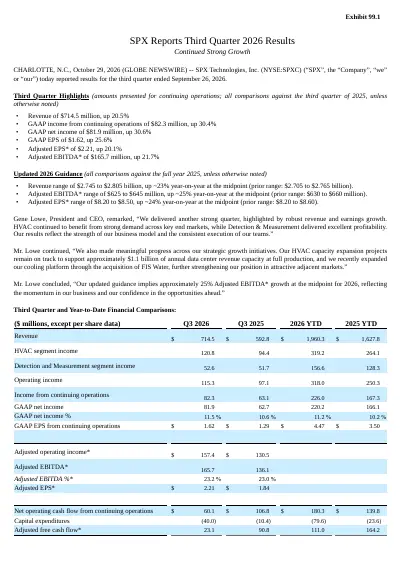
Adjusted EPS grew by 20%, marking the fifth consecutive quarter of a 20%-plus year-over-year growth. Our HVAC segment delivered excellent growth during the quarter, driven by strong demand in core end markets and the continued execution of our capacity expansions.
The D&M segment delivered another quarter of strong margin performance. Our recent acquisitions are performing well and delivering on our strategic objectives.
Inorganically, we recently announced the addition of FIS Water to the HVAC segment. This acquisition complements our existing cooling product offering and expands our capabilities in attractive adjacencies.
Finally, we are updating our guidance to reflect our third quarter results and outlook for the fourth quarter. At the midpoint, our updated guidance implies approximately 25% adjusted EBITDA growth for the full year, reflecting continued momentum in both segments.
Turning to our high-level results for the quarter. We grew revenue by 21% and adjusted EBITDA by 22% year-over-year, primarily driven by robust organic growth in the HVAC segment, strong margin performance in the D&M segment, and the benefit of recent acquisitions.
In HVAC, we experienced the effects of higher-than-forecasted growth-related inefficiencies resulting from an increasing ramp in production levels necessary to meet accelerating customer demand, as well as elevated input costs. As always, I'd like to update you on our value creation initiatives, starting with our organic growth activities.
The capacity expansions across our HVAC facilities to meet the strong demand for our data center and custom air handling solutions remain on track with the timeline and capital requirements previously outlined. We continue to expect approximately $1.1 billion of total data center capacity once at full production.
Importantly, Madison commenced assembly activities during the quarter, shipping both Olympus MAX and Ingenia products, and will ramp its production throughout the balance of the year. Turning to new product innovation, our heat trace launch is gaining momentum, providing a new avenue for growth across both industrial and commercial applications.
Early customer engagement has been strong, and we see meaningful opportunity to scale the offering through our established channels. Turning to FIS Water, this acquisition enhances our cooling platform with complementary water management and control solutions that broaden our offering to customers and strengthen our position in attractive end markets, including data centers.
These products are typically paired with cooling towers. We believe FIS Water will benefit from SPX's global channels, OEM relationships, and specification-driven sales capabilities, creating additional opportunities for growth.
We welcome the FIS Water to the SPX team, and with that, I'll turn the call over to Mark to review our financial results.
Mark Carano
Thanks, Gene. Our third quarter results showed strong growth.
Year-over-year, adjusted EPS increased by 20% to $2.21. For the quarter, revenue increased 20.5% year-over-year, with 11.8% organic growth, 8.5% inorganic growth, and a negligible FX tailwind.
Adjusted EBITDA increased by $29.6 million, or 21.7%, to $165.7 million, primarily driven by strong organic growth and the benefit of recent acquisitions. Adjusted EBITDA margin increased by 20 basis points to 23.2%.
In our HVAC segment, revenue grew by a record 35.5% year-over-year, with 13% inorganic growth and a negligible FX tailwind. On an organic basis, revenue increased 22.3%, driven by growth in both heating and cooling, including strong growth in data center volumes.
Segment income grew by $26.4 million, or 28%, primarily driven by strong organic volume and acquisitions. Segment margin declined approximately 140 basis points, principally due to the growth-related inefficiencies and elevated input costs that Gene noted earlier, with the former primarily associated with additional labor and outsourcing costs.
Segment backlog, on an organic basis, increased 69% year-over-year, 15% sequentially, to approximately $1.1 billion, crossing the $1 billion mark for the first time. In our Detection & Measurement segment, revenue decreased 7.7% year-over-year, largely due to the prior-year period benefiting from project timing, as highlighted in prior earnings calls.
Segment income increased by approximately $1 million, or 1.7%. Segment margin increased by 260 basis points.
The increase in margin was largely driven by favorable project mix and continued benefits from our segment synergy initiatives, as well as a commercial resolution with a customer. Segment backlog ended the quarter at $322 million, up 3% sequentially.
Turning now to our financial position at the end of the quarter. We ended Q3 with $121 million of cash on hand and total debt of $1.3 billion.
Our leverage ratio, as calculated under our bank credit agreement, was approximately 1.8 times at quarter-end, including the impact of the acquisition of FIS Water. Year-to-date, adjusted free cash flow was $111 million.
Moving on to our full-year 2026 guidance. We are lowering the top end of our full-year adjusted EPS guidance range to $8.50, resulting in a midpoint of $8.35.
This update reflects our revised outlook for both segments and modest accretion from FIS Water. For HVAC, we are increasing our revenue range to incorporate the addition of FIS Water and modestly higher organic volume.
The revised segment margin range for HVAC reflects the impact of growth-related inefficiencies and elevated input costs experienced in the third quarter, as well as the expected impact of these items in the fourth quarter. For D&M, we are updating our segment margin range to reflect our results for the third quarter and revised forecast for the fourth quarter.
As always, you will find our updated 2026 guidance on this slide and modeling considerations in the appendix to our presentation. With that, I'll turn the call back over to Gene for a review of our end markets and his closing comments.
Gene Lowe
Thanks, Mark. Current market conditions continue to support our 2026 outlook, which implies approximately 25% adjusted EBITDA growth.
In HVAC, core end markets remain healthy, including robust demand for our data center solutions. In Detection & Measurement, our run rate demand remains healthy, while the project-oriented businesses continue to see an active front log.
In summary, I'm pleased with our strong third quarter growth in revenue and profit. As we look to the rest of 2026, we expect to continue to drive additional shareholder value through both our organic and inorganic initiatives, including our ongoing efforts to expand capacity and deliver on our data center demand, the integration of FIS Water and our other recent acquisitions, which further scale our HVAC platforms and strengthen our positions in key end markets, and an active pipeline of attractive acquisition opportunities.
Looking ahead, I'm excited about the opportunities in front of us. With differentiated businesses, attractive end markets, and an experienced team, we believe we're well positioned to deliver sustainable, long-term shareholder value.
With that, I'll turn the call back to Johann.
Johann Rawlinson
Thanks, Gene. Operator, we will now go to questions.
Operator
Thank you. At this time, as mentioned, we'll conduct the question-and-answer session.
As a reminder, to ask a question, you'll need to press *11 on your telephone and wait for your name to be announced. Please also note to limit yourself to one question and one follow-up.
If you'd like to withdraw your question, please press *11 again. Please stand by while we compile our Q&A roster.
Your first question comes from the line of Andrew Obin with Bank of America. Your line is now open.
Andrew Obin
Yes. Good afternoon.
It's been a really long day. Sorry about that.
Mark Carano
Hey, Andrew. I understand.
A lot of guys going today,
Andrew Obin
so. Sorry.
Maybe we can talk about these inefficiencies in terms of the ramp. As we look at sort of the guide for your HVAC, HVAC certainly seems like they will continue into the fourth quarter.
Can you just describe what are you seeing, and what's the rate? Is it going to get better in the fourth quarter?
Is it sort of continues to get worse? What sort of stops and reverses it?
Thank you.
Mark Carano
Andrew, thanks. I figured you'd ask that question, and let me just put a little context around this.
As I think right, we've seen tremendous growth in our HVAC business this year. Our cooling platform is going to grow by 30% or so in the second half organically.
We've just been seeing accelerating demand right through the year and really into next year. As we began to ramp our capabilities to really meet this demand, and we rolled into the third quarter as that sort of unfolded, quite honestly, I don't think we felt like our capabilities or our productivity was ramping fast enough.
Really as a result of that, we made a decision, it was an intentional decision, to kind of accelerate our hiring and secure additional suppliers to ensure that we can meet the demand that's out there, really for the balance of this year and really set us up for next year as we look into what should be another strong year, particularly around data center, but across HVAC growth. That was really kind of the context of it, the background.
We do expect these, obviously, to continue on into Q4, you'll see that impact through the balance of the year. What I would say, though, as you kind of look into next year, right, my expectation is this labor will get more productive, and we'll begin to see efficiencies off of that.
That said, we will be hiring as we continue to ramp the facilities. Then on the outsourcing front, we're increasing our outsourcing, but as the equipment we have comes online, particularly at Madison, and we begin to insource more of that, you should see that come more online and be insourced more within our plant facility.
I caveat that with demand is still very strong. If we've got the capability to kind of drive and serve our customers, we're going to be balancing that with outsourcing.
This is really around metal fabrication, you know.
Andrew Obin
Okay. Then maybe we can talk about the state of the supply chain because I think a number of HVAC companies have reported already, and it sort of seems a long list of things.
You have a somewhat different product exposure, but I would imagine you're impacted by some of it. What has been your experience, and once again, how do you feel about the state of supply chain at the end of the third quarter and into the fourth quarter and early '27?
Thank you so much. Look, I appreciate that it was not an easy quarter, and you made the numbers.
Don't mean to take away from all the hard work that the team is doing, and the growth is terrific, but just want to sort of focus on these issues. Thank you.
Gene Lowe
Thanks, Andrew. I think, if you look at the supply chain, I think in general, as Mark had alluded to, you are seeing a tremendous amount of growth.
That is putting more pressure on the supply chain in general. I think if you look at our supply chain, I don't think we have anything material that has been a significant impact to us as we look in Q3 and Q4.
The biggest impact is the specific supply chain items that Mark has really alluded to is a lot of what we were doing ourselves. Our metal fabrication, with the size and scale of the growth, we did have to outsource some of that to meet customer requirements.
Overall, we feel like our supply chain is in good shape, but we are keeping a close set of eyes on it. Anything else, Mark, you'd kind of—
Mark Carano
I think the only other thing I would add to that is, particularly in what you were just referencing, right, where we're expanding our sourcing on some of this outsourcing that we are doing. As we go to secondary suppliers with lead times that are appropriate for meeting this demand, just given the environment we're in, it's coming in at a higher cost than I think we would have originally thought.
Andrew Obin
Terrific. Great answer.
Appreciate it. Thank you.
Gene Lowe
Thanks, Andrew.
Operator
Thank you. Your next question comes from the line of Bryan Blair with Oppenheimer.
Your line is now open.
Bryan Blair
Thank you. Good afternoon, guys.
Mark Carano
Hey, Bryan.
Bryan Blair
I'd like to stay on HVAC margins for now. I guess approach it a little bit differently.
Is there a way to parse out the impact of growth-related inefficiencies versus direct inflationary or price cost pressure in Q3? If so, are you willing to size that either on a dollar or margin basis?
Then, similarly, how are you thinking about Q4 on that front?
Mark Carano
Bryan, I'll start. Listen, I think if you look year-over-year, in the margin change, Q3 of last year, Q3 of this year, you would see that about 2/3 of that delta really relates to the volume net of these growth-related inefficiencies, as we call them, and then the balance of it, about another third, really relates to higher input costs or the price cost dynamic that we talked about.
That's how you should think about it. Those are sort of the two pieces for the puzzle there.
As we look into Q4, listen, we're into October. We feel good about the start of the quarter.
Remember, this is an intentional or conscious decision that we made around labor and the sourcing side. We've got our arms around it, we feel, but those costs will impact us in Q4.
That said, the guide will imply about 150 basis points of increase, sequentially. About 2/3 of that is going to be the operating leverage, the increased revenue, again, net of these growth-related inefficiencies, and then the balance of it is going to be from accretion from the acquisitions.
Bryan Blair
Understood. That's very helpful.
Sticking with margins, D&M profitability was eye-catching in the quarter. Full-year segment margin guidance now sits well above the medium-term framework that your team has out.
I understand there's mix favorability to consider for this year, but are we getting to the point where there's been enough structural margin improvement in D&M that the 22% to 24% medium-term margin level target is officially stale at this point?
Mark Carano
That's a great question. We obviously haven't updated that yet, Bryan, but clearly that business has done a very nice job, I think resetting the structural margin profile of D&M.
I expect we'll update that, perhaps as we roll out the guide for next year. No doubt, as we I think talked about in Q2, the business is really running at a higher margin level than that, as you described it, stale guide.
That said, this year has had some unique elements to it. I think as you recall, back in Q1, we had the scope expansion related to a transportation project.
We obviously called out what I would refer to as a kind of discrete or one-time commercial resolution. The mix was attractive this year, kind of relative to a normal mix.
When you think about our guide for 2026, and you sort of take those three elements, which I think we've shared the impact over the last few quarters, that equates to about 175 basis points or so. I think if you pull that out, that kind of gets you to where, I would argue, the structural margins of D&M should be operating at.
Bryan Blair
Understood. Again, very helpful.
Thank you.
Operator
Thank you. Your next question comes from the line of Jamie Cook with Truist Securities.
Your line is now open.
Jamie Cook
Hi. Good evening.
I guess two two questions. One, I understand some of the issues with capacity and inflation, that you lowered the margins for HVAC or are sort of tied to each other.
To what degree do we need to be worried with your backlog growing, that, yeah, backlog potentially it's not an optimal margin level just with inflationary pressures broadly just continuing to get worse? I'm just wondering, as we look to 2027, is there a sort of inflation risk to margins?
Then, I guess my second question, obviously everyone's very excited about data centers, but if you could just talk to what you're seeing in other markets or how you would characterize industrial growth outside of data centers, just sort of your broader portfolio organically. Thank you.
Mark Carano
Jamie, I'll start on your first question, then I'll turn it over to Gene. You're right.
I think, like a lot of folks, we saw a material increase in our input costs in Q3. You think about steel and, frankly, diesel that moved up dramatically that really leaks through the supply chain.
When I think about this year, we're really now kind of roughly price cost neutral on a dollar basis for the full year, but it's clearly had a margin impact as a result. That said, we have been raising price throughout the year.
We continue to look at raising price across all of our HVAC businesses to really offset or mitigate these inflationary pressures. You're right with respect to some of the near-term backlog that we have, and you kind of see that obviously in the margin profile.
That takes some time to pass through to new projects. To the extent some of that backlog, we have the ability to adjust price related to these costs, we will do that.
I think net-net, we will be in a better price cost position next year.
Gene Lowe
We have a lot of the price increases that are already in the backlog now.
Mark Carano
That's correct, yeah.
Gene Lowe
I think we're well positioned as we're set up for Q4 and then the first half.
Mark Carano
Yeah.
Gene Lowe
On the second question, Jamie, I think the markets that we're seeing, overall, we're feeling very favorable. You look at HVAC, obviously data center's very strong.
We're seeing, I would say, even accelerating traction there. We're feeling very good about what we're seeing for this year and next year.
If you look about the other HVAC markets, I would say power, very healthy, a lot of activity. Industrial and semiconductor, very healthy.
Healthcare, pharma. We've seen a good amount of sports and entertainment projects.
Then, I would say commercial replacement activity is very healthy. If we look at what's flat to down, I would say education and government seems to be soft.
New commercial still remains pretty soft. Then chemical, we don't see a lot of activity right now.
Net-net, if you look at HVAC, we're very pleased with the organic growth, and we're both in the core markets and in the data center markets. If you go to Detection & Measurement, I'll give you a quick look by the platforms.
Transportation's very healthy, good growth this year. We have new products.
We feel good about '27 there. Healthy there.
CommTech, we see continued growth. That would really be our biggest brands there, would be KTS and TCI.
L&I, our location and inspection business, I would say is normal, right in that kind of mid-single. The one that I would say is a little bit lower than our normal mid-single would be our Aton business.
We're seeing modest growth there, but we are seeing slower growth in Europe, the Middle East, and Asia. I'd say that'd be the one platform that we're seeing some slower growth, some modest growth, but not the mid-single.
If we look at, as we know, about 15% or so of mid-single mid-teens is data center. Even take that 85% that you're referencing, we feel very good about our normal growth model for our core markets as we look ahead to '27.
I think that'd be a good baseline to think about where we will be for '27 for our HVAC and Detection & Measurement. Then when you layer data center on top of that, that's obviously going to be a very high growth rate.
We're not prepared to, obviously do '27 guidance, but we're seeing good momentum there as we look ahead to '27.
Mark Carano
Net-net,
Gene Lowe
the markets are feeling pretty good.
Jamie Cook
Okay. Thank you.
I'll get back in queue.
Mark Carano
Thanks, Jamie.
Operator
Thank you. Your next question comes from the line of Amit Mehrotra with UBS.
Your line is now open.
Amit Mehrotra
Thanks. Good afternoon, everybody.
I just wanted to—
Gene Lowe
Hey, Amit.
Amit Mehrotra
—I'm doing well. Thank you very much.
I wanted to ask about the supply chain issue, and I know a lot's been talked about, but I wanted to just understand sort of how it came to be in terms of when did you get visibility on it? You're not alone.
A lot of people have had these issues, and I think what's been interesting to me at least is sometimes they sort of come out of nowhere and really bring things down. I know you have the IP, but you do use a lot of contract manufacturing.
I guess my question is, maybe shed some light on when this became really evident to you. Does the use of contract manufacturing weaken your visibility into the tier 2, 3, 4 of the supply chain?
What gives you comfort that the visibility has been kind of addressed?
Gene Lowe
Let me take a cut at that, and we can throw it over to Mark to add a little color. I think specifically with Q3, some of the challenges that we had was, as a reminder, at the end of Q2, we raised our guidance for data center, and we had very high customer demand, and we agreed with the customer to take on approximately $130 million, or the change was very significant change, north of $100 million.
As we ramped up, you're talking ramping several hundred people into the facility. When we're talking about supply chain, this is really our product, our components that we're making.
Think about cut steel, punch steel, that, frankly, we had more demand than our supply. It's pretty typical.
You can outsource cut products, things like that. It's our bill of materials, it's our intellectual property, but there are third parties that do that.
I would say we had a much higher amount of that than we were planning, and I would say the costs of that were higher. I think that, in general, there's a lot of demand on supply chains everywhere.
That's really what happened. What I would say is we have seen very nice improvement in performance.
If you look at our supply chain in September and actually where we are year-to-date in October, we're very pleased with what we're seeing. That's the specific dynamic.
In the macro, what I would say is there is a lot of growth here, you always have to keep an eye on all of your supply chain elements. As we've talked about in the past, if you look at our typical products, most of it is our intellectual property, most of it we own.
If there is a supplier or that we need more capacity, we can actually go out to another supplier that can fabricate that component for us. It gives us a lot more control and flexibility than being typically sole-sourced.
That's not always the case. There are a few times, I know, for example, EC fans is a very hot topic.
Vast majority of our products do not use EC fans, but we do use EC fans in a few areas, in our custom air handling and so forth. We haven't seen the disruption that I think you're well aware of that has been out there.
Mark, what other color would you like to add?
Mark Carano
I think, just to be clear on this outsourcing, and we're really talking, as Gene referenced, to metal flat fab. In that case, just because of the demand, we went to secondary suppliers where we had shorter lead times.
Just given the environment, I think we're all working in, that came at a premium cost, right? Input costs are higher, obviously, but we needed that at that time and place to support the demand for the growth.
We will see that, I think, through the balance of the year, just given the demand that we have. Recognize that, as the existing facilities and the new facilities come on, they're going to have substantial metal fab capabilities.
Once we get those fully operational and efficient, more of this will ultimately be insourced.
Amit Mehrotra
Right. That makes perfect sense.
Thank you. Just as a follow-up, I guess we're sort of on this journey from 430 million to 1.1 billion later this decade.
I think that path is fairly linear, if you can sort of correct me if I'm wrong on that. I do think, in addition to the facilities you're ramping, you do take advantage of maybe some leased facilities where the economics can be quite positive in terms of throughput and returns on those investments.
I guess, it's kind of a juxtaposition from the supply chain challenges, but is there an opportunity maybe accelerate that linear path based on maybe some leased facilities as well?
Mark Carano
I think, let me start. I think with respect to the 1.1 billion that we've talked about and the timing on that, when we referenced that, I believe it was last quarter and, at the time, we talked about it being kind of linear in nature.
That said, I think the bias is that there will be more than what the linear might imply next year, in 2027, particularly when you think about some of the activities that we've taken on to accelerate labor, these growth-related inefficiencies. They're impacting us today, but they should set us up better for 2027 to be able to drive more throughput and reach, potentially, that $1.1 billion, if not sooner.
Certainly, the ramp will be steeper. That's all within the confines of what we have underway and in our control today.
A leased facility or something like that, Gene,
Gene Lowe
yeah. I think that the leased facility is something we could do.
One good example and I think we've talked about our Springfield facility, which is a facility that we're very proud of, that built a lot of our cooling towers, our Everest cooling towers, a variety of products, very successfully, very well. That is a leased facility that we added a very small amount of capital, a couple million dollars, and are pushing a couple hundred million of revenue through.
We are very well aware of that model. When we look at Madison, that is fully integrated.
There is capital there, there's lasers there, there's metal bending. That is a soup-to-nuts.
I'm inferring from your question, once we get to a billion one, how would you go beyond that? What I would say, we're very actively looking at different models here, and we're very comfortable with both models.
The way I look at it, Madison, we needed Madison cuz we really with custom air handling as well as cooling and data center, that is a critical bottleneck that we had. As you look forward, I think you have to be more thoughtful on what is the duration of the demand.
We're going to be very thoughtful and careful as we look at the options. As we look ahead, there's a lot of hyperscalers talking very big numbers in '28, '29, and '30, it's certainly something that we are evaluating in great detail.
There's a lot of work going on, and it's a model that we're very familiar with. Yes, we are actively all over this.
Amit Mehrotra
Do you think we can get to the 1.1 run rate early '28 instead of late '28? I don't mean to put a fine point on it, but any additional thoughts there?
Mark Carano
I think, I'm not giving, obviously, 2027 guidance yet, I'm probably not going to give any 2028 guidance. Listen, we're optimistic.
We're going to work as fast as we can to get as much throughput through there, but—
Amit Mehrotra
Fair. It's my job to ask, but I appreciate it.
[laughter]
Mark Carano
You should. Absolutely.
Amit Mehrotra
[laughter] I'll see you guys on Monday, I guess, or Tuesday. Thank you very much.
Appreciate it.
Gene Lowe
Yep, thank you.
Mark Carano
Thanks, Amit.
Amit Mehrotra
Thank you.
Operator
Your next question comes from the line of Daniel DiCicco with BMO Capital Markets. Your line is now open.
Daniel DiCicco
Great. Thank you for taking my question.
Gene Lowe
Hey, Dan.
Daniel DiCicco
We'll go non-HVAC. I'm losing count of the number of deals you've done this year, maybe if you could just refresh us on anticipated accretion and then just how those are tracking, any areas that kind of stand out or any of the markets that stand out, and then any potential areas you're excited about as we move into '27 related to those deals?
Thanks.
Gene Lowe
Sure. I think we're very, very excited about the strategic deals we've done this year.
There's really been four strategic deals: Crawford, which is really Air Enterprises and a smaller coil business called RAM; there's Thermolec, Neptronic; and most recently, FIS Water. If you look at the amount of capital deployed, it was about a billion two, and then really you're talking about approximately $310 million of revenue run rate here.
These are really good businesses, very strong competitive positions. We see a lot of synergies across all of these in a number of dimensions: channel, technology, and so forth.
If you look at the blended multiple that we paid for these four transactions, it's approximately 11.7 times. Then really, how are we tracking?
We are basically on track or slightly to modestly ahead on a couple of these. Very, very pleased with the activity to date.
As you look ahead, what I would say is we have a very strong pipeline. I would not expect anything as large as FIS, but there are some very strategic opportunities that are still in the pipeline.
In terms of where we're seeing opportunities, there's been a little bit of change there. In HVAC, we typically talk about the very significant amount of opportunities in engineered air movement and electric heat.
That remains true. What I would say is we're seeing more cooling opportunities, and we're seeing more niche hydronics opportunities.
Really, across all of our areas in the HVAC side, we're seeing a lot of activity. We're seeing a lot of activity coming out in '27 as well.
On Detection & Measurement, I would say the two areas that we see the most activity right now would be on the location and inspection side, and then on the transportation side. Very pleased.
Busy integrating these four transactions and some very good strategic opportunities in front of us, but probably nothing major before the end of the year. Anything else, Mark, on the M&A side?
Mark Carano
I think one thing to point out, they've all been accretive to margins, and when you look at the full year this year and kind of look at year-over-year, you'll see it's about 60 basis points of margin accretion, give or take, from the four acquisitions.
Daniel DiCicco
Great. Very helpful.
Thank you.
Gene Lowe
Thanks.
Operator
Thank you. Your next question comes from the line of Joe Giordano with TD Cowen.
Your line is now open.
Joseph Giordano
Hey, guys.
Gene Lowe
Most
Joseph Giordano
of my questions have been answered already, but is the guide for HVAC, is it still 430 for data center? I know we're adding FIS, just curious if that number has changed.
Gene Lowe
We think it's modestly above that. It's probably another 20 or 30 above that.
One thing to point out, I think is worth noting, I think there is some data center in both Neptronic and FIS. That's not included in these numbers.
We're still kind of calculating the percentages. This some will dive into more detail as we come into the guide for next year.
Joseph Giordano
Okay. Then, yeah, can you just talk us through the mechanisms you have in some of these backlog contracts to work with the customer on some of these inflationary things as they pop up?
Are these mechanical, kind of if X goes up by this much, we get compensated, or is this discussions, or how kind of in place are these mechanisms?
Gene Lowe
I think what I would say is, when you have these frame agreements, you very clearly have mechanisms for how to make price adjustments. Typically, they'll ask for demonstrating and showing the actual delta or the change in the input costs.
You go through a process, and I think we're really talking about more that the data centers, where you have the hyperscalers, where you have these larger frame contracts. I think the mechanism, we have used this over the past couple of years.
It works. It doesn't happen in a day or a week.
There's typically a process you go through, you sit down, you have some meetings. It works very effectively.
It's something we're very careful on because we don't want to get pinned into a situation where we have structurally eroding margins due to backlog. We feel good about our structures.
It's something we're very cognizant of and something we pay a lot of attention to in all of our hyperscaler contracts.
Joseph Giordano
Thanks, guys.
Operator
Thank you. Your next question comes from the line of Piyush Khaitan with JPM.
Your line is now open.
Piyush Khaitan
Hey, thanks for taking the question.
Gene Lowe
Good evening.
Piyush Khaitan
Hi, good evening. Maybe just wanted to ask about backlog on HVAC side.
Usually, haven't seen backlog increasing from 2Q to 3Q sequentially. I understand a lot of data center growth is being embedded in there, but seeing the demand that you see out there, is it fair to assume backlog continues to grow on a sequential basis going forward?
Mark Carano
I think, listen, well, Gene talked about it. Our kind of core markets is healthy, and then, of course, I think we all know what's going on in the data center market, right?
That demand remains very strong. You always run into some puts and takes around backlog from quarter to quarter because sometimes you have a big release of a project or projects within a short period of time.
The backlog is 1.1 billion. It's at a record level.
I would expect that we're going to continue to see more and more opportunities on the data center side, which will continue to drive that backlog higher.
Piyush Khaitan
Thank you. Next follow-up would be more on the pricing front.
You guys talked about increasing pricing. Is it coming under any particular business or end markets, or is it across the company on the HVAC side?
We heard from your HVAC peers, there has been some pushback on pricing. Are you seeing any kind of pushback on pricing maybe?
Gene Lowe
We haven't seen any pushback on pricing. When I talk about that, it's really mainly in the HVAC businesses.
Of course, we're pushing price at different levels and at different times across all of those business units that are a part of it. Up till now, we've been effective at moving price.
Piyush Khaitan
Great. Thanks.
Gene Lowe
Thanks.
Operator
Thank you. Your next question comes from the line of Zack Schechtman with Wells Fargo.
Your line is now open.
Zachary Schechtman
Hey, good evening, guys. Thanks for taking my question.
Gene Lowe
Hey, Zack.
Zachary Schechtman
Hey, doing well, thanks. Since supply chain's a hot topic, I figured I'd dive a little deeper into that.
One of your heat rejection competitors talked about a coil shortage, we're just wondering what you're seeing in terms of demand in your RAM coil business, anything to highlight there on industry capacity, and if that's giving you a noticeable competitive advantage at this time?
Gene Lowe
We haven't had any coil shortages. I do think you have to develop your supply chain, and, as a reminder, we do some coils internally, some coils externally.
As a part of our Madison expansion, we will be expanding our coil manufacturer, but the way we're set up is we structurally do have outside suppliers that will fabricate. We have the engineering, we have the design, we have the quality, but we do have outsource providers.
We do have a number of suppliers that provide us really our design of coils. As we grow, you have to keep developing that because that's really if you look at the Olympus MAX or the Olympus V product categories, our dry or adiabatic, they're very, very coil-intensive, it's probably our most important bill of material item.
We've been able to manage this. We feel good.
We have good suppliers here. We will have to continue to expand and grow as we scale our volumes looking forward.
Zachary Schechtman
Got it. Thank you.
Then just on the dry cooler side, are you seeing competition ramp there from some of the other players? It seems like the air-cooled chillers from the legacy chiller OEMs have free-cooling capabilities built in, but are you seeing new entrants to spaces as water-cooled chiller demand starts to ramp, anything that you could touch on there?
Gene Lowe
We see a lot of different things. What I would say is, very common question we get is what architecture do you see, and do you see people with no chillers?
Do you see people preferring water-cooled chillers? When you have a water-cooled chiller, you typically put a dry cooler, an adiabatic tower, or a cooling tower on it.
Or do you see air-cooled chillers? One of the interesting things that we are seeing is we have seen some architectures where typically if you use our products, which you can use in free cooling, which would mean you don't require a chiller, you require lower capital investment.
We've seen one or two data center, I would say more on the neo-cloud side that are using this architecture, but typically you're going to have chillers there. I would say more commonly we see water-cooled chillers, but we have seen a few solutions where there's an air-cooled chiller with a dry cooler attached.
When you need to get the mechanical delta T, you can do it with a water-cooled chiller or an air-cooled chiller. Typically the air-cooled chillers are standalone, and they do not link into an external heat rejection, but we have seen some architectures where that's the case.
I don't think there's one standard. I think that there's different design criteria.
There's different ways people are approaching this. Some of it is design philosophy.
Some of it is the weather. You need a little bit less heat rejection in the northern regions than you would in Houston, Texas, for example.
We're seeing a lot of different solutions. I don't see one.
It's a variety. There's a lot of activity and a lot of differences there.
The more I look at it, though, what I would say is the TAM, our addressable opportunity that we can compete in is becoming a bigger and bigger share of the market. That's one thing that we're very confident in, and we're seeing this typically with the larger hyperscalers and the larger neo-clouds and so forth.
Overall, we feel like we have a good opportunity set in the evolving and changing data center technology space.
Zachary Schechtman
Got it. Thanks, guys.
Gene Lowe
Thanks. Thanks.
Operator
Thank you. Your next question comes from the line of Joe O'Dea with Vertical Research.
Your line is now open.
Joseph O'Dea
Hi, good afternoon. Thanks for taking my questions.
Gene Lowe
Hey, Joe.
Mark Carano
Hey, Joe.
Gene Lowe
Yeah.
Joseph O'Dea
I bring it back to HVAC margins. Really just trying to get a sense for dollar quantification of the headwinds relative to prior expectations.
Looking through it, I think back half of the year margins were previously anticipated around 26.5%, now maybe closer to 24%. That would suggest something like $25 to $30 million of cost headwinds.
Any color on that. Then, more importantly, as you think about next year, how do you see that pacing, meaning, are those costs going to be there for a while or, by the time we're in the back half of next year, have you really worked through that such that you could be back at that 26.5% kind of margin level?
Mark Carano
Joe, your math is close to right when you kind of do that bridge on the second half. It's about $25 million or so of costs.
The majority of it or more of it is really related to these growth-related inefficiencies. Think about $15 million, and the balance is around price cost.
These are obviously, I think we've talked about this earlier on the call, particularly with the growth-related inefficiencies. It was a conscious decision that we made, set ourselves up to deliver for the balance of this year and, as I mentioned, really for next year.
I think I also said this already, but I just repeat it. With respect to labor, I'm going to expect this labor that was hired, we're going to see the efficiencies and the productivity out of that, but we will be hiring more as we ramp Madison into full production at the beginning of next year.
The outsourcing, we will begin to insource more of that, but we'll be weighing that, I think, against the overall demand profile as that insourcing capability comes online. I think you're going to see some of that dynamic leak into 2027.
What I would say, and I'm really not prepared to kind of give 2027 guidance at this point, but I would expect our margins to be towards the high end of our medium-term target range that we've outlined next year, for the full year. No,
Joseph O'Dea
that's helpful color. Then just thinking about the revenue versus cost side of that.
The HVAC revenue guide moved up about $40 million at the midpoint. We're talking about $25 million of costs that went higher.
It seems like it's probably wrong to draw a direct line saying $40 million of revenue translated to $25 million of costs. It was more the total revenue base and achieving that was just a little bit harder to achieve, and that led to bringing on some of these costs.
Mark Carano
Your latter point is spot on. It was really the costs required to support what is just continually accelerating demand for 2026, and then, frankly, as we look at the opportunity into 2027, we need to be in a position where we can execute on that.
That was really the driver.
Joseph O'Dea
Got it. Thank you.
Mark Carano
Great. Thank you.
Gene Lowe
Thanks, Joe.
Operator
Thank you. Your next question comes from the line of Walter Liptak with Seaport Research.
Your line is now open.
Walter Liptak
Hi. Thanks, guys, for taking my question.
As we Monday morning quarterback this insource versus production inefficiency issue, kind of in retrospect, was there anything that you could have done differently? Could you have gone to outsourcing and then ramped the capacity?
Would that have had any cost difference, or is it purely just an issue of we thought one thing, that's what was in the guidance, and now we're doing something else?
Gene Lowe
Why don't I start, and then let Mark dive in. I think that when you're ramping very rapidly and you're talking in the several hundred employees and bringing them on, it's pretty obvious and we were expecting not to have brand-new employees performing as someone who had been in their roles for 5 years or 10 years.
We obviously took that into account. What I would say is where we had some material differences in how we thought things are going to play, we did have higher turnover in the quarter.
We're off on productivity. There was some variances there in our expectations as we've grown.
We have, I would say, changed how we're recruiting, how we're training, how we're scaling. I think, yeah, there's certainly things we could do better.
I think there are some lessons learned that we are very actively applying. I think that we're very pleased to get to meet our customer demand.
We have some very important customers. As Mark said, we invested to make sure we're going to meet our obligations and satisfy our customers.
Did we perhaps overinvest to some degree? We might have a little bit.
Overall, I feel like it was the right decision. Mark, you have more color on the breakdowns here.
Mark Carano
I might just add a finer point to it just because it dovetails off of really even the last question we had, right? In big picture, right, meeting the customer demand that was out there was important to us, and we really thought it was the best long-term decision for us to be in that position to capture that demand, meet that demand, and service our customers.
While the numbers and the impact that it had, we'd rather not have that, it does set us up, and we consciously did it so that we could be in a position to roll into 2027 in the best possible.
Walter Liptak
Okay. Understood.
Thank you very much.
Operator
Thanks. Thank you.
Your last question comes from the line of Jeff Van Sinderen with B. Riley Securities.
Your line is now open.
Jeff Van Sinderen
Hi, everyone. Can you give us a sense of how your customer concentration is evolving in data center among hyperscalers, neo-clouds, and colos?
What is your high-level view of the scope and cadence of data centers getting built out, considering the complex backdrop? Thanks for taking my questions.
Gene Lowe
I think, with data centers, if you're playing in data centers, you are going to have some structural customer concentration. What I would say is we have a lot of blue chip customers here.
The majority of what we have, I would say north of 90%, is really pointed to the hyperscalers. We do have some neo-clouds and some smaller data center activity, but I would say the bulk is really really with the hyperscalers, number of the hyperscalers, obviously, confidentiality, we don't talk specifics.
What I would say in the evolving landscape of data centers, what we see and hear from our customers is very good visibility over the next 2 to 3 years. What I would say is there's probably going to be some external factors that drive demand growth beyond that, the revenue generation of the customers that are using AI or using data centers or using these applications.
It might be harder to see, we have all of the market research reports that predict out for quite a long time. From what we see over the next 2 or 3 years, we see very healthy demand.
Like I said earlier on the call, where we sit today versus 3 months ago is increasing and accelerating demand. It's a very very good opportunity set, one that we feel like we have a good set of solutions that we can bring to the party here.
Jeff Van Sinderen
Thank you.
Gene Lowe
Thanks.
Johann Rawlinson
Great. Thank you all for joining today's call.
We look forward to updating you again next quarter. Operator, with that, we can conclude the call.
Thank you.