DBA Sempra
Q3 FY2026 · Earnings Call TranscriptNovember 5, 2026
Operator
[Good?] day, and welcome to Sempra's third quarter earnings call.
Today's conference is being recorded. At this time, I'd like to turn the conference over to Louise Bick.
Please go ahead.
Louise Bick
Good morning, and welcome to Sempra's third quarter 2026 earnings call. The live webcast of this teleconference and slide presentation are available on our website under the Events and Presentations section.
We have several members of our management team with us today, including: Jeff Martin, Chairman and Chief Executive Officer; Karen Sedgwick, Executive Vice President and Chief Financial Officer; Justin Bird, Executive Vice President of Sempra and Chief Executive Officer of Sempra Infrastructure; Caroline Winn, Executive Vice President of Sempra; Allen Nye, Chief Executive Officer of Oncor; Faisel Khan, Chief Commercial Officer of Sempra; Diane Woolls, Vice President, Controller and Chief Accounting Officer; and other members of our senior management team. Before starting, I'd like to remind everyone that we'll be discussing forward-looking statements within the meaning of the Private Securities Litigation Reform Act of 1995.
Actual results may differ materially from those projected in any forward-looking statement we make today. The factors that could cause our actual results to differ materially are discussed in the company's most recent 10-Q filed with the SEC.
Earnings per common share amounts in this presentation are shown on a diluted basis, and we'll be discussing certain non-GAAP financial measures. Please refer to the presentation slides that accompany this call for a reconciliation to GAAP measures.
We'll also encourage you to review our 10-Q for the quarter ended September 30th, 2026. I'd also like to mention that forward-looking statements contained in this presentation speak only as of today, November 5th, 2026, and it's important to note that the company does not assume any obligation to update or revise any of these forward-looking statements in the future.
We also encourage you to subscribe to the email alerts on our corporate updates web page so you can remain informed of the investor-related developments. With that, please turn to slide 3, and let me hand the call over to Jeff.
Jeff Martin
Thank you all for joining us today. Our business continues to execute well as we remain focused on building America's leading utility growth business.
The strength of that execution is reflected in our year-to-date financial performance, including double-digit growth in adjusted EPS at Sempra, driven primarily by strong earnings growth at Sempra Texas. Growth in our Texas segment is in response to robust customer demand and the following three drivers: higher levels of capital investment; completion of Oncor's recent rate case, which provided a timely update to the company's cost structure; and implementation of the unified tracker mechanism.
Based on the strength of our financial performance, we're pleased to guide to the high end of our adjusted EPS guidance range for 2026 and affirm our EPS guidance range for 2027. Karen will cover our financial results in greater detail later in the call.
Next, I'd like to walk through several developments in our business. First, an expected 20% increase over Oncor's 2026 through 2030 base capital plan.
Second, an update on business activities in California. Third, an update on our pending sale of a 45% equity stake in SI Partners.
Let me start with the historical perspective. Going into 2018, Sempra had approximately $14 billion in utility rate base, all of which was located in California.
Today, our business is larger, more diverse, and our earnings growth is more durable, with 2026 rate base now projected to exceed $65 billion later this year. What's also different is the significant growth in our Texas footprint.
Today, Oncor is the largest pure-play T&D business in the country and continues to experience remarkably strong demand growth, having recently reached a new peak on its system of 33 gigawatts, a 6% increase over the prior record set last year. This increase underscores the robust economic growth that's occurring in Texas as electric demand continues to exceed expectations.
In addition, Oncor continues to build out and advance one of our industry's most robust supply chain management programs, while also improving visibility to higher levels of future capital deployment. Examples include: new North and Central Texas transmission upgrades.
The PUCT's recent approval of both segments of import path 1 is part of the larger 765 kV Permian Basin reliability plan, with two segments comprising import path 2 remaining under PUCT consideration. In combination, these are critical infrastructure projects that are needed to address reliability concerns and grid constraints in West Texas and the greater DFW metroplex.
It's also important to note that Oncor remains committed to working constructively with the PUCT and all stakeholders to address landowner concerns. This will continue to be a priority for Allen and his team as they look to help ensure Texas has the infrastructure required to maintain reliability and support future economic growth.
That's why when we release fourth-quarter results next February, we plan to announce a 2027 through 2031 base capital plan that is expected to reflect, among other things, a significant increase of approximately 20% over Oncor's existing $47.5 billion capital plan. Along with the anticipated capital increase in Oncor's base plan, Allen's team is also tracking a significant opportunity set of incremental capital, which we look forward to providing additional details on in February.
Before wrapping up on Oncor, I'd be remiss if I didn't say how proud we are of Allen's leadership as well as Don Clevenger and the balance of that management team. Oncor is on a real growth footing, and it's doing a great job balancing a broad set of stakeholder interests.
Now turning to Sempra California, we continue to invest in modernizing critical infrastructure to enhance reliability, safety, and customer service. Recent milestones include advancing compressor station modernization projects at both utilities and launching a new customer information system at SoCalGas, which is designed to strengthen customer service and digital capabilities.
Caroline Winn and her team are also excited to advance the Golden Pacific Power Link, which is a FERC-regulated 500 kV transmission line that will extend over 100 miles across SDG&E's eastern system and form a part of Sempra California's roll-forward base capital plan that we'll discuss next year. On the regulatory front, the CPUC issued a proposed decision last week denying our petition for modification that was requested as an adjustment to the 2024 GRC capital attrition rates.
For our utilities, our petition for modification was viewed as a straightforward procedural filing to correct an error in the GRC decision and properly account for post-test-year capital investment. We expect to pursue all available regulatory avenues to get to the right decision here, but absent getting this corrected, we would expect Sempra California's segment earnings in 2027 to be toward the low end of its guidance range.
It's important to note that the potential financial impact here is limited to 2027 only. That's because rates beyond 2027 will be addressed as part of our pending 2028 rate case, with new rates expected to take effect in January 2028.
Turning to the SI Partners transaction, we've made significant progress and expect to close within the next two weeks. I'd like to thank Justin for leading the effort, as well as our employees at Sempra and Sempra Infrastructure who have helped get this transaction to the finish line.
It's really been a great team effort. Looking forward, our management team is excited.
Sempra's business model is getting simpler as we narrow our focus to regulated utilities. Importantly, with the completion of the SI Partners transaction, we expect to pay down debt, strengthen the balance sheet, and lower our risk profile to support future growth, and continue making investments to grow our rate base and ultimately drive the mix of earnings increasingly toward Texas, where we aim to give our owners increased exposure to significant value creation through the end of the decade and beyond.
In conclusion, I'm really pleased with the contributions from our leadership team and all of our employees. Our financial performance has certainly benefited from a back-to-basics utility strategy and broad-based growth with improving earnings and cash flows.
With that, I'll turn it over to Karen, who will cover our financial results. Please turn to the next slide.
Karen Sedgwick
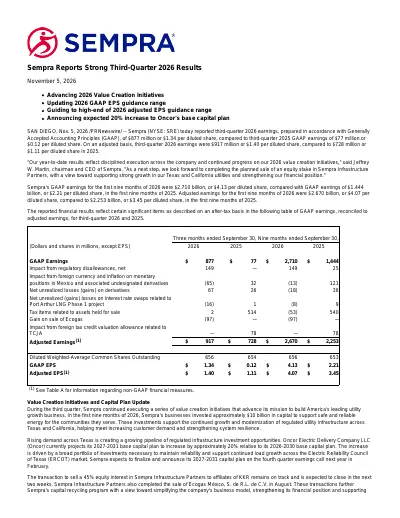
Thank you, Jeff. Earlier today, Sempra reported third quarter 2026 GAAP earnings of $877 million or $1.34 per share.
This compares to third quarter 2025 GAAP earnings of $77 million or 12 cents per share. On an adjusted basis, third quarter earnings were $917 million or $1.40 per share.
This is an increase of 26% compared to our third quarter 2025 earnings of $728 million or $1.11 per share. As Jeff noted, we're very pleased with our year-to-date performance, which gives us the confidence to guide toward the high end of our 2026 adjusted EPS guidance range.
Please turn to the next slide. Variances in the third quarter 2026 adjusted earnings compared to the same period last year can be summarized as follows: at Sempra Texas, we're seeing remarkable growth, with $154 million of higher equity earnings from new base rates, the UTM, SRP, and higher customer consumption, primarily attributable to weather, partially offset by higher interest expense, depreciation, and O&M.
Turning to Sempra California, we had $46 million of increased earnings, primarily from higher CPUC base operating margin, net of operating expenses, and higher electric transmission margin. Sempra California also had $44 million of lower earnings from lower income tax benefits, higher net interest expense, lower net regulatory interest income, and other.
At Sempra Infrastructure, earnings increased by $53 million, primarily from lower depreciation due to assets held for sale, lower interest expense, lower O&M, and other, partially offset by lower asset optimization. At Sempra parent, $20 million of higher losses from lower income tax benefits, net investment losses, partially offset by lower preferred dividends.
Please turn to the next slide. As this slide demonstrates, 2026 has been a year of strong financial and operational execution.
As a result, we're guiding to the high end of our full year 2026 adjusted EPS guidance range of $4.80 to $5.30, and affirming our 2027 EPS guidance range of $5.10 to $5.70, while recognizing that pending regulatory outcomes could cause results to be in the lower half of this range. We're also affirming our projected long-term EPS growth rate of 7% to 9%.
Given the growing opportunity set in front of our company, we're working to finalize our financial plan later this year, which will look to balance our updated operating cash flows with the expected increases in our capital expenditures through 2031. As part of that process, we'll continue to compete capital internally across the portfolio and execute our overall financing strategy, with a focus on prioritizing the most efficient funding sources, which could include, among other options: incremental capital recycling, proceeds received from the SI Partners transaction, the use of our established ATM program, and hybrid and debt financings.
With these options, we have a lot of flexibility to fund the expected growth ahead in an efficient way, while maintaining a strong balance sheet. In closing, we continue to believe there is significant value in higher growth T&D companies, particularly those positioned to benefit from sustained investment in critical energy infrastructure.
Sempra's utility businesses effectively operate as energy networks, with commodity costs passed through and significant credit risk from individual customers largely avoided. This creates an important distinction relative to the risks you're seeing play out in other parts of the utility industry, while reinforcing the lower risk and sustainable nature of our business model.
At Sempra, our growth is broad-based, supported by long-term infrastructure needs, and extends across all customer classes in two of America's largest economic markets. Also, backed by a diverse portfolio and disciplined investment approach, we expect Sempra's lower risk growth and income story will translate into significant value for our owners as we offer a compelling mix of current yield, durable earnings growth, and long-term capital appreciation.
I'm going to pause there, and we'll open up the call for your questions.
Operator
Thank you. This concludes the prepared remarks.
We will now open the line to take your questions. Please limit your questions to one question and one follow-up.
If you would like to ask a question, please signal by pressing *11 on your telephone keypad. Please make sure your mute function is turned off.
We will pause for just a moment to allow everyone to signal for questions. Our first question will come from Shar Pourreza from Wells Fargo.
Your line is open.
Shar Pourreza
Hey, Jeff.
Jeff Martin
Hey, Shar. How you doing?
Shar Pourreza
Not too bad. Hope all's well.
Just maybe starting off on the political changes in Texas. The data center rhetoric is becoming a little bit more uncertain.
I guess, what do you see as the risk to Oncor's transmission CapEx, especially as we're thinking about the state's kind of blue wave heading into a legislative window in '27? Think 765 will be the focus, or could we see legislative action on all wires fronts?
The state's such a big driver of growth for you, just thinking about the risks there. Thanks.
Jeff Martin
Thank you for that question, Shar. I think there's probably two key parts to it.
One is the measure of our confidence in Oncor's capital plan going forward, and I think I will take that question last. I think the other question you had embedded was really how we're thinking about the election.
Allen and I will tackle that first, and then I'll close out, Shar, if I could, on my confidence level about the capital plan going forward. I would just start by saying we look forward to working with the new administration in Texas.
Across our long history at Sempra, Shar, you will recall that we've always really focused on running our business well for customers. If you spend your time focusing on new and better ways to serve customers, we've found that that has always been very important advice and part of our culture for a long period of time.
I would say Oncor has traditionally taken the same approach, Shar. Allen, perhaps you can provide some color on how you're thinking about the political backdrop, and I'll come back to the capital plan.
Allen Nye
Sure. Thanks, Jeff.
Morning, Shar. Look, as Jeff said, we're looking forward to working with the new administration.
While it's too soon to tell exactly what it all means, but generally the way I think about it, we provide an essential service that's needed regardless of the party in power. Things like reliable, affordable, safe electric service, those are not partisan issues.
Things like economic development and job creation are not partisan issues. The things that attract people to Texas and businesses to Texas have not changed and go beyond any individual person or party.
We believe, and we continue to believe, that both parties want a strong and growing Texas, and we expect that to continue. We are going to continue to provide the necessary infrastructure to support our customers in our state.
Jeff said it, but I've been around this company a long time. Throughout the history of this company, we've always worked very well with both parties, and we're going to continue to do so.
Again, we look forward to working with the new state leadership in keeping Texas strong and growing.
Jeff Martin
Thanks, Allen. I'll just follow up real quickly, Shar, on the other part of your question regarding the capital plan.
From my perspective, I would say that we're very confident in the capital plan at Oncor, and let me provide you a little bit of context as to why we feel that way. I would start with the convention that Don Clevenger and Allen have adopted.
Going back to February of 2025, Shar, you will recall that they had a $36 billion capital plan, and it was their base capital plan, which is informed only by two types of projects: ones that have been endorsed by ERCOT or approved by the PUCT. If it has not been approved accordingly, it falls in what they've been tracking as an incremental bucket.
Last year, they had a $12 billion in that incremental bucket. When they rolled forward to February of this year, they added in $12 billion of new capital to their base capital plan, which is currently $47.5 billion.
Then, Shar, they took the next step to re-up that incremental bucket that they're tracking to $10 billion. We're using this call today to provide advanced view into what we expect they'll do next February, which is, again, raise their base capital plan by 20%.
Shar, they'll come back and, again, repopulate that incremental bucket. Here's two final points that really makes me feel great about their plan.
Number one, Shar, is what it excludes. The $47.5 billion base capital plan today, we're forecasting will go up by 20%, and it will not include the SRP, which we had in the prior incremental capital plan, and it will not include the Eastern Step 765 projects.
Those are excluded from our expected 20% step-up. The final reminder here, there's a lot of discussions around Batch 0.
That process continues to move forward. Hopefully, we will talk about that in today's call.
You will remember that the Batch 0 and all the capital and all the projects that will be associated with that will not be in Oncor's February 2027 base plan or incremental plan. It will continue to be upside beyond the numbers that we've been presenting to the Street.
I would just conclude that our confidence comes from the flexibility they have inside their plan today to move projects around, and the convention and discipline that they've adopted to make sure there's certainty in how they execute.
Shar Pourreza
Got it. That's perfect.
Then, Jeff, in terms of the California wildfire policy, the CPC report was probably the strongest argument we've seen yet for the legislators to act outside of the Earthquake Authority report. Can something get done in the remaining couple of weeks in the session?
Or do you expect kind of a longer and broader process in '27 when there's kind of a cleaner slate? We just can't get a strong sense from the hearings the past couple of weeks if something can get done or not.
Thanks.
Jeff Martin
Thank you for that question. Obviously, this is something that's important to the utilities in the state, and to be honest, it's really important to our bondholders and our equity holders as well.
I wish I had a definitive view to share with you, Shar, but what I would say is there continues to be ongoing dialogue in this area. I think the recent CPC report which you're referencing is really helpful, and a couple key points in that that I think you probably saw was: there's a clear view that bills are unaffordable.
There's a clear view that credit downgrades will constrain future utility service. There's a clear view in that report, Shar, that capital access, or the inability to access it affordably, is definitely going to hamper the California economy.
I think it clearly underscores that inaction doesn't work and that there's a real need for a timely solution. Now, I can't tell you whether it gets done and a bill gets filed before the 15th, which is the deadline, but I can tell you that whether it's action this fall or action next spring, I think there's a clear path that more and more people see it more clearly that the status quo does not serve the interests of Californians.
Shar Pourreza
Got it. That's perfect.
Thanks a lot, Jeff. I'll see you guys in a couple days.
Appreciate it. Thanks.
Jeff Martin
Thank you, Shar.
Operator
Thank you. Our next question will come from Steve Fleishman from Wolfe.
Your line is open.
Jeff Martin
Morning, Steve.
Steve Fleishman
Hi, good morning. Thanks.
Maybe just switching back to Texas, I think we start getting legislative proposals maybe next week, and then just into the legislative session. Any color on unlikely areas that impact you guys, I guess particularly more on transmission and just regulatory overall?
Jeff Martin
Right. Look, it's a great question, and Allen's very close to this.
Allen, would you like to provide some color?
Allen Nye
Sure. Thanks, Jeff.
Listen, I'm going to say this probably a lot this morning. It's too early for me to know definitively where this is all going, having the election just a couple of days ago.
I guess a couple of things. We continue to believe that the Texas belief or ideology that growth is good for the state remains unchanged, so that's one.
The debate is primarily focused around how to support growth while maintaining a reliable grid with fair cost allocation and while protecting communities and water resources and landowners. Those are all things that we support and will be working actively in legislation should the legislature go that direction.
The laws as they exist today provide a really constructive environment for our investments, and we're optimistic that they'll continue. We look forward, again, to working with the new administration and all the stakeholders in efforts to protect affordability, reliability, and ensuring that large loads pay their fair share.
Until we start seeing bills filed, I can't go much further than that.
Jeff Martin
The only thing I might add, Steve, is there's been a lot of discussion around the fact that today roughly 5% of America's GDP is directly tied to electricity and energy production, and the view that that first 5% actually informs and powers the other 95%. This is particularly true in Texas, right?
This is a state that has led the country in growth for about two decades, and I think there's a consensus, whether it's Republican or Democrat—we don't think of our business that way—but high-voltage electric transmission, Steve, is one of the hardest things to build in this country, and there's a lot of scarcity of value around it. I think, from a very fundamental economic standpoint, a lot of people tend to focus on the generation side or on the cost side, but that high-voltage transmission is the anchor investment that allows us to get past some transmission congestion, to add new generation to the mix, and support future customer growth.
There may be some mixed views about how we can do it in the most thoughtful way, but I think this is more about how we do it and not whether it happens.
Steve Fleishman
Okay. I guess just maybe more specific to the I guess it's the import path 2, the projects that got sent back to the judge.
Is there a schedule on when we're going to hear an update on that and get a commission order?
Jeff Martin
I would just start for the broader audience to say that path 1, which also serves the Permian, has two lines in it which have been approved by the PUC. To Steve's question, he's obviously referring to path 2, where we have two lines that also are intended to serve the Permian.
Perhaps, Allen, you could talk about what you think the procedural schedule is for that moving forward.
Allen Nye
Sure. Path 2 was remanded by the PUC on two issues: reliability standards and cost congestion generally.
In September and November, we filed our directory of evidence with LCRA. We're waiting for a SOAH revised PFD is basically where we are.
We're hopeful and thinking that maybe that happens mid-December, and then it'll be back at the commission, and we could see the commission hear oral argument again prior to issuing a ruling. Right now, we're kind of in a standstill waiting for the SOAH PFD revised.
Jeff Martin
The only thing I might add, Steve, and I think we've had this conversation before, but in the $47.5 billion base capital plan, the amount of exposure to 765 development is limited to $5 billion, and path 1 using ERCOT estimates are close to $3.9 billion. We're pleased that path 1 is moving forward.
What you're discussing with Allen has a relatively nominal part of the existing base plan, and we certainly think it's important that those projects go forward. Allen and his team will continue to work hard in that endeavor.
Steve Fleishman
Thank you.
Jeff Martin
Thanks, Steve.
Operator
Thank you. Our next question will come from David Arcaro from Morgan Stanley.
Your line is open.
Jeff Martin
Good morning, David.
Hi, this is Amanda actually on for Dave. Thanks so much for taking our questions.
Jeff Martin
Hey, Amanda.
Hey. Maybe just in Texas on the affordability front, are there any kind of additional measures to pursue at Oncor to help mitigate potential customer bill pressures and exposure to data center impacts?
Jeff Martin
It's such a great question. This is something I think that we're experiencing as a national issue.
It certainly has been a big theme in the political discussions during this political season. I think Texas in general has benefited from one thing that's helping a lot, which is growth.
As you're seeing higher volumes of electricity sales, it causes the overall rate not to move up that much. I think that a lot of the investments that Oncor is making is intended to take costs out of the system, i.e., by making transmission more efficient and having less congestion.
Perhaps, Allen, you could share your views on next steps regarding affordability and why that's such an important topic for your company.
Allen Nye
You bet, Jeff. We started this year, as we did last year, focused on two things: execution and affordability.
We understand the importance of affordability, and how big of an issue it's becoming nationwide. There's a number of things going on with regards to affordability that I think are going to be beneficial to our position.
The first thing is what's going on in Project 58,000 at the PUC, the first of which is a potential switch from 4CP to 12CP methodology, which the PUC is scheduled to consider in December. That's one.
Two is the concept of a take-or-pay contract for new large load, a new large load tariff for loads over 75 MW, where the customer would pay based on contracted load, not actual load, which would ensure that large loads pays for the transmission investment they require, as well as lower rates for other customers. Again, the PUC is set to consider that in December.
We've talked about the impacts of the UTM and the reallocation on prior calls, the fact that we can annually update who those costs are allocated to, that's certainly beneficial as well. Overall, just those potential changes or those changes, we've modeled the potential impact of the 58,000 Project 58,000 proposals, and we believe those changes will cover the cost, not only of the investments, but would also reduce the residential customer bill between $15 and $35 per year, depending on the amount of total CapEx required and the amount of load that actually connects.
Over 10 years, that's about a 1. point $1.4 billion savings.
Again, affordability is something we focus on every day. We'll continue working on it, but those things at least start to help us on the affordability front.
Jeff Martin
Thank you, Allen. Thank you, Amanda.
Thanks. Then maybe on the broader earnings growth trajectory, kind of given the expanded Texas investment opportunity and kind of the evolving regulatory outlook in California, where within that 7% to 9% long-term growth range do you expect Sempra to trend?
Kind of what factors would move you toward either end of that range?
Jeff Martin
I appreciate the question. I think what we have currently in terms of our 2026 to 2030 plan, couple of things we'd zero in on.
Number one is we're expecting to have approximately 11% rate base growth. Secondly, we're currently operating under a $65 billion capital plan, and we have a overall financing plan, Amanda, that we pulled together this fall.
That work is underway, and we look forward to making a pretty comprehensive presentation to our investors next February. You're on the right topics.
There is remarkable growth taking place in Texas. We're seeing upticks and opportunities also in California as well as Sempra Infrastructure.
I think what we need to do is get through our planning processes fall. We normally match up our internal operating cash flows with the timing and expected quantum of increase in capital expenditures to finance that efficiently.
We currently have a long-term EPS growth rate of 7% to 9%. I think that's very solid.
When you think about that relative to 11% rate base growth, I think that should cause you to have a fair amount of confidence in that range.
Thanks so much.
Jeff Martin
Thank you.
Operator
Thank you. Our next question will come from Ross Fowler from Bank of America.
Your line is open.
Jeff Martin
Hi, Ross.
Ross Fowler
Morning. Just probably delving a little deeper into a couple questions that have already been asked.
Just on, Karen, maybe one for you, as you look at California, as you look at headwinds into '27, can you kind of maybe flush out what you're talking about there with the final year of that 2024 GRC and the PFM Track 3, TIMP, and sort of the range of outcomes that are possible there and how much of a headwind that actually is to 2027 earnings?
Karen Sedgwick
Sure. Thanks for the question, Ross.
The PFM is really straightforward. The commission approved a specific capital investment as part of our 2024 GRC, and unfortunately that attrition mechanism failed to include the associated revenue requirements.
The petition for modification that we're filing is just to correct that. We see that as an error.
I would note for investors that a similar issue was found in Southern California Edison's last rate case and was corrected by the commission. We think that's the same as the right outcome here.
We've highlighted for you the revenue requirement in our materials that we've provided, which is $188 million. Of course, that's a revenue requirement.
You can do the normal tax affect that and see what that earnings impact is. We think we're going to get this corrected.
Now we think that if we can't for some reason, California is working very hard to mitigate that. An important note is this all goes away.
This is just a '27 issue because we have a new GRC starting rates in January of '28, so that won't carry over. We'll have a whole new rate case that won't have this impact.
It's a one-year issue. We think it's a mistake.
We think it gets fixed. For any reason it couldn't, we're going to try to mitigate that.
Jeff Martin
I would also note, Ross, that on the corporate update part of our slide, we laid out all the numbers and impacts for both '25, '26, and '27, which Karen just covered.
Ross Fowler
Thanks, Jeff. Then it's been a busy day, I didn't catch that.
It's 15 in a day is a lot. Anyway, back to Texas, Allen, maybe to you.
I know you talked about, and Jeff, if I heard you right, there's $5 billion in the current plan at Oncor related to 765, and $3.9 of that is path 1. Really beyond path 1, we're just talking about a little over a billion dollars.
What can you flush out what's in the 20% upside you're talking about? Is that 765, or could that revert to 345?
What's in that piece that you're looking to have line of sight to?"
Jeff Martin
Go ahead, Allen.
Allen Nye
Ross, there's kind of three general categories that I'll tell you now, and then we're going to have a lot more detail when we get to the rollout next year. In that 20% increase, one, first thing is the one-year roll-forward, you drop 2025 and you're adding 2031; two, just continued strong customer and load growth from a variety of sectors, really all over our system; and three, projects that we've moved from our incremental capital opportunities into the base capital plan.
This is important, I think, to note that the overall increase is supported by projects that have received PUC approval or ERCOT endorsement is how we plan every year. I think, as Jeff said earlier on this call, we do not expect the 765 step program or the SRP 2, they will remain in the incremental opportunities bucket beyond the base plan, so that's additional upside.
Ross Fowler
Got it, Allen. Thank you.
Very clear.
Allen Nye
You bet.
Jeff Martin
Thanks, Ross.
Operator
Thank you. Our next question will come from Nicholas Campanella from Barclays.
Your line is open.
Nicholas Campanella
Hey, good afternoon or good morning.
Jeff Martin
Hey, Nick.
Nicholas Campanella
Thanks. Hey.
Just on the Oncor CapEx composition, very clear no Batch 0 is included in this 20% increase. Still a lot outside the plan that could kind of make its way in.
Just how are you guys viewing the timeline for Batch under the current change in leadership? I know a lot of folks have been focused on this December 10th report, and then I think there's a 17th date for hearing.
Do you expect that to all remain on track with the various shifts in leadership that just happened? Thanks.
Jeff Martin
I'll make a couple comments. Thank you, Nick, and I'll pass it to Allen.
Just remember, we're currently operating under our capital program for Oncor between '26 and '30, and what we've indicated this morning is that when we roll forward that to '27 to '31, the base portion of that capital plan we expect to go up 20%. We will repopulate an incremental opportunity bucket as well that we'll talk about next February.
I think the really important thing we wanted to emphasize today is that the Eastern 765 step is not part of the expected roll-forward base plan, nor is the SRP program, which we expect to file next year. To your point, Nick, which is an important one, even when we roll those plans forward next February, both base and the incremental bucket, none of that will include anything from Batch.
That's signaling to you, at least through our current visibility into 2031, we don't see any of that coming into our plan during that plan period. Obviously, that could change if things accelerate.
Perhaps, Allen, you could talk a little bit more about how you're thinking about the Batch process and any potential delays.
Allen Nye
Sure. Thanks, Jeff.
Just procedurally where we are, and I think we address this in our appendix to the deck today, but kind of procedural deadlines: mid-December, I think December 12th, we're expecting the ERCOT verification and audit report; in April of next year, nominal Batch 0 study results; summer of '27, developer commitments; and then the second half of next year, the final transmission plan. I'll add one more thing.
This is kind of breaking as of this morning. You all may have heard or seen that ERCOT said they're sending a second RFI to about 80% of the large load customers in Batch 0 because their responses were deemed not adequate to meet the ERCOT validation criteria.
However, the important thing is that they're still aiming for a mid-December validation completion. I think that keeps it on track.
With regards to administrative changes and potential delays or additional delays, hate to say it again, but we're going to have to see. We're going to have to wait and see.
While we think the outcome of the elections might influence the overall policy framework and timing here, we still believe that the fundamentals needed to serve this qualifying load remains unchanged, as does the commitment to overall growth in Texas. While we're not seeing any delay right now, we'll have to see what happens, but overall we still feel very positive.
Jeff Martin
Thank you, Allen. I would just add one more kind of procedural issue for you, Nick, which is: because we expect to announce our 2027 through 2031 plan in February, that the timeline that Allen just outlined will conclude in the fall of 2027.
None of those updates will be in our five-year plan when we roll it forward.
Nicholas Campanella
Very clear. Appreciate that.
Maybe a wider question on capital allocation, just in light of this PD that you got on the 2024 attrition for California. On the last roll last year, you did kind of lower the capital expenditures in that state, and I'm just kind of wondering how this informs the next roll-forward.
Also acknowledging that you've already kind of filed for test years in '28 and beyond at the regulator. How can that all change into the fourth quarter?
Thanks.
Jeff Martin
Nick, I'll make a couple comments. We have not scaled back capital in the state of California.
In fact, our year-over-year capital plan was very, very similar, and we expect to continue to grow California. What changed was the overall rate of growth going forward for California, but our capital plans have remained very similar and are continue to grow in California.
What it does inform is how we allocate capital between FERC electric investments versus state electric distribution investments versus the Southern California Gas Company. It does cause us to prioritize capital that has been pre-approved as part of the GRC.
This is probably the most important point, Nick, to take away from this question, which is: traditionally, capital gets pre-approved here in California in advance as part of the GRC, unless there's a separate application. In some of those applications, like PSEP, Track 2, Track 3 type of investments, that's where we invested prior to there being a commission approval, and there was lookback risk related to that.
One of the things I think that Caroline Winn and her team have done, which is very thoughtful, Nick, is they've swept the majority of all those separate capital-approved items into the GRC. In this case, once we get to 2028, the capital we expect to of spend in the future will be pre-approved as part of an overall comprehensive rate case.
We have a improving view of California long term. We remain committed to investing capital steadily in the state.
We will compete the capital based upon where we think it can best serve customers across our gas platform, our high-voltage transmission platform, and electric distribution, but we remain strongly committed here. What's really different is we're really differentially growing the capital that's been allocated to Texas.
We've got plenty of capital for either state to the extent that there's growth opportunities.
Nicholas Campanella
Thank you.
Jeff Martin
Thank you very much.
Operator
Thank you. Our next question will come from Carly Davenport from Goldman Sachs.
Your line is open.
Carly Davenport
Hey, team. Thanks so much for taking the questions.
Maybe just a couple of kind of housekeeping items. First, just in Texas, you highlighted higher O&M as a headwind for '27.
Just any sense on the magnitude of the inflation that you're seeing there that you can point to, and maybe put that into the context relative to the inflation that you saw ahead of the last rate case filing?
Jeff Martin
Sure. I will pass this to Don Clevenger.
You will recall, Carly, he's the CFO of Oncor.
Don Clevenger
Thanks, Carly. In Texas, we are seeing about a percent to a percent and a half above the national inflation average.
As you can imagine, with all the growth that's going on and people moving to the state, and also the need for contractors and employees alike, that's about what we're seeing and about what we're figuring.
Carly Davenport
Great. Thank you for that.
Super helpful. Then, just on the SIP sale, I guess any risk of further delay there, or any color that you can share on the specific items kind of left outstanding to get that across the finish line in the next couple of weeks here?
Jeff Martin
Sure, Carly. Thank you for that question.
Justin, please proceed. Justin Bird (Executive Vice President of Sempra and Chief Executive Officer of Sempra Infrastructure):
Justin Bird
Sure. Carly, since our last call, we had two remaining conditions to closing.
Those were consent from the partners at Cameron and consent from the lending agencies in Japan. We're in great shape on both of those, and we do expect to close in the next two weeks.
Great.
Carly Davenport
Thanks so much for the time.
Jeff Martin
Thank you, Carly.
Operator
Thank you. Our next question will come from Aidan Kelly from JPM.
Your line is open.
Aidan Kelly
Hey, guy— thanks for the—
Jeff Martin
Hey, Aidan.
Aidan Kelly
Hey, thanks for the time today. Maybe just picking up on the funding side of the equation.
Clearly, you guys outlined a lot of CapEx in the pipeline with the 20% telegraphed increase, and then you've got the incremental opportunities from SRP and Eastern 765 kV. Just wondering, how much additional investment can Sempra accommodate while preserving its targeted credit metrics and no common equity funding?
You kind of mentioned you're on track to get that SIP closed in the next two weeks, but what would warrant a consideration of further monetizing that remaining interest at this time as we kind of think out into the next capital plan refresh?
Jeff Martin
Right. It's a great question, and what we do is all those issues that you are raising get resolved as part of our financial planning process this fall.
That's being led by both Justin and Faisel Khan on our team. They'll look at the magnitude of capital that needs to increase across a roll-forward five-year plan.
They'll also look at the timing of that capital through the lens of competing it to make sure, from a risk-reward standpoint, that we're funding the correct items. The key thing there is capital actually competes inside of Sempra, and then you stitch together your financing plan that starts always with optimizing your internally generated cash flows.
Then you go to all your sources of financing, and you compete that for efficiency. I think what's different this year is we just have a lot of levers to pull.
I think Karen talked about this a little bit in our prepared remarks. We've got a staged access to the proceeds from the KKR deal.
To your point, we have this option value, or store of value, in the remaining 25% at Sempra Infrastructure. We have a standstill agreement on that, Aidan, until the first part of January 2029, but that will also be part of the mix.
What we want to do is put together an overall financing plan that's designed to meet our growth imperatives and fund the right projects, and do it in a way that's the most accretive use of capital possible. That's what we look forward to bringing back to you in February of next year.
Aidan Kelly
Great. Thanks for the color, Jeff.
Maybe just one question on the non-data center demand. Appreciate you guys kind of highlighting disclosures there.
Looks like it ticked up a little bit to 19 GW from what I believe was maybe closer to 16 GW in the past. Just curious, how has the quality and maturity of that pipeline evolved, and which industries, from your perspective, offer the greatest visibility into incremental transmission investments?
Jeff Martin
Yeah. One thing I would note is that year over year, we've seen a 23% increase in large load requests, excluding data centers.
You're on the right topic. The growth that's taking place in Texas is broad-based.
The data centers are obviously the lion's share of it, but you're on a great point. There's a significant amount of non-data center growth, and I would refer you, if you don't mind, to slide 12.
In there, we do kind of a breakout of that 19 GW. You'll see that roughly 6 GW come from the manufacturing sector, about 5 GW comes from an expansion of oil and gas fields.
What's really important there is this is really a strong tailwind for both path 1 and path 2 that are part of the Permian plan. There's a real need to get more of that growth in West Texas connected to the grid, we feel great about that.
4 GW are associated with both utility and government expansion, including military bases, and then there's 4 GW of other C&I customers. You're on a great point.
There's a remarkable story for a business today that has a brand-new peak at 33 33 gigawatts. We've got 19 GW wholly unrelated to data centers.
Aidan Kelly
Right, appreciate you clarifying that. I'll leave it there.
See you guys soon.
Jeff Martin
Hey, thank you for joining.
Operator
Thank you. We have time for one last question today.
Our last question will come from Ian Rapp from Scotiabank. Your line is open.
Jeff Martin
Hi, Ian.
Ian Rapp
Hey, Jeff. Good morning, Jeff and team.
Thank you for taking my questions here. I just wanted to maybe clarify and put a finer point on some of the other questions that were asked.
In terms of the 2027 guidance indications, appreciate the color provided in the presentation and the press release. In terms of the guiding to the lower half of the range in '27, just wanted to clarify if the processes in California, the factual errors that you kind of identified in the pending processes, if those are addressed, would that ameliorate or completely resolve the lower end of the range and put you back toward maybe the midpoint, or are there other drivers there that we should be thinking about?
Sure.
Jeff Martin
I would say, number one, we've got a slide in the appendix that kind of walks through the puts and takes that will impact the transition of our earnings and cash flows from '26 to '27, I'd start by referring you to that slide. Then the second point I would say is we're not lowering our outlook for 2027.
We have affirmed our outlook for 2027. I thought it was appropriate, however, to talk about one of the issues that we're monitoring that could put pressures on us next year.
Right now, it's a proposed decision related to the PFM. It's not final.
There's a series of regulatory avenues that we will appeal to try to get to the right answer. Most importantly, and I think Karen noted this, the commission corrected the exact same error in the Southern California Edison rate case.
We think we're on the right side of this issue, and we look forward to trying to resolve it. Now, if we don't resolve it, we thought it was important to make sure that we identified the magnitude of the headwind there, and that's why we made a corporate filing on our website, really in the form of something that's essentially an 8-K to guide the Street.
The second point I would make is we have a series of business transformation programs going on in our utilities around people, process, innovation, and technology, as we continue to modernize and right-size that business. It's paid real dividends for Caroline Winn and her team in '25 and also in '26.
If we don't get to the right outcome here, we'll be basically working really, really hard to mitigate the impacts of it. To answer your question directly, we would feel even better about our 2027 numbers if we're able to get to the right answer here at the commission in the next month or so.
Ian Rapp
Great, that's really helpful. Appreciate that color.
Maybe on the same point, just as a follow-up, given that the issues seem a little bit transitory, would you expect your guidance update for the long-term EPS CAGR to maybe look through some of these issues for the longer term? I don't want to front-run you too much, but just curious how you're thinking about the long-term growth in respect to some of these transitory issues.
Jeff Martin
Yeah. It's a really interesting question, and I appreciate you asking that.
Currently, we talk about a long-term growth rate that is really intended to persist beyond the end of our five-year plan. In the 2026 to '30 plan, we have been guiding toward a 7% to 9% long-term growth rate.
I commented earlier on today's call that's backed by an 11% CAGR rate base growth across both of our utility platforms. As you roll this forward, remember, it is really confined to 2027, as Karen articulated, and that absence of taxes, depreciation, and interest that's missing in the revenue requirement currently for 2027, that would be trued up as part of the overall 2028 GRC that's currently pending.
I would view it as having no impact whatsoever on how we guide to the update to the 7% to 9% growth rate next February.
Ian Rapp
Great. Thanks again for the color.
See you guys in a few days.
Jeff Martin
Hey, thank you for joining us.
Operator
That concludes today's question-and-answer session. At this time, I'd like to turn the conference back to Jeff Martin for any additional closing remarks.
Jeff Martin
Look, I really like to thank everyone for joining our call today. With the expected closing of the SI Partners transaction, I wanted to remind everyone that Justin will be transitioning to his new role as Chief Financial Officer.
Karen will also be transitioning to be the President and CEO of SoCalGas. I'm really very excited for both of them, and expect great things.
I'm also excited to mention and welcome back Faisel Khan to Sempra in his new and expanded role as the Chief Commercial Officer. Faisel will report to Justin, and oversee our overall treasury, financial services, asset management, and corporate development functions.
Per custom, if you guys have any questions or follow-up items, please reach out to our IR team. We're really looking forward to seeing many of you in Arizona.
We'll be joined by Allen and Don Clevenger and Justin Bird and Caroline Winn, we should have a fulsome group there next week. We look forward to seeing many of you then.
This concludes our call.
Operator
Thank you for your participation, and you may now disconnect.