Stoneridge, Inc.
NNYSE:SRIQ3 FY2026 · Earnings Call TranscriptNovember 5, 2026
Operator
Good day everyone, my name is Regina, and I will be your conference operator today. At this time, I would like to welcome everyone to the Stoneridge third quarter 2026 earnings conference call and webcast.
All participant lines have been placed in a listen-only mode to prevent any background noise. After the speakers' remarks, there will be a question-and-answer session.
If you would like to ask a question at that time, please press *1 on your telephone keypad. If you wish to remove yourself from the queue, press *1 again.
Lastly, if you should need operator assistance, please press *0. Thank you.
I will now turn the call over to Mike Swartz, Head of Investor Relations. Please go ahead.
Mike Swartz
Good morning, everyone. Thank you for joining us to discuss our third quarter 2026 results for the period ended September 30th, 2026.
The release and accompanying presentation were furnished to the SEC and are posted on our website at stoneridge.com in the Investors section under Presentations and Events. Joining me on today's call are Natalia Noblet, our President and Chief Executive Officer, and Scott Humphrey, our Chief Financial Officer.
Before we begin, I would like to inform you that as a result of the sale of the control devices business segment on January 30th, 2026, the company has applied the provisions of discontinued operations accounting guidance and has retrospectively presented the financial results of the control devices segment as discontinued operations in the accompanying presentation for all periods presented. Additionally, in connection with the retrospective presentation of control devices as discontinued operations, prior period segment information has been recast to conform to current period presentation.
More information on the basis of presentation is included in the Form 10-Q, which was filed with the Securities and Exchange Commission on November 4th, 2026. During today's call, we will be referring to certain non-GAAP financial measures.
Please see slide 2 of the presentation for a more detailed description of these non-GAAP measures and the appendix for a reconciliation of these non-GAAP financial measures to the most directly comparable GAAP measures. In addition, certain statements made today may be forward-looking.
Forward-looking statements include statements that are not historical in nature and include information concerning our future results or plans. Although we believe that such statements are based upon reasonable assumptions, you should understand that these statements are subject to risks and uncertainties, and actual results may differ materially.
Additional information about such factors and uncertainties that could cause actual results to differ may be found on slide 3 of the presentation in our Form 10-Q, which was filed with the Securities and Exchange Commission under the heading Forward-Looking Statements. After Natalia and Scott have finished their formal remarks, we will then open the call to questions.
With that, I will hand the call over to Natalia.
Natalia Noblet
Thank you, Mike, and good morning, everyone. Third quarter results offered further validation of the progress we are making against our previously communicated strategic priorities.
Specifically, we are successfully expanding customer adoption of our market-defining safety- and efficiency-enhancing technologies, sharpening our organizational focus, improving operational performance, and realizing structural cost efficiencies. These efforts resulted in the strongest quarterly EBITDA performance since the second quarter of 2024, giving me further confidence that the enhancements we are making are putting us firmly on track to deliver a more profitable and sustainable long-term growth profile.
We have also strengthened our strategic and operational capabilities with recent additions to the Stoneridge executive team. Vivek Anand, who joined us as Vice President, Commercial Strategy and Global Sales, will lead Stoneridge's global commercial organization, including sales, product marketing, customer communications, and sales and marketing strategy.
Uwe Brandenburg, Global Vice President, Engineering and Innovation, will lead Stoneridge's global engineering organization, driving the company's engineering vision and strategy across product development and innovation and advancing Stoneridge's focused technology priorities in vision and safety, vehicle intelligence, and connectivity. Both bring extensive leadership experience within the automotive and commercial vehicle industries and will be invaluable as we look to deepen customer relationships, expand our portfolio of technological solutions, and execute upon our longer-range growth initiatives.
I couldn't be more excited to welcome Vivek and Uwe to the Stoneridge family. Given the progress we have made against the current strategic plan, as evidenced by our year-to-date results, and with our new leadership team now assembled, we are prepared to accelerate value creation in 2027 and beyond.
The strategic framework we have been discussing with you this year will remain central to our efforts. Specifically, we are committed to cultivating a broader market for our suite of innovative technologies, while strengthening product-level profitability, intensifying our quality assurance processes, reducing structural costs, optimizing working capital, and enhancing our financial flexibility.
While this will be an iterative process as we advance and execute against an evolving set of initiatives, our organizational North Star is resolute: delivering the most innovative and highest-quality safety- and efficiency-enhancing technologies to our commercial partners. We look forward to sharing more color on our progress and specific achievements on our fourth quarter earnings call in March.
To reiterate, the year-to-date progress we have made is commendable. I am very proud of our accomplishments thus far, none of which would be possible without the tireless efforts and dedication of the entire Stoneridge team.
However, as I said two months ago, this is a journey, not a sprint. Our central objective is to build a durable foundation for long-term profitable growth.
This is something that requires hard work and difficult decisions. That said, with the team we have assembled, I have nothing but confidence that our progress will continue.
Let's now turn to slide 4 for an overview of third quarter results. As referenced in an accompanying Form 10-Q filed on November 4th, earlier this week we received notice that on October 30th, an arbitrator issued a ruling on outstanding warranty claims brought by a customer of Stoneridge's former Control Devices business.
The claimant was awarded approximately $25.5 million related to a particulate matter, PM, sensor formerly manufactured by Stoneridge. This particular product line was exited in 2019, and we divested the Control Devices business in the first quarter of 2026.
We disagree with the ruling and continue to believe the claims lack merit. As such, we are evaluating our options.
We are comfortable that we have sufficient cash on hand to satisfy the arbitration award in the current judgment amount. Consequently, reported third quarter results include a non-cash, pre-tax charge of approximately $24 million, net of existing accruals, recorded as a reduction to net sales, reflecting the arbitration ruling.
Unless otherwise noted, our discussion on today's call regarding third quarter and year-to-date results, as well as any commentary that could be considered forward-looking, are furnished on an adjusted or non-GAAP basis, excluding the impact of the arbitration ruling. We believe this is useful in assessing the company's core operating performance and provides direct comparability versus the year-ago period.
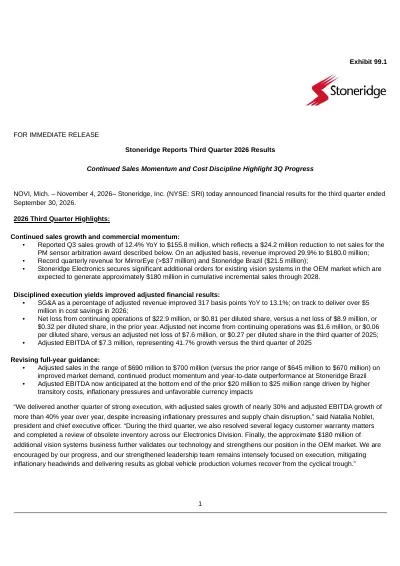
Third quarter results came in ahead of our expectations. Revenue, excluding the impact of currency and the Mexico manufacturing agreement related to the sale of the Control Devices business, grew by nearly 26% versus a year ago.
This was the fastest rate of organic growth in over three years and a meaningful acceleration versus the 8% rate of growth generated in the second quarter. In addition to vehicle production recovery trends in our European and North American commercial vehicle markets, we continue to gain traction with customers across existing verticals and key expansion areas, including bus and coach and off-highway industrial applications.
Our suite of CMS technologies remained a key growth driver. On top of MirrorEye achieving yet another sales record in the third quarter, we are pleased to announce that we recently secured additional orders in the OEM market for existing vision system technology.
This particular program, which will ramp up in 2027, is anticipated to generate cumulative incremental sales of approximately $180 million through 2028. Next, our cost structure optimization and efficiency initiatives were once again evident during the third quarter.
SG&A as a percentage of adjusted sales improved 317 basis points versus last year, contributing to an over 40% year-over-year increase in adjusted EBITDA to the highest level in nine quarters. We remain on track to generate at least $5 million in structural cost improvements this year.
Finally, despite our investment in working capital to support new commercial programs that are expected to ramp up in 2027, cash from operations during the third quarter improved versus the prior-year quarter to just over $4 million, and total debt outstanding was reduced by $7 million during the quarter. These achievements are even more remarkable considering the inflationary cost environment, especially for memory chips and other electronic components that we are navigating at present, as well as certain transitional actions undertaken that are temporarily masking our underlying financial performance.
In addition to the strategic inventory-related actions that were communicated last quarter, in the third quarter we elected to settle certain legacy customer warranty matters, the result of which negatively impacted profitability. Through collaborative negotiations with our key partners, we were able to reach agreements that we believe are equitable and in the best interest of the company.
This demonstrates our resolve to take decisive actions when necessary to improve organizational focus, accelerate our commercial impact, and enhance longer-term profitability and cash generation. While in the near term these decisions have come at a cost, we believe this is to be the right course of action as we position the company for profitable growth.
Looking out over the balance of the year, we see opportunities, but there are also attendant risks that we need to manage. To date, macro and geopolitical developments, including the steep increase in diesel fuel costs and the Fed's recent monetary policy actions, have not had a material impact on our business.
If anything, we've seen a strengthening of end market demand that is expected to carry into 2027, as evidenced by recent commentary from several large OEM partners. As such, we are raising our full-year revenue outlook for 2026.
At the same time, we now expect adjusted EBITDA to come in at the bottom end of our previous forecast, given ongoing inflationary cost pressures, especially for memory chips and other electronic components, which we expect to be more pronounced in the fourth quarter, a less favorable currency environment, and the proactive efforts we took to address and resolve several legacy matters that were not envisioned in our original guidance. To be clear, we have made progress recovering or offsetting a portion of the higher material costs in recent months, and we do expect to benefit from additional mitigation actions in 2027.
However, out of an abundance of caution, we believe it prudent to manage expectations accordingly. Scott will discuss our revised 2026 outlook in greater detail later in the call.
In sum, we are successfully executing the strategic plan outlined earlier this year. Our efforts are yielding a sharper organizational focus, improved profitability and cash flow, and a healthier capital structure to support our growth plans, the tangible results of which, including the fastest rate of quarterly revenue growth and strongest EBITDA performance in several years, were evident during the third quarter.
While encouraged, we are also not satisfied. This is just a starting point of our journey.
We see a much larger opportunity to create value in the years ahead, one that will confer significant benefits to all Stoneridge stakeholders. Now let's turn to slide 5 for a review of our end markets.
Global commercial vehicle end markets strengthened during the third quarter, with our weighted average OEM production up nearly 18% versus the prior year. Through the first nine months of the year, the market has shown modest growth of 2%, or slightly better than our initial expectation for a flat market for 2026.
During the third quarter, we again outperformed with organic revenue growth of nearly 26% versus the prior year, or 8 percentage points stronger than the rate of growth across our end markets. Through the first nine months of the year, we have generated organic growth in excess of 9%, a 7 percentage point outperformance versus the market.
We continue to anticipate supportive demand trends across our key commercial vehicle markets. Over the past few weeks, several of our largest OEM customers have publicly commented on strong order books and expectations for higher production and delivery levels in 2027.
In Europe, demand is anticipated to be stable, with the potential for modest growth, while forecasts for North America point to a stronger recovery following the deeper cyclical downturn experienced in the market over the past two years. For 2027, North American OEM volume expectations range anywhere from mid-single digits to double-digit percentage growth versus 2026 levels.
Given our growing exposure to the North American commercial truck market, we expect this to favorably influence our business over the next 12 months. IHS also recently updated its expectations for market growth, as depicted in the chart on slide 5.
Based on the newly revised estimates, our weighted average OEM end markets are expected to grow by 5% year-over-year in 2026. This is slightly more favorable than the 3.8% rate of growth expected at the time of our second quarter call in early August.
For 2027, IHS anticipates incremental growth over 2026 of nearly 3%. While this is a decline from the 5.3% growth expectation just three months ago, we believe this reflects a combination of order timing ahead of the new EPA fuel efficiency regulations that go into effect in 2027, as well as downstream supplier capacity uncertainties.
In sum, although the macro and geopolitical environment will likely remain a source of uncertainty for the foreseeable future, and inflationary pressure will continue to be a key risk factor into 2027, the combination of improving industry fundamentals and necessitated fleet replacement activity should underpin an improved demand environment over the next 12 months. Turning to slide 6.
Our commitment to customers remains priority number one. Specifically, our focus on delivering outstanding value and collaborating with all of our partners in the advancement of next-generation technologies for safer and more efficient transportation is steadfast.
In addition to broader market forces that are at our backs, namely the accelerating shift toward digital and connected solutions by major OEMs, our commercial aperture continues to widen with growing acceptance of our core technologies across a broader set of end markets and customers. As I mentioned earlier, during the third quarter we secured significant additional orders for our existing vision system that are expected to yield approximately $180 million in incremental revenue through 2028.
Recently, we also announced our collaboration with Kodiak AI, a leading provider of physical AI-powered autonomous driving technology for commercial vehicles. In addition to our MirrorEye system being integrated with Kodiak's technology on newly deployed vehicles, we are working with Kodiak to explore the integration of Stoneridge technologies into their autonomous vehicle platform and develop solutions that improve how vehicle data is processed.
These new developments serve as further validation of OEM and operators' continuing prioritization of unique solutions that advance fleet safety and operating efficiency, as well as the growing market acceptance of our range of vision and safety technologies, including MirrorEye. Over the past 12 months, we have clearly demonstrated through a range of previously announced partnerships spanning commercial truck, bus and coach, and off-highway and industrial applications, that the resonance of our product portfolio and the need for more intelligent safety- and efficiency-enhancing solutions only continues to build in the marketplace.
In turn, this gives us further confidence about our growth story. As mentioned earlier, MirrorEye set yet another quarter record with over $37 million in sales during the third quarter.
This represents 48% year-over-year growth. Importantly, whereas much of MirrorEye's growth in recent years has been driven by growing penetration and take rates with European customers, the improvement in the third quarter was more heavily influenced by the ramp-up of various OEM programs in North America, where MirrorEye's adoption is still very early.
In addition to the revenue gains we are currently enjoying, as we ascend the adoption curve, our focus on product quality, engineering optimization, supply chain and procurement efficiencies, and a more scalable platform approach should ultimately yield tangible benefits in the forms of stronger capacity utilization and a lower cost to serve. This will ultimately enable us to fully realize the value of our technology.
Now I will turn the call over to Scott for third quarter financial details and our updated 2026 outlook.
Scott Humphrey
Thank you, Natalia. Our key financial metrics for the third quarter are summarized on slide 8.
As a reminder, our discussion of third quarter results are provided on an adjusted or non-GAAP basis, excluding the impact of the arbitration ruling. We believe this is useful in assessing the company's core operating performance and provides direct comparability versus the year-ago period.
All comparisons are depicted relative to the year-ago period ended September 30th. Third quarter adjusted revenue came in at $180 million.
This represented growth of 30% versus last year. On a core basis, which excludes a modest unfavorable impact from foreign currency translation and the recognition of $6 million of contract manufacturing revenue under the Mexico manufacturing agreement associated with the sale of Control Devices, third quarter sales grew by nearly 26%.
The increase was primarily driven by the North American commercial vehicle businesses, supported by another record quarter of MirrorEye revenue and double-digit growth at Stoneridge Brazil. It's worth pointing out that the sequential step-down between second and third quarter revenue that we typically experience, which is influenced by lower seasonal production levels across Europe, was not as pronounced this year given the relative outperformance of the North American business.
As we look to cultivate greater adoption of our products with North American OEMs, we would expect a continuation of this smoothing effect between quarters. Third quarter adjusted gross profit margin declined 382 basis points versus the year-ago period to 19.9%.
During the third quarter, we made progress on our continuous improvement initiatives aimed at optimizing material costs, generating overhead efficiencies, and driving product quality improvement. However, these efforts were overshadowed by a combination of strategic inventory-related expenses, albeit at a lesser magnitude than experienced in the second quarter, and the successful resolution of certain legacy warranty obligations.
As Natalia mentioned earlier, we are taking decisive actions in the near term to position ourselves for sustainable profitability growth in the longer run. While these actions partially masked the underlying cost structure improvements during the third quarter, we believe they are the appropriate decisions as we look to advance our longer-term growth initiatives.
Third quarter adjusted operating income margin improved by 20 basis points to 0.4%. The combination of a higher revenue base and associated fixed cost leverage and benefits from our efficiency initiatives more than offset the decline in consolidated gross profit margin.
As a percentage of adjusted sales, SG&A expense declined by 317 basis points to 13.1%. This was punctuated by a nearly 20% reduction in unallocated corporate costs versus the prior year period.
To put a finer point on the progress we are making in resetting the cost structure, despite a $41 million year-over-year increase in sales during the quarter, SG&A expenses increased by just $1 million. Adjusted consolidated EBITDA came in at $7.3 million in the third quarter.
On a continuing operations basis, this marks Stoneridge's strongest quarterly adjusted EBITDA performance in over two years. As a percentage of sales, adjusted EBITDA margin expanded 34 basis points year-over-year to 4.1%.
This was largely attributable to the quarterly revenue improvement and realized cost efficiencies described previously. In summary, despite certain transitional costs during the third quarter, we delivered strong revenue growth, improved profitability, strengthened operational cash flow, and reduced debt outstanding.
This demonstrates the tangible progress we are making in establishing a stronger, more profitable foundation for the long term. Turning to slide 9.
Third quarter sales in our Electronics business came in at $158.6 million, an improvement of over 30% versus the prior year. Excluding a $1 million currency translation headwind and the impact of the Mexico manufacturing agreement, core segment growth was approximately 26% year-over-year.
Segment-level adjusted operating margin declined 217 basis points versus the year-ago period. Benefits from fixed cost leverage on a higher revenue base, operational efficiencies, and cost mitigation actions were more than offset by the discrete warranty and inventory actions mentioned earlier, as well as higher expense for materials.
Our commitment to improving the cost structure remains a top priority. In addition to a near-term focus on mitigating inflationary cost pressures, longer-term initiatives are underway to address materials and overhead costs, as well as the reduction of quality-related expenses.
Stoneridge Brazil delivered another solid quarter, as depicted on slide 10. Third quarter sales reached a record $21.5 million, up 25% versus the prior year.
Excluding a $1 million benefit from currency translation, revenue was up more than 19%. This speaks to the continued success we are enjoying in Brazil, stemming from a realignment around and investments in the OEM business.
Brazil remains an attractive long-term growth market for Stoneridge. Third quarter adjusted operating income was approximately $2.5 million.
As a percentage of sales, adjusted operating income was 11.5%, the 411 basis point year-over-year decline was driven by adverse product mix and overhead investments. These factors more than offset fixed cost leverage on a higher sales base.
I will next discuss the balance sheet and liquidity profile, as detailed on slide 11. As of September 30th, 2026, we had approximately $63 million in cash on hand and total debt outstanding of just under $144 million.
This compares to total cash of approximately $49 million and total indebtedness of $171 million at September 30th, 2025. The nearly $42 million reduction in net debt reflects the deployment of proceeds from the sale of the Control Devices business in January and tighter control of working capital over the first nine months of the year.
At the end of the third quarter, inventory on hand increased by $6 million versus the prior year, as we made strategic investments in support of new OEM programs expected to ramp up in 2027. That said, inventory turns improved to 4.7 turns versus 3.6 turns in the year-ago period, a roughly 30% improvement, and we generated a nearly $4 million increase in cash from operations versus the third quarter of 2025.
Capital expenditures for the quarter amounted to just over $4 million. As previously disclosed, in April we initiated a refinancing process to replace our existing credit facility, which matures in July 2027.
Our top priority is maintaining a prudent capital structure that supports our near- and longer-term growth objectives. While we do not have any updates today, we have had constructive conversations with our banking partners, and we continue to work towards completion of the refinancing process.
Now turning to our updated 2026 guidance on slide 12. Based on third quarter and year-to-date financial results and given our current visibility into the balance of the year, we are revising 2026 guidance.
We now expect revenue in the range of $690 million to $700 million. At the midpoint of the range, this reflects a $37.5 million increase versus our prior guidance.
In addition to stronger demand in the European and North American commercial vehicle businesses, which we discussed earlier in the call, the revision to our outlook reflects better than expected sales from Stoneridge Brazil, primarily driven by traction with local OEMs, and the continued success and market expansion of our innovative safety- and efficiency-enhancing technologies. We now expect adjusted EBITDA to come in at the bottom end of our guidance range of $20 to $25 million.
We remain on track to deliver more than the targeted $5 million in structural cost savings in 2026, and due to our mitigation efforts, inflationary impacts through the first nine months of the year have proven benign. That said, we do not expect the stronger revenue outlook, operational improvements, and realized cost savings to fully offset the costs incurred to resolve legacy warranty and inventory matters over the past six months.
Recall these costs were not envisioned in prior guidance, but are included in our year-to-date results. As reflected in our updated guidance, we are modifying fourth quarter expectations given persisting cost inflation and a less favorable currency environment.
As mentioned, we have successfully addressed inflationary pressures through the first nine months of the year. Cost mitigation remains a priority for the entire Stoneridge team, and further actions are underway.
However, with the fourth quarter being a seasonally small production period for many of our OEM customers, and given the inventory investments we are making to support several major OEM programs that will ramp during the first half of 2027, there is increased uncertainty whether we can fully realize additional inflationary recovery measures during the year. We have attempted to best encapsulate this risk in our updated outlook.
At the midpoint of our updated full-year adjusted revenue guidance range, the implied fourth quarter outlook still reflects over 20% year-over-year growth, while achievement of the bottom end of our full-year adjusted EBITDA guidance range would imply a roughly 60% increase in profitability versus the prior year period. With that, I will turn it over to Natalia to provide an update on our progress against our key priorities.
Natalia Noblet
Thank you, Scott. Now let's turn to slide 13.
To summarize, our unwavering focus on serving commercial partners with the highest-quality, innovative technical solutions is as strong as ever. We remain committed to enhancing shareholder value through the combination of continued market outperformance, improved profitability, and operational cash flow generation.
Our tangible progress on each of these fronts during the third quarter is a testament to the meaningful steps we are taking to improve execution while cultivating a culture of operational excellence, cost discipline, and cross-functional collaboration across the organization. First, our focus on advanced technology solutions and a strong customer service mindset continues to drive market outperformance.
During the quarter, organic revenue growth exceeded our weighted average OEM end markets by 8 percentage points, driven by continued momentum in our core technology portfolio, including MirrorEye and Stoneridge Brazil. The strong relationships and deep integration that we have developed with our key customers over decades has yielded new business opportunities, as discussed earlier on the call.
Driven by our continued investments in technology and people and a robust backlog of differentiated, innovative technologies, we believe we can outpace the rate of market growth by two to three times over the long term. Next, we are making progress against our excellence in execution initiatives.
We are reinforcing advanced quality planning and execution across our product development processes, with greater rigor, discipline, and early indication and prevention of quality deficiencies. This is complemented by a stronger approach to quality from product launch through sourcing, manufacturing, and field performance.
By embedding quality earlier and managing it more systematically throughout the lifecycle, we expect to improve product reliability, reduce the cost of poor quality, strengthen margins, and support sustainable long-term performance. While third quarter gross margins were impaired by the resolution of certain legacy matters, we are seeing directional improvement in underlying cost of quality metrics, and our structural cost initiatives helped drive a 34 basis point improvement in adjusted EBITDA versus last year.
Finally, we continue to prioritize sustainable cash generation and a strong balance sheet. Our efforts to improve cash flow conversion through operational excellence and working capital discipline are already bringing positive results.
Despite strategic working capital investment during the third quarter, cash from operations grew more than tenfold versus the prior year, while inventory turns improved nearly 30%, and our net debt position improved by nearly $42 million versus a year ago. These accomplishments have significantly improved the capital structure and positioned the company to pursue incremental growth opportunities as they arise.
Through consistent execution and by fostering a culture of accountability, creativity, collaboration, and continuous improvement, we are positioning ourselves to achieve near- and medium-term financial objectives and putting the company on a path to more sustainable performance for years to come. With that, operator, you can open the line for questions.
Operator
Thank you. At this time, if you would like to ask a question, please press *1 on your telephone keypad.
If you wish to remove yourself from the queue, you may do so by pressing *1 a second time. We remind you to please unmute your line when introduced and if possible, pick up your handset for optimal sound quality.
Our first question will come from the line of Gary Prestopino with Barrington Research. Please go ahead, your line is open.
Gary Prestopino
Good morning all. Congratulations, it looks like you're making some really great progress here.
Now, look, Natalia, I have a series of questions here. This warranty issue with Control Devices, this kind of popped up.
This was an issue with the prior regime. Is this a European-centric issue, or was this a domestic issue with the arbitration?
Natalia Noblet
Good morning, Gary. Thank you for the question and your comments earlier as well.
This issue, we have been informing in our Qs and Ks basically since 2023, since Stoneridge got the claim from one of our previous customers. The case was in Italy court basically managed.
That was in Italy.
Gary Prestopino
It was in Italian court. Okay.
Without giving away the store here, you're being more proactive on this whole warranty issue. Can you give us any idea of the magnitude of what you're up against here?
Is this something that could be ongoing for a couple of years as these things start creeping out of the system?
Natalia Noblet
We do not expect that continuing. Basically those were a couple of long-standing, legacy warranty matters, where the customer claims developed over a few years.
Basically, ultimately in the third quarter we reached the negotiated settlements that was overall positive for us, and we decided to settle. The incremental impact is $3 million in the quarter.
As I said, obviously, we are focusing a lot, and we've been focusing a lot on strengthening our end-to-end quality processes, improving our product development processes. As always, we continuously dealing like every company with those kinds of issues, but we do not expect following with any major incremental impacts in the next quarters.
Gary Prestopino
I'm sorry, did you say there was a $3 $3 million expended on warranty-related issues outside of this issue that was arbitrated in the quarter?
Natalia Noblet
That's correct, $3 million incremental to our results on the settlements of those other warranty issues.
Gary Prestopino
Okay. That was not backed out of adjusted EBITDA.
That's in the adjusted EBITDA number, right?
Scott Humphrey
Yes, Gary, that's correct.
Gary Prestopino
That's good. I just want to get an idea of this.
Then on to just a couple other questions here, on positive things here. Great increase in orders with the existing vision system.
Did you say that was in North America, Europe, and was it spread over several OEMs or just one OEM?
Natalia Noblet
Gary, this is a global business, and this is not MirrorEye. This is our another vision system, another camera system, which underlines also our progress on our suite of vision system technologies.
At this stage, we are really binded with confidentiality, we cannot disclose more information outside of the fact that it's a global business and in the OEM market.
Gary Prestopino
You said it's not a MirrorEye, okay, this is not going on Class 8 trucks, this is a new market? I'm trying to understand, if it's not MirrorEye, it's a existing vision system, where exactly, what's the application?
Is it for buses, off-road, what's the application?
Natalia Noblet
Gary, I'm really sorry, but I cannot share the exact application that's going across different vehicles. I can say it's not MirrorEye.
Again, we are really excited about that as this is additional revenue growth for us, and obviously underlying our close relationships with broader OEM market.
Gary Prestopino
Okay. That's fine.
I don't mean to pressure on that, I'm just trying to get an understanding. With these incremental sales that are coming through, when does these sales start hitting the P&L, in Q1 of '27?
Natalia Noblet
We will start the ramp-up from the beginning of 2027 and then gradually ramp up the volumes. That's correct.
Gary Prestopino
Okay. Then okay, great.
That's positive. Then one last question, and I'll let somebody else jump in.
Scott, what's with trying to refinance the credit agreement? The rationale is, is it too restrictive or what?
I realize you've got a lot of time here to do so before it matures, but what's the rationale for that?
Scott Humphrey
For the timeframe?
Gary Prestopino
No, just for trying to refinance it. It's due when, in '27?
Scott Humphrey
I'm sorry, Gary, now I understand. It expires in July of 2027, and so we kicked this off months ago to just have the process running so that we could get it done well before the deadline of July 1st.
Gary Prestopino
Okay. That's what I was trying to get at.
Is there anything in this credit agreement that is fairly restrictive that you're trying to alleviate with the new credit agreement, or is that something you can't comment on?
Scott Humphrey
No, I think our existing bank group is supportive. We obviously would like to secure something with a longer date into the future and not, as you see on the balance sheet, this because it's within 12 months now, has now moved into a current liability for us.
We would like to get that placed back into long-term debt once we secure the refinance.
Gary Prestopino
Thank you very much. I'll let somebody else go.
Scott Humphrey
Thanks, Gary.
Natalia Noblet
Thanks, Gary.
Operator
Again, to ask a question, simply press * followed by the number 1 on your telephone keypad. We'll take a follow-up question from the line of Gary Prestopino with Barrington Research.
Your line is open.
Gary Prestopino
I just wanted to get a handle on what you're talking about in Q4. You've got a couple of things here that are affecting the EBITDA generation.
I'm trying to flip to the slide where it is. Let's look at slide 4: inflationary cost pressure, unfavorable currency, actions to resolve legal matters.
Rank-order that. Is the inflation really a bigger issue, unfavorable FX, there's nothing you can do about that, actions to resolve legacy matters?
Just trying to get an idea of how much impact all those three issues you've cited are having on what could happen in Q4.
Scott Humphrey
Gary, yeah, thanks for your question. The biggest, I would say, overhang that we've been trying to work through in Q3 as well has been inflationary pressures, especially around memory.
We continue to have conversations with our customers. The team has been very successful so far in gaining cooperation from our customers and helping us manage through the inflationary pressure in Q3, and we hope to have the same result in Q4, but it is a major issue, I think, across the industry.
This isn't unique to us.
Gary Prestopino
That's fine. I just wanted to get an idea.
Thank you so much.
Scott Humphrey
Yeah.
Operator
Our next question will come from the line of Wolfe Joffe with EVR Research. Please go ahead.
Wolfe Joffe
Morning.
Scott Humphrey
Morning, Wolfe.
Natalia Noblet
Good morning.
Wolfe Joffe
Thanks for taking the question. The last time I looked at some of the ACT Class 8 figures, it looked like North American production for tractors, I think would be up about 18% in 2027.
Again, I might not be up to date. You guys are forecasting negative 4% for North America.
Is it a reflection of the end customer, or the mix of your customers, or why would there be such a discrepancy in the growth rates?
Natalia Noblet
Thank you very much for the question. What we are showing is really the IHS projection there, right?
We are giving every quarter the update on that. That is both the heavy-duty trucks and the medium-duty, right, 7 and 8 class.
I agree with you, overall, what we are hearing from the customers, what we see from FTR or ACT, we see that the demand, as it started to get stronger in the second half of 2026, should continue getting stronger in 2027. Therefore, we are showing here the IHS data.
However, we are always using the best market intelligence and our best projection when we are bringing our guidance and our plans. A couple of things here.
Demand is there, that's absolutely correct. A little bit different between heavy-duty and medium-duty.
What I have seen also with ACT that heavy-duty is still projected to be higher, and medium-duty production North America actually is projected to get a little bit lower, it's more cost sensitive as well. I think we will see obviously the situation overall is very dynamic in a way of fuel prices, interest rates, overall fleets' profitability, but also supply constraints.
We are there to see how the overall industry and the supply base will be able to keep up with those higher volumes in North America. Also it's important to underline that operating older trucks just getting really expensive for the fleet.
We are overall optimistic that this stronger demand that we've seen in the second half of 2026 in North America will continue in 2027.
Wolfe Joffe
Thank you. Then a long time ago, management had released a slide, this is back in 2025, I believe, and the slide had some 2027 targets on it showing, call it $715 million of revenue and about $45 million of EBITDA.
What sort of growth in the top line would we need or maybe just what level of revenue, or well, let me rephrase, the slide projects $715 million of revenue, $45 million of EBITDA. Is that reachable in 2027?
What actually makes sense now given the current environment?
Scott Humphrey
Hi, Wolfe. This is Scott.
I would say, great question. We're working through budgeting process right now, actually.
Now that we get through Q3 earnings, we'll be focused entirely on that the rest of the month here. We'll have more feedback around that in the next few months for you all, next quarter's call.
I think that obviously the market is dynamic. Since the slide that you're talking about has been put forth, obviously we're dealing with a lot of inflationary pressure and currency and all kinds of things.
Given that there are underlying changes to the assumptions, we're going to have a fullsome update for everybody that hopefully can give you some guidance and comfort around how that growth materializes and what does it mean for EBITDA. I think it's correct to say that Natalia and I are certainly not satisfied with the EBITDA margins that we're throwing off right now, and that everything that we are doing is focused on how we increase that EBITDA margin in 2027 and beyond.
I think that the idea that we're going to grow revenue and EBITDA is going to pick up in terms of percent of sales is absolutely correct. That is everything that we are working on.
Wolfe Joffe
Do you have a sense for which variables were baked into those prior assumptions, which of those variables has changed the most?
Scott Humphrey
I don't think that the impact of the Mexico manufacturing agreement is in there, but I am certain that the biggest impact on that has been the inflationary environment that we're in and the material costs increases that we are trying to work through. To be fair, I haven't spent a lot of time digging through the major assumptions that were used back a couple years ago to put forth long-range assumptions and guidance.
Wolfe Joffe
Understood. I do apologize for bringing up stuff that you were not responsible for.
Thank you for taking the questions, and really barring all the one-time stuff, very very nice performance this quarter. Thank you.
Scott Humphrey
Thank you.
Natalia Noblet
Thank you very much.
Operator
This concludes the question-and-answer session. I'll now turn the floor back over to Natalia Noblet for any additional or closing remarks.
Natalia Noblet
Thank you everyone for joining the call. I know that your time is very important, and as always, we truly appreciate your willingness to engage with us.
If you have any questions, please feel free to reach out directly through the Investor Resources section of our investor relations site. We look forward to updating you on our continued progress on our fourth quarter call.
Operator
This concludes the Stoneridge third quarter 2026 earnings conference call and webcast. Please disconnect your line at this time, and have a wonderful day.