Sensata Technologies Holding plc
Q3 FY2026 · Earnings Call TranscriptOctober 27, 2026
Operator
Please note this event is being recorded. I would now like to turn the conference over to Mr.
James E. Entwistle, Senior Director of Investor Relations.
Please go ahead, sir.
James Entwistle
Thank you, operator, and good afternoon, everyone. I'm James Entwistle, Senior Director of Investor Relations for Sensata, and I would like to welcome you to Sensata's third quarter 2026 earnings conference call.
Joining me on today's call are Stephan von Schuckmann, Sensata's Chief Executive Officer, and Andrew Lynch, Sensata's Chief Financial Officer. In addition to the financial results press release we issued earlier today, we will reference a slide presentation during today's call.
A PDF of this presentation can be downloaded from Sensata's Investor Relations website. This conference call is being recorded, and we will post a replay on our Investor Relations website shortly after the call concludes.
As we begin, I would like to reference Sensata's safe harbor statement on slide two. During this conference call, we will make forward-looking statements regarding future events or the financial performance of the company that involves certain risks and uncertainties.
The company's actual results may differ materially from the projections described in those statements. Factors that might cause such differences include, but are not limited to, those discussed in our forms 10-Q and 10-K, as well as other filings with the SEC.
We encourage you to review our GAAP financial statements in addition to today's presentation. Much of the information that we will discuss during today's call will relate to non-GAAP financial measures.
Our GAAP and non-GAAP financials, including reconciliations, are included in our earnings release, in the appendices of our presentation materials, and in our SEC filings. Stephan will begin today's call with comments on the overall business.
Andrew will then cover our detailed results for the third quarter and our financial outlook for the fourth quarter. Stephan will then return for closing remarks.
After that, we will take your questions. Now, I would like to turn the call over to Sensata's Chief Executive Officer, Stephan von Schuckmann.
Stephan von Schuckmann
Thank you, James, and good afternoon, everyone. Let's begin on slide four.
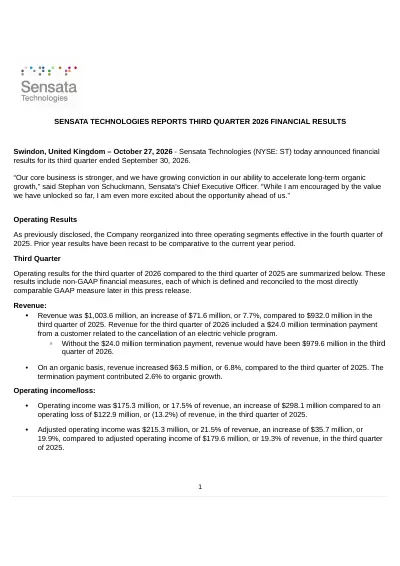
Sensata delivered an exceptionally strong third quarter with revenue, adjusted operating income, adjusted operating margin, and adjusted earnings per share all exceeding our expectations. These results included a $24 million program termination payment from a customer related to the cancellation of an electric vehicle program.
Andrew will clarify the impact of this termination payment in greater detail when he covers our Q3 results. However, given the magnitude of the benefit from this payment, I want to highlight a few points upfront.
First, our underlying results met or exceeded the midpoints of our guidance ranges across all key metrics without the benefit from this payment. Second, the related program cancellation occurred last year, and there is no impact on our revenue outlook in connection with this payment.
Third, while the recovery stands out in the quarter, it was earned by the hard work of our automotive team to turn a challenging situation into a commercially viable outcome. This is consistent with a broader theme in our automotive business.
The team has done an outstanding job of exercising pricing discipline to defend margins in an inflationary environment, much like we did with tariffs last year. With that said, my message for you today is that our core business is stronger, and we have growing conviction in our ability to accelerate long-term organic growth.
Third quarter revenue grew approximately 8% year-over-year, or 7% organically. Revenue and earnings growth were broad-based with all three segments delivering year-over-year organic revenue growth, market outgrowth, and operating income growth.
During the quarter, we reduced net leverage to 2.1 times trailing 12-month adjusted EBITDA, and completed $33 million of open market debt repurchases during the quarter. Free cash flow was exceptionally strong with conversion at 119%, and our year-to-date free cash flow of $489 million is in line with 2025 full-year free cash flow of $490 million.
2025 was an all-time record for free cash flow, and our extraordinary pace this year puts us on track for another record-breaking year. As our results continue to improve, and our business is growing stronger each quarter, we are increasingly focused on cultivating multiple pathways to higher-quality organic growth.
Let's turn to slide five, and take a broader look at how we are unlocking value in our business. Our transformation has never been just about improving margins or reducing debt.
It is about converting more of our earnings into cash, and allocating that capital effectively, we can invest confidently in future growth. Our disciplined operating model is delivering exactly that improvement.
We expect full-year 2026 free cash flow conversion to exceed 100% of adjusted net income, as our cash conversion cycle shortens, and CapEx efficiency improves. Importantly, growth has accelerated alongside these improvements.
Stronger cash generation and investment discipline have strengthened our balance sheet, reduced net interest expense, and supported equity value creation. From year-end 2024 through September 2026, we have reduced net debt from $2.6 billion to $1.9 billion.
Over the same period, enterprise value grew 18%, while our equity market value grew 48%. While I'm encouraged by the value we have unlocked so far, I'm even more excited about the opportunity ahead of us.
Let's turn to slide six to discuss how we expect to accelerate value-creating moving forward. Sensata has a differentiated technology platform built around mission-critical sensing and electrical protection, deep customer integration, leading market positions, and global scale.
We see two clear pathways to accelerate growth: first, expanding core products into attractive adjacent markets; and second, innovating to solve increasingly complex customer challenges with our sensing and electrical protection expertise. Turning to slide seven, let's take a look at the first pathway.
We are extending motors and actuators into aerospace, contactors and isolation monitoring into high-voltage data centers, and pressure and temperature sensing into power generation and liquid cooling. This is a capital-efficient approach because it builds on technologies, manufacturing capabilities, and long-standing customer relationships.
It requires [unclear] pathway innovation. On slide eight, our motors and actuators product line illustrates this approach.
Demand for compact, high-performance motion control is creating attractive aerospace opportunities. With more than 50 years of aerospace and defense experience, we have the inflight pedigree that matters to our customers.
Alongside that, our BEI Kimco motor brands brings proven designs and technical expertise to support next-generation drone and UAV platforms. Rather than fit customer requirements to a commercial or modified off-the-shelf solution, we offer bespoke solutions for our customers, customizing torque, speed, efficiency, and form factor around the application.
Our ability to deliver high torque and efficiency in compact, lightweight motors is valuable where space, weight, and power are constrained. With our US engineering and manufacturing footprint, we are able to meet high standards for supply chain risk mitigation.
As we go to market, we engage early in the RFP process, and we draw on proven designs, which enables us to deliver prototypes quickly, shorten development cycles, and reduce customer development risk. In fact, we are finding that speed is the most significant factor in securing new business, and we are meeting the challenge.
New motor business wins reached a record this year, doubling our pace of wins from last year, and approximately triple our typical annual win rate from two years prior. These wins support our participation in a global drone and UAV market, which is expected to grow at double-digit CAGR over the balance of the decade.
Moving ahead to slide nine, let's talk about innovation. As the motors example shows, a key differentiator is our ability to engineer solutions around evolving customer needs, rather than rely solely on catalog products.
Sometimes that requires a small modification, other times we innovate to develop an entirely new product. Both draw on our technical expertise and close customer relationships.
In automotive, we continue to innovate to address evolving efficiency, safety, cost, and weight requirements, for example, replacing actuation with force sensing, and advancing contactors for more sophisticated electrical architectures. In aerospace, defense, and commercial equipment, we innovate to enable commercial vehicle electrification and next-generation power systems.
In industrials, we develop innovative solutions for new regulatory requirements, such as A2L leak detection, and for emerging customer needs, such as the ever-expanding need for data center-specific sensing and electrical protection solutions. I'll touch more on that in a moment.
First, let's move to slide 10 to take a look at flow sensing as a recent example of innovation in our industrials business. Earlier this year, we discussed our data center sensing portfolio, and shared a new flow sensing solution we were developing for liquid cooling applications.
Last week, we followed through on that development work, and announced the launch of that product. Our FL Series uses ultrasonic sensing to deliver continuous, highly accurate coolant flow measurement.
As computing density increases, that measurement becomes mission-critical. Too little flow can cause overheating and constrain processor performance, while excess flow wastes energy.
Precise flow management helps customers maximize computing performance relative to power consumption, and that is exactly where we differentiated ourselves from competition. Our solution combines proven capabilities with targeted innovation to solve a complex customer problem and add content in an attractive market.
We expect initial shipments by mid-2027, subject to final customer timing. More broadly, our expanding data center portfolio positions us to meet a wider range of sensing and electrical needs, particularly with coolant distribution units, or CDUs.
Customers increasingly see Sensata as a one-stop shop for sensing and electrical protection solutions from grid to chip, and our long-standing system expertise earns us a position as a valued partner and preferred supplier to many of our customers. Turning to slide 11, let's look more closely at our data center growth.
Data centers remain one of our most compelling long-term growth opportunities. Deployment timing remains dynamic, but demand for power management, sensing, electrical protection, and thermal management continues to strengthen, and our largest opportunities are still ahead.
Our data center revenue from sensing and electrical protection spans two segments. Our industrial segment supplies sensing and electrical protection components inside data centers, while aerospace, defense, and commercial equipment supplies sensors for generators used for on-site power generation.
Together, these businesses generated $27 million of revenue in 2025, and we expect $48 million of revenue in 2026, representing annual growth of 76%. While we are excited with this recent growth, it is important to recognize that this has largely been driven by existing products as we have built our commercial presence in data centers.
Notably, this does not include the opportunity we see with Dynapower, nor does it reflect revenue from our design wins with hyperscalers that we have achieved thus far. We now have a total of seven wins spanning six hyperscalers, including a win in China.
That is up from five wins we shared last quarter, and a single win we had at the start of the year. As we discussed on prior earnings calls, we expect these wins to begin ramping mid-2027.
Beyond these design wins, the market growth drivers that underpin them are highly compelling. As cooling moves from in-rack to in-row to support higher GPU demands, demand for our thermal management solutions, including our new flow sensor, increases.
More effective cooling allows chips to handle more power, driving a transition to 800-volt data centers, which in turn increases the need for our contactors and isolation monitoring devices. High-voltage data centers are in turn driving higher grid loads, creating demand for power and peak management, such as the inverters, converters, and rectifiers we sell under our Dynapower brand.
As the grids work to adjust to higher loads, a backlog for grid connection has developed, creating demand for our on-site power generation, which in turn is driving demand for our pressure and temperature sensors. All of this contributes to robust opportunities for the next several years, and we expect to participate meaningfully.
There are four key tailwinds for our growth: first, underlying market growth rate in the mid-teens as data center construction accelerates; second, a 1.5 times to 2.5 times expansion in our serviceable addressable market; third, a stronger competitive position as sourcing shifts from opportunistic channel purchases to specification-driven decisions; and fourth, the need for power and peak management solutions with each new data center built. Sensata is well-positioned to benefit from every one of these tailwinds, and that is exactly why we have so much conviction in this opportunity.
With that, I will turn the call over to Andrew.
Andrew Lynch
Thank you, Stephan. Let's move to slide 13.
For clarity, unless otherwise specified, amounts are referenced in US dollars and rounded to whole millions, and growth percentages are approximate. We delivered exceptionally strong third quarter results with revenue, adjusted operating income, and adjusted earnings per share all above the high end of our guidance ranges.
The quarter included a $24 million termination payment from a customer in connection with the cancellation of an electric vehicle program. We did not incorporate this payment into our third quarter guidance, and therefore, I want to make clear that our underlying results met or exceeded the midpoint of our guidance range without taking into consideration the benefit of this termination payment.
Third quarter revenue was $1.004 billion, an increase of $72 million, or 8%, from $932 million in the third quarter of 2025. On an organic basis, revenue grew 7% year-over-year.
Without the termination payment, revenue would have been $980 million, representing 5% reported growth and 4% organic growth. Adjusted operating income was $215 million, and adjusted operating margin was 21.5%, compared with $180 million and 19.3% in the prior-year quarter.
Without the termination payment, adjusted operating income would have been $191 million, and adjusted operating margin would have been 19.5%, representing an increase of 20 basis points year-over-year. Adjusted earnings per share was $1.13, an increase of $0.24, or 27%, year-over-year.
This was our fourth consecutive quarter of double-digit adjusted EPS growth. The result met the high end of our guidance range without the termination revenue, and exceeded it by $0.16 as reported.
Free cash flow was $198 million, an increase of $62 million, or 46%, year-over-year. Free cash flow conversion was 119% of adjusted net income, an increase of 14 percentage points compared with the prior-year quarter.
Let's turn to slide 14 to take a look at performance trends. The quarter extends the consistent progress we have made against our operating, capital allocation, and growth priorities.
Adjusted operating margin expanded year-over-year for the fifth consecutive quarter. Trailing 12-month free cash flow conversion increased to 113%, and net leverage improved to 2.1 times.
Top-line organic growth was again in the mid-single digits territory, and earnings grew significantly faster than revenue. This combination of revenue growth, margin expansion, cash conversion, and deleveraging demonstrates the continued effectiveness of our operational rigor and disciplined strategy.
Moving ahead to slide 15, let's review capital allocation. We ended the quarter with $553 million of cash on hand, and our $650 million revolving credit facility remains undrawn.
In August, we returned approximately $17 million to shareholders through our quarterly dividend, and last week, we announced our fourth quarter 2026 dividend of $0.12 per share, payable on November 25, 2026 to shareholders of record as of November 11, 2026. We continued to reduce gross debt, completing approximately $33 million of open market debt repurchases during the quarter.
We ended the quarter with net leverage at 2.1 times, and return on invested capital improved 80 basis points sequentially to 12.1%, representing 190 basis points of improvement since we began our transformation seven quarters ago. Turning to slide 16, let's take a closer look beyond ROIC to additional economic benefits we are seeing from deleveraging.
First, we are meaningfully reducing net interest expense, which is driving cash savings and accelerating adjusted EPS growth. In 2025, this translated to approximately $0.06 of adjusted EPS compared to the prior year.
In 2026, we expect another $0.10 of year-over-year adjusted EPS growth from interest savings. Second, by proactively retiring nearly 80% of our nearest-term debt maturity due in 2029, we have reduced our refinancing exposure in a rising interest rate environment.
Lower debt service costs and longer-term debt maturity profile position us well to invest in organic growth and innovation. Now, let's turn to slide 17 to discuss our segments.
Automotive revenue was $556 million, an increase of 4% on a reported basis and 3% organically, while production decreased 2%. In total, automotive outgrew production by approximately 4% organically.
Automotive segment revenue was $158 million, and segment operating margin was 28.4%, compared with 23.7% in the prior-year quarter. Before the benefit of the termination payment, automotive operating margin increased 150 basis points year-over-year to 25.2%, reflecting productivity and disciplined cost management.
Industrials revenue was $210 million, an increase of 13% on a reported basis and 12% organically. Industrials operating income was $61 million, and segment operating margin was 28.8%, an increase of 160 basis points year-over-year.
The improvement reflects strong volume growth and operating leverage, which enabled disciplined investment in attractive growth opportunities. Our data center growth initiative is primarily anchored to existing or derivative products, and therefore does not require significant upfront investment, and we are therefore less sensitive to the precise timing of market developments.
Aerospace, defense, and commercial equipment revenue was $238 million, an increase of approximately 13% on a reported basis and in organic basis. This was the segment's third consecutive quarter of double-digit organic growth, led by commercial equipment.
Segment operating income was $63 million, and segment operating margin was 26.7%, compared with 27.4% in the prior-year quarter, with modest contraction attributable to growth investments and product mix. Let's turn to slide 18 for additional perspective on our end markets and fourth quarter assumptions.
Higher fuel prices and financing costs are affecting automotive demand. Global light vehicle production fell approximately 2% in Q3, including 6% in China and 5% in North America.
We expect a 4% year-over-year contraction in the fourth quarter, largely from China, and approximately 2% lower global production for the full year. Portfolio diversification and content gains support outgrowth, although China OEM mix remains a regional challenge.
Despite this backdrop, automotive margins are expanding, pricing discipline is offsetting inflation, and content gains are driving outgrowth. We expect full-year outgrowth of approximately 2%, outperforming every market except China.
Our growth in India exceeds 30% against a 10% market growth. North America is delivering double-digit organic growth against an expected 2% market contraction.
Outgrowth is accelerating to high single digits in Japan, with low single-digit outgrowth expected in Europe and Korea. In China, multinational OEMs are losing share at an accelerating pace.
Our content gains with local OEMs have meaningfully narrowed the content gap, but pricing pressure continues to contribute to a revenue per vehicle gap. Local OEM revenue now exceeds multinational OEM revenue.
We expect the next automotive growth wave from battery supplier wins as battery supplier defined architectures gain traction. Meanwhile, our other segments are delivering strong growth in China, with industrials expected to grow 15% this year, and aerospace, defense, and commercial equipment expected to grow 8%.
In our global industrial segment, US residential HVAC shipments have returned to growth after first-half weakness, and manufacturing indicators show signs of stabilization. However, both remain below 2024 levels.
Market recovery offers potential tailwinds for our core, while data center and energy applications are compelling growth opportunities. In aerospace, defense, and commercial equipment, aircraft backlogs and defense spending support a positive outlook.
North American on-road trucks began recovering in the third quarter, with Class 8 production up approximately 50% year-over-year. We expect a recovery through year-end and into 2027.
Data center infrastructure is driving growth in the construction vertical, while agriculture shows early signs of improvement. With that backdrop, let's move to slide 19 for our fourth quarter guidance.
For the fourth quarter, we expect: revenue of $942 million to $972 million; adjusted operating income of $185 million to $192 million; adjusted operating margin of 19.6% to 19.8%; adjusted net income of $140 million to $145 million; and adjusted earnings per share of $0.95 to $0.99. At the midpoint of these guidance ranges, we expect fourth quarter year-over-year revenue growth of approximately 5%, and adjusted EPS growth of 10%.
Before turning the call back to Stephan, allow me to put our guidance in context relative to consensus. It appears that recent automotive market developments are not yet fully reflected in revenue estimates, with some having moved towards $950 million, while others remain closer to $970 million.
Our fourth quarter guide reflects the softer automotive production outlook and changing market dynamics in China. Despite these challenges, we expect to outgrow production and deliver another quarter of sequential and year-over-year margin expansion.
$0.97 of EPS at the midpoint of our guide is consistent with Street expectations. Looking ahead to 2027, I would like to offer a reminder regarding margin seasonality in Q1.
Annual price reductions typically lower margins sequentially from Q4. Productivity generally offsets these reductions, but there is a lag as we sell through higher-cost inventory on hand.
As that inventory clears, margins typically improve sharply in the second quarter. With that frame, consensus estimates on margin in Q1 do not appear to fully reflect this dynamic, and we also note a wide spread on revenue estimates, seemingly reflecting varying market assumptions.
While we are not providing formal Q1 guidance today, I would like to share our directional expectations. We do not expect revenue to increase sequentially from Q4 into Q1, and therefore we do not expect sequential volume leverage to mitigate sequential margin seasonality in the same manner that it did last year.
We do expect operating margins to expand modestly year-over-year in the first quarter, and for the full year, our operating model will continue to target 20 basis points of full-year margin expansion that we have seen over the last two years. With that, I would like to turn the call back to Stephan for closing remarks.
Stephan von Schuckmann
Thank you, Andrew. Before we move to Q&A, I have just a few closing thoughts.
Let's turn to slide 21. Our transformation has significantly strengthened Sensata.
With more resilient margins, better cash conversion, and a healthier balance sheet, we have more capacity to invest in higher-quality organic growth. Our new segment structure is working.
Industrials and aerospace, defense, and commercial equipment each delivered double-digit organic growth, more than offsetting softer automotive end markets. This is why we are pursuing multiple pathways to organic growth: expanding market presence for our existing products, and innovating to develop new products.
Secular trends are in our favor. Markets are growing, our SAM is expanding, our right to win is compelling, and I am more confident than ever in our ability to deliver.
I look forward to keeping you updated on our progress. I will now turn the call back to James for Q&A.
James Entwistle
Thank you, Stephan and Andrew. We will now begin Q&A.
In order to allow all who wish to ask a question the opportunity to do so, we will limit each participant to one question. If you wish to ask an additional question, please re-enter the queue.
Operator, please introduce the first question.
Operator
Thank you. Our first question for today will come from Mark Delaney with Goldman Sachs.
Please go ahead.
Mark Delaney
Yes, good afternoon. Thank you very much for taking the question.
I was hoping you could start with some additional commentary on how you're looking at the medium-term revenue outlook. You identified some nice progress the company is seeing, especially in the data center market.
Certain end markets are picking up cyclically as well, but then you've got some weakness in China auto, and as you've started to share some preliminary views on the first quarter of next year, you talked about more flattish into 1Q, and I didn't catch any sort of specific, thoughts qualitatively as to what's maybe causing that more flattish trajectory into 1Q. Hoping you can talk a little bit more on what's underpinning some of those comments around how you're seeing the revenue play out not only for 4Q, but some of the initial views you're trying to share for the first quarter.
Thanks.
Andrew Lynch
Mark, thanks for the question. The comment on Q1 seasonality on revenue is more just a function of the global production outlook, specifically for auto moving from Q4 into Q1.
Despite some of the weakness that we're seeing regionally in the China market, it still is the seasonally strongest market in China, and we still expect a sequential step-down in Q1 connected to the holiday in the first quarter. Third parties got that called at about a 2 million vehicle unit step-down sequentially into the first quarter, and so that's really what frames our sort of, muted sequential outlook specifically on automotive volume, and I wouldn't interpret that to mean anything about our growth prospects in the other segments or what we're seeing in terms of progress in data center.
It's really specifically that automotive seasonality.
Mark Delaney
Thank you.
Operator
The next question will come from Joe Giordano with TD Cowen. Please go ahead.
Joe Giordano
Hey guys, thanks. Can you talk about what you're seeing just in terms of China automotive exports displacing local production elsewhere?
I know not much of a thing in the US at this point, but in Europe and in other parts of the world, what are you seeing and how much of a headwind has that been, or could it become?
Andrew Lynch
Sure, yeah. Let me just comment on what we see in our auto business broadly, and then I'll let Stephan comment on the China dynamics specifically.
Yes, we're seeing challenges in China, but we're not concerned that this is going to be a headwind to our overall automotive outgrowth story. The reason for that is if you look across the rest of our automotive business in the rest of our regions, we're outgrowing in every single region, and there's different drivers in each region.
In Europe, stepping up content on EVs as our next-generation vehicle platforms come to market, innovative products like our switchable contactors are driving that. In North America, we continue to gain share in that market as our ability to supply the market locally and the supply chain resilience plays in our favor.
In Japan, we've been talking for several quarters about displacing local suppliers and gaining share in that market. Korea, we continue to have a long-standing, successful relationship with Korean OEMs, high content per vehicle, and some of those vehicles are very successful in the market, rapid growth in the India market and rapid outgrowth.
Yes, while China may lag in the short term, our view is that the rest of those regions are highly growthful, and we expect to continue to outgrow the automotive market. Then...
Stephan von Schuckmann
Let me give you a bit more color on China. China auto, yeah, is one market, but although that's not the whole story.
The team around Jacky is managing the transition with discipline. They're winning new business with local OEMs, and they're growing across the rest of the business.
Let me lay that a little bit deeper because it's part of your question. Let me start with how the market is changing.
I think it's clear the market is shifting decisively towards Chinese OEMs with multinationals losing local share. Export growth also favors Chinese OEMs, as you've just mentioned, and JVs generally do not participate, so that's obviously creating a further mix headwind.
Then if you exclude exports, the domestic market is down roughly 25%, and obviously at the same time, as you all know, pricing pressure remains intense. Our response to that is actually to compete on value and stay disciplined on returns.
That's the one side. The other topic is that we also winning with companies that are shaping China's future.
Battery supplier wins really positioned us for growth, as their architecture gains adoption, and I'd like to mention that includes sophisticated dual-chemistry systems with global export potential. That's where we can benefit as well.
Then, and that's my point to the broader story around China, it extends well beyond China auto. Within China, industrials is expected to grow 10% this year, and commercial equipment around 5%.
That's just to give you a bit more color around what's happening in China for Sensata.
Operator
The next question will come from William Stein with Truist Securities. Please go ahead.
Hi,
William Stein
great. I really like this slide that you included in your presentation about the data center opportunity, especially the significant growth from '25 to '26.
Can you comment on your expected growth over the next couple of years? There certainly seems to be significant growth opportunity from all the customers in this end market, and I'm hoping you can comment on your growth outlook there beyond '26.
Thank you.
Stephan von Schuckmann
Sure. Let me frame the whole data center picture and explain to you why our data center business is growing today, but actually the larger opportunity lies ahead of us, it's much greater.
First, the market is moving in our direction. Data center market is going at 15%, SAM is doubling, and this obviously means an overall rising demand for exactly what we do, which is around thermal management, electrical protection, and energy management.
We're winning in it, those are the metrics that you've seen on that slide that you just mentioned. The 7 76% growth, from $27 million to $48 million, and that growth is coming from our existing products, and an expanded commercial presence.
These numbers exclude Dynapower, which offers another level of opportunity in this space. Then from there, the opportunity actually gets much bigger.
We have the seven wins on hyperscalers, which should ramp around 2027, that will really excel. Then we have technology shifts in the architectures around 800-volt architectures and liquid cooling, which expands the serviceable content from 1.5 times to 2 2.5 times per megawatt.
Then what's even more compelling in my point of view is the increasing right to win. We'll expect that that will translate into a meaningful higher take rate.
Then I think overall for the growth perspective going forward, what sets us apart is the breadth of our portfolio. With our overall product portfolio, customers see us really as this one-stop shop from grid to chip.
That's basically giving us a lot of opportunities going forward, and we can do that on assets that we already have. The market is moving our way, and we're already winning, and we can scale basically at low risk.
William Stein
That's very helpful. Actually, it's a springboard to ask something about Dynapower, because you mentioned it.
I think since you acquired this, this might not have grown very much, but maybe the growth opportunity is still ahead of us in this end market specifically. Can you talk about how Dynapower's been doing lately, and any update or details about that business in the recent past, and in the near future?
Thank you.
Stephan von Schuckmann
It's a good question. Dynapower is really a separate opportunity, right?
Dynapower takes us beyond cooling and protection into the data center power itself. By the way, that's a deliberate strategic choice that we took.
We've reset Dynapower's focus toward data center power needs, and at the same time, we're currently continuing to pursue active clean energy projects. It's both.
It's clean energy and data center. Why it's so compelling in our point of view, because these rising power loads play directly into Dynapower.
They create opportunities for our inverters, converters, and rectifiers, and those are used for power and peak management. Then, I think it's important also to mention that when power is scarce, efficiency wins.
The Dynapower products convert energy with high efficiency, and that matters more and more as data centers compete for grid capacity, and as energy efficiency becomes more critical to these AI economics. That's another reason why we've shifted strategically.
Far, we've actually only scratched the surface, Dynapower is not included in these $48 million that we have in components wins, and the opportunity is orders of magnitude larger, and is all ahead of us. It's something that's basically coming mid-2027 and onwards.
We've refocused on the data centers, differentiate on efficiency, and position basically for a much larger opportunity ahead of us.
William Stein
Great, that helps. Thank you.
Operator
The next question will come from Joe Spak with UBS. Please go ahead.
Joe Spak
Thanks everyone. You talked about some of the inflationary pressure and your sort of ability to help sort of manage some of that pressure you're seeing.
We've all seen the impact from electronics. I think you don't buy a lot of memory, but it's obviously expanded the PCBs, etc.
Can you just help us quantify or dimensionalize some of that pressure you're seeing, maybe if it is weighing on some of that margin commentary you talked about for fourth quarter of this year, or even first quarter of next year, and just reminds us about not only the sort of pricing process, but the recovery processor or lag, if there is one, on that.
Stephan von Schuckmann
Let me start with how we're managing it, and then Andrew can give you some more details on the numbers side. At Sensata, I would say inflation is being managed systematically, and our margins are protected, and Q4 will be no different.
Looking forward, that's no different. I think it starts with knowing exactly where the exposure is.
Memory is generally not an issue for us. It's boards and electronics that are more challenging.
Then obviously, the inflation is driven by data center demand. First, we take responsibility for our own costs, and what does that mean?
It means internal cost actions, VAVE, which is designing the costs out of our products, and then close collaboration with our suppliers. Then in that process, then comes pricing.
Prices are then adjusted to the new market reality. Where costs can't be designed out, or offset with productivity, now we work with our customers on appropriate price adjustments.
In boards and electronics, the supply is tight, and pricing reflects that, and we remain very, very disciplined on margins. Then maybe I think this is an important point.
I've mentioned in other calls, that works because our products create real value for our customers. They're mission-critical, they're designed in nature, and that gives us resilience.
That's exactly why our auto business for Sensata is so differentiated. We're clear on exposure, disciplined on costs, and in the end, firm on pricing, and resilient because our products are designed in.
Andrew Lynch
Joe, on the dollar impact, it's been a bit of a moving target throughout the year. We've seen earlier in the year metals were the story.
We started to see some moderation there. We've seen electronics pick up.
I think the more important point is that it's not dropping through in our margins. We're either designing the cost out or passing it through in price, but we're not seeing a margin impact.
The various drivers have been moving from quarter to quarter, but the margins have held up.
Joe Spak
Maybe as a quick follow, then, in the quarter, can you quantify what percent of the organic growth was just passing through some of that pricing?
Andrew Lynch
Yeah. Price was still a net headwind in the quarter of about a percent and a half or so in auto.
You would typically expect that to be in the 2% neighborhood. It's either showing up in price or we're offsetting it in productivity, but it's net neutral.
Joe Spak
Thank you.
Operator
Again, if you have a question, please press star, then one. Our next question will come from Guy Hardwick with Barclays.
Please go ahead.
Guy Hardwick
Hi, good evening. Have I got this correct?
That looks like an auto outgrowth is kind of trended through this year, 2%, 1%, and then excluding the termination or liquidated damage, would've been about 2% or two points in Q3, and guidance kind of implies around one point versus global production down 4%. Is that accurate, you believe, Andrew?
Andrew Lynch
We see market down about 4%, and we see revenue down three-ish in the fourth quarter. Net outgrowth of about a percent, yep.
Guy Hardwick
Okay. What slightly confuses me is that China is almost 40% of expected to be almost 40% of Q4 global light vehicle production looking at third-party estimates.
Since I think you've said in the past that China is 20 25% of auto, is that correct, or is it higher than that? Think you're underweight on a global basis.
Shouldn't you be kind of benefiting from outgrowth from China being down 8% in the market for Q4?
Andrew Lynch
China is about a quarter of our revenue. When you look at the impact in outgrowth, there's really two elements.
There's the in-market element in terms of our performance in the China market, and then there's the sort of global mix impact associated with China production relative to global production. When you net those two, undergrowing in China, but then getting a tailwind on a global basis, combined with the growth that we see in other regions, we're netting to outgrowth.
Guy Hardwick
Okay. All right, thank you.
Operator
The next question will come from Amit Daryanani with Evercore ISI. Please go ahead.
Victor Santiago
Thanks. This is Victor Santiago on for Amit Daryanani.
Thanks for taking my question. I was hoping to get more color on aerospace and defense growth of 4%, which appeared weaker than industry trends and the high-single digit market growth rate that you cited in the deck.
Can you talk about what drove the delta during the quarter, and expectations moving forward?
Andrew Lynch
In aerospace and defense specifically?
Victor Santiago
Correct, yes.
Andrew Lynch
I think we grew mid-singles in the quarter in aerospace and defense specifically. It's roughly in line with market.
The broader segment grew stronger, and that's driven by what we're seeing in the truck market in terms of recovery in North America.
Victor Santiago
Got it. Understood.
I think looking at the deck, the marking was that the end market grew high single-digit percent high single digits versus that mid single-digit reported growth.
Andrew Lynch
Just
Victor Santiago
more so trying to get more color on the delta there. Sure, yeah.
Andrew Lynch
Yeah. Much like auto, aerospace, outgrowth can be lumpy in any given quarter.
What we've seen sort of earlier in the year was an outgrowth tailwind driven by production mix with commercial wide-body aircraft. As we lap some of those comps, some of that outgrowth moderates.
This is still a very high-growth segment for us, and still one that we would expect to be growthful moving forward, and with market outgrowth. It's just it can be lumpy from quarter to quarter depending on the prior-year mix that you're comparing against, given different ship set values per aircraft.
Victor Santiago
Got it. Understood.
Thank you for the clarification.
Operator
The next question will come from Shreyas Patil with Wolfe Research. Please go ahead.
Shreyas Patil
Hey, thanks a lot for taking my question. Just to confirm, the auto outgrowth for the quarter of four points, that included the one-time payment that you received, the $24 million.
If I remove that, I think it would imply that the quarter you were maybe down one point versus the market. Am I looking at that correctly?
Andrew Lynch
I think when we calculated it, we were about a half a percent of outgrowth. We still had some net outgrowth in the quarter.
Shreyas Patil
Okay. Then maybe pivoting to the data center opportunity, it's impressive that you're already getting to $48 million this year.
Can you just remind us how many of those seven awards will be launching next year, and then how do we think about the run rate for the business as you get towards the end of '27?
Stephan von Schuckmann
A lot of those awards are based on the high-voltage architectures, and what we've been saying is that the start of revenue, depending on the build-out timing of these individual new architectures, is mid of next year. From then, we start gradually growing our revenue based on our thermal management products, our energy management products, and so on.
It's basically starts in mid-2027, and from then, it gradually grows.
Shreyas Patil
Okay. Is there any way just to kind of dimension, if you're doing roughly $50 million at the moment, with those added awards, by the time we exit '27, could this be kind of a triple-digit kind of business, or is it just too early to tell?
Stephan von Schuckmann
It's a bit too early to expose exact number now, but as we've mentioned, the opportunities are great for Sensata and we feel confident that we'll achieve a high growth rate. We'll keep you updated from call to call.
Shreyas Patil
Great. Thank you.
Operator
The next question will come from Wamsi Mohan with Bank of America. Please go ahead.
Wamsi Mohan
Yes, thank you. Apologies, I'm hopping between calls, if you already answered this.
Are there any other EV programs that are under reviews, or should we be thinking that there are potentially more of these kind of termination payments potentially, or was this a one-off that you don't expect really to recur?
Stephan von Schuckmann
We don't expect any reoccurrence in that dimension.
Wamsi Mohan
Thank you. Sorry, I missed that.
Then just if we think about the Q4 guidance, I think last quarter, you had said that Q4 would be roughly flat with Q3. If I take the midpoint of the new guide, it's about 2% below Q3 without the one time.
Could you just help bridge sort of what has changed at the higher level that's creating a little bit of a different seasonality to the course of the rest of the year?
Andrew Lynch
Sure, Wamsi. It's really just two factors.
One is outperformance in the third quarter as the market developed a little sooner than we expected. That creates a bit of a higher jump-off point.
Then the other is the revision downward in China. You net those two out, and you get to a number that reconciles to sort of what we expected a quarter ago.
Wamsi Mohan
Thank you so much.
Operator
This concludes our question-and-answer session. I would like to turn the conference back over to Mr.
James Entwistle for any closing remarks. Please go ahead.
James Entwistle
Thank you, operator, and thanks to everyone who joined today's call. Before we conclude, I'd like to extend my gratitude to everyone who participated in our recent investor perception study.
Your feedback clarifies shareholder priorities and opportunities to improve, helping to guide our path forward. To close, I'm pleased to announce that this quarter we will be participating in two conferences.
Andrew and Stephan will be attending the RW Baird Global Industrial Conference on Wednesday, November 11th in Chicago, and then Andrew and I will be attending the UBS Global Industrials and Transportation Conference on Wednesday, December 2nd in Florida. We look forward to connecting with many of you there.
Operator, you may now conclude the call.
Operator
Thank you. The conference has now concluded.
Thank you for attending today's presentation. You may now disconnect.