Acuvi AB
SSTO:ACUVIQ4 FY2025 · Earnings Call TranscriptFebruary 26, 2026
Mikael Magnusson
It is 1:00 and we welcome viewers here to this report broadcast where we are joined by Acuvi who today published their report for the full year of 2024 or should I say the Q4 ending the full year. Standing beside me, I have its CEO Nils Sjöholm.
Welcome.
Nils Sjöholm
Thank you very much. Good to be here.
Mikael Magnusson
I'll ask my own questions, but also during this broadcast, the viewers at home can also ask their questions and they can do that via the live chat during the broadcast. I will be keeping an eye on that.
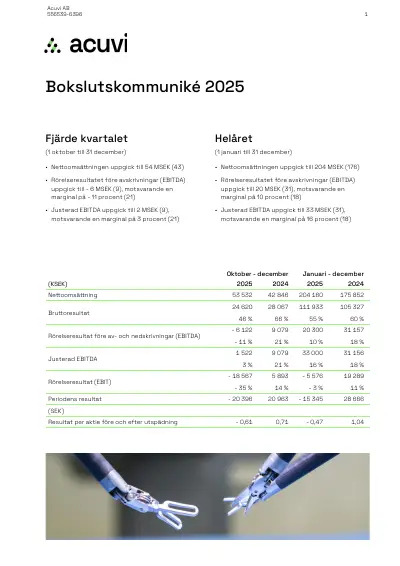
First and foremost, Nils, running through the numbers, you grew your net sales by 25% for the fourth quarter, landing on 54 million SEK. EBITDA turned negative, however, minus 6 million compared to last year's fourth quarter of 9 million SEK, which provided also a negative margin of 11%.
When you look at the quarter in hindsight, what are your thoughts?
Nils Sjöholm
I think when you look at the EBITDA, there are some questions that I'm sure you'll be raising later on, but what I bring with me is the strong finish that we have of the year and the bright future outlook that I think we're facing. We did grow on looking at the full year, 204 versus 176 and about 18% in constant currencies.
I think that shows that we are on the right track and that we have a strong product portfolio which our customers appreciate.
Mikael Magnusson
In the report, you mention that 2025 was a year of growth, but also lessons. We'll get to the lessons a little bit later, focus on growth now.
What primarily drove it?
Nils Sjöholm
We have engaged with a lot of customers in deepening our relationships, I would say that it is mainly growing existing customers and not really finding just a bunch of new customers because we know it takes a little bit of time to ramp those up. Primarily deepening our relationships with the existing customers, and it shows how important it is to have a very close relationship with your customers.
They are on a journey and we want to be on that journey together with them.
Mikael Magnusson
Last time you were here, we talked about a little bit of the reorganizations you are doing. Amongst others, you went from using distributors to more in-house sales.
Has that given results given your previous answer?
Nils Sjöholm
I would say definitely, because instead of reaching out and communicating with one distributor, we are able to reach out directly to the customers individually, and there are several customers that actually grew this year that are coming from distributors in the past. I think we're definitely seeing some progress there.
Mikael Magnusson
We have to talk about the margin, the EBITDA, because at the beginning of this broadcast, I brought up the non-adjusted EBITDA, but adjusted, it was positive 2 million. Could we begin there?
What did you adjust for?
Nils Sjöholm
Over the year, we had some adjustments and they totaled about 13 million. Not all of it was, of course, in Q4, but in general, you can say that it was due to five main reasons.
One of them was closing down the Swiss sales office that we did during the year, and that was quite a big cost, 3.5 million. Then you have another 3.7 million coming from a human error, manual mistakes that we were experiencing while we were implementing the new ERP system.
That was pretty huge, and it's basically coming from evaluation of inventory. Then we had some costs when it comes to closing the TPI acquisition that was still trailing that we closed down now.
Then additionally, we have the fixed-price project and a patent or a license dispute that was ongoing that we closed as well, and a small due diligence cost from a few years back that is affecting us just by 0.5 million, but still. Those in total come up to 13 million and a lot of it was in Q4, which is why you see the negative EBITDA in that quarter.
Mikael Magnusson
Continuing on the EBITDA, you had your forecast here during the 2025 full year, and you didn't quite manage to reach them during this year. You attribute this, one, to lower sales.
You also attribute this to currency affecting your business, but also, of course, the lower gross margins from your product mix. Can you elaborate a little bit on the last point?
Nils Sjöholm
I think the forecast was about 215 million, and we were really close to that. There was about maybe 7-8 million that were dropped out in some sales projects that didn't realize.
Overall, I don't think there's anything unnatural with that because even if we come to a stage where we are developing prototypes for our customers, that would be a stage where we usually think that the forecast would be very reliable, but there's still a million reasons for a customer to discontinue a project where they have spent money developing prototypes. That's what happened.
There were two projects that were discontinued. They won't happen, but that's life.
We were very close in terms of revenue. When it comes to product margin or gross margin, the product mix for us is really, really important.
We sell products that range between 20-29% gross margin up to almost 80%. Depending on how your sales turn out, that would greatly influence what your EBITDA lands at, of course.
For the future, we have to focus on our high-margin products, but also maybe moving up in the value chain that I've mentioned in the past where I think by manufacturing modules and being a greater part of an instrument, that will make much more sense for us and it will raise our margins as well going forward.
Mikael Magnusson
We'll talk more about the product mix,
Nils Sjöholm
but
Mikael Magnusson
before we do that, you did mention the development projects customer side, and there's a viewer here in the chat that asks, "What are these scrapped development projects?"
Nils Sjöholm
It was a fixed-price project, there was the fixed-price project and then also the license dispute that I mentioned. It was 2.5 million, so, yeah, that's it.
Mikael Magnusson
Talking then about your product mix, what can be done to optimize it further and increase your gross margins?
Nils Sjöholm
I think, if we want to reach some quick results, that would mainly be by promoting the high-margin products and also developing our offerings to include more modules and integrated solutions rather. Those would be the things that we would do in near term, and that's exactly what we are doing as well.
Mikael Magnusson
How much control of that do you feel that you have? Having gross margins be affected that much of a product mix being unfavorable, it almost seems like bad luck, or how should we interpret it?
Nils Sjöholm
I see exactly what you mean. I think you're somehow right, but remember, we are coming from a very reactive sales stage, moving into being much more proactive, and I think we can really proactively promote modules and larger solutions to much greater extent, and this work has already been started.
We have a completely new sales process in place already, and this is how we're now pursuing the market, hoping that we will be able to capitalize on this fairly quickly. As we do have some quite long sales cycles, it's not going to be tomorrow, but hopefully this will generate some really much better results in the future.
Mikael Magnusson
Let's talk about the future then. You set up new targets for 2026.
You want to reach an EBITDA between 37 million and 50 million SEK considering the sort of rough landing that you had here towards the end of 2025. How confident are you in this target, and what lessons are you taking in from 2025 into this year?
Yeah.
Nils Sjöholm
I think if you look at the 20 million EBITDA or if you look at the adjusted EBITDA of 33, that will give you the quite quite a lot of the answer, because stretching 33 growing from 33 to 37, that should be highly manageable, I think. It will require a little bit of top-line growth.
It will require not too bad effects on the currency. It will require that we get a little bit of a better product mix, of course.
A few things have to come together,
Mikael Magnusson
but
Nils Sjöholm
the goals and targets are really realistic, I think.
Mikael Magnusson
You mentioned top line there. You also mentioned the product mix that affects gross margins.
When you talk about this goal, do you expect it to be primarily driven by the top line or by cost control and margins? Oh,
Nils Sjöholm
the only answer to that question is both ends, right? You have to grow the top line and keep control of your costs, and we're doing a lot of things in both ends.
Cost can be direct cost, but it can also be by increasing efficiency or being more productive in what you're doing, and so on. It's both ways, definitely.
I think you can already now see some clear efforts on controlling costs and also what I told you about being much more proactive in sales. That's going to drive top line, definitely.
Whether it's going to be for the next quarter or in two years, that remains to be seen, but I think we can do a little bit along the whole journey as well. Then
Mikael Magnusson
perhaps a harder question: do you have a ballpark expectations of the top-line growth and a ballpark sort of expectation on the margin as well?
Nils Sjöholm
I think that we have communicated that we're going to grow the top line by at least roughly 10% give or take, I think that's the target. If we do that and we have the right product mix, I'm sure we'll reach the targets.
Mikael Magnusson
Let's talk a little bit about the organization then. Last time you were here, we talked a lot about that.
Amongst others, you're doing the moving from distributors to in-house. The whole reorganization that you're doing in the company, what sort of timeline can we expect?
Nils Sjöholm
Oh, I did take a little bit of time when I was new to understand the company and the team and the conditions that we operate under, but I would say that we move really quickly and we can see a lot of the structural changes within the organization, the personnel changes, the focus on how we're driving the business, how we are decentralizing the company a little bit. All these things are being put into effect immediately, and, of course, it will take a little bit of time before you actually see them implemented 100% throughout the organization.
I would say maybe it's fair to give the organization about 6 to 9 months to be fully implemented and living by the new discipline that we enforce.
Mikael Magnusson
There's a viewer that writes the following: "It almost feel like you're starting all over again with a new sales process and long sale cycles." I'm curious to know in communicating these things, when will the market sort of know that it's finished or the results of it rather?
Nils Sjöholm
I think results should speak for themselves, right? If you ask me the questions, I can explain to you what we're doing and why we're doing it.
I'm pretty sure that if you focus on the process and you make sure that you are driving these processes in the right direction and doing the right things, communicating this to your team members that this is why we're doing these things, the results will come. Of course, I know exactly why, because I think being proactive in today's market is really important.
There was a phase a few years ago, maybe one or two decades ago, it was pretty much enough to just be online, available. You have a home page and you can start selling, right?
It's not going to be enough going into the future. We have to really do a combination of going back to the roots where customer relationships are really the primary driver, but also reaching out to new customers in new markets.
For instance, we've been in some markets quite extensively, like we've been talking about medtech, life science, and semicon in the past. I really see some new markets growing.
It's getting a lot cheaper to send satellites out to space, so that would be quite an interesting market for us to sort of move one step ahead of the market rather than trying to chase other segments where we would be right next to the competition, right? I think there's a lot to do proactively, and I don't agree at all that it's the same story as always.
I think there are many new ideas. We have reorganized the sales organization so that we now have a chief commercial officer who will manage and make sure that marketing and sales are really synchronized, so that we don't spend marketing efforts to do things that do not show off as generating actions in the sales pipeline.
I think really there's a whole new concept, and bringing in somebody who has been working in big global organizations like Siemens or Elekta and these things, it really adds a touch that I think will benefit Acuvi a lot going forward.
Mikael Magnusson
Talking about your markets then, in the US, you're pausing in the West Coast in San Jose and concentrating instead on the East Coast in Charlotte. Why?
Nils Sjöholm
There are a couple reasons. One reason is the pure cost control.
Opening an office in San Jose is not cheap, of course, but maybe the more important reason is that we want to build one Acuvi, a team. We want to make sure that we have knowledge transfer.
Some of our team members are quite new hires, and they have to learn. Although I understand that a salesperson needs to be able to engage with customer and interact with them and once there is the door opened, then they can bring in an engineer, it would of course be much more beneficial if these people could actually drive the dialogue together with the customers a lot further.
I think one way of achieving that is to make sure that all your staff sits next to where the engineer and the product specialists are, because that's how you get the knowledge transfer. I think also, we will do the same thing in Sweden.
We will not have two teams, one sitting in one office, another one sitting in a production facility. We will try to bring these two together in the future for the same purpose.
Mikael Magnusson
The Japanese market as well and the whole of Asia region, what's happening there?
Nils Sjöholm
Oh, that's really interesting market. It has such a huge potential, and I think we have only scratched the surface.
I think the strategy of going direct in Europe and US is really the right way to do it. I think we are also doing it the right way in Asia where we start with supporting our distributors, because the cultures are very different.
I can tell you, by having a person who actually knows Okay, in this case, the Japanese culture, but it goes for Asia, somebody who is very custom to the culture has already proven very significant, because we can see how this is driving not just the relationships already with all the distributors and the customers in the region, but we can also see how some of the customers are engaging in deeper dialogues with us. We are growing some very prominent names to start buying other things from us as well.
Local presence seems to be very important, and we are strengthening the team in Japan serving APAC, that's Asia and Pacific, with another engineer. The idea is because there's so many time zones difference to Sweden and the US that they need to be self-sustaining.
It's, of course, an investment, but we can already see, like I told you, a couple of customers who are engaging more with us and spending more money with us. I'm very confident that this will turn out really well.
Time will tell. Maybe in two years, we will really have the truth, but the signs so far are really good.
The market, like I said, are huge. Now we have some very interesting possibilities in new segments.
I told you we've been very strong in semicon, medtech, life science, but there are a couple of new areas growing. Space is one.
Energy or even nuclear energy is another. It's really interesting to see what we can do with this.
We also know that some of the segments like just to mention IVF as an example, rules, regulations, certifications, they can differ between regions, and that's actually quite beneficial for us that the regulations are not as strict in Asia when it comes to IVF as compared to Europe or the US.
Mikael Magnusson
What are your expectations for the Asian market during 2026?
Nils Sjöholm
It's a bit tough, both because I'm new and Asia was not our biggest market in the past. We're already seeing growth despite the short time that we've had with 2026 already.
I would say my expectations are high. Whether you're asking me to quantify them, I would rather not, but we are on the right track and we can see good progress.
Then
Mikael Magnusson
I'm heading towards the end of my questions here, but I have a few more before we'll head into the viewer questions. Parallel to the report, you corrected your Q3 numbers.
Net sales went from 52 million SEK to 58, increasing, while EBITDA lowered from 11 million to 6.7. What posts needed adjusting, and most importantly, why?
Nils Sjöholm
This is really unfortunate, of course, and it's actually started at the end of Q2, and it was due to our implementation of the new ERP system. At some point, you decide to make a switch from the previous processes that you had to the new ones.
Maybe in hindsight, we should have waited another month or two, but the decision was made, and in that process, a few of the steps that were very clear to the organization in the past were less clear and some manual errors were made that the auditors have found and we need to revise them, unfortunately.
Mikael Magnusson
Moving into 2026 then with your targets in mind, do you feel like you can achieve that growth without adding extra capital? Oh,
Nils Sjöholm
yeah, I think we have already started looking at a few potential possibilities. Of course, when growing, you can do it organically or inorganically, and I think Acuvi is open to both.
However, if we're going to do this with our own cash flow, we need to step up first a little bit, build a solid foundation, get a positive cash flow in all aspects, maybe build a little bit of cash, then we can start looking into acquisitions. We have had a couple of prospects that were not too big for us to actually manage on our own.
They fell short because they were either not where we need to be in the future in terms of quality, or the price tag wasn't really what we require. We have to be really picky on those two going forward, really not to engage in something that is not profitable in the future.
Of course, if we were to find a perfect opportunity that was a little bit too expensive for us, that would be a different question. Our eyes and ears are open, but I wouldn't say that it's my first priority right now.
Like I said, we have already engaged in a couple of projects, we are open to discuss if something comes across.
Mikael Magnusson
What other properties of a potential acquisition are you looking for? For instance, in Japan, would you be interested in acquiring a company to accelerate the growth there?
Nils Sjöholm
I would love Asia. Japan the better, because our team is in Japan, but pretty much Asia.
South Korea is a high-tech country, is Taiwan, China in some aspects as well, but I think the political reasons make it a little bit difficult to look at China. I would love to grow in that region, definitely.
I have already asked our regional director for APAC to keep his eyes and ears open. I think that would bring a lot of stability to Acuvi, make us a little bit less dependent on Europe and North America.
I think there are also different ways of looking on complementing the business we have. It can either be something that fits sort of perfectly with something else that we already have in the portfolio, but it could also be something that is in the right niche.
When you're talking about precision motion, there are lots of things to look at. Just to mention a few, or just to mention one, but stages could be one.
We know that's an easy way to provide modules rather than components, either through collaborations with other parties or even acquisitions. The right criteria needs to come along and that's quality and price tag,
Mikael Magnusson
and then
Nils Sjöholm
making sure that it fits in the group.
Mikael Magnusson
Heading into the viewer questions then, the 8 million, are they delayed or canceled?
Nils Sjöholm
That's what I mentioned before. We had really good reason to put them in our forecast and pipeline, and probably eight or seven out of 10 projects that we come to prototype phase where we develop prototypes and that the customer is actually paying for, they usually come through.
In this case, they didn't, and they were discontinued, I would not see them as something that will come later. We've learned a lot.
It was not free of charge because we did get paid for those prototypes. In some cases, we can also use prototypes that were developed in one project for something else.
We'll see.
Mikael Magnusson
Same user asks, "Why is piezomotor performing so poorly, and why are you not reporting any numbers for it?"
Nils Sjöholm
Okay. It can always be questioned which numbers do you report, which do you not report.
I can say this: the question has been raised. I think at the end of the day, it's a matter for the board to discuss how we should report, but the question was raised.
Mikael Magnusson
The same user also asks, "What is the status on the telecom projects?"
Nils Sjöholm
I would say, and this is also coming back to the discussion that we just had on the different segments and the fantastic opportunities that we can see in some other segments where we have not been present in the past as well, I think we have to sort of look at this and figure out whether we want to throw ourselves into somewhere where there's a lot of competition that we would be alongside, or whether it makes more sense to try and grab a market that is a little bit ahead of us, right? Space, for instance, like I was saying.
It's a decision that still to be made, I would answer.
Mikael Magnusson
Could you use some of the things that you've learned from the telecom projects so far into other projects in the group?
Nils Sjöholm
Oh, absolutely. I think telecom has a lot of high demand and the requirements are very specific, especially in terms of size and performance, so that's something that benefits us in all other aspects as well.
Mikael Magnusson
Another viewer asked the following question: "It feels like your time has been spent fighting fires. Are you confident that the tide is finally turning and that these uncertainties are a thing of the past?"
Nils Sjöholm
I wouldn't call it fighting fires, but of course when you come in new and you have some other ideas on things that you want to do, then what was challenges in the past maybe look as fires. They're just things that you have to get past, and once you're past them, then you look forward.
I think we are very close to a time where we can spend 100% of our time looking forward rather. Also, it was necessary to look backwards because it's also a way for me to learn.
It tells me a lot about the company and the people and the processes and everything like that. It's not fires, but it's good challenges and good lessons,
Mikael Magnusson
and
Nils Sjöholm
we did mention lessons learned and that's probably part of it.
Mikael Magnusson
A final question here from the chat then: "Since you took over, not a single order has been announced to the market. How come new orders seems to have stopped?"
Nils Sjöholm
They didn't stop! They didn't stop.
I think the reason for that is one, we had a profit warning that came out end of December, and that puts a lot of restrictions on communication, I would say, and you become much more careful. Another thing that I noticed is that some customers, and I would say most of our customers, they definitely don't want us to mention their names, because remember, we are involved with our customers at a very early stage of maybe a product development.
If you have somebody developing a medtech instrument, this could be something that's 3, 4, 5, 6, even 7 years away before they get all their approvals and FDA approvals and so on. They really don't want us to mention their names.
Of course, I understand because I've also heard that shareholders have a lot of questions regarding our communication. As an investor myself, I understand the criticism.
I take it serious. I think this is something that I have to improve going forward and I will improve it, but it has to be in a sensible way that makes sense and that I can really stand for.
As long as it is business as usual, we'll probably not say so much, but definitely when we see things moving in an extraordinary way, that will be communicated. I look forward to finding new ways of interacting with our shareholders in general.
There are different kind of shareholder meetings and investor meetings and small gatherings around the country and maybe even abroad and so on. This is something that I really see as one of the more fun parts with this job and I would look forward to it.
I just didn't have enough time up until now, and maybe a little while forward, I will be quite busy as well. Once we get everything in place with the new organization and getting everything structured and we can look forward, then that will be something that we take very seriously.
Mikael Magnusson
Feels like a lovely way to end this interview. Nils Sjöholm, thank you very much for being here and answering our questions.
Nils Sjöholm
Thank you very much for having me.