Boliden AB
Q3 FY2026 · Earnings Call TranscriptOctober 29, 2026
Olof Grenmark
Ladies and gentlemen, I'd like to welcome you to Boliden's Q3 2026 results presentation. My name is Olof Grenmark, and I'm Head of Investor Relations.
Today we will have a presentation led by our President and CEO Mikael Staffas and our CFO Håkan Gabrielsson. We will also have a Q&A session, which I will moderate, and we will start here in Stockholm.
Mikael, welcome.
Mikael Staffas
Thank you, Olof, and welcome to all of you here in Stockholm and everybody who is listening to this online. It is, of course, an especially pleasant day to come and visit you all.
We have presented our quarterly results, and it's the best quarterly result ever, which always feels good to say. Of course, helped by the fact that we have very good price and terms, but also from a very good production quarter in general.
Let's jump into the material. More easily said than done.
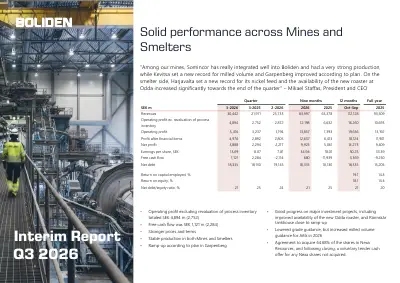
Here it goes. The highlights, as I already pointed out, we have strong earnings of about 4.9 billion Swedish krona.
We have a solid performance in general across the mines. I'm picking here specifically Somincor, which is doing very well, and also Kevitsa, which is doing well.
The ramp-up plan in Garpenberg is also going very much according to what we have said we're going to do, even though we, of course, still much below where we were last year. We also have in our smelters, especially Harjavalta, a very strong quarter, I would say almost exceptional availability of the equipment in Harjavalta.
We also have a new record in Harjavalta in terms of nickel feed. The Odda smelter is moving on in a much better pace than it has in previous quarters.
We have come up to an availability in the quarter of about 50%, way up from the 17% in Q2, and in the last month of the quarter in September, we had 70% availability, the curve is clearly going in the right direction as of right now. Then during the quarter, as you all know, we also announced that we are going to go ahead and acquire first of all the Votorantim stake in Nexa and then after that also continue with a broader offer for the minority shares.
Looking at the financial performance, you can see here very clearly a big uptake around these ones. We have the operating profit of 4.9 billion Swedish krona.
There's a little bit of planned maintenance in this quarter as well, although much less than in Q2. We have a positive cash flow.
Håkan will come back in a little while and talk a little bit more about the details. We have the net debt to equity, the gearing is now down to 21% again, and capex at 3.4 billion Swedish krona right exactly how we guided and then what we also had planned for.
The key projects, I'll start with the Rönnskär tank house, because as we have always said, we intended to start it up in Q4 of this year, and early today we actually had power on in the first of three sections in Rönnskär, the tank house is, as I'm speaking right now, already producing on that first section. The other two sections are intended to have the power on later during the quarter, and as we go into Q1, we should have a full pace of production.
The Boliden Area, sand recycling is working according to plan. The Rönnskär zinc clinker is still very early days, ramp-up in the first half of '29.
The Garpenberg project, those who read Swedish news will know that we had the official start of the project with the ceremony for the first excavation for the new shaft the other day. That one is early on track as well, although it's very early days, but that looks good.
Then the Odda expansion, the ramp-up is ongoing. The availability of the roaster is increasing, as I said before.
We saw 50% on average for the full quarter, 70% in September, and this is clearly moving in the right direction. The mechanical issues that we had in the beginning, linked not so much to the actual critical equipment, but linked to things like transports and other thing, have now been cleared out to a large extent.
On the ESG side, we did not have the best of quarters in terms of lost-time injuries. There's also been a fatality during the quarter or actually right after the quarter in early October, a very unfortunate event.
It's still a little bit unclear to us what really happened, also a little bit unclear whether it is a workplace-related fatality or whether it is a sickness fatality, doesn't really matter. We've had a fatality.
We're working around it, trying to figure out what really happened and how we can get better from that. The other lost-time injuries also in the quarter was not brilliant.
We had a higher level than what we had last year, and we continue to work with these issues relentlessly. The sick leave, however, is going towards the right direction.
We now had 4.0% in the quarter. That's around the level of what we were before the pandemic.
We have been on much higher levels, and you can say this is the first time we're back to pre-pandemic levels. Then the greenhouse gas emissions is going according to our plan.
Market development, I think that you all know that we have good price and terms, and you can see here that when the Boliden Index, which is the red line here, has plateaued, but on a very high level compared to before, and just from 2021, we're at index 175, 75% up for the mix of metals that we have. Also the currencies are helping, although a bit on less scale, but the currencies have also been helpful in this situation.
I also must point out the sulfuric acid prices, which are also helping quite a lot in this situation. The prices for copper and zinc, I'm not going to do any detailed market analysis, but you can all both see here that compared to the cost levels in the industry, we have high price levels.
Most everybody in the industry makes money. You can see that on the copper side, actually, costs are going up, which could be an indication that the margins might get a little bit smaller going forward.
This cost increase on the copper side has to do with diesel prices going up. It also has to do with sulfuric acid prices going up, which for many copper mines is a cost.
On the zinc side, also a good margin on this one and more of a flattish cost level development across the industry. If we then go to Boliden and look at our production, as I said earlier, we've had a good production.
Aitik has a mill volume of 10.3 million tonnes, which is clearly better than last year. Also strong mine production when you add on the waste rock production, the stripping going on is very strong.
The copper grade is in line with previous quarter, higher than last year, but it is lower than we had indicated in the guidance, and we will reduce guidance for the copper grade for the whole year in Aitik based on this, but we will increase the guidance for throughput for the year. Boliden Area, very stable operation, looks very good.
The Garpenberg, yes, it's not a good thing that we don't have the Lappdat available, but given that situation, very good production in the quarter, producing according to the plan that we had internally and that we've given to the market, actually slightly better grade than we had guided for. Kevitsa, a record volume, very good.
Of this mixed grade, but it's still a relatively good level. Somincor, very strong, particularly copper.
We are very positively surprised by Somincor coming into the family. Tara, a little bit lower than what we had liked to, but still within reason.
Zinkgruvan has stable operation. Mixing it all together, very good mine production.
On the smelter side, let me take Harjavalta first, which is outstanding in its terms of equipment availability, has had a very strong quarter in general, and it's a quarterly record in terms of feed on the nickel line. Kokkola, also very strong production, which is clear that we also get better production than last quarter.
Bergsöe, very strong production. Rönnskär has had a maintenance stop around that and also lower silver production due to lack of availability of one of the silver furnaces.
That is now fixed, and as of Q4, we're full speed also on the silver line. Then Odda, as I said, we've had the availability going up, which is much better than it was before.
We have, however, encouraged somewhat of a difficulty on the old Odda roaster and the associated acid plant, which means that we have more planned maintenance going into the old roaster and the old acid plant in Q4, and we're also therefore guiding up for total effect from maintenance stops for smelters from 450 to 500. With that, Håkan, go through the numbers, please.
Håkan Gabrielsson
Thank you, and good afternoon. As Mikael pointed out, a strong quarter.
We are reporting an operating profit of 4.9 billion, which is clearly up to the comparisons, and it is, in fact, the best quarter so far for this profit level. Capex, 3.4 billion, in line with guidance.
We also in this quarter had 219 payout for acquisition activities, that is the contingent consideration for the acquisition of Somincor and Zinkgruvan. These two newer assets have had a really good development, both in terms of operational development and also prices.
As we have kind of a profit sharing in the contingent consideration, there is a payout going to the sellers. Free cash flow, 1.1 billion.
I'll come back to that. Looking then per business area, as you can see both in the charts and in the table, there's a good development in both business areas, starting with Mines up to close to 4 billion.
Compared to Q2, mines are helped, of course, by the strong price development, but there is also a significant effect from Garpenberg producing in line with the guidance. Also a good development in Smelters, and there you have to remember that Q2 was, as usual, impacted by quite extensive planned maintenance, and of course, Smelters also has some help from prices.
Moving in to operating profit deviation, the EBIT bridge year-on-year, starting first in Q3 of this year compared to Q3 of last year. We have a significant, a very big impact from prices, 3.2 billion.
This is, of course, mostly metal prices, where we have a good development of copper, zinc, and gold, to take them in order of importance. It also includes a significant effect from provisional pricing, but it's not only the metal price, it's also a small but significant increase of by-products.
We have in here about 200 million from sulfuric acid. Volumes are down compared to last year, and this is overexplained by Garpenberg, we have lower production in Garpenberg and then as a result of the seismic events last year or earlier this year, but it's partly offset by better production at other sites.
Some that are worth mentioning are Aitik with a good production, Somincor performing well, and Harjavalta, which Mikael talked about. Costs compared to the same quarter last year are up by about 600 million.
In there, there is an oil-driven inflation that hits oils, it hits chemicals, and it hits transports. We also have some additional cost in Odda during the ramp-up, and also due to the fact that we have a strong third quarter, we've had to increase the provisions for our profit-sharing programs that goes to all staff.
In the other line, the plus 259, there are different things, foreign exchange and others, but the biggest individual item there is the sales of excess electricity that we do in Odda. Of course, when we'll get up to full capacity there, that this part will disappear, because we'll consume the electricity ourselves, but for now, there is a significant impact from sales of electricity.
Comparing instead sequentially, Q3 to Q2, it's a similar story. A good development of prices and terms.
Again, it's copper, zinc, and gold primarily, but also about 100 million each from foreign exchange and sulfuric acid. Volumes compared to Q2 are up 900.
Getting Garpenberg up from where we stood in Q2 to the current rate in Q3 is about a third of that amount, meaning then 300 millions. Then, in addition, we've got better grades in Aitik and good production in Somincor, Zinkgruvan, and less planned maintenance in smelting, good volume quarter.
Costs are lower than in Q2. That's two parts in that.
It's the less planned maintenance in this quarter, and then we also have some seasonal effects where we have a little bit of a lower cost during the vacation period that we had in Q3, even if it's easy to forget now when we're in October. Depreciation is up 80 million.
That's largely Odda. Odda is not depreciating in full pace yet.
We expect another 150 million roughly in pace in Q4, and then Odda will be depreciating at the full pace of after the expansion. We had some impact already in this quarter.
Then further on for next year, we'll, of course, have an effect in Rönnskär also when that is producing. Moving over to cash flow, I think we've commented the operating profit and the investments side.
Working capital is minus 1 billion. That's two things that are worth highlighting.
With the price development that we've had, we get quite significant impact on working capital for better prices. We tie more inventory in Swedish krona than if we have a higher copper price or a high zinc price and so on, so that's a significant part.
We haven't quite been able to reduce all of the working capital that we tied in Q2, either. Looking forward on the working capital side, I'd just like to remind you that in Q4 we will tie working capital in the tank house in smelter in Rönnskär.
We mentioned a number of 2 billion last quarter, and since then prices have increased even further, filling the tank house with copper and gold and so on, that means that we're going to build some working capital. For those of you modeling, please include that.
Apart from that, I think we've covered the remaining parts in cash flow. That leaves us with this final slide from my side.
It's a strong balance sheet. We've got 20% debt-to-equity ratio, with I think is a good level to be when we look back at the Lundin acquisition and we look forward to the Nexa acquisition.
We have a net payment capacity of 19 billion, and all in all, a strong balance sheet. Mikael, you want to continue?
Mikael Staffas
Thank you. Just remind you about the Capital Markets Day that we are planning for March.
It's high time to report your participation if you want to join us. Outlook going forward, I think we've touched upon this very much.
There is a lowering for this year of the grades in Aitik, but a highering of the throughput in Aitik. Apart from that, there's not really anything that changes.
There's a little bit of a difference of the classification on the capex on the mining side, with the larger part going to mine sustaining and a smaller part to other mines, but otherwise, the guidance is very stable. I should also, by the way, mention, as I said before, smelters' planned maintenance is also up from 450 to 500.
With that, I leave the floor open to questions and for Olof to monitor us through this session.
Olof Grenmark
Ladies and gentlemen, that opens up our Q&A session, and we will start here in Stockholm, and we have Johannes Grunselius from SB1 Markets, please.
Johannes Grunselius
Yes, hi, everyone. It's Johannes here, SB1.
Two questions, please. The first one on Aitik, you have lowered the grade guidance for us to 0.16.
How should we think about 2027? I know you're going to talk more in depth in December, but could you give us some color at this point?
Mikael Staffas
Not really. You're absolutely right, we're going to talk about it in December, and the mine plan for next year is not finished yet, and until it is, I'm not going to comment too much.
Johannes Grunselius
If we look at the previous guidance, that implied an uplift in second half year, which is not coming through. Should we think that that is basically pushed one or two quarters?
Could you help us with that? No, but
Mikael Staffas
I can give you a little bit of light. There's part of that is being pushed out, and there's also one thing that we hope is more of a one-off effect of this one, that we're having a couple of benches which have a higher waste rock dilution than we are used to in Aitik.
That's also linked to why we're having a higher throughput, is that we are not trying to separate this waste rock, we're loading it all through the mill, helping on the volume, but being negative on the grade. We, of course, need to look around this.
We have a sense that Aitik should go back to normal, i.e., that we don't have much of waste rock dilution as we come to the deeper benches, and we've been trying to check for this as this thing has happened. It's unexpected waste rock dilution and a combination also that by mining a little bit slower than initial thoughts, it takes a little bit longer to get to the better grades.
Johannes Grunselius
Then the other question I have is on sulfuric acid. I think you said was it 200 million plus in delta year-over-year?
I know you have plenty of annual contracts in your portfolio. Do you expect sort of more incremental profits from acid/sulfur going forward, given where prices are right now?
Mikael Staffas
To that, I can say yes. If you want to know about how much, I need to look at my neighbor.
Håkan Gabrielsson
I'm not going to guide how much, but we see a positive trend in there, I think that we'll see a positive number also next quarter. I'm not going to give an exact number on that yet.
Olof Grenmark
Johan Sjöberg, Nordea Securities, please.
Johan Sjöberg
Thank you, Olof. Could you talk a little bit upon the EBITDA contribution from Norzink and from Rönnskär now when you're ramping up that, given the current metal prices?
Also sort of how we should look at that into Q4, given the positive trends in Odda, and then also when it comes to Rönnskär's tank house, when we should start to see the positive impact on EBITDA from that?
Mikael Staffas
It's good to hear somebody saying Norzink. It's been a long time since I heard that word last time, but it's a nice name.
We'll give it back the numbers exactly to Håkan, but just a sense of it, we haven't had anything come through yet in Rönnskär, and therefore, it's all ahead of us, the positive impact that we're going to see. On Odda, there it's a little bit more complex, and so as you saw, we've gotten much better, or as I said, we've gotten much better throughput.
There's more still to come. There also in Odda, we have been holding back on silver-rich concentrates, because until we have everything under control, we don't want to risk wasting silver into tailings.
Therefore, there you will get the effect once we will start daring to take silver-rich concentrates in there. Now Håkan, numbers.
Håkan Gabrielsson
I'm not going to give you an updated numbers for both cases, because there are so many moving parts with sulfuric acid, zinc, and so on. I rather refer back to the Capital Markets Day, where we gave an update, and then it has moved in the right direction since then.
Only additional comment is that for Odda, I think it's important, and also for Rönnskär, there are a few weeks before you sort of put it in until you get it out. For example, in Q3, we had almost no extra effect from Odda, even if it's moving in the right direction.
I think there is some lag, but we'll see money starting flowing in Q4. Then
Johan Sjöberg
a follow-up question on Johannes' on sulfuric acid and the contracts. How big share of your volumes have been exposed to this price increase, i.e., how much is sort of renegotiated next year, so that the delta between Q1 and Q4?
Håkan Gabrielsson
There are all kind of versions in there. It's a fairly small part that is directly linked to spot, in particular if you read in the newspapers about global spot prices, that's a very tiny part of our sales.
Most is connected to European indexes of various kinds, and then contract by contract, it differs on how often it's reset. If anything, I'd say that 80% of the production we have is connected to European index on some frequency, yearly or shorter.
Johan Sjöberg
How big share have you seen already impacted by higher prices
Håkan Gabrielsson
and
Johan Sjöberg
how much is sort of yet to come next year?
Håkan Gabrielsson
That comes gradually, but I think when we're through with this year, we'll have a fairly recent impact on all of the sales. There are a few contracts reset every quarter, it's continuous, if you like.
Johan Sjöberg
Thank you.
Olof Grenmark
Kaleb Ahl Solomon, SEB.
Kaleb Solomon
Thank you. In Q2, you expected Odda to reach full production during Q3, and you said roaster availability averaged 50% this quarter, and I think you said it was 70% by September.
Is that a fair sort of run rate to assume for Q4, and what still needs to be resolved before you can sort of sustain full production?
Mikael Staffas
As always when you have these things, I should say, by the way, that when we run, we run 100%. We don't really run it slower.
The question is how do you avoid having to stop as many times, and I think you've had the discussions. We've had mechanical issues.
We've had issue with the safety system that has blocked out the different stations when it should not have, and so on. We're getting better and better at this, and I think that 70 should be kind of the new floor and moving up towards somewhat like 90%, where the availability should be for equipment like this.
I think we're quite close to getting there to get the ramp-up. Then, just to get everything clear, once we have the ramp-up, when we have the full feed, that's the only time we can start using all the later stages, the leaching and everything else going on full pace.
That's when we also need to make sure that we get the recoveries of silver right and start mixing in more silver-rich concentrates. There it will take some time to fine-tune this thing, but I think the mechanical problems that we've had, which has been the problem especially in Q2, mechanical problems that shouldn't happen, they are behind us.
The mechanical issues are solved.
Kaleb Solomon
That's helpful. Thank you.
Just on Aitik volumes, when we asked you about the sort of very good development last quarter, you partly mentioned seasonality and less relining, but is it fair to sort of interpret you now as this being a lasting improvement, and should we expect it to carry into next year?
Mikael Staffas
We had a very good Q2. Q3 is a little bit slower than Q2 because of the reasons you just mentioned, but we think we reached a better base level, if you want to say so, in Aitik.
Kaleb Solomon
Thank you.
Olof Grenmark
Anyone else here in Stockholm? Operator, then we start with international guests, please.
Operator
If you wish to ask a question, please dial pound key five on your telephone keypad. To enter the queue, if you wish to withdraw your question, please dial pound key six on your telephone keypad.
The next question comes from Alain Gabriel from Morgan Stanley. Please go ahead.
Alain Gabriel
Yes, hi. Good afternoon, and thank you for taking my questions.
I have a couple of questions. Firstly is on Odda.
I think, Mikael, you mentioned that 70% utilization is the new floor. Is the ramp-up to 100% going to be a straight line from here or will it be more of a hockey stick trajectory, and over what time period do you expect it now that you are over the mechanical issues to get to 100%?
That's my first question.
Mikael Staffas
Here you should be careful with 100%. You never have 100% availability, there's always some downtime in a roaster.
I have said that 90% is probably reasonable for full availability. We hope that we're going to get there pretty soon.
Now our self-confidence is not so strong regarding Odda, because I said that before, but generally speaking, we should get there pretty soon to get the throughput in place and working with the other parts.
Alain Gabriel
Thank you. The second question is on the Nexa deal.
Do you have any updates on the MTO process for Peruvian-listed subsidiaries? I believe the last public comment you made, you had given an estimate, rough estimate of around 3 billion SEK to take out the minorities there.
Does this figure still stand, and what are the next regulatory or legal steps that are needed for you to move forward with the process?
Mikael Staffas
I'm going to answer the way I hate to answer, but I'm going to answer that due to legal advice regarding both the voluntary tender offer and the mandatory tender offer, I will refer to what's in the press release and not say anything more.
Alain Gabriel
Understood. Thank you.
Operator
The next question comes from Adrian Gilani from ABG Sundal Collier. Please go ahead.
Adrian Gilani
Hello. I guess, first of all, on Garpenberg, you write that the ramp-up is going as planned, but if anything, you seem to be above the 30% utilization rate that you talked about previously.
Is that just sort of a normal quarterly fluctuation or can there be some upside to the ramp-up timeline you communicated before in Garpenberg?
Mikael Staffas
The guidance we've given is the 1.5 million tonne for the whole year, right? That's what we need to deal with, and then you can say a couple of 10,000 up and down in a quarter is not really relevant.
We are very much in line with the guidance we've given. Somebody made a little bit of a smart comment that, okay, you're going to go from 100,000 tonnes to 200,000 tonnes.
Is that happening on New Year's Eve? No, it's not really happening on New Year's Eve.
It's, of course, happening gradually, yes, theoretically, we could go a little bit faster in Q4. We're not going to be at the pace of 200 per tonne 1,000 tonnes per day on January 1 either, it's going to be a gradual pieces, but we're guiding for whole years.
Adrian Gilani
Understood. Makes sense.
Then my second question, could you talk a bit about your view on benchmark TCs for copper and zinc heading into 2027, and if they do end up being negative, would you still stick to your policy of locking in 80% of your smelter volumes in benchmark terms?
Mikael Staffas
We will stick to that one, because we have those contracts already in place, we cannot really step away to a large extent from the strategy that we have. We will have roughly 80% on benchmark, even if they go negative.
I'm not going to speculate in what the number will be. The number will be what the number will be.
I will just make in a general comment that if you add in the very bad treatment charges with the very good value of free metals and the good value of the sulfuric acid, smelter terms as a package are not that bad.
Adrian Gilani
Yep, makes sense. I guess that takes care of both my questions.
Thank you.
Mikael Staffas
You.
Operator
The next question comes from Liam Fitzpatrick from DB. Please go ahead.
Liam Fitzpatrick
Good afternoon. Three questions from me.
Firstly, on Odda, you mentioned, Håkan, excess power sales in Q3. Could you quantify that number for us?
Second question is on working capital. Was any of the 2 billion build related to Rönnskär in Q3 or is that all in Q4?
Then related to that, we normally see a seasonal reduction in working capital in Q4. Ex Rönnskär, should that still come through?
Then the final question is a bit of a follow-up on treatment charges. It's tough to model the TCs into next year, given we're now in negative territory.
Are you able to give us some sort of number for copper TCs, like if 2026 was a negative TC of, say, minus 100, what would that have meant in terms of impact on EBIT this year?
Håkan Gabrielsson
Do you want to start or should I start?
Mikael Staffas
You can. I think these are mostly yours, all of them, you go ahead.
Håkan Gabrielsson
Okay. Starting with the excess power, I think it's about in the quarter just over 150 million.
Working capital, nothing of the Rönnskär tank house working capital that we're going to tie of the 2 billion, nothing of that happened in Q3, all of that will happen in Q4. You're right seasonally, we typically have a good fourth quarter when we come to working capital.
I think the underlying development is probably going to be pretty okay, except the capital build in Rönnskär, but perhaps less so than last year. We ended last year on very low inventory numbers, and I don't think we'll be at quite the same level this year.
Then also I can just mention that in a copper smelter, the value of the inventory is very big, it doesn't take very much of a hiccup in the ramp-up to build extra working capital in there, I'm a bit conservative in my estimates for Q4 working capital. You're right, the seasonality is still there, so that's a fact.
Then could you please repeat the last question or did you get that?
Mikael Staffas
What's the impact of negative 100 TC, what would it have done? I don't know, we published the TC sensitivities.
Håkan Gabrielsson
We have the sensitivity in the quarterly report. Around zero it becomes tricky.
Yeah. I think we'll have to redo those, but what we do see right now is that I think if you just work at the feed level, I think you can get the general idea, but TC is a very small part of the money we make in smelters.
In our case, it's positive, though, because we do get payments for complex material in the feed. I have to come back to some form of sensitivity on those TCs.
Mikael Staffas
Thank you.
Operator
The next question comes from Jason from Fairclough. Please go ahead.
Hi, gentlemen. Thanks for the presentation.
Just two questions for me. One, any thoughts you could frame for us on how the smelters are under-earning relative to their capitalization and the recent investments that you've made?
That's the first one. A second one, Mikael, you seem quite excited about Somincor.
I'm just wondering how you're thinking about the optionality in this asset. Is there any option for a low-capital-cost debottlenecking there?
Mikael Staffas
If we start with the second one, the answer is yes. There are, and we've talked about that many times, there are geographic or geological potential in there.
If you read the European Union list of strategic projects, there is an expansion in Somincor in there. Yes, there are clearly options for, as you describe, typical brownfield expansions with relatively little capex.
I would say yes, the answer is yes. The first question, just so I understand, you were talking about the underperformance of smelters, and it depends, of course, where you put your baseline.
I'm not sure that there is really an underperformance of smelters, but there is an upside of smelters, which I would argue is all of the guided uptake in EBITDA in Rönnskär, because nothing of that has happened as of Q3. It is most of the indicated EBITDA uptake on Odda, even though some has happened, but as Håkan pointed out, with the fact that there is a timing delay between the time you can feed, which is linked to the availability, until you get the product out.
Most of that has not come out yet, and we've also had still somewhat higher cost for the adaptions we need to do. I would argue also that most of the upside as communicated in the Capital Markets Day in Odda is ahead of us.
Sorry, Mikael, could you just remind us then what's the EBITDA uplift potentially we could see in each of the two smelters from here?
Mikael Staffas
In the Capital Markets Day, and I'm looking at Håkan to remind me if I say the wrong thing, but I think that we said it was €150 million in Odda at the outtake, which was at the time of the Capital Markets Day, €250 million with the price and terms as of March this year. For Rönnskär, we said 1 billion Swedish to start with, then we said I think it had gone to 1.5 billion, right?
Håkan Gabrielsson
Correct.
Mikael Staffas
With the prices and terms as of March this year, and since March, the price and terms have improved. These numbers should be slightly higher today, but I at least don't have an exact number.
Håkan Gabrielsson
Okay. Overall we should be talking about, call it, 2 to 3 billion SEK improvement once these things are running properly, fully ramped up?
Mikael Staffas
If you add what I said, it was four.
Håkan Gabrielsson
Sounds good. Thank you very much, sir.
Operator
The next question comes from Amos Fletcher from Barclays. Please go ahead.
Amos Fletcher
Afternoon, gentlemen. A couple of questions.
First one was just on the subject of Nexa. It had a credit rating downgrade to junk earlier this week.
I just wanted to ask what are the implications if we get another agency downgrading them, bonds get put to the company?
Mikael Staffas
You can put this in two ways. There will be the opportunity for the counterpart to ask for a prepayment on the bonds.
This particular one that happened is going to have a quite limited impact, and other ones could have bigger impact if they were to happen. Then it's a question whether anybody wants to prepay or whether they would like to stick with them anyway.
I would say that this is a little bit of a complicated matter, has to do with many things, but we feel relatively good about the situation.
Amos Fletcher
Okay. Then secondly, I just wanted to ask just I guess a little bit more clarity on the working capital side, just whether you have built all of the concentrate inventory at Odda that you are requiring for the full ramp-up or whether there's going to be any more of that to happen in Q4 that we should be aware of?
Håkan Gabrielsson
I think basically we've built all we have to build in Odda, and we haven't built anything that we need to build in Rönnskär. I think that's the easiest way of putting it.
Amos Fletcher
Okay. Then I just wanted to ask, I suppose on timing on the Odda ramp-up, as you say you expect to get towards 90%, relatively soon.
Then I just wanted to ask what's the kind of timeframe for getting the recoveries right and then putting the more silver-rich concentrate feed through the plant? Is that something that happens kind of through H1 next year or is it likely to take a bit longer?
Mikael Staffas
As I said, my kind of self-confidence in promising things in Odda is a little bit low, but I would say it should clearly happen in the first half of next year.
Amos Fletcher
Okay. Then I just wanted to ask, you were mentioning about D&A uplift or depreciation uplift from Rönnskär as it ramps up in 2027.
Is there any sort of guidance on the quantum of D&A uplift that we should expect?
Håkan Gabrielsson
On depreciation, it's about let's see, 150. 150 million SEK, we're talking about, roughly.
Mikael Staffas
Per quarter.
Håkan Gabrielsson
Per quarter.
Amos Fletcher
Perfect. That's all my questions.
Thank you.
Operator
The next question comes from Daniel Major from UBS. Please go ahead.
Daniel Major
Hi. Thanks for the questions.
First one on Garpenberg, last couple of quarters you've given us quarterly EBITDA, EBIT, kind of run rate just to help us model through the year. Clearly, volumes improved.
Can you give us, say, more frame it a different way, how much of the volume delta in mines quarter-on-quarter came from Garpenberg? Let's
Håkan Gabrielsson
see if I can starting to think what I should say. I think if we compare Q2 to Q3 and talk about the volume aspects, there was about 300 million SEK in volume uplift between the quarter.
That also brought the mine from a slight loss to close to 300 million EBIT profits, Q2 to Q3.
Daniel Major
Around 300. That's.
Håkan Gabrielsson
Yeah. Thanks.
Daniel Major
The second one, a little surprised both mining and smelting had a positive cost benefit in the quarter, given some of the fuel pressures. Can you just remind us the fuel sensitivity, and from a perspective of any time lags, if the status quo European diesel pricing remain the same Q4 into next year, what would the cost delta be?
Håkan Gabrielsson
There is a little bit of a time lag, but I can give you the overall numbers that we've spent in the quarter, and then you can apply various percentages. On oil and diesel, we've spent about 400 million SEK in the quarter.
Depending on price developments from here, that's the base. Power, we've spent about 700 million in the quarter, and on other forms of energy, it's about 100.
That's what we have, and then, in addition to that, the diesel also impacts transports, chemicals, although with some lag. I think if we spend 400 on diesel, I think on oil and diesel, I think you can add roughly the same amount on chemicals and transports.
That's the base, and then you can apply the percentages that you want to apply on that.
Daniel Major
Just to follow up on that. You said there is some time lag.
If just the status quo remained the same Q4 and into next year, would that be material or would you have largely realized
Håkan Gabrielsson
it as
Daniel Major
kind of uplift in the spot price this quarter?
Håkan Gabrielsson
I think we would largely have it in. I'd guess it's a month lag or something like that.
We have most of it.
Daniel Major
That's clear. Thanks.
Then maybe final one, what was the provisional pricing impact on the quarter?
Håkan Gabrielsson
Provisional pricing was about 200 million positive. When I say provisional pricing, then I, as usual, I refer to the preliminary priced volumes at the end of Q2 that were then finally priced in Q3.
That had a positive effect of 200.
Daniel Major
Great. Thanks a lot.
Operator
The next question comes from Matt Greene from Goldman Sachs. Please go ahead.
Matt Greene
Hi, Mikael. Just a quick question on Garpenberg, you touched on production is recovering as planned, but just more on development meters.
It's fallen again quarter-on-quarter. Where do you need to get those rates to support 2.3 sorry, 2.3 million tonnes next year?
I guess just trying to sort of see if there's any technical, personnel, or equipment constraints in you being able to lift those development meters, appreciating that you do need to open up new mining areas given 70%, 75% of your working areas were lost with Lappdat. Thank you.
Mikael Staffas
I think we are at around 1,300 meters, right, 1,300, 1,350 meters of development, and that's roughly what we need. We are not with a big margin, but we are tunneling at roughly the pace that we need to tunnel in order to be able to meet what we have guided for, and also to be able to do the tunneling that's needed for then the new shaft that is also now starting to be being put in place.
Operator
The next question comes from Krishan Agarwal from Citigroup. Please go ahead.
Krishan Agarwal
Hi, and thanks a lot for taking my question. Most of them have been answered.
A quick follow-up on the Nexa process. You've announced in the release that you've got the approval on October 27 for one of the Votorantim's FDI receipt in the Swedish market.
Can you help us with any of the other major regulatory approvals that are still pending for the transaction, and also the vote which you are going to hold on November 23, that has to be the simple majority or the supermajority?
Mikael Staffas
To just start in the backwards, that's a simple majority needed for that in our EGM. Then if you look at they're all together roughly 15 regulatory approvals that we need.
That's a combination of the ones we already gotten, the foreign direct investment in Sweden. There's a combination of the permits that we need in Brazil for owning some natural resources, and then anticompetition rulings that we need from roughly 10 countries.
All of them are well in progress and well processing, but it's only one so far that we really gotten. We feel that the process is okay for a closing in Q1, but you never know.
We don't control the process.
Krishan Agarwal
Understand. Then of the 10 countries, does that include China?
Mikael Staffas
No, not China. China is not on the list.
Krishan Agarwal
Okay.
Operator
As a reminder, if you wish to ask a question, please dial pound key five on your telephone keypad. The next question comes from Christian Kopfer from Arctic Securities.
Please go ahead.
Christian Kopfer
All right. Thanks very much.
A few follow-ups from my side. Firstly, you talk about the guidance in Aitik, and I appreciate that you update on the grades there in second half.
I also, if I understood you correctly, it seems that there is some upside to volume guidance in Garpenberg for Q4. If I look at pretty much all other mine assets and if I try to square those production numbers to your full-year guidance, it seems that there is upside more or less all over the place, including grades.
Are you just being cautious or should we expect pretty much heaven's down in Q4?
Mikael Staffas
I think that we've always warned everybody when you're standing at Q3 and you get a full-year number and you try to kind of work out what Q4 is by taking the full year minus the three quarters that have been presented, there's always a big kind of risk in taking that too long. I would also say that don't take that too seriously.
When we don't change the guidance, that means that we're more or less going to continue the way that we have guided for before, and don't take that too long. It looks pretty good, but don't overdo it, Christian.
Christian Kopfer
All right. Then just a small detail perhaps.
In the presentation, sorry if you already talked about it if I missed it, but you had some minus number on metal premiums. Where is that coming from?
Also pretty big minus number on TC/RCs. Is that spot-related or what's going on?
Mikael Staffas
Håkan, I'll let you go into detail, but TC/RCs must be spot-related. We do have some spot in the mix that will go through there.
The premiums, Håkan, help me.
Håkan Gabrielsson
As you say, the TC level or the premium level is related to spot during vacation periods. The TC, I'll have to get back on that.
We're following the benchmark, but then you have quarterly variations depending on the amount of complex material, the amount of, for instance, mercury and similar that we get extra payments for. It is a variation, and given the ramp-up of Odda, the flows have been a bit more volatile than usually.
I'll come back to you separately on that, I think.
Mikael Staffas
That's a good point. Just if you're comparing premiums Q-on-Q, we always have lower premiums in Q3 because of the vacation period, and thus selling more overseas with lower premiums when industry in Europe take vacation.
Christian Kopfer
All right, fair enough.
Operator
The next question comes from Erik Rougier from Fearnley Securities. Please go ahead.
Erik Rougier
Hi, Mikael, and hi, Håkan. Thank you for presentation and for all the questions.
I had a few questions. On Tara, I see unchanged full-year guidance.
This implies approximately 500 kilotonnes milled in 4Q, which is roughly 60% above 3Q and subsequent or the previous quarters. What supports this implied acceleration going forward?
Mikael Staffas
Once again, I will refer to what I just said. You have to be a little bit careful exactly how you look at the guidance and exactly what kind of conclusion you do draw for Q4 individually.
As was pointed out by Christian just a while ago, I think that there is some upside to certain numbers, there could be downside to certain numbers as well in terms of guidance, and we have not overspent going into the exact details of certain mines. In general, we know Tara is continuing more or less where it is, maybe slightly better in Q4 because things are sorting itself out, but it's in line with what has happened before.
Erik Rougier
Thank you. Appreciate it.
Also following the proposed Nexa acquisition, should we expect the balance sheet and deleveraging to take priority over additional growth investments? I'm thinking, for example, projects such as Laver.
Mikael Staffas
It's a good question, but it's a little bit difficult to answer right now. We will answer capital commitments to projects like Laver or Nautanen as they mature, and what will take a look into what the balance sheet will look like in every time.
Now having said that, you know that those two big-ticket items are a couple of years out, which means it gives us a few years of hopefully good, positive cash flow to make sure that we have a balance sheet where we want it to be.
Erik Rougier
Thank you, and that is a perfect segue for my last question. On Garpenberg, you reiterated the 2.3 million tonnes production target for '27, but also mentioned of an ongoing permitting process for additional waste rock storage following the seismic event.
How confident are you that an interim approval can be secured in time, and does your 2.3 million tonnes guidance assume that the new stockpile is operational for the first half of '27?
Mikael Staffas
You're referring to, and now just for everybody's clearance, there's been some discussions in Sweden that we have asked for a permit to store more waste rock above on surface for our plan going ahead in Garpenberg. That the County Board, who can give an exemption, have decided that this is too much of a change to give an exemption, we need to get an altered environmental permit from the court.
That's what you're referring to. I think just to be very clear, we do not have an issue to handle the waste rock.
There are many other ways of doing it, including the kind of very simple one to just put it through the mills and put the tailings out on the tailings facility, because we have full permit for that. It's a little bit stupid to spend energy on grinding waste rock just to put it in a tailings facility, and I think everybody's aware of this.
I don't think that in the end of the day, this is going to be any issue whatsoever, and there are lots of plans that might not be the perfect plans if for some reason this permit gets delayed.
Erik Rougier
Thank you for the clarification and for the encouraging in the guidance.
Mikael Staffas
Yeah.
Operator
The next question comes from Boris Bourdet from Kepler Cheuvreux. Please go ahead.
Boris Bourdet
Hello, gentlemen. Thank you for taking my question.
It's a follow-up on Garpenberg following your comments on the 300 million SEK sequential improvement. Just wanted to check that's an EBIT figure, as far as I understand, and that compares to something that was close to zero in Q2.
I would be interested in getting if that's actually EBIT contribution, how much is the related depreciation? Thank you.
Håkan Gabrielsson
It's an EBIT number, but depreciation is not very variable, it's fixed, it will be the same in Q2 and Q3. The EBIT change is pretty much the same number as you get as a revenue change.
The variable cost is very limited in this situation.
Boris Bourdet
Last year the depreciation was 650, we would divide that number by four and get the depreciation per quarter, right?
Håkan Gabrielsson
That's correct, with the addition that we wrote off a few hundred million SEK, and that goes away from the depreciation base. Apart from that, you should be pretty close with what you're saying.
Boris Bourdet
Thank you.
Mikael Staffas
With that, it looks like we're coming to the end of the questions. Then I would just like to wish all of you a very happy All Saints' Day, if you're in the part of the world that celebrates All Saints'.
I wish you also then a very good end of the year, and I look forward to seeing most of you well, some of you we will talk to at least through a press release in early December with the guidance. Otherwise, we'll see you all in this setting in 3 months from now.
Thank you.