Electrolux Professional AB Class B
Q3 FY2026 · Earnings Call TranscriptOctober 28, 2026
Jacob Broberg
Good morning, and welcome to Electrolux Professional Group third quarter result presentation. My name is Jacob Broberg.
I'm heading up Investor Relations and Corporate Communication. As before, I have Paolo Schira, our President and CEO, with me, and also Fabio Zarpellon, our CFO.
As always, we start with you, Paolo. Please go ahead.
Paolo Schira
Thank you, Jacob, and good morning, good afternoon, everybody. Happy to present the Q3 results.
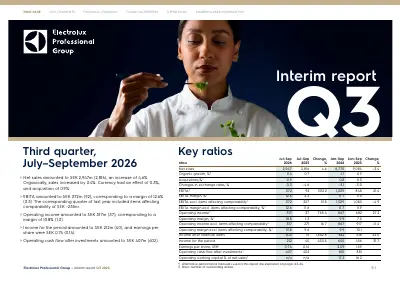
Has been a good quarter for Electrolux Professional because both the reported segment are presenting a growth, as well as the different geographies are showing organic growth. The number is 3.4%, and it is supported by price, volume, and customer care development.
Positive start for this quarter. Profitability has improved as well, to 12.6%.
It is fair to mention that we had a tariff refund during the quarter of 26 million. Even removing the refund from US for the tariffs, the baseline profitability has been improving in the quarter.
It is positive. Cash flow returned to the historical high level.
Compared to prior year Q3, cash is higher, slightly higher. Even more important, the comparison with the Q2, where actually there is a material improvement.
Thanks to the good cash generation, we can see that our leverage, net debt on EBITDA, is returned back to 1, which is positive. This is also remarkable considering that during the year, we had some cash out related to the efficiency program, as well as beginning of the year, we did an acquisition.
Historical strength of the cash flow for Electrolux Professional is confirmed. Looking at the quarter, the Q3, we have seen a bit of acceleration towards September, that has been a very good month.
Overall for the group, the order intake is up. Looking now on the geographies, and I mentioned earlier, this is a positive situation we have seen in Q3 because the three macro regions, Europe, Americas, and APAC MEA, has been delivering growth with different dynamics.
In Europe, the main driver has been food and beverage. In Americas, main driver laundry.
In APAC MEA, actually both of the reported segment had a positive evolution. Now let me give you a quick perspective on the two reported segments, starting for the food and beverage and then moving to laundry.
Food and beverage, organic growth 2.3%. Different dynamics between the regions.
Europe continue with several months of good trajectory of growth, whereas Americas still has a little bit of difficulty in the quarter. Having said so, we do see actually a decrease of the decline in Q3, especially in September.
In terms of dynamics within the American market, we do see the institutional, the general market, doing fairly well for us. It's in the chains where we had a little bit of missing rollouts in the quarter.
The activity level is on a good level. APAC MEA reported a very good growth of 8%.
I think you recall in the previous quarter, I mentioned that we had some postponed deliveries from Q2. A part of this growth you see, the 8% on APAC MEA, is due to actually the postponed deliveries.
A part of it is actually genuine new orders we have taken. The order intake is fairly flat or slightly positive.
The margin is improved organically. In specific case of food and beverage, the impact on US refund for tariffs has been 17 million SEK.
We go to laundry. Very good quarter for laundry, with strong evolution on profitable growth.
Organic growth robust at 5.2%, and margins on 18.1%. Growth delivered significantly from North America.
For full transparency, last year in Q3, we had a relatively weaker quarter because of anticipation to the tariffs impact, we had good orders and deliveries in Q2. Even removing this effect, I would say America's performance has been very positive.
APAC MEA very positive. A little bit softer on the Europe side due to Central and Northern Europe.
If I were to take a longer horizon than the quarter, I would say Europe has been this year delivering fairly well. Order intake positive in laundry across the different territories.
Profitability, as I mentioned, has been developing well. Also, in the case of laundry, we had tariff refund, in this case roughly 9 million SEK.
Also here, same reasoning as for the other reported segment, the baseline profitability has been improving. In a few minutes, I will give you some color, but also noticeable to mention that we launch now, recently, the first part of the range of Line 7000, the new range of laundry machines.
I think having said so, is a good time to give the words to our CFO, Fabio, to give us a bit more details on the numbers.
Fabio Zarpellon
Thank you, Paolo, and good morning, good afternoon to everybody. Paolo went through the business dynamic in Q3.
I will first give you some more insight into our P&L development. Just to do some order on the table, let me remind everybody that last year, Q3 was affected by 235 million SEK restructuring costs, part in gross margin, 133 million, and 102 million in SG&A.
That is the reason why the comparison on reported figures is somehow misleading as is, but I will develop on it in a second. EBIT margin last year without item affecting comparability was 11.6%.
A few words then to dig into the figures. In the quarter, we had a positive contribution from currency translation, both on top line and somehow minor on the bottom line, but the margin as such was not influenced.
In the quarter, as Paolo anticipated, we improved the margin, and the EBITA margin expansion was driven by a gross margin expansion that you see reach 36.1% versus like-for-like, excluding item affecting comparability, of 34.8% of last year. This margin expansion was a combination of different factors.
The tariffs that Paolo mentioned, we had also in the quarter positive currency transactional effect of roughly 10 million SEK. At the same time, we faced important increasing input costs, in particular on transportation costs, that affected significantly the cost in the quarter.
Direct material had some negative effect, not really material so far in the quarter, but more is expected to start heating our profit and loss already in Q4. On the positive side, positive impact from volume growth, price sticking and contributing to offset the inflationary item, and last but not least, the contribution, as expected, of the restructuring program implementation.
Restructuring program that is proceeding according to plan. We have already commented the closure of the coffee facility and the move of the production in the existing facility in France.
The move of production from Sursee down to Italy is proceeding according to plan. The overall, this plan is confirming the yearly positive contribution 85 million SEK on a full-year base.
To give you a flavor, the contribution in the quarter was in an area of roughly 25 million SEK. Finance costs continue a well development, was lower than last year, due to both a combination of lower borrowing, but also a more and more competitive funding structure.
The tax rate had a peak in the quarter, was approximately 30%, that is higher than the historical average, and this is mainly due a country mix. We generated more profit in more high-tax countries, but also in United States, we had a negative influence in term of state mix.
EPS, as a consequence of the stronger EBIT performance and the lower funding costs, increased to 0.74 SEK per share. Cash flow, as you have seen, we are returning to solid cash generation.
The cash generated in the quarter was over 400 million SEK, despite the cash-out that we had for the restructuring program in area of 35 million SEK, and the continuing investment that we are doing, in particular, in the product development side. Operating working capital end up over 17% at the end of the quarter, is higher than the level it was last year the same period.
I would say two major ingredients behind this development: one is higher receivable, this is mainly related to a country mix, majority of the growth in the quarter happened in the Mediterranean area as well as in US for laundry, that are, let me say, the country where structurally that we have the longer payment term. It's country mix, no tension, no highlights in term of quality of the receivable that remains absolutely at good level.
The second piece is related to inventories, and this is because of decision we have taken. We have taken decision to close a couple of operation, as and this has created temporary increase of inventory, as well as some additional inventory due to phasing and phase-out of new product.
The Line 7000 that Paolo mentioned earlier is one example of it. These are more internal factor, our decision.
At the same time, and if you remember we already reported in the previous couple of calls, we were sitting on higher than normal finished good inventory because of customer postponing deliveries. We start to see a decrease of the impact of this item, but being this a rolling 12-month indicator, is still suffer from the pile-up of inventory that were booked due to customer postponement.
When it comes to our financial position, is remained pretty strong. We are now at 1 in term of ratio net debt on EBITDA.
It is lower than September last year, in line with December. Along this journey, I believe a lot happened, in the sense that we have been running acquisition, heavy significant payout related to the restructuring program, we pay dividend, and we continue to finance our organic growth.
I would say remarkable improvement, and we are entering Q4 definitely with a pretty strong balance sheet. With that, back to you, Paolo.
Paolo Schira
Thank you, Fabio. As I mentioned earlier, I'm very keen to share some news about the product development, the launches we've been taking in these weeks.
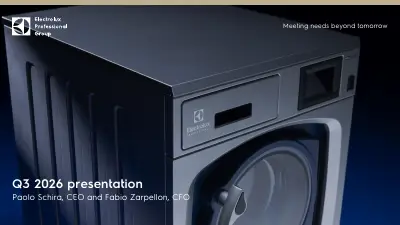
What you see here in the picture is the first part of our Generation 7000 launch that started now in October and will continue during next year. We're very excited about this launch.
This is behind a major product innovation pathway we took as a company, with big investments. Now, the first range is the small chassis, below 10 kg machines.
We're very happy because it's like a new category in the industry. Typically, small machine in the industry are derived from consumer machines, because of the capacity, but performance are somehow compromised.
We're the first one to introduce in the market in this part, the sub-10 kg, actually a fully professional 40,000-cycle machines who can deliver speed, ultimate energy efficiency, chemical and water savings. Really cool.
With the next slide, I can mention that we start launching it during last week in Milan. There have been a specific laundry show happening every four years, big show, one of the three big shows we have globally in the professional laundry industry.
The reaction we got on this product, as well as many other innovation we had at the booth, has been really, really remarkable. I saw many of the dealers commenting, "You nail it, Electrolux Professional.
This is what we need to thrive in this complex environment." We also took the chance to launch what you probably remember from Q2 information, the Re-Up, this completely circular remanufactured units.
We are the first in our industry to come with a remanufactured unit in a professional line, not done in a small bit and pieces. Also there, the reaction from different customers have been very positive.
Overall, left the show on Sunday with a lot of energy coming from the customer and the distribution. We're working on the right priority and trajectory here.
Probably good to summarize, Jacob, on what has been the Q3 for us. Overall, a positive quarter.
I think to see organic growth in the reported segment as well as in all geographies is comforting. With and without the tariffs refund, we deliver better profitability, which is as well a good thing.
Clearly, a priority remains from my side and the team to make the turnaround on our US food and beverage business. We do see a little bit of decrease of the decline.
The activity level, and having been frequently to US so I can confirm it firsthand, is on a good level. Expect it to see improvement soon.
Then clearly, tariffs as well as efficiency program help us in our profitability, but even removing the tariffs, as I said, profitability has been improved. Exciting activities coming from the new products, and more to come in next year.
As Fabio mentioned, I think historically strength of this group is cash flow and the balance sheet, and I think we have proven again in Q3 that we are on this strength continuously. I just want to conclude with one slide, then leaving back the word to you, Jacob.
Just to remind what we somehow tackle in Q2 call. That's a little bit my approach as a new CEO.
I think we have a super long legacy and history, more than 120 years in our spaces, with a lot of innovation. I think we want to become a more disciplined and focused player, to make tougher choices.
The overall mantra we're taking internally in the company is really the doing fewer things, but with a different degree of execution and capability. That's really narrowing down to the few essential things, and really secure outstanding execution.
It is really the top priority of the management team and clearly myself. What does it mean in practice?
We have defined core categories, the areas where we want to double R&D investment over time, and secure we can really become the clear, undisputed leader on those categories. As well as moving more people from the back end to the front end, securing, once we have the best products in the market, that we are able to give this value to the customers.
The last point is about making and leveraging much better our customer care, our installed base. We have 100,000 of assets of machines out there.
I think there is a lot of opportunity for us to use it in a more intentional way, and to grow the weight of customer care for our overall business. We are, I think, working in this trajectory, and we hope to show quarter by quarter the progress in that respect.
Jacob, I think it is back to you.
Jacob Broberg
Thank you, Paolo. Thank you, Fabio.
With that, we open up for questions. Operator, please go ahead.
Operator
Thank you, sir. We will now begin the question-and-answer session.
Anyone who wishes to ask a question may press star and one on the telephone. You will hear a tone to confirm that you have entered the queue.
If you wish to remove yourself from the question queue, you may press star and two. Questioners on the phone are requested to disable the loudspeaker mode while asking a question.
Anyone who has a question may press star and one at this time. Our first question comes from Gustav Hagéus from SEB.
Please go ahead.
Gustav Hagéus
Thank you, operator. Good morning, guys.
Thanks for taking my questions. We can start with a little bit of a broader question then to you, Paolo.
Doing less things better is what I gather from sort of main priority going forward now. Do you have already now sort of a rough sketch of number of SKUs perhaps that you offer today compared to what you would think is an optimal, more optimal composition a few years into the future, just as to get a sense of how big you intend to sort of skew the strategy in that sense?
Thanks.
Paolo Schira
First and foremost, welcome back, Gustav. We are all very happy to have you back here.
On your question, I'll try to articulate probably in a few lines the reasoning. First, our approach is to be disproportionately focused on fewer categories.
To name them and spell them clearly is about the overall cooking line, the overall laundry, and the cold beverage. The first level of simplification for us is to secure we dedicate R&D dollars and sales people bandwidth disproportionately to these categories.
That's the first part we see on simplification. All the rest, if it is making good money, we're happy to take it.
If it doesn't make good money, we want to be more intentional in either make a turnaround or then take stronger decision on the assortment and other things. That's the first level of disciplined focus we want to establish in the organization.
The second level is, you're right, is to reduce the number of variants, the SKUs. I think we have matured over the years, and clearly in some areas like laundry, we are more advanced, whenever there is high level of modularization.
In Line 7000, I think we're reaching really automotive level modularization. Actually, the SKUs is not so much the point.
It's more on the components, what we call the ANCs, the unique article number inside. There we are working very hard to simplify because I think over the years, professional grew complexity disproportionately, and there is enormous value to make it.
Back on the SKU question, Gustav, I think more than for our cost and our complexity, I think it's helping also customer choices. Historically, in our industry, the catalogs given to customers were thick, very thick, 1,000 of pages.
I think in modern business, it is way too much complexity for customer. We need to guide on what is the right product for them.
Clearly, also in the way we present SKUs, we call it part of our commercial and marketing excellence, we will take more stringent action to make it simpler for everybody.
Gustav Hagéus
Okay. Thank you, and thanks for those warm words.
On the customer care then, that has been a focus of you also the previous management to sort of grow that share. What do you intend to do differently as compared to history to accelerate that growth?
Secondly, I don't see any comments on sort of the One-E strategy, and maybe I missed something here, but is that sort of a strategy of the past that you try to move away from? If you could elaborate a bit on that, that would be helpful.
Thanks.
Paolo Schira
Sure. Let me tackle both questions one after the other.
First one on customer care, it is true, has been high in our agenda for a while. Now what we're trying to do is we we spell out internally what we call the two commitments.
One of them is called monetize the first one, actually, monetize the installed base. We are planning to be more intentional, to be more clear on how we make it happen, and to stage the action by the different businesses in more consequent way.
Probably the short answer, Gustav, would be we try to be much more practical, pragmatic, spending time on the how, and securing investment follows the ambitions. It will take a bit of time, of course, but I'm confident, if I look at many successful industrial companies, that's the strength, helps profitable growth, creates moats to new entrants, it make just makes a lot of sense.
More intentional, I would say, the short answer. On the second part, and is a very important topic you lifted Gustav on the One concept.
Here, our approach is shifting a little bit. Historically, we said we want to be the single point of contact for our customers.
Now, if you take the from IT industry analogies, we try to be the best of suite, what Microsoft or other big companies are doing today. You want to encircle the customer with everything.
Now, this is very successful in some areas, and is mostly linked to the capability of fulfillment. If you are strong in an area, I take South Europe for our case, and you can really provide this peace of mind to the customer, you actually win and you take market share.
The point is, not everywhere in the planet we are able to fulfill and deliver this promise seamlessly. What we took with management as a cautious decision is to keep this One concept wherever we have fulfillment capabilities, where we are strong, but then to bring in many other areas a much more focused and stronger approach, again, from the IT world, we call it best-to-breed approach.
We want to be way more intentional in some areas where we want to play, and then secure that on the categories we selected, like cooking or laundry, we disproportionately invest, and then ultimately grow. I hope is a pretty articulated reasoning behind.
I hope, Gustav, I gave you the executive summary answer.
Gustav Hagéus
Sure, and maybe a discussion to to take more in-depth in the future. Can I squeeze one last question in, more of a housekeeping question?
The higher corporate costs, I think they were up 12 million year-over-year, and also the the strategic initiatives relating to the production facility consolidation that are hitting Q3 outside of the adjusted numbers, are these costs likely to to carry into Q4 and next year, or or how isolated should we view them in our models for Q3? Thanks.
Fabio Zarpellon
Gustav, Fabio speaking. When it comes to the moving cost, we had an impact in Q3.
There will be a tail also in Q4. I do not expect any major costs hitting our P&L in 2026.
When it comes to the group common cost increase, we had a peak somehow in Q3. I consider it as a peak somehow, and it is related to some special project that we are running at group level, and we have been accounted in the group common cost.
Gustav Hagéus
Sorry. Just to be clear, you think group common costs should trend down sequentially?
Is that is that how I should read it?
Fabio Zarpellon
This is how I see it in comparison with last year. It will remain pretty much on the same level last year beside any inflationary item.
Gustav Hagéus
Appreciate that. Thanks for taking all my questions.
Have a nice day. Before
Jacob Broberg
before opening up for more questions, I have a question from the from the web, from Stefan Stjernholm at Handelsbanken. He's asking about R&D costs as percent of sales.
How has it developed sequentially in Q2 Q3 and Q2, and what to expect in Q4 and going into 2026? That was the first question.
The second question is Q3 organic growth up 3%. Are there any support from volumes or only price?
Do you expect price to support even more sequentially in Q4?
Fabio Zarpellon
Maybe I can take these two questions, and eventually, Paolo, you complement as required. Let me elaborate around R&D costs first.
In 2024, as you remember, we have reached somehow the peak of our R&D costs, both in absolute term, but also in term of weight on sales. If you remember, we were closer to 5% effort on sales.
We were anticipating that 2024 was really the peak, and we were expecting a reduction already this year. In Q2, if you remember, we reported that in the food and beverage segment, we started to see a decrease in term of R&D costs in absolute term and weight on sales.
Now in Q3, we have been enjoying also a decrease also in the laundry segment in relation also to sales. Just to to reflect around the R&D costs, and I connect myself with what Paolo mentioned a few seconds ago, we will continue to invest in R&D.
Innovation is key to bring product innovation and solution innovation in the market. Connectivity and the investment in electronics are taking more and more importance into our investment in R&D.
The discipline that Paolo mentioned start to apply also in R&D. We are really double down the investment on the core categories and take taking really a super discipline approach on the on the rest.
On the second part of the question regarding price and volume contribution, in Q3, the overall growth was driven both by price and volumes development. Price across the different geography and customer segment being able to compensate the inflationary items we have been faced, from the salary to the transportation costs.
Volumes contributing significantly in definitely in Europe and in the laundry business. Going forward, moving into Q4, we have I I expect still a positive contribution from volumes.
We have a somehow tough more tough comparable for Europe where last year in Q4, we had really outstanding performances, but the other geography should somehow balance it. Price, price execution is continuing.
When we were anticipating the increase, for example, of the transportation costs, and we have activated price surcharges or and we have been anticipated the price increase. Looking into Q4 with the pricing being able to continue to compensate the inflationary items.
Jacob Broberg
Thank you, Fabio. Thank you, Fabio.
With that, we open up for questions from from the operator again.
Operator
Thank you, sir. The next question comes from Emanuel Jansson from Danske Bank.
Please go ahead.
Emanuel Jansson
Good morning, and thank you for taking my questions. Just looking at the sales momentum, you mentioned that trading improved towards September, and you sound quite upbeat on on volume growth in in Q4.
Has the momentum continued into October, particularly in order intake, or and has the improvement been broad-based, or how should we view it?
Paolo Schira
The way we see it, the market is continue to be on the flattish side, and we do see some of the customers tending to procrastinate a little bit longer. The demand and the discussion remains on the positive side.
You're correct, we closed the quarter with a higher order intake, specifically in laundry, more flat on the food and beverage. I think there is a lot about us in being able then to convert the good discussion, the order coming, into invoicing and sales in Q4.
I think we have this cautiously optimistic view on how we move forward. There is a lot about us in the capability to execute and deliver.
Emanuel Jansson
Perfect. Thank you.
That's that's clear. Looking at the working capital, how how much of the inventory build should unwind in Q4 versus remaining to 2026?
Also, in addition to that, how much restructuring cash outflow is still outstanding after the 35 million SEK paid in in Q3?
Fabio Zarpellon
One by one. Inventory, we are continuing to work on cleaning up the the the book stock, and I expect a positive contribution from in term of inventory reduction at the end of Q4 compared to the level we are today.
When it comes to the cash-out regarding the restructuring program, the tail that we have in term of cash-out is in area of roughly 50 to 60 million SEK. I expect that most of it to happen in Q4.
There will be a tail into 2026 first part, but will be somehow minor in term of cash impact for the overall group.
Emanuel Jansson
Perfect. Thank you.
That's that's very clear. Jumping to the efficiency program, and correct me if I'm wrong, but I think it's now year-to-date, it's roughly 70 million in savings, and you have a target of 85 million for full-year expectation.
That implies roughly 15 million in in Q4 versus the 25 million we we experience in Q3. Is that simply a cautious assumption, or is the reason for the lower lower or is there any reason for the lower quarterly contributions, or could it potentially exceed expectations here?
Fabio Zarpellon
First, so far year-to-date, the contribution is roughly 65 million SEK in term of cost-out related to the execution of the the program. The yearly guidance is around 85 million.
We confirm it. I will be happy to report a better outcome if and when it comes in January.
Emanuel Jansson
Perfect. That's that's clear.
Looking at the tariffs refunds, are there further claims outstanding that could generate additional refunds in Q4?
Fabio Zarpellon
There is a tail mainly interest to mainly related to interest request or refund, but we talk about a few million SEK. Still positive, but minor in the greater picture of the performance of this group.
Emanuel Jansson
Perfect. That's clear.
Last question from my side, and jumping to the new laundry platform and new products, it's the the initial dealer feedback sounds encouraging for sure, and but how much of the opportunities replacement of existing products versus entering to new customer segments? When when should we think that this new launch could contribute meaningfully to to top line?
Paolo Schira
You are correct. Good good reaction so far.
Now, we just started, I believe this year would be optimistic to expect very material impact from this line. A part of this business, as you properly said, will replace our old generation of products, but then obviously, with our commercial team, we are very keen to expand to new new customer groups, new distributors, and new markets.
The journey started, and I'm really keen to see then the results coming in in 2026.
Emanuel Jansson
Sounds promising. I think that was all my questions for now, thank you, Paolo, Fabio, and Jacob.
Thank you for now.
Operator
As a reminder, if you wish to register for a question, please press star followed by one. Our next question comes from Igor Tubic from DNB Carnegie.
Please go ahead.
Igor Tubic
Thank you, and hi, team. I just want to clarify the 35 million in the restructuring program, did that impact the P&L or only the cash flow in the quarter?
Fabio Zarpellon
You mean the 35
Igor Tubic
the
Fabio Zarpellon
35 million cash-out was referring to the cash the cash flow only. The program, just to summarize the number I mentioned, in the cash flow of 400 million SEK we generate in the quarter, included and absorbed 35 million cash-out for payment related to the execution of the program.
This is the cash-out related to the program. I also mentioned the positive impact in term of cost reduction into the quarter related to the execution the program in the area of 25 million SEK for Q3.
Two number: 35 the cash-out related to the execution, 25 million the benefit in the P&L.
Igor Tubic
Great. Thank you.
Very clear. I also want to clarify in terms of you mentioned that the raw material prices will hit you in Q4, I just want to see clarify also there that do you expect the price increases to offset that as well, or do you see an impact from that on gross margin level?
Fabio Zarpellon
As I anticipated earlier, first we we we expect raw material to start negative impact the cost base, yes, already in Q4. At the same time, as anticipated, we have taken proactively actions to compensate not only the incoming direct material increase, but also the transportation costs, activating already in Q3 price surcharges or whenever it was possible, anticipate the price increase that normally we start executing at the beginning of the year.
Proactiveness is super important to compensate this factor, and history has been showing that this group, with a super discipline pricing execution, has being able to compensate on a yearly base all the inflationary cost increase. You may have also going forward some delta in individual quarter, but I would say structurally, we have a pretty strong and disciplined execution on pricing.
Igor Tubic
Okay. Thank you.
Very clear. A final one on the food and beverage in Americas, which was down, I think 4%, right, organically this quarter.
Looking at Q4 last year, would you say that the comparables are are yeah, from what base level are you are you coming from, to say?
Paolo Schira
Yeah. You're correct.
As I mentioned earlier, I think on the general market institution part, we've been doing okay, is on the chains. Chains is really related to rollouts.
The level of activities have been observed now in the market is good. Simply from the customer side, because of the inflationary item, the geopolitics, and whatever, I think there is a little bit more wait-and-see approach.
I think our strong will is really to secure with with our commercial team that we bring in some of these businesses in Q4. Very difficult to project, but there is a strong focus for us.
US is a big market, and I think working as we're doing now in the right sequence of things, I believe we will see good turnaround moving forward.
Igor Tubic
Very clear. Thank you very much.
That was all for me.
Paolo Schira
Thank you, Igor.
Operator
Ladies and gentlemen, that was the last question. I would now like to turn the conference back over to you gentlemen for any closing remarks.
Paolo Schira
Thank you very much for joining us this morning, and with that we say thank you and goodbye and speak to you next time. Thank you.
Bye.