Saniona AB
Q3 FY2026 · Earnings Call TranscriptNovember 26, 2026
Moderator
First off, there will be a presentation from the company, and afterwards we will have a Q&A session. We have received quite a lot of questions, I have tried to group them to answer as much as possible.
Yes, please continue to send in your questions. First off, Saniona, please do your presentation.
Thomas Feldthus
Thank you, Fredrik, and good afternoon, everyone, and thank you for joining Saniona's third quarter investor call. With me today, I have Pierandrea Muglia, our Chief Medical Officer, and Johnny Stilou, our Chief Financial Officer.
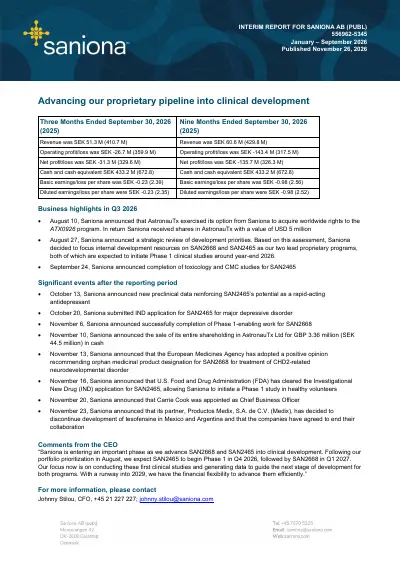
Our two wholly owned programs are approaching the clinics. We expect to dose the first subject in the 2465 study before year-end, and in the SAN2668 study in the first quarter of 2027.
Today, we will talk about what we expect to learn from those studies and how our partnerships and financial position support the next step of development. Before we begin, please note that today's presentation contains forward-looking statements based on the current expectations and subject to the risks and uncertainties.
I'll start the quarter's highlights and a few developments since the end of September. Pierandrea will take you through the two Phase 1 studies.
Johnny will cover the financial results and our cash runway. We will then finish with your questions.
Before I turn to the quarter, I want to address our decision this week to remove tesofensine and tesomet from our pipeline. In its final review, COFEPRIS requested an additional Phase 3 study.
Medix, they concluded that another study would not be commercially viable and decided to discontinue development in Mexico and Argentina. We agreed to end the collaboration, and we thank Medix for its work over many years to advance tesofensine through Phase 3.
We also reviewed the partnering prospects for tesomet. We had no plans to develop it ourselves, and we saw limited interest from potential partners.
We therefore decided to remove both legacy programs from our pipeline. We know that some shareholders have followed these programs for many years, and I acknowledge their disappointment.
The decision sharpens our focus on neurology and psychiatric diseases. It has no impact on our ongoing development plans or our cash runway into 2029.
Our immediate priorities are to advance 2465 and 2668 into clinical development. Both programs reached important milestones this autumn.
We expect to submit the clinical trial application in Europe by the end of December, and dose the first patient in the first quarter next year. For SAN2465, our candidate for major depressive disorders, the FDA has already cleared our IND, and we expect to dose the first patient before year-end.
Pierandrea will take you through the key milestones in a moment. Saniona stands on two legs.
We focus our internal development resources on SAN2668 and SAN2465, which we own outright. Our partners fund and advance the programs they licensed, and those collaborations help finance our own development work.
Acadia is preparing a Phase 2 study for ACP-711 in essential tremor. Starting that study will trigger a $10 million milestone to Saniona.
Jazz is preparing the first Phase 1 study for SAN2355, which will trigger another $7.5 million milestone. Then AstronauTx, selected a candidate this summer, is advancing ATX-0926 toward the clinics.
We have also strengthened our leadership team. I'm very pleased to welcome Carrie Cook as our Chief Business Officer.
Carrie brings experience from both global pharma and neuroscience biotech. That combination is important for Saniona.
Carrie understands how large pharmaceutical companies evaluate opportunities, and she knows how to build and execute deals in small biotech. She will lead business development, partnering, and alliance management as we advance two wholly owned programs ourselves.
Our ambition remains to partner at least one internally developed asset in the near to mid-term. With Carrie on board, the executive team covers the full span from research and clinical development to finance and partnering, supported by a board with deep experience in the biotech industry.
We ended September with 403 million crowns in cash. We expect further 44.5 million crowns in non-dilutive cash proceeds in the fourth quarter from the sale of AstronauTx shares, which we received when they exercised their option in August.
Our cash position is expected to fund both prioritized Phase 1 programs in 2027 and a proof-of-concept study in 2028 for SAN2668. The extraordinary general meeting also authorized the board to issue up to 10% new shares, giving us added financial flexibility.
Johnny will come back to our cash runway later. On partnerships, in addition to AstronauTx's option exercise and the upcoming milestones with Acadia and Jazz, I can report that our research collaboration with Boehringer Ingelheim and Cephagenix continues to progress.
During the quarter, Cephagenix reached a lead-up milestone with their migraine program, which released a financing which is supposed to take this candidate into candidate selection. Cephagenix was founded by Jesper Olesen, a key opinion leader within migraine, and Saniona.
The company is now headquartered in Paris and financed by [AdBio?] Ventures and AdBio Ventures.
Our business development and investor relations: we participated at BIO-Europe in Germany and at various investor conferences in Sweden and Denmark. Our team presented at scientific meetings in Rome, Washington, and Vilnius.
In relation to the conference in Rome, Pierandrea and the team convened an advisory board meeting with European epilepsy specialists. Their input is helping us refine our clinical development plan for SAN2668 in developmental and epileptic encephalopathies.
Earlier this year, I was asked about AI. At that time, we were still exploring where it could help us.
Today, I can point to three practical uses of where we will be in a few months. First, our teams use AI assistants for everyday work such as drafting, analysis, and document review.
All employees have been trained to use Copilot, and we have licensed the use of Claude and ChatGPT. Second, we are currently establishing a system of AI agents together with a startup that tracks clinical trials, competitors, publications, and regulatory developments in epilepsy and depression.
The aim is to bring relevant information to the team faster and in a format they can use. Third, we are implementing AI in our research, enabling us to conduct in silico drug discovery soon.
In our EEG lab, AI now automatically scores sleep and wake stages in our preclinical studies. This is traditionally done by hand and takes a lot of time.
We are also making our ionBase searchable by AI agents. This is our extensive CNS compound library with decades of proprietary ion channels.
The first version is being tested now. We have just signed an agreement with Anvilabs, a Swedish AI company whose models predict how strongly molecules bind to their target.
This should help us find promising new molecules faster. We will soon implement the use of predictive AI models with partners, including a large AI model developed by a major pharmaceutical company.
Such models can predict key drug properties such as absorption, metabolism, and safety, and help us decide which molecule to make and test in our laboratories. AI is only as good as the data behind it.
Our ion channel research goes back more than 30 years. We have more than 25,000 proprietary compounds designed for CNS targets.
Each compound is linked to high-quality experimental datasets. This is hard to replicate.
We are now combining our ionBase with leading external AI tools to conduct in silico drug discovery. Why does this matter?
Our small team will be able to obtain faster insight and conduct better informed decisions, allowing us to use our financial and human resources more effectively on the prioritized research programs and clinical programs. Before I hand it over to Pierandrea, let me close with four key points.
First, we have a validated CNS platform. Our research team has delivered five clinical candidates in the past 5 years, and leading pharmaceutical companies have invested substantially in our science.
Second, we own two differentiated programs in indications where Big Pharma has recently paid billions of dollars. Third, we have funds for execution.
Our cash position is expected to support development into 2029, beyond initial clinical readouts. Finally, we are approaching human validation.
During 2027, we expect the first human data on safety and target engagement for SAN2668, and study in photosensitive epilepsy patients that can give us early signal of effects. Saniona is transforming from a company that has demonstrated its ability to create value through research and early partnerships to one that can capture substantially more value through its own clinical development.
With that words, Pierre, it's all to you.
Pierandrea Muglia
Thank you, Thomas. I'm going to take you through the progress of our two leading programs, as you heard, both of which are now rapidly approaching clinical development.
If we can go to the next slide. Our aim to address diseases with substantial unmet need, they both have the potential to offer important advantages over currently available treatments.
Let me start with 2668. This is our candidate for the treatment of severe and difficult-to-treat childhood-onset epilepsy syndromes.
These syndromes, collectively known as developmental and epileptic encephalopathies, have a burden for patients and families that is very important, and it goes beyond seizures. These children are often experiencing significant cognitive, behavioral, and motor difficulties, with potential lifelong consequences.
Unfortunately, the available therapies used to control seizures, they can further aggravate some of this existing problem. Their adverse side effects really can impair cognition, motor functioning, and won't have effect on controlling behavior.
Patients and families have to accept this issue that they are generated by this treatment in trying to control seizures that they are nevertheless not always controlled. If we go to the next slide, this is to precisely tell you what we aim to address with 2668.
Based on the selectivity of the compounds and the preclinical data, our ambition is really to preserve a strong anti-seizure effect that is typically associated with this mechanism of action, but the selectivity is expected to reduce the most problematic issues that including sedation, cognitive, and motor impairment that limit the full utility of benzodiazepines. Those that you see here are the key differentiating properties we intend to establish in our clinical studies.
If we go in the next slide here, we can see that the substantial progress we have made in preparing 2668 for clinical development. We have just completed successfully the required Phase 1 enabling activities, as we have announced.
We are finalizing our clinical trial application, that the submission is expected before year-end this year, and that we expect to start dosing early next year. We have also reviewed, as you heard, our clinical development strategy with the leading European experts, and also, as we announced, received positive opinion from European regulatory agency for obtaining orphan drug designation for the molecule in CHD2-specific genetic developmental epileptic encephalopathies.
This is clearly important step forward we made in the program. Let me get into the various items more specifically.
You see in the next slide that earlier this month, we gathered together five European experts in epilepsy. Those are experts that have extensive experience in developing new treatment for DEEs.
We presented our preclinical data and discussed our clinical development strategy. In essence, the discussion confirmed our hypothesis of a clear unmet need of this condition and highlighted the potential of our molecule to address this limitation of current treatment for this condition.
We will continue engaging experts externally, and this will be an opportunity next week while attending the American Epilepsy Society annual meeting, where we are planning to meet another number of epileptologists and experts. Now, this is an important summary of our clinical strategy.
Let me explain briefly what the strategy is. As you heard before, our overarching ambition remains to develop 2668 for the broad population of patients with DEEs.
At the same time, we're exploring the option of pursuing a more focused development program in a specific rare genetic form of epilepsy, such as CHD2. CHD2 represents a clear opportunity, and this orphan designation is an important step forward and acknowledgement of the potential of our compound in this condition.
We're aiming to have a focused development pathway for the program that could enable an earlier readout and eventually an earlier market entry. The initial plan will be to conduct the study jointly for the broader DEE with this condition, and eventually accelerate for the single condition.
What is CHD2 in a nutshell? It's a rare genetic condition characterized by early-onset seizures that they are difficult to treat, and developmental challenges and behavioral issues.
No treatments are approved. The important component is that there is an engaged patient community and advocacy group.
This is the Coalition to Cure CHD2, that typically supports families, education, awareness, and more importantly for us, for the clinical trial, is they will offer the opportunity to give us a better view and understand patient needs, and inform our clinical development strategy, so as an important component of the program. In essence, what are our milestones for the next few years?
The Phase 1, that as you heard, we aim to start early next year, and it's typical safety and tolerability, include a biomarker demonstrated the molecule engage with the target. The addition of biomarker will corroborate our differentiating pharmacological thesis for the selectivity of our compound.
The Phase 1, as you heard, also include another component in patients. This will investigate the anti-seizure activity in patients with photosensitive epilepsy.
This is expected to deliver our first in-patient data early in 2028. Subject to these results, we anticipate to start the clinical trial in the target population in the second half of 2028.
Now, this is 2668. Let me switch now to the other compound, as 2465, that we are aiming to develop as a novel treatment for treatment-resistant depression.
Treatment-resistant depression is a rather common condition and incredible burden for patients and for society in term of cost. Recent development as the approval of esketamine demonstrate the value of a rapid antidepressant treatment such as esketamine.
This is validated by the commercial success with the revenues that it's generating for the company that is developing it. This is in spite of the limitation of this compound that needs to be administered in a controlled setting due to safety issues and dissociative effect that typically associated with its use.
Another key element of this slide is that one out of three patients with depression suffer also from cognitive impairment. This is quite relevant because this cognitive impairment reduce the response to antidepressant treatment, and more importantly, perhaps, is also that antidepressant treatments do not improve this condition.
That's kind of further underline the need of a compound that will have, in addition to antidepressant effect, a pro-cognitive potential, such our 2465. If you go to the next slide, you will see that esketamine, as we said, demonstrated the commercial value of the rapid antidepressant in spite of the limitation.
Our ambition for 2465 is really to deliver also rapid-acting antidepressant that can offer the advantage of being easily administered at home, is not expected to be associated with dissociative effect, and expected to have a much better therapeutic index than esketamine. Through this modulatory activity at the alpha-5, we also expect, based on the data and the pharmacology, to have a pro-cognitive effect.
In fact, if we go to the next slide, I want to briefly show you in a new data that our laboratory are producing. As we recently communicated, these new studies have demonstrated that 2465 enhances synaptic plasticity.
This is a biological process that plays an important role in learning and memory. This is further corroborate the potential of this mechanism of action as a pro-cognitive enhancer.
That might explain also what is behind the underlying antidepressant effect that we saw in preclinical species. We're looking forward to share additional data that have been produced now.
Let me now finish with the next slide to summarize our current delivery on this asset. As you heard now, we have obtained external validation with the FDA that has reviewed our Phase 1 enabling packages and gave us green light to start the clinical study.
This is clearly an important milestone, and so we are eager to start dosing before year-end. If you go to the next slide, finally, you will see also for 2465 the key milestone and inflection point, where basically the study is expected to deliver the Phase 1 results before the end of 2027.
This will include, of course, in addition to the safety, tolerability, a composition of biomarker that will again demonstrate the selectivity of our pharmacology and the potential. In addition to the Phase 1 in 2027, we will have another event and an opportunity to start a proof-of-mechanism study that mechanistically will demonstrate that the compound is active in the brain with expected pharmacology.
Then eventually, this will lead to the start of a Phase 2 late in 2028. With this, I completed my part, and I'll hand over to Johnny for the financials.
Johnny Stilou
Thank you, Pierandrea. Next slide.
Our net result for the third quarter was a loss of SEK 31 million, and a significant improvement over the last quarter. This improvement is driven by the $4.5 million, or SEK 48.3 million, milestone from AstronauTx we received during the quarter, and it was received in shares.
This has been recognized as revenue during the quarter. The increase in cost is again driven by progression of our two internal assets, SAN2668 and SAN2465, as we progressed them towards initiation of clinical Phase 1 trials around year-end in accordance with our published plans.
The increase in personnel cost is driven by headcount increase, mainly within clinical development. As of September 2026, the organization compromised 46 employees, compared to 31 the previous year in September.
Next slide, please. Here you find an overview of our operating expenses for the past eight quarters.
Operating expenses, or OPEX, was realized at SEK 78 million in the quarter. This is an increase of SEK 13 million, 13, compared to the previous quarter.
The increase in OPEX is driven mainly by the planned progress toward Phase 1 initiation of SAN2668 and SAN2465. OPEX also includes a SEK 5 million write-down of the tesofensine asset, which was the original purchase price recognized in the balance sheet.
Next slide. At the end of June, we held SEK 433 million in cash.
During Q4, the SEK 44.5 million from the AstronauTx share sale will be received in cash. The AstronauTx milestones of the 48.3 million SEK was recognized, as mentioned, in Q3 as revenue, and the following sale of shares for SEK 44.5 million is incurred in cash during Q4.
The cash payment of SEK 44.5 million is not included in the shown SEK 433 million as of September this year. We expect to receive an additional $17.5 million, equal to approximately SEK 180 million, in near-term milestones payments when Acadia starts their Phase 2 trial and Jazz start their Phase 1 trial.
Including these near-term milestones, our current funding can sustain our planned operations into 2029. With that, I'll give the word back to Thomas for final remarks.
Thomas Feldthus
Thank you, Johnny. With our current cash position and the expected milestone payments, Johnny said, we expect to fund our planned operations into 2029.
Our immediate priorities are to start the two Phase 1 studies. We expect to dose the first patient in SAN2465 study before year-end, and in the SAN2668 study in the first quarter of 2027.
The first human data will guide the next step for both programs. For SAN2668, our goal is to generate early proof of concept in patients with DEEs in 2028.
At the same time, Acadia and Jazz are preparing studies that could trigger a combined $17.5 million in milestone payments. That's how the two parts of our strategy work together.
Our partnerships help fund the development of programs we own outright and can take further ourselves. With that, we are happy to take questions.
Thank you.
Moderator
Thank you very much for that presentation. First off, I have a few questions about tesofensine and tesomet, as that was an event this week.
First off, does Saniona retain full access to and ownership of all clinical data and documentation from Medix's Phase 3 trial with tesofensine?
Thomas Feldthus
This is correct. We own all the data, and it will be delivered back to us.
All documentation from the Phase 3 study, as well as any material which has been produced in order to do clinical studies, and even for commercialization. That said, tesofensine is no longer part of our pipeline, and we don't intend to invest further in it.
Moderator
Got it. Another question was about could CSTI-500's similar mechanism have deterred a partner from pursuing tesomet in PWS?
Thomas Feldthus
We cannot speak for other companies or comment on individual partnering discussions. Potential partners, they are considering many factors, including the clinical profile, competitive environment, development requirements, and fit with their own portfolio.
What we can say is that we have looked for a partner for tesomet for several years, and we see limited interest. We don't find it reasonable to have tesomet in our pipeline.
We therefore decided to remove it from it.
Moderator
Got it. Would Saniona consider an outright sale of tesofensine, including all associated IP and clinical data, if an attractive offer would emerge?
Thomas Feldthus
Absolutely, provided that a company or group of investors provide a solid plan, of course, and have the capabilities to bring it forward.
Moderator
Got it. Could you give us some more details on the new Chief Business Officer, Carrie Cook, and what will be her focus?
Thomas Feldthus
As of right now, SAN2465 has its IND cleared, and SAN2668 is close behind. Both programs are about to enter the clinic.
That is when partnering conversations become more concrete. Our ambition is to partner at least one internally developed asset in the near to medium term, and out-licensing also help fund our own pipeline.
Carrie has more than 25 years in global business development, most recently in Citryx, where she closed a licensing deal with Boehringer Ingelheim worth $500 million, and prior to that, Cereno, a collaboration with Merck worth over $1.1 billion. She will lead business development, partnering, and alliance management, including our existing partnerships.
It's about having the right capabilities for the next phase, not about specific transaction. As we always say, we are not commenting on individual transaction discussions.
Moderator
Maybe a follow-up: how does your internal work change with a Chief Business Officer? Does it free up time for you, for example, or other parts of the management team, or...
Thomas Feldthus
That's pretty obvious. Since she's very experienced, she can handle that herself, yeah.
Moderator
Yes. A question we had from an investor was: what do you mean with near to mid-term?
Could it be more precise, or what does it mean?
Thomas Feldthus
Our plan is to take these two programs through Phase 1 to capture further value, and but of course, we're always open to discussion if you have meaningful offers. This is probably what it means.
Moderator
Given the growing interest in AI-driven drug discovery and compound libraries, is Saniona seeing concrete interest in its platform?
Thomas Feldthus
AI is only as good as the data behind it, and our ion channel data and compound collection built on many years of valuable research, as I alluded to in this presentation. I also think that AI is no longer restricted to a selected group of companies.
We already use AI in our own research. We are looking for ways to create value from the platform and data where it fits our strategy.
This is our intention, yeah.
Moderator
You mentioned also in the presentation that a large AI model from a pharma company, can we maybe discuss that a bit, or is it too early to say?
Thomas Feldthus
I think we will report when we have started, when we have We have given an offer to join to be invited to use a very large library. We will come back when it's realized.
Moderator
Got it. If we move over to SAN903, given the growing body of research supporting KCa3.1 inhibitor across multiple indications, is the partner interest in SAN903 limited to IPF, or do you see the potential in other indications as well?
Thomas Feldthus
We agree that KCa3.1 is an interesting target across several diseases, because it plays a role in both inflammation and fibrosis. We are now evaluating SAN903 in lung fibrosis, which is an indication outside our core CNS focus, and we will communicate when there is something concrete to announce here.
Moderator
Has darigabat or ENX-102 made potential partners more hesitant about SAN2219, or do Saniona still see significant potential in that asset?
Thomas Feldthus
Pierandrea.
Pierandrea Muglia
Let me take that one. We are fully aware, in great details, the results of darigabat and the Engrail molecule that both in epilepsy and anxiety clinical studies.
The results that we saw and reviewed are one of the main reasons why we selected and prioritized 2668 versus 2219, as 2668 has a clearly differentiated profile.
Moderator
Got it. Another question from an investor here was: how excited are you about the next compounds to come from the research platform?
How would you rate them compared to the current lead assets?
Pierandrea Muglia
Excited, those compounds are capitalized on decades of experience in the space by the platform and the scientists. The main thing is that we will develop only compounds that they are expected substantial improvement versus our current compounds, and of course externally as well.
We are program in lead optimization. Our ambition is to least select one new candidate in 2027.
We know that the platform has delivered five candidates in 5 years, we have good reason to believe in that milestone and achievement.
Moderator
Another question here was: you expect to deliver one to two new compounds from the platform next year. Seeing as you paused SAN2219, will you have the capacity to move this forward after candidate selection, or will you require new funding?
Pierandrea Muglia
Let me start first to say that the first question is if this compound can answer the critical question and the potential differentiation versus current standard of care or what we expect to become standard of care based on developmental activities. Our priority and our funding is clearly focused on developing 2668, 2465, and so we are well funded, as you heard, into 2029 for delivering those plan that you just heard.
How will we take this candidate forward, we will decide when we get there, and then it will be based on a number of external activity, what we see in competition, data that we generate internal, and partner interests. At the moment, we cannot commit on further on this.
Moderator
Now a finance question, I believe maybe answered, but I can ask it for the sake of repetition: will the cash position of roughly 478 million last into 2029 without the USD 17.5 million in milestones from Jazz and Acadia, or are those included in the calculations?
Johnny Stilou
Yes, you're right. As I mentioned in the presentation, our current cash position, and I mentioned that the AstronauTx funds from the sale of shares will be received here in the fourth quarter, those cash funds, including the $17.5 million coming in from Jazz and Acadia when they initiate next steps in their trials, those funds will take us into 2029.
Yes, when we state that funds into 2029, yes, we do include the $17.5 million.
Moderator
Also you showed a slide for 2668 and the proposed program. How much of that is funded currently?
The
Johnny Stilou
as Pierandrea mentioned, the Phase 1 trials for both programs as presented, those trials are fully funded with the current funding including the two milestones payments, and can take us into 2029.
Moderator
Another question here: you aim to partner at least one internally developed asset in the short to medium term. Which program is the most natural candidate, and would you prefer to partner before or after Phase 1 data?
Thomas Feldthus
I'll take that one. SAN2465 is the most natural candidate.
Depression is a large indication, and later-stage trials need a partner's scale and infrastructure. It remains most likely candidate for licensing deal once Phase 1 data is in hand.
With SAN2668, we plan to take it through Phase 1 and the photosensitive study ourselves, because a layer of human data increases its value, and we also see the long-term potential for us in this field.
Moderator
In 2668, you mentioned both a narrower path to a smaller subset of patients and a broader DEE label. Would it be possible to retain the rights to one small indication and out-license it to the broader DEE, or is that a yeah, is that a potential, or do you need to choose either way?
Thomas Feldthus
Pierandrea, will you take that one?
Pierandrea Muglia
I'm not so sure about the partnering, but the program will start jointly. We will have a broader DEE basket study that will include the single entity and the broader spectrum.
The orphan can accelerate at some point when we think is data are convincing enough, and we will take it to the finishing line more rapidly than the broader indication. Partner-wise, partnering-wise split indication is becoming not easy pathway, potential could be pursued, but I don't want to try to comment on this because we are still at an early stage in the program.
Let's see.
Moderator
Can you give any timeline for the Boehringer Ingelheim collaboration and when do you expect the next milestone?
Pierandrea Muglia
Yeah. Fredrik, should I take it or...
Thomas Feldthus
Go ahead.
Pierandrea Muglia
The BI collaboration is active and in lead optimization. Those are following the research milestone that were achieved in October 2024.
This is the stage where the best compounds get refined and then eventually selected for development. The candidate selection is based on Boehringer's decision, the timing, decision is on their side.
We cannot really provide any guidance on the next milestone. It's really in Boehringer hands.
Boehringer cover our research cost. There's an agreement is worth up to 76 and a half million in milestone, plus royalties.
We look forward to hear more from Boehringer in due time.
Moderator
Do you have any update on when Jazz will start Phase 1 with SAN2355 and when Acadia will start the Phase 2 trial, the two events that will trigger the milestones?
Thomas Feldthus
Do you want me... 26
Pierandrea Muglia
Acadia has informed the market that they plan to start Phase 1 in 2027, and we have not heard anything else. We think that the program is on line on that.
Jazz has not communicated anything, and but they're preparing for Phase Phase 1. They're very excited about the compound, but the timing and the for this is is their decision, and also the communication around it.
Moderator
Yep. Another question here that just got in is: how much do you need to have runway to the end of 2029?
Thomas Feldthus
No, we have into 2029.
Moderator
The question was throughout, how much more would you need to fund the whole year?
Thomas Feldthus
We are not making this kind of guidance.
Moderator
Got it. Let's see if there was any more questions.
Yes, this is a question that might be a repetition from my part, but there are obviously two programs that you can look at when you think of the clinical development of 2668, and that is Lundbeck and Praxis, and they have slightly different approaches in how they will develop the programs. Obviously, when you discussed the strategy with these European experts, and you look at these ongoing clinical trials, what are your learnings?
Can you maybe make it more efficient, a smaller number of patients, or do you look at them a lot in terms of design?
Pierandrea Muglia
No, well, of course we are looking at this space clearly with a great level of attention. We're expecting results from Lundbeck, bexicaserin, late this year or early next year.
We already saw presented the demographic and the data of what is the largest study in this space. This is going to be a lot of learnings for the field and for ourselves.
I want to emphasize the fact that our compound properties are clearly different from any competitive activities. They're mostly on serotonergic drugs, on the wake of fenfluramine and bexicaserin and everything else.
Praxis compound being quite different mechanism of action from ours. Our program has a differentiated angle that is based on our pharmacology and also on the learning.
We have had with developing 711 in Phase 1, and this is where the key data were shared with our key opinion leaders, and they support our choices and preferences and decision on how to take and move the program forward.
Moderator
If I understand correctly, the Lundbeck pivotal trials are larger in terms of number of patients, and from your perspective, would you say that the number of patients is about powering and finding a clinical the number of patients needed for showing a clinical effect, or is it more about safety? In that respect, would the number of patients in the Praxis trial, which is, I believe, maybe in total about 300 patients, would that be enough as a low bar, or...
Pierandrea Muglia
It's highly dependent on the assumptions you make when you power the study, and then it's difficult to know if your assumptions are right or wrong before you finish the study. I think it's a slightly different design, and of course, the more heterogeneous the population, the larger the study need to be.
There are also key elements of differences in the way that the study is designed between the two companies. I think it's, in essence, each study will make his own rules in term of sample size, but the other important thing, as I said, it's the assumptions you make.
Then, as I was saying, these large studies will deliver a great deal of information, they will be useful for our the powering of our study. Our assumptions will be refined by the learning that we will get out of these studies.
Moderator
If we're talking about Praxis, their narrow indication that study, I believe it was quite small, about 50 patients or so, and it was ended early because of a clinical effect. Is that maybe the best possible scenario for you as well to do a relatively small initial study in, for example, CHD2 and that's then showing, yeah, getting an approval quite fast?
Pierandrea Muglia
Yes, indeed. Yes, indeed.
Then on our program, an interest on EEG, and particularly certain specific type of EEG that we see in this patient, as in this CHD2, that might provide earlier readout. I guess data will tell, but in essence, we will have the option to accelerate on the program based on earlier readouts.
The initial phase will be all learned, will be similar to what you described for others, as including Praxis.
Moderator
Maybe a final question: why is CHD2 an attractive indication in terms of mechanism of action?
Pierandrea Muglia
I think it's it's came from the discussion with other experts, and but the main thing is about the pharmacology of the compound. This is strong activity at the alpha-3 subunits is a clear component.
There is another criteria that I like to call clinical trial readiness for the population. That means that there is a registry, there is an advocacy group behind.
These studies in this rare condition, they're what I like to call them community-based study clinical study design. We need to go to the to the advocacy group, learn a great deal about the patients, learn a great deal on how to design a clinical study.
As I said, the fact that this condition has a registry in place, with patients identified across different countries, and again, the representation of the disease, the type of seizures, combined with our pharmacology, make a strong connection between the, our mechanism of action and the population.
Moderator
Actually, a final question here was about: how many patients will be included in the two Phase 1 studies? Oh,
Pierandrea Muglia
well, that's the patient is it's less than 100, for sure. I need to review that, because there are one different components, we are approximately 70 to 80 subjects, they are not patients.
Moderator
Yes, I think that's all the questions we had time for. Thank you very much.
I think it was very valuable and interesting to hear. Thank you.
Thomas Feldthus
Thank you, Fredrik.
Pierandrea Muglia
Thank you for the questions.
Moderator
Thank you.