Senzime AB
Q3 FY2026 · Earnings Call TranscriptOctober 29, 2026
Gustaf Meyer
Hi, everyone. Welcome to Redeye and today's live Q with Senzime.
My name is Gustaf Meyer. I work equity research analyst here at Redeye.
Today, as I mentioned, Senzime will do a presentation first with the CEO, Philip Siberg. And then after that, we'll have a Q&A session.
And also remember that you can send in your questions on our website for the Q&A session. But let's start with the presentation with Philip.
Philip Siberg
Good morning, and welcome to this presentation of the Q3 report for Senzime. Okay.
Just as a little recap starter, Senzime. We are a medical device company.
We are pioneers in the field of precision-based patient monitoring. Specifically, what we do is what we've developed and we've been pioneers in the field of neuromuscular monitoring.
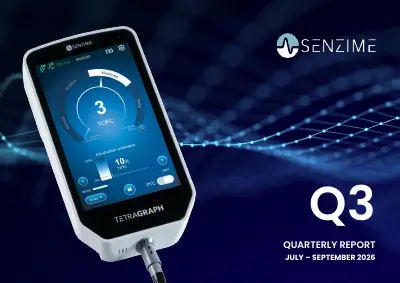
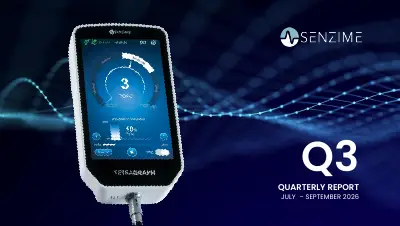
We brought to market the TetraGraph. It's the world's first portable electromyography-based system.
It's used by anesthesia clinicians to ensure the right timing of intubation to ensure that every patient gets the right dose of paralytic drugs during surgery and that each patient can wake up and breathe by themselves after surgery. My phenomenal team has brought this system to the global market.
So as of now, we have about 6,000 systems delivered out to operating rooms around the world. The opportunity is far beyond 400,000 operating rooms.
We have about 800 hospitals in about 30 markets. By now, we've monitored over 1.3 million patients.
Our business model is based on recurring revenues of sensors and selling and placing monitors. So today, about 80% of our business is recurring sales of disposable sensors.
Last year, we did about SEK 100 million in sales. And since the market normalized after COVID, we've had an annualized growth rate of an average of 95% per year.
And to support our technology, we have a strong patent portfolio of about 109 patents. Okay.
So let's look a little bit of Q3. So Q3, I think, was a pretty good quarter.
We reported growth in all our regions around the world. We regained growth and grew 14%.
Specifically, what's important is that the disposables, the sensors grew 43%. Our gross margin increased to 74% versus 61% last year.
I'll come back to this. We continue to decrease our operating expenses.
They were down by 15% which led to ultimately our EBITDA moving in a very nice consecutive manner towards profitability. So in September, we were almost breakeven.
The cash flow also improved significantly, thanks to this. And we disclosed the market that we once again have secured the financing needed to take us to long-term profitability.
Okay. So let's look at some numbers.
Let's start out looking at the sensors. As I said, the sensors continue to grow very nicely.
We shipped out over 130,000 sensors in the quarter. If you look at the trailing kind of rolling 12 months, the growth rate is 53%.
And then if you look at the installed base, how are we doing with the systems in the market? And I want to continue to track this KPI to the market going forward and looking specifically at U.S.
accounts. This is where we can control the business and we're very close to our customers.
And if you look at the key accounts, which contribute to about 90% of the volume, you can see that the weekly average utilization rate continues to increase. If you look at over this year, it's actually grown by 60%.
And this is thanks to meticulous hard work. We're supporting our customers.
We're training. We're providing them the tools, analytics and various types of services to help them standardize this technology.
So what the utilization means here, it's the number of TETRA sensors used per monitor and week. So we still have a significant opportunity to grow this, but we're moving very nicely in the right direction.
If you want to look at one specific U.S. case study, this was a study that was presented about 2 weeks ago at the big anesthesiology Congress in the U.S.
So this is one of our customers. This is University of Miami, the big hospital system.
They have been users and customers of ours since about 2023. And what they reported here is that they had a very interesting increase in utilization over time.
And what happened was that in mid-'25, we upgraded to the next-generation TetraGraph, our current state-of-the-art monitor. And that, including that the hospital system institutionalized or protocolize the usage of our products really made them to the next level.
So now today, they are at about 80% utilization rate. So the right technology, the right supporting protocols and the support from us and the clinicians, that's what drives up this usage.
And then one more number on utilization. So look at pediatrics, and I reported this a couple of times that there were European guidelines published that specifically talk about children, specifically talk about when they get paretic drugs, they need to be monitored.
And these guidelines state that they should be using electromyography-based technology. So when the guidelines were first announced about last summer, we saw an interesting kind of change in the growth trajectory curve.
So we went from a constant growth rate and then suddenly the growth rate doubled. And I'm seeing that we're kind of winning and then attracting pediatric hospitals around the world right now.
Okay. So let's just look at 3 main events during the quarter.
We started in mid-July, we announced the Philips OEM/commercial partnership. This is a landmark agreement for Senzime.
It's the biggest and most important partnership we've signed so far. I've educated the market a little bit about this before, but what we're doing, we're co-developing, we're going to co-commercialize and this is something that will scale the business of Senzime to a next level.
Further, a couple of weeks later, we announced that we were awarded a sole-source agreement from the U.S. Veterans Affairs.
It's a 5-year agreement. The U.S.
Veterans Affairs is the largest U.S. hospital system with over 170 hospitals.
And then we've continued throughout the quarter to win and secure more hospital contracts. We announced one of these, which is a major system in the eastern part of the U.S.
And there, we deployed 60 TetraGraph systems. But this was just one of many opportunities.
Okay. So let's look at overall sales.
So as I said, we're back to growth. We're growing in all regions.
The growth rate for the sensors was 43%. So that offset a weaker number, which was monitor sales.
So monitor sales continue to have a little bit of a tougher year, specifically in the U.S. market.
We're just seeing, like I reported in Q1, Q2 that it takes time to close the deals. We do believe -- I feel that the catch-up effect is coming.
I feel we're increasing the opportunity to close the pipeline. We have a partly new leadership team in the U.S.
that is doing a phenomenal job, and I'm very positive about the outcome for the U.S. market.
But the important thing is here that if you look at the product mix of our company right now, in Q3, the sensors accounted for 83% of our business. So we're building a very strong recurring revenue base in this company.
And U.S. continues to be the strong driver with 70% of the business.
Okay. Let's look at the gross margin.
As I said, it grew very nicely. It reached 74%.
I think this is a new record level. It's up 13 percentage points from same quarter last year.
The improvement here comes from various sources. One is new products.
I announced earlier in the year that we moved production. We redesigned our sensors.
We now have partly European-based operations of that, and that has really given us more favorable unit economics. We also have a nice product -- kind of product market mix with a heavy weight on sensors.
And we were boosted a little bit from tariffs. As you can see, the 74% was the reported gross margin number, 73.2% is the green number to the right, which is if I net it from U.S.
tariffs. So we had a repayment of $116,000, but we also had a number of payments that we actually paid in tariffs.
So I would say that the normalized gross margin level is probably 71%, 72%, but it continues to increase. And this is what I've communicated constantly in the past that we are driving innovation.
We are working with pricing levels, and we're doing things to really drive up our gross margin to be in excess of 70%. And then let's look at the operating expense level.
So we've -- this year really worked hard. We have a meticulous cost control.
We've lowered our operating expense level with 15% as of -- if I compare to the Q3 number last year. And if I look at specifically at Q3, this is about SEK 6 million.
So we have reduced headcount. We've focused more into the commercial sector.
We're using AI, which is making productivity enhancements within specifically our technology team, and we just have a lower cost base level to the product. So if I translate this to so what does this mean with the sales, with the gross profit and then the OpEx, okay, EBITDA, as I showed before, it's a nice trend.
It's moving favorably month by month, and we are moving towards profitability. We also internally report how are we doing from a profitability point of view in our U.S.
market and in our German market, which are separate entities. And both of them reported non-allocated head office expenses, but they reported EBITDA positive numbers.
So the Q3 EBITDA improved by 59%, and it's quite a difference where we are minus SEK 8 million versus minus SEK 19.4 million last year. So how does this transfer then into cash flow?
Cash flow has also improved quarter-over-quarter. It's actually improved by 70%.
And so the burn rate of the quarter was minus SEK 8.7 million versus SEK 28.3 million last year. So this is a major improvement, I would say.
The improvement here is from increased sales, improved gross margin, reduced expenses, but also working a lot with our working capital. So we're optimizing.
We're getting our inventory to move faster, and we are getting our customers to pay us faster as well. So just look at a little bit on the financing.
We did report during the quarter that we refinanced our loan package. So what we have is a SEK 35 million credit line, which is provided by predominantly the Segulah Group and the Crawford Group.
We renegotiated it during the quarter to get a little bit better interest rate, and we extended it in time as well. And this facility, I can call upon as needed, and it's a very smart way for the company to use as working capital needs are on.
So we had SEK 28.7 million in cash at the end of the quarter. And then on top of that, we have the SEK 35 million in the credit line.
So we have SEK 63.7 million in available funding. So it's important to kind of emphasize that we have the capital needed to take us to profitability.
And we also reiterated a few weeks ago that we still believe we have the -- we're on path to reach positive cash flow within the fourth quarter. Okay.
Let's look at an update on the shareholder base. There's been a lot of trading going on in our share during the third quarter.
If you look at from the top, I mean, a company like ours is constantly under restricted trading. There's always a log book.
There's always something going on that restricts insiders from trading. But in these few spots, we had a couple of insiders that increased their share.
But we also have a pretty massive outflow from 2 of our funds, the Tin Ny Teknik and also Lannebo Fonder. And I think these -- there was a couple of million shares that were flooded into the market, and this really were difficult to catch up by buyers.
But all in all, we continue to have very, very strong support from our top 10 shareholders. Okay.
To wrap up the third quarter with 3 takeaways. One, our recurring revenues continue to grow very nicely.
43% growth in sensors. We're proving that the installed base is generating recurring revenues.
Two, the operating model of our business is proving that it's scalable and that we're moving towards profitability. And then number three, we're very well positioned to leverage on the next level of growth.
And we're going to do that by continued market adoption, but also working with leading OEM partners to find new markets and integrate our technology to grasp the mass market of this opportunity. So join us on our mission as we safeguard every patient's journey from anesthesia to safe recovery.
Thank you.
Gustaf Meyer
Perfect. Thank you very much for your presentation.
Thank you and welcome. But let's dig into the report.
Maybe we can first talk about the sales development, SEK 30.1 million in Q3, as mentioned in your presentation. What would you say is the main drivers of the positive development compared to the first half of this year?
Philip Siberg
Yes. I mean I think it was a decent quarter in terms of sales.
As an entrepreneur, it's a chronic disease that you always want more. But I think it's good to see a positive traction.
The driver is, of course, recurring sales of disposables, the single-use sensors that we use on each patient. So that had a nice growth rate.
The U.S. continues to be the main kind of locomotive of our business.
So we're seeing that both new accounts, but also existing accounts continue to develop very nicely. So U.S.
is big, of course, as I mentioned, but also -- I mean, we're seeing that the Asian markets and the European market are starting to kind of take off as well. But the big driver is really the next-generation TetraGraph system that we brought to market about 18 months ago.
We're seeing such very nice effects that it drives up utilization, the ease of use and the integration and the attractiveness of the system really helps to drive up utilization.
Gustaf Meyer
And if we look into the first half of this year, you mentioned the challenges that you see in the U.S. market.
You also mentioned in this report that you continue to see some challenges. Maybe you can elaborate what are the challenges that you see?
And do you see any kind of trend of a more positive development moving forward?
Philip Siberg
I mean -- sorry, it's definitely been a tougher year in the U.S. It takes longer time to close the deals.
Deals can get approved. They continue to get stuck with purchasing, with legal.
And so we have a lot of deals in the pipeline pending to close. And they're -- I can't control these processes.
That's my challenge. But I'm seeing -- we saw -- I think in Q3, we're starting to see with the new U.S.
team, the very great leadership. We brought in more people to the U.S.
team now and commercial-wise, just seeing that I feel the catch-up effect is to come because it's getting easier to get it out there. And I've also tried to mention that we've had -- I mean, the about 800 hospitals we now have worldwide, many of them were early adopters, technology freaks, drivers of we want to be guideline compliant, et cetera.
And now we're probably a little bit at the chasm where we're reaching the mass market. So some of these budgets to get these more big mass market hospitals may take a little bit longer time.
But that's why we're elaborating with TetraGraph as a Service and capital, and we are meticulously working hard, and we will get there.
Gustaf Meyer
But what's your view on the current pipeline, if we look in the short term, would you say that it's a strong pipeline?
Philip Siberg
Yes. We have a strong pipeline.
It's just a controllable of when is it happening. And I mean, Q3 was -- some of the stuff in the pipeline happened, but there was a lot that didn't happen.
So more to come.
Gustaf Meyer
And what about these larger agreements, first of all, the IDN contracts that we have seen during the year, also the Veteran Affairs agreement. When could we expect to see any sales?
Philip Siberg
Yes, it's a good -- I mean one of the IDN contracts that we announced during the spring was that we started to win a number of hospitals within one of the -- I think it's the second largest IDN in the U.S. And what's happened since then is that we keep now winning hospital after hospital.
We had a win this week where these hospitals may be more like 20 monitors. So it's not that -- I don't feel it's press release worthy to go out with these.
But one door opens another. And that's exactly what I want to get to.
So winning, having people driving it for us and then ultimately getting kind of a corporate contract. So that's working.
The VA contract, we have now a couple of VAs as customers. It's not happening like overnight with this, but it's a framework agreement, and we're positive to really ramp that up.
Gustaf Meyer
And you also mentioned the TetraGraph-as-a-Service. And when I look into the numbers and also my model and so on, I get the sense that it's a relatively low level of service.
I also got a question about that.
Philip Siberg
We didn't have any TetraGraph-as-a-Service contracts during Q3. We do have a lot in the pipeline.
I think we potentially have underestimated a little bit that we thought that it would go a lot faster because of the -- you don't have to buy the capital, but just the legals of the documentation and the framework agreement still takes some time. So it will happen.
Gustaf Meyer
Yes. And is that more like -- could we expect a bit more in 2027?
Is that the case? Or is it already in Q4?
Philip Siberg
I think we have some Q4 pipeline on it. And the ones that we have running have shown very favorable numbers.
So we're seeing that it pays off. The business model works.
And these are a couple of Ivy League hospitals on the East Coast of the U.S. And so it is a good model, but I always want to sell if I can because I might get a little bit better commitment from the hospital.
Gustaf Meyer
Also, we should definitely dig into the gross margin unit because it was very strong 74% -- there were some product mix and so on and also this U.S. tariff repayment.
I also noticed in your presentation that the repayment was of $116,000, and if I remember correctly, the whole repayment was $350,000 or something.
Philip Siberg
Yes, we have something like $260,000 more to come. It might happen in Q4.
These are like -- it's with the U.S. Customs Agency.
But I've noted a lot of other public Swedish companies have started to get the money coming back. So we should be in line.
I feel they're favorizing the big ones and smaller ones are second in line, but it will come. So that affected the gross margin.
Yes, we got the money back, which I already reported in July, so -- which made a positive peak on the July gross margin. And if you look at my EBITDA development curve, it did not affect the September numbers where we were almost at breakeven point.
Gustaf Meyer
And when we talk about the gross margin, of course, the product mix was favorable because of the high disposable sales. If you look into 2027, you mentioned in the report that you hope to have at least a 70% gross margin in the future.
But if you have a lot of monitor sales, maybe that could go down a bit. What do you say?
Philip Siberg
Yes. I mean we -- I keep on telling that we're driving innovation.
We're driving smarter ways of designing, producing and so we're getting the cost down, and it's happening for both sensors and monitors. And as we have announced new products during the year, one was our new portfolio of sensors.
where unit economics are a lot better. So that helps to drive up, but we're also working to keep price levels as high as we can.
And despite product mix being changed, I think we're always going to be in the line of 70% to 80% of our business is going to be recurring revenues. I do think over time, it's going to be even higher than that.
There should be long-term favorable effects on the gross margin to be even higher than it is today.
Gustaf Meyer
Great. Also your target reaching profitability or positive cash flow within Q4.
Looking at the report and the graph that you showed in this presentation, September looked really good. What actions are you doing to reach this target?
Philip Siberg
I mean it's, of course, a number of actions. It's continuing to sell well, keeping the gross margin up.
We've done a lot on our expense base this year, as you can see, and then working so hard with working capital. I mean, as a growth company, working capital is everything and making sure that we have good agreements, spinning around the inventory faster and getting paid.
So I have a tough team on my finance team who are making sure that the hospitals are paying in time.
Gustaf Meyer
But just to make this clear, the target is to reach it within?
Philip Siberg
And within what I mean is what I've always said that, yes, that means November and December or November or we'll see what it is. It's the first step.
Gustaf Meyer
Maybe we can also talk about the Philips partnership. I know that you can't say that much about it, but can you share any updates?
Philip Siberg
The projects are progressing as planned. It will be in a project development phase for the next mid- short term.
So we continue to do that. We're not disclosing anything when this is going to market yet.
But I can just say that it's progressing as planned.
Gustaf Meyer
Because we also got a question about the partnership. Let's see here.
So -- regarding the sales, could the demand for the monitors be affected.
Philip Siberg
No, no.
Gustaf Meyer
Okay. And why not?
Philip Siberg
Because the clinical market -- I mean, we haven't been clear on exactly what is it we're developing. What is the product, where it's going to suit what markets, et cetera.
So that's one thing. The people -- the pipeline we are talking now, they want solutions here and now.
So I don't see this -- the Philips agreement is business that will complement what we're already doing. It's addressing new type of markets.
So we're going to continue to lead and drive innovation with our own business, with our own handheld system. And then the Philips and potential other OEM agreements will target other markets.
But there are very hospitals that we have limited access to today with being a small company with a single product portfolio, the ability to come in with big public tenders is the way to go via these OEM partners.
Gustaf Meyer
But looking forward, mid, long term, how will you balance your own sales channels with this OEM strategy?
Philip Siberg
Yes. I think they will help each other.
So by driving our own innovation, that can help to drive our own business, but also help to capitalize OEM business and vice versa. But we did make an announcement during the quarter also saying that we believe that about probably more than 50% of the business over the next 10 years is going to be OEMs.
It's going to be a very important addition to our business.
Gustaf Meyer
Also another question I got was we have seen some software launches during the year. Could you give us an update?
How do they progress?
Philip Siberg
They do well, I think. I mean I've said it before, but I want us to stand out exactly as any other consumer electronics.
As a customer, you expect to get innovations, upgrades, updates. You don't buy anything and then you have it for 7 years.
So customers of ours are so appreciative of always getting the latest updates and innovations. And the more data that we generate, the smarter features we can get.
And one of these features was the predictive recovery algorithm. So we're first in the industry to come out with an algorithm that helps to predict the onset of recovery, meaning that you can individualize the recovery phase, the last part of you waking up from surgery.
And by doing that, you can make sure that you get the right level of drugs. Some people might not even need drugs, they can actually wake up spontaneously, which is safer and cheaper for hospitals.
But all in all, to answer your question, these software updates are very appreciated, and I think it's a highly competitive part of our portfolio that we can offer this.
Gustaf Meyer
I would also like to talk about the market in general and also clinical guidelines. We saw in your presentation, if you look at the pediatric segment, it has been a really strong growth since the guidelines over there.
Could you give us any updates on other types of guidelines or anything that you look at?
Philip Siberg
I mean, yes, there's been a number of guidelines come out during the last couple of years. The last one was the pediatric, and that was the European one.
I know there are initiatives ongoing in the U.S. to mimic that and make -- U.S.-based pediatric guidelines.
But otherwise, they are there. During the summer, there was a survey that came out in the U.S.
about the guidelines, like 3 years later, what's the stance? And the reality of the data was that was there is still a lot of work to do.
The market has -- there's a very high opportunity left to convert. And it just shows the numbness, it takes time to change health care.
But guidelines are an accelerator and what's required to make the change. And beyond that, I'm seeing other countries who continue to develop this.
And I've seen some initiatives that you're taking to the next level, which is to make it standard of care documentation. So that will happen within the foreseeable future as well.
Gustaf Meyer
If you also -- we can talk about other markets in the U.S. for a bit.
European markets, of course, very interesting. Also Latin America.
Could you share any updates on those markets?
Philip Siberg
Yes. I mean, Latin America, it is exciting for us.
We are approved in Brazil and Mexico. We've sold in a couple of other Central American countries, and it's progressing well.
And they mimic a lot what's going on in the U.S. They are -- we have some big initiatives going on in Brazil now in November.
So I'm positive about it. If we look at the Asian markets, which is predominantly South Korea and Japan, Japan has developed pretty well this year because they -- during the spring, they rolled out the next gen.
So they're building up a big dedicated sales force for Kudadeshi in Japan. So a lot of trials, a lot of monitors starting to roll out and also seeing increased utilization.
In South Korea, we're still in regulatory submission mode. we believe there's a couple of months left.
And South Korea otherwise has very high utilization, and I think there is strong opportunities once we get the next in there as well.
Gustaf Meyer
I guess that the main focus will, of course, continue to be on the U.S., but do you see any markets that you maybe would like to increase your resources in a bit in the future?
Philip Siberg
We'll see. I think we're trying to be very focused, and I'd rather say no to a lot of markets and leverage what we have.
Perfect. It's enough.
Gustaf Meyer
Maybe we can just have a last question, maybe if you could summarize the quarter, your expectations for the future. What should investors keep in mind so on?
Philip Siberg
Yes. I mean I think we did pretty well.
I mean the things that we can control, expenses, margins to the extent, cash flow, we're showing the scale of our business. We're showing that we can take the company to profitability, and we're on that path.
And the massive investments we've done in the market over the years are starting to pay off, which is really exciting. I said sales, I'm really happy that we're starting to show growth again.
We're growing in all regions. And I feel we're on a very nice trajectory.
And with the right people I have, I have a fantastic team. We're well positioned, great products, and I'm very positive for the future.
Gustaf Meyer
Perfect. I look forward also to see the positive cash flow in Q4.
Thank you very much, Philip, for today.
Philip Siberg
Thank you.