STRATTEC SECURITY CORPORATION
NNASDAQ:STRTQ4 FY2026 · Earnings Call TranscriptAugust 26, 2026
Operator
Greetings. Welcome to STRATTEC's fourth quarter and fiscal year 2026 financial results conference call.
At this time, all participants are in listen-only mode. Question and answer session will follow the formal presentation.
If anyone should require operator assistance during the conference, please press *0 from your telephone keypad. Please note this conference is being recorded.
At this time, I will turn the conference over to Deborah Pawlowski, Investor Relations for STRATTEC. Thank you, you may begin.
Deborah Pawlowski
Thank you, and good morning, everyone. We appreciate you joining us for STRATTEC's fourth quarter and fiscal 2026 financial results conference call.
Joining me on the call today are Jennifer Slater, our President and Chief Executive Officer, and Matthew Pauli, our Senior Vice President, Chief Financial Officer. Jen and Matt will review our fourth quarter and full-year financial results, the progress we are making on our transformation, and our outlook for fiscal 2027.
You can find a copy of the news release and the slides that accompany our conversation today on the Investor Relations section of the company's website. If you are reviewing those slides, please turn to slide 2 for the safe harbor statement.
As you are aware, we may make forward-looking statements during the formal discussion and during Q&A. These statements apply to future events that are subject to risks and uncertainties, as well as other factors that could cause actual results to differ materially from what is stated on today's call.
These risks and uncertainties and other factors are discussed in the earnings release and in other documents filed by the company with the Securities and Exchange Commission. You can find these documents on our website as well.
I also want to point out that during today's call, we will discuss certain non-GAAP financial measures, which we believe are useful in evaluating our performance. You should not consider this additional information in isolation or as a substitute for the results prepared in accordance with GAAP.
We provided reconciliations of non-GAAP measures with the most directly comparable GAAP measures in the tables accompanying the earnings release and in the supplemental slides. With that, I'll turn the call over to Jen, who will begin with slide 3.
Jennifer Slater
Thank you, Deb, and good morning, everyone. Fiscal '26 was a year of progress as we continue to reshape STRATTEC into a more resilient, higher-performing business.
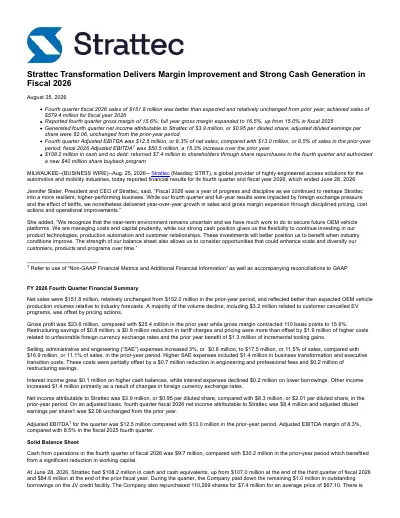
We delivered record annual revenue of $579.4 million, expanded full-year gross margin by 150 basis points to 16.5%, generated $46.3 million in operating cash flow, and ended the year with $108.2 million of cash and no debt. In the fourth quarter, sales of $151.8 million were better than expected and essentially flat with the prior-year period.
These results were achieved in a dynamic automotive environment. Throughout the year, we managed fluctuating North American production levels, the evolving tariff environment, foreign exchange headwinds, and customer cancellations of certain EV programs.
We believe that our fiscal '26 results are an affirmation that the transformation is delivering, our teams are executing, and we have the resiliency to offset a meaningful portion of these external pressures through pricing, cost actions, and operational improvement. During the year, we realized approximately $6 million of savings from restructuring actions.
We also continued to invest in our commercial organization, innovation capabilities, and the operating infrastructure needed to improve our margin profile. We are continuing to evolve our approach to growth.
Automotive is a long-cycle and cyclical industry, it's critical that we engage customers earlier and more strategically in their development process. This is relatively new concept for STRATTEC that historically did not have a process around a future-looking sales pipeline and only engaged with the customer when an RFQ was received.
We have invested in our team and are in the early stages of developing the foundation around a future-looking development process with a focused product portfolio around three pillars: Permission, Motion, and Hold. Permission includes secure vehicle entry technologies, Motion encompasses powered access systems, and Hold includes latching products designed for safety, strength, and durability.
This framework better aligns our commercial, innovation, and engineering teams around customers' evolving access needs and future program opportunities. Our consistent cash generation also allowed us to return $7.4 million to shareholders in the form of share buybacks in the fourth quarter, and our board of directors has authorized a new $40 million stock repurchase program, which we intend to use to offset equity share dilution and opportunistically buy back shares.
Slide 4 highlights the disciplined execution of our transformation plan. We are working to improve how the business operates every day.
Since fiscal '25, we have implemented restructuring actions that have delivered $9.5 million of savings. This past year, we consolidated our test lab operations in Auburn Hills and continued to invest in equipment and improve manufacturing flow at our Milwaukee operations.
We also implemented new tools for sales pipeline management, financial consolidation, benefits administration, and expense reporting. These technology innovations help us make better decisions, enhance accountability, simplify processes, and create a more scalable operating platform.
In addition, we introduce culture pillars centered on innovation, collaboration, and accountability, reinforced by a recognition program that highlights team members who put those values into action. The culture element of our transformation is critical to our success.
Our strong balance sheet and cash balance of $108.2 million give us the flexibility to invest in organic growth and modernization, maintain an appropriate cushion for industry variability, repurchase shares opportunistically, and evaluate M&A opportunities that can provide scale and diversification. With that, I'll turn the call over to Matt to walk through the financial details.
Matthew Pauli
Thanks, Jen, and good morning, everyone. Fourth-quarter net sales were $151.8 million, essentially unchanged from the prior-year period.
This result was better than expected as we originally had estimated fourth-quarter sales to be down 3% to 4% based on third-party estimates of OEM build rates at the time. Actual OEM production levels for the quarter came in down just 1.4%.
Compared with the prior-year period, we had $3.2 million lower sales from OEM-canceled EV programs, which offset $1.4 million in pricing benefits and certain customer inventory builds. For the full year, net sales increased to $579.4 million from $565.1 million in the prior year, which represents a 2.5% increase.
Pricing contributed 2% with volume growth being less than 1%, consistent with the overall North American automotive market. Sales growth was stronger in the first half of the fiscal year as macroeconomic conditions, reduced OEM production builds, and EV program shifts weighed on second-half sales.
Our customer and product mix remains diversified across leading OEMs, tier-1 customers, and commercial accounts, as well as across our various product lines. Let's turn to slide 6.
Fourth-quarter gross profit was $23.6 million compared with $25.4 million in the prior-year period, and gross margin was 15.6%. The fourth-quarter comparison was affected by unfavorable foreign exchange rates and lower tooling gains.
On a constant-currency basis, gross margin improved, reflecting lower tariff costs, pricing, and restructuring savings, partially offset by higher cost of quality. For the full year, gross profit increased to $95.4 million from $84.6 million in fiscal 2025, and gross margin expanded 150 basis points to 16.5%.
Importantly, this demonstrates the continued progress we are making in improving the underlying cost structure of the business, even while managing external headwinds. Please turn to slide 7.
Selling, admin, and engineering expenses were $17.5 million in the fourth quarter, or 11.5% of sales, compared with $16.9 million, or 11.1% of sales, in the prior-year quarter. The increase primarily reflected business transformation costs, as well as higher salaries and benefits.
These expenses were partially offset by lower engineering and professional fees and restructuring savings. Higher business transformation costs in the quarter primarily related to the use of outside advisors to advance strategic initiatives, including the transformation of our Milwaukee operations and advancing our focus on M&A alternatives that could deliver shareholder value.
For fiscal 2026, SA&E expenses were $68.8 million, or 11.9% of sales, compared with $61.8 million, or 10.9% of sales, in fiscal 2025. The full-year increase includes investments in salaries and benefits, business transformation, restructuring, and executive transitions.
It also reflects targeted investments in commercial, innovation, quality, procurement, supply chain, IT, and program management capabilities. We remain focused on managing expenses with discipline.
Excluding unusual items, our longer-term objective is to operate SA&E in a range of approximately 10% to 11% of revenue. In the near term, we will continue to make selective investments that support our transformation and position STRATTEC for future growth.
Please turn to slide 8. Net income attributable to STRATTEC in the fourth quarter was $3.9 million, or 95 cents per diluted share, compared with $8.3 million, or $2.01 per diluted share, in the prior-year quarter.
Fiscal 2026 fourth-quarter GAAP earnings reflected incremental business transformation and executive transition costs, as well as $2.9 million of discrete income tax adjustments associated with changes in tax regulations. On an adjusted basis, fourth-quarter net income attributable to STRATTEC was $8.4 million, and adjusted diluted earnings per share was $2.06, unchanged from the prior-year period.
Adjusted EBITDA was $12.5 million compared with $13.0 million in the prior-year quarter, with adjusted EBITDA margin affected principally by foreign exchange. For fiscal 2026, earnings per share grew 9% to $5.00, validating the impact of our transformation actions against the macro headwinds discussed today.
We believe we have built a stronger business that can be more durable through the automotive cycles. Full-year adjusted EBITDA increased to $50.5 million, up 15% from fiscal 2025, and adjusted EBITDA margin was 8.7%.
Our fiscal year financial performance, which includes a 100-basis-point improvement in adjusted EBITDA margins, illustrates an improved earnings base. Please turn to slide 9.
We continue to demonstrate our strong cash generation capabilities with $9.7 million in cash from operations during the fourth quarter and $46.3 million for the full year. As a reminder, fiscal 2025 cash flow benefited from a significant reduction in working capital and pre-production balances as we worked to release value that had been dormant on our balance sheet.
Nevertheless, the company generated substantial cash in fiscal 2026 while continuing to invest in the business. We also returned $7.4 million to shareholders through the repurchase of approximately 110,000 shares during the fourth quarter, which was about 2% of our outstanding shares.
We accomplished that under a previous share repurchase authorization. As Jen mentioned, the board approved a new authorization under which $40 million is available for future share repurchases.
Our capital allocation priorities are straightforward: We will support organic growth and new customer programs, invest in automation and process modernization, and preserve flexibility to manage cyclical industry conditions. Depending on the market, we will also repurchase shares opportunistically and evaluate M&A opportunities that can add scale and diversify our customer, product, and program base.
We will remain disciplined in how we evaluate and deploy capital. Please turn to slide 10.
As we look ahead to fiscal 2027, we expect the automotive environment to remain challenging. Based on current third-party forecasts, we expect softer industry production in fiscal 2027, including an approximately 2% decline in North American production and a nearly 6% decline at our three largest customers.
Our revenue will continue to be influenced principally by production levels at those customers, along with program mix, pricing, and aftermarket demand. We also expect typical second-quarter seasonality.
We believe the actions that we have taken and transformation progress expected in fiscal '27 will help to offset our typical 30% decremental impact to gross profit on lower sales. However, we will face headwinds from foreign currency.
For example, had the peso been at its five-year average, or 19.50 to the US dollar, our gross margin would have been about 100 basis points better in fiscal '26. The peso has already started the year at 16.90 compared with last year's average of 18.
For perspective, based on our foreign currency exposure, a 5% change in the US dollar relative to the Mexican peso could affect annual manufacturing costs by approximately $4 million before the impact of any hedging activity. Over the next few years, we continue to target gross margins of 18% to 20%, assuming the peso returns to its five-year average.
We demonstrated the ability to generate gross margins at 16.5% this past year, and we believe our ongoing productivity, pricing, and cost actions can support continued improvement. As I mentioned, we are targeting longer-term SA&E to run at approximately 10% to 11% of revenue, excluding unusual items.
In the near term, it will likely be slightly higher than our stated range as we continue to make investments that support the transformation amidst a weakening automotive market. Our effective tax rate for fiscal '27 is expected to be approximately 24% to 25%.
We also expect a normalized operating cash flow run rate of approximately $10 million per quarter, subject to typical working capital variability. We are planning about $12 million in capital expenditures for the year.
With that, I'll turn the call back to Jen to close with slide 11.
Jennifer Slater
Thanks, Matt. Let me review the progress we made in fiscal '26 with our transformation actions.
We rebranded the company and created three focus pillars for our product lines: Permission, Motion, and Hold. We injected new talent throughout the organization.
We advanced engagement with current customers and began conversations with prospective customers as we worked to institutionalize a future-looking pipeline development process. We captured $11 million in pricing.
We moved the test lab from Milwaukee to our Auburn Hills location. We added 16 new automated assembly stations, which brings our total number of automated stations to 9%.
This of course means we have a lot more opportunity in front of us. We freed up 91,000 square feet, or about 26%, of production space in our Milwaukee facility.
We right-sized our manufacturing operations by reducing head count by an additional 7%. We automated our commercial pipeline management system, financial consolidation, employee benefits, and expense reporting.
We generated $46 million in cash from operations and ended the year with $108 million in cash. We returned $7.1 million of cash to our shareholders and paid down $8 million in debt.
I want to thank all of our employees for their dedication and hard work. Without them, we would not have accomplished as much as we did.
We enter fiscal '27 with a stronger operating foundation, an improved earnings base, and a balance sheet that provides meaningful flexibility. We recognize that we have more work to do, particularly as we pursue future vehicle programs and navigate the challenging automotive environment.
We will execute on the actions within our control: serving customers, improving operations, innovating new products, advancing future programs, and allocating capital with discipline. With that, operator, we can open the call for questions.
Operator
Thank you. We'll now be conducting a question and answer session.
If you'd like to ask a question today, please press *1 on your telephone keypad, and a confirmation tone will indicate your line is in the question queue. You may press *2 if you'd like to remove your question from the queue.
For participants using speaker equipment, it may be necessary to pick up your handset before pressing the star keys. Once again, that's *1 to ask a question.
Thank you, and our first question comes from the line of John Franzreb with Sidoti. Please proceed with your questions.
John Franzreb
Good morning, everyone, and congratulations on a good quarter in a tough environment. I'd like to start with your outlook for the year.
You talk about down 2% in production. I'm kind of curious about the timing.
What are you hearing out there? Is that going to be a first half of fiscal year '27 event, or is it more towards the second half of the year?
Matthew Pauli
John, this is Matt. I think the overall North American automotive production is down 2% or projected to be down 2% in fiscal '27.
However, our top three customers, being Ford, Stellantis, and GM, are projected to be down slightly more than that, at around 6%. When you think about it from a calendarization perspective, it's fairly consistent throughout our fiscal '27.
Obviously, you've got some seasonality there in second quarter, just with the holiday shutdowns, but it's fairly consistent as we look forward to fiscal '27.
John Franzreb
Okay. Got you there, Matt.
You mentioned about some of the cost savings that you realized in the past two years, I think $9.5 and $6 last year, not for a total, but since '24 '25 and $6 last year. Can you talk about what major program initiatives that still remains to be done, or is the heavy lifting kind of already happened?
Jennifer Slater
Yeah. Hi, John, and good morning.
Thanks for the question. I think what we touched on in some of the areas, we still feel there's still opportunity in the business.
I talked about our automation being at 9% of our assembly stations. I think the team's been making really good progress in how they're looking at that, but I think there's a lot of opportunity to continue there.
As we continue to look at our supply chain processes, getting more stability across our supply chain is something that we haven't talked about, and it takes a little bit longer to start delivering, but there's continued opportunity there. Then as we make improvements in those areas, continuing to look and make sure that we're constantly right-sizing our cost structure.
Matt and I are really working on laying out what that is going to look at, because I think, as we've talked about in prior calls, a lot of our work has been about prioritization. There's been so much to do, and getting the low-hanging fruit and the easiest to deliver first, and now it's about making sure we've got good plans for the rest of the opportunity and alignment with the organization on what those priorities are.
Matthew Pauli
I think the other thing to add, John, is we've been fairly measured in the actions that we've taken just to try and make sure that we've got good delivery with our customers. We still think there's an opportunity.
The team's done a nice job around kind of transportation costs, the automation that Jen mentioned, but there still is an opportunity to continue to improve our margins. We've said kind of longer term we want to be in the 18% to 20%, and we see a path to get to there.
John Franzreb
Just one more quick question. Can you talk a little bit about the $1.4 million in cost of quality?
I don't remember hearing that last quarter. What is that item?
Jennifer Slater
I think the first thing to make sure you understand is it's not the quality of our products. We make sure through our end-of-line process checks and everything else that we're delivering good quality products to our customers.
Sometimes to do that, that will find in our processes issues that we have in the supply base, that then turn into expedited freight and other things to make sure we're getting good quality parts to our customers on time. One of the things that we've been focusing on the last two years is understanding our supplier base and making sure we've got good suppliers who are aligned with their strategies and our strategies going forward.
Our purchasing director, who's relatively new to the organization, has done a really nice job in balancing and working through some suppliers that have had exits for financial issues, some suppliers that haven't had the right quality for our expectations, and all of that gets put into that cost-of-quality bucket.
John Franzreb
Thanks. Dead on.
I'll get back in queue. Thank you.
Jennifer Slater
Thanks, John.
Operator
Our next question comes from the line of Ethan Starr with Private Investor. Please proceed with your questions.
Ethan Starr
Thank you. Nice year.
I'm wondering, are you seeing more opportunities to innovate and add content to vehicles in future model years that are still on the drawing board?
Jennifer Slater
Hi, Ethan. Thanks for the question.
I talked a bit about what we have done with our branding of our products and focusing on our pillars with our permission, hold, and motion pillars. The reason why we organized our pillars that way and aligned them to access is we feel, with our existing products, we still have a lot of opportunity to work with our customers and get more content and proliferation on a larger set of platforms.
We're continuing to work on our innovation process around those products and working with our customers much more up front than we have in the past to understand what problems they have and make sure that we're designing our product road maps to differentiate and provide value to our customers. I think it's really a new approach here for the team that we've been focusing on, and I'm feeling really good about the progress the team has made that, with those three pillars, we will be able to address a much larger set of customers, and then it's just about the time it takes to do that for the long-cycle business.
Ethan Starr
Great. Are you making efforts to add new automaker customers in North America?
Jennifer Slater
Our commercial team has, definitely, we've brought in some new talent there that's leveraging some of the prior relationships that they've had with other automakers. Our focus really is first on automotive transportation, and then we think about extending it to a broader base of mobility, where you've got off-road and ag customers and commercial truck, but we're starting in automotive, and our customer team is making really good groundwork in developing some new relationships.
Then I just always have to add the reminder of the time length that that takes to turn into revenue, because of the long-cycle nature of the business. We're typically working, five-year, 5-plus years out to when a start of production would happen and when we would realize that revenue.
Ethan Starr
Thanks. How much money do the automated manufacturing and assembly stations save, and what plans are there to add more such stations?
Jennifer Slater
It's typically less than a year payback in how we're looking at it. What we're looking right now in our manufacturing is the simple automation, where we can do more simple automation to replace a station at a line.
As we're engaging with new customers and new products, we'd look at more transformational automation, where we'll have fully automated lines. I'll let Matt add on to that question a little bit.
Matthew Pauli
The capex has not been significant, Ethan. Our capex in total was only about $7 million for the fiscal year, and that included the automation that we wanted to do, which is primarily around assembly, as Jen mentioned.
We are rethinking other avenues for automation as well.
Ethan Starr
Great. That's helpful.
Last question. What, if anything, is happening with the potential sale of the Milwaukee facility?
Matthew Pauli
I think we've talked in the past. We had the building for sale, and we've decided that we are going to continue to manufacture here in Milwaukee at our current facility.
The facility is still too large for what we need for operations, and so we'll likely pursue a sale and a leaseback a portion of the building that we need to continue to operate here in Milwaukee.
Ethan Starr
Great. Thank you very much.
Jennifer Slater
Thank you, Ethan.
Operator
Thank you. As a reminder, to ask a question, you may press *1.
Our next questions are from the line of Conga Yerte with Freedom Brokers. Please proceed with your questions.
Conga Yerte
Good morning, everyone. Congratulations on strong quarter, and thanks for taking my questions.
My first question is going to be about outlook on the gross margin. On the outlook slide, you say gross margin is challenged by FX and volume in the next year.
Should we be modeling margin down year-over-year? If so, where does that leave the 18% to 20% target?
Matthew Pauli
I think from a gross margin perspective, obviously, we've provided some comment on the revenue and the revenue is being down on a year-over-year basis. Fundamentally, I think we've got a stronger business heading into '27 than we did in fiscal '25 or '26.
There will be pressure on the margins from the volume and the other portion there is FX. FX is a headwind on a year-over-year basis from where the peso is today versus the average in fiscal '26 was about 18.
We've got the offsets to that. We don't know that we'll offset all of it, but we'll offset a good portion of it based on some pricing actions, not to the level that we saw this past year, and also some continuous improvement actions that we have.
We've been very measured on the restructuring that we've done in the past. There still is opportunities to take further costs out of the business, and we'll work on those in fiscal '27.
Conga Yerte
Got it. Thank you.
My next question is about capex. Capex was $7 million this year against $15 million, or so of depreciation.
Net PP&E came down. Slide 4 is about upgraded equipment and assembly automation.
Is the automation work generally that capital-light, or is there spend that's been deferred and comes back in the next fiscal year?
Matthew Pauli
Our estimate for next year is still around $12 million, which is a little less than 2% of sales for capex.
Jennifer Slater
I would say our business generally is more capex-light, even for some of the simple automation that we've been talking about.
Conga Yerte
All right, thank you. One more question.
The top three is about two-thirds of your revenue. Over the next three or four years roughly, how much of that content comes up for resourcing as platforms reach end-of-life?
On the ones that have already been re-bid, have you retained the content?
Jennifer Slater
I talked a bit about all the work that we've been doing with our pipeline business. Matt and I have been clear that over the next two years we are going to follow the automotive production.
Then past that, we've been working to understand what, with some of the opportunities that the team has worked on and as you pointed out, some platforms that are being renewed, some that are falling off, where do we feel confident our revenue will be longer term. I don't think we're going to have a good level of confidence until the end of our fiscal year to give any longer-term guidance past what we have done as far as these fiscal year '27 and fiscal year '28 following typical North America production.
Conga Yerte
Got it. Great.
Thank you so much, guys. I'll get back into the queue.
Thank you.
Jennifer Slater
Thank you.
Operator
The next questions are from the line of John Franzreb with Sidoti. Please proceed with your questions.
John Franzreb
Just a question about the revenue outlook. You talked a little bit about canceled EV programs.
Has that kind of all been flushed out, or is that something we have to be cognizant about in the year-ahead revenue profile?
Matthew Pauli
That's kind of all flushed out in our fiscal '26, John. It was about a $10 million headwind from fiscal '25 to '26.
John Franzreb
Got it. Thank you, Matt.
Just want a point of clarification. In the slide, you talk about cash flow.
Is that an operating cash flow number, or is that a free cash flow number?
Matthew Pauli
That's an operating cash flow number of about $10 million a quarter.
John Franzreb
Perfect. No, the major automotive producers are now getting there tariff refunds.
How does that flow down to you, if it does at all?
Matthew Pauli
We've filed for certain tariff recoveries from IEEPA claims, but a lot of our agreements with our customers would require us to reimburse the customers to the extent they previously had compensated us for the tariffs. It's essentially neutral for STRATTEC.
John Franzreb
That's good to hear. I guess, I've asked this question before.
I'm going to ask it again, and can you talk a little bit about maybe the willingness to reinstate the dividend? Also at this level, given your cash position and everything else, also maybe a stock split, increase the float there?
Matthew Pauli
John, I think we've talked about it in the past. We're currently not contemplating a dividend, but I think we've laid out kind of our capital allocation priorities in the presentation material.
We want to continue to invest in the business, first and foremost, and then we've got other alternatives to drive shareholder value, which is really around exploring M&A, which will help us from a scale and a diversification perspective, and also opportunistically buying back shares with the new authorization.
John Franzreb
Then let's press that button. When you're talking about M&A, can you give us a sense of what kind of businesses you're targeting, maybe size and scale?
You have a clean balance sheet, you can borrow rather significantly. Maybe give us some thoughts about the dynamics as far as M&A's concerned.
Jennifer Slater
What I would say to that, John, is the easiest thing for us, knowing we still have transformation here to do at this business, is to stay in the industry that we're in. It's important that we're diversifying our customer base, an opportunity that would help us diversify our customer base would be helpful to build those relationships faster than I said we can do organically.
Then scale in this business is very important. If you look at our competitors, they have more scale, substantially more scale than we do, and so continuing to build scale faster than we can organically would be also important for M&A.
Then finally, as we've better defined what our product pillars are, something that fits in those product pillars so that we're not going too far out of our core is also important. I think we talked about M&A before that, we were in the early stages of developing a framework for our M&A, and we have worked with some third parties and we're continuing to be active in that thinking, and because there's a lot of dynamics right now in the industry, and we want to be ready if something comes to us that we've thought through what works for us and what doesn't work for us, to your point on what are we thinking about.
John Franzreb
Thanks for taking the follow-up questions, Jen and Matt. I appreciate it.
I'll get back into queue.
Jennifer Slater
Thanks, John.
Operator
Thank you. As a reminder, you may press *1 to ask a question at this time.
Thank you. Ladies and gentlemen, this will conclude today's question and answer session, and will also conclude today's teleconference.
Thank you for your participation, and have a wonderful day.