Strawberry Fields REIT, Inc.
Q3 FY2026 · Earnings Call TranscriptNovember 6, 2026
Operator
Good day and thank you for standing by. Welcome to the Strawberry Fields REIT third quarter 2026 earnings conference call.
At this time, all participants are in a listen-only mode. After the speakers' presentation, there will be a question-and-answer session.
To ask a question during the session, you will need to press star one one on your telephone. You will then hear an automated message advising your hand is raised.
To withdraw your question, please press star one one again. Please be advised that today's conference is being recorded.
I would now like to hand the conference over to your speaker today, Jeff Bajtner. Sir, please go ahead.
Jeff Bajtner
Good afternoon and welcome to Strawberry Fields REIT's Q3 2026 earnings call. I am the Chief Investment Officer and joining me today on the call are Moishe Gubin, our Chairman and CEO, and Greg Flamion, our CFO.
Yesterday evening, the company issued its Q3 2026 earnings results, which are available on the company's Investor Relations website. Participants should be aware that this call is being recorded and listeners are advised that any forward-looking statements made on today's call are based on management's current expectations, assumptions, and beliefs about Strawberry Fields REIT's business and the environment in which it operates.
These statements may include projections regarding future financial performance, dividends, acquisitions, investments, returns, financings, and may or may not reference other matters affecting the company's business or the businesses of its tenants, including factors that are beyond its control. Additionally, references will be made during this call to non-GAAP financial results.
Investors are encouraged to review these non-GAAP financial measures as well as explanation and reconciliation of these measures to the comparable GAAP results included on the Non-GAAP Measure Reconciliation page at the back of our investor presentation. Now on to discussing Strawberry Fields REIT and our Q3 2026 performance.
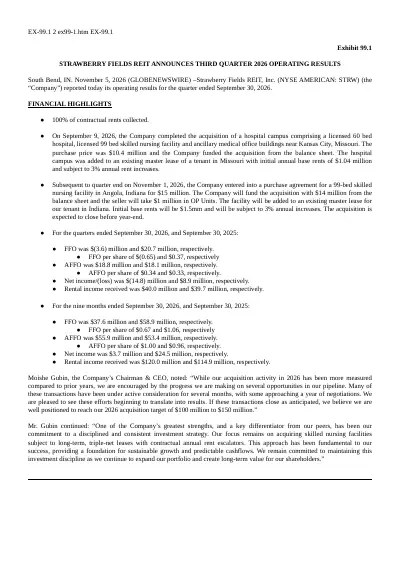
I wanted to start by sharing some key highlights for the quarter. During the quarter, the company collected 100% of its contractual rents.
On September 9th, 2026, the company completed the earlier announced acquisition of a hospital campus comprising a licensed 60-bed hospital, 99-bed skilled nursing facility, and ancillary medical office buildings near Kansas City, Missouri. The purchase price was $10.4 million and the company funded the acquisition from the balance sheet.
The hospital campus was added to an existing master lease of a tenant in Missouri with initial base rents of $1.04 million and subject to 3% annual rent increases. Subsequent to quarter end, on November 1st, 2026, the company entered into a purchase agreement for a 99-bed skilled nursing facility in Angola, Indiana for $15 million.
The company will fund the acquisition with $14 million from the balance sheet, and the seller will take $1 million in OP units. The facility will be added to an existing master lease for our tenant in Indiana.
Initial base rents will be $1.5 million and will be subject to 3% annual increases. The acquisition is expected to close before year-end.
As I mentioned in last quarter's call, we have been very busy on the deal front. Our pipeline currently has $400 million of deals, of which we anticipate closing $123 million of these deals before year-end.
Assuming we do get these deals closed, we will have closed over $130 million of acquisitions in 2026, which falls right in the middle of our target acquisitions for the year of $100 to $150 million. Yesterday, the board of directors approved the Q4 2026 dividend, which will be 17 cents a share.
The dividend will be paid on December 30th to shareholders of record on December 16th. I would now like to have Greg Flamion, our Chief Financial Officer, discuss the quarter-end financials.
Greg Flamion
Thank you, Jeff, and welcome everyone to the Strawberry Fields third quarter earnings call. Let's start with the Q3 balance sheet.
Total assets were $844.1 million, a decrease of $41.1 million, or 4.6% compared to December 31st, 2025. The year-over-year decline in assets was driven by lower fixed assets and cash balances at the end of the year.
On the liabilities and equity side, lower debt balances were driven by third quarter bond redemptions. Equity was lower year-over-year primarily due to a decline in accumulated comprehensive income related to foreign currency translation adjustments and offset by ATM common stock sales.
Continuing now to the consolidated statement of income for the nine months ending September 2026, 2026 revenue was $121 20 million, up $5.1 million compared to September 30th, 2025. This represents a 4.5% increase, which was driven by the timing and integration of properties acquired in 2025.
While we experience higher revenues, the income growth was offset by higher depreciation, which was driven by new property acquisitions. General and administrative expenses were also higher due to higher closing costs, corporate salaries, and other operating expenses.
These increases were offset by lower amortization expense. Looking at other expenses, the company recognized a $24.6 million foreign currency transaction loss resulting from the exchange rate differences associated with the redemption of its three shekel-denominated bond series during the third quarter of 2026.
As a result, year-to-date net income was $3.7 million compared to $24.5 million for the nine months ended September 30th, 2025. Excluding the foreign currency transaction loss, year-to-date net income would have been approximately $28.3 million, an increase of $3.7 or 15.2% over the comparable period in 2025.
While reported net income declined year-over-year, underlying earnings increased primarily due to the contributions from properties acquired during 2025. Going on to the next slide, we will now review the quarterly income statement comparison for the third quarter of 2026 versus the third quarter of 2025.
Third quarter 2026 revenue was $40 million, an increase of $0.3 million compared to the third quarter of 2025. Operating expenses were $0.6 million lower than the prior-year period.
Lower amortization expense and property tax expense were partially offset by higher general and administrative expenses. The company reported a net loss of $14.8 million for the quarter, primarily due to a $24.6 million foreign currency transaction loss recognized in connection with redemption of the three shekel-denominated bond series mentioned earlier.
Excluding the foreign currency transaction loss, third quarter net income would have been approximately $9.8 million, representing an increase of approximately a million dollars, or 11% compared to the third quarter of 2025. Finally, I'd like to end my presentation with some financial highlights.
Our 2026 projected AFFO is $74.5 million, representing an 11.1% compound annual growth rate. The 2026 projected AFFO per share growth is 10.1%.
The 2026 adjusted EBITDA is $129.5 million, representing a 14 14% compound annual growth rate. Our yield on leases is 14 14.3%, and the company's net debt to net asset ratio currently sits at 48%.
As of September 30th, 2026, our dividend was 17 cents a share, representing a 5.3% yield and an AFFO payout of 50.2%. This concludes the financial portion of the earnings call presentation.
I'll now turn it back over to Jeff Bajtner, who will walk us through additional portfolio highlights.
Jeff Bajtner
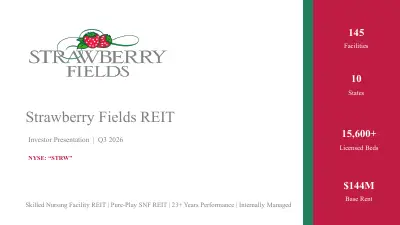
Thank you, Greg. Looking at our portfolio highlights, our portfolio currently has 145 facilities located in 10 states.
These facilities are comprised of 15,655 licensed beds. Our total asset value at acquisition is $1.1 billion.
Currently, our portfolio has 16 consultants advising the operators. The weighted average lease term is 6.8 years.
As we're proud to report, our tenants continue to do better and better each quarter, and our rent coverage is currently at 2.24 time 2.24x. Our net debt to adjusted EBITDA is 5.4.
On the portfolio, we continue to collect 100% of our rent. As I mentioned earlier, we have an acquisition pipeline of $400 million, of which $123 million we expect to close before year-end.
With that, I'll hand it over to Moishe Gubin, our Chairman and CEO, to continue with the presentation. All right, thank you
Moishe Gubin
thank you, Jeff. I want to start before I present the rest of this slide deck, I want to just go back to slide 4 and just talk about like if you look at our quarter year-over-year, our numbers are good.
It's relatively relatively flat and and our net income would have beat last year's third quarter by about a million dollars if it wasn't for the foreign currency transaction loss. I want to add a little color because I'm sure the folks that are out there are going to want to ask about it, might as well just talk about it now.
The foreign currency transaction loss was a was an accumulation that that for those that are good at accounting here, we we accumulated OCI over the years and it it the the the actual expense already found its way into interest expense throughout the years as we had cuz we quarter over every quarter we we mark our balance sheet to spot price, the shekel to dollar. When this when this quarter ended, during that quarter, we had paid off three bond issuances.
The reason we paid off the three bond issuances is because the bond market, you price at the day of the market and we just had the bad luck of the days that we went to price, the market, a bomb hit or something in Israel or whatever occurred, which ended up causing the interest rate to be too high of a rate on the on the bond. As a good custodian of our company, we had a backup plan all along, and we ended up taking instead of the rate that was being quoted in Israel, even though we would have saved this 24 million of interest of currency exchange, the interest rate in Israel is about a point or a point and a half higher than what we ended up taking, which I think our at the at September 30th is 6.66 was the interest rate I believe on that money versus 8 and 1/2 in Israel.
We basically saved the two points on the interest expense, and then and had to then realize this currency loss, which was already in our retained earnings. That's why if you go to the balance sheet, the equity didn't change.
It's just it moves it into from an OCI, which would have been expensed as other comprehensive loss, to now be on our regular income statement above the line. That's what this is.
To anybody concerned about it, it's a one-time event. In the grand scheme of things, the way I'm looking at it is, we replace it with five-year money at SOFR 275, which was two points cheaper almost than what we would have been in a fixed in a fixed product, which would have had a prepayment penalty.
If we amortize it over five years, this 24 million turns out to be less than 1%, we end up ahead of the game. That being said, I'm going to go on with slide 6.
I'll also start by saying thank you everybody for joining us today. Happy with where we are, happy to present that we're going to be able to, which Jeff brought up already, that we should end this year ahead of budget as far as buying.
It happens to be unfortunately it's at the end of the year as opposed to the beginning of the year, the full financial results next year should be should be killer compared to this year and previous year. That being said, if you look over the last six years, our AFFO our growth rate is over 11%.
You see it went from 43 million to 74 million. We like that.
That hopefully should continue to grow. The next slide after that is just talks about our portfolio growth.
Again, this is based on what we is is our a 10 cap value on our on our rents is really what it is. Still a 13% growth rate, which is good.
Reality is is we probably are doing ourselves a disservice and it's probably more value than we're saying, and that's look at the non-GAAP spreadsheet at the end of the presentation. Even so, being conservative at a 13% growth rate over the last six years is still pretty good.
Our stock price is holding up. Unfortunately, unfortunately, yesterday there was a stock crash, which wasn't great.
I think we ended the day close to 12.60, 12.70, something like that. Otherwise, we're holding our own.
We feel we're really undervalued. At some point, we hope that we get recognized and the stock price goes up.
We're going to keep doing what we're doing though. Most of the long-term shareholders that exist are holders, not sellers, and they're happy with the growth and happy with what we're doing, get a lot of compliments, and I'll keep doing what we're doing.
Hopefully that's succeeding. Slide 9 just basically talks about, what the difference between us and them.
We're we're we're trading at a 9 and 1/2 multiple, meanwhile our peer our closest peer is trading almost double, which is which is painful for us every time I see this. We're going to keep pushing, and we're going to bring in better yields, we're going to bring in better returns, we're going to keep doing what we're doing.
We're committed to the disciplined growth, the disciplined, how we buy, as we've spoken to a lot of you folks. It's pretty wash, rinse, repeat how we do business here.
As Jeff said earlier again, we have all of our rents being collected, our portfolio is performing. Our dividend, like we announced, is staying flat for this quarter, but we're proving that we're consistent a consistent return for our shareholders.
We expect that we expect that to continue. On the next slide, we just talk about our stock performance, but even more important really is is our true our true return at over 10%.
I think that kind of follows the value of the the the AFFO per share as well. At least we're not lagging behind that.
Like meaning the market is discounting us at a multiple, but at the end of the day, it's staying consistent with what the the stock price is growing at that same 10% clip because at least our and our FFO is growing the same 10% clip. From that point of view, at least that's that's that's good.
The stock price performance, as you see over here, we're we're right we're above where we started, but hopefully hopefully on a bigger chart, you'll see the growth rate's been good in the stock and hopefully it continues to to improve. Again, we we and we're going to be at we're going to be at REITweek, REITworld, REITweek, whatever it's called, in two weeks from now in San in in Atlanta.
Last year we were at that, it was when people were screaming out our name in the hallways and people were telling us we're the unicorn, keep doing what we're doing. I was actually very positively feeling about that, so now when we talk to people, I'm not I'm always was proud of what we have.
The fact is we're 90 over 90% skilled nursing, and exactly what we're still doing and continually growing in the skilled nursing space. Oddly enough, the one deal that we made came with a nursing home, a hospital, and a MOB.
All the next deals that we're going to close by the end of the year are all SNF, are all SNFs. On the next slide, just the same thing, peer comparison.
Our AFFO payout still remains way below everybody else and that's giving us we're doing all these deals without raising any equity. We're going to close we're going to close like Jeff said, I think 120 120, 130 million probably at $120 million or $130 million in the next two months, and we're using we're using our own cash.
We're not raising any equity, as we can't dilute our shareholders when the stock price is down. Anyone owning our shares today is just going to make more money tomorrow, without us diluting anybody.
The per-share growth is going to be, good. Again, that's why our AFFO share growth rate is higher than all of our peers, which is the slide to the right.
On the next slide, again, this payout ratio, as Greg said earlier, is right around 50%. We announced that it's going to stay that way at this point from for this quarter.
The AFFO share growth again is over 10%, and again, that matches almost exactly what the what the stock appreciated over the last 12 months at the same 10.1 growth rate. Again, we're at least at least the marketplace is not lowering our our multiple.
That's a positive. I'm always I've always been the optimist, for good or for good or bad.
Next slide just talks about our debt. We're past this now at this point, maybe we'll take the slide out of this take the slide out of this deck because at one point we were worried about the bullet, but at this point now, 26 ends the year quiet, 27, 28, very little it's the same it's the same amortization.
It's about 20 million of principal being paid down a year, maybe a drop more. Uh 29 is the next bullet, which has two one-year renewals, and and has bond bond renewal.
At this point, the Israeli market wasn't good in the last couple deals, even though they like to claim that they did good by me because everyone else would have been even worse. To my point of view is, I'm stronger than everybody else, we should have gotten treated a little better.
When this thing renews, most likely we probably just pay it off and move towards an exit of the Israeli market. We'll see what happens.
It could be the market gets super strong and whatever I just said, I'll have to eat my words. That being said, there's a slide later that talks about what valuation you want to put as a net assets.
Based on a 10 cap net assets, we're at 48% leverage with a net debt to EBITDA of 5.4%. Those are good numbers.
Blended interest rate of 5.8%. Super strong.
We still like HUD. We're working our way still through through the HUD world to be able to take a bunch of our buildings to HUD.
At this point, we're we have a a little throughput issue that we have to work ourselves through, and God willing, that'll happen in the next few quarters. In which case, hopefully by the end of 27, we should be able to have, maybe another $100 million sitting in HUD debt as opposed to conventional or Israeli debt.
On the next slide, as as I've been saying the last few years, it's become one of my favorite slides where it just shows you how diversified we are with our rents and diversified by states. That's going to continue.
The deals that we're doing now, two of the two of the deals that we have are going to be two new states. I think we've announced one of them is Florida, and the other one we didn't announce yet.
Then and then everything else is going to be is going to be Indiana, it's a state we're already in, of course, and Texas, which we're already in. All good.
All of the deals that we're doing now are going to be third-party operators. Nothing nothing, so that I think we were at 42%.
Once this transaction is done in sometime first quarter, I think that number is going to drop pretty good. Next slide, slide 16, just just just just giving statistics of the facilities averaging 77%.
I've talked about how that doesn't really matter. I'll just gloss over this slide and go to 17.
On the on on 17, we're just basically talking about how what our what our map looks like and percentages of facility types. Good.
It's hasn't changed really quarter-over-quarter and it remains it remains the same. The way we buy, that we've talked about over the years, is 10% cash-on-cash return day one before leverage.
Then we add a little leverage, which increases our return. All the deals that we're doing today are all the 10 cap purchases.
All the math is exactly what we've told everybody. Anybody modeling our financials, you can model, the 130 million or so, that fully next year will will will add up to about a $13 million of rent increase.
We got a couple of other deals that are that won't really hit the tape, but but we did a couple of deals where we increased the rent and then paid something out to our tenants, so that'll increase revenue. We got a couple of other smaller things just cleaning up the the the portfolio a little bit to the positive.
That'll increase our our revenue. On our last two slides, the first one is just basically showing nine months ended AFFO, or net income through FFO to AFFO.
Look at the net income, it's really down. Depreciation and amortization, but it gets you to FFO.
Again, that's that's that's because of the foreign currency, but then once the straight-line rent and the loss of foreign currency, your AFFO gets to be 55,879, which is which is $2.5 million higher than than 25. EBITDA, again, net income, adding back the depreciation, interest expense, keeps you below.
When you want to add back the foreign currency and the straight-line rent, you end up with an adjusted EBITDA that's $3.5 million higher than it was last year at nine months ended. That's pretty good.
The next slide, the last slide, which which I like that we put this in here because if you guys are following skilled nursing at all, you see that a lot of the deals from the other guys are at 8 and 1/2 caps or 8 and 3/4 caps. Basically what this is telling you that we're we're marking our whole balance sheet to not our balance sheet, we're marking like all these presentations to a 10 cap.
We're showing net assets at a million $467, let's say. Then when saying that our net debt to net asset is 48%, but really, we could be using the low end of this and saying really our net assets is really a milli- a billion 673 and therefore our net debt to net asset is 42%.
To the folks that are out there that are looking for a lower net debt to net asset, really, you can hang your hat on saying that a cap rate of 8.75 is not unreasonable, especially when you see all these other deals, CareTrust and the other guys are doing that are at 8 and 1/2 caps or even lower. With that, I want to thank everybody for joining us and I want to pass it back to the operator.
Operator
Thank you. As a reminder, to ask a question, please press star one one on your telephone and wait for your name to be announced.
To withdraw your question, please press star one one again. One moment while we compile our Q&A roster.
Our first question is going to come from the line of Gaurav Mehta with Alliance Global Partners. Your line is open.
Please go ahead.
Gaurav Mehta
Thank you. I wanted to go back to your comments around the $120 million portfolio that you guys are looking to acquire in the next couple of months.
Can you maybe talk about where you expect your leverage to be after closing that portfolio and how should we think about capacity to make more acquisitions in '27 after that portfolio?
Moishe Gubin
Hi, Gaurav. Thank you.
Thank you for joining us and thank you, as always, that's a good question you're asking. We model out to be below 50% in our portfolio once all of these deals close using current cash and raising our debt a little bit to be able to fund everything.
When all these deals close, hopefully by 12/31, we should still be below the 50 the 50%. Just to remind you, like we've always gave guidance to say that our policy is between 45 and 55.
So, 50 is fine. Again, if we really look to lower cap rate and like the last thing I said in the presentation, right, we're probably closer to 40 45% at an 8 and 3/4 cap.
Gaurav Mehta
Thanks for that color. A second question I have is on the pipeline.
You mentioned $400 million of the pipeline. Can you maybe provide a breakdown on what's in that pipeline?
Are you looking at more portfolios? Then what kind of impact have you seen of higher rates on your pipeline?
Moishe Gubin
I really I should let Jeff answer that, but I'll just I'll just take away some of his thunder and I'll just, the the the biggest the biggest part of that portfolio of the pipeline, we have a deal that's very very likely to get done and it's going to be a really sizable deal. Assuming we can work we can we can get that deal under contract, then you're talking about first quarter a first quarter deal that will meet majority of our or more than our budget for the year.
Then everything the rest of the year will be gravy. I don't want to make anyone crazy today, but like the reality is, is assuming assuming we go under contract, you you'd have to base an assumption on on where our stock price goes to see whether or not we're going to end up doing a capital raise for a portion of it.
It would seem like most likely we would do a capital raise because of the leverage. That's that's kind of what's coming down the pike.
When when we speak next or maybe to some of you individually, we'll have conversations with as soon as as soon as we get something under contract because that would be one that we would have to announce and it has to do the regular traditional audit because it's a bigger it's a bigger portfolio acquisition. That's that's that's the gist of the first bigger deal that that's and that's pretty pretty likely that it'll occur.
With that, I'll give it to Jeff for him to talk further about the pipeline and and the deals that we're working on.
Jeff Bajtner
Thank you, Moishe. No, as we're heading towards year-end, we're working on three or four deals.
One of them is we announced, it's the skilled nursing facility in Angola. One of them also Moishe announced, or Moishe mentioned in his comments that it's going to be down in Florida.
Then there's another portfolio, a sizable portfolio that we're looking at as well. A few of them have been deals we've been working on since the beginning of the year, but it's just the matter of the deals play themselves out and they have a life of their own.
We are working very hard and diligently to get them closed before year-end. Total, as I mentioned in my remarks, it's roughly about $123 million of deals that we're aiming for to close before 12/31.
Moishe Gubin
Likely though for first quarter of 20, maybe I'm getting ahead of ourselves, and I thought that's what Gaurav was asking, is I think for first quarter of 2027, based on the total pipeline, there's a likelihood that I know we have one deal that's near Houston, a smaller deal, and then we have a couple of other things, but then we have this big deal. If we pull off this big deal, that should be a nice change that'll bring us over $2 billion in assets based on market value, and it should be I don't know about a game-changer because everything is a 10 cap, basically a 10 This one is going to have a little bit of a different metric, a longer lease, a smaller cap rate, and then when you blend it out over the life of the it's a 10 cap minimum.
That being said, it should be an exciting first quarter and it'll change us just by making us a little bit larger. Hopefully that happens.
I'm excited about that.
Gaurav Mehta
All right, thank you. That's all I had.
Moishe Gubin
Thank you. Be well.
Operator
Thank you. Our next question is going to come from the line of Richard Anderson with Cantor Fitzgerald.
Your line is open. Please go ahead.
Richard Anderson
Hey, thanks. Good morning or afternoon, wherever you are.
I'm curious, Moishe, if you have any thoughts about mid-term elections' impact on kind of oversight from politicians in the skilled nursing space and you all want the same thing: good quality care for your residents. They could be needling for property owners like yourselves.
I'm just curious if you've got your antennas up at all with a new political landscape in front of us now.
Moishe Gubin
Hi, Rich.
Richard Anderson
By the way, let me just finish the thought. How that might change, you got a lot of stuff in front of you potentially, but how that might change the pipeline going forward?
Sorry, thanks.
Moishe Gubin
You're welcome. I appreciate the question.
I could tell you that right away, I don't want to give away what we didn't announce yet, but one of our portfolios that we're buying, this is the bigger deal that God willing will close before the end of the year, is in a state that the blue won on that deal, and they've already announced that they're going to raise the Medicaid rate for nursing homes for that state. Right away, financially there's a boon, which is not unusual over the years, when it's Democrat-led a government in that state.
Typically the trade-offs been, more money to pay to the nursing homes and the trade-off to that is a lot more regulation, not in the sense of more regulation, but in more supervision of that regulation. Historically, Illinois, at least the city of Chicagoland where it's blue and the rest of the state is actually red.
City of Chicago, the revenue is usually there, or yeah, basically. The way they regulate has been aggressive, really aggressive to the operator, and very quick to find.
It's been like that. I've seen that.
I'm a historian. This is the main business I've been in since my career started as an accounts payable bookkeeper in a nursing home in 1990 right around the beginning of '98.
This is the way it's always been. The Republicans will leave you alone, but try to lower your rates, and the Democrats will raise your rates, but not leave you alone.
A good operator really doesn't care much either way. We prefer more revenue, but really wants to take care of the residents.
Which is the way I was as an operator, and now as a landlord, I'm trying to find tenants and push for the tenants to give good care, though I don't have control over the care they give. This was a mid-term election that I think to some benefits, Collins losing in Maine, she was a huge proponent with Elizabeth Warren that they wanted to attack REITs, healthcare REITs and owning nursing homes.
With her being out of the picture, that should also improve a little bit of the gusto from the Senate to go attack REITs or equity funds that own the real estate in the nursing home world and the hospital world. That should be an improvement.
For us fundamentally, the way I ended up being where we are in Strawberry is I found myself graduating college and taking a job in the bookkeeping at a nursing home, not knowing I would fall in love with wanting to take care of people. I was always in hospitality before that, with the catering business in New York and all, but from that minute on of where I started working at the nursing home and caring for people, it's always been anyway philosophically, and similar at my bank, we're doing good by the world.
At the same time, we make money doing it, but we're not looking to not do good and try to find money, Hopefully you guys understand me. I'm not too articulate today.
The end of the day is in our case, we're a big fan of when we find the tenants and do what we do, is care is number one anyway. I don't really think, Rich, at the end of the day, if you sum it all up, I think the benefits are already coming in that's going to be good stuff, but we know already the negatives are going to be where it's going to be more regulation and more enforcement of the regulation and more fines.
God willing, they say the more things change, the more things stay the same. That's why one of the quotes you could use for one of your articles you write.
That's basically what ends up happening, right? The person who gives good care is going to be fine.
We're not avoiding any states more than we've already been avoiding. Meaning, I don't look at deals in Massachusetts, Connecticut, New York, California, and we still avoid states where there's not enough population.
Like we're not going to buy in Alaska. We're not going to buy in Hawaii.
We're not going to buy in Wyoming if there's only X amount of facilities in the state. We're limited to where we could have a big enough portfolio.
All right, I hope I answered you. I'm sorry if I didn't.
Yeah.
Richard Anderson
Just give those politicians some soup and you'll be fine. The other question I have is just looking at the map of all the different assets on page 17 of your deck.
You're moving into Florida. I'm just looking at the cluster in the Midwest, but then you have some stuff on the outskirts.
Is there any kind of asset recycling opportunities here and maybe with one intention being to build a greater presence in Florida? I'm just curious how you're thinking about all that on a go-forward basis.
Thanks.
Moishe Gubin
That's a good question and it's a point that I should have made and I didn't. Our portfolio that we're buying that we didn't announce yet, hopefully in the fourth quarter, in the next month or two, is in the Midwest, in a state that we're not in, and it's a new operator.
That'll fill in the cluster in the middle. In the Florida deal, it's a sale-leaseback, and the guy who's selling has been in the nursing home business for 30, 40 years.
Part of this arrangement is once we close this transaction, it's expected that they have six other buildings in Florida or they have an ability to buy six more buildings in Florida where we would buy it and then lease it to them in a master lease. We didn't expect it to be a one-off.
The reason why we were able to do a one-off, as a starting point before getting to a bigger, is because Infinity, which is, as you guys know, I'm a related party to and some in ownership at least, not in operations, is now based in Florida, been there for between 5 and 10 years. The corporate nursing and the corporate operation team, they're all Floridians.
They, bunch of them are from Tampa area and the others live South Florida, Fort Lauderdale, and Miami. This as a one-off, it was basically a hedge bet because I went to Michael and I said, "Michael, we have this deal.
It's basically something we wouldn't even look at." He says, "Well, do the deal.
If the numbers work, and worst-case scenario, the team here can manage it because we live here and everyone knows Florida. Even though we don't operate in Florida today, we know the Florida landscape."
That was why we're willing to do this. This would be our first real one-off, but it's a hedge bet.
That's how I look at it. I'm really hoping that this ends up being a master lease of seven facilities in the next 18 months.
Richard Anderson
Okay. Sounds good.
Thanks very much.
Moishe Gubin
Welcome. Thank you.
Operator
Thank you. Our next question is going to come from the line of Mark Smith with Lake Street.
Your line is open. Please go ahead.
Mark Smith
Hi, guys. First off, just a question on kind of P&L.
G&A came in a little lower than we'd expected this quarter. Is that sustainable or will we see that kind of come back up here in the coming quarters?
Moishe Gubin
Greg can add more color, but I think if you are comparing it to what was it last year around this time was when the company gave me stock options. I assume there's two things in the G&A.
Or I'm not assuming, I know there's at least two things in the G&A. One is financing costs from doing the line of credit, and that was the second quarter.
If you look at last quarter, we had a bunch of money in there that was really a one-time event. Then if you look against last year, you would see a compensation that was a catch-up and it's lower now.
I think Greg can probably expand on what I just said and maybe give you even more color.
Greg Flamion
We don't expect to have I guess any of these one-off events in December, I would expect G&A to kind of be in line with where we're at right now I guess in regard to Q3. Hope that helps you out with your analysis, but again, we don't expect anything going forward that should be higher than where we're at right now.
I guess I'm regarding the rate for next quarter, so.
Mark Smith
Okay. Then second question that I have was just curious if you guys can talk at all about this potential transaction in Arkansas, maybe selling off some of these facilities, any insights you can give us on if that's going to go through and potential impact?
Moishe Gubin
That's another thing I glossed over accidentally. That transaction was an option that we gave the tenant.
We usually don't give options. It's that option, we have one other option out there.
I think they've been tenants right now for how 6 years, maybe a little longer at this point. The deal that we made at the time, when we bought those facilities at a relatively inexpensive price, with the turnaround of me and my partner Michael fixing these facilities.
We were the operator at the time, and we didn't get compensated, other than the net income from the operator point of view. We took these buildings that we got a great deal on, and we worked hard and turned them around and made them worth a lot more.
We were able to then pass it along to the next guy, who's the current tenant, and they've done a fantastic job there. They've been waiting patiently for the legal issue that's been outstanding between the people who sold it to Strawberry, and we beat those guys in court.
Now it's been three times. They got one last appeal for the Supreme Court or something.
They lost fair and square, and when they lost the last time, it gave the ability for our current operator to exercise their option. They lined up financing.
They're cashing out between $50 and $100 million on this transaction. They're going to pay us off, they're going to buy it from us, and they're going to have a nice cash, and good for them.
They've worked hard, they've done a good job. It's partially those proceeds from that, we're doing a 1031 so that we don't have to pay cuz otherwise we'd have to dividend out all the capital gains.
The true capital gain is around $60 million on this deal. That 60 we're going to parlay into using cash to buy the deals that we're closing.
It's imminent. We're waiting for one letter one one last letter to come in from the government to allow the transaction, which is going to come, just a question is timing.
We've been waiting already 2 weeks for it, and there's a likelihood the deal closes next week. When that deal closes next week, I think at this point, I don't even know if we have to do an 8-K cuz we announced today talking about it, right?
It was in the 10-Q. Once that deal closes, that money's going to be sitting there waiting to be spent on the new deals.
When you net it all together, everything we did, we're still going to net out with a higher rent number going forward than what we have now. With all the deals coming in versus getting paid off in that deal, if you're modeling it out, you'd probably take the current number and probably add I don't know, $3, $4 million of additional rent or something like that is going to be the change all in.
It'll be strong. Then we get rid of an option that's been haunting me that someone's going to exercise, and now, got one last option, I think it's 28 million bucks or something like that in Southern Illinois.
That's probably those guys are making a lot of money, so that's probably going to happen, I assume, in '27 sometime. We expect to buy higher than the range or the top end of the range of 150 million bucks in '27.
In the grand scheme of things, we'll just I think Rich used the word "cycle through" or whatever the word was to "recycle." We'll get rid of properties that we've had that have an option to go into properties that don't have an option, most likely.
Can't say that I'm not going to give an option to somebody if the deal makes sense. We're poised to keep chugging along positively and to the same or better than what we've been.
Mark Smith
Great. Thank you.
Moishe Gubin
Thank you, Mark.
Operator
Our next question is going to come from the line of John Massocca with B. Riley Securities.
Your line is open. Please go ahead.
John Massocca
Good afternoon. Maybe just kind of following up on the tenant purchase option.
The $60 million number you quoted, is that net proceeds net of any kind of debt that needs to be paid off, or is that just kind of actual gain you're making on the transaction? Just trying to think about what number to kind of use from that transaction is kind of a source of proceeds for the $123 million worth of deals you quoted earlier
Moishe Gubin
in the call. The purchase the purchase price and thank you for joining us, John.
The the the purchase the purchase price for that deal is $90 million. That's been the option since the beginning.
Out of $90 million, we have $6 million in debt on the properties all together. We're our net cash is going to be $83 million.
Out of $83 million, we're going to buy the and the deals that we announced, one deal is going to be $14 million in cash at the door, one deal is $21 million cash at the door, and then lastly, the remainder of that cash, plus a little bit of debt, is going to be for the last deal at the door. That should leave us with that should leave us with with enough cash to pay our dividend in December, close all those deals, have enough money for us to, end the year with with ample cash and ability ability to still borrow against our line to do more deals in in '27.
John Massocca
I guess in thinking about maybe the $123 million in terms of sources of proceeds for those transactions, do you feel that between that disposition and kind of existing debt availability, you could address those potential acquisitions, or do you think you need additional new debt?
Moishe Gubin
No, actually, interestingly enough, the deal that we're doing in the new state we're going into, but for reimbursement to remain the same for the tenant, they're relying on that current revenue number based on, the revenue is decided by the state and the feds through Medicare, Medicaid. Private pay, even if it's 10% or 15%, is still immaterial number.
The rest of the house is paid for either by the state or the feds. Reimbursement by state varies.
This state actually has a component, which most states do, but they usually have a flat number in the capital component that allows for interest by landlord or tenant to get included as an expense, an allowable expense for capital. The tenant-to-be said to us that they need us to put about 53% leverage on the assets that we're buying so that their reimbursement rate doesn't drop.
I was glad to do it because I managed the balance sheet off of the aggregate, not off of the individual assets. It's perfectly fine to do.
We're going to be borrowing about $43 million on that transaction. You've got to take that 43 plus, like I said, 83 is 126.
126 is more than enough for us to meet all of these deals by end of '26.
John Massocca
Okay. I appreciate all that math.
Then maybe kind of bigger picture, as you think about where interest rates have moved, and I know you've kind of traditionally have had this return threshold or this kind of day-one cap rate you've targeted, that seems a little bit agnostic to moves in interest rates. As interest rates have moved up, does that give you some power thinking about investments in '27 to go beyond that 10% cash cap rate?
Moishe Gubin
No. Your question is good.
We literally had a board meeting yesterday and that came up in conversation where, right, this come up multiple times over the years. I don't know all of you guys who's listening to this call what your backgrounds are and stuff, but in life you have a choice.
You can either stick with what's working, proven over time a model that works, or you adapt and you evolve. There really the answer is a balance between all of that, right?
In our case, because of the perm financing in HUD and the ability to have fixed financing with the bond debt, and then you have the conventional, that's variable rate, when you get through everything, if you look at slide 14, our blended interest rate for all of it is 5.8. For us to buy it at a 10 cap, the 10% return on day one, and then when you add in the benefit of, let's say the blended is 5.8, right, I'm satisfied.
Again, I answer to the shareholders and the board, we work together in our directorate. I'm satisfied with that yield.
That's what we've been doing over the years. The benefit from what you suggested, and you're right, is that we probably could squeeze maybe a little bit more rent or we could squeeze a little bit lower in a price somewhere.
We're happy with the ability to close. Cuz it's a balancing act to the seller.
The seller says, "I want this amount of money." They don't give a damn what my cap rate is or how I'm buying.
They want X amount of money. Right, we're happy closing, like we said, the 100 to 150 mark.
Because doing that is non-dilutive to the shareholders. I don't have to raise equity for us to keep growing at that pace.
That presents a good yield to our shareholders between that growth and our dividend. We feel it's compelling investment at 16%, when you put those two together.
I like the benefit of knowing that we're reliable, that we're going to close the 100, 150 every year, and that model's been working for us. I don't know if I sound indecisive, I'm really not.
It's just we debate this because it's a good business philosophy or theory debate, which is: Do you keep evolving, cuz you should evolve? Do you keep changing, and then therefore, it's not exactly sellers in the market that know how you buy, right, they're not going to necessarily come to you if you're wishy-washy or you change your pricing matrix.
They can't trust to call Moishe and say, "Moishe, I got a deal for you. I know your math.
It's making X and this is how much I want. Pay me and let's close."
Right, I would lose that. I would lose a little bit of the stability of how we buy and how the amount of volume we're able to buy.
That's really as much color as I could give you. Your question is something that comes up in conversation board level a couple times a year.
Then conversationally, just amongst people comes up more often than less often. Because when rates go up, they say you should raise it, and then when rates go down, no one ever says you should lower it.
We just go and do what we do. For me, being consistent and kicking off returns to the shareholders consistently at a high double digits has been Why screw with the model?
is basically the argument the other way, right? Why mess with it?
It's going great. I don't know.
Hopefully I did okay with you answering you. No,
John Massocca
I appreciate all that color. That is it for me.
Thank you.
Moishe Gubin
Welcome.
Operator
Our next question is going to come from the line of [Ken Billingsley?] with Compass Point Research & Trading.
Your line is open. Please go ahead.
Ken Billingsley
Thank you. I wanted to follow up on the expense answer you have.
I just want to clarify, when you talked about third quarter being a run rate, I know you said fourth quarter, we could extrapolate to that. Would that be an annualized number we should be looking at on the current book of business?
Moishe Gubin
We By the way, Greg will answer that, but We've told people before, we're at almost full employment. As these properties come on, we have to add one asset manager to the mix.
At some point, maybe we got to add a paralegal or maybe a clerical person. You're talking about a total increase in labor costs of maybe 250 a year, maybe 300 a year.
It's not a big number. As far as the current labor, we've been sticking with, I think, What did I do last year?
15% bonus? Yeah.
Everyone, instead of raises, and I give raises based on market. Other than that, we're still running relatively flat as far as we make more money, we're giving 15% bonuses to everybody, and it's clean.
It's clean, and that probably will move up, market, the people on this call: me, Jeff, Greg. At some point, those are all the increases somewhere built into there.
Other than that, our stays where we are, and all the costs of how we run our business is we run very lean and we don't expect any of that to change. We're not looking to buy or rent in an expensive office space somewhere.
We're peacefully in our spaces where we are and it's okay. Greg, you want to answer that?
Greg Flamion
I'll just be a little bit more specific. I guess last quarter we were a little bit less than $2 million.
Looking at that number for Q4, I don't see anything that's going to materially move the needle on that number. If you guys are looking for a G&A for Q4, I'd look at $2 million.
Jeff Bajtner
Sorry, Greg, I would add to that, you have to add Moishe has a $700,000 bonus. It's been
Greg Flamion
approved. Oh,
Jeff Bajtner
well, then maybe not. You can't beat that one.
Moishe Gubin
I didn't even know. God bless you all.
Take the money. Thank you.
Ken Billingsley
As you're talking amongst yourselves, just to clarify, about $2 million a quarter would be a safe bet, assuming though that as you do these acquisitions, there is going to be some incremental increase, but a starting point of about $2 million would be about accurate?
Greg Flamion
A starting point of about $2 million would be about accurate. Again, we're not planning on having new loans or anything else like that in Q4 that would necessitate the cost that we saw in Q2.
Again, I would go with the $2 million number as of right now.
Ken Billingsley
I know you've talked a lot about the acquisition. More of a specific question on the ones you're looking to close for fourth quarter: What are some of the risks to the closing?
Is there risk to the actual closing of the deals, or if anything, is it more of a risk of timing?
Moishe Gubin
No, on the Florida deal, that's timing ready to go. On the Indiana deal, that's also timing ready to go.
On the other deal, there's two things left to the diligence. One of them is me visiting the property, and I kind of going next week.
The second one is a little bit more detail to the financial statements. Financial statements have already been spread and all the numbers work.
Somebody wanted on the on our tenant side, wanted a little bit more detail on some of the financial. The expectation is that they don't expect to find anything that's going to make the deal not occur.
There is something on that deal that can still I could go there on Monday and find the places to be disgusting, decrepit facilities. In which case, if I don't feel good about it, we won't do the deal, no matter how good the deal is.
I generally, we won't do it. I have to feel good about what we own.
That's about it.
Ken Billingsley
The addition of these wouldn't likely need you to increase expense structure, at least with the closing of these? That's rolled in to where you are right now?
Moishe Gubin
No. No, no.
Because, again, we're using the cash that we already have. The asset managers we currently have are going to absorb these properties.
There's going to be a drop of legal, there's a little bit of closing costs that go with it, but that's usually under FASB 91, I think, we take that and we spread it over the life of the lease of 10 years, there's not a one-time hit generally for that. No, yeah.
You'll just have an increased revenue number, a little bit increase of interest expense only because, like I said, there's that $43 million that we're going to take for that one deal, and that 43 is going to be, SOFR 265, something like that, SOFR 270, 265. Other than that, top line is based on those deals and the bottom line is not affected other than the interest on that 43 million.
Ken Billingsley
Great. Good luck through the end of the year.
Moishe Gubin
Thank you so much.
Ken Billingsley
Thank you.
Operator
Thank you. I would now like to hand the conference back over to Jeff Bajtner for closing remarks.
Jeff Bajtner
Thank you so much. I'd like to thank everyone for joining us today.
We appreciate all the questions and at the back of the presentation there are our email addresses. If you have any questions, please feel free to reach out.
I wish everybody a wonderful weekend.
Moishe Gubin
Thank you, everybody.
Operator
This concludes today's conference call. Thank you for participating and you may now disconnect.