ARCHION Corporation
Q2 FY2027 · Earnings Call TranscriptNovember 10, 2026
Takao Kenmochi
Dear participants, thank you very much for joining Archion's presentation of our FY 2026 first half results and the full year outlook today. As we have reached the scheduled starting time, let us begin with the presentation.
I am Kenmochi from IR team, and I will be serving as a moderator for this session. Today's session is scheduled for 60 minutes in total, about 30 minutes of presentation, followed by 30 minutes for Q&A.
The meeting will finish at 8:30 Japan time. The presentation materials shown on screen today are also available on our website.
Before we start, please note that today's presentation may include forward-looking statements based on current assumptions. All such statements are subject to risks and uncertainties, and actual results may differ materially from the projections shown today.
We will be sharing our presentation slide on the screen. Today's speakers from Archion Corporation are Karl Deppen, Representative Director, President, and CEO, and Hetal Laligi, Representative Director and CFO.
Karl Deppen will present business update, and Hetal Laligi will present the financial results and outlook. After the presentations, we would like to open the floor for Q&A.
With that, I would like to hand over to Karl Deppen. Thank you very much, Kenmochi-san, and
Karl Deppen
a warm welcome also from my side. It is a true pleasure to be with you here again today.
With our first six months as Archion, we are off to a good start. Let me highlight three key messages.
First, we have delivered a strong first half. Our business in Japan is firmly on the road to recovery, Southeast Asia delivered strong volume growth, and service and parts, as well as pricing measures, further strengthened our earnings.
As a result, unit sales, revenue, and operating profit all grew at double-digit rates compared with the pro forma first half of last year. Second, we remain on track to achieve our full-year outlook.
Our strong first half has given us a solid base, while we remain mindful of the challenges and uncertainties ahead of us. We expect headwinds in the second half, particularly from raw material inflation and the situation in the Middle East.
These factors are already reflected in our unchanged full-year outlook. Third, we have launched Leap 1, our group-wide performance program building on the midterm plan we presented at our Capital Markets Day in May.
Leap 1 is designed to drive execution across the group. It brings together initiatives on growth and efficiency, including synergies between Hino and Fuso under one program with strong governance and clear visibility on the progress.
Let me now take you through the agenda for today. I will start with an update on our business, highlighting the key developments and milestones that Archion has achieved since its launch six months ago.
Laligi-san then will walk you through our first half financial results and our outlook for the full year. Over the past six months, we have made tangible progress in delivering what we announced, as these four examples demonstrate.
First, we are building a stronger presence as Archion. At the Japan Mobility Show Bizweek in Japan or at the IAA Transportation in Hannover, Germany, we raised awareness of the Archion Group together with our Hino and Fuso brands among customers and partners in Japan, in Europe, and worldwide.
Second, we are delivering our first products from our integrated platform strategy. In Japan, we have now launched the new Hino Ranger and the new Fuso Fighter as its first models.
The next model, a new electric light-duty truck for Hino, is already in the pipeline. Third, we are strengthening our financial resilience.
Within six months of starting operations, we established a two-year, 250 billion yen syndicated committed credit facility, centralizing our yen funding at group level and replacing fragmented short-term borrowing at individual companies. Fourth, we are advancing public transportation.
On November 2nd, Fuso Bus, our joint venture between Mitsubishi Fuso and Foxconn, started operations as announced. It is also a concrete example of our active portfolio management, systematically assessing the attractiveness of our businesses and taking decisive action.
Alongside these milestones, we remain firmly focused on delivering the financial targets of our midterm plan: a return on sales of 4.5% this year and 7% by fiscal year 2029, an improvement of nearly 4 percentage points from our pro forma 3.2% in fiscal year 2025, and 10% or more by fiscal year 2032. To achieve these ambitious targets, we need disciplined execution.
That is why we have launched Leap 1, our group performance program to drive our financial performance. Leap 1 brings together cross-functional teams across the group with strong governance and clear visibility on the progress.
The program addresses all four value creation levers of our midterm plan, covering both growth and efficiencies. Most importantly, we already taking the first tangible steps forward.
First, we have started joint sourcing from our combined supplier base and are leveraging shared logistics and other facilities to drive efficiency and scale. Second, we are scaling up our medium-duty business and strengthening the product offering across both brands.
These are tangible first steps towards realizing the benefits of our integration, and with Leap 1 providing the framework to accelerate performance improvement. With that, let's turn to our first half financial results.
Archion has delivered strong results in the first six months, putting us firmly on track for the full year. For a meaningful comparison, we measure our performance against last year's first half results on a pro forma basis as if Fuso and Hino had already been integrated.
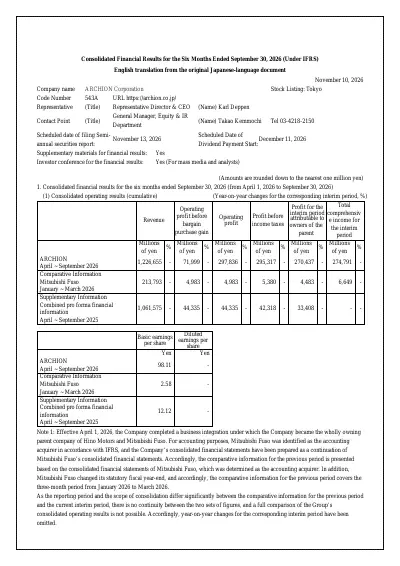
Unit sales increased by 25% to 128,000 units, while revenue grew by 16% to approximately 1.2 trillion yen. Operating profit before the preliminary bargain purchase grew even stronger, rising by 62% to 72 billion yen.
This strong profit growth reflects higher volumes, supported by pricing, continued growth in service, and cost efficiencies. Revenue grew more slowly than volumes, partly due to the sales mix, as Laligi-san will explain later.
Against our unchanged full-year outlook of 230,000 units, approximately 2.43 trillion yen in revenue, and 110 billion yen in operating profit, we have built a strong foundation for the full year despite the headwinds expected in the second half. Let me outline where our volume growth came from.
Our unit sales rose by 25%, or 26,000 units, to 128,000 trucks, with both brands contributing. Hino grew by 20%, and Fuso grew by 31%.
Two markets were the main driver of this growth. In Japan, unit sales grew 27% to 39,000 units.
With a stronger product lineup and better availability, our recovery at home continues. In Southeast Asia, unit sales nearly doubled to 53,000 units, mainly driven by the Indonesian government fleet order.
We delivered around 22,000 units, or 80% of the total order volume, demonstrating our strong position in this important market. These front-loaded deliveries will also affect second half volumes, as Laligi-san will explain.
The Middle East was a main exception, where the regional crisis continued to weigh on our sales. Although alternative shipping routes helped mitigate the impact on shipments, at the same time, challenges in the region remain and will also affect us in the second half.
In summary, we delivered a strong 25% increase in global unit sales. Let me now turn to Japan, our home market.
The truck market above 3.5-ton grew around 5%. Our retail sales grew by 24% to 36,000 units, lifting our market share from 41% in the first half of last year to 48% this year.
We gained share in both segments, particularly in light-duty trucks, where model availability had been limited last year. This reflects the product improvements we outlined in May, including the introduction of the updated Hino Dutro and the return of the 13-liter engine for the Hino Profia, strengthening our product lineup.
Overall, our recovery extended across every truck segment. With that, I hand over to Laligi-san, who will take you through our financial results and outlook in more detail.
Thank you.
Hetal Laligi
Thank you very much, Deppen-san. Let me now put our progress into financial terms: our results for the first half and how they build towards our full-year outlook.
Here are the key figures. With 128,000 units and revenue of around 1.2 trillion yen, we have laid a good basis towards our full-year outlook.
As in Q1, we show our profitability from two perspectives due to the business integration effects in our first year. The first perspective is our operational business performance before the preliminary bargain purchase gain, with an operating profit of 72 billion yen, a return on sales of 5.9%, up by 1%-- 1.7 percentage points, and net income attributable to owners of 44.6 billion yen.
These figures reflect transparently how our business is performing and will be our focus for today. The second perspective includes the so-called preliminary bargain purchase gain, with an operating profit of around 298 billion yen and net income attributable to owners of around 270 billion yen.
As also explained in our Q1 disclosure, this is a one-time noncash accounting effect from the business integration with no impact on cash flow or dividend policy. Please find the detailed explanation in the appendix of our disclosure material.
As Deppen-san has already covered unit sales, let me now turn to revenue development. Revenue reached around 1.2 trillion yen, led by new vehicle sales up by 21% to around 745 billion yen.
Our growth was particularly strong in Q2, reflecting our higher sales volume. Growth was strongest in Japan, where new vehicle revenue rose by almost 30% as our recovery continued.
Overseas new vehicle revenue grew 14% to 382 billion yen compared with 25% unit sales growth. This largely reflects the sales mix, including knockdown kits supplied for the Indonesian government fleet order with lower revenue per unit.
Service and parts revenue grew 5% to around 259 billion yen, with growth in both Japan and overseas. Based on around 3.8 million vehicles in operation worldwide, this recurring revenue strengthens our resilience throughout economic cycles.
Operating profit before the preliminary bargain purchase gain rose from 44.3 to 72 billion yen, again particularly driven by the Q2 development. Let me now highlight the main drivers.
First, especially higher unit sales from Japan's recovery and strong sales in Southeast Asia contributed 29.8 billion yen through volume and mix, offsetting declines due to the situation in the Middle East. Growth in service and parts, pricing, and our complementary business also contributed positively.
Second, while higher material costs weighed on profit by 16.5 billion yen, pricing and efficiency gains helped offset this impact. The different currency exposures of Fuso and Hino largely balanced each other, underlining Archion's resilience to foreign exchange fluctuations.
Overall, stronger business performance translated into higher profitability. At the same time, pricing, efficiency gains, service and parts, and favorable currency effects more than offset material cost inflation.
Our operating performance also translated into higher net income. Excluding the preliminary bargain purchase gain, net income attributable to owners of the parent rose 34% to 44.6 billion yen.
Including the gain of approximately 226 billion yen, net income attributable to owners of the parent reached around 270 billion yen. This bargain purchase gain, again, is a one-time noncash accounting effect from the integration with no impact on cash flow or dividend policy.
We have refined our estimate of the gain from around 233 billion yen in the first quarter to 226 billion yen now. The amount remains preliminary and may change as we complete the annual audit.
Let me now close our first half review with two key takeaways: profitable growth and cash generation. Revenue increased 16% while operating profit grew 62%, lifting our return on sales to 5.9%.
This performance also translated into cash. After funding our investments and considering outflows for Hino's past engine certification issue, free cash flow was at 53.7 billion yen.
Before turning to the full-year outlook, let me update you on the Middle East. Our priorities remain the safety of our employees and continuity for our customers and partners.
Our initial assumption was an impact from the crisis concentrated in the first half with normalization in the second. Given the ongoing situation in the region, we now expect the crisis to continue, affecting our business at least throughout the second half of this fiscal year.
In the first half, alternative shipping routes and close cooperation with our partners enabled us to ship more vehicles than initially expected, although full-year unit sales in the region are still expected to remain below 2025 levels. In addition, the logistics remain challenging and these new routes come with higher logistics costs.
Our estimate of the full-year profit impact is unchanged at around 15 billion yen. While the 5 billion yen impact in the first half was lower than anticipated, we now expect the remaining impact of around 10 billion yen in the second half, reflecting lower volumes and additional costs compared to last year.
Let me now provide a transparent view on our business development in the first half and our assumptions for the second half of the year. In general and for the full year, we continue to expect an improved performance through sales, service and parts, pricing, and efficiency improvements to more than offset cost increases.
This is in line with our outlook. With 72 billion yen in the first half, we have a good basis for the full-year operating profit outlook of 110 billion yen.
Our first half results reflected the strong underlying performance, but also benefited from the timing of deliveries and cost inflation. Around 80% of the Indonesian government fleet order was already delivered in the first six months, while cost inflation remained below the levels implied by our full-year outlook.
For the second half, consequently, we expect lower unit sales, a greater share of the expected full-year material cost inflation, and increased impacts from the Middle East crisis. We also anticipate seasonally higher overhead costs, as well as an accelerated ramp-up of mainly integration-related R&D and IT expenses.
Considering these specific effects in the first and second halves, we have estimated Archion's underlying performance to provide a clearer view of profitability. On this basis, we estimate the underlying return on sales at approximately 5% for the first half and expect approximately 4% for the second half.
Both represent improvements over the corresponding pro forma periods last year, when return on sales stood at approximately 4% and 2.5%, and are in line with our outlook. Let me now turn to our full-year unit sales outlook and the updated regional mix.
Our full-year unit sales outlook remains unchanged at 230,000 units, presenting growth of 6% compared with last year. However, the regional mix has shifted slightly.
While our business in Japan continues to recover, we have slightly lowered our outlook by 3% compared with our previous forecast, reflecting longer lead times at bodybuilders. In Southeast Asia, we have raised our outlook by around 9%, supported by higher sales in Indonesia beyond the government fleet order, as well as stronger sales in Thailand.
Other markets, particularly North America, are expected to be lower than earlier forecasted. Turning to operating profit, our full-year outlook remains unchanged at 110 billion yen before the preliminary bargain purchase gain.
This implies a return on sales of 4.5% compared with the adjusted fiscal year 2025 pro forma figure of 3.2%. While the overall outlook is unchanged, let me update on the underlying drivers.
Reflecting our strong first half performance in sales and service and parts, volume and mix now contribute 32 billion yen and complementary business 12 billion yen, both above our previous outlook. The bridge also reflects an accelerated, mainly integration-related ramp-up in R&D and IT costs as we bring the businesses together.
Pricing and efficiency contributions are also higher than previously forecasted at 20 billion yen and 13 billion yen, respectively. Together with continued growth in service and parts and a net positive FX impact, these stronger operating drivers allow us to absorb the 41 billion yen impact from inflation.
In summary, we maintain our full-year outlook. In line with this, Archion will be delivering shareholder returns from its first year.
In December, we will pay an interim dividend of 4 yen per share as per prior communication. Our full-year dividend forecast remains 8 yen per share, a payout ratio of 30% of underlying net profit before extraordinary effects, a clear signal towards our midterm payout ratio target of 40%.
In summary, our operational outlook for fiscal year 2026 is unchanged, from unit sales and revenue to operating profit, underlying net income, and dividends. For free cash flow, we anticipate seasonally higher capital expenditure, working capital impacts, and further already-provisioned engine certification-related outflows in the second half of the year.
The only change is the preliminary bargain purchase gain, now estimated at 226 billion yen, in line with the amount recognized in the first half after refinement. Including the gain, we expect net income attributable to owners of 296 billion yen.
Looking beyond the financial figures, our first six months demonstrate both improved operational performance and tangible progress on our strategic priorities. Our strong first half performance provides a solid foundation for the full year, despite the cost headwinds we expect in the second half.
Our free cash flow development also demonstrates that earnings are translating into cash, in line with our financial framework. In addition, the committed syndicated credit facility at group level further strengthens our financial resilience and capital management.
On strategic execution, Leap 1 is driving the implementation of our midterm plan, with the first initiatives already underway across the group. Simultaneously, Fuso Bus began operations on November 2nd, marking another milestone in our active portfolio management.
The market environment remains challenging and uncertain. Nevertheless, the progress we have made in our first six months reinforces our confidence that fiscal year 2026 represents an important step toward our midterm return on sales target of 7%.
This concludes today's presentation. Thank you for your time and attention.
We look forward to your questions.