Sony Financial Group Inc.
Q2 FY2027 · Earnings Call TranscriptNovember 12, 2026
Kuriyama
Thank you very much for joining the financial results briefing session of Sony Financial Group for the second quarter of 2026. My name is Kuriyama.
I will be moderating the session. I would like to introduce the speaker.
The main speaker today is Hayakawa, who is the CFO and Corporate Executive Officer. Hayakawa will present for roughly 10 minutes and then we will have Q&A session to address the questions received.
We would like to limit to institutional investors and analysts to raise questions. Presentations and Q&A sessions, partially we will turn off the camera of the presenter so that we can project the materials on the screen.
Hayakawa-san, over to you.
Hayakawa
Thank you very much for joining us today. The key points of our results are as shown on this slide.
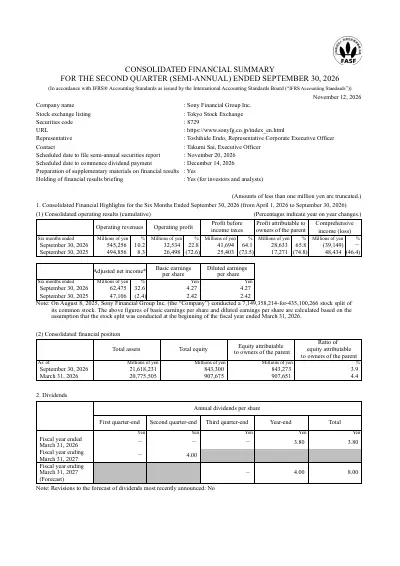
The group consolidated adjusted net income for the 6 months ended September 30 was ¥62.4 billion, an increase of 33% compared to the same period of the previous fiscal year. In the Life Insurance business, adjusted net income increased 28% year-on-year to ¥48.3 billion, mainly due to a decrease in repo cost and an increase in CSM amortization.
In the Non-Life Insurance business, adjusted net income increased 31% to ¥6.0 billion, mainly due to improved operating expense efficiency and increased revenue. In the Banking business, adjusted net income increased 43% to ¥8.3 billion, mainly due to an increase in net interest income.
The full-year forecast of consolidated adjusted net income for the fiscal year ending March 31, 2027 remains unchanged from the previous forecast of ¥110.0 billion. In the Life Insurance business, we have maintained the full-year forecast while we will continue to closely monitor sales conditions and lapse trend going forward.
In the Non-Life Insurance business, several natural disasters occurred during the 3 months ended September 30, 2026. At this point, however, their impact remains within the range assumed at the beginning of this fiscal year.
In the Banking business, we have incorporated to a certain extent the impact of rising interest rates in Japan and overseas, but have maintained the full-year forecast. I will now move on to an overview of each business segment.
Let me begin with Sony Life. I will discuss our initiatives regarding the misconduct incidents later in the presentation.
As we work to restore the trust of our customers and other stakeholders, we regard improving corporate quality, which forms the foundation of our management, as our highest priority in our business operations. Annualized premiums from new policies for FY 2026 first half decreased 9% year-on-year to ¥76.5 billion.
As in the 3 months ended June 30, sales of a single-premium whole life insurance with a market value adjustment remained strong. However, overall sales were sluggish mainly due to lower sales of variable individual annuity insurance, SOVANI.
In the Life Planner channel, developments related to the misconduct incidents and a series of media reports have had a certain impact on sales activities, particularly among new individual and corporate customers since September. In the agency channel as well, new business acquisition has been somewhat weak, partly due to intensifying competition with products offered by other insurers.
We will work to steadily restore sales momentum by reinforcing our commitment to customer-oriented sales activities and providing high-quality protection tailored to the needs of each customer. Looking at the product mix of new business CSM at the end of FY 2026 second quarter, the proportion attributable to protection-type products with lower capital requirements increased to 51% from 45% in the same period of the previous fiscal year.
CSM amortization for FY 2026 first half increased 7% year-on-year to ¥83.4 billion. The lapse and surrender rate for FY 2026 second quarter was 1.29%, remaining broadly unchanged from FY 2026 first quarter.
For onerous contracts under IFRS accounting that have loss components, the lapse rate also remained broadly at the same level as in FY 2026 first quarter. I will now discuss the progress of Sony Life's customer verification process in relation to the misconduct incidents.
We sincerely apologize to our customers and all other stakeholders for the concern and inconvenience these incidents have caused. We have revised a part of the schedule for the verification process covering approximately 2.8 million customers, which we began at the end of April.
Following our September 11 announcement regarding incidents involving the misappropriation of money in connection with the insurance business by 4 former sales representatives, we decided to add further steps to the customer verification process in order to thoroughly identify any misconducts. Until now, we have conducted verification through methods including email, postal mail, and telephone calls with customers considered to be at relatively higher risks, such as elderly customers contacted through multiple methods.
Under the revised process, customers who have already been contacted by email will additionally receive verification requests by postal mail, and we will also expand the scope of customer contacted by telephone. In this way, we will ask a broader range of customer to complete verification multiple times.
As a result, the expected completion of the verification process for all customers will be later than the end of November, which we had initially anticipated. Nevertheless, in order to eradicate misconduct and restore the trust of our customers, we will continue to conduct our investigation thoroughly and carefully.
Next, I will explain the suspension of sales activities by certain sales representatives. For certain sales representatives about whom we received reports from customers concerning financial matters during the customer verification process, we have decided to suspend their sales activities while we investigate the relevant facts.
As these suspensions are particularly precautionary measures taken at this stage until the relevant facts can be confirmed, we will refrain from disclosing the number of sales representatives concerned. We plan to provide an update on the progress of these investigations in mid-December.
As before, however, if any material incident is identified, we will disclose it promptly. As announced on October 28th and November 9th, certain systems at Sony Life were subject to unauthorized access by a third party, resulting in the leakage of certain customer personal information.
In order to protect customer information and prevent further damage, Sony Life has currently suspended certain services. We also sincerely apologize to our customers and all other stakeholders for the concern and inconvenience this incident has caused.
We are giving the highest priority to conducting investigations, including with external experts, and responding to our customers. At the same time, we will work to further strengthen our information security management as we seek to resume the suspended services.
Next, let me turn to Sony Assurance. Direct premiums written for fiscal year '26 first half increased 14% year-on-year to ¥110.1 billion, while the combined ratio remained broadly flat at 92.1%.
The loss ratio for auto insurance increased year-on-year, reflecting higher average claim costs, as well as the impact of natural disasters, including the heavy rainfall in Chiba in August. Against the backdrop of these higher average claim costs, we implemented our largest-ever premium rate increase in July.
Both the new policy conversion rate and retention rate for existing policies, however, they remained at high levels, broadly in line with our expectations. Direct premiums written have continued to increase, driven by higher average premiums resulting from our premium rate revisions and growth in the number of policies.
At the same time, disciplined expense management has enabled us to achieve continued profit growth. In October, we began offering long-term automobile insurance, becoming the only direct insurer in Japan to offer such a product.
Approximately 40% of customers in Japan's non-fleet automobile insurance market choose long-term policies. By adding this new option to our cost-competitive direct insurance offerings, we aim to develop a market segment that we have previously been unable to reach and further expand our customer base.
Regarding fire insurance available exclusively online, business also continues to grow strongly, with direct premiums written increasing 37% year-on-year. This growth has also been supported by an increase in customers switching to Sony Assurance as policies written since 2015, when the maximum policy term was shortened to 10 years, reach maturity.
In this way, Sony Assurance continues to achieve growth in both top-line revenue and profit while maintaining high levels of customer satisfaction and its leading share of the direct insurance market. To give you a deeper understanding of Sony Assurance's strength and growth strategy, we plan to hold our first analyst small meeting dedicated exclusively to the Non-Life Insurance business in early December.
Next, let me turn to Sony Bank. The yen deposit balance at the end of fiscal year '26 second quarter was ¥4 trillion, a slight increase from the end of the previous fiscal year.
As for foreign currency deposits, partly reflecting the appreciation of the yen during the quarter, the number of foreign currency deposit accounts increased by 24,000 from the end of the previous fiscal year to 420,000, while the balance of foreign currency deposits increased by ¥100 billion to ¥876 billion. Both reached record highs on the quarter-end basis.
The average deposit balance per foreign currency deposit holder, including yen deposits, remained high at ¥5.74 million. New account opening and fund inflows are also increasing steadily.
Backed by high-quality and stable customer base, foreign currency deposits, which offer higher profitability than yen deposits, are driving the steady expansion of our foreign currency-centered ecosystem. As part of our group-wide collaboration initiatives, in late October, we launched a service enabling insurance premium payment for Sony Life using Sony Bank WALLET.
Group consolidated ESR at the end of fiscal year Q2 was 176%, remaining within our target range. During the quarter, further increasing interest rates placed downward pressure on ESR.
However, following Sony Life's first-ever issuance of $700 million subordinated bonds, as well as the implementation of financial measures, including the use of derivatives and bond sales, group consolidated ESR increased by 3 percentage points from the end of June. Let me conclude by summarizing our key priorities.
At Sony Life, we will reaffirm our commitment to putting customers at the heart of everything we do. Through our ongoing customer verification process and initiative to prevent recurrence, we will place even greater emphasis on the quality of every aspect of our operations and services.
Restoring the trust from our customer is our highest priority. With this in mind, we will formulate our next mid-range plan with concrete initiatives aimed at making Sony Life a life insurer that delivers even higher level of quality and earn greater trust from its customers.
As for Sony Assurance and Sony Bank, we believe both companies can continue to deliver steady profit growth by further enhancing their respective unique strengths. That concludes my presentation.
Kuriyama
With this, we are going to close our presentation. Now moving on to question and answer.
First, we would like to take question from Muraki-san from SMBC Nikko Securities.
Muraki
I'm Muraki of SMBC Nikko Securities. The decline of new business on page 18, can you talk about the reasons and outlook?
You said that the impact will be from September onward compared to July and August. How much the new business declined in September and the reasons?
Life Planners are spending a lot of time in the investigation and had less time to do new business development. That is how you explained in the previous quarter.
Is that the only reason? Or is there any reputational issues or competitive environment that have impacted to the new business?
Hayakawa
Thank you for the question. I would like to address your question and if necessary, Yamashita will add.
The decline of the new business volume, let me explain channel by channel. As explained in the presentation, like first quarter, one is new product with MVA.
The existing customers sales were the focus areas, and SOVANI was also sold. There has been a weakening on the focus on the SOVANI and also selling protection-type at the same time, so that has been continuing from the first quarter.
As Muraki-san has just mentioned, in the sales channel, currently because of the misconduct incident, because of our announcement and also media report, the sales activities to new customers are declining, and from September onward, in terms of the trend, it has become visible. The existing customers, the explanation and responding to existing customers, that is where the time is spent.
Given the media report, it is difficult to raise the momentum to approach new customers. Another point for corporate channel, in response to the media report, a new consignment-based contract has slowed more than our initial expectation, that is another impact.
For agency channel, the individuals, the SOVANI area is declining. Another point, as Muraki-san said, the competitor's environment, competing products.
In our case, we had a product strength and that contributed to gaining share, but other companies are catching up, similar products have been launched and the competition has become more fierce, that is emerging in the agency channel. The outlook going forward, the sales platform is not really deteriorating structurally, but the level of activity, especially towards new customers, is declining.
We are going to take measures internally as much as possible. On the other hand, as was mentioned in the presentation, customer information leakage is partially happening.
The customer response to that, especially the customer service system, is currently suspended in order to check the safety. Sales are spending more time in responding to the existing customers because of that.
Of course, customer's response is the top priority, so that is the impact, and we also need to assess the degree of impact going forward. That is why we are looking at carefully the sales status.
Yamashita
This is Yamashita. In this quarter, in particular in September, that was the question.
We do not present the monthly figure, but in July and in August, the trend was closer to the trend in the first quarter, but compared to that, in September, the level clearly dropped one level. I'm sorry I cannot share with you the quantitative response, but that is the situation.
Muraki
Understood clearly. Thank you very much.
Kuriyama
Moving on to the next question. Next question is from JPMorgan Securities, Ms.
Sato, please.
Sato
This is Sato from JPMorgan. I have one question.
For this fiscal year, you haven't revised the forecast, but compared versus your explanation 3 months before, the possibility of the achieving the guidance, if there's any change to your perspective? From the policy, there's an increase of the surrender 3 months before, for the Insurance Business segment, there is a downside risk and that will be compensated by the Non-Life Insurance and the Banking business.
The onerous contract, based on the increase of the surrender of the onerous contract compared versus 3 months before, how did that change? The subordinated bond, the interest rate is going to be there for 6 months.
I'm not sure how much cost you're going to incur, but like we have confirmed for the flag, the security incident response is pushing the cost generation. That's a possibility.
The topic based on the topic you have in the past 3 months, if there's any change to the possibility of achieving the guidance, please summarize that.
Hayakawa
Thank you very much for your question, Sato-san. On the subordinated bond part, I'm going to let Tsai-san to explain about that.
To explain the first high-level situation, as you pointed out, we haven't revised the guidance, and not even revised the guidance for the respective business. Based on the first-quarter results coming out and the initial guidances, compared versus that, the Life Insurance business, we're sticking with the guidance, but on the annualized level, there is some downward pressure.
The loss element is one thing, and the expectation of the surrender. Based on the initial guidance, especially for the onerous contract, the surrender ratio of that compared versus last year or from the initial guidance, it's been gradually increasing.
On that point, we need to continue to focus. On the other hand, for the life insurance, the annual guidance, until the second quarter, that there's assumption of the surrender and based on that, the fiscal year-end, the review of that premium, based on that, we do factor in to a certain extent.
It's a repeat, as I explained in the presentation, for the surrender situation and the sales situation, we would like to continue to monitor. For the Non-Life Insurance and the Banking businesses, in the speech, I have shared some color sentiment, but the interest rate hike is basically positive for this business, we do factor in that to a certain extent.
On the other hand, in a short-term duration, so as we do invest our asset, there are some unrealized loss because of the interest rate hike, replacement of the bond, refinances, including that, we are maintaining the original expectation, but we can expect some upside, that's my personal view. For the Non-Life Insurance business, as I explained in the presentation, so-called the momentum of the business hasn't really been changed, there's a steady progress.
In the second quarter, including the torrential rain in Chiba Prefecture, there are multiple natural disaster happening, there is a loss being generated. As I mentioned, we do factor those in to the initial guidance, but if natural disaster do not happen, then it can be the upside.
The risk is surfacing partially. For Non-Life Insurance business, compared versus the initial or the first quarter ending time, there are some natural disaster impact that can push down the upside slightly, but the possibility of the upside, well, we consider there is an impact of the natural disaster, that's the overall situation.
For the subordinated bond, Tsai-san is going to explain, and for the security cost, we are causing concern and problem coming from the cyber attack, and right now we are responding to customer and prioritizing to recover the system, but the impact of that, going forward, we need to examine and we need to factor that in whenever needed. We need to continue to monitor closely.
For the subordinated bond, Tsai-san, please.
Tsai
This is Tsai speaking. The issue of the subordinated bond was done in the mid of September.
Based on the environment there, there is a long-term interest rate volatility in US slightly. The cost is a little bit higher, but we made sure that the value is fixed, we issued in September.
Interest rate has been factored into the guidance originally, there are slight increase, but the impact is not so significant in a negative manner. The raised fund is to be used for the repurchase cost.
We're able to recover based on other means of investment, there shouldn't be any major impact. There are some issue-related expense, but based on IFRS, we can defer in the 10 years.
Anyway, there is no major impact, that's it.
Sato
In that case, compared versus 3 months before, for Non-Life Insurance business, you had the upside expectation, but that has been shrinking. Life Insurance downside risk, how much you can compensate?
From that perspective, there is a higher cautious tone, right?
Hayakawa
Thank you for that. Me personally speaking, yes, you're right.
It's a repeat, but this time for us to come up with the guidance outlook, we do factor in the ongoing situation to a certain extent.
Sato
Understood. Thank you very much.
Kuriyama
Moving on to the next question. Daiwa Securities, Watanabe-san, please.
Watanabe
This is Watanabe of Daiwa Securities. Loss component and reinsurance are my questions.
The level of the surrender of onerous contract, you said that the second quarter was the same as the first quarter. There's additional 6.1 billion as the recovery from the reinsurance.
My question is, is there any increase of impact due to hedging and any other scheme that you can explain?
Yamashita
This is Yamashita. Thank you for the question.
Firstly, one factor is the new MVA product that we're selling right now. On this product, we utilize reinsurance in the product.
As a result of that, for reinsurance, this is more of an accounting-based technical matter versus the overall performance of the product, and there's a P&L for the reinsurance and also P&L for the insurance company underwriter, and we are splitting into the two. The loss component balance for the insurance company is rising.
On the other hand, the reinsurance gain is also rising on net base is shown under lapse and surrender, loss component for the onerous contract. Accounting-wise, it's split in two, it's a technical reason.
Right now, the sales of this product is growing, and if you split, then the changes will be more visible. For this product, we will utilize reinsurance to control the P&L.
I hope you understand in that way.
Watanabe
The gain in the reinsurance will be net out to the loss component of this product. Am I right?
Yamashita
Yes, that is correct. Thank you.
Kuriyama
Thank you very much. Moving on to next question from BofA Securities, Tsujino-san, please.
Tsujino
Tsujino speaking. Thank you very much.
Earlier for this year's guidances for life insurance, you should be able to achieve the guidance, that's what you said. Based on second quarter, the generated claim amount was lower than expectation.
The insurance service cost others, it's a positive contribution to profit, compared versus normal quarter, it looks a little bit inflated. Considering the loss status so far, these positive element can be carried forward?
Because there's going to be negative impact in third and fourth quarter, that is not your assumption, right? If that's the case, then for next year, it's going to cause a profit to go down.
From that perspective, the positive element until the second quarter might go away in next year, we need to be cautious about that?
Hayakawa
Thank you very much, Tsujino-san. For the payment in the second quarter, there is a more increase in than we have expected for this fiscal year, this is not really one-off element, but it's pushing up.
Your question is about the impact for the next fiscal year. What we can say is for this fiscal year, compared versus last year, the repurchase cost is expected to go down, there is a ¥5 billion impact per annum expected.
Repurchase cost in dollar is expected to be stable in the future, that's how we view right now. The positive impact this year is going to go away next year.
On the other hand, so as I mentioned in the presentation, CSM structure, I explained. CSM amortization, sales is a bit weak right now, but centering the enterprise, CSM portfolio is changing, CSM amortization is increasing, that's the trend we are seeing.
On that, it's going to be positive for next fiscal year. Also, from second half this year, the sales and the surrender situation, we need to carefully monitor and come up with guidance next fiscal year.
The repurchase cost going out next year, including that, we need to carefully examine and come up with next year guidance. That's it.
Tsujino
CSM amortization, the risk-adjusted release is going to be linked to a certain extent. In third quarter, that we expect CSM to go down.
The amortization period is going to be a bit shorter in second quarter. Of course, after reflecting those elements, your point is, at high level in the next 2 to 3 years, CSM release gain, including risk, is going to improve, but next year, you might suffer, I guess.
Do you agree or disagree?
Hayakawa
Yes, you make a point to a certain extent. As we explained in the previous presentations, for the loss element, there are some onerous contract being generated.
Less loss component generated, it's going to continue next year. Of course, it really depends on the interest rate increase pace, but as you pointed out, for next fiscal year, the lingering impact, so, for example, the asset management, even though we have a less balance now, but we are able to proceed.
It takes time, but we want to achieve incremental profit generated.
Tsujino
Thank you very much.
Kuriyama
Moving on to the next person, Mizuho Securities, Sakamaki-san, please go ahead with your questions.
Sakamaki
This is Sakamaki of Mizuho Securities. I would like to ask a question.
The sales rep, the recruiting and turnover. When we look at the Life Planner number, there's a decline by 3 from first quarter, and on the other hand, the agency's supporters head count is increasing.
Can you talk about the new recruitment and the turnover for each of the recruitment channel?
Hayakawa
Let me explain, and if needed, Yamashita will add. In terms of the recruiting, the track record as of the end of September is to a certain extent within our expectation.
In terms of the hiring activities, we take time in choosing the candidates, but the initial-stage selection activity volume is declining. For future Life Planner recruitment, we do expect some impact.
The leavers, the turnover, including supporter and Life Planners, as of now, we do not recognize a significant increase of leavers. Anything to add, Yamashita-san?
Yamashita
Thank you very much. The headcount declined slightly from the first quarter, but it is currently trending in line with the initial plan.
For the recruitment in the second half, there will likely be some impact. We take some time in our recruiting activities, and there are some areas that's visible.
We need to be conscious of the quality when we hire, and given the company's situation, the candidates who has the desire to challenge at our company, we are carefully communicating with them in proceeding. Thank you very much.
Kuriyama
Moving on to the next question from Nomura Securities, Sasaki-san, go ahead.
Sasaki
Nomura Securities, Sasaki speaking. Thank you very much.
Page 9 of the presentation material, the third from top, the bullet point, there's a mention that there's a request for that monetary payment. Does that mean that the misconduct that had happened before, the similar case has been confirmed?
I hope to better understand what you're talking about that. The sales activity to be suspended by some number of the employees, but well, there are some media report on that, but you're not disclosing how many people have been subject for that treatment.
On the second point The first point, so as a preventive manner, we are suspending the activities right now, and depending on the situation, the number can increase and decrease, of course. On the number of employees, we are not now disclosing.
That's a latter part of the question. For the first part of the question, Yamashita-san will respond.
Yamashita
Right, not limited to the exchange of the money, not only giving out or the loan or the referral about the investment, there are certain offer about monetary exchanges.
Sasaki
Those offer meaning that the customer have talked about that? Am I right to understand that?
If there's any exchange of money confirmed, which is the case?
Yamashita
This is a alleged case, this is something we have heard.
Sasaki
Understood. Another point about the sales activity.
In September, the sales activity volume has declined. Based on the surrender ratio, there is not particularly change happening, but your Life Planner finds difficulty visiting customer.
Is it coming from your own customer unique reason that the activity level has been declined? Or if there's any situation about the customer involved?
Hayakawa
Let me answer your question. Far, the activity volume of Life Planner is substantial, that's how we view at this point in time.
If customer depart from us, then it's going to be reflected to the surrender ratio, and we are closely monitoring on that, but we are actually not confirming any change based on the figure we are confirming. In the future, how is it going to be expressed?
We are closely monitoring not only the surrender ratio, but we're trying to check how that situation is reflected to what kind of a figure.
Sasaki
Thank you very much.
Kuriyama
Any other questions? We are accepting questions.
Please press raise hand button if you have a question. We still have some time, but since there are no additional questions, we would now like to close the Q&A session.
Thank you very much for attending the briefing session. Thank you very much.