Barrick Mining Corporation
Q3 FY2026 · Earnings Call TranscriptNovember 9, 2026
Operator
Welcome to the Barrick third quarter 2026 results. After today's prepared remarks, we will host a question-and-answer session.
If you would like to ask a question, please press star one to raise your hand. To withdraw your question, press star one again.
I will now hand the conference over to Emily Chieng, Senior Vice President, Investor Relations. Please go ahead.
Emily Chieng
Thank you, and good morning, everyone. We hope you've had an opportunity to review the press release we issued before market open this morning.
This presentation deck is also now available to download on our website. Presenting our results today are Mark Hill, Barrick's President and CEO; Seb Bock, CEO of Barrick International, which we previously referred to as Barrick Rest of World; and Helen Cai, Senior EVP and CFO.
Other members of Barrick's management team will be available after our prepared remarks for Q&A. Before we begin, please note that we will be making forward-looking statements.
This slide includes a summary of the significant risks and factors that could affect Barrick's future performance and our ability to deliver on those forward-looking statements. This material is also available on our website.
I will now hand it over to Mark.
Mark Hill
Thanks, Emily. We had our fourth quarter in a row with improved safety and excellent operating and financial results.
Once again, we delivered against all four of our priorities. We continue to focus on safety, which remains our number one priority.
We delivered higher gold production than last quarter and continue to manage our costs. That allowed us to capture the benefits of higher metal prices and deliver strong financial results.
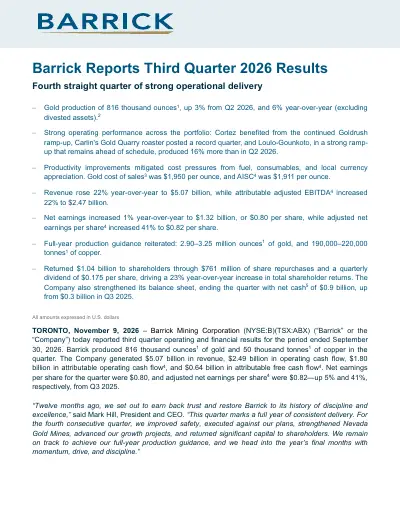
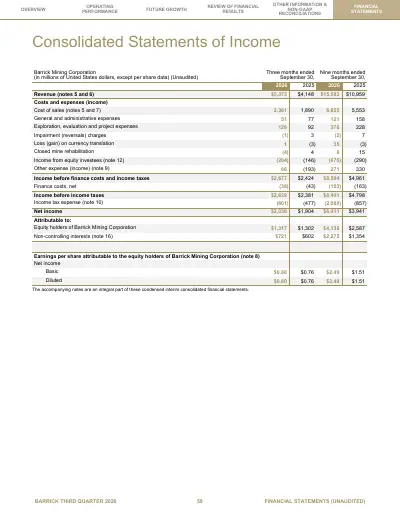
We had adjusted net earnings of 82 cents per share and consolidated adjusted EBITDA of $3.5 billion and consolidated free cash flow of $1.2 billion. As we announced last quarter, we have restructured the management of the Fourmile project into NGM, which has already produced significant synergies.
On the growth projects, we continue to advance the PV resettlement and tailings expansion, and Lumwana continues to be on track and on budget. Finally, we expect to complete the IPO of our North American gold assets by the end of this year or early next year, subject to market conditions and regulatory review.
As I said, safety is our number one priority. Our goal is for everyone to go home safe and healthy every day.
In Q3, our leaders continue to get out in the field to identify and manage risks. We conducted over 24,000 critical control verifications.
Our recordable injury rate decreased quarter-on-quarter from 0.77 to 0.71. We're also working hard to reduce high-potential incidents.
Turning to our Q3 highlights, we delivered 816,000 ounces of gold. As we flagged last quarter, gold production was higher in Q3.
The strong ramp-up of Goldrush Underground and Loulo-Gounkoto more than offset the weather disruptions at Veladero and Porgera. Third quarter copper production was 50,000 tonnes, which Seb will provide more details on shortly.
We continue to manage our gold costs. While we are seeing pressures in Africa from fuel, other consumable costs, and foreign exchange, we expect to remain within our full year guidance range.
Our adjusted net earnings of 82 cents per share is up 41% year-over-year. Our attributable adjusted EBITDA is up over 20%.
Our year-to-date capital returns of $3.2 billion are double last year's. We're also on track to deliver full year production guidance, and we expect to further extend our track record of strong operational execution.
In North America, we had another increase in production this quarter with almost half a million ounces of gold, with NGM and PV generating 67% and 72% EBITDA margins, respectively. We saw record throughput at the Goldstrike roaster.
We progressed the ramp-up of Goldrush Underground and mined record tonnes from Turquoise Ridge Underground. Gold production from PV was softer in the third quarter due to planned autoclave maintenance.
Also in North America, we continue to evaluate a number of growth opportunities. At NGM, we're assessing options to optimize infrastructure, including new processing capacity at Cortez and rail infrastructure, which could drive a step change in production over the next decade.
At Cortez, we're advancing drilling along one of the most prospective corridors in Nevada down the Goldrush trend. At Carlin, we turned our focus to drilling out Greater Leeville.
We're also looking at optimizing processing capacity, which could extend open pit life well beyond 2050. Turning to Pueblo Viejo, where the resettlement and advancement of the TSF construction continues on schedule, we have 99% of the resettlement packages accepted and have resettled more than 97% of the families.
We continue to advance the engineering work for the addition of a third flotation train, which will deliver improvements to recovery beyond 2030. We expect to share more information regarding that work in PV with our upcoming IPO filings.
With that, I'll turn over to Seb to discuss the performance of Barrick International. Thanks, Seb.
Seb Bock
Thank you, Mark. Good morning, everyone.
Barrick International produced 319,000 ounces in the third quarter, up 6% on Q2, with strong performance at Loulo-Gounkoto, Kibali, and Bulyanhulu more than offsetting weather disruptions at Veladero and Porgera. The increase came from two places: Loulo-Gounkoto continued to perform well, up 16% on higher throughput and grade, with mining and processing consistently running ahead of the original restart plan; and Kibali, up 20%, delivered its highest quarterly production since Q4 2023, as the underground brought more ore at higher grades.
Moving to Tanzania, Bulyanhulu stepped up again as the upper west development resulted in greater mining flexibility. North Mara was up on the quarter despite an extended plant shutdown and some power instability.
Veladero and Porgera were affected by El Niño weather events. Severe winter storms suspended operations at Veladero on several occasions, while drought-related water shortages at Porgera limited plant operating rates.
We've seen these conditions continue into early Q4. We manage Barrick International as a portfolio, and the performance across the rest of the operations keep us on track for our full year gold production guidance.
On costs, higher volumes at Kibali and Bulyanhulu brought unit costs down. Veladero, Porgera, and North Mara went the other way, with impacts from the storms adding to Veladero's costs.
Royalties and fuel remain the main pressures year to date. Despite that, Barrick International generated over $800 million of attributable adjusted EBITDA from the gold operations in the quarter, with an adjusted EBITDA margin of 59%.
Moving to copper, production remains on track for full year guidance. We produced 50,000 tonnes in the quarter, with Lumwana completing a planned mill reline in late September, which sets us up for a clean run through the fourth quarter.
Our other copper operations were flat on a combined basis, with higher grades and recoveries at Jabal Sayid offsetting lower throughput and grades at Zaldívar. Costs were higher in the quarter, driven mainly by diesel prices, local currency appreciation, higher royalties on the stronger copper price, and some additional waste stripping on top.
For the full year, we expect our copper costs to be around the top end of the range, given the same diesel and currency pressures. The Lumwana Super Pit expansion will take production to 240,000 tonnes a year with a mine life of more than 30 years, and it remains on track for first copper from the expansion at the end of Q1 2028.
Since the start of the project, we've spent $795 million on the expansion, and total expected project capital remains on target at $2 billion. Procurement of all major long-lead equipment is complete.
The mill building, which sits on our critical path, is scheduled for completion in Q4. To close, quarter three shows the portfolio delivering where we control the variables and doing what we can to mitigate the external pressures on costs.
We remain on track to deliver full year production in line with guidance for both gold and copper. With that, I'll hand over to Helen.
Helen Cai
Thank you, Seb, and good morning, everyone. We produced a strong set of financial results this quarter with solid operational execution, allowing us to capture more of the favorable gold and copper prices.
This more than offset the increasing cost pressures we face. Compared to last year's Q3 results, we delivered a substantial increase in earnings, highlighting our leverage to rising prices and robust operating cash flow.
Adjusted net earnings rose 37% year-on-year, and attributable adjusted EBITDA increased 22%. Operating cash flow was in line with last year, and we stepped up investment in our growth options across the portfolio.
This includes executing on the Lumwana expansion project, increasing stripping at Loulo, and developing NGM optionality. Free cash flow was strong at $1.2 billion, with $154 million of additional growth-related capex compared to this time last year.
We closed Q3 with $0.9 billion of net cash on the balance sheet, up $586 million over prior year, despite higher return to shareholders, still leaving us some flexibility to invest in our future growth opportunities. A disciplined approach to capital allocation is a top priority, particularly when the business is generating significant cash.
We have a clear framework for deploying capital. Our first priority is balance sheet strength.
With $0.9 billion of net cash and an undrawn $3 billion revolving credit facility and no meaningful debt due until 2033, we are in a strong position. Our second priority is sustaining the business and earnings-accretive growth.
Lumwana and NGM optimization are two clear examples where we are deploying capital into low-risk, brownfield opportunities that we believe will generate superior returns. Our third priority is returning cash to shareholders.
Our new dividend policy, implemented earlier this year, prioritizes a quarterly base dividend of 17.5 cents per quarter, topped up at year-end to target a total payout of 50% of attributable free cash flow. This quarter, we completed $0.8 billion of share buybacks, and we continue to return excess cash to shareholders.
Since 2021, Barrick has returned $10.4 billion to shareholders, and this year we are set to deliver record annual returns, with $3.2 billion returned so far. With that, I will turn the call back over to Mark.
Mark Hill
Okay. Thank you, Helen.
For 2026, production and cost guidance remain unchanged. As we round out the year, we expect the fourth quarter gold production to be slightly higher than Q3.
We expect copper production to also increase as we process material stockpiled during the quarter at Lumwana. We also expect to remain within our full year guidance for costs.
In conclusion, for the fourth quarter in a row, we have improved our safety, although we acknowledge there's more work to do; we delivered on our production and cost; we advanced our growth projects on time and on budget; and we advanced our North American IPO. With that, I will hand it back to the moderator for Q&A.
Thank you.
Operator
We will now begin the question-and-answer session. Please limit yourself to one question and one follow-up.
If you would like to ask a question, please press star one to raise your hand. To withdraw your question, press star one again.
We ask that you pick up your handset when asking a question to allow for optimum sound quality. If you are muted locally, please remember to unmute your device.
Please stand by while we compile the Q&A roster. Your first question comes from the line of Daniel Major with UBS.
Please go ahead. Your line is now open.
Daniel Major
Hi Mark, Seb. Thanks very much for the questions.
The first operational question, it looks with higher fourth quarter production expected, you're going to be upper end of the guidance range. Can you give us any kind of indications around whether we should extrapolate that into 2027 in terms of how the mine plans are shaping up relative to your previous guidance?
Mark Hill
Okay. Thanks, Daniel.
Look, we'll be around the midpoint or slightly above for guidance for this year. We'll come back to you as we do next year with our guidance for 2027, but you shouldn't be extrapolating that going forward.
Daniel Major
Thanks. Then, yeah, maybe the second question, just how you're thinking about capex into next year and the projects.
At Pueblo Viejo, the recoveries continue to lag, and I think there's some kind of processing projects there that could be enacted to improve recoveries. Similar, now you've fully consolidated Fourmile, is there significant scope to accelerate capex in elements of NGM?
I just wonder if you could kind of give us a directional first look on how you're thinking about that capex and the projects you're focusing on into next year. Look,
Mark Hill
Daniel, let me just give a high level, and I'm going to hand it over to Seb, and then Wessel can give you a bit more information. Certainly at PV, we are looking at what we can do with a third flotation train, but it's still at the engineering stage.
That will require some capital. Obviously our other projects are still, as we've said, on schedule and on budget, and that will continue next year as well.
Maybe, Seb, you could go first and just talk about capital in Rest of the World for this year and next year.
Seb Bock
I think that the biggest capital driver for Barrick International for next year still remains Lumwana. Slight step-up probably from this year, but very much the same kind of run rate, because we expect to start commissioning earlier in Q1 2028.
Then the only other point I would make is we will be doing some studies next year. Kibali, we will start with the arc study, so that will require some capital, but I think not very different to what you've been seeing.
Mark Hill
Wessel, do you want to comment on North America at all?
Wessel Hamman
Thanks, Mark, and thanks, Dan. I would add, in addition to, I suppose, the projects that we've already outlined, Dan, and that you are quite familiar with, yes, we are looking at expansion in NGM, but that's not items that we expect to lift the capital profile within 2027 specifically.
Really, when you look at the projects that we've already disclosed and that we've guided to, it's really those, in addition to our sustaining capital, that should shape your expectation for next year specifically.
Daniel Major
Thanks. Maybe just on the whole subject of Reko Diq, can you remind us on the kind of care and maintenance carry costs, your share, and directionally how you're thinking about that rate of spend into next year?
Seb Bock
Look, as we've said, you've seen we've adjusted our guidance down, we've actually reduced the spend this year at Reko Diq. We're still active.
That project still being actively managed. We, as we've said before, we're doing a full review of where we think we should be going with the project, and so that's a multiple workstreams we're looking at.
We expect to be able to give the market some feedback by the middle of next year. The only thing I would say, the run rate for next year will remain kind of where we are now as we close out on current commitments and all the social investment that we've been doing.
Outside of that, really, as I've said before, by the middle of next year, we'll be able to give you a much clearer picture around that project and how we see that going forward.
Daniel Major
Okay. Thanks very much, and congrats on a good set of numbers.
Mark Hill
Thanks, Daniel.
Operator
Your next question comes from the line of Richard Garchitorena with Barclays. Please go ahead.
Your line is now open.
Richard Garchitorena
Great. Thanks, and congrats on the quarter.
First question, just touching on the production guidance, just wondering, you mentioned Veladero and Porgera issues in the third quarter continuing into the fourth. Is it fair to say on the international side that we should expect better than expected, I guess, on the African operations, and then South America still under pressure, and then on North America, how should we think about the strong production in the third quarter that continues into the fourth?
Seb Bock
I'll start. This is of course the first quarter we running these assets as one business unit, but as to the point I've made earlier and what you've just pointed to is that we'll manage the guidance within the portfolio.
We've had, as I've pointed out, some significant challenges at Veladero. We've had 17 days of downtime in this quarter, but we're very comfortable that within the wider portfolio, we'll still manage and we'll come in at guidance.
Mark Hill
Richard, just on North America, look, what we have tried to do this year is rather than have this typical production profile where we start off low in Q1 and then we sort of do the ski ramp all the way up to Q4. Whilst North America will have a strong Q4, it's not what we have typically done in the past.
We've still got our planned maintenance. We've still elevated our inventory levels so that we can get a more steady state and come into Q1, what I would call normal quarter-to-quarter.
It will be a strong quarter, but we have definitely changed our approach and are trying to level out these ups and downs and not just finish on a high and then come in on Q1 much lower.
Richard Garchitorena
Great, thanks for that. Then as a follow-up, maybe if you can just give us an update in terms of the IPO, North America Barrick, what are the next milestones we should look for and any color you can give there?
Thank you.
Mark Hill
On the IPO, we'll file, as we said, we're going to file the S-1 this month, and we're also going to attach those technical reports to that. Then, and George jump in if I misquote this, then the SEC will give us their feedback, and depending on how long that takes, we are still trying to get this done this year, but it may slide into January.
I don't know, George, is there anything else?
George Joannou
Okay.
Richard Garchitorena
Great, thank you.
Mark Hill
Thanks, Richard.
Operator
Your next question comes from the line of Anita Soni with CIBC World Markets. Please go ahead.
Your line is now open.
Anita Soni
Hi, good morning, guys. Thanks for taking my questions.
I wanted to focus on PV. I just wanted to understand recovery rates.
I think I just wanted to understand the recovery rate profile as it goes forward now. Is the technical report that was put out in February of this year, I guess February 27th, I'm just looking at it right now, is that still valid for a timeline on the recovery rate improvements?
Is that what we should be using, or is there some modification to the timeline?
Mark Hill
Thanks, Anita. Tim, can I hand that over to you?
Can you comment on that flotation?
Tim Cribb
Sure. Thanks, Mark.
Hi, Anita. Look, I think on PV, we will be updating it, as Mark said, when we put out the SK-1300 reports later this month with the filing.
I think the important thing here is we work towards the engineering of that third train, which we agree will bring benefit and allow us to lift the recovery and deliver the throughput that we've said. We are working at that, as well as some additional cells, stack cells or concord cells, to improve the mix of feed that goes to the autoclave.
They're really the key drivers to lift that recovery in the long term. The timing for that remains consistent with what was put in the technical report.
There will be some changes throughout the feed profile between now and then, and that's really driven by a lot of the test work which the team has been focused on this quarter. We've been doing a lot of trials around how we run the flotation circuit and as well as on the use of reagents.
I think that trial work is definitely something you see in terms of the recovery that you see in conjunction with the maintenance which Mark mentioned. I think we're working well towards that, and certainly all the work that we've done to date supports the benefit of putting this third train in, and the fact that that will deliver that recovery step change once it's implemented.
Anita Soni
Okay. Can you give us some goal posts on what we should be using sort of for that longer-term number once this third train is in terms of recovery rate, and what we should use in the interim until that third train comes in?
Tim Cribb
Yeah. Look, I think longer term it remains similar to that low to mid-80%, so that's the good guide to use longer term as we get up.
What I would suggest is that we'll be putting this report out in the near term, and it would make sense to wait and use the numbers from that. You're seeing some ups and downs between now and that mid to low 80%, and that's primarily a function of the feed material and the blend that we run, which we've also done some work on.
I think it's best to wait and use the updated numbers that will come out in that SK-1300.
Anita Soni
That's it for my questions. Thanks.
Mark Hill
Thanks, Anita.
Operator
Your next question comes from the line of Matthew Murphy with BMO Capital Markets. Please go ahead.
Your line is open.
Matthew Murphy
Hi. Maybe one on this S-1.
The technical reports coming out with that will have updated reserves, resources, projections. Is there anything in there about what Nevada looks like with additional roasting or autoclave capacity and anything on Fourmile in there?
Oh,
Mark Hill
look, Matthew, the reports are imminent, you'll see what's in them. Obviously, they won't update the reserves and resources, that'll be done at the end of the year as the usual timeline.
It will give you a better guide as to what's going to happen at NGM and PV, but I don't really want to comment until we finalize them, and like I said, they'll be out this month anyway.
Matthew Murphy
Okay. Then just one on capital returns.
You've paid out a little more than your attributable free cash flow this quarter, and you've got this Newmont cash incoming. How do you feel about the current pace?
Have any of your capital returns so far this year been in anticipation of that $1.5 billion, or could we see a bigger capital return in Q4?
Mark Hill
Helen, you want to comment?
Helen Cai
Hi, Matthew. As stated in our prepared remarks, we do have a holistic framework for our capital return, and that includes rewarding our shareholders, but also maintaining a healthy balance sheet and driving our growth.
We take all of that into consideration, and yes, we will consider the additional capex coming in, but as of now, our execution is based on our current plan and the current capex outlook. We also take into consideration quarter-over-quarter change of capex and the volume change in the average of 3Q versus 2Q.
Again, if you talk about the future incoming proceeds, that is not our exercise in the past two quarters when we do buyback.
Matthew Murphy
Got it. Thanks, Helen.
Helen Cai
Thank you.
Mark Hill
Thanks, Matthew.
Operator
Your next question comes from the line of Tanya Jakusconek with Scotiabank. Please go ahead.
Tanya Jakusconek
Oh, great. Thank you for taking my questions.
Just a follow-up not so much on the buyback, but your free cash flow, your payout when you report in February. Should we consider that that whole amount could be added to that payout?
The Newmont payment.
Helen Cai
Thank you for the question. Basically, our original definition is a top-up dividend based on our 50% attributable free cash flow.
Any additional proceeds coming from Fourmile sales and Fourmile went in and also the IPO will be in addition to any top-up we have, and that's pending our final board decision.
Tanya Jakusconek
The board would have to decide on that. Okay.
Then maybe, Mark, you've done really well on your improving the health and safety and stabilizing Nevada Gold Mines. Maybe just talk a little bit about your turnover.
Has that improved from the 14%, and sort of what productivity gains are you seeing now that you've got the platform stabilized?
Mark Hill
Thanks, Tanya. We have seen an increase in productivity, especially in NGM, and Tim actually had a few slides he was showing me.
Look, Tim, do you want to comment on the productivity and the throughputs and the underground development rates?
Tim Cribb
Thanks, Mark. I think firstly, just on turnover, Tanya, it's relatively flat.
We haven't seen a significant drop, but I would cite the difficulties and the growth that you're seeing in the industry in Nevada, both in terms of gold and other critical minerals. We are seeing a bit of movement of people as these other opportunities start up, but I don't think that it's an alarming trend.
As Mark said, we've been able to deliver on a lot of the productivity. If you look to the roaster, which is really important to us with the proportion of that refractory ore coming through, we've been able to run the roasters at higher throughputs this year.
I think some of the changes that were made in people earlier in the year and the leadership they've provided really helped. The same thing at Turquoise Ridge, that underground has really performed, and we've also looked at opening up additional fronts there.
I think that growth opportunity to look at expanding both open pit, but also the underground, we've recommenced operation of the roadheader at Turquoise Ridge. When you combine that all together, it's giving us the opportunity to add flexibility in terms of where we operate and the development meters are up, and the tonnes are up to go with it.
Tanya Jakusconek
Okay. If I could just squeeze one in on just how should I be thinking holistically about your cost structure going into 2027?
Should the exit rate of 2024, barring obviously the fuel price, should I be thinking that 3% to 5% inflation on a Q4 exit would be a reasonable assumption for you? Look,
Mark Hill
Tanya, we're still working through this. Look, I will say that, as you've seen, right, we've controlled costs whilst particularly in North America, costs have been controlled quite well.
The things that are driving Rest of the World are obviously things that are outside of our control, which is fuel price, royalties, and foreign exchange. We're still working through the budgets, and so I haven't got an update for you, but I would say we've got our costs well in hand.
I don't know, Seb, whether you want to add.
Seb Bock
No, I think you've covered it, and I think what you're seeing this year, we controlling the controllables and mitigating as much as we can, but those pressures are there, specifically on the diesel side and some of the foreign exchange challenges we have.
Tanya Jakusconek
Thank you.
Mark Hill
Thanks, Tanya.
Operator
Your next question comes from Bennett Moore with JPMorgan. Please go ahead.
Bennett Moore
Good morning Mark, Seb, Helen. Thank you for taking my questions.
At Fourmile, it looks like this year's construction and decline development budget may have been throttled back a bit, and the PFS target pushed out a year. Wondering if there's any additional color on this front, and to what extent the new JV agreement maybe played a role here, and maybe also to what extent you're kind of realizing synergies so far since that agreement has come to fruition?
Mark Hill
Thanks, Bennett. Look, obviously since we've done that agree with Newmont, we have revisited this whole Fourmile.
We've combined all the teams, and obviously that gives us a lot more flexibility and adds some synergies. Also we can access Fourmile now from NGM properties like Goldrush.
As far as the schedule and going forward, I think, Tim, you're best placed to comment on that.
Tim Cribb
Okay. I think just on the schedule, there's two things driving it.
As Mark said, it's now in the process of being benched in and being treated as part of the NGM complex. That did make some changes to the spend, as we adjusted the permitting that was in process to commence the Bullion Hill decline.
Now we do expect that this quarter, but that did play an impact in the last quarter in terms of the timing there. The other side of it is that we will see some benefit from sharing of resources and bringing them under that NGM front.
We are redoing the engineering and looking at the ways in which we can now access Fourmile from Goldrush and develop that side of the ore body. That work is in process, and it's something that we'll be bringing to this year's life of mine plans.
The other thing I would just say is, again, as we've said previously, if over the course of this month, as we release this S-1 and the filings that come with it, there'll be more information around Fourmile. That's probably the best to look at.
Bennett Moore
Thanks for that, and look forward to the S-1. I guess if I could then turn to the international portfolio, in the MD&A, you highlighted some opportunities within the Andean portfolio, and have also talked about Arka Kibali.
With the Reko Diq project review, just wondering how you kind of might force rank growth opportunities within your international portfolio?
Seb Bock
I think as I pointed out few weeks ago at Denver, we have reviewed this portfolio. We've got a portfolio of long-life, high-quality gold and copper assets, and we have a significant part of that base sits in South America.
The team and I are working to have a relook at that and see how we actually unlock the value from those assets and monetize them in some way or form. Exactly the same with Reko Diq.
We will be doing the review, as I said, and by next year, we will look at what the best path is forward. Of course Africa kind of remains that operating engine.
Lumwana expansion is on track. We'll be doubling that production when we start getting to 2028.
I think that the real change in focus has gone to look to go back and see what is our embedded growth, where does that quality of that portfolio lie, and how do we unlock that?
Bennett Moore
Thank you very much. Best of luck.
Mark Hill
Thanks, Bennett.
Operator
Your next question comes from the line of Lawson Winder with BofA Securities. Please go ahead.
Lawson Winder
Thank you, operator. Hi, Mark.
Good morning to you and the team, and nice quarter. Could I ask about Lumwana?
It would seem to me that the higher guidance on the unit cash costs would be largely a function of Lumwana, given some of the drivers that you cited, the higher currency and then as well as the higher diesel prices, and we saw similar statements from some of your peers in Zambia. Curious, though, on the capex side, there's been no change to the $2 billion target for the Lumwana expansion.
I guess to ask the question, what gave you the confidence to hold that budget? Then, did you see any risk to the capex budget, just given some of the cost inflations you're seeing on the opex side?
Seb Bock
Look, I think a big part of that, those are long-lead items, it's already been locked in. Where you do see the pressure, of course, is diesel and freight charges.
We are managing that. At this point in time, we are comfortable with the $2 billion, and we're managing within that number.
Lawson Winder
That's fantastic news. Thank you, Sebastian.
Then on the exploration commentary that you included in this result, particularly around NGM, it's really intriguing, and I'm hopeful we'll get some more information on this as we go forward, and possibly with the S-1 filing. North Crow, Pathfinder, you highlighted some exceptionally high grade, but at North Crow, there were some particularly interesting high-grade intercepts.
How quickly could that mineralization enter the resource or a mine plan? Then what existing infrastructure could it utilize, or put another way, do you have a sense of whether it's oxide, single refractory, or double refractory?
Then do you have a sense of how that might fit into the medium or long-term production profile?
Mark Hill
Thanks, Lawson. Look, it's an opportunity actually to talk about exploration.
We've completely changed that over the 12 last 12 months, because in my view and everyone else's, NGM is underexplored. The fact that we found Fourmile right next to Goldrush seems quite unbelievable after 25 years.
We have unconstrained that budget in NGM, and actually this'll be a record year for the amount of drilling and money we pour into brownfields exploration around NGM and the rest of North America. On the actual details for Crow, I don't actually have an answer to that.
I don't know whether, Tim, you have anything you could add to help Lawson with that question.
Tim Cribb
I do. Thanks, Mark.
Hi, Lawson. Look, on that area of Crow and the intercepts that we put forward, we're really focused on that region that sits between Goldrush and Fourmile.
You have Crow and KB in that area, and it's an area where we were developing Goldrush and we had capacity, we're developing Fourmile. Now that the two are joined together and you have this ability to access through the Goldrush side, it is a key area of focus.
In terms of the ore type, we don't have the metallurgy back on that specific ore, but we expect it to be consistent with what we see through there, which is mostly double refractory, potentially some single. In terms of the growth and the feed, I guess that concept is really underpins the story which we went through at Denver around the additional processing capacity at Cortez.
It is a core piece of that, and as Mark said, that's why we're increasing our spend so that we can define that now that that area and region between the two is being benched in. Very prospective and positive results so far.
Lawson Winder
Sounds exciting. I look forward to hearing more.
Thank you very much for the color.
Mark Hill
Thanks, Lawson.
Operator
Your next question comes from the line of Fahad Tariq with Jefferies. Please go ahead.
Fahad Tariq
Hi, thanks for taking my question. On the optimized Nevada Gold Mines infrastructure, can you talk about the timing of that and how we should be thinking about capex, and whether the improvements, whether the Cortez processing or the rail, are they all really to optimize Fourmile, or is it the other operations as well?
Thanks.
Mark Hill
Let me start off and then others can jump in. Look, what we're trying to do is now that everything is rolled into NGM, the idea was, and Tim and the team are going about optimizing the whole of the NGM assets.
We're not looking at them in isolation. We are trying to work out what is the optimal processing routes for all of the ore.
I think one of the questions actually that analysts keep asking is, can we provide a flow chart? We're actually going to have that, and we'll be able to give that to you.
What it shows is it's quite complex. To optimize that and what new processing capacity and where we need, still that's a bit of a work in progress.
The roaster work is at its early stage. We've only just awarded the engineering study to Hatch, so that will take some time.
Then the rail is obviously the ability to move things around Nevada at a much lower cost, which again will optimize the total group of operations rather than just any individual operation. Tim, again, if you want to add something to that?
Tim Cribb
I think you covered most of it, Mark. Just in terms of the question around is it just Cortez or is it more broader, again, I'd refer you back to the presentation we gave at Denver, because once you take a view of increased processing capacity at Cortez, you free up roaster capacity at Carlin.
The exploration of Carlin, particularly focusing in that North Leeville area, as well as increasing potentially the material handling capacity through a shaft or decline there, becomes important, because then you're talking additional processing capacity at both of the centers.
Mark Hill
Thanks, Tim.
Fahad Tariq
On the timing, these improvements all come after 2030? Is that the right way to think about it?
Mark Hill
That's the right way to think about it, yes.
Fahad Tariq
Thank you.
Operator
Your next question comes from Brian MacArthur with Raymond James. Please go ahead.
Brian MacArthur
Good morning, and thank you for taking my question. Can I just follow up a little bit on the last question?
In the S-1, you've talked a lot about optimizing all the flows, which we've talked about for years. Do you think now you actually have had enough time to figure it out, or should we think about the S-1 is kind of optimization one, and then as we do more work over the next year, we do optimization two, which changes what's out there in 2030?
Because it would strike me a little bit that there's still a lot of information, as you said, from drilling you don't have yet to try and optimize everything perfectly. Is that a fair comment?
Seb Bock
Look, Brian, I think that's a very fair comment, right? We've only just done this, and you're right, it's highlighted some gaps and things we have to drill off and more information we have to get.
At least it's giving us a roadmap to actually start identifying those gaps and what we have to do to further optimize the complex. Yes, you are 100% correct.
Brian MacArthur
Great, thank you. Maybe just one other question.
I noticed you highlighted the Andean portfolio, and you talked a little bit about that at El Alto, or Norte Abierto and Lama. When you talk about review of development options, is that the process to review how you're going to develop them, or is it just the whole process that we might actually see these things sold going forward?
Seb Bock
Look, it's a process to review the assets as they stand today in the environment we are today. A lot has changed in the last 10 to 15 years.
That said, that doesn't mean we would necessarily want to develop them. The point is, we need to understand the assets better.
How do they actually fit into if you were to develop them today, or try and derive some kind of value from them? If I talk about going back to South America, it's number one, it refers to, of course, all the exploration opportunities.
The governments are a lot more business-friendly and pro-mining at the moment. The gold price and commodity prices are a lot higher.
We've now got power at Veladero, which we didn't have a decade ago, etc. I think it's more holistic.
It's around how do we actually get the most value from those assets and not let them just sit on our reserve and resource statements? Does that answers the question?
Brian MacArthur
No, great. Thanks very much for the color, that's very, very helpful.
Thank you.
Mark Hill
Thanks, Brian.
Operator
Your next question comes from Bob Brackett with Bernstein. Please go ahead.
Bob Brackett
Good morning. Could we get an update on the starter dam permitting for Pueblo Viejo?
Mark Hill
Tim, do you want to give the update?
Tim Cribb
Yeah. I assume you're referring to El Naranjo, the new TSF.
In terms of that, the works advance. We have the initial construction of the walls occurring, and we're still depositing into Yugual.
We have approximately a 6 to 12-month buffer between that changeover when we move to El Naranjo in late 2029, early 2030. In terms of the permitting, the majority of the permits received.
There are some permits around road construction and bridges which are ongoing, but they are not impacting the schedule. As we've done over the past 12 to 18 months, we bring them in as needed.
I think things are on track, and the budget for it's also on budget, as Mark mentioned earlier.
Bob Brackett
Very clear. Thank you.
Mark Hill
Thanks, Bob.
Operator
There are no further questions at this time. I will now turn the call back to Emily for the closing remarks.
Emily Chieng
Thank you everyone for joining us today. We look forward to speaking with you again on our next results call in the new year.
Please get in touch with us if you've got any further follow-up questions. Thank you.
Operator
This concludes today's call. Thank you for attending.
You may now disconnect.