Adecoagro S.A.
Q3 FY2026 · Earnings Call TranscriptNovember 12, 2026
Operator
Good afternoon, ladies and gentlemen, and thank you for waiting. At this time, we would like to welcome everyone to Adecoagro's 2026 third quarter results conference call.
Today with us, we have Mr. Mariano Bosch, CEO; Mr.
Emilio Gnecco, CFO; Mr. Renato Junqueira Pereira, Sugar, Ethanol and Energy VP; and Mrs.
Victoria Cabello, Investor Relations Officer. We would like to inform you that this event is being recorded, and all participants will be in a listen-only mode during the company's presentation.
After the company's remarks are completed, there will be a question-and-answer section. At that time, further instructions will be given.
Before proceeding, let me mention that forward-looking statements are based on the beliefs and assumptions of Adecoagro's management and on information currently available to the company. They involve risks, uncertainties, and assumptions because they relate to the future events and therefore depend on circumstances that may or may not occur in the future.
Investors should understand that general economic conditions, industry conditions, and other operating factors could also affect the future results of Adecoagro and could cause results to differ materially from those expressed in such forward-looking statements. Now, I will turn the conference over to Mr.
Mariano Bosch, CEO. Mr.
Bosch, you may begin your conference.
Mariano Bosch
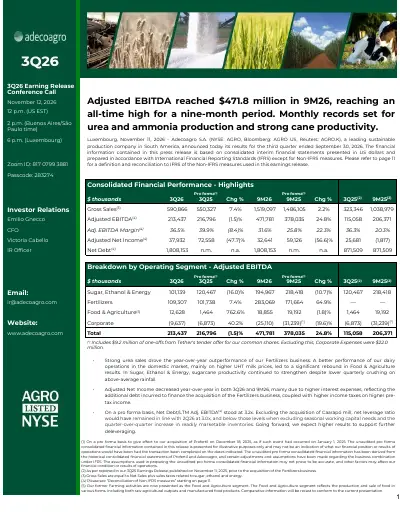
Good afternoon, and thank you for joining Adecoagro's nine-month 2026 results conference. Consolidated nine-month adjusted EBITDA reached an all-time high of $472 million.
This is almost $100 million more than our previous record for this period. A year ago, we announced the acquisition of South America's largest urea plant.
Today, it is fully integrated to our operations and continues to set production records. Consistent gains in efficiency, competitiveness, and operational excellence, combined with our team's knowledge, are generating these greater results.
In Brazil, cane productivity continues to improve month over month. We are maximizing crushing across all our mills while capturing better sugar and ethanol prices.
With Carapó mill now integrated into our cluster in Mato Grosso do Sul, we have additional industrial capacity, and together with our continuous harvest model, it will enable us to crush excess cane and keep growing in volumes. By applying our know-how and best practices in the region, we are becoming the largest sugar and ethanol cluster in Brazil, and we believe the lowest-cost producers too.
In Food and Agriculture, cow productivity reached a new quarterly record, followed by an all-time high in October. Strong operational performance and better commercial results, mainly from our daily consumer goods, drove the improvement in the earnings.
We are now in the middle of the planting season with very good conditions and favorable forecast, pointing to good crops development. Following the strategic opportunity that we got with the Carapó mill, we still remain committed to achieving our year-end target in terms of deleveraging the company.
To conclude, I would like to thank everyone at Adecoagro. These achievements are the results of their daily commitment, hard work, and constant drive to do better.
Thanks also to our shareholders for their continuous trust and support. Now, I will let Emilio walk you through the numbers of this period.
Emilio Gnecco
Thank you, Mariano. Good afternoon, everyone.
Please turn to slide four, which presents a summary of our consolidated financial results. As a reminder, we are presenting our numbers on a pro forma basis, assuming our fertilizers business had been part of Adecoagro since the beginning of 2025.
We believe this provides a more meaningful year-over-year comparison. Gross sales totaled $591 million in the third quarter and $1.5 billion year-to-date.
The year-over-year increase during both periods was mainly driven by a stronger performance in our fertilizers operations, which more than offset the lower revenues in sugar, ethanol, and energy due to lower sugar prices and sales volumes. While quarterly adjusted EBITDA remained in line with the prior year, the nine-month result reached a new all-time high, approaching the company's full-year record.
Strong urea sales drove the year-over-year growth in the fertilizers business, while improved domestic dairy performance supported a significant rebound in Food and Agriculture results. This performance, in turn, more than offset the softer results in sugar, ethanol, and energy, which I will discuss in a moment.
Let's move to slide six to review the financial and operational performance of the sugar, ethanol, and energy segment. First, I would like to remind you that we completed the acquisition of the Carapó mill in September 1st, 2026.
Since then, the mill has been fully integrated into our operations and consolidated into our results. Turning to our operational performance, we crushed 4.6 million tons of sugarcane during the quarter, slightly below the prior year as above-average rainfall in September reduced effective milling days.
Cane productivity improved significantly, with TRS per hectare increasing 31% during the quarter and 24% year-to-date, supported by favorable growing conditions. As a result, year-to-date crushing volumes reached 10.4 million tons, remaining above the prior-year level and sustaining the growth trend observed since the beginning of 2026.
Regarding our production mix, we continued to maximize crushing volumes while giving priority to the product offering the highest marginal contribution at any given time. Year-to-date, our production mix was 35% sugar and 65% ethanol.
Production costs were negatively affected by the appreciation of the Brazilian real. Excluding this foreign exchange impact, year-to-date production costs in local currency remain in line with the prior year.
Sales declined both during the quarter and year-to-date, primarily reflecting lower sugar prices and volumes, which more than offset higher ethanol volumes. During the third quarter, we accelerated ethanol sales to capitalize on the significant recovery in prices.
This improvement was supported by tighter domestic supply and demand conditions and government measures that strengthened ethanol's competitiveness relative to gasoline. This was consistent with the strategy we implemented during the first half of the year.
We sold ethanol inventories and daily production at peak prices ahead of the new harvest, and subsequently rebuilt inventories to capture more favorable pricing opportunities later in the year. Overall, adjusted EBITDA totaled $101 million for the quarter and $120 million year-to-date.
The year-over-year decline primarily reflected lower sales and the impact of lower Consecana prices on the mark-to-market valuation of our biological assets, particularly unharvested sugarcane. Looking ahead, we continue to expect mid-teens growth in crushing volumes supported by greater cane availability.
Our continuous harvest model allows us to process any sugarcane left unharvested at year-end beginning in January. This positioned us to benefit from strong yields and potential increases in sugar and ethanol prices during Brazil's traditional inter-harvest period.
Let's now turn to slide eight to discuss our fertilizers operations. We delivered another strong quarter supported by solid operational execution and commercial performance.
The plant continued to operate at high utilization rate, achieving a new monthly urea production record in August, and new ammonia production records in both August and September. As a result, urea production increased 4% year-over-year during the quarter and 11% year-to-date, supporting further cost dilution.
On the commercial front, urea demand strengthened ahead of the 2026/27 planting season, supported by normal seasonality and lower prices following the peak recorded between March and May. Despite the sequential price decline, our average realized price for the first nine months reached $561 per ton, that is $81 per ton above the same period of last year.
This performance generated adjusted EBITDA of $109 million for the quarter, up 7% year-over-year, and $283 million year-to-date, 65% above the first nine months of 2025. Higher production volumes and operating efficiencies also contributed to a meaningful expansion in margins.
In 2026, we expect the business to outperform prior years supported by higher production, including new monthly records for both urea and ammonia in October, and the higher prices captured during the first half of the year. Please turn to slide 10 to review the performance of our Food and Agriculture segment.
We completed the 2025/26 harvest season with better-than-expected yields, producing more than 1.2 million tons of agricultural products. In dairy, productivity at our free stalls reached a new quarterly record while milk processing volumes also increased.
On the commercial front, our consumer brands continue to perform strongly in the domestic market, particularly in UHT milk. We also accelerated white rice sales as prices gradually recovered, contributing to higher sales during the quarter.
Together, these operational and commercial improvements drove a significant recovery in Food and Agriculture results. Turning to the 2026/27 season, planting is progressing, with 57% of the planted area already seeded.
We are increasing planted area by 3% year-over-year, mainly in rice and peanuts. We expect yields to be in line with or slightly above historical averages, supported by above-average rainfall during crop development and El Niño conditions expected to persist through the first quarter of 2027.
In dairy, we expect milk processing volumes to continue growing, supported by new product launches across our consumer brands. Productivity at our free stalls also continues to improve, reaching an all-time monthly record of 41 liters per cow per day in October.
Let's move to slide 12 to review our capital allocation strategy. During the quarter, we completed the acquisition of Carapó mill for approximately $136 million paid in cash at closing.
Carapó has been fully integrated into our sugar, ethanol, and energy cluster in Mato Grosso do Sul and is already proving accretive by processing surplus cane from Angélica and Ivinhema. This should enable the mill to operate above its historical crushing levels from its first year under our ownership.
We are also applying our operational best practices and gradually introducing our continuous harvest model to improve efficiency. Because Carapó is located in the same micro-region as Angélica and Ivinhema, it benefits from the same competitive advantages.
As we transition to this model, we expect to progressively increase effective milling hours. Including the acquisition, year-to-date expansion CapEx totaled $602 million.
The final payment for Profertil, completed in the first quarter of 2026, remained our largest capital deployment. We also continue to invest in attractive organic growth opportunities across our businesses, including biomethane production in Brazil.
Now, let's turn to slide 13 to review our debt profile. Net debt totaled $1.8 billion at the end of the quarter, while our pro forma net leverage ratio stood at 3.2 times.
The quarter-over-quarter increase in net debt was entirely attributable to the Carapó acquisition. Our debt levels also reflect seasonal working capital requirements and higher readily marketable inventories consistent with the seasonality of our operations.
Excluding this effect, net leverage would already be below the levels recorded in previous quarters. We expect leverage to decline as EBITDA generation increases, enabling us to reach our year-end target of approximately 2.5 times.
During and after the third quarter, we completed several liability management initiatives, including the redemption of our 2027 global notes in late October, further strengthening our debt profile. Following these transactions, long-term debt represents 78% of total debt, and average maturity has been extended to 4.2 years.
The currency composition of our debt remains closely aligned with our cash generation profile, helping to mitigate foreign exchange risk. We remain focused on deleveraging while maintaining a balanced debt structure and extending maturities.
Finally, on November 19, we will pay the second $17.5 million installment of our annual cash dividend, equivalent to 12 cents per share. This payment will complete our 2026 shareholder distribution program.
Thank you very much for your time. We will now open the call to questions.
Operator
Thank you. The floor is now open for questions.
If you have a question, please write it down on the Q&A section or click on raise hand for audio questions. Please remember that your company's name should be visible for your questions to be taken.
We do ask that when you pose your question that you're picking up your headset to provide optimum sound quality. Please hold while we poll for questions.
Our first question comes from Gustavo Troyano with Itaú BBA. You can open your line, sir.
Gustavo Troyano
Hello, everybody. Thanks for taking my question.
My first question is is on Carapó mill. Now that, it's already part of your portfolio, just wanted to have a clear road map for the ramp-up of the asset.
You have discussed the 4.5 million tons of crushing for 2027 and potentially higher volumes over time. I just wanted to understand a little bit more the ramp-up curve for for this asset and how quickly could Carapó converge towards the operational KPIs of your existing cluster.
Also to to understand a little bit more if the carryover impact of the crushing ramp-up throughout 2027 would automatically imply more volumes for 2028 onwards? That's my first question.
On the second one, still in the sugar and ethanol space, and with the above-average rainfall levels that we're seeing recently in the Brazilian Center-South that is likely to postpone industry's sugarcane crushing towards next year, just wanted to have an updated view on the commodity prices going forward for 2027, basically to understand if you if you understand that we are heading towards a more challenging year in terms of commodity prices. Thank you very much.
Mariano Bosch
Hi, Gustavo. Thank you for your question.
Before passing the word to Renato that will answer in detail, I would like to point out this Carapó mill. I think that the Carapó mill acquisition was something very important for us.
It was a very attractive opportunity. We acquired a mill very near or within our own plantations, being really part of the cluster.
This mill has the capacity to mill between 5 to 7 million tons that is similar to what we already mill in Ivinhema. It even has more capacity on some parts of the of the system, it is something really attractive for us.
If we only assume that we acquire this mill where we can mill 5 million tons with no problem at all with the cane that we already have in the cluster, we have excess cane in the cluster because this excess of rains that we have, and we have a very high productivity this year. We are having excess of cane that we couldn't have milled.
We acquired this mill, if we assume 5 million tons, it's less than $30 per ton. This is something impressive in terms of the quality of the of the mill that we acquired for such a low price that includes everything.
We are really happy with this transaction. We think this was a great opportunity, and we are very comfortable that we will start showing the results as soon as we continue to mill.
After making this quick clarification that I wanted to point out because it's something extraordinar- an opportunit- an extraordinary opportunity that presented in front of us this quarter, we couldn't we couldn't have been so clear in our previous call, so that's why we wanted to point it out this time, this great opportunity that we had by acquiring the Carapó mill. Making this quick clarification, I will ask Renato to go in detail to your to your question.
Renato Junqueira Santos Pereira
Okay. As as Mariano mentioned, Carapó is in the same micro-region as Angélica and Ivinhema, it's part of the same cluster.
We see Carapó almost as an organic growth of of the cluster. We are going to adopt the same operational model that we have in Angélica and Ivinhema.
The equipments of Carapó have a lot of have a lot of potential. The milling systems is exactly the same as Ivinhema, which is crushing 6.5 to 7 million tons.
The sugar factory is the same size as Ivinhema, and the distillery is even higher than the bigger than than Ivinhema. The steam generation is also bigger than Ivinhema.
We think that Carapó has a lot of potential. Also, we we we think that we can adopt the best practice that we are that we have in our cluster to to improve some important KPIs of of Carapó.
For example, the industrial efficiency, which is basically the the the out the sugar inputs and the sugar outputs transformed in either sugar or ethanol. We think that we can improve this the these KPIs, which which is very important.
Also, the use of time. We we we think that there are a lot of potential to improve the use of time.
In other words, we we think that we can have less mechanical problems in Carapó and crush more hours during during the year. Also, the energy consumption in Carapó is higher than in our cluster, and we think that with small adjustments, we can put it in the same level.
Finally, in the agriculture area, we think that we can improve the sugar or the TRS per hectare of of Carapó, adopting the same way that we are doing in our in our cluster. Also, the the the Carapó team is is very good.
I think the integration was was was very, very good. It seems that they are working with us for for a longer period of time.
We are very, very happy overall. Regarding our second part of of the question, I think it's it's it's important to talk about 2026 before to get into 2027.
I think the scenario is is very positive, especially for for ethanol. Today, the supply of ethanol is is is is is smaller than everybody was thinking as a consequence of the rains that the whole Center-South region is receiving.
The the the delay in crushing and also the the lower TRS content decrease the the ethanol outputs. In the other hand, the demand of ethanol is very high.
Actually, the higher demand since 2019. The hydrous demand per month is is more than 2 billions, 2.3 billion liters of of ethanol.
The parity rates at the pump is still in São Paulo 62%, favoring ethanol consumption. If you take the the inventories now, is 14% lower than the same same period of of last year.
We think that the scenario is is is is very tight, and prices should be high until at least until the the the the the to finish the first quarter of of next year. We are taking advantage of this this scenario.
The price is very good, and also we are taking advantage of of the subsidies that the government is is is giving. The the subsidy is in the hydrous ethanol, and it's based in the sales of ethanol that we have during the period, and we are taking advantage of that.
I think it's very important to mention that we don't have any commitment of anhydrous with contracts of anhydrous. We are maximizing hydrous now to get all the the this benefit.
We believe that the the the beginning of next year, the scenario for ethanol is going to be really, really good. Once the the season starts, we think that the the the ethanol supply is going to to increase, but although the the the amount of the sugarcane probably is going to be very high, that sugarcane first has to be crushed.
I think Brazil has crushed 655 million just one year in the history, in 2023. It's not easy to crush all that cane.
Also, we believe that the the mix is going to be more sugar-oriented. This year, probably is going to finish around 46%, and next year, probably is going to be close to 50%.
Part of of the ethanol is going to be transformed in sugar. The the corn ethanol is going to increase.
If you if you put all those variables into the equation, we think that the the the ethanol supply is going to increase around 3% only. We think that 3% more ethanol can be easily absorbed by the by the the the flex-fuel cars.
We could see this year how responsive the demand is to to the parity of the rate of the parity of the pump. We think this this ethanol the excess of ethanol is going to be absorbed.
In in the case of of sugar, we think that Brazil is the same situation of of ethanol, the the the 40 million tons that everybody was talking at the beginning of of the season, today is is difficult to to reach 37, 38 million tons. The the the the amount of the sugar of sugar that Brazil is going to produce is is lower.
Also, this El Niño effect is causing a a dry weather in other producer countries, especially in India. India probably is going to produce less than it it consumes this year.
For the next year, probably India is not going to increase the production because of the planting period that was very dry. We think that the scenario is is is good for sugar as well.
Gustavo Troyano
That's quite helpful.
Mariano Bosch
Thank you, Renato.
Operator
The next question comes from Matheus Enfeldt with UBS. You can open your line.
Matheus Enfeldt
Hi. Thank you, thank you, thank you for the time.
My first question on on on Profertil or both of my two questions are on Profertil, but the first one on the potential expansion of the extension of the urea plant. Any updates around that on potential timeline for for an FID?
That's my first That's sort of the first point. I also want to get your sense on how do you think that once your project potentially is running and the the other competitor is also producing urea in Argentina, and Argentina becomes a net exporter of urea.
I know that Brazil may be a target for for sales, but pricing will need to absorb freight costs to Brazil. I'm just curious on how you think that the outlook for urea production expansion looks in Argentina and how that could negatively impact prices, particularly domestic, given if you have to export to Brazil?
That's my first question. Then the second one is on on on Profertil's costs.
It looks to us if we're not seeing the wrong number here that OPEX per ton for for urea production is up 16% year-on-year. Then when I look into natural gas prices in Argentina, again, might be seeing the wrong reference here, but we see it then up 5% in the same period.
The question is what's driving this increase in urea production costs, and if you could just help us sort of understand what's the outlook from here and normalization from here just because we're seeing about $270 per ton cash cost per per ton of urea for this quarter. At this level, it looks like the normalized EBITDA for for Profertil will be slightly below what we were previously discussing once the acquisition was concluded.
Trying to get a sense of really how to think total cost for for the urea plant there. Those are my two questions.
Thank you.
Mariano Bosch
Okay. Thank you, Matheus, for your question.
I'm going to address first your second question, just to clarify in term in terms of cost of production of urea that there were some misunderstandings here. Number one, it is important to look at it on an annual basis or at least on the nine-month basis, because when we talk about quarter-by-quarter, sometimes there are some small specifications.
Going specifically for the nine months, we have nine months '25, $262 per ton, while in nine months '26, we have $237. This is a 10% decrease in terms of cost of production.
We are having a lower cost of production this year than in the pro forma of the previous of the previous year. This is around 10% lower cost of production.
This also includes some additional expenses. In reality, it's even lower than this number of 237, because we are including the sales of some other products on top of urea, and thus the cost of production of all that when you make that type of calculation that includes ammonia, ProAgre, and e-Blue.
That is a small change that have to be adjusted. Then we are also including in the 237 some growth and maintenance CapEx that are marginally contributing today to an increase in production.
Also some of the expenses that may be related to this potential expansion that is what you were also asking. All all in this, we are around 15% lower costs comparing to the previous year.
This means some improvements in terms of gas prices, some improvements on logistics. There are several improvements that are being happening during this year that makes this improvement in terms of the total cost of production up to now.
Then going to your first question related to the the the the expansion of the plant or this possibility of more than duplicating today's Profertil plant and the other projects that are here, what we believe, and we believe since the very beginning when we analyzed this business and when we acquired this Profertil business, we were always thinking on this increase of the plant of this project or potentially more than duplicating. Because what we see is that we can be the lowest-cost producers in terms of urea to export within the region.
We are going to be very competitive to go to Paranaguá. Going to Paranaguá is even cheaper than going to Rosario Port within Argentina.
Once Argentina completes its normalizations in terms of imports and exports, it's going to be equally cheaper or or even cheaper going to Paranaguá Port in Brazil than to Rosario Port. For us, it's we are not looking at the plant and Argentina as only for the domestic market.
Argentina has a possibility to sell within the region. The region still imports more than 8 million tons.
It's a 9 million tons what the region is importing today. The ability to make these two projects will only add 3.5 million tons.
They are still more than double to be a net importer in the region. That is how we really look at this potential business.
We don't see any risk if the two projects are being completed. We think that we can continue to deliver this kind of results that we are delivering today.
That's why we are so optimistic. We are working hard on developing all the engineering and all the necessary needs to reach the FID that we hope to reach to it within next year, at some point of next year.
We are working hard on that to happen.
Matheus Enfeldt
Thank you. Just one, one clarification on the urea costs.
Back in December, I think we were discussing a normalized mid-cycle EBITDA for Profertil of around $300 million per year. Do you think that that's still reasonable compared to what you're seeing today?
I know that prices can move, urea prices can move, but if in general, that's the that's the mid-cycle EBITDA that we can expect for Profertil?
Mariano Bosch
Yes. As I was mentioning before, we are finding more and more opportunities to continue improving, we can even have better numbers than that.
We are certainly going to close this year on a higher number. This is affected by only two months of higher prices than normal, because March, April, and and a portion of May were when the prices of urea were out of the of the of the historical numbers.
Then the rest of the years, then during the rest of the year, we had historical numbers when you look at the CFR urea price in Brazil.
Matheus Enfeldt
That's clear. Thank you.
Operator
Once again, if you have a question, please write it down on the Q&A session or click on raise hand for audio questions. Our next question comes from Guilherme Palhares with Santander.
You can open your mic, sir.
Guilherme Palhares
Good afternoon, everyone. Thank you for taking my questions.
Just a follow-up on Matheus' question. Of course, you have a great opportunity there on the fertilizer market within Brazil and the Argentina consumption.
I just want to try to drill down a bit on the costs between natural gas and other costs. If you could just explain a bit on a high level, you mentioned a bit the the benefits that your guys are seeing because you're reaching the the record production levels.
Which of the lines and the fixed costs are you being able to [unclear]
Mariano Bosch
Sorry, Guilherme, we lost you.
Guilherme Palhares
No, just want to understand you mentioned that you guys are putting out record production numbers for the fertilizer business. I'm just trying to understand a better how much is fixed versus variable cost there and how we can model a bit the cost curve going forward as you guys continue to deliver those lower costs year-over-year.
What is the the level that we should be looking at long-term? Okay.
Mariano Bosch
In terms of fixed cost or variable cost, probably 70% to 75% are variable costs. Within the variable cost, you can also work on them.
The gas is the number one variable cost, and there are some opportunities to continue improving this gas pricing and especially gas pricing at the at the level of the plant, including all the transportation of that. That is something that we do expect to continue to improve.
Then, on the logistics in general, have been improved and there are still some room for improvement while Argentina continues to normalize.
Guilherme Palhares
That That makes sense. Just drilling down a bit on that.
If you could just share with this such high level of production, how much of the gas today is coming from the fixed cost that you guys have, and how much is variable? Have you already been able to manage a bit those spot prices offered of natural gas and how are they doing now?
Mariano Bosch
Yes, sure. Around 80% or 85% is a fixed price, and then there is still a 20% to 15% variable price that you can take opportunity of cheaper gas prices at these moments of the year.
Guilherme Palhares
Perfect. That's very clear.
Operator
The next question comes from Gabriel Barra from Citi. You can open your line, sir.
Gabriel Barra
Hi, team. Thanks for taking my questions.
I have two from my end here. The first one, I think the discussion about ethanol is quite interesting at this point, right?
You have the subsidy that should be renewed by next month. We are seeing the the anhydrous ethanol in a really tight market today when you take a look on the inventory levels.
Demand is it's peaking on the hydrous. My question is how how to operate this market, right, in terms of mainly in terms of the commercialization strategy here from now on until until next crop season?
I want to hear a little bit more about in terms of mix, you mentioned that you don't have contracts on on hydrous, but we on the other side we are seeing a more tight more tight market on this side. We have oil price decreasing and price spread normalizing, it's a it's an interesting moment to understand a little bit more on the commercialization side from you guys.
The second one, about the Carapó discussions, and the and the the end of this crop season, we we still see some some chance here in order to crush the the rest of the sugarcane. We understand that we have this conti- continuity on the on the the crushing process during the end of the year, and you have this spare capacity in Carapó, right?
Given the fact that you have more sugarcane, and you have, I would say, if correct right here, you are reaching the maximum capacity of the the legacy plants that you have, Carapó could be one of the ways to the bottleneck this this higher productivity and higher production of sugarcane. If you if you could give us more color about that and in terms of cost, if if this should be a net positive or a net negative in a cost perspective for the average cost for the company, this could help us a lot here to understand the trend of the cost and the the crushing dynamic.
Thank you.
Mariano Bosch
Thank you, Gabriel, for your color. In a quick answer, we are selling as much ethanol as possible, or we are selling all our ethanol during this period of time.
Also, and the second question is a clear net positive. Then Renato can give you some more color on these two questions.
Renato?
Renato Junqueira Santos Pereira
Okay. Regarding the ethanol question, we are we are producing hydrous ethanol now to take advantage of the subsidy.
We think that in the first quarter of next year that we're we are going to be crushing in our continuous harvest model, probably we are going to be producing anhydrous. We have the equipment to produce anhydrous in all our mills.
We are we are ready to to change the mix to anhydrous and to capture this price. We think that anhydrous is going to to increase, also because the the gasoline consumption is is going to increase because hydrous ethanol is going to move toward the 70% parity.
Regarding the the second part of your question, I think it's important to mention that Carapó, we are going to have 2 months of inter-harvest because Carapó is not ready to do the continuous harvest. We are going to start crushing in Carapó in March 1st.
That's why we are considering that Carapó is going to crush between 4 and 5 million tons of sugarcane. In in our continuous harvest model, we don't see those cane as a cana bisada.
In in this model, at some moments, when the weather is is is is wet and it's raining and we are delayed in the in the crushing, we we end up crushing that sugarcane with more months. In other moments, when the weather is drier, we anticipate the the crushing of of those sugarcane, sometimes with less than the the the 12 months.
We expect that at some time during the the year, the weather is going to give a chance to to to put the sugarcane in the right age to be crushed.
Gabriel Barra
Thank you, Renato a follow-up here on your I don't know if you could comment on that, but what's your base case in terms of the subsidy? You guys are working with this subsidy being postponed for for more for some months here, or you think that's going to end by December?
How's How are you guys working with this base case at this point?
Renato Junqueira Santos Pereira
We we also don't know. We are selling as much as we can.
Today, the the the the hydrous equivalent is 21 cents per pound in Mato Grosso do Sul, and we know that the the the subsidy is going to be in place until December 9. After this this date, we don't know what's going to happen.
Gabriel Barra
Thanks a lot. Very clear.
Operator
The next question comes from Thiago Duarte from BTG Pactual. You can open your line, sir.
Thiago Duarte
Yeah. Thanks, thanks for the opportunity.
Hello, everybody. Two two questions on on my side.
First one, following up on on Renato's previous comments on on the market outlook, and very detailed color that I appreciate very much. A follow-up on that, Renato, particularly with regards to ethanol market, right?
I I get your your optimism regarding prices for the coming months, especially towards the beginning of 2027. As you mentioned, there is there is like mounting supplies coming from especially from corn ethanol.
My question to you is is really where where you think the demand is going to have to come from? Do you think it's just a matter of hydrous ethanol becoming more affordable and then gaining share against gasoline, it will be a price mechanism?
Or how how optimist or confident you are that other routes for ethanol will will will deploy such as SAF and bunker and other other different sources of demand that might absorb this this mounting supply of ethanol? That would be the the first question.
The second question, I I appreciate the the target leverage for the end of the year, 2.5 times as you put in the presentation. The question is how where do you expect or where do you want to see the net leverage ratio getting before you can start thinking about new uses of capital, either speeding up dividends or, new M&A in in the fronts that you you have today?
These are my questions. Thank you.
Mariano Bosch
Okay. Thank you, Thiago, for your question.
I will ask Renato to answer your first question, and then Emilio, your second question. Renato?
Renato Junqueira Santos Pereira
Hi, Thiago. As as I mentioned, we think that for next year, there are two variables that we don't know what's going to happen.
First is the is the amount of the sugarcane that's going to be crushed. I think it's difficult to crush 650 million tons.
Even if it's crushed, I think the mix is going to be more sugar-oriented. It's going to to to decrease the the the the mix the ethanol mix in the sugarcane ethanol.
The excess of ethanol that we are going to have, even considering those variables that I that I mentioned, we think in the short term, it's going to be absorbed by by the hydrous market share as we saw this year happening. If you think in the in the in the mid-long-term, and then we think there are other sources of demand as agricultural machines, biobunkers, SAF.
In the short term, I think it's going to be the the hydrous market share.
Mariano Bosch
Okay. Thank you, Renato.
Then Emilio, can you take the the question on the leverage?
Emilio Gnecco
Sure. First, and I will use this opportunity to reiterate that, as we do from time to time, our businesses are best evaluated on an annual basis.
Accordingly, the results of any single quarter are not necessarily representative of the full-year performance of each business. As as we showed in the presentation, and you you just mentioned, we are anticipating that we will be or we will fall to 2.5 times our net debt-to-EBITDA ratio by December the the 31st.
This is after doing certain liability management that allow us to extend the maturity of our debt for more than 4 years, and most importantly, with a cost below 7%. Now, specifically to your question, we always said that something between 2 to 2.5 times is where we would feel comfortable to be.
If you look at our history, we've been below that threshold, and that is when we we took the opportunity of increasing our leverage when we saw very accretive opportunities such as Profertil. To the extent we reach that level, which hopefully we can we can be there by by 2027, well, we we are going to be in a position to to rethink.
As always, and and and what what happened in the past, if there's an an opportunity that meets our thresholds and and and the repayment is is clear going forward, we might we might take that that chance. Always with the support of our shareholder that that has been there in in recent acquisitions.
Mariano Bosch
Thank you, Emilio.
Thiago Duarte
Thank you.
Operator
The next question comes from Julia Rizzo from Morgan Stanley. The floor is yours.
Julia Rizzo
Hi. Hello, everybody.
I think I have two questions, maybe a third. I know you have already discussed a lot about the ethanol in the commercialization, but if you could be a little bit more specific of how much we are already in November, how much it was already sold, and the price improvement that you're seeing in the fourth quarter versus the third.
I'm saying that the direction is important for us because it was quite confusing the the third-quarter the third-quarter analysis because of the the subsidies. Without subsidies, and that will be helpful to know a little bit of the direction here in the commercialization pace.
Also, if you could give some clarity of how much cane do you expect to crush in 2026, and the leftovers, if any, for 2027? The the third and the final one is is is the running rate of Profertil with the 100 $110 million the 110 that you did on the on the on the third quarter, is that a good running rate that we can assume in in the next couple of quarters?
Mariano Bosch
Hi, Julia. I'm going to take your last question, your last question on the EBITDA of Profertil.
As I mentioned before, somewhere above the $300 million is okay. So, 110 is a little bit higher per quarter than what we would expect per quarter.
This quarter, we sold some more urea from the previous quarter, as we explained before in our previous call. That's why you are seeing this.
In again, it is important to see it in an annual basis, as we were explaining before also. We will always expect to sell almost 100% of what we produce.
If we don't sell 100%, it's because we have a a specific strategic view of putting a little bit more urea from one quarter to the other or from one year to the other. All what we produce is being sold, because it is a commodity.
As I explained before, the whole region imports a lot more than what is being produced here. Making that quick clarification, I will ask Renato to answer your questions on the ethanol specifics.
Renato Junqueira Santos Pereira
Hi, Julia. In the in the last quarter, we believe that we are going to sell 200 200,000 cubic meters more ethanol than in the third quarter with a price approximately 25% higher than in the third quarter, already including the the subsidy.
Regarding the the the crushing, we we are going to crush, we believe we are going to crush about 15% more than we crushed last year, including Carapó's crushing.
Julia Rizzo
Any leftover for the next one, Renato? Sorry to interrupt.
Renato Junqueira Santos Pereira
The the the leftover, as as I mentioned, we have the continuous harvest model. We we we don't consider that cana bisada.
It's a cane that that is with age in months higher than than usual. We are going to be crushing in the first quarter.
At some point, when the weather gets drier, the the age of the sugarcane is going to be more close to to 12 to 13 months, which is the normal age of the sugarcane.
Julia Rizzo
Great. Thank you.
Operator
The next question comes from Lucas Ferreira from J.P. Morgan.
You can open your line.
Lucas Ferreira
Hi, everybody. Thanks for the time.
Two questions, one to Renato. Renato, what's your forecast for sort of the unit cost of production this season, and how this number should compare like now in the second half of the of the season versus the first half?
I would imagine that, some of these effects of El Niño end up impacting a bit the pace of of crushing, and and could have some some issues there. I wanted to ask if you see an increase in the cost unit cost now in the end of the season versus the first half, and how the full year looks like.
Then on on the farming and rice business, pretty much how do you guys are seeing, productivity? I think they have been, much better, and and then boosting your your results.
Wondering if you have any views now into the into the into the summer season coming in, in terms of how to think about the the productivity in each of the crops so we better understand what's what's coming next in terms of margins, and especially that prices have been a bit better for most of the products, right? Thank you.
Mariano Bosch
Okay. Thank you, Lucas, for your question.
Renato, do you want to answer the the cost of production on on the sugar and ethanol?
Renato Junqueira Santos Pereira
Okay. Lucas, we we we think that the the cost of production just makes sense to look at the annual basis.
If you take the annual basis, we think that that the the our cost of production is going to be similar to slightly lower than than last year in reais terms. In dollar terms, even though the real has depreciated now, the average of the year, the real is is stronger than than last year.
The the cost should be around 5% higher than last year. I think that the reason for this this increase in cost is the cost dilution that is lower now.
The the we are going to crush less sugarcane than initially thought because of the rains, and also the TRS content, which is lower also because of the rains.
Mariano Bosch
Thank you, Renato. Then answering your question on Food and Agriculture business, that is a business that we've been suffering the last year and a half.
From now onwards, we are in a very good situation. All our production costs are doing very well, because they were all adjusted accordingly.
Also, we are having an excellent planting season. We are just finishing or in the end of the planting season.
All our plantations are in excellent conditions. As was expressed before, the cow productivity is also getting records.
All the sales in the domestic market is also doing great, and the export market also doing great. We are in a very good situation going forward, especially because of the price recovery coming from the rice and the peanuts that are the two products that substantially change prices, reaching the bottom of prices, historical bottom of prices, around six months ago.
We are well positioned, and we should continue to see this somewhere above 10% EBITDA sales, more than 10% of EBITDA over the sales. That's what we should expect going forward.
Lucas Ferreira
Thank you very much.
Operator
This concludes the question-and-answer section. At this time, I would like to turn the floor back to Mr.
Bosch for any closing remarks.
Mariano Bosch
Thank you all for participating in this conference, and we hope to see you in our upcoming calls.
Operator
Thank you. This concludes today's presentation.
You may disconnect at this time, and have a nice day.