Aker ASA Class A
Q3 FY2026 · Earnings Call TranscriptNovember 4, 2026
Cecilie Langum Becker
Good morning, and welcome to Aker's third quarter 2026 results presentation. I am Cecilie Langebekk, Head of Media Relations.
I am joined today by Aker's President and CEO, Øyvind Eriksen, who will take you through the key highlights and the portfolio developments in the quarter. Aker's CFO, Svein Oskar Stoknes, will lead you through the financial results in more detail.
After the presentation, we will open for questions. You may submit your questions at any time using the chat function in the webcast player.
With that, I hand it over to Øyvind Eriksen.
Øyvind Eriksen
Thank you, Cecilie, and good morning, everyone. Before we go into the third quarter, let me take a step back and look at the bigger picture.
We are living through a period of profound change. Geopolitics, energy security, and technology are reshaping industries and shifting capital flows.
In this environment, the Nordics are uniquely positioned, with abundant energy, strong industrial capabilities, and political stability. For Aker, that creates significant opportunities across the industrial themes where we have chosen to invest.
At the same time, markets will remain volatile. We have seen that in recent weeks, not least in AI technology and AI infrastructure.
Sentiment will come and go. At Aker, we measure ourselves over time.
Our job is to stay disciplined on capital, focused on execution, and mitigate risks. We encourage our portfolio companies to be prepared for market volatility and to be transaction-ready when opportunities arise.
Aker has maneuvered steadily and safely year to date. Aker net asset value increased by 44 billion Norwegian kroner during the course of the first three quarters, reaching 111 billion at the end of Q3 after paying 2.2 billion kroner in dividends.
Total shareholder return was 83% year to date, including dividends, significantly outperforming both the Oslo Stock Exchange benchmark index and the Brent oil price. Market volatility has reduced the return so far this quarter, but it is still north of 50%.
That's not an achievement happening by chance. Three drivers stand out.
First, energy. Aker BP and our other listed energy holdings added 22 billion Norwegian kroner through higher share prices and dividends.
Second, Nscale. It added also 22 billion kroner and is now our second largest asset.
Our net asset value reflects the $14.6 billion valuation from the Series C funding round in March. Third, Cognite.
The sale added 7 billion kroner to Aker. Closing is expected this quarter, and the proceeds will significantly strengthen our net asset value, liquidity, and financial flexibility.
That is what Aker is about: building value as an active owner and crystallizing it when the timing is right. With that, let me turn to the third quarter.
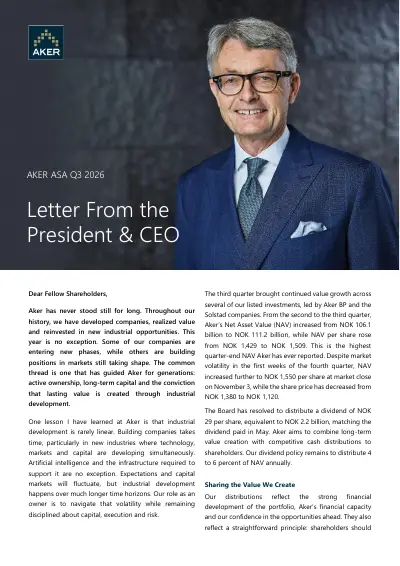
As mentioned, Aker's net asset value ended the quarter at 111 billion Norwegian kroner. This was up from 106 billion in the second quarter and the highest quarter-end net asset value in Aker's history.
The main driver in the period was Aker BP. The total shareholder return in the quarter as such was 20.2%.
Across the portfolio, our companies continue to develop, strengthen their positions, and build a solid foundation for further growth. In line with Aker's dividend policy of paying a predictable and growing dividend, the board has approved a second dividend of 29 kroner per share, bringing the total for the year to 58 kroner per share, or 4.3 billion Norwegian kroner.
To sum up, yet another solid quarter for Aker. Let me now turn to the portfolio and the key drivers behind our performance, starting with energy, still Aker's largest segment at around half of gross asset value.
At the end of the quarter, our listed energy holdings were valued at 64 billion kroner. Including 5 billion in dividends, they have added 22 billion kroner to our net asset value so far this year.
Aker BP alone added around 14 billion kroner this year, including 2.5 billion in dividends. Operationally, Aker BP continues to deliver.
Production has been solid, realized prices strong, and free cash flow is now expected to be well ahead of what we anticipated at the start of the year. Aker BP has also announced a new executive management team from January 1st, 2027, aimed at reducing complexity, improving execution, and strengthening collaboration.
The market backdrop is also supportive. The physical oil and gas market is exceptionally tight.
Achieved crude prices on the NCS hit new all-time highs above $150 a barrel in October, while jet fuel and diesel have traded above $200 per barrel in Europe. This is not a spot price story.
The Hormuz crisis has lifted the whole forward curve. Since January 2027, prices are up around 50%; 2028, around 30%; and 2029, around 20%.
That supports Aker BP's value and cash generation well beyond 2026. Energy security matters.
Europe needs reliable supply, and the Norwegian Continental Shelf delivers. Norwegian oil and gas has never been more valuable, economically or politically, as Europe faces low gas inventories and continued competition with Asia for LNG.
This fall, the Norwegian Continental Shelf passed 100 fields in production for the very first time. Our belief in the shelf remains strong, but unlocking the increasingly complex resources will require greater scale, collaboration, and better use of software and AI.
Aker BP is adapting to that reality. The strategy remains unchanged, but the company is strengthening execution through partnerships, technology, and AI to unlock more resources and create more shareholder value.
That's why Aker BP's two new partnerships matter: one with Equinor and Vår Energi, targeting some of the largest remaining opportunities on the Norwegian Continental Shelf, and one with Equinor, using technology to unlock resources in tight reservoirs. Wisting is the largest known undeveloped oil discovery on the Norwegian Continental Shelf for the time being.
Through Aker BP's 27.5% stake, Aker is well positioned for its development. For Aker Solutions, the first Wisting award was not the outcome we had hoped for.
As several large projects are completed in 2027, engineering and fabrication activity will normalize. At the same time, Aker Solutions has a substantial backlog in lifecycle services and a strong track record of adapting to changing markets.
As an active owner, Aker will support Aker Solutions in adapting and developing new industrial and commercial opportunities. Solstad Maritime and Solstad Offshore have also delivered.
Their combined market value is up more than 3 billion Norwegian kroner this year, and they have paid more than half a billion kroner in dividends. Akastor has contributed another 241 million kroner in dividends this year.
In short, energy remains Aker's industrial backbone. It generates cash today, and it gives us optionality for decades ahead.
Over to real estate. This year shows the benefit of having a diversified portfolio.
Higher commodity prices have benefited our energy holdings, while higher inflation and interest rates have put pressure on real estate. The sector has largely been driven by interest rates rather than company performance.
As long-term owners, we see three reasons why this is an attractive time to own high-quality real estate. First, valuation.
The sector trades at around 13 times cash earnings, close to 30% below its 10-year average, while listed shares trade below net asset value. Second, private transactions support these values, with deals at or around book value despite the discount in listed markets.
Third, higher interest rates create upside if rates come down, while rents linked to inflation support earnings in the meantime. What matters most to us is what the companies deliver.
Public Property Invest, Sveafastigheter, and SBB have been transformed since we became owners in May 2025. Public Property Invest has grown its portfolio from 15 to 53 billion Swedish kronor.
It's now listed in Stockholm, rated BBB+ by Fitch, and cash earnings per share is up 37% year-on-year. The underlying market remains attractive, supported by an aging population and growing demand for care.
Sveafastigheter completed its merger with Klarabo, creating Sweden's largest listed residential company, with more than 45 billion Swedish kronor in property value and twice the size of its closest peer. The merger also removed expensive financing for SBB, costing 13% a year, and earned Svea an upgraded credit rating from BBB- to BBB.
SBB has also changed fundamentally since we became owners. It has continued to strengthen its balance sheet, including through property sales of more than 8 billion Swedish kronor.
It has gone from an operational property company with a complex structure to a simplified real estate investment company with attractive stakes in market-leading platforms. Aker has been instrumental in reducing its debt by around 14 billion Swedish kronor over the past year.
How do we view this from an Aker perspective? Real estate is countercyclical to much of our portfolio.
It provides stable, inflation-protected cash flows that balance our more cyclical energy exposure and makes Aker's portfolio less prone to volatility. We own market leaders with investment-grade balance sheets and remain focused on disciplined growth, low leverage, and shareholder distribution.
In short, energy gives us strong cash flow when commodity prices are high. Real estate gives us stability through the cycle.
Together, they make Aker more resilient. Now, let me take you through what is happening in AI infrastructure and why it matters.
Markets have been volatile in recent weeks, and AI stocks have been at the center of it. Views on AI investments will shift over time, but one thing is certain: compute is becoming the engine of our future society.
Whoever leads in this race will shape the future. Today, the race is dominated by the US and China.
Europe simply has to move faster. We must build the infrastructure, secure the power, and increase capacity.
We need to wake up to that reality, and we need to speed up. Aker is not allowed to comment on Nscale's ongoing IPO process.
Hence, everything on this slide is based on the public S-1. What I can say is that Nscale has developed significantly in recent months.
During the quarter, the company signed major contracts with Anthropic and Figure AI, bringing total contract value to more than $100 billion. Nscale also raised $3.36 billion in convertible financing, further strengthening its funding position as the company continues to scale.
It agreed to acquire AnyScale, adding software orchestration to its full-stack offering. Where does Nscale stand today?
Nscale has around 461,000 GPUs under contract, most of which are on the latest NVIDIA Vera Rubin platform. It also has line of sight to more than 10 gigawatts of power, with contracts averaging close to 6 years.
Josh Payne, Nscale's founder and CEO, has brought together an exceptional team with some of the best people in the industry. Most recently, Nscale has strengthened its organization and governance with Fidji Simo, Frank Slootman, and Amy Hood joining the board; Justin Osofsky as COO; and Adam Rossman as chief legal officer.
For me personally, it's incredibly inspiring to be part of this as an Nscale board member and to follow the development of AI from the inside at a time when the industry is moving at extraordinary speed. Last month, Kjell Inge and I visited both Nscale Kvandal here in Norway and Nscale Monarch in West Virginia.
We were both blown away by the scale of the projects, the speed in execution, and the quality of the Nscale team. What makes Nscale different?
Three things. First, it's purpose-built for AI, not a general-purpose cloud that has been retrofitted.
Second, Nscale offers everything in one integrated platform, from power to token. Nscale designs, builds, owns, and operates the whole chain: energy, data center, compute, and software.
This full-stack platform means control over cost, speed, and delivery, and long-lived assets rather than lease liabilities. Third, large hubs in low-cost power markets, mainly behind the meter.
Here, Aker's industrial DNA matters. Access to low-cost power at huge scale is the main bottleneck in AI, and building energy infrastructure is what Aker has done for decades.
Monarch in the US is another differentiator and a true game changer. It shows the scale of the opportunity: about 8 gigawatts of gross power capacity at one single site, anchored by the $45 billion contract with Anthropic.
That's just for Building 1 at Monarch. The opportunity is significant, and delivering on it will require capital, operational discipline, and execution at scale.
To sum up, as an industrial investment company, Aker is today focused around a few high-conviction themes and more diversified as a result. We remain committed to our target of delivering stable and growing dividends.
Energy continues to be at the core, representing about half of our gross asset value and delivering solid cash flows. At the same time, we have invested in new pillars for growth, mainly AI infrastructure and real estate.
Markets will move up and down. This fall has shown just that.
However, the global trajectory and the industrial rationale for our investments remains firm. Our job is not to get distracted by market volatility.
In fact, for an active owner like Aker, it may lead to opportunities. Our focus remains long-term thinking, active ownership, and building great companies with high-quality assets, value-accretive contracts, and strong people.
Looking ahead, we stay committed to active ownership, disciplined capital allocation, and a solid balance sheet set to improve further with the closing of the Cognite transaction. This gives us the flexibility to act when opportunities arise.
Aker has never stood still for long. The portfolio will change, but our approach will not.
The opportunities ahead are significant, and so are our ambitions. That concludes my part.
I will now hand it over to Svein Oskar, who will take you through the numbers in more detail.
Svein Oskar Stoknes
Thank you, Øyvind, and good morning. I will start with our three asset categories: listed investments, unlisted investments, and cash and other assets, and then go through the financial results in some more detail.
At the end of the third quarter, Aker's listed equity investments were valued at 64 billion kroner, 50% of total assets or 869 kroner per share. The value of the listed portfolio fell by 1.8 billion kroner in the quarter.
The decline is mainly technical: Aker BioMarine moved from listed to unlisted investments ahead of the take-private merger, which reduced the listed portfolio by 6.6 billion from the previous quarter. I will come back to that on the next slide.
However, underlying market values developed positively. Aker BP increased by 5 billion kroner and the Solstad companies by 1.5 billion, together largely offsetting the mentioned reclassification.
This was partly countered by a 1 billion kroner decline in Aker Property Group's listed real estate holdings. Dividends from listed investments totaled 1.2 billion kroner in the quarter, mainly from Aker BP with 855 million and Solstad Maritime with 233 million.
Turning to our unlisted equity investments, at the end of the quarter, these were valued at 60 billion kroner, 47% of total assets or 820 kroner per share. The value increased by 7.5 billion kroner in the quarter.
As mentioned, the main driver was Aker BioMarine. Ahead of the take-private merger, Aker's 78.7% stake moved from listed to unlisted investments, valued at the merger price of 105 kroner per share.
The merger was completed in October, and Aker today owns 100% of the company. Our 22.7% stake in Nscale is valued at 32.1 billion kroner, unchanged from the previous two quarters.
The value is based on the Series C round in March at $14.6 billion and excludes any future dilution, for example from the convertible financing or from a potential IPO. Our stake in Cognite is valued at the agreed sale price to Schneider Electric of 14.7 billion kroner, and we continue to expect closing in the fourth quarter.
Finally, cash and other assets. At quarter-end, cash and other assets were valued at 3 billion kroner.
That is 2% of total assets or 41 kroner per share. Cash inflows in the quarter were 2.5 billion.
Debt drawdowns contributed 1.3 billion, and dividends contributed 1.2 billion from Aker BP, Solstad Maritime, Akastor, and Solstad Offshore. Cash outflows were 2.2 billion.
We invested 976 million in equity and loans to portfolio companies. This includes 367 million to Aker Property Group and 172 million to ACE.
Share buybacks were 766 million. These shares will be used to settle the share consideration in the Aker BioMarine take-private merger.
Operating expenses and net interest came to 353 million, and other items net to -139 million. As a result, the cash balance rose from 0.7 to 0.9 billion at quarter-end.
That is 1 billion including liquid funds. With that, let's turn to the third quarter financials for Aker ASA and holding companies, starting with the balance sheet.
In line with our accounting principles, investments are recognized at the lower of historical cost and market value. At the end of the quarter, the book value of Aker's investments was 55.8 billion kroner.
This was an increase of 503 million compared with the previous quarter. The increase mainly reflects the conversion of Aker's 459 million receivable from Aker Property Group into equity during the quarter.
The book value of equity at quarter-end was 42.5 billion, down 112 million from the previous quarter. The decrease reflects share buybacks in the quarter, partly offset by profit before tax.
Adjusting investments to fair value adds 68.7 billion, up from 63.5 billion last quarter. On a fair value-adjusted basis, Aker's gross asset value was 127.5 billion.
After deducting liabilities, net asset value amounted to 111.2 billion, or 1,509 kroner per share, an increase of 5% from the second quarter. The fair value-adjusted equity ratio was 87%.
Of total liabilities, 15.9 billion kroner is related to bond debt and bank loans. Aker maintained a strong financial position at quarter-end, with modest leverage and ample debt capacity.
The loan-to-value ratio was 12%. The liquidity reserve amounted to 4.8 billion kroner, including undrawn credit facilities, cash, and liquid funds.
The all-cash Cognite transaction, expected to close in the fourth quarter, will considerably lift our available liquidity and further strengthen the balance sheet. Net interest-bearing debt increased to 13.8 billion from 13.1 billion in the previous quarter.
The increase was primarily driven by higher bank debt to fund the quarter's investments and share buybacks. Aker's weighted average debt maturity was 2.6 years at quarter-end.
Including available options to extend credit facilities and loans, the effective maturity is up toward 5 years. Finally, turning to the income statement.
Operating expenses for the third quarter amounted to 129 million, in line with the previous quarter. Dividend income totaled 1.2 billion kroner.
This mainly came from Aker BP with 855 million and Solstad Maritime with 233 million. The net value change for the quarter was -36 million.
Net other financial items were -351 million. This mainly reflects a writedown of receivables of 269 million and net interest expenses of 172 million, partly offset by a foreign exchange gain of 129 million.
As a result, Aker's profit before tax for the quarter was 655 million kroner, up from 460 million in the third quarter last year. Thank you.
That concludes today's presentation. We will now move to Q&A.
Cecilie Langum Becker
We then open up for questions. The first question is to Øyvind.
Nscale has become Aker's second largest asset and a major contributor to the net asset value growth this year. What gives you confidence in the investment, and where do you see the main risks?
Øyvind Eriksen
First and foremost, due to the S-1 filing process, there are a cooling and quiet period, where there are limitations on what I can say about the company specifically. The sector is continuing to develop, the speed of innovation, the amount of investments, the capital available, and the adoption of the technologies continue to grow.
There is no doubt in my mind that new winners and losers are about to be defined, and ultimately, history tells that the best performance, the best execution will win. Aker is here to support Nscale, as we do with all portfolio companies, to succeed in that competition.
Cecilie Langum Becker
We have a follow-up also on Nscale. Microsoft pulling out of Nscale, of the Nscale contract in the UK, how big of a setback was that?
Øyvind Eriksen
Since we did the Series C, Nscale has almost or more than doubled its activity and contract portfolio. That was one, relatively speaking, minor contract in a bigger portfolio.
How Nscale has responded to that termination, which was, by the way, expected, will be answered by the company in the S-1 process.
Cecilie Langum Becker
Then we have a question on energy, which represents half of Aker's gross asset value and has been a major driver of value creation this year. How do you see the role of energy as Aker builds new growth platforms in AI infrastructure and real estate?
Øyvind Eriksen
What has happened this year is that Aker has continued to develop and grow in energy by the record-high investments in Aker BP to get new production capacity, which will come on stream this and next year at Aker BP. We have combined continued significant investments in energy with more diversification, not only by investing in Nscale, but also by investing in real estate.
We are still exposed to market volatility. That creates opportunities.
We would like to stay in volatile industries. More diversification will also make Aker more predictable longer term.
Cecilie Langum Becker
Then we have a question for Svein Oskar. With the Cognite proceeds coming in during the fourth quarter, Aker's cash position is very strong.
Do you have any concrete plans for the use of cash, given that there are no plans for an extraordinary dividend?
Svein Oskar Stoknes
Starting out, we already have a very strong balance sheet, very strong position. We have a loan to value below 12%, solid liquidity, investment grade rating.
Closing Cognite is not going to change anything in terms of how we act, how we operate, but it will give us flexibility to act. Aker as an investment company, we will continue to allocate capital to where we see the best potential to create long-term shareholder value.
We're going to remain disciplined. We have our investment criteria, and that's what we're going to stick to.
Cecilie Langum Becker
Then we have another question. While you cannot comment on Nscale, the IPO process, can you comment on your positioning on the IPO?
How much, how far would you participate, and would you try to keep your stake unchanged in the post-IPO? I think I know the answer to that.
Øyvind Eriksen
I think Svein Oskar already answered that question. Aker will generally speaking allocate capital where we see the best opportunities for return on investment.
We benchmark investments in Aker BP, Nscale, and real estate not only based on the short-term expected returns, but also the longer-term opportunities and for return on the individual investments, but also on the portfolio at large. That's a decision Aker is prepared to make when we know the specifics.
Cecilie Langum Becker
This is probably the last question. Has the recent decline in market value of neocloud companies and the increasing opposition to data centers changed your perception of your investment in Nscale in any way?
Øyvind Eriksen
One of Aker's advantages is that we're used to volatile industries. Energy in general and oil and gas in particular, and has been exposed to geopolitics and changes in supply-demand for decades.
That's core business and a part of our method of work. As far as AI infrastructure is concerned, some kind of market correction was expected by us and other investors, but the longer-term trajectory has not changed, the fundamentals have not changed, and hence it fits well with our longer-term perspective on active ownership.
Cecilie Langum Becker
Thank you, Svein Oskar and Øyvind, and we have no further questions here, so that concludes our Q&A, and we hope you have a great day.