Orica Limited
Q4 FY2026 · Earnings Call TranscriptNovember 12, 2026
Natalie Worley
Good morning, everyone, and thank you for joining us for Orica's 2026 full-year results presentation. I'm Natalie Worley, Vice President, Investor Relations.
Joining me here in Melbourne today are Sanjeev Gandhi, our Managing Director and CEO, and Jamie Crough, our CFO. Sanjeev and Jamie will shortly take you through our full-year performance and outlook, and will leave plenty of time for questions at the end of the presentation.
Before I hand over to Sanjeev, I'd ask you to please take a moment to note the disclaimer on slide 2. Thank you, Sanjeev.
Over to you.
Sanjeev Gandhi
Thank you, Natalie, and thank you all for joining. Let me start with safety.
Safety continues to be our highest priority and is absolutely fundamental to how we operate. Sadly, during the year, we lost a colleague at a customer site in North America.
Our thoughts remain with their family, friends, and colleagues. The investigation has been completed, and we remain highly focused on embedding those learnings and continuing to strengthen our safety performance.
Our serious injury case rate was 0.094 compared with 0.098 last year, while we recorded zero significant environmental incidents. On sustainability, we achieved a 35% reduction in net Scope 1 and Scope 2 emissions from our 2019 baseline, exceeding our FY2026 target of 30%.
We remain focused on our 2030 target of at least 45% reduction and our long-term ambition of net zero emissions by 2050. During the year, we also reached final investment decision to proceed with the Hunter Valley Hydrogen Hub, supporting the longer-term decarbonization of hard-to-abate manufacturing at Kooragang Island and improve our competitiveness there.
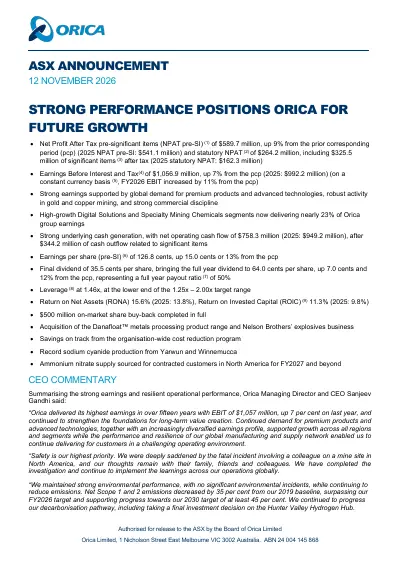
Turning now to slide 5, our financial and operational performance. We delivered another year of earnings growth in FY2026, achieving our highest earnings in more than 15 years, while continuing to expand margins and improve returns.
EBIT increased 7% to $1 billion and 57 million year-on-year. On a constant currency basis, this was 11% improvement versus the prior period.
Our group EBIT margins continued to improve, increasing from 12.2% to 12.8%. Net profit after tax before significant items increased 9% year-on-year to $590 million.
This strong performance reflects continued execution of our strategy, disciplined commercial performance, and the resilience of our global and diversified portfolio. Importantly, returns also improved.
EPS increased 13% to 126.8 cents. Return on invested capital increased from 9.8% to 11.3%, and return on net assets increased from 13.8% to 15.6%.
From FY2027, ROIC will become our primary measure of capital returns, reinforcing our focus on disciplined capital deployment and long-term shareholder value creation. The board has declared a final dividend of 35.5 cents per share, bringing the full-year dividend to 64 cents per share, an increase of 12% on prior year.
The dividend remains consistent with Orica's payout ratio policy of 40% to 70%. Our balance sheet remained well-positioned with leverage of 1.46 times towards the lower end of our target range, providing us with flexibility to continue investing for growth, both organically and through M&A.
Operationally, our global manufacturing and supply network again demonstrated amazing resilience. We achieved record production across key assets and successfully managed third-party supply disruptions in Western Australia and in the United States.
We've sourced ammonium nitrate supply for contracted North American customers for FY2027, and we now have line of sight on sourced ammonium nitrate to supply contracted customers in North America until 2030. We expect the supply dynamics in the US to change during 2027, which might offer Orica further opportunities to optimize ammonium nitrate sourcing in the US.
At the same time, our portfolio continues to diversify. Our higher-margin, high-growth Digital Solutions and Specialty Mining Chemicals now contribute nearly 23% of group earnings, complementing the resilience of our core Blasting Solutions business.
We also continue to invest for future growth, completing the Nelson Brothers and the Cyanco acquisitions, progressing expansion opportunities at Yarwun, Carseland, and Winnemucca, and reaching the final investment decision to proceed with the Hunter Valley Hydrogen Hub. Together, these outcomes demonstrate both the quality of the FY2026 result and the progress we are making to position Orica for sustainable growth and improve returns also in future.
Jamie will take you through the financial performance in more detail shortly. Moving now to slide 6.
Our strategy is working. Over the past five years, earnings and shareholder returns have more than doubled, while our portfolio has become more diversified and more global.
That diversification is strengthening the resilience and quality of our earnings, while returning more value to our shareholders. On slide 7, we delivered earnings growth across all regions and all three business segments in FY2026 as previously guided.
Australia Pacific and Asia delivered EBIT of $666 million, up 1%, with a very strong performance across Australia offset by lower Indonesian coal production, a three-month outage at a supplier's plant in Western Australia, and adverse foreign exchange movements. North America increased EBIT 20% to $254 million, supported by strong gold and copper markets and demand for our premium technology offering.
During the year, we also managed an extended outage at a third-party supplier's ammonium nitrate facility and sourced alternative supply for contracted customers in FY2027 and now beyond, further reinforcing the resilience and flexibility of our global supply network. EMEA increased EBIT 8% to $108 million, benefiting from higher activity across key mining markets and continued commercial and cost discipline.
LATAM increased EBIT 4% to $94 million, with technology adoption, new business, and structural cost improvement supporting performance in a very competitive market. Importantly, the breadth of this performance demonstrates the resilience of our portfolio across geographies, commodities, and technologies.
Turning now to slide 8 with Blasting Solutions. The core Blasting business was very resilient, with EBIT increasing 2% to $881 million.
The reported result was impacted by two significant external headwinds: a $34 million adverse impact of foreign exchange translation and a 20% lower Indonesian coal production quota issue in our key market of Indonesia. Adjusting for foreign exchange, EBIT increased 6%, driven by a $53 million improvement in mix and margin, while volumes were down.
We continue to see increased adoption of higher-margin premium products, advanced blasting technologies supported by disciplined commercial execution, and the successful renewal of numerous key customer contracts across the globe and several new contract wins across the globe. We also began to realize benefits of a structurally lower cost base with the organization-wide cost reduction program in line with the plan.
Operationally, we successfully navigated third-party supplier outages at Burrup in Western Australia for three months and in North America, while completing the major Carseland turnaround, which lasted two months. Overall, despite the Indonesian coal production cuts, third-party supplier outages, and our own major plant turnaround in Canada, the performance of Blasting Solutions demonstrates the resilience of the business and our ability to continue to grow mix and margin.
Turning now to Digital Solutions on slide 9. Digital Solutions delivered another year of high growth, with EBIT increasing 25% to $115 million, well ahead of revenue growth of 12%.
Importantly, this demonstrates the increasing scalability of the business, with EBIT margin expanding by 2.9 percentage points to 28.7%. Across Orebody Intelligence, robust global exploration activity continued to support demand for Axis products.
In Blast Design and Execution, favorable gold and copper fundamentals supported increased adoption of predictive grade control solutions, with strong demand for our blast measurement technologies as customers look to improve ore recovery and operating efficiency and improve costs. In Geosolutions, we saw very strong uptake of our new Series 5 radar for safety-critical pit wall monitoring, alongside continued demand for our broader geotechnical monitoring solutions across tailings dams and civil infrastructure applications.
Overall, the result reflects strong customer demand for connected workflows, our ability to provide solutions that deliver measurable improvements to our customers' operating outcomes, and Orica's global advantage in delivering at scale, with revenue growth translating into higher margins and significantly higher earnings. Slide 10.
Importantly, Digital Solutions growth is supported by continued momentum across its key leading indicators that we monitor very carefully. Our exit annual recurring revenue increased 14% to $258 million, while customer retention improved, with the churn rate declining from 5.8% to 3.7%.
We're also seeing benefits from leveraging Orica's existing customer relationships and channels to market to cross-sell our digital offering. Blasting customer penetration increased from 35% to 37%, while multi-product adoption across our Blast Design and Execution portfolio increased, with 31% of all BDE customers today adopting more than one BDE solution.
At the same time, we continue to invest in the next generation of technology across the portfolio, including exciting new developments in Orebody Intelligence, Blast Design and Execution, and Geosolutions. What is particularly important is that digital business is delivering strong stand-alone growth, while also complementing and strengthening our core Blasting Solutions offering.
By connecting Orebody Intelligence, Blast Design and Execution, measurement, and geotechnical monitoring through our open, secure, and AI-enabled common data platform, we can bring digital and blasting technologies together to help customers make better decisions, improve productivity, and increase resource recovery. That integration further differentiates Orica's offerings and gives us confidence in the continued growth potential of Digital Solutions.
Turning now to slide 11, Specialty Mining Chemicals. This business delivered another year of significant earnings growth, with record sodium cyanide volumes and continued margin expansion driving EBIT 25% higher to $126 million.
This performance was supported by record production across Winnemucca in the US, Yarwun, and Deer Park here in Australia, together with strong commercial discipline and supportive gold and copper fundamentals. We're also continuing to invest to support future growth.
We've already approved phase 1 of the Yarwun capacity expansion, with additional production expected in 2028, and we are also advancing expansion options at Winnemucca. Beyond sodium cyanide for gold, Cyanco is delivering good early sales momentum as we progress our strategy to expand our offering into copper processing chemistry.
We're also seeing robust customer demand for our specialty emulsifiers and increasing uptake of our scientific technical services for sodium cyanide at gold customers. Overall, Specialty Mining Chemicals is demonstrating the benefits of scale, with higher volumes, higher margins, and translating into strong earnings growth, while our investment in capacity and copper processing chemistry provide additional impetus for future growth.
I'll now hand over to Jamie to take you through our detailed financial performance.
Jamie Crough
Thank you, Sanjeev. Good morning, everyone, and thank you again for joining us on the call today.
I'll move to the key financial metrics shown on slide number 13. Our consistent and improving financial performance in 2026 is demonstrated by three things: the strength and increasing diversity of our earnings, disciplined conversion of those earnings into cash, and improving returns from the capital invested across the business.
While sales revenue grew by 1% to $8.3 billion this year, our earnings before interest and tax rose to $1 billion and 57 million, a 7% increase compared to the prior year. On a constant currency basis, sales revenue grew by 5% and EBIT by 11% versus the prior financial year.
I'll provide more details on this in the coming slides. Net profit after tax pre-individually significant items increased by 9% to $590 million.
Further to the disclosure at the half year, significant items totaling $325 million after tax have been recognized for the full year, primarily relating to litigation costs and settlement expense of the CF Industries litigation, incremental supply costs following the incident at the Yazoo City facility in November of last year, restructuring costs associated with the organization-wide cost reduction program, and a net gain on acquisition of the Nelson Brothers US explosives business. A breakdown of first and second half significant items is provided on slide 14.
After inclusion of these significant items, statutory net profit after tax finished at $264 million for the year. Net operating cash flow was again a key focus this year, finishing at $758 million.
Strong underlying cash generation across the business was partly offset by movements in foreign exchange and cash outflow relating to the significant items just mentioned. Normalizing for these items, underlying operating cash flow was strong, growing by 9% versus the prior year.
Return on net assets improved to 15.6% and increased from 13.8% in the prior corresponding period. Further to this, Orica has transitioned its primary capital return metric from return on net assets to return on invested capital, providing greater industry comparability and alignment with after-tax returns to shareholders.
Return on invested capital increased to 11.3% and increased from 9.8% in the prior year. Our strong performance in 2026 has enabled us to deliver continued improvement in earnings per share, pre-significant items, to 126.8 cents per share, an increase of 15 cents per share, or 13%, from last financial year.
Importantly, earnings growth was broad-based, with every segment contributing and the higher-growth Digital Solutions and Specialty Mining Chemicals businesses continuing to increase their contribution to group earnings. Turning now to slide number 15.
Starting with the Blasting Solutions segment, mix and margin increased by $53 million from the prior year, normalizing for movements in foreign exchange. This was driven by continued strong demand for our higher-margin premium products and technology solutions, a successful re-contracting cycle, and continued strong cost and commercial discipline.
This strong growth was achieved despite lower sales volumes in Indonesia due to a circa 20% reduction in thermal coal production permitting and an outage at a third-party supplier's ammonia facility in Western Australia in March. Premium product sales remains a key value driver for the Blasting Solutions segment.
Margin growth from our blasting technology product range increased by 11% in 2026, with strong, continued demand for safety, efficiency, environmental, and cost benefits delivered to our customers through our WebGen wireless blasting and specialty emulsion ranges. In the Digital Solutions segment, earnings increased by 25% to $115 million, an increase of $23 million from the prior year.
The segment continues to scale rapidly, underpinned by contracted and recurring revenue and strong customer retention. Pleasingly, the growth was ahead of plan.
Within Orebody Intelligence, elevated gold prices and copper demand continue to support high levels of exploration and demand for Axis technology products. As an example, drilled projects in September were at a 44-month high.
Total drill holes exceeds what was a strong 2025, with Australia and Canada reporting the largest number of drilled projects globally. In Blast Design and Execution, demand for OrePro and FRAGTrack continues to be strong, driven by a robust gold market.
Within Geosolutions, launch of the new Series 5 radar has received strong interest, providing the business with a robust pipeline for sales into 2027. In the Specialty Mining Chemicals segment, again, growth this year was ahead of plan.
Earnings increased by 25% to $126 million versus the prior corresponding period. Volume, mix, and margin increased, underpinned by record sales in sodium cyanide and emulsifiers.
Strong gold fundamentals continue to drive robust demand, and investment in the Yarwun phase 1 capacity expansion was approved this year, with completion expected in the second half of 2027 and production uplift expected in 2028. In North America, recent contract awards in the Nevada gold basin means that our Winnemucca solution capacity is oversold into 2028.
Pre-engineering is well underway to support further plant debottlenecking and potential expansion opportunities. In copper, demand remains robust, with established mines focused on maximizing recovery and concentrate quality.
Cyanco, acquired in April, is delivering strong early sales momentum and performing above its investment case, and has established Orica's first position in specialist copper chemistry. This represents an important step in diversifying the segment beyond cyanide.
Across our Blasting Solutions and Specialty Mining Chemicals manufacturing assets, we've also delivered improved performance versus the prior year. New sodium cyanide and emulsifier production records were established at Yarwun, Deer Park, and Winnemucca.
The Carseland major turnaround was completed in the second half. The Winnemucca major turnaround that commenced in October was successfully completed this week, and the Kooragang Island turnaround currently underway is progressing well.
Finally, global support costs have decreased versus the prior year, reflecting ongoing disciplined cost management, including savings from the organization-wide cost reduction program, and I'll expand on this shortly. In summary, our results this year have reflected the effective execution of our strategy, the resilience that we've built within the business over recent years, and our focus on broad-based earnings growth that is sustainable through the cycle, and importantly, that has continued into the start of the new financial year.
Turning now to operating cash flow on slide number 16. Underlying cash conversion, normalizing for the cash outflows related to significant items, increased to 70% and increased from 68% in the prior period.
EBITDA generation was strong, growing by $83 million. This was driven by growth across all segments and regions, more than offsetting adverse movements in foreign exchange, the unplanned Western Australia ammonia facility outage, and lower Indonesian thermal coal production.
Net cash outflows related to financing costs and taxes reduced by $33 million versus the prior year, with higher interest costs on drawn debt more than offset by lower tax installments given movements in regional country profits. Finally, net movements in working capital and cash inflows from associates was $22 million lower than the prior year.
As our business continues to grow, efficient cash management and the relationship to EBITDA remain a key focus across the entire business. Turning now to slide number 17 and trade working capital.
Encouragingly, the improvements that we've focused on over the past two years have been maintained throughout 2026. Absolute trade working capital finished September at $612 million, a decrease of $8 million from the prior corresponding period.
Importantly, this final balance included $61 million of net trade working capital held within the Nelson Brothers explosives business at 30 September following the acquisition, in contrast to prior periods where this balance was included in equity-accounted investments. Continued efficiency improvements drove a $38 million reduction versus the prior period, and foreign exchange had a favorable impact of $31 million.
Rolling trade working capital cycle days reduced by 3 days from September 2025. Days sales outstanding improved by 2 days, reflecting our sustained commercial discipline.
Importantly, days inventory held improved by 1 day, despite critical pre-stocking ahead of the October Kooragang Island and Winnemucca major turnarounds. Trade working capital to sales also improved versus the prior year, finishing the financial year at 7.4%, improving from 7.6% at September last year.
Turning now to slide number 18. Total capital expenditure for 2026 was $509 million, with expenditure across the existing business of $464 million, broadly in line with the prior year.
A further $45 million was allocated to development of the Hunter Valley Hydrogen Hub and capital expenditure associated with the acquisition of Cyanco and the Nelson Brothers explosives business. Across the year, $301 million was directed to sustenance capital expenditure.
This included successful completion of three turnaround events within the Specialty Mining Chemicals business in the first half and completion of the major Carseland turnaround in June. We continued to invest in our Blasting Solutions downstream business, including upgrades to our mobile delivery systems fleet in markets with strong demand for specialist emulsions, together with investments in our cyanide infrastructure and sparge fleet in support of record sales.
$163 million was also allocated towards growth capital expenditure in line with strategy, with this supporting upgrades to regional shipping infrastructure, initiating system capacity expansions in Latin America, further investment in our strategic partnership with Alpha HPA, and purchase of long lead-time items for the Yarwun cyanide plant expansion. We expect 2027 capital expenditure on the existing business to be between $470 and $500 million, and a further $130 million related to construction of the Hunter Valley Hydrogen Hub, net of government grants.
Turning now to slide number 19 on the balance sheet and liquidity. At 30 September, our balance sheet remains in a strong position, with a number of key funding initiatives successfully executed.
During the year, we successfully refinanced or extended $359 million of existing committed debt facilities for an average period of 5 years. We also established a new senior unsecured syndicated loan facility of $500 million in the Asia term loan market, a new loan market for Orica.
The average tenor of our committed debt facilities at 30 September was 4.1 years. Net debt ended at $2.1 billion, excluding lease liabilities, an increase of $224 million from the prior year.
This increase was driven by cash outflows, including $450 million of dividends and share purchases, together with $576 million of strategic capital investment, including the acquisition of the Cyanco and Nelson Brothers explosives businesses. This was partially offset by our strong underlying operating cash flows, net of cash payments made in relation to significant items.
Consistent with our capital management framework, our leverage ratio is 1.46 times EBITDA and sits comfortably within the lower end of our target range of 1.25 to 2 times. We maintained a robust liquidity position.
At year-end, we had $762 million in cash and $1.6 billion in undrawn committed bank debt facilities. In December 2025, S&P reaffirmed Orica's BBB stable investment-grade credit rating.
In summary, our balance sheet remains strong. It positions us well to manage external market volatility, execute on Orica's strategic priorities and long-term growth plans, and importantly, continue to deliver increasing returns to shareholders.
Turning now to slide number 20. At our half-year results in May, I shared that we'd commenced an organization-wide program to deliver both an enduring step change in the cost base of our business and to position the company for the next phase of profitable growth.
Across the organization, we've further expanded our global business services hub in Manila, made a number of changes to our in-country asset base, including go-to-market models, delivered significant freight cost reductions, and continued to leverage our respective buying power across key raw material and finished goods product categories. Pleasingly, the program is progressing well and on track to deliver our objective of at least $100 million of annualized cost savings by the end of 2027 relative to our September 2025 cost base.
In terms of a 2027 exit rate, we expect to deliver at least 2 times the program cost, with the benefits delivered across 2026 and 2027 materially exceeding inflation. Importantly, all program costs will have been incurred and provided for in the 2026 financial year.
Turning now to slide number 21. The Orica board of directors today have declared a final dividend of 35.5 cents per share, which brings the full-year dividend to 64 cents per share, unfranked, representing a full-year dividend payout ratio of 50.3%.
This represents a 7 cents per share, or 12%, increase on the 2025 full-year dividend of 57 cents per share. This increase, together with completion of the $500 million on-market share buyback, demonstrates our commitment to delivering enhanced returns to shareholders in a sustainable and disciplined manner, consistent with our capital management framework.
In summary, despite a difficult external environment, this year, we have delivered consistent and improving financial performance, with higher earnings, stronger underlying cash generation, and improved returns, while maintaining a strong balance sheet. This gives us the financial capacity to invest in our strategic priorities and continue increasing sustainable returns to shareholders.
With that, I'll now hand back to Sanjeev.
Sanjeev Gandhi
Thank you, Jamie. I'm now on slide 23.
Over the past five years, we have successfully executed our strategy to build a more diversified and resilient Orica. Earnings have more than doubled since 2021, while our portfolio has become more diversified across commodities, geographies, and technologies.
Digital Solutions and Specialty Mining Chemicals each grew EBIT by 25% this year alone, and together now contribute nearly 23% of group earnings. We've also deliberately increased exposure to gold and copper.
This has improved the resilience and the quality of our earnings and strengthened the platform for future growth. During FY2026, we undertook a comprehensive review of our strategy.
The conclusion was clear: the strategy is working, and there's more value to unlock from the portfolio and the capabilities we have already built. Turning now to slide 24.
Most of the assumptions underpinning our strategy way back in 2021 remain valid today. Gold and copper fundamentals remain attractive, with a positive long-term outlook.
Digital and technology adoption continues to accelerate, and our earnings diversification is progressing as intended. Acquisitions remain an important enabler, with our focus on value-accretive opportunities that strengthen the core or scale our complementary businesses.
One assumption has evolved: the energy transition is progressing more slowly than anticipated in 2021, with thermal coal demand proving more resilient. Turning now to slide 25.
Against that background, the market fundamentals supporting our strategy remain strong, providing a clear and long runway for future growth. Commodity demand remains robust, providing a tailwind for Orica across all three segments.
Gold fundamentals remain strong in a period of geopolitical uncertainty, while copper continues to benefit from the energy transition, supporting both our Blasting and Specialty Mining Chemicals business. This is also supporting increased exploration activity and demand across our digital business.
At the same time, our customers face increasing productivity, supply, and sustainability challenges, creating even further opportunities for Orica's differentiated solutions. Turning now to slide 26.
We see three areas of opportunities in our business. First, return on our customers' assets.
We see declining ore grades, increasing strip ratios, and rising costs, and this means customers need to move and process more material while improving productivity. Supply security: supply chain disruptions, labor constraints, remote operations, and increasingly complex permitting requirements are increasing the importance of reliable supply and operational resilience.
Thirdly, environmental and social responsibility: customers need to optimize energy, water, and the use of resources, reduce waste, and maintain their license to operate. These are increasingly interconnected challenges, and they favor trusted partners that can bring them together through the capabilities across the entire mining value chain to solve these challenges.
This plays directly to Orica's strengths. Better blasting and better fragmentation can reduce downstream processing and milling costs.
Our digital technologies give customers better information to optimize drilling, blasting, recovery, and to make better decisions and manage risk. Our specialty chemicals and technical services can improve metal recovery outcomes in processing.
Across our portfolio, our solutions help customers improve safety, manage environmental and social risks, and maintain their license to operate. Technologies such as wireless blasting reduce personal exposure to hazardous areas.
Our GroundProbe monitoring solutions help manage geotechnical risks, and our environmental blasting solutions help customers reduce vibration, nitrate, and other environmental impacts. With operations reaching more than 100 countries, we are the leading player with the global footprint and customer relationships to deploy these solutions globally at scale.
Underpinning all of this is our global manufacturing and supply network. It gives customers confidence that we can reliably supply and support their operations, including in some of the world's most remote mining regions, while maintaining high standards of safety, environmental, and social performance.
Our refreshed strategy is about integrating these capabilities even more deeply and help customers improve productivity, manage risk, and optimize the value they recover from their orebodies. Turning now to slide 27, our refreshed strategy.
Bringing this together, we believe we have the right strategy to deliver continued profitable growth and long-term value. Our purpose is to mobilize critical resources for a better future, and our vision is to build long-term value as our customers' preferred partner.
We have four strategic levers that differentiate Orica: firstly, reliable execution: operating safely, reliably, consistently, and delivering consistently for our customers always. Second, an integrated portfolio: combining blasting, digital, and specialty chemicals to solve more of our customers' challenges.
Thirdly, our global network: providing supply security, resilience, and the ability to serve customers at scale all around the world. Fourth, data-led insights and technology: helping customers make better decisions and improve productivity, recovery, performance, and safety.
These strategic levers are delivered through our three core businesses and brought to life by our people, our team. We have built the portfolio.
Our opportunity now is to integrate these capabilities even more deeply to deliver better customer outcomes, sustainable growth, and improved returns. We intend to hold a strategy day in March to elaborate on drivers and KPIs underpinning future earnings growth, and I hope to see all of you there.
Turning now to the outlook for 2027 on slide number 29. For FY2027, we see continued positive momentum, strong fundamentals, and profitable growth.
In Blasting Solutions, earnings growth will be supported by uptake of premium products, commercial discipline, cost reduction benefits, and Nelson Brothers acquisition. We do call out that we continue to see lower Indonesian thermal coal, and our assumption for FY2027 is that the coal permitting will stay at the level of FY2026.
Now, if that changes in the new year, that's obvious upside for our business because we are a market-leading player in the Indonesian market. We do have planned major turnarounds, and that is also called out.
In the Blasting Solutions business, we've got Kooragang Island being maintained and shut at the moment, and we expect to start the asset up end of this month, and in the second half of our financial year, we will have the Yarwun asset down for maintenance. Digital Solutions is expected to maintain strong earnings growth as customer adoption and cross-selling continue to increase by leveraging Orica's unique access to the blasting workflows.
Specialty Mining Chemicals earnings growth will benefit from the ongoing robust gold demand and growth from the new mining chemicals offerings, partly offset by the planned turnarounds at Winnemucca in the first half of this year. The plant has now already restarted, and then in the second half, we do have a Yarwun sodium cyanide shut.
We will remain focused on disciplined cost management and execution while maintaining balance sheet strength and leverage within our target range. CapEx is expected to be between $470 to $500 million, excluding approximately $130 million related to the construction of the Hunter Valley Hydrogen Hub, net of government grants.
Looking beyond FY2027, we continue to see positive momentum and growth opportunities across the portfolio, and our medium-term outlook remains unchanged. We continue to expect GDP-plus earnings growth in Blasting Solutions, mid-teens earnings growth in Digital Solutions, and high single-digit earnings growth in Specialty Mining Chemicals.
Combined with the refreshed strategy I've outlined today, we believe Orica is well-positioned to sustain earnings momentum, improve returns, and maximize total shareholder returns over time. Turning now to my last slide on page number 31.
Let me close with five key messages from today. First, we've delivered strong earnings growth and underlying cash conversion while continuing to improve returns on invested capital.
Secondly, our business has once again demonstrated its resilience, supported by the strength of our global manufacturing and supply network and our ability to manage significant external and supply disruptions. Third, we continue to deploy capital with discipline, including through value-accretive acquisitions and targeted investments in growth opportunities across our portfolio.
Fourth, our balance sheet remains strong, giving us the flexibility to continue investing for growth while delivering sustainable returns to shareholders. Finally, the strategy is working.
We have reaffirmed our direction, and with supportive long-term market fundamentals, we see continued opportunities for sustainable growth and improved returns. We've started FY2027 with strong momentum, a clear strategy, and a stronger, more diversified portfolio.
Our focus remains on executing consistently for our customers and maximizing shareholder returns over time. With that, Jamie and I will be happy to take your questions.
Operator
Gentlemen, we will now begin the question and answer session. If you would like to ask a question on the phone, please press *11 and wait for your name to be announced.
To cancel a request, you can press *11 again. One moment for our first question.
The first question comes from the line of Niraj Shah from Goldman Sachs. Your line is open.
Niraj Shah
Hi, guys. Thanks for taking my question.
Just a couple clarifying the outlook. I guess the first one is, notwithstanding the shuts in Indonesia, just want to clarify whether you expect earnings growth within Blasting Solutions?
Sanjeev Gandhi
Yes, that's our intention, that we'd like to grow all three segments year-on-year in terms of earnings, Niraj.
Niraj Shah
Got it. Thank you.
Then just double-clicking on Digital Solutions for a second. Obviously, the beyond '27 guide is, or the target is mid-teens, but your comment on maintaining momentum, does that suggest it should be sort of closer to the rate of growth that we saw in '26 rather than the mid-teens level?
Sanjeev Gandhi
Higher the better, Niraj, always. You see the challenge with forecasting digital is the teams are so creative and so innovative.
We are launching something like 8 to 10 to 12, 15 products or solutions a year. The pipeline is so rich, and one or the other might become a blockbuster, we might even grow faster.
That's why I always say higher the better. We don't have any ceiling on growth and ambition in the digital business.
Niraj Shah
Fair enough. Thank you.
I'll leave it there. Participants,
Operator
please hold for our next question. The next question comes from the line of Jakob Cakarnis from Jarden Australia.
Your line is open.
Jakob Cakarnis
Hi, Sanjeev. Hi, Jamie.
Just question on Specialty Chems. Through the second half, you saw about 330 basis points of EBIT margin expansion.
You saw a re-acceleration of growth in that division. Obviously, industry conditions are good, but how do we think about capacity in that business and maybe some of the sustainability of those growth levels as you've exited '26, please?
Sanjeev Gandhi
Thanks, Jakob. The pipeline looks very, very exciting.
We saw this development two years back, two and a half years back with the exploration pipeline into gold. Obviously even today, gold has come off a bit, but it's still at whatever, $4,000, $4,500 an ounce, very, very attractive.
We're seeing benefits coming obviously into the blasting business. You have to blast more rock to get the same grams of gold out, but especially in SMC, you need much more sodium cyanide, and that's been the macro that's been very beneficial for us.
When we acquired Cyanco and the two assets in the US, we did call out that our theoretical nameplate capacity is around 240,000 tonnes, including Yarwun and the two assets in the US. We've also said at this year-end that capacity is being maxed out as we speak, and we're not able to keep up with demand.
That's the reason why, after investing significantly over the last two, three years in reliability at Winnemucca, we are now proceeding with expansions at Winnemucca. Winnemucca has got a lot of capacity that we can liberate.
When we acquired the asset, we knew this, but it was always the priority was first safety, secondly reliability, and then third expansion. Now we're now at the third step.
We are also now looking at expanding, and we've already started the project to do more at Yarwun. Now, Yarwun has maybe tripled in capacity since that asset was built, but there's always more room, and that's all credit to our manufacturing folks.
They always have these brilliant ideas, and we are now giving them capital to execute. My expectation is 2027 will be a strong year.
We will still see volume growth because we still have some headroom in terms of plant capacity, and 2028, we'll see new volumes coming through. Why is that important?
Because our contracting pipeline and the new businesses we have won, not only in the gold belt, but globally, a lot of those start to commercialize from end of 2027, and we needed those capacities. Meanwhile, we have to source third-party tonnes in the market to ensure that we are pre-marketing those expanded capacities, and then we'll replace the third-party product with our own product.
The pipeline is very attractive, the fundamentals are very sound, and we need more capacity, and we needed it yesterday. We are well on track with that.
Jakob Cakarnis
Thanks for the color there, Sanjeev. Just one for Jamie.
The $100 million cost-out, obviously saying
Sanjeev Gandhi
Jakob, you there?
Operator
I beg your pardon. Sir, may I have Jakob to press *11 again?
I beg your pardon. While waiting, allow me to take the next question from Lee Power of JPMorgan.
Please go ahead.
Lee Power
Hi, Sanjeev and Jamie. Sanjeev, just on following up from Niraj's question, maybe a different way around Blasting Solutions.
In the different regions, do you expect earnings growth? Maybe a part of that, if there's any way that you can quantify the Indonesian impact in '26 and kind of how that plays into '27?
Sanjeev Gandhi
Let's start with the Indonesia because these are published numbers. Indonesian permitting happens twice a year in the first calendar half and the second calendar half.
In the second calendar half of last year, permits were reduced by 20%. Production of coal came down by around 12% to 15%.
There was real volume reduction at our customers. We are the leading player in Indonesia, we talk to our customers every day.
There's a lot of frustration because the thermal coal prices are still very, very attractive. There's a missed opportunity there.
Now, if you read the press and we know what's happening on the ground in Indonesia, there's a lot of political upheaval there, and there's a lot of distractions happening there. We don't read the future.
We don't know the future. What we've assumed is that same level of production our customers had during FY2026 will continue to FY2027.
That's a reduction of between 10% to 15% of volumes versus a normalized year of FY2025. Now, there are signs that things might improve, but yeah, when we get it, we'll take it, obviously, since we're already there, but there might be a bit of a lead time because once customers get permits, they start to mobilize and ramp up production.
It takes a few weeks, months, because some of our customers have sent their crew back and reduced people on-site. I don't expect an immediate recovery within the next couple of months, and then we'll watch this in the second in the first calendar quarter of next year.
Obviously, if production increases, that's an upside to blasting. That's where we are at Indonesia.
We're taking a more conservative approach. There may be upsides.
It might come faster, but we are there. We've got manufacturing, we've got ammonium nitrate there, our detonator plant is running very well, and we've got some major contract wins and renewals already executed.
We are just waiting for our customers to go through the permitting process again, and hopefully, the political situation will not defer or delay this. That's Indonesia for you.
AusPac is looking very, very strong from a volume point of view. We've just finished October, very strong momentum.
I don't expect that to change, but remember that in December, January, we get wet weather, we've had a few years where the weather's been really wet, and then mines had to shut down, so that's something we watch. Again, our production network is now more resilient.
We've got more emulsion capacity. If the weather gets wet, but miners still operate, we will benefit.
North America is looking very, very good. We don't have the Carseland shut, we've got significantly better volume coverage there.
Then, as I said, we are covered contractually there for all of our contract customers. Sourcing costs have gone up in the US.
That's very, very clear. Again, as we highlighted a few weeks earlier, we don't see that as a material headwind to our margins in North America in FY2027 and beyond.
Now we've got line of sight until 2030 for contracted customers, we feel relatively comfortable there. We continue to see momentum in the Canadian belt as well as in the gold belt in the US, and also in the construction market, and this is mainly driven by the aggregates demand for data centers.
We've got a bigger footprint with Nelson Brothers now in the quarrying and construction market, so that's giving us a lot of leverage. EMEA is looking very, very positive.
There will be a slowdown in EMEA, as it is in Canada. This comes from winter in the first quarter, but then after that, we should see strong demand both for the mining sector in Africa and also in the Q&C sector in Western Europe and other parts of the globe.
LATAM remains a very competitive market, but we've had some fantastic customer wins and renewals, and the business is looking really, really strong, and there is a massive push on technology in LATAM. There's a lot of automation interest, and wireless blasting and sophisticated emulsions.
Also the volume outlook in LATAM is looking pretty good. Overall, I would say Blasting Solutions is looking good, but we do have to watch for the two major shuts we have this year: Kooragang Island as we speak now, and then Yarwun in the second half of the year.
Lee Power
It sounds like Blasting Solutions earnings growth as you have in your guidance, and then Asia Pac is kind of just a bit dependent on what happens with Indonesia, obviously we're kind of watching the media around the quotas. Then Specialty Mining Chemicals and digital, there's been a few questions on that already, but the second half in Specialty Mining Chemicals, you delivered more EBIT than revenue growth in dollars, and digital had a very strong 2H as well.
I guess why don't we grow closer to a 20 than kind of in the teens? I hear your point around Yarwun, but it doesn't feel like outside of that there's a massive difference on the turnaround schedule year-on-year, and it doesn't feel like it was a big free kick into the 2H '26 either, from what you've said around the genuine momentum in the business.
You're clearly doing a good job. I just kind of struggle a little bit as to how I progress that through to '28 and what does kind of slow down that growth rate that we've seen in the second half?
Sanjeev Gandhi
Look, the only unknown is the macros in gold, and that's your bet versus our bet. Our view is that given global volatility, gold will continue to be strong.
Exploration pipeline is now starting to convert into actual production, new mines coming up. We've got some great contract wins.
That's going to drive further volume growth, and that's why we're preparing further expansions. In the first half of 2026, we did have a couple of shuts at Winnemucca, and that did impact volume availability, and we had to supplement this with either Yarwun exporting long distances, lower margin, or buying third-party.
Now, obviously in the second half of FY2026, it was cleaner. We did not have that many shuts.
We have a shut as we speak in October this year, and that also gave us more own manufactured product, which always comes at better margins. Then the supply chain optimization, the team has also done a good job in terms of managing their costs, optimizing the global supply chain between the three manufacturing sites we have, and obviously re-contracting and bottom slicing.
All of that plays into it, and now we'll start to see the first full-year benefits of all of that hard work done commercially, and then the volume growth will start from '27, end of '27, '28.
Lee Power
Perfect. Appreciate the color.
Thank you very much.
Operator
Thank you for the questions. We have a follow-up question from Jakob Cakarnis from Jarden.
Your line is open. Please go ahead.
Jakob Cakarnis
Hi, guys. Thanks for the opportunity to finish the questions there.
It was just one for Jamie, just on the $100 mil of cost-out. I think you said that most of the below-the-line restructuring costs were taken through calendar '26.
Just the expectations there for below-the-line items into 2027. Then how do we think about the gross savings versus the net savings on that $100 mil of targeted costs, please?
Jamie Crough
Thanks for the question, Jakob. Just to clarify, we're not planning for significant items next year.
We're not planning for any further disruption. All of the costs associated with the cost-out program were either incurred or provided for in the '26 financial year.
Now, that's cost. In terms of cash, there will be some cash flow into 2027, around $20 million, and that's to do with the organizational changes that we made through the second half.
All costs associated with the program were expensed in 2026. In terms of the actual cost delivery, as I said, we're on a run rate to deliver twice the program cost.
The entire benefit will more than cover inflation across two years. Now, remember, we did start the program just before the start of the second half, it's about 6 or 7 months of benefit in 2026.
There'll be a full year in '27, and then you look at the exit rate coming out of '27, it'll be well and truly more than inflation and then around the 2 times the program cost.
Jakob Cakarnis
Thanks, guys.
Operator
Thank you for the questions. Please hold for our next question.
The next question comes from the line of Sam Seow of Citi. Your line is open.
Please go ahead.
Sam Seow
Morning, all. Thanks for taking the question.
Just a quick one on, I guess, the net turnaround benefit you're expecting in FY2027. Obviously, Carseland won't happen again, but you've got KI and Yarwun offsetting.
Is there a net amount you're expecting in FY2027 or even directionally whether that should be a benefit or a headwind? Thank you.
Sanjeev Gandhi
Look, we had two, we had the Carseland plant shut for two months last year. That's roughly 100,000 tonnes missing from our network in FY2026.
We also had the unplanned three-month shut at Burrup, and that is another roughly 100,000 tonnes missing from our network. Last year, we were missing, or FY2026, we were missing 200,000 tonnes of own manufactured product.
Now, obviously the Burrup being a joint venture, we took 50% of the hit, I would say 50,000 tonnes of volumes were missing. That was roughly 50,000 tonnes in Australia missing and 100,000 tonnes in Canada missing, that's 150,000 tonnes.
This year, we've got two months at Kooragang Island, and then an extended shutdown in the second half at Yarwun. That's roughly 200,000 tonnes missing.
We are negative in deficit by roughly 50,000 tonnes this year because of the plant shuts versus the prior year. If that helps, Sam, to calculate the numbers.
Sam Seow
No, thank you. That really helps.
Then maybe then on Nelson, the accounts have about $150 million in sales, about a third of the 400-odd it did this year. In terms of profit contribution, should we assume a similar third of that $35 mil you've previously talked to as well in FY2026?
Thank you.
Jamie Crough
I'm happy to take that one. If you look at, I guess, if you look at the earnings pre-acquisition and then post, pre-acquisition, it delivered around $16 million, and then post-acquisition, it's delivered around $12 million, and that's pre-significant items after acquisition.
Remember that the $12 million post-acquisition would have included integration costs that we've been working through in the latter part of the financial year. We are on track to deliver the incremental $35 million earnings, as we said in the announcement post-integration, in the first full year of ownership.
Sam Seow
That's helpful. Thank you so much.
Operator
Thank you for the questions. One moment for our next question.
Our next question comes from John Purtell of Macquarie. Your line is open.
John Purtell
Good day, Sanjeev and Jamie. Hope you're both well.
Look, just had a couple of follow-up questions there. Thanks for the commentary, just in terms of the shutdown impacts again for the year ahead.
I appreciate the tonnage comments there. Obviously, Australia is sort of highly profitable region.
I'm just wondering if you're able to sort of quantify a sort of collective EBIT impact from shutdowns for this year. You've obviously given us a bit of a steer there, but it's obviously going to be a material item and I suppose maybe whether you agree with that as a starting point.
Thank you.
Sanjeev Gandhi
Thanks, John. Take the 50,000 tonnes delta that's unfavorable for FY2027.
You've got the gross margins of the Australian and this all own manufactured product at KI and Yarwun, and you've got the gross margins there. That gives you a very rough calc.
If I would do it, and don't hold me on those numbers, I would come to a gross margin impact of, Jamie, he'll kill me here, but maybe around $30 million gross margin, and then you can do the math on that, John, if that helps.
John Purtell
Thank you. Just two two other questions, please, and I'll just ask them at once there.
Coming back to your North American comments, Sanjeev, you said you've got a line of sight until fiscal '30 re North American supply contracts. That implies that you have signed additional contracts since the update in September.
Sanjeev Gandhi
It's calendar 2030, John. Our contracts are on an annual basis.
They don't bother about our strange financial year ending to September, it's just calendar. We've got the line of sight.
We've been working through every little detail, and you can imagine our cautiousness in what we sign and where we sign. It's taking a bit of legal work on it, but we feel very, very comfortable that we will cover all of our contractual obligations until calendar 2030.
John Purtell
The final one, just to follow up that, and one other question if that's okay, but so would you be expecting to have those sort of multi-year contracts sort of signed within the next sort of 6 to 12 months? Is that a realistic timeframe?
Then just lastly, price increases in Australia, I think you've got a bit more of your book up for renewal this year, any commentary there? Is that a material positive for you in '27?
Thank you.
Sanjeev Gandhi
Thanks, John. We'll have everything lined up and covered.
When we got out of the former contract with single source, I said that the strategy is to have multi-year, multi-source contracts in different parts of the US to support the North American business, and that's what we have achieved. It's multi-sourced, it's not single source, and it's multi-year.
It's not 10 years, but it's also not 12 months. We've managed to get everything we wanted, but we are still keeping some powder dry because I do expect there might be some change in supply dynamics in 2028 or maybe in the latter half of 2027.
We're keeping all options in the air. Meanwhile, we're working really, really hard to optimize that supply chain.
Those four assets we acquired from Nelson Brothers, they've been brilliant for us because that's where we make the value-added emulsion. That's where most of that product that we source is consumed, and now we are optimizing supply chain.
We're using rail cars, we're using transport barges, everything, to ensure that we are landing the product at least as good as we did with the former contract, and in some cases, even better, and our volumes are much lower now. All of that is fitting beautifully into that strategy and the vision that we had to redesign supply chain in North America.
Now, don't forget that we've also got more capacity in Carseland, and that obviously is the most precious tonnes we've got in terms of margin, and now we've got the flexibility to also flex the Carseland capacity. Carseland also can have some low seasons during winter and all the other stuff, we are now able to flex all of that, and then it's the beauty of the global network.
We can land product anywhere in the world we want as long as customers are willing to pay for it, but that always comes with a cost, and that's why I keep saying that if we have a contract, we will fulfill the contract. We've never let a customer down.
That's the resilience of the business in terms of our AN nitrogen situation in North America. The second question was
John Purtell
Contract renewals.
Sanjeev Gandhi
Contract renewals. In Australia.
Look, good momentum. We've done very well, we've had a few wins, it's looking good.
I don't think there's any big step-up in our contract renewal book for next year. I think it still stays in the 20% to 30% ballpark, not just here in Australia, but globally.
Most of the heavy lifting we did in 2025 and 2026, and we're enjoying the full-year benefits of those improvements there. I don't see 2027 as any kind of special or out-of-cycle year.
We should be in pretty good shape with everything we have, and given that the market is favorable in terms of supply and demand, we feel very, very comfortable with our commercial discipline.
John Purtell
Thank you.
Operator
Thank you for the questions. Please hold for our next question.
Our next question comes from Mark Wilson of Royal Bank of Canada. Your line is open.
Mark Wilson
Thanks very much, Sanjeev and Jamie. Just coming back to the US, just wondering how tight you are seeing the market at the moment, and what you are actually doing in order to navigate that with a major plant still down, and looks as though it'll be down for the next 12 months?
Sanjeev Gandhi
Look, when a million tonnes of capacity is out, it obviously means that the market does not have significant length. Having said that, given our size and scale and the way we manage our supply chain and our global network, we've supplemented what we were missing because of the force majeure through the network.
We've got Carseland back up and running at max load, so that's been really, really helpful. We're looking at further debottlenecking at Carseland, all of that is extremely valuable.
We've leveraged the global network, and we are able to land product if we need it, and then we've got the sourcing alternatives that I just talked about when John was asking about it. Sourcing costs have gone up very clearly, and you know that our US business is traded tonnes business, we do this as a service to customers.
We don't have manufactured margins out of traded tonnes in the US, similar to what we do in LATAM. If a customer is willing to pay, we are more than happy to source the product.
We will always source the product, given our size and scale and our global network. It comes at a cost, obviously, and wherever customers are willing to contract, we are happy to continue to serve them.
Otherwise, the big focus in the US market has always been services, and now with the Nelson Brothers infrastructure there, the significant more number of people on the ground, the trucks on the ground, the emulsion assets, that's where the bigger focus and the strategic focus of the business is: how do we feed those assets into the value-added services that we provide to our customers? Bottom line, sourcing costs went up.
We are sourced for our contracted customers, and if customers are interested in dealing with us, we can obviously have those conversations and get them more volumes.
Mark Wilson
Are you able to impose your pass-through arrangements with all of your contracts?
Sanjeev Gandhi
For traded products, it goes right through. Otherwise, we would not do it.
It always does, right? For all of our businesses, wherever we buy nitrogen, we pass it through straight off.
It's the same model in the US, nothing different to what we do elsewhere in the world.
Mark Wilson
Given that the US market has historically been long, is there the prospect now that you are able to actually start to get some real price increases through, even on, I know they are traded tonnes, but start to gain a margin on those traded tonnes?
Sanjeev Gandhi
Costs have gone up, and that means prices go up. It gets reflected in the COGS for the downstream products.
It also gets reflected wherever, and it's very rare that we supply AN as AN, but if we ever do that, it just gets fully passed through. Prices have gone up, but honestly, for me, prices are irrelevant because in the end, we focus on margin.
We don't focus on tonnes or revenue. As long as we're able to make a traded margin and we don't lose money, we are happy to serve our customers.
Mark Wilson
Yeah. I was thinking more for your Carseland plant.
Sanjeev Gandhi
Look, most of Carseland, I would prefer Carseland staying in Canada because you don't want to add logistics cost. That takes away your margin.
In the past, we've been excluded from leveraging Carseland for the US. Today, we could do swaps.
We could do regional swaps, we could do location swaps, we could do time swaps. If we feel that there is value in moving Carseland product indirectly into the US, we are more than happy to do that.
If we need to physically move the product, then we have to be very cautious that we don't give away margin by increasing supply chain costs. The beauty of the current situation is we've got every option on the table, and in the past, we were limited from leveraging our global network.
Now we're happy to do that, yeah, and it works in our favor.
Mark Wilson
That's great. Thanks very much, Sanjeev.
Operator
Thank you for the questions. Please hold for our next question.
Our next questions will come from the line of Ramoun Lazar of Jefferies. Your line is open.
Ramoun Lazar
Morning, us or good afternoon, Sanjeev and Jamie. Maybe just on the seasonality, sort of first half, second half, you're expecting in '27, just given that turnaround schedule across across a couple of your businesses.
Maybe if you can help us with that, be good.
Jamie Crough
Hi, Ramoun. Good question.
If you go back, look at the last two financial years, I think from memory, 2025 was around 49/51. I think in '26, we were 48/52.
There will be more of a second-half bias because of the Kooragang Island and Winnemucca turnarounds. I think at this stage, if rule of thumb you said 45/55, that would be about right.
Ramoun Lazar
That's very helpful. Then maybe, Jamie, while I've got you, I guess just how you're thinking about the leverage at the end of fiscal year '27, just given the elevated CapEx, and then also some strong working capital performance.
Do you expect any of that to sort of reverse into the new year, any guidance around balance sheet would be helpful?
Jamie Crough
Sure. I expect, when you look at the performance in the way that the business has managed working capital in really difficult circumstances over the last 2 to 3 years, it's terrific.
I expect that to happen again into the new financial year. In terms of the balance sheet, look, it's in great shape.
If you look over the last 2 years, and you look at the dividends that we've paid to shareholders and the on-market buyback, we've returned over $1 billion in capital back to shareholders at the same time that we've been investing for growth. The balance sheet's in great shape.
As I said, leverage is in the lower half of the leverage range. I think I might have said this on a previous call: we do our strategic planning process in February, where we look at what does the next 5, 10, 15 years look like for the business, and what's the next horizon of growth.
We've just refreshed our strategy. That's the time we look at where do we have to deploy the balance sheet to deliver that growth.
Then we'll obviously have more that we can say at the investor day that we're planning in the first half in terms of capital deployment.
Ramoun Lazar
Great. I'll leave it there.
Thanks.
Operator
Thank you for the questions. One moment for our next questions.
Our next questions come from the line of Brook Campbell-Crawford from Barrenjoey. Your line is open.
Brook Campbell-Crawford
Thanks for taking my question. I just had two following on from that comment on the balance sheet.
You mentioned in the opening remarks, Sanjeev, about M&A, and just wondering just sort of providing a little bit of extra color there, what are you thinking about the sorts of opportunities that could be complementary to your group at the moment? Thanks.
Sanjeev Gandhi
Thanks, Brook. You've seen our track record.
We've done Axis successfully. We've done Cyanco successfully.
We've done Terra Insights successfully. Now Nelson Brothers.
It's been a pretty decent run, timely. We've paid the right values, and now we're benefiting with the growth that's bringing to us.
As Jamie just said, we've just refreshed our strategy. We're in the process of outlining the 10-year horizon and the 5-year plan.
We'll confirm that in February. We'll then, as much as we can, talk to you at the strategy day in March.
The new strategy is about growth. It's about doubling down on what we've done successfully, building up the portfolio, scaling up the businesses we've acquired, and the ambitions are in all three segments.
If we see an opportunity in Specialty Mining Chemicals, or in digital, or even in blasting perhaps. The last major move we did in blasting was in 2019, and now we did the move in the US with Nelson Brothers.
We're open for everything. We'd like to have a seat at a table wherever there's an opportunity.
We've got the balance sheet capacity, and we will not do silly things. I think it's a good combination, and everything we do in terms of capital deployment will be about profitable growth going forward.
We're open to investing organically. We are also open to looking at M&A within the guardrails of the refresh strategy and at the right value.
Brook Campbell-Crawford
Thanks. Just a second question around the return on net assets.
It looked like it was about 10% for chemicals and digital, obviously higher in blasting. Interested to hear the outlook to lift that return on net assets for digital and chems.
Any targets you can share with us, or sort of a timeline around perhaps where you think that sort of might get up towards where your blasting returns are operating at? Thanks.
Sanjeev Gandhi
Higher the better, Brook. That's always the constant focus, and that's why we keep focusing on the margin improvement in in chemical and digital.
Obviously, we've invested heavy M&A CapEx in both both digital and chemical business, and the way the RONA is calculated is you got the asset base day one, and then the earnings come over a period of time. How we struggled to to stabilize production at the at the Cyanco assets.
It took us several years to do that now. Now it's pumping, and now we are able to start pushing and focusing on margins, and and reliability, and and commercial discipline.
The same with digital. It always takes time, but we do catch up, and we've had this great track record of proving that those investments were those acquisitions were timely, and the focus clearly and the challenge is on continuing to grow the business, but also to continue to improve the margins.
Now, average margins in digital are significantly higher than the entire portfolio. Average margins in chemicals are also very, very attractive, and I see no reason here to to stop that good work.
We'll continue to push RONA, but we'll next year onwards, we'll start or from this year onwards, we'll start talking about ROIC now. That's going to be the new metric that we're going to focus on.
Group RONA at close to 16%, we basically achieved everything we wanted, and I think it was with the strategy refresh a good time to look at ROIC as a more comparable metric when we benchmark versus the world, yeah.
Brook Campbell-Crawford
All right. Thank you.
Operator
Thank you for the questions. One moment for our next questions.
Our next questions come from Nathan Reilly from UBS. Your line is open.
Nathan Reilly
Afternoon. I was just looking at the significant items reconciliation.
Just picking up on the second half US supply disruption costs, obviously Yazoo City force majeure being the issue there. Your second half looks like the implied gross pre-tax costs in terms of annualized impact running about $50 mil.
With that sort of situation now sort of dealt into your new approach to market, is it safe to assume that notional cost headwind has been fully offset or more than offset by adjustments you've made to your network in terms of freight savings, leveraging Carseland, some of the cost-out initiatives, but also just getting into some of those, I guess, rearranged supply arrangements in terms of offtakes coming through at a better than spot price?
Sanjeev Gandhi
That's correct, Nathan. When we started off with this unfortunate situation in November, where the force majeure was announced, we were 100% spot, obviously we bought the most expensive tonnes because we would not allow our customer site to shut down, and then slowly but surely, we've transitioned into leveraging the network.
Now we're leveraging Carseland post the shutdown in June earlier this year, and then we've contracted. Obviously, the contract, even though sourcing costs have gone up, the contract prices are not as high as the spot prices, which is quite obvious.
All of that is helping us to slowly but surely get that cost element in control. Then, as you said, supply chain optimization, we don't need thousands of rail cars now.
We can do so with much lesser running cost of the supply chain, a more optimized supply chain, less distance to transfer, closer to those emulsion assets we've acquired in the US. All of that is really starting to play out.
When we announced contracting for FY2027, we said that any negative margin impacts are negligible. That's the outcome of all of that work that we have done.
Now, multiple sourcing, line of sight on new contracts, all of that will make the situation even better. Again, to be clear, sourcing costs are higher than they were before the world turned topsy-turvy in the US, but we've managed that, and once again, the team did a brilliant job to manage that.
Then the cost restructuring and all of that helps to ensure that we don't have any margin headwind in FY2027 from third-party sourcing.
Nathan Reilly
Does it translate to a tailwind in '28 with the updated contracting which you've done more recently beyond '27?
Sanjeev Gandhi
Depends on supply dynamics. We don't know in which form, when capacity comes back into the market, but that will clearly change supply dynamics, and we are ready.
We are a net buyer, right? At the right price, we will always source tonnes to serve our customers.
If that's an upside, we are happy to take it.
Nathan Reilly
Okay. Thanks very much.
Operator
Thank you for the questions. Our next questions will come from the line of Harry Saunders of E&P.
Your line is open.
Harry Saunders
Good afternoon. Thanks for taking my questions.
Firstly, putting together a lot of your earlier comments, if we're bridging '27 overall versus '26, if we just firstly look at digital and specialty and your medium-term growth ambitions, would imply, call it around $30 million of EBIT just on the two growth you're targeting, and perhaps running a bit better than that currently. Then in Blasting, I think medium-term you're expecting GDP-plus growth, and you pointed to growth this year.
Just appreciate there's some other impacts, but can we expect something similar to GDP-plus in FY2027, please?
Sanjeev Gandhi
Harry, I always answer this question by saying higher the better. It would be the same answer.
Now, just look back at FY2026. Underlying blasting was what, 2%?
Underlying blasting without the currency impact was 6%. That's well in line with GDP-plus, even in a very, very difficult year for us, right?
I hope that FY2027 doesn't give us any curveballs that we don't control, and if everything works in our favor for a change, and not against us as we've seen the last couple of years, and if Indonesia comes back, then there is more upside than downside for FY2027. Now, your guess on GDP for FY2027, and then I can then add on to that and say hopefully we'll do better than that in Blasting.
Harry Saunders
Got it. I guess the question really stems from there's some impacts in Blasting, even factoring those in, and not factoring in an Indonesian pickup, it sounds like you're aiming potentially for call it that 6% again?
Sanjeev Gandhi
Higher the better. Okay.
Harry Saunders
Then just maybe we talk through these impacts a bit more. The net impact of turnarounds, I think you were talking to a $30 million number potentially on a net basis after factoring in the Carseland non-repeat.
Then just wondering, what is the incremental contribution from Nelson Brothers anticipated? Cuz I think it's $35 mil is first full year, and you would have had some in '26, and it was ramping.
Just curious what the sort of net incremental is there. Then incremental cost-out across the group '27 on '26, can you just give us a sense net of inflation there, please?
Sanjeev Gandhi
Let Jamie answer that. Just to clarify, the $30 million number which I threw out there is a gross margin number based on a 50,000-tonne volume headwind we have because of the consolidation of the Burrup tonnes.
Just to make that clear. Jamie, you want to address the net of inflation and impact from the cost savings at Nelson Brothers?
Jamie Crough
Just on Nelson Brothers, just as I said before, you can see from the stats what the joint venture was contributing when it was an equity-accounted associate. Obviously, now that we have purchased the business, you need to double that.
Then obviously, there's going to be synergies and cost savings and costs associated with the joint venture that fall away, and that's how we get to the incremental $35 million post-acquisition in the first full year of ownership. What was your second question around the cost-out program?
Harry Saunders
Firstly, on that 35, clearly it's this year, but what is the incremental on '26 roughly, cuz there's synergies and everything else that would have partly contributed in '26? Then cost-out, just wondering what the net of inflation sort of cost-out you would anticipate in '27 over '26, and should we maybe think of it as additive on top of those medium-term growth targets, or is it sort of just supportive of those?
Thanks.
Jamie Crough
As I said earlier, the earnings pre-acquisition was $16 million, and post-acquisition were $12 with full ownership. Now, if you think if it were a JV, you'd half that.
It's similar to the year before, but remember we had integration costs that were incurred in the second half. In terms of the cost-out program, as I said, we're expecting across the program to be double the program cost and to well and truly exceed inflation in both of the years.
Harry Saunders
Understood. Thank you.
Last one, just wondering if you could give us a sense of what Blasting Solutions volumes did across the group, and also any sense by region versus PCP, please?
Sanjeev Gandhi
Sure. Indo, we've talked about at length.
Indo volumes were down. AusPac volumes were strong.
EMEA volumes were strong. North America volumes were down because we did not have Carseland, we talked about that with the shut happening there.
LATAM volumes were flattish to slightly up, if that helps, Harry.
Harry Saunders
It does. Just on a group level versus the '25 reported number, what did that come out?
Sanjeev Gandhi
-4% on a group level. Volumes were down -4% very roughly.
This includes obviously the impact of Indo, Carseland, and Burrup, not to forget that.
Harry Saunders
Understood. Thanks.
Operator
Thank you for the questions. We will now take our last questions, coming from the line of Scott Ryall from Rimor Equity Research.
Your line is open.
Scott Ryall
Hi. Thanks very much.
I only have one, and hopefully it's relatively simple, and it refers to slide 7, Sanjeev, which basically is a grid, right, four 4 geographies, 3 business lines. Just following up on some of the earlier questions, I'm wondering if you could pick maybe the 2 or 3 boxes within that grid where you see the most attractive investment opportunities over a 3 to 5-year timeframe.
I guess inside of the answer, I'm wondering if you could just confirm where does the Hunter Valley Hydrogen Hub fit within that grid, and how do you see the business case for that, please?
Sanjeev Gandhi
Great question. Hunter Valley Hydrogen sits as part of the AusPac business because it is integrated fully into the Kooragang Island asset in the Hunter.
We'll get synergies because we'll share OSBL, we'll share utilities, we'll share scale, people, and operators, there's a lot of synergy building it there, and then obviously we don't have to pipe it. Piping hydrogen is not easy, we don't have to pipe it long distances.
It goes over the fence into the SMR and then supplements the gas that we crack to make hydrogen. That's relatively straightforward.
There's a lot of technology behind it and a lot of work, but it's from a setup, relatively straightforward, and all the benefits of that will go into the AusPac business, but again, production will not start before 2028. At the moment, we are busy with ordering product and ordering the equipment and building the plant, and we'll keep the market updated when the plant is commissioned, and we might even have a small ceremony there.
There's a lot of benefits of that because obviously we reduce our consumption of gas, which is, before the gas controls and before legislation passes, is still quite expensive in Australia. We eliminate CO2 emissions, so that gives us credits, we get carbon credits.
We are also then protected further from the safeguard mechanism because that's the ammonia plant. Ammonia has more hard to abate.
Ammonium nitrate, we've already abated using our technologies, but ammonia is more challenging, we'll eliminate CO2 out of the ammonia asset, that's handy. That gives us credits and also protects us from penalties going down the line, and then it's the market opportunities, the third-party market opportunity.
We're getting a lot of interest from transport, from marine fuels, and the gas companies. It looks to be a very exciting business case, and obviously the government support both at the federal and the state level is helping us to justify the economics to make it very, very clear.
The cost of hydrogen will not be any different to natural gas-based hydrogen, Orica will not be disadvantaged because you've got the manufacturing credits that come with every tonne of green hydrogen we produce, and that will then bring that raw material input at the same cost as if we were producing it from gas. Quite an exciting project for us, and then the future will depend on gas supply and what happens in Australia, and whether we want to scale that up further, or we're happy with what we have, we keep that open.
In terms of the grid, all of the markets are attractive for Orica, and I don't have any favorites here. The good part of having a global footprint is if something goes down, something else pops up.
We've had Indo outperforming massively the last 5 years and contributing a lot of earnings to Orica Group, and then we've had the unfortunate slowdown from the last half year, but then we've got strong pickup coming in in EMEA. They've been a consistently strong performer.
Australia was outstanding and brilliant as always, so that's been very, very good, and LATAM had a bit of a bounce back. We lost a couple of contracts there a couple of years back.
We reset the organization, we brought in the new technologies, and I'm very impressed with the LATAM customer base because they are the most proactive in asking for technology and innovation. That's been working very, very well, and the North American business has been a slow and steady contributor to Orica, always profitable, and then we had the massive hiccup with the supply disruption there, and now we are catching up again, '27 and '28 onwards, it should look even better.
All segments doing well, all regions doing well, and then you always have the up and down, but it's the resilience of the portfolio and the geography that if something goes wrong, as it has in the past, Russia, Ukraine happened, we had to give up Russia, we had the China challenges, we had COVID, but we still managed to grow earnings year-on-year. That's our strategy: leveraging us as the only global player in this industry, yeah, and ensuring that earnings go only in one direction,
Scott Ryall
yeah. Great.
Thank you.
Operator
Thank you for the questions. With that, I would like to hand the call back to management for closing.
Natalie Worley
Thank you, everyone, for joining us today. Thank you for your questions, and as always, if you have anything else, please do reach out.
With that, I'll say close the line. Thanks, operator.