Seagate Technology Holdings PLC
Q1 FY2027 · Earnings Call TranscriptOctober 27, 2026
Operator
Welcome to the Seagate Technology fiscal first quarter 2027 conference call. All participants will be in listen-only mode.
Should you need assistance, please signal a conference specialist by pressing the star key followed by zero. After today's presentation, there will be an opportunity to ask questions.
To ask a question, you may press star then one on your telephone keypad. To withdraw your question, please press star then two.
Please note, this event is being recorded. I would now like to turn the conference over to Shanye Hudson, Senior Vice President, Investor Relations.
Please go ahead.
Shanye Hudson
Thank you. Hello everyone, and welcome to today's call.
Joining me are Dave Mosley, Seagate's Chair and Chief Executive Officer, and Gianluca Romano, our Chief Financial Officer. We've posted our earnings press release and detailed supplemental information for our September quarter results on the Investors section of our website.
During today's call, we'll refer to GAAP and non-GAAP measures. Non-GAAP figures are reconciled to GAAP figures in the earnings press release posted on our website and included on our Form 8-K.
We've not reconciled certain non-GAAP outlook measures because material items that may impact these measures are out of our control and/or cannot be reasonably predicted. Therefore, a reconciliation to the corresponding GAAP measures is not available without unreasonable effort.
Before we begin, I'd like to remind you that today's call contains forward-looking statements that reflect management's current views and assumptions based on information available to us as of today, and should not be relied upon as of any subsequent date. Actual results may differ materially from those contained in or implied by these forward-looking statements as they're subject to risks and uncertainties associated with our business.
To learn more about the risks, uncertainties, and other factors that may affect future business results, please refer to the press release issued today and our SEC filings, including our most recent annual report on Form 10-K and quarterly report on Form 10-Q, as well as the supplemental information, all of which may be found on the Investors section of our website. Following our prepared remarks, we'll open the call up for questions.
To provide as many analysts as possible the opportunity to participate, please limit yourself to one main question and a brief follow-up. With that, I'll hand the call over to you, Dave.
Dave Mosley
Thank you, Shanye, and hello, everyone. Fiscal '27 is off to an outstanding start.
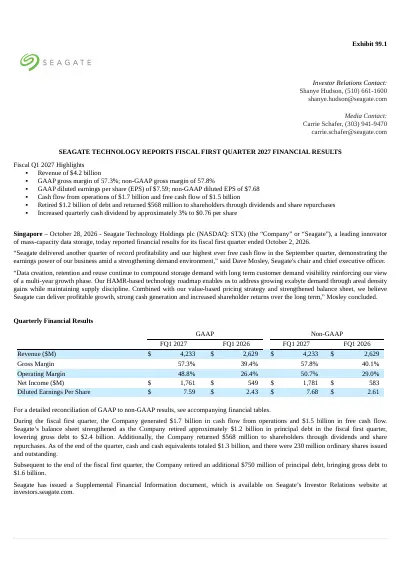
September quarter revenue grew by more than 60% year-over-year, and non-GAAP EPS expanded by nearly three times to a record $7.68. We also achieved record gross and operating margins, demonstrating the earnings power of our business and ongoing demand strength for data storage.
Both the data center and edge IoT markets delivered double-digit sequential revenue growth, up 18% and 13% respectively, reflecting ongoing demand and pricing strength. These trends support our expectation to deliver strong sequential revenue growth and gross margin expansion throughout fiscal 2027.
Our confidence is supported by an extremely strong demand environment, with visibility extending beyond 2030, and an areal-density-driven technology roadmap poised to capture this growth. In the September quarter, we shipped a record 198 exabytes of nearline capacity into data center customers, and we expect a meaningful step-up in the December quarter supported by the continued ramp of Mozaic 4.
As we stage new generations of Mozaic products and ship to a broader customer base, quarterly exabyte growth may vary. At the same time, we expect our technology roadmap to support nearline exabyte supply growth in the mid-20% range on a compound basis.
Overall, we delivered another very strong quarter, including record free cash flow generation of nearly $1.5 billion, driven by durable demand, our continued technology innovation, and disciplined operational execution. Additionally, we significantly strengthened the balance sheet, achieved our primary debt reduction objectives, and regained investment grade status.
With those goals largely achieved, we are shifting our focus towards capital returns, with share repurchases serving as our primary vehicle complemented by dividends. This month, our board approved an increase in the quarterly dividend to 76 cents per share.
Importantly, this capital allocation strategy reflects our confidence in the cash flow potential of the business, as well as the multi-year demand visibility afforded by our customer agreements. Demand strength continues to be driven by data center customers, which accounted for 90% of our shipped capacity.
Within data center, cloud nearline products achieved a 12th consecutive quarter of revenue growth, while enterprise OEM revenue reached its second-highest quarterly level in over a decade. Data growth is profound across a wide variety of applications.
Behind these trends is a growing recognition that the value of data extends well beyond its original use. In a recent discussion with Seagate, a leading hyperscale customer observed that their customers are increasingly discovering new ways to extract value from data long after it's initially stored, strengthening the incentive to retain it.
AI innovations are amplifying this dynamic. As AI adoption expands beyond model training and toward inference and agentic applications, persistent data becomes increasingly important.
These systems rely on vast amounts of historical data to make informed decisions and take effective actions, while constantly generating new output that must be governed, retained, and reused. Estimates suggest that billions of AI agents will be deployed worldwide over the next decade, executing hundreds of billions of actions daily.
At that scale, agents will continuously consume, generate, and reuse data. We believe future storage demand will increasingly be tied to this new data lifecycle and compound again as physical AI applications proliferate.
As the volume of persistent data grows, storage demand can extend well beyond the initial infrastructure build-out. These positive demand dynamics play directly into the strength of hard drives, which deliver the scalable, reliable, and cost-efficient foundation for data retention.
Hyperscale customers have long recognized these benefits and continue to pursue higher-capacity storage architectures. Our engineering teams work closely with leading cloud providers to align our product roadmap with future data storage requirements and simplify the adoption of higher-capacity drives.
A recent example is Microsoft's qualification of a joint Seagate and Broadcom solution that combines our HAMR-based Mozaic drives configured with SMR technology and Broadcom's connectivity infrastructure. Microsoft already deploys HAMR drives, and this recent qualification validates the SMR-enabled solution at hyperscale.
Customers can benefit from additional capacity gains that SMR provides. However, broad adoption at higher drive capacities had been limited given the meaningful architectural and software changes required.
This joint solution provides a blueprint for implementing SMR storage to unlock additional capacity gains on top of our HAMR-based Mozaic platform. Beyond hyperscalers and CSPs, demand is expanding among a broader set of enterprise OEM customers that are managing increasingly large datasets.
We are engaging more directly with many of these customers and developing reference architectures that pair proven compute and storage hardware with flexible, customer-selected software. These solutions offer a path to scale persistent data capacity, improve storage economics, and drive platform efficiencies.
The strengthening demand environment is extending our customers' planning horizons, which is reflected in the supply agreements we now have in place. The vast majority of our nearline exabyte supply is now allocated under long-term supply agreements through calendar 2028, with some cloud customer agreements extending through calendar 2030.
Our strategic planning discussions extend even further. We are working closely with customers to address their growing storage needs across this time horizon by executing our Mozaic product roadmap.
As we transition to HAMR-based Mozaic products, we are investing in additional tools and technology necessary to offset longer manufacturing cycle times and maintain stable unit production. For Seagate, increasing capacity per disk is driving exabyte growth.
Our build-to-order contracts establish specific configuration and pricing terms for nearline shipments through calendar 2027. As we move through the next few quarters, we expect to begin finalizing configuration and pricing terms with customers for the exabyte supply that we've allocated to them for calendar 2028.
Pricing continues to improve, reflecting both the execution of our value-based pricing framework and higher external component costs. We expect a stronger demand environment, evident in customers' multi-year commitments, to continue to support these healthy pricing dynamics.
Taken together, these agreements provide customers with greater supply assurance while increasing visibility for both parties. They also reflect customer confidence in long-term demand growth and the increasingly strategic role that hard drive storage plays in the modern data ecosystem.
Supporting this demand growth requires storage solutions that deliver scale, efficiency, and economics. These very attributes serve as the foundation for our technology strategy.
Increasing storage density within the same data center footprint is the most cost-efficient way to "maximize bytes per square foot," as one large hyperscale customer put it, and our HAMR-enabled roadmap is designed to deliver on that objective. Advancing areal density is our North Star.
We are scaling drive capacity through areal density rather than relying on higher drive unit production. We believe that this is the most efficient way to help customers manage their extreme data growth and retention needs.
The same approach supports profitable exabyte growth for Seagate. We are executing well on the product roadmap milestones that we've outlined.
We continue to expect HAMR to represent roughly 50% of our nearline exabyte shipment run rate exiting calendar 2026, with Mozaic 4 representing roughly half of those HAMR shipments. Mozaic 4, which offers up to 44 terabytes of capacity, is continuing to ramp with two leading CSPs.
We are on track for additional qualifications to complete over the next couple of months across multiple global CSPs and OEM enterprise customers. Product development for our third-generation Mozaic 5 product remains on track.
These drives can deliver upwards of 50 terabytes of capacity and leverage our highly efficient 10-disk platform. We continue to expect customer qualification shipments to begin towards the end of calendar 2027.
Reflecting on our ongoing advancements in photonics, we recently demonstrated 8 terabytes per disk in the lab, providing further evidence that HAMR and the Mozaic platform can deliver on customers' growing capacity needs and reinforces our conviction that increasing exabyte supply through areal density growth is the right long-term strategy for both our customers and for Seagate. Wrapping up, our results demonstrate both the durability of demand and the effectiveness of our strategy.
Data creation, retention, and reuse are compounding demand for mass capacity storage, and based on the long-term visibility we have with customers, we believe we're still in the early days of a multi-year growth phase. Our technology roadmap, combined with disciplined supply management and a value-based pricing strategy, and the operational leverage in the business gives us confidence in our ability to deliver strong profitability, cash generation, and shareholder returns.
I'd like to recognize our global team for their execution in delivering a record quarter and a strong start to fiscal '27. I'd also like to thank our customers, suppliers, and shareholders for their continued trust and support.
Now I'll turn the call over to Gianluca.
Gianluca Romano
Thank you, Dave. Seagate posted very strong results for the September quarter, exceeding the high end of our guidance range for both revenue and earnings per share, while continuing to establish new profitability records that translated into our highest-ever free cash flow generation.
September quarter revenue was $4.2 billion, up 17% sequentially and up 61% year-over-year. Non-GAAP gross margin came in at 57.8%, up 510 basis points sequentially.
Non-GAAP operating margin increased 610 basis points sequentially to 50.7%. Non-GAAP EPS was $7.68, up 35% quarter-over-quarter and 194% year-over-year.
Sustained data center demand continues to drive strong company performance. In the September quarter, we shipped a total of 220 exabytes, up 21% year-over-year, with data center representing 90% of that total.
Data center revenue was $3.4 billion, up 18% sequentially and 63% year-over-year, and representing 81% of total revenue. Data center shipments totaled 198 exabytes, up 24% year-over-year, and represented 90% of the company's overall exabyte volume.
As Dave noted, we are staging Mozaic 4 products ahead of anticipated customer qualifications, and we expect capacity shipments to meaningfully step up in the December quarter. Global cloud customers accounted for the vast majority of data center revenue and exabyte demand, a trend that we expect to continue as we ramp Mozaic 4 volume.
At the same time, demand across enterprise OEM data center markets has continued to strengthen. As AI applications transition more toward inference and agent-based workloads, customers are seeking scalable, high-capacity storage solutions across hybrid cloud data center environments.
In the September quarter, revenue from these markets increased for the sixth consecutive quarter, with double-digit growth both sequentially and year-over-year. Complementing this trend in our data center business, our edge IoT markets also delivered solid revenue growth.
Revenue totaled $784 million, representing 19% of total revenue. This was an increase of 13% sequentially and 52% year-over-year.
Moving on to the rest of the income statement, non-GAAP gross profit increased significantly to $2.4 billion, up 28% quarter-over-quarter and more than doubling from $1.1 billion in the year-ago period. Non-GAAP gross margin expanded to 57.8%, up from 52.7% in the prior period, reflecting favorable pricing execution and an improving product mix as we ramped Mozaic 4 products.
These factors more than offset cost headwinds associated with certain externally sourced components. Looking ahead, we expect continued benefit from our value-based pricing strategy and product mix to support quarterly margin expansion for the rest of fiscal 2027.
Non-GAAP operating expenses were $300 million or about 7% of revenue. The strong demand environment, combined with discipline in expense management, drove substantial operating leverage, with non-GAAP operating profit up 33% sequentially to $2.1 billion, representing 50.7% of revenue.
Other income and expenses totaled $38 million in the September quarter. Following the debt reduction we completed earlier in October, we anticipate other income and expenses to decrease further in the December quarter to approximately $25 million, benefiting from the lower interest expense.
Non-GAAP net income grew to $1.8 billion, with corresponding non-GAAP EPS of $7.68 per share, based on tax expense of $328 million and a diluted share count of approximately 232 million shares. Turning now to cash flow and the balance sheet, operating cash flow was $1.7 billion and capital expenditures were $211 million for the September quarter or 5% of revenue.
For fiscal 2027, we continue to expect capex investment will remain within our target range of 4% to 6% of revenue as we support the ongoing transition to HAMR technology. Higher profitability and in-line capex resulted in free cash flow generation of $1.5 billion, up 32% from the prior quarter and more than tripling year-over-year.
We expect cash generation to further improve throughout fiscal 2027, supported by sustained demand, operational efficiencies, and capex discipline. During the September quarter, we retired $1.2 billion in debt, including the remaining convertible notes and approximately $1 billion in high-yield debt.
We exited the quarter with gross debt of approximately $2.4 billion and a net leverage ratio of 0.2 times. Following the close of the September quarter, we retired an additional $750 million of high-yield senior notes, reducing principal debt to approximately $1.6 billion.
As a result of our actions, we expect to be net cash positive exiting this calendar year. We have now delivered on our goal of strengthening the balance sheet and are now focused on returning more of our free cash flow generation to our shareholders.
During the September quarter, we returned $568 million to shareholders through dividends and share repurchases, roughly two times the amount returned in the June quarter. We are also increasing our quarterly dividend by approximately 3% to 76 cents per share, reflecting our confidence that strong cash generation is sustainable.
We exited the September quarter with $4.4 billion remaining on our existing share repurchase authorization and expect to significantly increase share repurchases starting in calendar 2027. We ended the September quarter with cash and cash equivalents of $1.3 billion and total liquidity of $2.6 billion, including our undrawn revolving credit facility.
Turning now to the December quarter outlook, we expect another quarter of strong sequential growth underpinned by continued demand momentum, a significant increase in exabyte shipments, and ongoing execution of our value-based pricing strategy. We expect December quarter revenue to be in the range of $4.8 billion, plus or minus $100 million, which represents a 70% year-over-year improvement at the midpoint.
Non-GAAP operating expenses are expected to remain flat at approximately $300 million. Based on the midpoint of our revenue guidance, non-GAAP operating margin is expected to expand towards the mid-50% range.
Non-GAAP EPS is expected to be $9.20, plus or minus 20 cents, based on a tax rate of about 16% and non-GAAP diluted share count of 233 million shares. Our September quarter results and December quarter outlook reinforce our expectation for annual revenue growth to meaningfully outpace fiscal 2026.
Durable demand, increasing Mozaic adoption, and healthy operating leverage are supporting ongoing revenue growth, margin expansion, and strong cash generation. Together with our increasing focus on capital returns, we are well positioned to increase long-term shareholder value.
Operator, let's open the call up for questions.
Operator
We will now begin the question and answer session. To ask a question, you may press star then one on your telephone keypad.
If you are using a speakerphone, please pick up your handset before pressing the keys. To withdraw your question, please press star then two.
In the interest of time, we ask that you limit yourself to one question and one follow-up. If you have further questions, you may re-enter the question queue.
Once again, that was star then one to ask a question. The first question today is from C.J.
Muse with Cantor Fitzgerald. Please go ahead.
CJ Muse
Yeah. Good afternoon.
Thank you for taking the question. I guess first question regarding exabyte deceleration in the September quarter and curious given your inventory days moved up to 97 from 83, was there kind of staging involved, pre-building, that's supporting your outlook for the accelerated exabytes into December?
Then maybe, as you think about calendar '27, you were kind of in the mid-30s range, you're reiterating kind of the mid-20s long term. Curious, given the ramp of Mozaic, whether we should be kind of in that 30-plus range or do you think we will revert to that compounded number at some point in calendar '27?
Dave Mosley
Hi, C.J. Thanks for the question.
If you think back to the June quarter, we had a pretty appreciable step-up. In the September quarter, we were relatively flat, to your point, and the quarter we're in now, the December quarter, we'll step up again.
We are on a trajectory and I think 25% is a really good number for that. We're driving product transitions, and we have to stage them quite a ways out in time.
We make sure that we lock in with our customers on when those things have to hit their dock and sync up with all the other parts that they need to build the data center. Pretty happy with the progress, and still staging very aggressive areal density and product transition technologies so that we can get to those higher exabyte levels.
Gianluca Romano
C.J., we have few customers that will qualify Mozaic 4 in the next quarter, and therefore we are preparing manufacturing for those quals and the volume that we can ship to them in the December quarter and later.
CJ Muse
Perfect. As a quick follow-up, Gianluca, on the operating margin guidance in the slide deck approaching or towards the mid-50s, should we be modeling 50% or are you suggesting something else?
Gianluca Romano
No, I think we are suggesting— A
CJ Muse
55%, sorry. 55, sorry.
Gianluca Romano
We are suggesting something that is between 50 and 55. [laughter] So of course is another improvement compared to what we have done this quarter that was already above the 50%.
We are very happy on how we are managing the operating margin in particular. You have seen continuous improvement in revenue, in gross margin, very stable opex, this is resulting in sequential strong improvement in operating margin.
No, we are approaching, no, even higher result that we have guided for this December quarter. As we said in prior calls, we expect to improve even more in the rest of the fiscal year.
CJ Muse
Very helpful. Thank you.
Thanks, C.J.
Gianluca Romano
Thank you.
Operator
The next question is from Erik Woodring with Morgan Stanley. Please go ahead.
Erik Woodring
Hey, guys. Thank you so much for taking my questions.
Really strong pricing obviously in the quarter. I'd love any commentary that you could provide there just on how to look forward on that price per terabyte metric.
Separately, also just address the cost per terabyte declines. Over the last four quarters, you've done something like 15% annual cost declines or year-over-year cost declines.
You just did kind of mid-single digits. Can you maybe help us understand any temporary factors that are impacting that related to the Mozaic transition or when we should expect that metric to accelerate?
Then quick follow-up, please. Thank you.
Dave Mosley
Thanks, Erik. It's a complicated question.
On the pricing side, I continue to believe that that's very dependent upon demand, and demand continues to be very strong, not just in quarter, but you look two, three, four quarters out. People are demanding that we go higher in exabytes as well, it's a great long-term relationship that we have with the customers.
We're able to predictively go through these product transitions and accelerate our technology the way we talk about. I don't see that changing.
In the past, years ago, we would see product swaps and things like that, people saying, "I don't need product in quarter." We're seeing none of that right now.
Absolutely everything we can make above and beyond our plans is being spoken for. On the cost side, you know that we control our manufacturing efficiency of our critical technologies, and that's the largest driver of our costs.
We get a lot of efficiency, especially in cost per terabyte, if that's a metric, as we transition platforms. During some of the transitions, we get early costs, things like scrap that go up.
It doesn't dissuade us from driving the transitions. We continue to drive them very hard, and then we go work those things down.
Right now, I see more opportunity because the future transitions look even brighter than I would have said 90 days ago, I'm pretty excited about that.
Gianluca Romano
Erik, I would say our cost decline for what we produce, so as a media, is continuing to be very, very strong, we are happy with that. The cost of the external component, as compared to a year ago, is now much higher, and therefore there is at least a partial offset of our internal cost reduction from an higher external component cost.
We have to see where the external component cost will go in the future. What we can control is actually performing very well.
Now, when we have enough visibility and we have the time to include that cost increase for the external component into our pricing, of course, we do it. This is also why you have seen a little bit higher price increase to our customers in the current quarter, but sometimes it's not so predictable, we need a little bit of time to adjust.
Erik Woodring
Okay. Super.
Thank you very much for the feedback there. Then Dave, maybe just going back to C.J.'
s question at the top of Q&A, just want to make sure I understand the kind of product staging dynamics in the September quarter. I just want to make sure there's no kind of right-tail risk here in terms of any yield issues that we need to be thinking about, anything in terms of data center readiness.
I just want to make sure there's none of those that are impacting and this was generally just product transition leading to the slower sequential exabyte growth as opposed to anything maybe that would be a little more concerning. Thank you so much.
Dave Mosley
Yeah. There's none.
The big step-up in the June quarter, it tapered off a little bit in the September quarter just timing, and then it'll be another big step-up in the December quarter and then, as we get through these product transitions, we'll see exabyte growth.
Erik Woodring
Awesome, guys. Thanks so much.
Good luck.
Operator
The next question is from Amit Daryanani with Evercore. Please go ahead.
Amit Daryanani
Yep. Good afternoon.
Thanks for taking my question. I guess the first one was really, you folks reiterated the 4% to 6% of revenue for capex in fiscal '27.
Is that a sustainable framework to support mid-20% exabyte growth longer term beyond fiscal '27 as well, especially given the fact you talked about longer tooling needed to offset the longer HAMR manufacturing cycles? Just talk about what the right framework would be longer term.
To the extent you need additional heads or media capacity, how do you kind of weigh between building it organically versus acquiring it? To
Dave Mosley
first order, there's no way we can acquire the HAMR technology, the leading-edge technology, we have to do that ourselves, exactly to your point. Yes, we see that 4% to 6% model being plenty for us to continue to grow according to our plans.
Actually the the latest acquisition of new tools is really helping us drive areal density because we get to buy remarkable new tools that are that are maybe more capable than what we're replacing in the factory, so that's that's cause for optimism. We are using some legacy technology from outside as on a case-by-case basis.
That'll help us through some help us pivot some of our manufacturing technology to HAMR. I definitely think that 25% is the is the target for our exabyte growth.
We can do that predominantly through the areal density transitions that we're driving. Some of those components get we've talked about this in the last couple of quarters, some of those components get a little bit longer time in the factory, and so therefore we have to adjust our output and accordingly, but we can do that all within the 4% to 6% window.
Amit Daryanani
Got it. That's helpful.
Then, as HAMR ramps up, especially with Mozaic 4 becoming a bigger percent of exabytes for you folks, what's the right way to think about cost-per-bit declines as you get through that transition? I get that the 4% to 6% range right now isn't the optimal one, but I'm just curious, as HAMR ramps up for you, what's the right cost-per-bit decline longer term?
Gianluca Romano
Yes, as I said before, the cost for the component that we produce, of course, is continuing to decline. When you go from a 3-terabyte per disk to a 4-terabyte per disk, you have a major impact in term of cost-per-terabyte decline.
As I said before, right now there is also a impact from external component. You need to separate a little bit the two between internal efficiency and technology improvement that is driving cost reduction, and the overall cost per terabyte that is, of course, also impacted by the external supply chain and external component cost.
You have seen a very good decline in the prior quarters, a little bit less in the September quarter. I'll say we need to understand the various drivers for the different components, because we buy a lot of different component externally.
Overall, now when you go even longer term, the technology is what is driving cost per terabyte. Having a technology that continue to generate more terabyte per disk is exactly the way that we want to follow in order to reduce the cost per terabyte and improve our profitability.
Amit Daryanani
Thank you very much.
Dave Mosley
Thanks, Amit.
Operator
The next question is from Krish Sankar with TD Cowen. Please go ahead.
Krish Sankar
Hi. Thanks for taking my question.
Dave or Gianluca, I just want to follow up on the earlier question. I understand the dynamics of the cost with the product transition.
If you just look at from a high level, 50% of your exabytes exiting this year is going to be HAMR, which is gross-margin-accretive. Unlike your peer, you are sticking to 10 platters, not going to 12 or 14, which in theory, I think yourself decreases cost.
I'm just wondering why wouldn't the cost downs be even better going forward? Or would you consider moving beyond the 10 platters, or is there any technical reason for not doing it?
Then I have a follow-up.
Dave Mosley
I'll start at the end. There's no technical reason for not moving beyond 10 platters.
I think we like the platform and we get leverage, cost leverage, to your point, going from product generation to product generation. We don't have to transition the mechanical piece parts and pay for new tooling and things like that, we know the platform.
We like it. We're going to stay on it, but there's no technical reason why we can't start adding platters.
Actually, from a qualification perspective, it's much simpler, especially with our customers, to just qualify one thing that they don't have to go through any new risks on except for just the technology transition. They don't have to change the dynamics of how many heads and disks are in the drive.
From my perspective, probably should have said this in one of the earlier comments as well, there's not a significant cost increase in the HAMR technology from one generation to the other. The cost per terabyte takedown, you can pretty much calculate it if you go from 4 to 5, for example, and we are driving 5 very, very hard right now.
Krish Sankar
Got it. Then it's a quick follow-up.
I understand you're maintaining your capital intensity 4% to 6%. Obviously, your peer spoke about going into range of 8% the next couple of years.
Obviously the distant third player talking about adding capacity in Japan. I'm just wondering, is the 4% to 6% still a good bogey to use for the next few years, or should we worry about any potential share loss, or is the demand so much greater than supply that it should not matter?
Dave Mosley
I won't really speculate on what our competitors' plans are. I'll just say relative to ours, I think 4% to 6% is just fine.
I have a lot of respect for everybody in the industry, but their technology solutions may differ from ours and you may see that over the next few years. From our perspective, demand remains really strong, and from the supply side, we continue to believe that bringing meaningful HDD capacity to market is a really complex process that requires substantial investment in R&D and technology.
It's an intricate supply chain balance, and the idea of just plugging in a few machines, it's orders of magnitude more difficult than that. It really requires tight coordination throughout our supply chain.
As I said in the prepared remarks, our nearline exabyte supply is already allocated through calendar year 2028, and we're having conversations much further out than that, we have a lot of confidence that our customers are going to be there and we believe supply will remain fairly tight for our products over that period. We're just going to keep focusing on our technology roadmap and try to get the products out and meet exactly what the customers need when they do, and I'm not really worried about anything else.
Krish Sankar
Thanks a lot, Dave.
Operator
The next question is from Asiya Merchant with Citi. Please go ahead.
Oh,
Asiya Merchant
great. Thank you for taking my call.
You mentioned a lot about KV cache adoption contributing to demand. Given that, how should we think about unconstrained demand and the impact to exabyte demand given just this trend that you're seeing on KV caching?
Thank you.
Dave Mosley
Thanks. I do think we are watching a lot of new technologies come out that are increasing the value of data very quickly.
I know a lot of people toss around the letters AI. It gets really confusing.
What I would say is the datasphere is growing leaps and bounds anyway. Just look at video on the internet or video analytics, for example, in places like our factory, it's growing very quickly.
Then AI is an accelerator of that dynamic. The ability to take data from the application layer and move it down to the storage layer, and then promote data from the storage layer back up, we've never seen the systems be as efficient as they are right now, with software not in the way, with compute technologies that are much faster than they were in the past.
Architecturally, things like the KV cache plug between those two layers only accelerates it even faster. Very excited about that.
I don't think any of us has ever lived in a world where things are this efficient above the storage layers, and I do think that'll drive a lot of future demand for us.
Gianluca Romano
We are seeing demand for storage in the different part of the cloud growing very rapidly, even a little bit faster than what we were expecting. As we were discussing before, demand is stronger and stronger.
I'll say the supply demand gap is probably growing at this point. As we said, we are really focused on our technology transition, and we will ramp more of our 40-terabyte drive in the next few quarters, and this is how we want to address demand.
Asiya Merchant
Okay. Just as a follow-up, could I just even ask about physical AI?
I know that's probably a little bit longer term, but are you seeing any of that demand currently translate into meaningful inflections for your exabytes? Thank you.
Dave Mosley
I would say not yet directly, but we're hopeful. We've had conversations for a long time with autonomous vehicles companies and people that are moving data around in the world.
The interesting thing to us about physical AI is not only the need to store the data for training, but it's also the need to store the data to make sure you made the right decision. That storage will probably be closer to where the data is actually created, which is the edge.
There's maybe new products that are coming on the horizon. It's still very early days in this, but I think there's a lot of innovative companies out there driving for value-add solutions out at the edge, and we're watching them carefully.
I think this could be a further driver of storage that we haven't really contemplated yet.
Asiya Merchant
Thank you.
Operator
The next question is from Mark Newman with Bernstein. Please go ahead.
Mark Newman
Yeah. Thanks for taking my question.
Congrats on the numbers. I just want to look a little bit deeper at this price and cost to gross margin.
You've had another very, very strong quarter of gross margin appreciation and this is obviously factored into the guidance as well. When I look at the price, it seems to be accelerating significantly from what was something like mid-single digits Q-on-Q to something like a mid-teens Q-on-Q this September quarter.
Meanwhile, your cost is still slightly confused about that appears to be actually up Q-on-Q. You did point out about some of the component costs coming up.
I understand that could be part of it. Is there anything else that we should be aware of, perhaps on the mix or something else that may have boosted the price or hurt the cost temporarily that we should be aware of?
I have one follow-up. Thanks.
Dave Mosley
No. Thanks, Mark.
The first thing I would always say is that I'm really happy with the bottom line. We continue to drive the operating income really well, the free cash flow really well.
As you get up into things like gross margin and then above it to price, there could be some in-quarter dynamics going on about our product transitions. I mentioned scrap already.
As we drive these hard product transitions, we have to incur some of that scrap. We actually incur a little bit of manufacturing, I'll call it, lossiness when that happens as well.
The yields on the product transition may not be where we want. We go take a quarter or two and we go beat those back into what the old yields were.
There's a little lost capacity in that. From my perspective, the pricing dynamic is really still about long-term demand.
It's not about in-quarter demand, it's about long-term demand. We're having great conversations with our customers about staging these technologies, making sure that we get through the product transition, and that their systems are ready for that product transition as well, because they have to make sure their architecture is ready for the higher-capacity drives and we do that very carefully and making sure we don't build too early for those transitions, make sure we just time it right.
It's very important because the size of the supply chains that we have out in the world are enormous, and in order to make sure you're doing what the customers want today, tomorrow, and next year, and the following year, you have to make sure you sync up the number of square sets, if you will, with those customers. We're working all of that very hard, and I think that all plays into the pricing and the cost dynamics which you talked about.
Gianluca Romano
No, that's correct. I think pricing and cost dynamics are always somehow correlated.
When we have visibility on some external cost increase, we try to pass that to customers including that in our pricing. Now sometimes the timing is not immediate, because, no, we have contracts in place and, no, we have commitments.
Over time, that additional cost from the supply chain, if any, is going to be passed to customers. This is why pricing now is increasing a little bit faster than what you have seen in the past is also to cover that additional cost.
As I said before, there is nothing unusual internally. Now our cost for producing as a media is declining as we were expecting, but there are additional costs from external components.
As you have seen before, the improvement of gross margin is actually accelerating because, no, pricing more than offset that increasing cost, I think we are managing this external component cost increase in the right way, in a way that is accelerating the profitability of the company.
Mark Newman
Really appreciate that. A follow-up on price.
Given all that and the huge price increase you've been getting recently, should we expect this type of quarterly ASP growth to continue in the mid-teens range, or is that more of a one-off? I appreciate strong pricing will continue, but that was extremely strong pricing you just printed, I'm just curious if that's realistic to consider that to continue at that rate.
Dave Mosley
As we talked about, on supply, there'll be step-ups as new contracts come up all the time. I've said in the prepared remarks that we don't see any demand destruction at all.
If anything, we see a lot more demand creation kind of quarter-over-quarter, and we're projecting where this is going to be three or four quarters from now. Then we get into the negotiations with the customers on the exabytes that we've kind of allocated for them.
We lock down the configuration and then lock down the pricing, and I don't see the trend changing too much right now.
Gianluca Romano
Every quarter is a bit different. Every quarter is a bit different.
Of course, everything is included in our guidance, you see a strong revenue upside. Part of that is coming from exabytes, as Dave said before, part is coming from pricing, and I think you can model another step-up in in gross margin, and of course, that is coming at this point mainly from pricing, because now we discuss about the cost and the and the offset from the external component cost increase.
Mark Newman
Really great. Thanks so much.
Operator
The next question is from Wamsi Mohan with Bank of America. Please go ahead.
Wamsi Mohan
Yes, thank you. I wanted to touch on pricing as well.
Maybe if you could just double-click a little bit on the pricing, how much of this would you say was achieved with already-contracted pricing versus what's floating, any relative percentages on there, or hyperscaler versus OEM versus edge or by capacity tranches? Any color incrementally, just given the sheer magnitude of what we just saw, and I have a quick follow-up.
Dave Mosley
I think most of it's on the I'll call it the rolling re-upping of the contracts, Wamsi. It's not because we're getting more exabytes out or we're pushing more exabytes out.
We're running the business very predictably on that front. Usually when we see a pricing upside, it'll be two or three quarters away because we'll be able to find a way to get a few more exabytes out, then we'll say who wants them.
That comes because we are working operations really hard and just trying to get a little bit more efficiency out of our factories.
Gianluca Romano
We have not changed our pricing strategy. Now the strategy is the same, but as we said before, when we have visibility for some of the external cost increase, now we have to pass that through and include in our new pricing.
When we negotiate a new contract, of course, we also consider the current situation for external supply chain cost and adjust the pricing according to that, but apart from that change, the strategy is exactly the same that we have followed for the last three years at this point.
Wamsi Mohan
Right. Okay.
Then just as a follow-up on the exabyte growth, I understand that you're calling for an acceleration, a meaningful step-up again next quarter. As we think through the fiscal year, is it right to think that we should be seeing sort of improving exabyte growth trajectory as we go through the course of the year given that some of this product transition issues would be behind you and you're still saying that you're meaningfully under-shipping demand?
Thank you.
Dave Mosley
I don't think we had any issues with product transitions. I think that's all been planned.
To your point, the wafer cycle time is quite long, we've known exactly what our exabyte output is going to be. Yes, you will see continued acceleration of Mozaic 4, and then we're going to start leaning into Mozaic 5 as well.
I'm very happy with the 25% number. We're going to keep driving it as hard as we can.
Wamsi Mohan
Thanks, Dave.
Operator
The next question is from Ben Reitzes with Melius. Please go ahead.
Ben Reitzes
Yeah. Hey, thanks a lot.
Dave and Gianluca, I wanted to talk about the buyback and the cash return pace, because you say you're going to start in the March quarter. You actually don't have any debt that comes due, I believe, until June of 2029.
You probably start with free cash flow of around a couple billion, maybe 2 billion, at the start of this period. What does it imply for buybacks?
Are you going to do 100% of the free cash flow that we start with in that March quarter of '27? Can that continue up until you have to pay down that debt?
What kind of percentages of the free cash flow are we looking at here? Thanks a lot.
Then I have a follow-up.
Dave Mosley
Yeah. Thanks, Ben.
We're very happy to be through the period where we dealt with the debt like you said and we're back to being ourselves. Our model's 75% and we should be able to get back to that model over some period of time, so that's great.
Beyond that, it's opportunistic. When we can, when we don't think we have any other needs for the free cash flow that we're generating up above and beyond that 75%, we'll look at it.
Gianluca Romano
I think that's correct. Now we had the last debt repurchase earlier this month.
We are also, now, active in the market in term of share buyback this quarter. What we said, starting next quarter, because we don't have any other debt activity planned, we will step up the share buyback program, you will see much more happening on that side starting the March quarter.
Ben Reitzes
Thanks a lot for that. Your customers, especially for most of your business are the big hyperscalers.
Are you hearing anything about, in terms of their ability to purchase on time, are you hearing anything about land, power, shell delays? Or are you hostage to their timing of when they get chips or land, power, shell?
How are you managing that, and how would you characterize that? Thanks a lot.
Dave Mosley
Ben, that's an interesting question. The answer to your question is no, but we are very mindful of the fact that we don't want any of our products sitting anywhere.
It's very important that we don't overbuild, that we build exactly to what we think the demand is. The demand for exabytes will strengthen.
More exabytes in the box makes the data center much more efficient. The customers know that.
They want that. In general, the storage layer doesn't use a whole lot of power compared to the compute layer.
It doesn't use a whole lot of space, and it doesn't use a whole lot of money either. We can calculate all those things, but we don't want to overship into a channel that necessarily doesn't have the components elsewhere, right?
We want to make sure we spread out as much as we possibly can. I think we're doing a good job of that, giving our customers that predictability, not just for next quarter, but for the next few years now, so that they know exactly what they're going to have to go acquire, and they know what their footprint is, they know what their data requirements are, but also their data center capabilities are, and we try to time all that together.
Ben Reitzes
Thank you.
Operator
The next question is from Karl Ackerman with BNP Paribas. Please go ahead.
Karl Ackerman
Yes, thank you. Obviously, hyperscale demand is robust, but you spoke about near-record sales from on-prem enterprise.
I'm cognizant that CPU providers have said traditional server demand supports 25% of the agentic CPU opportunity. My question is, frankly, have you seen it yet?
As more of these CPU racks become deployed over the next 12 months across both hyperscale and on-prem, how is your penetration rate of high-capacity hard drives changing due to this agentic CPU demand move? Thank you.
Dave Mosley
It's an interesting question. I would say typically those enterprise and OEM customers lagged quite a bit the highest capacity points, and they're starting to not lag as much.
The storage layers are much more data-rich and the products are higher-capacity drives than they ever have been before. I think maybe inside of your question, there's some of this is it truly just an on-prem instance where you may only have 1 petabyte, or are we talking about people that maybe service through these channels that may grow to a larger scale?
I think we're seeing both. There's demand for both types of products.
There may be just on-prem meaning a small office or a small enterprise, and then there may be some of these channels that are actually servicing people who are doing sovereign cloud instances and things like that.
Karl Ackerman
Thank you.
Operator
The next question is from Joe Quattrocchi with Wells Fargo. Please go ahead.
Joe Quattrocchi
Thanks for taking the question. I was wondering if you could just quantify, what was the external component impact on gross margin, and then is that expected to be completely offset embedded in the December quarter guide?
Gianluca Romano
It is included in the December guidance. As I said before, there is the cost related to what we produce, and that is declining as rapidly as we said in the past.
Then there is the cost of what we buy externally, and if you compare to, now, the cost of the same component a year ago today, that cost is higher, and so is partially offsetting the cost decline that we generate internally. Everything is included in the guidance, and the guidance is showing strong improvement, not only in revenue, but also in gross margin, in operating margin, and of course EPS.
I think the trend of improvement is the same that you have seen in the past, and of course, we are managing this additional external cost as well as we can and still generating strong improvements. Okay.
Joe Quattrocchi
Then maybe as a follow-up, apologies for another question kind of around ASPs, but just thinking about the increase in dollar per terabyte, can you help us understand how much of that was maybe mix driven by higher HAMR contributions relative to like-for-like price uplift?
Dave Mosley
It's let's see. If the products going to say hyperscalers, they're pulling really hard on new capacity points that are much more efficient, better TCO proposition for their data centers.
We get the benefit from that. Relative to a price per terabyte, that's fairly well blended across the entire portfolio.
Some of those contracts with the hyperscalers are more four quarters, think of them as four quarters rolling, if you will, but and some of the other stuff is a little less than that. I don't know that you can really look at it different markets.
I think that relative to our ability to actually predict, we're going after the highest capacity points to make sure that we keep those big chunks of demand kind of predictable for us so we can run our factories.
Operator
The next question is from Joseph Cardoso with J.P. Morgan.
Please go ahead.
Joseph Cardoso
Hi, good afternoon and thanks for the question here. Maybe just wanted to follow up, I think in the past you kind of hinted at maybe an outlook around HAMR exiting your fiscal '27.
Just curious if there's any update there on how we should be thinking about HAMR share of nearline as we track through the fiscal year just given any shifts and thoughts around constraints on getting there faster like customer quals, head wafer cycle times, or any other variables? Then I do have a quick follow-up.
Thank you.
Dave Mosley
Thanks, Joseph. Everything on the 4 terabyte per platter is on track, we're happy with the qualification progress.
We're happy with the initial units we've shipped to the field and how they're doing in the field. Everything's on track there.
The 5 terabyte we're actually more optimistic than we were last quarter, I'd say. We see the ability to make this transition a little bit faster than we originally planned, and we'll get to talking to that when we get into fiscal '28.
We're going to stage that and go as hard as we possibly can because that's yet another improvement for us. I also see the 5 terabyte per platter extending fairly rapidly into 6 terabyte per platter, love this platform.
The technology development's going quite well, and we're pretty optimistic about it. We'll keep driving it.
Gianluca Romano
Our share there are no changes on on our targets that we discussed in the prior quarter in term of HAMR as a percentage of total nearline exabytes for end of calendar '26 and then for fiscal '27.
Joseph Cardoso
No, got it. Makes sense.
Then, just wanted to touch on some of the comments in the prepared remarks that you guys had around agreements extending through calendar '30, if I heard correctly. Maybe just touch on is there any changes or differences between the agreements going out all the way through calendar '30 versus maybe the ones that are more near-term in terms of calendar '28?
Just curious in terms of how you guys are thinking about, or how we should be thinking about maybe more importantly around those agreements relative to locking in exabytes, pricing, etc. Maybe how these agreements are influencing your capacity plans?
Thank you.
Dave Mosley
Our process hasn't changed, we're giving visibility to people about what our exabyte growth will be, and then we're saying basically when you get within say 12 months, we lock in the configuration that we're going to be building in our factories, and then we lock in pricing, and that's what I would call the build-to-order process that we have. As things roll forward, if demand stays strong, as strong as it is, we may see that some of those contracts we lock them in at higher prices.
That's fine. We also would understand very quickly if somebody wasn't pulling according to the plan, we could pull back.
We don't see any evidence of that right now. I think we're in a multi-year growth phase for data, and the reason I say that is just go back 5 years ago.
The data storage products were roughly shipping half the exabytes on a quarterly basis of where we are today, and then we had this big downturn. The world's making up for a lot of lost time and there's growth, extreme growth in data everywhere, I think the next 5 years will be very strong from that perspective and the value of that data with some of these accelerated applications is becoming much more valuable.
I'm very excited about this. I think the customers are as well, they know what they're planning for, what they're going to install capacity for, and we'll work together with them on that.
Joseph Cardoso
Thank you. Appreciate the color.
Dave Mosley
Thanks, Joseph.
Operator
This concludes our question and answer session. I would like to turn the conference back over to Dave Mosley for any closing remarks.
Dave Mosley
Thanks, Gary, and thanks again to everyone for joining us. Look, we're entering fiscal 2027 with really strong momentum ahead of what we believe is a multi-year growth phase for mass capacity storage.
We're executing our strategy that positions Seagate to capture that opportunity through continued technology innovation and disciplined execution, with a relentless focus on driving profitable growth and creating value for our customers and shareholders. Thank you, and we'll talk to you next quarter.
Operator
The conference has now concluded. Thank you for attending today's presentation.
You may now disconnect.