Sunrise Realty Trust, Inc.
NNASDAQ:SUNSQ3 FY2026 · Earnings Call TranscriptNovember 11, 2026
Operator
Good morning, and welcome to the Sunrise Realty Trust's third quarter 2026 financial results conference call. At this time, all participants are in a listen-only mode.
Later, we will conduct a question-and-answer session, and instructions will be given at that time. I would now like to turn the call over to Gabe Pogatz, Chief Legal Officer.
Please go ahead.
Gabe Pogatz
Good morning, and thank you all for joining Sunrise Realty Trust's earnings call for the quarter ended September 30th, 2026. I'm joined this morning by Len Tannenbaum, our Executive Chairman; Brian Sedrish, our Chief Executive Officer; and Brandon Hetsler, our Chief Financial Officer.
Before we begin, I would like to note that this call is being recorded. Replay information is included in our October 20 26th, 2026 press release and is posted on the Investor Relations portion of our website at sunriserealtytrust.com, along with our third quarter 2026 earnings release and investor presentation.
Today's conference call includes forward-looking statements and projections that reflect the company's current views with respect to, among other things, market developments, our investment pipeline, anticipated portfolio yield, financial performance and projections in 2026 and beyond, the anticipated benefits of our merger with Sunrise Realty Trust, and our share repurchase program. These statements are subject to inherent uncertainties in predicting future results.
Please refer to Sunrise Realty Trust's most recent periodic filings with the SEC, including our Form 10-Q for the quarter ended September 30th, 2026, for certain conditions and significant factors that could cause actual results to differ materially from these forward-looking statements and projections. During today's conference call, management will refer to non-GAAP financial measures, including distributable earnings.
Please see our third quarter earnings release available on our website for reconciliation of the non-GAAP financial measures with our most directly comparable GAAP measures. The format for today's call is as follows: Len will discuss our recent merger with SRT and our share repurchase program; Brian will cover the commercial real estate lending market, our portfolio, and investment pipeline; and Brandon will review our financial results and position.
After that, we'll open the lines for Q&A. With that, I will now turn the call over to our Executive Chairman, Len Tannenbaum.
Len Tannenbaum
Thank you, Gabriel, and good morning. Since our last earnings call, SUNS reached an important milestone.
On November 5th, we completed our merger with Southern Realty Trust, or SRT, our affiliated private mortgage REIT. At SUNS' October 23rd special meeting, approximately 91.6% of votes cast approved the issuance of SUNS common stock in connection with the merger, with approximately 60% of the outstanding shares represented.
At SRT's October 23rd special meeting, a majority of SRT's outstanding shares approved the merger. We thank stockholders of both companies for their support, and I am pleased to welcome former SRT stockholders as SUNS stockholders.
We also welcome Howard Sadnow, a former independent SRT director, to the SUNS board as an additional independent director. This merger creates a larger, more efficient public CRE lending platform.
On an unaudited pro forma basis as of September 30th, 2026, as if the merger had occurred on that date, the combined portfolio would have had approximately $478.6 million of total loan commitments and $393.1 million of outstanding principal. We issued approximately 8.5 million shares at an exchange ratio of 1.45 SUNS shares per SRT share.
The combined company has approximately 22 million shares outstanding, with roughly 38.5% held by former SRT stockholders. Our amended and restated management agreement is now in effect.
It reduces the incentive fee from 20% to 17.5%, and the annual hurdle rate from 8% to 7%. Additionally, beginning in the first quarter of 2027, base management fees will be reduced by $250,000 for each quarter of 2027, totaling $1 million for the benefit of SUNS stockholders.
With the merger complete, our focus is on realizing the benefits of that scale. We believe our larger equity base can, 1, broaden financing options, potentially including unsecured debts; 2, support greater trading liquidity; and 3, reduce duplicative costs.
Given our team's experience managing both portfolios, which shared 100% overlap in the same loans, we do not anticipate any integration risk. We also believe opportunistic share repurchases can be an attractive use of capital.
In October, our board authorized a $20 million share repurchase program through December 31st, 2027. With that, I will now turn it over to Brian Sedrish, our Chief Executive Officer.
Brian Sedrish
Thanks, Len, and good morning. I'll start with the market, then cover new investment activity and the portfolio.
Higher rates and renewed volatility created additional pressure for borrowers during the quarter. The Federal Reserve raised its policy rate in September for the first time since 2023, and in early October, the 10-year Treasury yield touched its highest level since 2002 before easing.
That volatility comes against a substantial maturity backdrop. According to the Mortgage Bankers Association, approximately $875 billion of commercial and multifamily mortgages are scheduled to mature in 2027, with another $652 billion in 2027.
For sponsors with loans coming due, refinancing proceeds can fall short of outstanding debt balances, creating demand for additional equity and structured capital, which increases the value of lenders that can commit and execute with certainty. That environment plays to how SUNS is built.
We do not seek to compete primarily on price for stabilized assets where banks and other lenders focus. We earn our returns by underwriting transitional business plans and negotiating structure, which allows us to operate with modest corporate leverage and help limit the financing and liquidity pressures that can affect more heavily levered lenders.
Subsequent to the completion of the merger, given our low leverage and expanded capital base, we have ample capacity to deploy across new transactions. We were deliberate with new commitments during a volatile third quarter, and we continue to prioritize pricing, structure, and sponsor quality over deployment volume.
Since quarter end, our activity has picked up. Subsequent to quarter end, SUNS closed on approximately $3 million senior secured loan for Buildings A and B of Sommet Blanc, a luxury residential project in Park City, Utah.
We were already a lender on the adjacent building, and following the merger, SUNS' commitment across all three buildings now total approximately $17 million. The TCG real estate platform is advancing transactions under signed term sheets.
As discussed last quarter, one is a proposed $93 million senior construction loan for a multifamily development in Texas, comprising a $62 million A-note with a third-party partner and a $31 million B-note expected to be held by SUNS. We expect this transaction to close shortly.
The other transactions, which have signed term sheets, total $169 million. All transactions remain subject to diligence, documentation, and customary closing conditions.
Turning to our portfolio, on October 9th, we completed the $41 million sale of the Thompson San Antonio through our joint venture, consisting of $9 million in purchaser cash and $32 million of senior secured financing, now held entirely by SUNS following the merger. The transaction closed in line with our investment's carrying value before closing costs and transaction expenses.
The loan bears interest at a fixed rate, increasing scale from 8% to 10% rates throughout the term. The buyer intends to fund additional cash equity towards capital improvements.
Separately, SUNS continues to pursue available remedies under the former sponsor's guarantee. Following the sale, SUNS no longer holds any owned real estate.
All loans in our portfolio were current and performing at September 30th and remain so today. Looking ahead, we are primarily focused on deploying SUNS' capital into loans that meet our underwriting standards, opportunistically executing the share repurchase program, and continuing to fund construction commitments within our existing book.
A performing loan portfolio, low leverage, and an expanded equity base support the financial flexibility to pursue these priorities selectively. I will now turn to Brandon Hetsler, our Chief Financial Officer, to review our financial results.
Brandon Hetsler
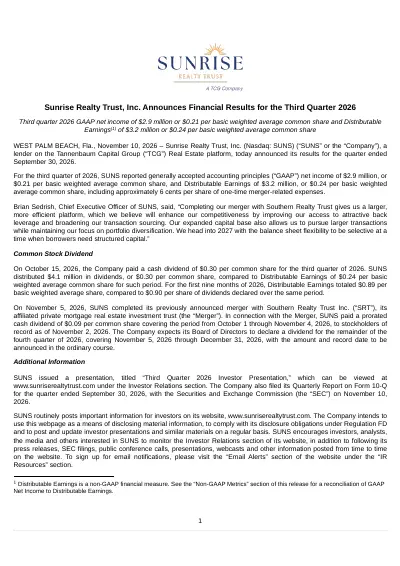
Thank you, Brian. For the quarter ended September 30th, 2026, we generated net interest income of $5.8 million and distributable earnings of $3.2 million, or 24 cents per basic weighted average common share.
GAAP net income was $2.9 million, or 21 cents per basic weighted average common share. These results included approximately $900,000, or 6 cents per share, of one-time merger-related costs.
For the nine months ended September 30th, 2026, we generated net interest income of $18.9 million and distributable earnings of $11.8 million, or 89 cents per basic weighted average common share, compared to 90 cents per share of dividends declared for the same period. GAAP net income for the nine months was $10.2 million, or 75 cents per basic weighted average common share.
We believe that providing distributable earnings is helpful to stockholders in assessing the overall performance of SUNS' business. Distributable earnings represents net income computed in accordance with GAAP, excluding non-cash items such as stock compensation expense, unrealized gains or losses, and the provision for current expected credit losses.
In the third quarter, SUNS funded $17.1 million of new and existing loans and received $58.9 million of repayments, primarily reflecting the July repayment of the Panther National senior term loan and construction revolver. We ended September 30th with $313.9 million of loan commitments and $256.9 million of principal outstanding across 12 loans, all current and performing, with a weighted average estimated portfolio yield to maturity of approximately 12%.
Following the Thompson San Antonio sale and the Sommet Blanc loan, as of October 30th, 2026, SUNS standalone portfolio consisted of $336.3 million of current commitments and $283.6 million of principal outstanding across 14 loans. As of September 30th, 2026, our CECL reserve was approximately $900,000, or 36 basis points of loans held at carrying value, and all 12 loans in our standalone portfolio were risk-rated 2.
As of September 30th, 2026, approximately 95% of our loan principal was floating rate, with a weighted average SOFR floor of approximately 3.9%. We estimate that a 100 basis point increase in benchmark rates would increase our annual interest income by approximately $1.9 million, while a 100 basis point decrease would only reduce it by approximately $500,000, reflecting the protection provided by our rate floors in each case before any change in borrowing costs.
As of September 30th, 2026, our debt outstanding was approximately $96.8 million, representing a debt-to-equity ratio of approximately 0.5 times. On a standalone basis, as of September 30th, 2026, SUNS had total assets of $285.4 million, and our total shareholder equity was $181 million, with a book value of $13.39 per share.
For the quarter ended September 30th, 2026, the board of directors declared a 30-cent common stock dividend per share outstanding, which was paid on October 15th, 2026 to shareholders of record as of September 30th, 2026. In connection with the merger, the board declared a prorated stub period dividend of 9 cents per share, or approximately $1.2 million, covering the period from October 1st through November 4th, 2026, which was paid on November 5th to stockholders of record as of November 2nd, 2026.
We expect the board to declare a dividend for the remainder of the fourth quarter covering November 5th through December 31st, 2026, with the amount and record date to be announced in the ordinary course. With that, I will now turn it back over to the operator to start the Q&A.
Operator
Thank you. If you would like to ask a question, please press *11 on your telephone.
You will then hear an automated message advising your hand is raised. If you would like to remove yourself from the queue, please press *11 again.
We also ask that you wait for your name and company to be announced before proceeding with your question. One moment while we compile the Q&A roster.
Our first question will be coming from the line of Gaurav Mehta of Alliance Global Partners. Please go ahead.
Gaurav Mehta
Thank you. Good morning.
I wanted to ask if you could discuss your balance sheet targets post-merger for the combined company?
Brandon Hetsler
Sure. We haven't disclosed the balance sheet numbers as we're still working on the purchase price accounting, and due to the timing of the deal closing, that has not been complete.
We did put into the investor presentation what the current commitments on a combined basis as of 9/30 would have been, which shows about commitments of $478.6 million with principal outstanding of about $393.1 million.
Gaurav Mehta
Okay. Second question.
I think in the prepared remarks you talked about $169 million in signed term sheets. Are you able to provide some more color on that?
Are those loans mostly residential? Any color on that would be helpful.
Brian Sedrish
Sure. Hey, Gaurav.
Those deals are deals we've been spending a lot of time on. To answer your question, they are residential plays where in one case there's an existing very high-end luxury destination home resort where ultimately we would potentially be providing the capital to help improve and build additional homes for sale.
There's that one. We have another one where, again, a very successful residential community, we'd be helping, very similar, in the capital to help continue to add value in that site.
Then lastly, another play, again, all residential as well. These are both condos and single-family homes where, again, the sponsor needs the requisite capital to help them continue to deliver product to their clients.
I think generally, broadly what I'll say is we found a lot of interest in those types of transactions, and we think sort of leaning into those really take advantage of our expertise. We've been spending a lot of time in those.
Then the other thing I might add is there's just much less competition in that type of market. I think we find that we can deliver pretty interesting, attractive returns to our shareholders through those types of deals.
Gaurav Mehta
Okay. Then lastly, you have one loan maturing in December 2026 in Fort Lauderdale.
Are you guys expecting that loan to be repaid, or do you guys expect that to be extended?
Brian Sedrish
The answer to that question is, if we do extend out, it would be for a relatively short period of time. That deal is a deal that we put on nearly three years ago.
The sponsor has done exactly what they said they were going to do in terms of delivering on time, actually ahead of time and on budget. They pre-sold of those for-sale condos a little over 50% of those.
The units look great, and the inventory is there, the logical takeout is an inventory loan. The question just is, because the loan's maturing in December, whether the sponsor needs a couple more months—they're going to have a signed term sheet shortly.
We may end up extending out for a couple months. If we do, we look at that as extremely positive.
Alternatively, the sponsor may just decide to just pay us out. It's just a question of timing as to how quickly they can bring it all together.
Ideally, we'd like to have the opportunity to keep it out a little bit longer. It's been a great performing loan for us, and we really like the sponsorship.
Gaurav Mehta
All right. Thank you.
That's all I had.
Brian Sedrish
Great. Thank you.
Operator
One moment for the next question, please. Our next question will be coming from the line of Jade Rahmani of KBW.
Please go ahead.
Jade Rahmani
Thank you very much. Could you provide a book value estimate pro forma for the merger close?
Brandon Hetsler
We have not disclosed the pro forma book value due to not having the final purchase price accounting finished due to the timing of the recent close of the merger. I believe in the proxy we did have an estimate as of 6/30.
Jade Rahmani
Okay. Just thinking about the dividend beyond the next declaration, which would be for a partial period, what's a reasonable range to assume?
Len Tannenbaum
I think that you're going to pay a stub dividend. Board still hasn't determined that.
The intention is to pay out close to our income for the year, so that I think that's going to be the balance of this year. Then we'll look at the pro forma results for next year and make a determination next year.
Jade Rahmani
Is there a target ROE we could apply to what we think pro forma book value is to make an estimate?
Len Tannenbaum
I think the tough part of where we are today, and I think you can see it in the numbers, is we're underlevered, and we have a lot of capacity. The good news, we have a lot of capacity to do deals.
The bad news is a lot of these deals that Brian was talking about earlier, I would have expected to close already, and everything takes longer. What's going to drive earnings is getting us back to appropriate leverage and driving the right ROE for our stockholders.
I think that's the big indicator that I'd be looking for over the next 3 to 4 months is as we announce deals as they close and we close them, that should be driving our stock and future ROE.
Jade Rahmani
What's a reasonable target for annual originations and debt-to-equity ratio?
Len Tannenbaum
Target debt-to-equity ratio is at least 1-to-1, right? We're not anywhere close to that, unfortunately.
That's still very low for mortgage REITs to have a 1-to-1 debt-to-equity ratio, and we have approximately, I'm now rounding numbers, $300 million-ish of equity, and drawn, what are we, $400-something million?
Brandon Hetsler
On the—
Len Tannenbaum
Actual draws, like—
Brandon Hetsler
393.
Len Tannenbaum
Yeah, 393. We should be $200 more million dollars outstanding, drawn, for us to achieve the ROE targets that we were really looking for.
Jade Rahmani
Not commitments, but actual draws. What are those ROE targets?
Len Tannenbaum
I don't have specific targets. I just wanted to say we are definitely too low today given really $100 million of leverage on a $300 million-ish equity base.
We need another $200 million of deals, not to close, but close and fund, or fund existing commitments for us to achieve a much better ROE.
Jade Rahmani
Okay. Switching gears, when you think of the turmoil that's playing out in the commercial real estate landscape, we saw sort of phase one play out from 2022 through late 2024, driven by the Fed rate hikes, as you all well know, plus office uncertainty.
Some of that has diminished, and the office sector has begun a recovery. Industrials also doing quite well, as are retail and hotel, which leaves multifamily.
Multifamily has been facing plenty of supply challenges across the Sunbelt, including in Florida, but we could be perhaps close to a trough there, although everyone's been thinking that for the last year. Nevertheless, at the same time, rates are going higher.
Multifamily could be sort of the next wave of stress, and then you look at where commercial mortgage REITs are trading at 50% of book value. I guess what are your high-level thoughts on the landscape we're facing, and where SUNS can really move the needle, if it's going to just be on direct originations, or if you see that there could be potential consolidation opportunities?
Len Tannenbaum
The good news is our headquarters is in a place called Palm Beach, Florida, and Palm Beach, Florida is an A+ market according to many many different indicators. What we are definitely experiencing Southern Florida, certain on the Treasure Coast, some absorption issues in multifamily.
We're not really seeing it right where we are, and that's so you really have to have pockets of one and the other. Brian and his team do an excellent job understanding the submarkets, the markets, and that's a lot of our analysis is over absorption, absorption trends.
We're we're definitely on top of it, and as I said to you over the past year, look, it's it was terrible to get the the lot the REO that we had. We were fortunate that we sold the hotel, and currently we really just don't have any other stressed assets at all.
That's the good news. Then I think, so that's that's part one, right?
Two is how do we take advantage of stuff? We we actually are agree with you.
There are pockets of real distress out there, and distressed REITs, and I think we are should be looking at their assets and them them also for potential opportunities for our shareholders. We'll we'll be out there in a looking at opportunities.
We're opportunistic lenders, and we'll be opportunistic also with trying to find distressed assets or distressed managers, and take and and help them get through this cycle.
Brian Sedrish
Yeah. Obviously, hey Jade, it's Brian.
I I absolutely agree with Len. I think clearly what's happening in the markets right now just from our competitor perspective, you know better than us, you're seeing a lot of groups opting to either exit the business and/or dealing with asset management issues.
I think that you're definitely seeing consolidation in the type of REITs that are focused much more on the flow-type business, which, as is not what we focus on. It's much more it's much more value-add type opportunities, and what we've seen is a significant pullback in the groups doing those types of deals, which I think largely is what's opened it up for us.
I think the biggest thing for us is being patient. I think deals are coming to us.
I think the biggest risk is acting too expeditiously on a transaction. As Len sort of hit on, we are seeing some of these groups who have been competitors of ours currently struggling and therefore are looking to offload some of their of their portfolio.
I think we are in offensive mode based upon everything we said in terms of our availability of capital, and we're just being super strategic in what we're going after. On the multi side, as I mean I think there's going to continue to be a lot of issues.
Rates going up is exactly the wrong move for groups that are sitting on transactions that they originated in '21, '22. That vintage multifamily is now definitely the epicenter of the problem.
That is, fortunately, we don't have those types of assets. I think we're feeling pretty good there.
On a go-forward basis, as that cliff of development has dropped off precipitously, and that will in markets like Len mentioned, Palm Beach and other growth markets, that will certainly allow groups to start building again, because there's growth behind it. I think there's a lot of pockets of opportunity we'll keep going after, and it's a combination of all those.
I think the biggest thing for us is just staying patient and going after the pockets that that are we think are really interesting returns for our investors.
Jade Rahmani
Thank you very much.
Operator
Thank you. One moment for the next question, please.
Our next question is coming from the line of Timothy D'Agostino of B. Riley.
Please go ahead.
Timothy D'Agostino
Yeah. Hi.
Thanks for taking the questions today, and congrats on the the the merger. I guess with the with the combined portfolio now and just looking forward, could you maybe talk to or quantify the potential annual G&A savings, and when those might show up, if there are any?
Thank you.
Brandon Hetsler
Sure. You can find this in the in the proxy as well.
We estimated that the the annual G&A savings would would be about $1.2 million, and that relates to, combined personnel, less audit, no duplicate audits or tax returns, less board fees. That's what's really driving the G&A, is the duplicate items of having similar funds.
Timothy D'Agostino
Should we expect to see that in would they fully show up in 4Q, or is that more like a 1Q event?
Brandon Hetsler
Since the merger just happened, it's going to be more of a forward-looking 2027 event. Then also wanted to point out that in 2027, we also do have the management fee waiver of $250,000 per quarter.
Timothy D'Agostino
Okay. That's helpful.
I guess just in regards to the pipeline, I was wondering if you could just provide maybe any color on what that looks like. I guess maybe in terms of location, property type, as well as, investment size.
It might be hard to comment on, but just looking at, the one deal that closed in the third quarter, I believe it was the the Park City, Utah residential for I think the current commitment is about $2.1 million. It'd just be good to kind of hear a little bit more about what's in the pipeline.
Brian Sedrish
Yeah. Sure, Tim.
It's Brian. Largely, the type of deals we're going after is is exactly the type we've historically gone after.
Big focus on the Southern US, right? That's not changing.
As we've always said, strategically and opportunistically, we may follow a borrower or a pre-existing relationship into another market, and we are certainly willing to do that. The core has always been, will continue to be, focusing on where those paths of growth are.
That's what comprises the current pipeline for the substantial majority of the deals we're going we're going after. Like I said in earlier, I think you should think about residential will continue to remain a key focus of ours.
I think particularly for us, where we're seeing the pockets of opportunities, both from a rate of return, because as I mentioned earlier, some of our competitors are pulling back in that area, and and then just also from a from a division of where the opportunity set is, is those higher and, sort of K-shaped type recovery opportunities where we're still seeing a lot of demand for residential product. We want to keep leaning into that.
We obviously had our Panther deal. We have several others we're working on.
Those are some big focuses. Then outside of that, where we do really well is in some mixed-use properties where there's more complication, and we can lean in and hopefully bring our expertise.
Those are the those what I would say are the really are the really big areas of focus for us. From a deal size perspective, look, we have to be cognizant of concentration.
We often are playing in the bigger deal sizes, and so what that typically means is is if they get too large and chunky, we will bring in co-investors to, help us with those deals, while still maintaining, certainly a a a big, important control position in those deals. I think that's that's sort of sort of what we're mindful of.
As we obviously can can expand and grow, we can continue to hold and eat more of that cooking ourselves. I think the pipeline's pretty strong.
The other one I'll say is, one that you've heard many times and we're certainly seeing this is now, clearly with rates expected to go up, let alone stay, in their elevated state, that is absolutely reducing the amount of sales that are happening, and that is resulting in additional calls that we're getting on providing those gap equity, or I should say those gap capital needs, where we would come in and either take out the senior and expand out, or alternatively provide a sub-debt tranche. We're we're seeing a lot of those types of opportunities.
I definitely expect that those will continue, particularly as we move towards year-end.
Timothy D'Agostino
Great. If I could just ask one more.
I know I believe Len talked a little bit about in the prepared remarks, but with the deal now behind you and you have more scale at the platform, I guess, what are we thinking about unsecured financing? It seems like that's probably the next step here.
Could you just provide a timeline on that? Has anything changed around when you're thinking about a potential unsecured deal?
Len Tannenbaum
The problem with the unsecured markets in my and as we talk to our partners is it's too expensive. There's too many rates borrowing in the low double digits, and somehow that you get broad-brushed with that even though we have lower leverage, we don't have the non-accruals everybody else has.
We have a really good, solid portfolio. It doesn't matter.
I think the combination, at least we get a little bit bigger and we get more scale, which is going to be part of what we need. The other thing is we're going to need the markets to allow us to get a cost of capital that makes sense.
As we currently lend at 9% all-in cost to SUNS from a mezzanine perspective, right?
Brandon Hetsler
Our unsecured is—
Len Tannenbaum
Unsecured.
Brandon Hetsler
It's an 8% fixed with a 1% annual fee, yes.
Len Tannenbaum
To get an all-in cost there, right, with OID, broker fees, and everything else, to have to be able to beat that, in my view, to want to access the unsecured market. Hopefully as we grow and we continue to perform and we get a good rating of BBB eventually, that can lead to a sub-9% all-in cost of capital, which is I think that's sort of my bogey for being willing to access that market.
Timothy D'Agostino
Okay. Understood.
That's helpful color. I appreciate it.
Thanks for taking the questions today, and congrats again.
Len Tannenbaum
Thanks.
Brian Sedrish
Sure.
Operator
One moment for the next question. Our next question is coming from the line of Tyler Batory of Oppenheimer.
Please go ahead.
Tyler Batory
Good morning. Thanks for taking my questions.
First one for me, the share repurchase program, just help us think about how you're balancing that with originating new loans. Sounded like in the prepared comments you'd like to execute on that before year-end, just wanted to be sure that I heard that correctly, too.
Len Tannenbaum
We definitely will start it before year-end. I'm not sure we're going to execute on the whole share buyback.
Brandon Hetsler
I think maybe you heard that the share buyback is currently through December 31st of 2027, through all of next year as well.
Len Tannenbaum
Right. I think it's an important component.
Look, the stock is trading at a level that the board determines that could be a very good use of capital to buy back shares. As long as the stock continues to trade in this area, I think share buybacks have to be considered more than using that equity to do something different with.
I think we're excited to be able to buy back shares at a significant discount to our NAV.
Tyler Batory
Okay. I appreciate the clarification there.
There have been a number of questions here just on originations and what not. I'm curious, was the merger a hang up at all in terms of what you could execute on?
I don't know if there was maybe any sort of pause in terms of your process while you were working on that deal, or maybe just the broader environment is just a bigger hurdle in terms of getting stuff across the finish line.
Brian Sedrish
Yeah. Definitely the latter.
It wasn't the merger that was holding us up. I think it's back to the commentary before, I think that we have a big focus on patience and picking our spots to get involved in.
I think that the biggest risk right now that anyone has is an eagerness to get capital out. We think the opportunity set ahead of us, and like I said, we're starting to see that, is really strong, and I think you pick your spots and be patient about that.
On top of that, as Len mentioned, there are several deals that we are in heavy diligence on, and these types of deals are just not flow-type deals, they just take longer to actually execute. Sometimes you just end up with a chunky quarter, sometimes you don't.
I think it's a combination of those two things that are the reason why I think what you're really asking is which transaction volume slower in the quarter.
Tyler Batory
Okay. That's all for me.
I'll pass it on. Thank you.
Brian Sedrish
Sure.
Operator
Thank you. That does conclude today's Q&A session.
I would like to turn the call back over to Brian Sedrish, CEO, for closing remarks. Please go ahead.
Brian Sedrish
Thank you all for joining us today. We look forward to updating you on the progress next quarter.
Have a good day.
Operator
This concludes today's programming. Thank you all so much for joining.
You may now disconnect.