Latham Group, Inc.
NNASDAQ:SWIMQ1 FY2026 · Earnings Call TranscriptMay 5, 2026
Operator
Good afternoon, and welcome to the Latham Group first quarter 2026 earnings conference call. All participants will be in listen-only mode.
Should you need assistance, please signal a conference specialist by pressing the star key followed by zero. After today's presentation, there will be an opportunity to ask questions.
To ask a question, you may press star then one on your telephone keypad. To withdraw your question, please press star then two.
Please note, this event is being recorded. I would now like to turn the conference over to Casey Kotary, Investor Relations representative.
Please go ahead.
Casey Kotary
Thank you. This afternoon we issued our first quarter 2026 earnings press release, which is available on the Investor Relations portion of our website.
On today's call are Latham's President and CEO, Sean Gadd, and CFO, Oliver Gloe. Following their remarks, we will open the call to questions.
During this call, the company may make certain statements that constitute forward-looking statements which reflect the company's views with respect to future events and financial performance as of today or the date specified. Actual events and results may differ materially from those contemplated by such forward-looking statements due to risks and other factors that are set forth in the company's annual report on Form 10-K and subsequent reports filed or furnished with the SEC, as well as today's earnings release.
The company expressly disclaims any obligation to update any forward-looking statements, except as required by applicable law. In addition, during today's call, the company will discuss certain non-GAAP financial measures.
Reconciliations of the directly comparable GAAP measures to these non-GAAP measures can be found in the slide presentation that is available on our Investor Relations website. I'll now turn the call over to Sean Gadd.
Sean Gadd
Thank you, Casey, and thank you all for joining us today to review our first quarter results and discuss our business outlook. Our first quarter results represent a good start to 2026.
We are especially pleased with our performance given the adverse weather conditions that plague most of North America. There are several key takeaways from the quarter that are worth noting.
First, it was another quarter in which we saw year-on-year sales growth in each of our product lines. Latham's category leadership position across our product portfolio and our geographic diversification are key competitive advantages for us.
Secondly, we continue to effectively execute our Sand States strategy, showing double-digit sales gains in fiberglass pools in our priority Florida market. We are taking further actions to accelerate our growth in this region.
Third, we expanded our margins, benefiting from operating leverage inherent in our business model and from the lean manufacturing and value engineering initiatives that continue to yield very positive results. Oliver will provide additional detail on this later on in the call.
Lastly, we were pleased to confirm our 2026 guidance, which anticipates significant sales growth and even stronger growth in adjusted EBITDA within a challenging macro environment, where pool starts will be about flat with last year. Our guidance includes moderate increase in transportation and commodity costs due to today's high oil prices, which we are mitigating with temporary fuel surcharges.
We are closely monitoring the dynamic situation in the Middle East and the potential impacts on costs and consumer demand. Taking a closer look at our first quarter results, in-ground pool sales increased 3.5%, and virtually all of that growth can be attributed to the one-month contribution from the Freedom Pools acquisition.
Adverse weather was definitely a factor in our organic performance, keeping organic in-ground pool sales steady year-on-year. However, April sales trends were in line with our expectations, and we are on track for fiberglass pools to approach 80% of our full-year in-ground pool sales in 2026.
The Freedom Pool acquisition we completed on February 26 is integrating as expected. As we've noted, the acquisition expands our presence in Australia and New Zealand, markets where fiberglass pool models have a strong foothold, and broadens our reach into new markets in Western Australia, including Perth, which is the fastest-growing city in the country.
We recently spent a week in Australia bringing together the Narellan and Freedom teams. In addition to this transaction being immediately accretive to Latham and giving us a market-leading position in the country, we anticipate achieving considerable revenue synergies from this combination over time, as well as gaining firsthand experience from the direct-to-consumer business model.
Cover sales advanced 6% in the first quarter, driven by growth in autocover demand as consumers increasingly recognize the safety and economic benefits of this excellent product. Our industry-leading autocovers are compatible with all in-ground pool types.
In many parts of the U.S., they provide the homeowner with an alternative to fencing, while delivering additional cost savings from reduced evaporation and chemical usage. Educational marketing campaigns, including our partnership with Olympic gold medalist and pool safety advocate Cody Miller and his wife Morgan to promote pool safety, have served to build consumer awareness and increase attachment rates of autocovers to new pool installations.
First quarter liner sales were up 9% year-on-year, reflecting increased demand and buying in advance of the pool season. We continue to gain traction with our Sand States strategy in the first quarter and are moving forward with plans to accelerate our growth in this important region.
Many of the investors and analysts whom I've met since taking on the CEO role in January have asked me where I see the major growth opportunities ahead for Latham and what our playbook is for capturing that growth. Let me start by saying that the opportunity is substantial.
We do not need to wait for the recovery in the U.S. pool market to drive growth.
There are enough pool starts for us to go and attack the Sand States now, given our relatively low penetration in that region. The key here is that fiberglass is the growing category and we are the number one player in it in the U.S., and so we are best positioned to gain share.
Fiberglass pools are an excellent fit for the Sand States for many of the same reasons that the category is growing nationally: fast and easy installation, lasting durability, low maintenance, and we have an exceptional designed range of sizes and options to choose from, many of which are smaller rectangular shaped pools with attached spas that are perfect for our target communities. Latham has laid a good foundation for growth in the Sand States.
There is definitely increased brand awareness among consumers and dealers in Florida thanks to several high-profile marketing campaigns paired with local activations. In 2026, we plan to build on that foundation to set the stage for accelerated long-term growth.
As I have many years of experience successfully selling against the standard in the building products industry. When I apply that experience to Latham's current position in the Sand States, I've identified several actions to capture consumer demand and provide additional value to our dealers.
First, we are building out our commercial organization with the key pillars being sales strategy, sales operations, and sales execution, with responsibilities to design and drive sales plans, product leadership, and sales effectiveness. Our goal is to provide a world-class commercial organization that supports our growth not just in Florida, but across all the Sand States and all of North America.
Second, we have introduced a new market development framework, an approach at Latham that I believe will make us even more effective at capturing share. The key element of this framework is segmentation, meaning that we will be very selective with our targeted Sand State markets, determining the specific sections and neighborhoods that offer the greatest opportunity for us.
In essence, it's all about neighborhoods. We're looking for neighborhoods with a large number of homes with home values, lot sizes, and household incomes that fall within our parameters.
These can be in, adjacent to, or outside of master-planned communities. Third, we'll be adding sales resources in the field to make sure we stay close to the consumer throughout the pool buying process.
In this way, we'll be able to assist our dealers in converting more leads into sales and gaining greater understanding of the consumer journey. We know that consumers are looking for designs that fit their lifestyles, and we believe that Latham has the best range of products to meet those needs.
In 2026, we are increasing our investment in branding and marketing in a very targeted way to capture greater consumer awareness. Together with our network of trusted dealers, we are able to fulfill the demand we generate.
In support of all this, we are revamping our marketing and advertising campaigns to give homeowners a full understanding of the true benefits of fiberglass and why it is the right solution for their backyard to enable their dreams of creating wonderful memories to come true. With that, I will turn over the call to Oliver Gloe, our CFO, for a financial review.
Oliver?
Oliver Gloe
Thank you, Sean, and good afternoon, everyone. I am pleased to report on what was a solid start to 2026.
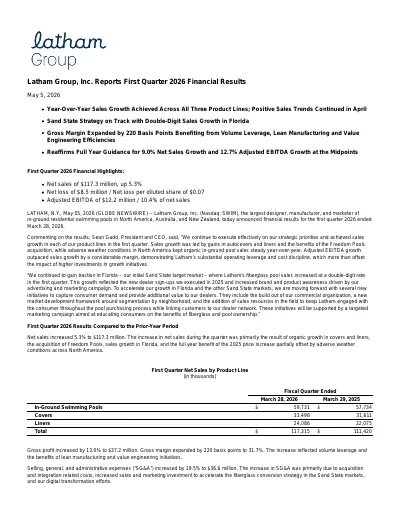
Please note that all comparisons we discuss today on a year-over-year basis compared to the first quarter of fiscal 2025, unless otherwise noted. Net sales for the first quarter of 2026 were $117 million, 5% above $111 million in Q1 of 2025, of which 3% represented organic growth and 2% represented the one-month benefit of the Freedom Pools acquisition we completed at the end of February.
Organic growth was led by the continued strength of autocovers and increased demand for our pool liners. By product line, in-ground pool sales were $60 million, up 4% from Q1 2025, with virtually all the year-on-year growth coming from Freedom's fiberglass pool sales.
Cover sales were $33 million, up 6%, and liner sales were $24 million, up 9% compared to the first quarter of 2025. We achieved a first quarter gross margin of 32%, reflecting a 220 basis point increase above last year's 30%.
This performance is primarily due to volume leverage, along with production efficiencies driven by our lean manufacturing and value engineering initiatives. SG&A expenses increased to $37 million, up 20% from $31 million in Q1 of 2025.
This was largely tied to strategic investments in sales and marketing to accelerate fiberglass adoption, digital transformation initiatives, and acquisition and integration related costs, which includes $2.3 million of performance-based compensatory earnout expenses related to our Coverstar Central acquisition in 2024. Target synergies have been realized for Coverstar Central, and we are pleased with the contribution from the acquisition, which has exceeded our initial expectations.
This earnout will total roughly $9 million over the course of the year, with similar impact in each remaining quarter in 2026. Net loss was $9 million or 7 cents per diluted share, compared to a net loss of $6 million or 5 cents per diluted share for the prior year's first quarter, primarily due to the before-mentioned increase in SG&A expenses.
First quarter adjusted EBITDA was $12 million, 9% above $11 million in the prior-year period, primarily resulting from volume leverage and efficiencies gained through our lean manufacturing and value engineering initiatives. Adjusted EBITDA margin was 10.4%, a 40 basis point expansion compared to last year's first quarter.
Turning to the balance sheet, we continue to maintain a strong financial position, ending the first quarter with a cash position of $27 million. In line with our expectations, net cash used in operating activities was $48 million, reflecting a seasonal increase in working capital needs ahead of peak pool selling season.
We ended the quarter with total debt of $311 million and a net debt leverage ratio of 2.8, also in line with our expectations. Capital expenditures were $23 million in Q1 2026, compared to $4 million in the prior-year period.
The increase is primarily due to the purchase of four key fiberglass manufacturing facilities in Florida, Texas, California, and West Virginia for $18 million, including a $12 million deposit made in 2025 that was settled in Q1 2026. Additionally, we incurred $5 million of CapEx relating to ongoing projects in line with our expectations.
As a reminder, we expect CapEx to range between $42 million and $48 million in 2026. This includes $25 million of maintenance CapEx, expenditures related to the purchase of the fiberglass manufacturing facilities that I just mentioned, and investments to upgrade our newly acquired Freedom Pools manufacturing facilities.
While the beginning of 2026 was affected by adverse weather conditions across North America, we are encouraged that April sales trends have been in line with the historical seasonal ramp. We continue to monitor geopolitical developments and their potential impact on our freight and raw material costs, but we believe we are well positioned to manage effectively through this pool building season.
We are pleased by the steady progress we are seeing from our fiberglass awareness and adoption initiatives, highlighted by strong consumer engagement with our branding and marketing campaigns and continued gains in Florida, our initial Sand State target market. Based on our performance to date and our current visibility into the remaining season, we are pleased to reaffirm our guidance for 2026 revenue growth of 9% and adjusted EBITDA growth of 13% at the midpoint, amid expectations for new U.S.
pool starts to be flat with last year. With that, I'll turn the call back to Sean for his closing remarks.
Sean Gadd
Thanks, Oliver. In summary, we are pleased with our first quarter performance, encouraged by recent order trends, and excited by the great opportunities we see on the horizon.
Latham is firmly on track to outperform the market for new U.S. pool starts again in 2026, and we intend to take advantage of soft markets to accelerate our Sand States strategy and strengthen our execution.
I see tremendous opportunity for Latham to drive market penetration in the Sand States, as well as the rest of North America, Australia, and New Zealand. With that, operator, please open the call to questions.
Operator
We will now begin the question-and-answer session. To ask a question, you may press star then one on your telephone keypad.
If you are using a speakerphone, please pick up your handset before pressing the keys. To withdraw your question, please press star then two.
Please limit yourself to one question and one follow-up. At this time, we will pause momentarily to assemble our roster.
Our first question comes from Ryan Merkel with William Blair. Please go ahead.
Ryan Merkel
Hey, everyone. Appreciate the question.
Wanted to start off with sort of the fiberglass backlog and orders as you enter the season. How is that looking?
Then have you seen trends pick up now that the weather is cleared?
Sean Gadd
Thank you for that question, Ryan. In terms of backlog, I think we've seen what we would have expected to see coming out of the first quarter.
The order flow in April looks strong to us, and looks like it is picking up per the season. We feel good enough that we obviously have reaffirmed guidance, but generally we are seeing that pick up in orders and feel pretty good with trends.
Ryan Merkel
Got it. Okay.
Thanks for that. Then my second question is that the fiberglass conversion is key to the story, Sean, you know that, and you're adding a bunch of resources, it seems.
I'm curious, what are the biggest tweaks that you're making to the strategy? Then any early results, or maybe it's a little too early?
Sean Gadd
We are definitely making some tweaks. It is, I will tell you, it's too early.
The main thing, and I've talked about it earlier on, is we are segmenting the market a little bit differently to how we have done it in the past. We've got our criteria now built up where we know or we feel like if a neighborhood fits that criteria, the likelihood of them going to Latham and then to fiberglass is higher.
We like that. We started to test that, and if we get those right, with the right dealers, we'll be able to start building out more and more neighborhoods.
We're early, but I feel like that's definitely on a good path for us. The second thing we're doing is adding heads, and really I'm trying to organize the commercial organization into sort of three areas: sales strategy, which is really just understanding where's the opportunity, doing more of the segmentation, becoming a little bit smarter around sales; and then sales operations, which for me is really about converting what we think about the market into real game plans that the sales team can execute; then measuring that sales team; and then sales team to go and execute.
Just getting a little bit more organized so that we get the most out of our sales organization, and that's really across the whole U.S., but including the Sand States.
Ryan Merkel
That's great. That's interesting.
Okay. Appreciate that.
I'll pass it on.
Sean Gadd
Thank you.
Operator
Our next question comes from Greg Palm with Craig-Hallum Capital Group. Please go ahead.
Greg Palm
Thanks. I wanted to piggyback on the first question a little bit, since a lot has happened in the last couple months since we were all on the phone together.
It doesn't sound like demand environment has changed all that much, I guess, relative to maybe what you would have thought a couple months ago. Maybe you can just confirm that again.
From an input cost side of things, you mentioned freight, wanted to get your sense on how you're dealing with that and also anything else that's on your radar, whether it be increase in resin prices. Are you seeing any availability shortages of key inputs like that, anything else that should be on our radar?
Sean Gadd
Thanks, Greg. I'll start by talking about the market a little bit.
We still see the market overall for this year look likely to remain flat. Our assumption for that hasn't changed.
We are seeing some green shoots coming out, and we feel good about that. Like I said, our order trend for April looked strong and into the start of May.
We feel good about that. PK would have indicated, PK Data would have indicated that some more growth starting to occur with cheaper pools.
Again, we like that, that's a good sign for us. Obviously, pools are getting smaller, so that is good.
Obviously, the volatility is not helping, but I know we have a sound approach, I think we'll work through that. Then from a dealer perspective, when we caught up with the dealers, what they'll tell us is it's pretty competitive, 4 or 5 quotes per job, which is generally up.
From my take is, it's certainly uncertain, but I believe less people will be traveling, the price of gas doesn't help, and so they're staying at home. I think that's the opportunity.
I think that's what the green shoots are where we're seeing that people will rather now spend time at the home and hopefully that's add/build a pool.
Oliver Gloe
Greg, let me address the second part of your question with regards to the conflict in the Middle East and some of the updates here on input costs. Let me start off by saying we don't see the availability to be an issue as of today, and partially that's due to our supplier diversification coming out of COVID that allowed to be multisourced and be as diversified as possible.
We are seeing obviously headwinds in costs, right? That comes in two forms.
One is transportation, the price at the pump, and especially in the world of fiberglass, we are obviously incurring transportation costs. It's expensive to ship those fiberglass pools across the nation.
In terms of mitigation, what we've done on that side is to introduce temporary fuel surcharges that we plan to fully mitigate us when it comes to transportation costs. I think it's too early to tell what the impact is going to be on the commodity side.
Obviously, suppliers are reaching out. We are exposed to again the conflict in the Middle East as we consume a lot of oil derivatives in the world of resins, vinyl, and so forth.
Again, I think it's too early to tell. Certainly currently in discussions with the suppliers.
I think we're making the first purchase orders as we speak under slightly higher price levels. We'll have to see how the very dynamic situation evolves.
I'm confident in the playbook that we have. We have applied that playbook during COVID.
We have applied that playbook certainly last year. I think we have confidence that the playbook will also work this year as we work through commodities.
Greg Palm
Great. Then on some of these initiatives that you talked about, re-segmentation, adding sales resources, I'm curious, how do you feel about your current dealer network right now and how important of a lever can that be not just adding new and more dealers, but also leaning in to some of your more successful ones?
Maybe you can talk a little bit about that as well.
Sean Gadd
Sure. I'll start with dealers are very important.
They are obviously the extension of us as they sit across the kitchen table. We need them.
We need them to help us to close the sales. Now, what I will tell you is I believe we've got the opportunity to get more out of our current network, which is goal number one.
I'm talking really about our core, what I would call our core markets: Midwest, Northeast, Canada. That's really about account management.
We're going to be defining what account management looks like for Latham and making sure our organization's trained around good account management. I expect to get more out of our current network.
Then I think about adding where we got white space. We're always going to be looking for dealers to play in white space if our current dealer network doesn't get us there.
That is going to be part of the strategy. Then when I think about the Sand States and material conversion, we have a good network of dealers there right now that we're going to be feeding as we go into these neighborhoods.
They will be able to get the benefit of referrals and everything else that comes out of those neighborhoods. Feel good about the network in the Sand States, particularly Florida, but our intention will be over time to grow that.
Greg Palm
Fair enough. I will leave it there.
Thanks.
Sean Gadd
Thank you.
Operator
Our next question comes from Timothy Wojs with Baird. Please go ahead.
Timothy Wojs
Hey, guys. Good afternoon.
Sean Gadd
Good afternoon.
Timothy Wojs
Maybe just first question just on kind of the re-segmentation of sort of the sales force and things like that. Is the plan that there's incremental investments in terms of dollars that's going into some of the initiatives, or are you just kind of reallocating what you have?
Sean Gadd
A little bit of both. We are definitely going to get ahead a little bit because we need more people on the ground and actually thinking about our game plan.
That will be additive. Our intention will be if you think about SG&A as a percentage of sales, over the medium and long term, that should stay the same.
We will continue to fund that as we grow, and then we will look at opportunities to sort of trim back on the back side of the business to give us some space to spend on the front side of the business and invest.
Timothy Wojs
Okay. Then, Oliver, just on the price/cost question, I guess it's not totally clear if higher resins are kind of in the guide or is it kind of a wait-and-see approach right now, and if you do see higher resins, you guys have the ability to take costs out or improve efficiencies or pass them on price?
Is that kind of the main message?
Oliver Gloe
It's probably more the latter. I think transportation costs, it's relatively foreseeable what that means to us, and that's in the guide, right?
With commodities, I think it's too early to tell.
Timothy Wojs
Sounds good. Thank you, guys.
Sean Gadd
Thank you.
Operator
Our next question comes from Andrew Carter with Stifel. Please go ahead.
Andrew Carter
Hey, thank you. Good afternoon.
Wanted to ask and just double-click to make sure we understand exactly what the pricing is for the year. You are putting in temporary fuel surcharges.
Can you give a magnitude of how much that's kind of incremental to the old guidance? You are not taking any price increases on products for resins, just want to make sure and triple-check that.
I think you said we're well prepared for materials during the season, I'm guessing is that a comment that everything's good for now, and you take a price increase later? Then kind of finally, if you have to take a price increase, can you take one mid-season, or does that mess things up, or just how do those dynamics work around when you have to make a decision on pricing?
Oliver Gloe
Got it. Andrew, I would say the transportation cost and the temporary surcharge, I'd say for the year is probably worth 60 basis points.
Again, it's very dynamic and volatile, right? Obviously, as the headwinds change, that the temporary surcharge can change over time as well, right?
That's just order of magnitude, right? I think, again, for commodities, too early to tell.
Quite frankly, we haven't even ordered or just about to start ordering materials that would be subject to a change in pricing. It's really too early to tell.
Then, obviously, the materials get shipped to our sites, work their way through inventory ultimately as they get consumed in the P&L. Again, we have our playbook, and we'll react in time as necessary.
If I remind you, last year we actually did do a mid-season price increase catering to the environment last year that came in June. It's not preferred, but it's also not unheard of.
Andrew Carter
Thanks, I'll pass it on.
Oliver Gloe
Thanks, Andrew.
Sean Gadd
Thank you.
Operator
Our next question comes from Scott Stringer with Wolfe Research. Please go ahead.
Scott Stringer
Hey, guys, thanks for the question. I'm just wondering if the adverse weather mentioned in 1Q pushes some sales into the second quarter?
The guidance obviously implies an acceleration through the rest of the year, right? Guess it would just be helpful to know if tailwind from sales being pulled into 2Q if that is the case.
Thanks.
Oliver Gloe
I would say the adverse weather really means we had a lot of snow, ice on the ground in January and February. If you think of our annual organic growth of 6%, we certainly didn't quite achieve that in Q1.
It was probably half of that. I would attribute that to weather.
If you translate that to shipping days, that equates to about a shipping day in today's seasonality. I'm not reading too much into that.
The season is young. Q1 is a comparatively small quarter.
Again, translating our underproportional organic growth in Q1 vis-à-vis the annual guide into shipping days, it's one day. I think that's another way of saying we put in the prepared remarks that really the trends in April have been as expected.
We're seeing the seasonal ramp. Whether we'll catch up on that one day in Q2 or in Q3, we would see it early in the quarter.
Certainly nothing we've seen in Q1 and in our ramp in April that would make us change our view on '26 and the guide.
Scott Stringer
Got it. Then I think you guys talked about this a little bit earlier, but just curious on the visibility into 2Q and 3Q for in-ground pool installs.
Is that pretty much set, or just curious, how much variability is there over the next two quarters for that segment? Thanks.
Sean Gadd
I'll start, and then I'll hand it over to Oliver. I think from a Q2 perspective, we're all but set based on our lead times currently.
That looks like, as I said, we've started the quarter really really well. Q3 still obviously while we've got orders that do fall into Q3, it's probably too early to tell.
Again, from what we're hearing inside the market, from what we're seeing, we still feel very confident of what the order flow looks like and that we'll be able to all continue to hold guide.
Oliver Gloe
If I compare today's order book versus prior years, really nothing that would cause us to think differently about the seasonal pattern vis-à-vis the last year. Again, all confirming our guide today.
Scott Stringer
Got it, that's helpful. Thanks for the time, guys.
Sean Gadd
Thank you.
Oliver Gloe
Thanks, Scott.
Operator
Our next question comes from Matthew Bouley with Barclays. Please go ahead.
Elaine Ku
Good afternoon, guys. You have Elaine Ku on for Matt Bouley today.
Good afternoon. For my first question, I'm just curious, what are the top concerns you're seeing from buyers today, between rates, economic uncertainty, just the need to step up more consumer awareness of fiberglass pools, what's kind of the biggest challenge today?
Sean Gadd
From from what I've heard, the number one thing would be, which is tied to interest rates, is, basic fund financing is difficult to get. Anybody who's hasn't got the cash or is able to get got a good FICO score is unable to get financing.
We're hearing that a fair bit, which which isn't all that different to what we would have heard last year. Then, I I think the other part would be the dealers were are saying that, they're fighting, having to fight for the sale a little harder than they would have previously.
When when I when I mentioned 4 to 5 quotes, that's typically 2 to 3 quotes. Everyone's fighting for the business pretty hard.
Now, reality is, we feel in an environment where things are tough, I actually feel good about fiberglass pools because, obviously, pools are getting smaller, that fits our trend. Pools have low maintenance, the actual costs on an ongoing basis is lower than than our than the alternatives out there.
The expenditure on chemicals, and like I said, on evaporations lower, especially if you have an auto autocover. The durable pool means that there's no no ongoing expense done with the pool.
While we see the market as a little tough, we still see it not adversely affecting us relative to last year.
Elaine Ku
Got it. In terms of your increased branding and marketing spend, can you walk us through the cadence of what that might look like through the year and its impact on SG&A?
Also, what does this sort of look like? Is it a targeted brand program for dealers?
Is it more sales people on the ground? Or is it more on the ad and marketing spend?
Thank you.
Sean Gadd
It's a bit of both. Right now we're running a national campaign.
National campaign's good because it lifts all markets up, which is great. The other good part about our national campaign is when you think about the Sand States, there's a trend of people moving from the Midwest, Northeast into the Sand States.
We like that because fiberglass is the standard in those markets, they know us. We like the marketing campaign being a national format.
I'll just start with the timing, the start of the timing is really set for the pool season. We started sort of February, mid to late February, and then we're moving all the way through to sort of July, August.
That's really the time frame for the national campaign. Then when I think about my neighborhoods, that's going to be way more tactical in nature.
I'm talking about things like digital marketing, I'm talking about door hangers and marketing around the homes, and talking about doing events at the home to inspire the neighborhood. Those are pretty tactical, small expenses that will run in every neighborhood.
Oliver Gloe
When it comes to the increase and the cadence of the increase, as we said earlier on, I think over the foreseeable future SG&A as percent of sales will roughly be flat. It was 22.5% last year, we expect it to be a similar amount this year.
The majority of that is spent as you've heard from in the sales organization and marketing. There's a little bit of digital transformation in there and obviously inflation on the core meaning G&A, but again, the majority is going into the sales organization and marketing.
There's also a little bit of increase in the absolute dollar number as we bought Freedom and that comes with about $3 million of SG&A. That gives you the 22.5 million, but I would like to remind you that in addition, we have the earnout expenses for Coverstar Central, that is about $9 million.
It's tied to 2026, it won't recur in '27, neither did it occur in '25, so that is a earnout expense that is tied to 2026. Now, with regards to cadence, it's roughly the same as usual.
You will see that Q1 and Q2 are a little bit heavier, and that is because we are running our marketing campaign, our national TV campaign earlier and longer in '26 versus '25.
Elaine Ku
Great, thanks. I'll pass it on.
Oliver Gloe
Thank you.
Operator
Our next question comes from Susan Maklari with Goldman Sachs. Please go ahead.
Charles Perron-Piché
Hey, everyone. This is Charles Perron-Piché in for Susan.
Thanks for taking my question. First, I'd like to shift gear a little bit and talk about the autocover and the opportunity that you see in this market.
Considering the changing macrodynamics, is there any impact you're seeing in terms of the adoption and any efforts you can do here to further expand the penetration over the coming years?
Sean Gadd
I'll start with that. I think so the answer is no, we're not seeing a decrease in adoption.
We had a pretty good quarter in autocovers, and covers in general. We think we had very large growth last year, we expect it to grow this year and we expect it to grow in the coming years as well.
It's really about awareness for us. Reality is most people still don't know that autocovers are available.
Autocovers can fit on every pool, it doesn't really matter if it's fiberglass pool or not, the market's actually very large for us. We've got our value-added resellers set up to take advantage of that.
We've also now getting Latham's sales organization around that product, and it's still early for that to happen, we see that as more upside as we go. The product is a good product.
It does what it needs to do. Consumers who have it love it, and I think we just got to make sure we continue to drive the awareness, and I don't see that trend changing.
Charles Perron-Piché
Got it. That's helpful, Sean.
Then switching gear, I appreciate all the callers so far on the call on input cost and inflation, but should we see more unfavorable dynamics coming through from a cost perspective, can you talk about the opportunities to further lean on your lean manufacturing and value engineering initiatives to further protect your margins?
Oliver Gloe
I think lean and value engineering continues to be a key contributor to our P&L. Like you've heard me on prior calls, the contribution is about $2 million, $2.5 million per quarter.
In Q1, it was $2 million, and that's just because Q1 is a light quarter and lean and value engineering programs go up and down with volume. I think as some of those programs mature and you see the tailwind that's really now getting into our DNA.
This is how we lead our plants and factories and it's part of the everyday cadence. You'll see a lot more programs.
Maybe not of the same magnitude because the low-hanging fruits are being cleared here, and that's more common for lean manufacturing, whereas value engineering, we're really in the beginning of the journey. I think there are still some low-hanging fruits out there that our team of PhD-level scientists is pursuing.
Again, both initiatives under full steam, and certainly in Q1 delivering what we expected them to deliver, and there's no change in our thoughts for the rest of the year.
Charles Perron-Piché
Got it. Thank you for the color, guys, and good luck with the quarter.
Sean Gadd
Thank you.
Oliver Gloe
Thanks, Charles.
Operator
Our next question comes from Shaun Calnan with Bank of America. Please go ahead.
Shaun Calnan
Hi, guys. Thank you for taking my question.
Just first, the double-digit growth in Florida was quite impressive. What do you think has led to the success in Florida versus the other Sand States, and can you talk about what lessons you can take from Florida to apply to the other Sand States?
Sean Gadd
I'll start with it is obviously our largest focus of all the Sand States. We are set up quite well from a sales number perspective.
We've been working on dealers now over the last 18 months, we've got a set of dealers that are really the right dealers for us to help fulfill the demand that we're creating. We've been running our marketing in general campaign for now 18 months, we've seen the flow of that.
Then we've got a really good strong value proposition relative to concrete. We're getting deeper and deeper into the market and being able to communicate it.
We are seeing good growth, and I feel good that if a homeowner understands the benefit of fiberglass over concrete, there's a really high chance that we go with fiberglass. We're just very early still in the adoption curve, our mission is to make sure our awareness continues to get driven up, and that we have the connection between that awareness and our dealers positioning at the kitchen table.
Then I'll just remind you, at the end of the day, while we are very pleased with the numbers, we look to accelerate that, and in reality, we're still working off pretty small numbers when you think about Florida.
Shaun Calnan
Great. Then just one cleanup question on the surcharges.
Are you aiming to offset the higher transportation costs on a dollar basis or a margin basis?
Oliver Gloe
On a on a on a on a dollar basis. The the the headwind is is, as we as we as we incurred it, it's it's being passed on with the temporary surcharges.
Shaun Calnan
Great. Thank you.
Oliver Gloe
Thanks, Shaun.
Operator
Our next question comes from Andrew Carter with Stifel. Please go ahead.
Andrew Carter
Hey, thanks. I wanted to double-click and make sure on that incentive cost.
You're not backing that out, if you were to put that back in, the incremental here is still 28 to 38 in investment year. I just want to understand that double-click.
Thanks. The earnout around Coverstar.
My fault.
Oliver Gloe
Right. The earnout is included in SG&A, it will be sitting on top the 22.5% as percent of revenue, but as it is an expense tied to an acquisition, for EBITDA purposes, it's backed out.
Andrew Carter
It is just not excluded, it is within guidance that expense, just double-checking.
Oliver Gloe
Correct. It's an addback to EBITDA, and it is in SG&A.
Andrew Carter
Okay. My fault.
Sorry about that. Thank you.
Sean Gadd
Thanks, Andrew. Thank you.
Operator
This concludes our question-and-answer session. I would like to turn the call back over to management for closing remarks.
Sean Gadd
Thank you very much. I just want to thank everybody for getting on the call.
We felt like we had a strong quarter, obviously marred a little bit with weather, but the momentum's there, April looks strong, and we feel confident about our guide. With that, I'm going to conclude the call.
I look forward to seeing all the folks on the call over the coming weeks and months at different types of events. Again, thank you for everyone for attending.
Thank you.
Operator
The conference is now concluded. Thank you for attending today's presentation.
You may now disconnect.