Southwest Gas Holdings, Inc.
Q3 FY2026 · Earnings Call TranscriptNovember 4, 2026
Operator
Welcome to Southwest Gas Holdings third quarter 2026 earnings conference call. Today's call is being recorded, and our webcast is live.
A replay will be available later today and for the next 12 months on the Southwest Gas Holdings website. All participants are currently in listen-only mode.
A question and answer session will follow the prepared remarks. If you would like to ask a question at that time, please press star one, then the number one on your telephone keypad.
If you would like to withdraw from your question, please press star two. I will now turn the call over to Mr.
Will Batista, Director of Investor Relations, Sustainability and Stakeholder Engagement. Please go ahead.
Will Batista
Thank you, Kelsey, and good morning, everyone. We appreciate you joining the call this morning.
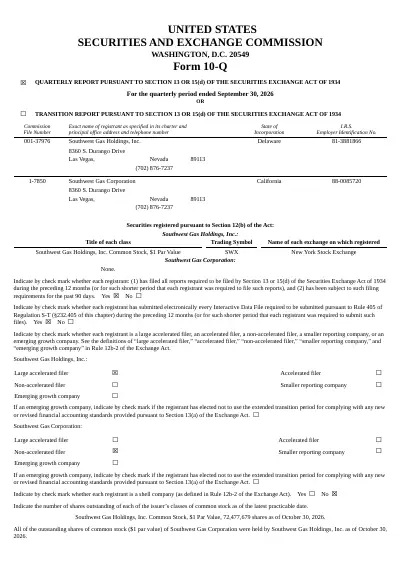
This morning, we issued and posted to Southwest Gas Holdings' website our third quarter 2026 earnings release and filed the associated Form 10-Q. The slides accompanying today's call are also available on Southwest Gas Holdings' website.
will refer to those slides by number throughout the call today. Please note that on today's call, we will address certain factors that may impact 2026 earnings and discuss longer-term guidance.
Information that will be discussed today contains forward-looking statements. These statements are based on management's assumptions on what the future holds, but are subject to several risks and uncertainties, including uncertainties surrounding the impacts of future economic conditions, regulatory approvals, and capital projects.
This cautionary note and a note regarding non-GAAP measures are included on slide 2 and 3 of this presentation, in today's press release, and in our filings with the Securities and Exchange Commission. We encourage you to review each of these disclosures.
These risks and uncertainties may cause actual results to differ materially from statements made today. We caution against placing undue reliance on any forward-looking statements, and we assume no obligation to update any such statements.
As shown on slide 4, on today's call, we have Justin Brown, President and CEO, and Justin Forsberg, Chief Financial Officer and Treasurer. Other members of the management team are also available to answer your questions during the Q&A portion of the call today, if necessary.
I will now turn the call over to Justin Brown.
Justin Brown
Thanks, Will. Good morning, everyone, and thank you for joining us today.
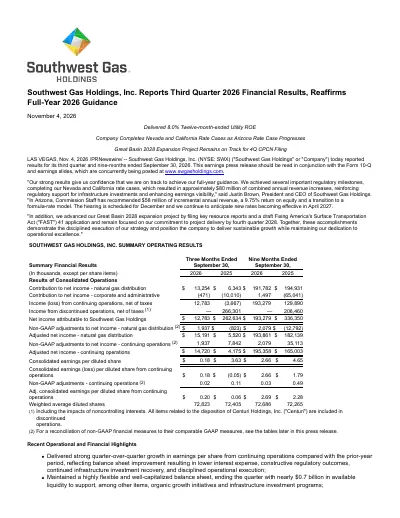
Beginning on slide 5, we delivered strong third quarter and year-to-date results while continuing to execute on our regulatory and growth priorities. Reported adjusted earnings per share from continuing operations of 20 cents compared with 6 cents in the third quarter of 2025, and year-to-date adjusted earnings per share from continuing operations of $2.69, which is up 18% from the same period last year.
The improvement was primarily driven by constructive regulatory outcomes and disciplined cost management as we remain focused on delivering on our 2026 strategic priorities and key initiatives. Based on our current expectations, we are reaffirming our 2026 adjusted EPS guidance of $4.17 to $4.32 per share and our 12% to 14% long-term adjusted EPS growth target.
In Arizona and Nevada, we are working to better align cost recovery with the pace of our investments, which benefits customers and investors alike. Importantly, our plan does not depend on any single outcome as we have multiple credible paths to our objectives regardless of how individual cases may unfold.
We remain focused on delivering near-term performance and long-term value that starts with safe, reliable, and affordable natural gas service for our customers and extends to supporting economic development across the communities we serve, all backed by disciplined capital investment and cost management. Turning to slide 6, we continue to execute on our 2026 strategic priorities and remain on track to deliver on each of our key initiatives.
We received final orders in both our California and Nevada rate cases, which together authorized approximately $80 million of incremental annual revenue. In Arizona, staff testimony was constructive, and I will cover it in more detail shortly.
At Great Basin, we submitted our FAST-41 draft application for the 2028 expansion project, and we remain on track for the FERC certificate application by year-end and a targeted fourth quarter 2028 in-service date. On slide 7, at the utility, we delivered a 12-month ended return on equity of 8%, and third quarter O&M expense remained relatively flat on a per customer basis, consistent with our disciplined cost management efforts across the company.
We ended the quarter with nearly $700 million of available liquidity after having invested more than $800 million of capital at Southwest Gas and Great Basin so far this year. We delivered these results before realizing the full benefits of our recent regulatory outcomes in Nevada and while Arizona remains pending, underscoring the strength of our underlying business.
With new California and Nevada rates now in effect and as we work with the parties and the Arizona Commission to bring our case to a close, we expect the associated rate relief to further improve our results as we move into 2027. We continue to see constructive outcomes as we move through our general rate case cycle.
In California, the final decision on cost of capital was received in August, and this completed our general rate case. The final decision authorized just over $32 million of incremental revenue, a 10% return on equity, and a 52% equity ratio, with rates effective back to January 1st of 2026.
A summary of the outcome is shown in the appendix on slide 26. Turning to slide 9, in Nevada, we received a final order on October 14th authorizing nearly $48 million of incremental annual revenue, maintaining our authorized return on equity of 9.5%, and an actual equity ratio of 51.35%, up from the 50% in our prior case, with rates effective October of 2026.
This outcome exceeds the roughly $40 million and 9.3% proposed by the other parties. While we were pleased with several elements of the outcome, we filed for reconsideration of certain post-test year plant that we believe should have been included in rate base and not deferred to a future rate proceeding.
If successful, this request could further improve the overall revenue outcome in Nevada. We also expect the commission to finalize its rules surrounding alternative ratemaking by the end of 2026 and anticipate making a filing to implement alternative rates by early second quarter 2027.
In Arizona, we received intervenor testimony, and notably, the commission staff recommends $53 to $58 million of incremental annual revenue, depending on the treatment of the fair value increment, and a 9.75% return on equity. Staff also supports post-test year plant subject to in-service verification, and most notably, our proposal to transition to formula rates with some modifications.
Our rebuttal testimony was filed November 2nd, and we updated our request to $91.3 million in annual revenue to reflect updated post-test year plant estimates and cash working capital assumptions, as well as other minor adjustments and corrections to our original filing of $101 million. Additional testimony is due by the end of November, and the hearing is scheduled to begin December 7th, with anticipated rates becoming effective April 1st, 2027.
Our formula rate proposal would provide an annual rate adjustment beginning one year after new base rates take effect, with a 20 basis point deadband above and below the authorized return on equity, and would replace several existing mechanisms. Staff supports the mechanism with some modifications to the deadband, proposing a 50 basis point deadband, and proposing some adjustments to our proposed timeline for the first filing, as well as recommending the lower end of their ROE range, while RUCO just opposes it in its entirety, and we address each of these positions in our rebuttal testimony.
Collectively, these proceedings strengthen earnings visibility, support timely recovery of prudent investment, and advances our focus on reducing regulatory lag while providing rate stability for our customers. Across all three states, the strategy is the same: pursue timely, constructive outcomes that align cost recovery with the pace of our investment.
Turning to slide 11, we continue to advance our Great Basin 2028 expansion project, and preparation of our FERC certificate application remains on track for filing by year-end. Recent progress includes filing key draft resource reports, submitting our draft FAST-41 application, conducting field surveys and public outreach, and advancing engineering and design work.
Shippers have executed binding precedent agreements and posted security supporting 1 Bcf per day of contracted demand, and upon FERC approval of the certificate, they are required to execute transportation service agreements with a minimum term of 20 years. Based on that contracted demand, we expect the project's estimated $2.3 billion investment to generate approximately $270 to $300 million of incremental annual margin beginning at the expected fourth quarter 2028 in-service date.
Because this is a cost-of-service project, the 1 Bcf per day already under contract is expected to fully support that margin estimate. As a reminder, $600 million of the $2.3 billion estimate, along with the associated incremental margin, is not reflected in our long-term guidance.
We don't expect the updated estimate to materially affect our 2026 capital expenditure guidance, and we will update long-term guidance with our annual five-year plan in February. Importantly, the current 48-inch pipe design will serve the contracted 1 Bcf per day and can accommodate greater throughput with relatively modest additional investment, depending on shipper specifications.
As such, additional demand served within that current design capacity is expected to lower the rate for all shippers subscribed to the 2028 expansion project. Capital spending is expected to be approximately 15% in 2026, 25% in 2027, and 60% in 2028, as shown on the slide.
We anticipate a decision on our CPCN filing in late 2027, and AFUDC is expected to be capitalized into project costs and contribute to future invested capital upon placement into service. We remain focused on executing the project safely, efficiently, and in a manner that supports long-term value creation.
I will now turn the call over to J-4 to discuss our financial performance, expected financing plans, and our guidance outlook in greater detail.
Justin Forsberg
Thank you, Justin. Turning to the EPS walk on slide 13, the quarter-over-quarter improvement at Southwest Gas was operationally driven by improved rates, as well as customer growth.
Lower interest expense at the holding company also contributed to the increase. While the third quarter tends to be our lowest earnings period, the earnings growth continues to support the benefits of our simplified, fully regulated natural gas business model, as well as our disciplined focus on cost management, regulatory improvement, and purposeful capital allocation.
On slide 14, you'll see the key drivers of the quarter-over-quarter change in Southwest Gas's adjusted net income, comparing the third quarter of 2026 to the same period in 2025. Operating margin increased $3.8 million, driven primarily by updated rates in California, as well as customer growth, which remains steady across our service territories, despite a prolonged higher interest rate environment.
We also saw the margin benefits from the Arizona System Integrity Mechanism capital tracker. These and the other increases in recovery return on regulatory account balances were partially offset by lower billed margin across Arizona and Nevada attributable to non-decoupled customers, as well as lower margin related to the Nevada VR mechanism, the impact of which is offset in net interest deductions.
Our team continues to deliver disciplined cost management. Year-to-date, O&M is relatively flat, and we expect our continued focus on operational efficiency to help us achieve our goal of maintaining flat O&M expense per customer at the utility over our five-year plan.
Depreciation and amortization increased by a net $1.8 million. The increase mostly reflects a 7% increase in gas plant in service compared to the third quarter of 2025.
Partially offsetting the higher depreciation expense was an adjustment related to certain regulatory assets to more closely align the return on those assets with the time period over which those costs have been deferred. The increase in plant in service is consistent with our disciplined infrastructure investment strategy focused on safety, reliability, and customer growth.
Lower net interest deductions primarily related to lower amounts incurred on over-collected PGA balances for Nevada, as well as recoveries associated with the Nevada VR mechanism I mentioned earlier offset in margin, also benefited results by $4.9 million. Although other income was flat, lower non-service pension-related income and lower interest income were nearly fully offset by higher COLI gains and an increase in AFUDC equity driven mostly by capital investment in Great Basin's 2028 expansion project.
Finally, even though adjusted earnings were higher, we had a net income tax benefit driven mostly by lower deferred state income taxes. Overall, we remain confident that we are on track to achieve our full-year outlook.
Turning to slide 15, I'll discuss our financing plans. We are in a strong financial position, utilizing strategically sourced liquidity to support future growth.
We have yet to issue any equity outside of our dividend reinvestment plan so far in 2026, and we continue to anticipate no equity issuances for the remainder of this year. We currently plan issuing debt at the utility this year, which we anticipate sizing as needed to support liquidity and capital allocation priorities.
Our strong liquidity across the company provides us with flexibility to optimize external financing sources across the enterprise as we navigate a relatively volatile interest rate market. Additionally, we have wide flexibility in terms of tenor as we monitor borrowing costs across the yield curve and evaluate laddering maturities against our current debt maturity profile.
Recall that our five-year plan includes a mix of leverage capacity at the holding company, utility bond issuances, and modest ATM usage to finance our growing $6.3 billion capital plan, and we intend to optimize the lowest-cost source of funds when prudent. Later this month, when we extend the shelf registration, you'll see us update and extend our existing at-the-market equity program while retaining its capacity at $340 million.
Maintaining ATM capacity remains a prudent financing tool and should not be interpreted as a change in our current financing expectations. We continue to only expect modest external equity needs to fund our capital plan, and we do not anticipate needing to draw meaningfully on the ATM through the end of our current planning horizon.
Our highly flexible and well-capitalized balance sheet positions us well to fund future growth. Over the long term, we continue to believe we have sufficient leverage capacity at the holding company to absorb much of the anticipated equity needs of the utility that are driven by our capital plan.
Supported by meaningful cushion above our current downgrade thresholds, we retain considerable flexibility in how we finance investment while preserving our financial strength. Briefly on slide 16, at the end of the third quarter, consolidated net debt was approximately $3.7 billion when considering the purchased gas adjustment balances that are payable to customers.
We maintain investment-grade ratings with stable outlooks across the enterprise. We continue to target consolidated S&P FFO to debt above 17% over time, as the significant margin growth from the investments we are making are expected to support even further strengthening of the balance sheet, as well as potential capital reinvestment opportunities.
Finally, on slide 17, based on current visibility, we are reaffirming our 2026 adjusted EPS guidance expectations to center around the midpoint of the range of $4.17 to $4.32. In addition, we are reaffirming 2026 capital expenditures and our long-term guidance metrics and drivers.
As noted, those long-term metrics reflect $1.7 billion of Great Basin capital through 2030 and do not yet incorporate the updated $2.3 billion project estimate. We intend to include the full estimate when we roll forward our five-year capital, financing, rate base, and earnings assumptions this coming February.
The successful execution of our current five-year capital program would nearly double our system-wide rate base from today by the end of 2030. Taken together, we believe our year-to-date results, on-track plan execution, and the continued commercial interest in Great Basin's expansion opportunities reinforce the durability of our plans.
We remain confident in our ability to deliver on our long-term financial objectives of receiving timely recovery of investments, improving earned returns, and preserving balance sheet strength. The progress we have made this year reinforces our confidence in achieving our long-term objectives regardless of the timing of individual regulatory outcomes.
We remain committed to prudent capital allocation and to supporting long-term value creation for stockholders. With that, let's open the line for your questions.
Operator
Thank you. Ladies and gentlemen, we will now begin the question and answer session.
Should you have a question, please press the star followed by the one on your touch-tone phone. You will then hear a prompt that your hand has been raised.
Should you wish to decline from the polling process, please press the star followed by the two. If you are using a speakerphone, please lift the handset before pressing any keys.
One moment, please, for your first question. Your first question comes from Constantine from Wells Fargo.
Please go ahead.
Constantine Lednev
Hi, good morning, team, and congrats on the quarter. Maybe just starting off on the Arizona ACC turnover, do you see any impacts for the current litigated process, and would it be feasible still to get at least a partial settlement on the more straightforward elements, specifically as we look at the formula rates backdrop?
Justin Brown
Constantine, it's Justin. I think it's a good question.
Obviously, the election was yesterday. I don't think they've called it, but things directionally appear to be the turnover like you mentioned.
I don't see how that would have any impact on the litigation itself, the hearing per se. Then, I think the commission turnover, again, I think that the consistent thing there is the staff and our working relationship with the staff.
I think our prospects around settlement or working with the staff and the parties is the same regardless of elections and different things. That's the one consistent that we do know about Arizona is they do have elections every two years, and we manage our business accordingly in a very measured way and focus on our working relationship with the underlying parties like the staff and the consumer advocate.
Constantine Lednev
Excellent. Understood.
Maybe shifting to the overall progress on regulatory matters year-to-date, how are you thinking about the gross margin drivers in the context of '27? California and Nevada are known, Arizona is progressing, any way to frame the net ROE lag with the new rates, anything structural that you would call out that still remains?
Hey,
Justin Forsberg
this is Justin Forsberg. Constantine, thanks for the question.
I think when we think about margin, obviously, we have California and Nevada behind us, and so we kind of have line of sight or clarity for the impact on 2027 in those states, especially when you think about Nevada. Just as a reminder, we plan on filing for formula rates, which will not necessarily impact 2027.
It's more of a further out impact on that potential adjustment. Then, I think, the risk that's left is really Arizona, as we talked about just a second ago, right?
We're expecting we have a hearing in December. We're expecting a final decision sometime early next year with rates effective in our plan by April.
I think from that perspective, that's kind of how we think about margin improvements on the regulatory side for next year.
Constantine Lednev
Then just to clarify, then with the timing between Nevada and Arizona, those would kind of roll in in '27, '28 towards the full kind of margin contribution from the improvement, right?
Justin Forsberg
As far as the margin contribution, full run rate, yeah, you're exactly right. Like Nevada, full run rate would be '27.
Arizona would be partial year '27, full run rate '28, with formula rate or alternative ratemaking adjustments currently expected mid-'28.
Constantine Lednev
Excellent. Perfect.
Thank you so much. Thanks for the time.
Operator
Thank you. Your next question comes from Eli Jossen from JPMorgan.
Please go ahead.
Eli Jossen
Hey, thanks for taking the question. Maybe sticking with Nevada, obviously, we saw the governor's seat flip.
Just wanted to get a sense of where you guys are in the rulemaking process and how to think about if there are any implications to consider in the state there more broadly.
Justin Brown
Eli, it's Justin Brown. We are still working through the regulations at the PUCN, and so they had issued draft regulations in May.
They received feedback and comments on those. We anticipate them issuing a new draft and hopefully voting on it by year-end.
We don't see the governor's race really impacting that process, and so we would anticipate kind of that's the timeline we're still thinking about in terms of moving forward with respect to those regulations. As J-4 just mentioned, kind of the timing around how we're thinking about a formula rate or an alternative ratemaking proposal in Nevada and kind of when that would show up in rates, we're still targeting middle of 2028.
Eli Jossen
Gotcha. I know you said the ACC race isn't called, but I guess if outcomes were to hold, and the commission is clearly moving towards democratic base and if we think about the timeline into next April for rate finalization, what are the kind of key items for us to monitor in next year and if there's any historical precedent for this kind of timeline with the commission?
Again, you still have a majority of Republicans, but just at a high level thinking about the timeline into next year.
Justin Brown
It's a good question, Eli. I think, given kind of recent voting record among the existing five and really the three commissioners that are staying, I would just look for kind of continued consistency in terms of their approach on these different filings.
I think you've seen that they've kind of coalesced around approach this year, and it seems like those three have been fairly consistent. I would look for that consistency to continue into the year.
Obviously, when you have two new commissioners, we'll see kind of where they end up voting on different matters that come before them. Time will tell on that as cases come up and we start to see kind of their votes and the rationale for their votes.
I think the key is looking for the consistency with the three that are currently seated, and then just as we move into 2027, we'll be evaluating kind of directionally where the two new commissioners, kind of what their perspectives are, what their rationale is, and kind of where they start to place their votes.
Eli Jossen
Thanks.
Operator
Thank you. Your next question comes from James Ward from Jefferies.
Please go ahead.
James Ward
Hi, guys. Thanks for taking my question.
The D&A true-up and the state tax benefit added about 12 cents this quarter. Were those in your plan when you set guidance, and if not, what's offsetting them?
Justin Forsberg
It's a good question. I think when we sort of rewind, we do have in our plans potential items when we think about it as we do our sort of plan clear numbers.
I think I have to really think through the magnitude of some of these opportunities that showed up, while that might be a little bit different than what we had in our plan. When we put our plans, we have opportunities that are in front of us that we could look at.
In terms of sort of your question on offsetting, I think we don't necessarily think that there's anything significant going the other direction. I guess other than the PGA is probably returning back to customers a little slower than what we would have anticipated, just simply given weather conditions and volumetric rates.
The reduction of our PGA has been a little bit slower, especially in Nevada, and so that's probably something that would have been offsetting it the other direction.
James Ward
Got it. That makes sense.
Thanks. In Arizona, if the commission adopts the formula rate at the low end of staff's range, how much would you still expect to see an improvement versus actual earned returns in recent years?
Separate, but related to that, could you live with a 50 basis point deadband like UNS
Justin Brown
got? James.
I think we've talked about the deadband in the past. The policy statement provides for, I think, 20.
I think the commission's and the staff's been pretty consistent on their votes around a 50. I think that's still, from our perspective, an improvement over kind of the current historical test year model and regulatory lag that exists, and so we definitely still think there's improvement there and regarding that possible outcome.
We'll see how it goes on a go-forward basis. Obviously, we're proposing the 20 basis point band.
Then, obviously, that circles around whatever ROE you end up getting, and so whether you're authorized at our current 9.84% and you have the deadband, or if they adjust the ROE to something else, that's just part of the process, no different than any rate case where they set an ROE and an authorized ROE, and you're trying to manage your business to get as close to that authorized level as you can.
James Ward
Thank you very much. Appreciate the answers.
Justin Brown
Yep.
Operator
Thank you. Your next question comes from Gabriel Moreen from Mizuho.
Please go ahead.
Gabriel Moreen
Hey, good morning, everyone. If I can ask a couple Great Basin questions.
Can you talk about the FAST-41 application and what that may or may not do for the process in terms of either accelerating it, smoothing it out? Then in terms of that 1.8 Bcf of additional customer interest, can you just talk about where you are, you think, in terms of getting some of that interest across the finish line?
I'm curious also of that 1.8 Bcf to date, to what extent that's data centers or other interests like industrial or power gen, not data center related?
Justin Brown
Gabe, it's Justin. On the FAST-41 application, I would think of that as more of a kind of a transparency and a coordination opportunity.
It's a voluntary program where we'll make an application filing. We've submitted a draft application, we'll get feedback.
Really what it does is it doesn't necessarily guarantee things to be faster or it's the same review requirements. It's just more of a coordination among the different permitting agencies, and so it provides greater transparency and regarding how that process will go, and so greater predictability in terms of the schedule.
That's how we're thinking about it. Granted, there could be some efficiency improvements as a result of the coordination, but that's not a guarantee.
Then with respect to the additional demand, again, that's something, right now, we're really focused on the 2028 expansion and the shippers that have signed up there, and we're continuing to work with those that are looking at capacity beyond that. will continue to that.
We continue to receive inbound calls to this day where we get additional inquiries. I think over time that'll settle in where once we start the process, in terms of the FERC filing, maybe even construction around '28, we'll probably get greater clarity around those shippers and kind of what their anticipated timelines are, and then we'll try to coalesce around a date and look for an announcement sometime in the future regarding kind of what that looks like, what shippers are willing to commit to binding precedent agreements with security, similar to what we did this last year and a half.
Gabriel Moreen
Thanks, Justin. I know you responded earlier to Eli's questions on the Nevada governor election as it pertains to I think forward rates.
Can you talk about it within the context of Great Basin? I don't know to what extent it matters for land acquisition, rights-of-way, or stuff like that.
I know it's early days, but can you speak to that, too?
Justin Brown
I think it's early. It's something we'll obviously keep an eye on.
I think when we think about the 2028 expansion, I think a lot of those things are already in motion. I think given the locale of where the shippers primarily are located, I think some of them have already received some of their permits from different state agencies.
I don't really anticipate any change in trajectory around the '28. Obviously, time will tell around the '29 to '35 and those shippers and kind of their appetite for continuing with their projects and things like that.
That's something we'll keep a close eye on as we work with them to firm up their interest.
Gabriel Moreen
Great. Thanks, Justin.
Appreciate it.
Justin Brown
Yep.
Operator
Thank you. Your next question comes from Chris Ellinghaus from Siebert Williams Shank.
Please go ahead.
Chris Ellinghaus
Hey, guys, good morning.
Justin Brown
Hey, Chris.
Chris Ellinghaus
J-4, I heard what you said about the ATM, but could you just repeat sort of what you were saying about equity following that?
Justin Forsberg
Yeah. I was just talking about just housekeeping that we'll renew the ATM when we extend the shelf here in a few weeks.
Just wanted to help people understand, keeping the size of it the same as expected at $340 million, and our expectations for need for equity externally haven't changed. Just trying to help people understand that it's just a housekeeping item.
Essentially still when you go back to what we've said previously, still expect relatively modest equity issuances externally off the ATM during the construction time frame of Great Basin primarily.
Chris Ellinghaus
Great. Thanks.
As far as the Great Basin margin range goes, can you give us some sense of what you're thinking the variables are within the range?
Justin Forsberg
I think, there's a couple of things, the way we think about it. Remember that it is a cost-of-service project, and so the margin really depending on, assuming that you don't have significant change in the construction cost, the margin should be relatively similar, supported by everyone who's signed up today is what's we're thinking about the range.
We do in our construction estimates, we do assume some contingencies in the capex numbers, and so that is something that could bring the range, say, a little bit lower if costs end up coming a little bit lower than what we've estimated in our estimates. Then I think when you think about what could raise it much higher, I think it kind of depends on the timing and spending of capital, which would impact your AFUDC numbers, which would then obviously change the total cost of the project as far as rate base goes once you ultimately capitalize that interest and equity from AFUDC could have an impact on the margin.
Those are kind of how we think about the range, bottom and top.
Chris Ellinghaus
Actual spending timing would be an important factor as well.
Justin Forsberg
Yep.
Chris Ellinghaus
The elections, I guess people have been trying to ask questions around this in various ways, but rather than thinking about the individual personnel or governors or whatever, but just the general swing, how what happened last night, do you think that leads to any kind of policy direction that might have any implications at all?
Justin Brown
Chris, it's Justin Brown. It's a really good question.
I think when we look at our three states and based on the changes, obviously, time will tell. I don't think there's anything that jumps out to us as a big risk in terms of big swings in policy changes that would affect our day-to-day business.
Chris Ellinghaus
Okay. Fair enough.
All right, thanks. Appreciate the details.
Justin Brown
Thank you.
Operator
Thank you. Your next question comes from Paul Fremont from Ladenburg.
Please go ahead.
Paul Fremont
Thanks, and congratulations on your quarter. I guess my first question is on the depreciation adjustments to the regulatory assets.
Is that spread over a number of states? Is it all in one state?
Where would that be? Paul,
Justin Forsberg
you can assume it's across our jurisdictions. Just really working to line it up with the timing of the when the intent of those regulatory accounts are deferred, the costs are deferred over.
Then
Paul Fremont
I guess I would assume that in your next rate filings, in I guess it would be all three jurisdictions, that would sort of be a pass-through back to customers? Or was there an immediate sort of an adjustment to revenue when you adopted the depreciation change?
Justin Forsberg
I would say you should probably think of it more as non-recurring, because, essentially as we align that with the timing of our allowed deferral, it's something that you might have waited until you had a rate case outcome in the past to make a true-up adjustment on your finalization. A higher-level way to think about it, Paul, is when you have to make an assessment in the accounting world as to how do you believe that you're going to be able to recover the return on those assets that you were allowed to book by the regulators, right?
From our perspective, the regulators, as we went through and assessed all of our regulatory assets in this case, we believe that we're going to get recovery from the regulators on the returns that they've already allowed us to book on certain regulatory accounts, and so that's just the true-up.
Paul Fremont
Okay. Since you've already had two rate outcomes in Nevada and California, we would assume that it may be some period of time before you file again in those jurisdictions?
Justin Brown
Paul, it's Justin Brown. I think a lot of it will probably hinge on California, we have a five-year rate cycle, and so we are on a five-year rate cycle absent something unique happening, and so I think you can look at it from that perspective on California.
On Nevada, I think largely it'll depend on the timing of the commission issuing the regulations on the alternative ratemaking. If that happens, we anticipate it happening within sufficient time.
I think we have up to six months after our rate case decision to make a filing under those regulations per the legislation. As long as the regulations are done and we meet that window, we would look to move to more of an alternative ratemaking model, and as we mentioned, looking to make a filing in '27 for rates effective in '28.
If for some reason that timing doesn't work, then we would look at probably filing another rate case at some point and around that same timeline, just to kind of stay current with our rates, and then at that point in time transition to an alternative rate. A lot of it will just depend on the timing of the regulations in Nevada.
I think it's probably fair to look at Arizona the same way. Obviously, we'll get a final decision in around April of next year, and then we'll evaluate, one, whether we get approval of a formula rate proposal, but then kind of the transition timing and how we think about our rate case.
Historically in Nevada, we've been anywhere from 18 to 24 months from rate case to rate case. In Arizona, we're kind of on a similar timeline of, kind of depending on if you look at it from when you file to file, it's been about two to three years.
Then in Nevada, it's been a year and a half to two years. We usually try to keep rates as fresh as possible by making frequent filings.
Paul Fremont
Then, given the fact that the two commissioners are going to be seated very late in your rate case process, is there a possibility of a delay in the schedule so that they are able to get sort of up to speed on the issues, or would you expect the schedule to hold exactly as it is?"
Justin Brown
It's a good question. I think if our schedule provided for a draft decision in January for a vote, I think there might be a greater risk.
I think looking back over history, sometimes you would see things get moved from January to February to your point. Interestingly enough, in our last rate case a couple of years ago, or two rate cases ago, during an election, we had a vote on our rate case in January.
Since our schedule is really not a January schedule, it's more of a March-April timeline, I think that probably lessens any likelihood that there would be a delay, because the new commissioners would be in their seats for a couple months. I think, generally speaking, they're kind of expected to be ready to take on their roles and responsibilities when they're seated in January.
I think if there is a minor delay, it would be anything that would come up for vote in January that might get pushed to February, but I really don't expect a trickle-down effect beyond that, at least we've never seen it historically. Then
Paul Fremont
last question for me. Since the two commissioners on the Republican side who lost sort of played a major role in the establishment of sort of the formula rate filings that were approved by the commission, do you see any potential sort of changes that might come about given the fact that they won't be any longer on the commission?
Justin Brown
Paul, I think that's a fair question. Nick and Kevin were both strong advocates.
I would say, though, that they've been very effective just culturally. You can see where the commission staff has been supportive.
I think the other three commissioners that are still there have been supportive. We touched on that earlier in terms of them coalescing around kind of different outcomes.
Then, whoever ends up getting seated, we'll see kind of where their perspective is on these issues. I think in Arizona, you always have that kind of situation where when you have elections, you have changes, and I think you see things kind of evolve back and forth on different policy objectives.
Over time, we'll see how that goes. Clearly, on the formula rate issue, there's three commissioners that'll still be there that'll have a majority next year around kind of these proposals, and they seem to have been supportive, at least most recently.
Time will tell. I think from our perspective, again, we don't anticipate major swings in policy just given the current makeup and where people have been voting more recently.
Paul Fremont
Great. I think that's it for me.
Thank you.
Justin Brown
Thanks, Paul.
Operator
Thank you. Your last question comes from Ryan Levine from Citi.
Please go ahead.
Ryan Levine
Good morning. Wanted to touch on Great Basin.
Looks like some of the capex was moved slightly to be more back-end weighted from your guidance last quarter. Any color as to what drove the change and any impact to timeline?
Justin Forsberg
This is Justin Forsberg, Ryan. I think probably not a lot to read in there.
I think as we go along, we continue to refine some of the estimates. As you think about at this point in time, we have really mitigated the risk that might have been out there from a supply chain perspective in terms of pipe, as well as the compression side of things.
We have a lot more clarity around the timing and when we might roll pipe and take delivery on those kind of things. Then I think when we think about the construction timeline and try to align the expected construction spending with what we're expecting to an EPC contractor to do, it's just some modest refinement.
Nothing major changing there.
Ryan Levine
Okay. Then just a follow-up on that.
In terms of that answer, you suggested that you have more confidence around the supply chain contracts. Is there anything to note around agreements that were signed or what portion of that cost that's now been secured over the last few months?
Justin Forsberg
No, I think we've really secured or signed POs, if you will, a little bit earlier this year or over the summer, etc. I think there's not a lot has changed there.
We feel pretty confident on where we stand with suppliers. As you probably know, it's just important to add that we don't yet have an EPC contractor for the construction phase.
We have had early meetings, like an early contractor meeting as far as education, Q&A sessions with them, but we have not finished or completed the RFP there for the EPC set.
Ryan Levine
Okay. Appreciate the time.
Operator
Thank you. There are no further questions at this time.
Mr. Batista, you may proceed your conference.
Will Batista
Thanks again, Kelsey, and thank you all for joining us today and for your questions. This concludes our conference call.
We appreciate your interest in Southwest Gas Holdings and look forward to speaking with many of you soon.
Operator
Ladies and gentlemen, this does conclude your conference call for today. We thank you very much for your participation, and you may now disconnect.
Have a great day, everyone.