TransAlta Corporation
Q3 FY2026 · Earnings Call TranscriptNovember 3, 2026
Operator
Good morning. My name is Andrew, and I will be your conference operator today.
At this time, I would like to welcome everyone to TransAlta Corporation third quarter 2026 results conference call. All lines have been placed on mute to prevent any background noise.
After the speakers' remarks, there will be a question-and-answer session. If you would like to ask a question during this time, simply press star one one on your telephone keypad.
If you would like to withdraw your question, please press star one one again. Thank you.
Ms. Paris, you may begin your conference.
Stephanie Paris
Thank you, Andrew. Good morning, everyone.
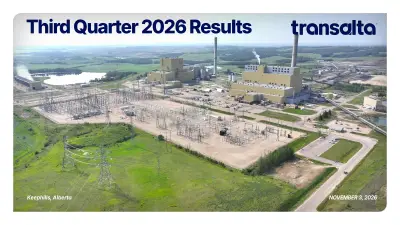
My name is Stephanie Paris, and I am the Vice President of Investor Relations and Corporate Strategy of TransAlta. Welcome to TransAlta's third quarter 2026 conference call.
With me today are Joel Hunter, President and Chief Executive Officer; Mike Politeski, EVP Finance and Chief Financial Officer; and Chris Fralick, EVP Generation and Chief Operating Officer. Today's call is being webcast, and I invite those listening on the phone lines to view the supporting slides that are posted on our website.
A replay of the call will be made available later today, and the transcript will be posted to our website shortly thereafter. All the information provided during this conference call is subject to the forward-looking statement qualifications set out here on slide 2, detailed further in our MD&A, and incorporated in full for the purposes of today's call.
All amounts referenced are in Canadian dollars unless otherwise noted. The non-IFRS terminology used, including adjusted EBITDA, free cash flow, are reconciled in the MD&A for your reference.
On today's call, Joel and Mike will provide an overview of TransAlta's quarterly results. After these remarks, we will open the call for questions.
With that, I will turn the call over to Joel.
Joel Hunter
Thanks, Stephanie. Good morning, everyone, and thank you for joining our third quarter conference call.
TransAlta delivered strong third quarter operational and financial performance, demonstrating our fleet's ability to continue to deliver results during challenging market conditions. Our Alberta portfolio hedging strategy and active asset optimization continued to generate realized prices well above spot prices, while availability remained high across our diversified fleet.
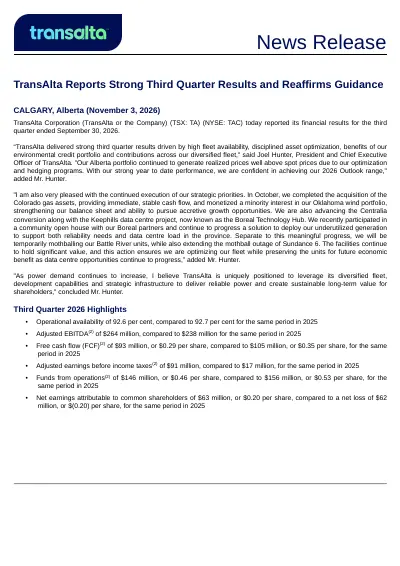
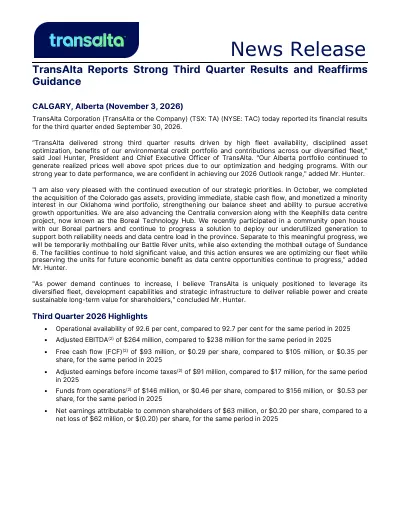
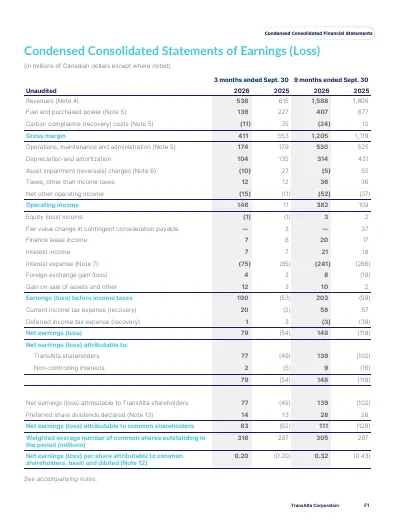
During the quarter, we delivered adjusted EBITDA of $264 million, free cash flow of $93 million, or 29 cents per share, and average fleet availability of 92.6%. Due to our strong performance year-to-date and expectations, we remain confident in achieving our 2026 guidance range, which Mike will cover in more detail.
In October, we closed the acquisition of two natural gas-fired peaking facilities in Colorado for US$1 billion, which collectively will provide approximately $110 million of low-risk, high-quality adjusted EBITDA per year. These operating assets, totaling 318 megawatts, add immediate, stable cash flow that can be redeployed into our most compelling growth initiatives, including the Centralia conversion and Alberta data center projects.
We also closed the sale of a 49% interest in our 502 megawatt Oklahoma wind portfolio to Ares Infrastructure funds for US$305 million. This transaction monetizes a portion of our investment in a non-core geography while retaining operational control.
We look forward to partnering with Ares and leveraging our combined strengths to enhance the value of the assets. Proceeds from the sale will strengthen our balance sheet and support our accretive growth opportunities as large load growth, electrification, and onshoring increase power demand across our core geographies.
Progress continues with the conversion of Centralia to natural gas. We expect to receive our environmental permits by year-end, and we continue to advance towards a final investment decision next year.
In September, the U.S. Department of Energy issued its fourth order under Section 202(c), requiring Centralia Unit 2 to remain available for operation for an additional 90 days.
We continue to comply with the directive and remain confident in our ability to recover our associated costs. Yesterday, we notified the AESO that we will be mothballing our Battle River units and extending the Sundance 6 mothball outage.
Doing so maintains the long-term optionality of the units while optimizing our Alberta portfolio in the near term. We retain the flexibility to return the assets to service, along with Sheerness 1, when market fundamentals strengthen, particularly as data center load develops across the province.
Our remaining Alberta fleet will operate at higher capacity factors to support our hedging strategy, provide reliability, and capture value during higher-priced hours. Finally, together with our partners Brookfield, CPP Investments, and BGRE, we continue to make meaningful progress on the Keephills data center project, now known as the Boreal Technology Hub.
On October 7th, the Boreal team hosted a community open house, welcoming local stakeholders and other interested parties to learn about the project, ask questions, and share feedback. Boreal is located directly south of our Keephills generating facilities, where we are the exclusive land and power provider.
At full build-out, Boreal is currently anticipated to provide up to 1.6 gigawatts of electrical load. Power will be provided from our initial 230 megawatt grid allocation, capacity from our underutilized gas-fired steam fleet, and longer term, potentially from the Sundance 5 and Keephills 1 redevelopment projects.
I'm pleased to share we received AUC approval for the Keephills 1 project in October. We continue to make meaningful progress with the AESO on a solution to serve data center load from our underutilized generation, including our mothballed units.
Our gas-fired steam units are designed to operate as baseload generation at capacity factors greater than 90%. Using underutilized generation will help serve new load while continuing to provide affordable and critical reliability to Alberta's electricity system.
The Boreal project is currently pursuing their master site development permits, which is the next major milestone ahead of construction commencing. This project is a significant opportunity for TransAlta, our partners, Alberta, and the local community, and will establish one of Canada's largest AI and digital infrastructure hubs.
I'll now turn the call over to Mike to talk more about our third quarter financial performance.
Mike Politeski
Thanks, Joel, and good morning, everyone. During the quarter, we generated adjusted EBITDA of $264 million, a strong outcome given the soft price environment in Alberta.
Our hydro segment adjusted EBITDA reflected the optimization of hedge positions and higher intercompany sales of emissions credits. Our wind and solar segment reported increased adjusted EBITDA as higher wind resource across all regions provided additional upside.
Within our gas segment, adjusted EBITDA was $29 million higher due to the continued strong optimization of our Alberta fleet, realization of emissions credits, and positive contributions from our facilities in Eastern Canada. Energy Marketing performed well in the third quarter, up $13 million year-over-year, reflecting strong performance from our trading desks across U.S.
power and natural gas markets. In our corporate segment, we continued to control our costs, which were 20% lower than the prior year.
Finally, our energy transition segment reflects the cessation of coal-fired generation at Centralia at the end of 2025. As Joel previously mentioned, we continue to comply with 202(c) orders received from the DOE.
Our renewable assets provided considerable environmental offset to our gas fleet's 2026 year-to-date carbon compliance obligation, resulting in a $51 million reduction in our carbon obligation during the quarter, reflecting the value of our diversified fleet in Alberta. Going forward, we expect the realization of emissions credits to better match our carbon compliance costs in the period incurred, which should provide a clearer view of the quarterly performance of each segment.
Finally, we also generated strong free cash flow during the quarter, totaling $93 million. Year-to-date, our sustaining capital expenditures are down $22 million, however, we expect higher maintenance capital in the fourth quarter, keeping our aggregate sustaining capital within the previously guided $140 to $160 million range.
Turning to the Alberta portfolio, spot prices averaged approximately $36 in the third quarter, down from $51 in the third quarter of 2025. The decline was primarily due to continued strong supply, mild weather, and relatively limited periods of market tightness.
We enhanced our margins by fulfilling portions of our higher-priced hedge commitments through power purchases and monetization of positions when market prices were below our variable production costs. We benefited from approximately 2,500 gigawatt-hours of hedges at an average price of $65, which represented a $28 premium to the average spot price.
Our gas fleet realized an average merchant price of $55, which was a 53% premium to the average spot price, largely due to our dispatch optimization during high-priced hours. Our hydro fleet also continued to capture merchant upside, delivering an average realized price of $43, a 19% premium to the average spot price.
Our merchant wind fleet realized an average price of $19, reflecting increased thermal production in the market and the timing of intermittent wind and solar generation. During the quarter, we also delivered approximately 2,800 gigawatt-hours of ancillary service volumes at an 11% premium to the average spot price.
Through effective fleet optimization and meeting hedge obligations with purchased power, we consistently addressed the AESO's need for reliability products. We continue to have a strong hedge book to support our Alberta business.
For the balance of the year, we have approximately 2,100 gigawatt-hours of our Alberta generation hedged at an average price of $67, significantly above current forward pricing. Looking ahead to 2027, we have approximately 6,700 gigawatt-hours hedged at an average price of $65, also well above current forward levels.
We will continue to opportunistically manage our hedge position to ensure we protect our cash flows while capturing upside as market conditions evolve. Our gas-fired steam units continue to operate well below their potential and have the ability to run at significantly higher capacity factors.
As higher-priced hours emerge, that flexibility allows us to increase our generation and capture additional value. Our fleet decisions position us well for the current pricing environment while preserving meaningful upside as market fundamentals improve.
Our focus remains on optimizing the portfolio today while maintaining the flexibility to capture growth longer term. Turning to our financial position, we remain focused on strengthening our balance sheet and maintaining our financial flexibility.
Asset recycling continues to be an important lever, as demonstrated by the recent sale of a minority interest in our Oklahoma wind portfolio. Longer term, improving Alberta power prices, potential contracting of underutilized generation, and the expected cash flows from Centralia post-conversion will provide cash flow growth to further strengthen our financial position.
We are well-positioned to meet our 2026 guidance. Our contracted fleet, strong hedge position, and consistent optimization provide us with core cash flows even in a low merchant power pricing environment.
The net effect of the Colorado acquisition and Oklahoma disposition has a relatively modest impact to 2026, further contributing to the reaffirmation of our guidance. With that, I will turn the call back over to Joel.
Joel Hunter
Thanks, Mike. As we move through the balance of the year, our priorities remain clear and our focus remains firmly on execution: specifically, improving our leading and lagging safety performance indicators while achieving strong fleet availability; delivering adjusted EBITDA and free cash flow within our 2026 guidance ranges; maximizing the value of our legacy thermal sites by advancing our Alberta data center strategy, as well as our coal-to-gas conversion at Centralia; pursuing strategic M&A opportunities where we see a compelling fit within our portfolio; and enhancing our financial strength and flexibility through disciplined capital allocation and cost control.
I believe TransAlta offers a compelling investment opportunity, built on the strength of the business we have today and the significant opportunities we see ahead. We have operated a safe and reliable power generation fleet for over 115 years, providing strong and enduring cash flows.
This strength is grounded in a diversified portfolio of hydro, wind, solar, storage, and thermal assets across three countries, enhanced by our industry-leading asset optimization and energy marketing capabilities. Our legacy sites continue to represent considerable and increasing value.
We are proactively pursuing repurposing initiatives at these facilities to address the growing demand for reliable power in our operating markets. Concurrently, we maintain a leadership position across multiple technologies, consistently prioritizing responsible and reliable generation.
We are disciplined in how we grow. Our priority is creating shareholder value as we diversify our portfolio within our core geographies and continue to increase the proportion of stable and contracted cash flows.
This strategy is supported by a strong financial foundation. We have a flexible balance sheet and ample liquidity, giving us the ability to pursue and deliver multiple growth opportunities while continuing to return capital to shareholders.
Finally, and most importantly, we have our people. Everything we accomplish starts with the expertise, commitment, and dedication of our employees and contractors.
I want to thank them for everything they do to safely and reliably power our customers, execute our strategy, and position TransAlta for continued success. Thank you, and I'll now turn the call back over to Stephanie.
Stephanie Paris
Thank you, Joel. Andrew, would you please open the call for questions from the analysts?
Operator
Certainly. As a reminder, to ask a question, please press star one one on your telephone and wait for your name to be announced.
To withdraw your question, please press star one one again. One moment, please.
Our first question comes from the line of John Mould with TD Securities.
John Mould
Hi. Morning, everybody.
Maybe I'd just like to start with the mothballing of the Battle River [sighs] units. Wondering why now, just given the soft pricing environment and let's say relatively soft dispatch volumes you highlighted in your prepared remarks.
Then why the Battle River units versus other lower-utilization coal-to-gas units, and I'm thinking of Sheerness 2 as an example, and how should we think about what market conditions or contracting opportunities could drive returning any of these units to service ahead of the timelines you've laid out?
Joel Hunter
Thanks, John. It's Joel here.
I'd say that we spend a lot of time kind of analyzing this similar to previous mothballs that we've announced. With Battle River, when you look at the capacity factors for both units 4 and 5, they're very low currently and they were low last year.
This is purely an economic decision and really to preserve the long-term optionality for both of these assets as load will increase over time with data centers coming into the province. Again, a lot of time spent kind of analyzing this and how do we kind of lower our costs, it is an economic decision.
We communicated this with the government, with the AESO. Nothing to read into it here.
We still remain very confident in our ability for data center load to come to the province. This is simply to position these assets really longer term.
As we think longer term with data center load, we expect that we would have long-term contracts that would underpin these assets, including potentially Battle River and 4 and 5 as part of this. Again, a lot of time considered here to this mothball, but it really is an economic decision.
In fact, with the employees there, John, there's 45 employees there that will remain on site here and really to ready these assets for the longer term here. As we've mentioned before, Battle River 4 and 5, similar to our other gas-fired steam units, can easily flex up to over 90% kind of capacity factor with very little kind of capital behind them.
Again, we're just trying to preserve the long-term optionality here as load will come to the province longer term.
John Mould
Thanks for that. Then maybe just moving on to the data center MOU at Keephills and thanks for all that information on the open house that you had.
There is a reference, as you noted, to up to 1.6 gigawatts of capacity there, the original MOU you announced early in the year referenced 1 gigawatt. Has the MOU scope been formally increased to support this 1.6 gigawatts?
In terms of timing, you previously pointed to definitive documentation in 2026. Is that still your expectation given where you're at in the underutilized generation discussions with AESO and then the bring-your-own-generation process more broadly?
Joel Hunter
John, I would say, you think about when we signed the MOU back in February, there was still a lot of unknowns. We had our 230 megawatts under Phase 1 of the large load integration.
Our customers at Brookfield and CPPI Investments, they wanted to look to increase that, and so we said up to 1 gigawatt at the time. Since then, with the data center regulations that we saw from the government back in June, really recognizing that underutilized generation should be considered here as part of kind of it for to serve data center load, allowed us to go up to this 1.6 that I would say this is initial, based on the site, where we have today.
We remain very encouraged by that, and the ability to think not only how we can serve that 1.6, which would come from a function of the 230 under Phase 1, also the assets that we have right there with Keephills and Sundance being right next door, and really our whole fleet, if you will, along with kind of longer term how we could look to rebuild those facilities here, repower them kind of in next decade. Your question around this year for the definitive agreements, I would just say to you that they continue to be ongoing, and we remain very encouraged by it and working very collaboratively with our customers.
Can't say definitively if it'll be this year or sometime obviously in 2027. I think once we have a full understanding of what the underutilized generation that we can actually use here will be an important step forward to really kind of advance the definitive agreements here to the final stage here.
I wouldn't say it's probably 2026, it's probably into sometime early into 2027 at this point in time once we understand exactly the amount that we can offer our customers as it relates to our underutilized generation.
John Mould
Thanks very much for that color. I'll get back in the queue.
Joel Hunter
Thanks, John.
Operator
Thank you. Our next question comes from the line of Mark Jarvi with CIBC.
Mark Jarvi
Thanks. Good morning.
Just picking up on those comments, Joel, just curious in terms of the timeline for the discussions with the AESO and the underutilized assets. Is that possible to wrap up by year-end and then you move to the final negotiation with Brookfield/CPPI, or is that also something that probably you get clarity in early '27?
Joel Hunter
Mark. I can't really obviously speak for the AESO other than as we've said before, and it continues to be the case, that we work very collaboratively with them.
Ongoing discussions with the AESO here. We expect something in the near term is all I can say.
We don't have anything definitive at this point in time. As I mentioned in responding to John's question, I think once we have clarity on the amount that we have, then, as far as definitive agreements, they will come together, I would expect, relatively quickly here, given that they are very well advanced at this stage.
It's really just trying to fill in the blank, if you will, as to how much we're actually offering beyond kind of our Phase 1 allocation here. Again, discussions remain very fluid with the AESO, very collaborative, and we're trying to achieve a common goal here where we know we want to bring data centers to the province, but we want to ensure reliability for the grid, along with affordability for Albertans here going forward.
Mark Jarvi
Just to follow up on that, Joel, then just with the discussions is it the terms of the usage of the assets that is requiring the most effort right now? Is it the scope of megawatts?
Then in terms of the potential terms around either curtailment or restrictions on the units, can you share anything in terms of what might be amenable or you guys would be comfortable with on those units?
Joel Hunter
Mark, I can't really, cuz it does remain kind of confidential here. We have to respect our discussions that we have with AESO.
I would say it's all of the above, right, that we want to ensure that we get it right here as to, first of all, what's the allocation and how curtailment will work. I think what we said before is then we have obviously a product that we can then offer to our customers that they can then offer to their customers.
Again, it really is all the above that you mentioned there, but again, it remains very constructive at this point and well advanced. Just can't give you a definitive timeline other than we expect to hear something probably in the near term.
Mark Jarvi
Okay. Then just on the repowering projects, just curious what you're seeing in them right now in terms of cost and equipment availability.
Are you actively out there looking to price out the repowerings right now, or is that sort of something that's going to happen in the next year or two?
Joel Hunter
I would say to you that we remain very active, knowing that the lead times here, Mark, are very long. Nothing has really changed from our last update where for a large frame unit to get a turbine, for example, you're looking at 5-plus years from the time you actually get into the queue to actually taking delivery.
We're thinking into the next decade here as it relates to repowering here. Those discussions and, obviously we're putting a lot of effort behind it right now just given the lead times that we see.
We are in the queue for a large frame unit, which is very good, and we're looking for other opportunities right now and obviously forming a business case for the usage of these units. I think really in the near term, the best use is our underutilized generation.
That is the cheapest and it's speed to power for data centers. That is really the focus.
Then really thinking more longer term, how do you repower those facilities? Those are discussions obviously we're having with our customers right now here.
Because again, they're not going to sign up for 5, 10 years, they're looking for longer term as they make large capital investments for data centers. Certainly we have an ability here to power those facilities with our existing generation for the medium term, if you will, and then we would look to repower kind of longer term.
Mark Jarvi
Sounds good. Appreciate the comments.
Joel Hunter
Thanks, Mark.
Operator
Thank you. Our next question comes from the line of Maurice Choy with RBC Capital Markets.
Maurice Choy
Thank you, and good morning, everyone. Just wanted to take a step back and look at the power markets more broadly across North America.
With the changing market dynamics, policies, and politics in certain power markets in the US, have you seen a different tone from your prospective data center customers when they are looking at Alberta as an option?
Joel Hunter
Maurice, I would say the short answer to that is yes, we have, and it's positive tone. When you look at the moratoriums that are out there today, you just pick a few markets, for example, there's moratoriums in Texas, Pennsylvania, New York, and what we know is the demand for power is not abating, and we've talked about this before where there's just so much demand far exceeds the amount of power that's kind of available almost in the near term that all of a sudden when you look at Alberta here, where there's obviously strong policy support from the government, strong support from the AESO.
We are the only jurisdiction that really I'd say is long power within North America. Again, we talked about speed to power, I think that there is a real opportunity here for Alberta.
Again, I applaud the government and what the AESO have done here. They've been very deliberate and very focused on ensuring they don't want to compromise reliability or affordability here for Albertans.
At times people might feel a bit frustrated by that, but I think it's actually very intentional and being very focused not only in the medium term, but the long term, and because we've seen what's happened in other jurisdictions where maybe the build-out has gone too quickly and, as a result, it requires a lot more infrastructure that results in higher utility bills for customers. As a result of that, we've seen the moratorium.
I think, all that being said, I think it's been directionally positive here for Alberta as we move forward here to bring data centers to the province.
Maurice Choy
Thank you. If I could just finish off with a deeper exploration about the Battle River mothball decision, but taking a little bit of an alternate approach here.
When the Heartland Generation deal closed at the end of 2024, I had thought that this unit would have been mothballed a lot sooner, and certainly not almost two years after the deal closed. Assuming you agree with that, can you just help me dissect what was the outlook for this facility back then and then comparing that outlook to what actually transpired over the last two years?
Joel Hunter
I would say, when we closed the acquisition back in December of 2024, really at that point in time, data centers and the discussion around data centers in Alberta was really starting to come into place, if you will. We were very fortunate actually, when we think about Battle River 4 and 5, the initial kind of investment thesis didn't contemplate data centers coming to the province and was think of probably more of a longer-term kind of repowering opportunity for that facility, knowing that it is an older facility, it has a higher heat rate and therefore the capacity factor is going to be lower.
You fast forward to today where things look a lot differently, and this is what's really encouraging for our employees here at TransAlta. When I talk to our folks out in the field, especially for our gas-fired steam units, knowing that, and we've been saying this all along, that you have this surplus capacity, how best can you use it and ensure reliability within the province.
I think this is a real win-win where all of a sudden we're bringing new load to the province here with data centers, and at the same time these units will run for longer and then can run for longer, and that ensures reliability for the province, which is critically important here. As a lot has changed, Maurice, since the initial thesis around the Heartland acquisition, but certainly right now looking back on it, it looks we were very fortunate to have made this acquisition and acquiring it at the multiple that we did.
We got some really great assets out of it that I think really create a lot of long-term optionality for our company here as it relates to data centers and just future opportunities that we see there. Because what we do know is that having steel in the ground is very important.
When you think about access to natural gas, water, transmission, that's one thing you see with our units, whether it's Battle River 4 and 5, Sheerness 1, Sundance 5, pick any one of them, they all have that in common that they are ideally situated and they're located on industrial lands, too, which is important because you hear a lot about NIMBYism, and really we don't see that here. We are very actively engaged with our stakeholders in these regions and looking for future development here, and these have assets that have been around for decades, and we hope that they're around for decades to come here.
Maurice Choy
It's great to have optionality. Thank you very much for that.
Joel Hunter
Thanks, Maurice.
Operator
Thank you. Our next question comes from the line of Benjamin Pham with BMO.
Benjamin Pham
Hi, thanks. Good morning.
I know you mentioned that you're waiting for the ISO outcome respective of unutilized capacity to perhaps firm up a definitive agreement for the Keephills / Boreal project. You didn't mention that you need to wait for the Phase 2A intake results to drive that.
Is there a reason for that?
Joel Hunter
I'd say, Ben, first of all, again, as I mentioned earlier, that we're well advanced with the Phase 1, the 230. As you think about when, as I mentioned earlier, when we announced the MOU back earlier, I guess in February, we talked up to 1 gigawatt.
We now know that that could be a higher number, and you saw that from the open house here. They are linked together that we're not only looking for 230, but how big can this be?
Our team here is working very closely with the teams at Brookfield and CPPI around that to put those definitive agreements in place here. It is important to kind of understand how big are we talking about here?
Again, I think hopefully we'll hear back in near term around our underutilized generation and what that will kind of constitute, and then from there I would expect that the definitive agreements would come together relatively quickly after that.
Benjamin Pham
Got it. Joel, you mentioned earlier you defining the 1.6 at Boreal as Phase 1.
Can you unpack that a bit? Is that analogous to the Green Line project where they broke it up into two phases, but they called it one phase?
Joel Hunter
I'm not sure, Ben, if I look at it that way. I think when I look at the 1.6, we showed this at the open house where kind of call Phase 1 as the kind of initial data center, which would be kind of one facility, which would be around 230 megawatts up to 300 megawatts, and then going from there I think we could have up to six facilities on site there.
I'm not comparing this to Green Line. I'm looking at this as kind of just kind of in phases and what we wanted to show for Phase 1, because, of course, we have clarity on that allocation at 230.
At the open house, we really kind of focused on that, and we talked about kind of the water usage, for example, that we would see for Phase 1. We talked about the economic benefits, the number of people we would employ for Phase 1.
Again, and as we learn more about how much we have, then we'll be able to share more there. That's the way I kind of look at this is kind of within phases within our project, if you know what I mean.
Benjamin Pham
That's very helpful. Thank you.
Joel Hunter
Thanks, Ben.
Operator
Thank you. Our next question comes from the line of Robert Hope with Scotiabank.
Robert Hope
Morning, everyone. Maybe a follow-up question on that.
As you're thinking about the build-up of Keephills, when you're envisioning that one moving up to 1.6, would that all be under kind of Brookfield/CPPI agreement, or are you envisioning the potential kind of we'll call it further phases to be supported by other customers, and are you in discussions regarding that?
Joel Hunter
Rob, we obviously remain very focused working with Brookfield and CPPI on this, as evidenced by the open house and up to the 1.6. We do have the optionality, if you will, to work with others here.
Our focus again, want to keep everybody laser-focused on the prize here and really thinking about what we've got here at Boreal with our partners. To the extent that we see further the ability to do more, then it could be with them, but it also could be with other customers.
As you can well imagine, there's a lot of interest, given, as I mentioned earlier, where we do have moratoriums elsewhere within North America, where I think that there's a lot of focus on Alberta at this point in time. We do remain focused working on the Boreal Technology Hub with our partners, but it doesn't preclude us to working with others as well.
Robert Hope
All right, thanks for that. Then maybe a broader question just in terms of recycling of capital.
We saw the transaction in Oklahoma a couple of weeks ago. How are you thinking about monetizing other assets in non-core geographies or modalities?
Mike Politeski
Hey, Rob, it's Mike. Maybe I'll take this one.
Asset recycling important for us right now. It's going to play a part in getting our balance sheet back to where we want it to be.
Happy with the start that we had with the Oklahoma sale and the proceeds we brought in there. Partnering with Ares, great partner, and happy with how that transaction played out.
If you look going forward, the internal team here is continuing to move and advance other opportunities. Think we've talked before around the size of our portfolio.
We have over 90 assets in the portfolio. Many of them are outside of our core areas.
Lots of smaller assets that aren't contributing much, and you saw that actually during the quarter we moved out a small asset and brought in $27 million kind of under the radar, but there's lots of opportunities within the portfolio that we can look to monetize and bring in proceeds. We're going to be patient.
We're going to be thoughtful. Got to ensure the deals are making sense and we're bringing in fair value.
For sure the team has stood up and advancing other initiatives, and I guess stay tuned for further progress on this front.
Robert Hope
Thank you.
Operator
Thank you. As a reminder, to ask a question, please press star one one on your telephone.
Our next question comes from the line of Patrick Kenny with National Bank Capital Markets.
Patrick Kenny
Good morning. Joel, just back on Boreal, sounds like there wasn't much in the way of negative feedback from the open house, but perhaps you can confirm if there are any key concerns from the community that you might look to address at your November 12th meeting, and how you might be positioning the project to address or get ahead of any of those outstanding issues.
Joel Hunter
Thanks, Pat. I would say overall we were very pleased with the open house.
It ran for 4 hours. There was just over 180 people there, a lot of obviously local folks there, very interested in the project.
I think the takeaway was they want to understand more around data centers. It's still, even though we talk a lot about data centers, it's still relatively new.
They have questions around, for example, what's the amount of noise that will come from the facility, what's the amount of water that would be used, for example. These will be covered in further detail as part of the technical sessions, going forward here, really to address any kind of concerns or questions that our stakeholders may have around that.
I'd say overall, Pat, we were very pleased. I thought the team did a really great job being very well organized.
We had kind of 30 kind of storyboards, if you will, there at the site, so that people could walk around and ask questions of the team, and so it was very very engaged. There was no protests or anything like that.
It was really people just trying to get more information. Again, I think this is something for TransAlta, we have been in this area for over 70 years with the Keephills and Sundance facilities, it's certainly an area that we are very familiar with, we're very engaged with the local communities and First Nations as well.
I would say overall we were very pleased with the outcome, and we look forward to the next kind of technical sessions here, which will I think do more of a deeper dive on some of the technical questions that arise, as I mentioned earlier, from a project of this size.
Patrick Kenny
Thanks for the additional color there. Then I guess early days on getting the keys to the Colorado facility, but curious any early indications or opportunities that you might be seeing to leverage your position in the region to either expand your presence in the US WECC market, either from a trading or additional M&A perspective?
Joel Hunter
I would say, Pat, and this goes back to when we announced the transaction back in June, kind of our thesis around making this acquisition. As you highlighted there, when we look at the WECC, like the Western United States, it's a core market, core geography for us.
Today we don't have a lot, or we didn't prior to the acquisition. It was really our investment in Centralia.
Now having two brand new facilities of 318 megawatts fully contracted for 27 years with two very high-quality counterparties, I think does create a lot of opportunity for us going forward within Colorado. Today Colorado burns roughly 20-25% of their powers from coal, and they will move off of coal to natural gas, I think that in and of itself can create an opportunity here for TransAlta that we didn't have prior to making this acquisition.
We also have a new partner, if you will, with Kindle through Blackstone, this is who we acquired the assets from, where they're looking for other opportunities as well within the WECC that certainly TransAlta might be able to partner with them, and especially really leveraging our marketing and trading capabilities, as you mentioned here, as they look for future development there. I think it's, again, a real opportunity here for us, early days, but now we have a platform to really build off within a core market for us.
I'm very happy with the transaction. It closed kind of on time and the commissioning went extremely well with the last unit coming online, and Chris Fralick had the opportunity to be out there on Friday and came away very encouraged by the team there and obviously the assets.
Now we will look for future opportunities there to further develop our presence in Colorado and within the West.
Patrick Kenny
That's great. Thanks, Joel.
Joel Hunter
Thanks, Pat.
Operator
Thank you. There are no further questions at this time.
I would now like to turn the conference back to Stephanie Paris for closing remarks.
Stephanie Paris
Thank you, everyone. That concludes our call for today.
If you have any further questions, please contact the TransAlta Investor Relations team.
Operator
This concludes today's conference call. You may now disconnect.