Talos Energy, Inc.
Q3 FY2026 · Earnings Call TranscriptNovember 4, 2026
Operator
Good morning, ladies and gentlemen, and welcome to the Talos Energy third quarter 2026 earnings call. At this time, all lines are in listen-only mode.
Following the presentation, we will conduct a question-and-answer session. If at any time during this call you require immediate assistance, please press star zero for the operator.
This call is being recorded on Wednesday, November 4th, 2026. I would now like to turn the conference over to Kyle Sahni, Manager, Investor Relations.
Please go ahead, sir.
Kyle Sahni
Thank you, operator. Good morning, everyone, and welcome to our third quarter 2026 earnings conference call.
Joining me today to discuss our results are Paul Goodfellow, President and Chief Executive Officer, Zach Dailey, Executive Vice President and Chief Financial Officer, and Bill Langin, Executive Vice President, Exploration and Development. Please refer to our third quarter 2026 earnings presentation that is available on our website under the Investor Relations section for a more detailed look at our results and operations.
Before we start, I would like to remind you that our remarks will include forward-looking statements subject to various cautionary statements identified in our presentation and earnings release. Actual results may differ materially from those contemplated by the company.
Factors that could cause these results to differ materially are set forth in yesterday's press release and our Form 10-K for the period ending December 31, 2025 filed with the SEC. Forward-looking statements are based on assumptions as of today, and we undertake no obligations to update these statements as a result of new information or future events.
During this call, we may present GAAP and non-GAAP financial measures. A reconciliation of certain non-GAAP to GAAP measures is included in yesterday's press release, which was furnished with our Form 8-K filed with the SEC and is available on our website.
Now I would like to turn the call over to Paul.
Paul Goodfellow
Thanks, Kyle, and good morning to everyone joining us on the call today. As always, I want to start by thanking our employees for their continued commitment to safety and environmental stewardship.
The results Zach and I will discuss today are a direct reflection of the talent, drive, and relentless focus on execution across the One Talos team. The third quarter continued to demonstrate the strength of the business we are building.
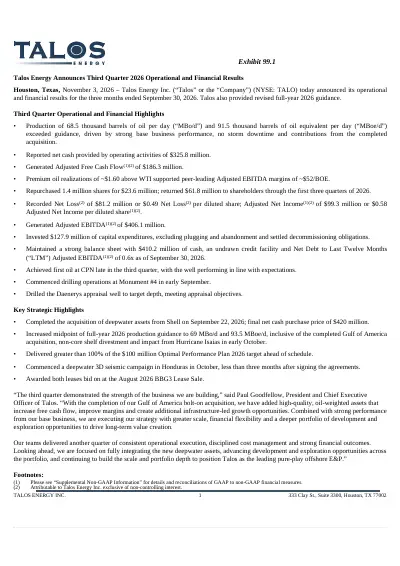
We delivered another quarter of consistent execution from the base business, completed our Gulf of Mexico bolt-on acquisition while keeping leverage at 0.6 times, raised full year production guidance, and significantly bolstered our portfolio of development and exploration opportunities. Taken together, these results reflect continued progress across all three pillars of our strategy and further strengthen the foundation to be a leading pure-play offshore E&P.
I want to begin, as I always do, with the base business, which continues to provide the foundation for everything we do. Oil production averaged approximately 69,000 barrels per day and total production averaged approximately 92,000 barrels of oil equivalent per day, both exceeding guidance.
That was driven by strong base business performance, the absence of storm-related downtime, and an initial contribution from the Gulf of Mexico acquired asset following closing on September the 22nd. Importantly, even after adjusting for weather and excluding the acquisition contribution, production was at the high end of our guidance range.
That clearly signals the underlying strength of the business. Those operational results, combined with premium oil realizations, translated into strong adjusted free cash flow of $186 million and supported another increase to our full year 2026 production guidance.
Zach will walk through the details later in the call. These results also reflect our optimal performance plan, and I am pleased to report that we have delivered on our full year $100 million target by the end of the third quarter.
We expect these business improvements to be lasting and carry into next year and beyond. They have been broad-based across the organization, spanning margin enhancement, capital efficiency, commercial opportunities, and organizational improvements.
Delivering the target does not change our focus. Continuous improvement is embedded in how we operate, and we will keep looking for opportunities to improve production and uptime, spend capital more efficiently, and reduce costs across the portfolio.
This is exactly what we mean when we talk about improving the business every day. I'm incredibly proud of what the team has accomplished this year.
These results were delivered because our teams choose excellence each and every day. We saw that again in early October ahead of Hurricane Isaias.
Our priority was the safety of our offshore personnel and protecting the environment, which meant shutting in production and evacuating our platforms. I want to thank our operations team for their commitment to living our values.
Once it was safe to return, we confirmed that there was no damage to our facility and shifted our focus to restoring production. The increased full year guidance Zach will discuss includes the fourth quarter hurricane impact of approximately 7,000 barrels of oil equivalent per day, which was within the weather allowance incorporated into our full year plan and guidance.
In addition to the outstanding performance in production operations, Talos continues to distinguish itself through best-in-class execution, and we advanced several important projects during the quarter. That execution starts with drilling.
When we benchmark our recent operated wells, including Daunares, Sunspear, Katmai West Number 2, and CPN, they all rank in the top quartile of Gulf of Mexico industry performance. The recent Daunares appraisal well, drilled to a total vertical depth of nearly 29,500 feet, ranked in the top decile.
Full credit goes to our drilling team. Drilling and completing faster and more efficiently translates directly into lower well costs and better returns, and is a clear example of what we mean when describing Talos as a technically differentiated offshore operator.
At CPN, we achieved first oil in September as planned, and the well is performing in line with expectations. CPN is an operated, infrastructure-led tieback to Na Kika and is a good example of the type of high-return, short-cycle opportunity that underpins our development program.
At Brutus, we commenced the development program during the third quarter with operations from the platform-based rig. Our team has optimized the plan to incorporate batch drilling and completions, which we believe improves execution efficiency and project returns.
The program has also expanded from four to five wells with the addition of another sidetrack opportunity. We expect first oil beginning in the second quarter of 2027 with production phased in through the fourth quarter as the wells come online.
At Monument, the first development well TD'd in June and found approximately 250 feet of net oil pay, in line with pre-drill expectations. The second well spud in early September following the operator's rig deployment to one of its own fields.
First oil is now expected in the first quarter of 2027, and our view of the project economics is unchanged. Now let me turn to Daunares.
We spud the appraisal well in early July and drilled to target depth in late August, meeting our appraisal objectives. The well tested the northern portion of the prospect and encountered oil pay in multiple sands.
We collected samples that are undergoing testing to further assess the reservoir and fluid properties. Daunares is a multi-year appraisal program.
The additional appraisal activity is needed to better understand the reservoir. As planned, the next step in the program is an appraisal sidetrack in 2027.
Together, the data from this year's well and next year's sidetrack will help inform the path forward. In parallel, our teams continue to evaluate a range of development concepts, from a tieback to existing infrastructure to a standalone host.
We're also building out a broader opportunity set around Daunares. In late 2027 or early 2028, we expect to drill an exploration well targeting a prospect we acquired in the December 2025 Big Beautiful Gulf 1 lease sale.
If successful, it has the potential to be co-developed with Daunares. Turning to the Gulf of Mexico bolt-on acquisition, on September the 22nd, we closed the transaction alongside our partner Ridgewood.
This added a 50% working interest and operatorship in the Coulomb field, along with a 25% non-operated working interest in the BP-operated Na Kika platform and four associated fields. The final net cash purchase price was $420 million, less than our original expectations.
Integration is well underway, and we're pleased with how the assets are performing to date. The acquisition adds high-quality, oil-weighted production that enhances our scale, margins, and free cash flow generation while providing infrastructure-led growth opportunities that leverage our core strengths.
I also want to spend a moment on why we believe the value of this acquisition extends well beyond the acquired reserves. Talos has a proven track record of acquiring mid-life assets and extending field life.
As an example, across Ram-Powell, Pompano, and Brutus, cumulative production since acquisition, combined with the remaining 2P reserves at year-end 2025, represents more than a 40% uplift relative to the 2P reserves at the time of acquisition. That uplift came from extending field life and identifying additional resources through infrastructure-led opportunity.
We intend to apply that same playbook to the acquired assets here. We've already identified multiple development and infrastructure-led exploration opportunities, including the operated Coulomb development well, which we expect to compete for capital in 2027.
Beyond the Gulf of Mexico, we continue to progress our newest exploration and development opportunities. In Mexico, we continue to work with the operator to advance Zama towards an expected FID in 2027, while also progressing our newer opportunity in Block 29.
In Block 29, we are progressing the SENER approval required to close the farm-in transaction for that block, while working with Repsol towards FID in 2027. With two oil discoveries holding more than 200 million barrels of oil equivalent of gross recoverable resource and similar exploration potential on the block, this remains a development-led opportunity with meaningful upside.
We continue to work with Repsol to plan an exploration well late in next year. In Honduras, we commenced the first ever 3D seismic program across a portion of the deepwater acreage in October, less than three months after signing the agreements.
This initial deepwater 3D program has now been completed, and we expect the first processed data in the early part of 2027. The broader position is equivalent to roughly 700 Gulf of Mexico blocks, with the existing Main Cape oil discovery validating a working petroleum system in this large, under-explored basin.
While these opportunities are at different stages of maturity, that is by design. Our portfolio now spans a strong base business in the Gulf of Mexico, combined with pre-FID development and longer-cycle exploration.
The speed with which our teams and partners are moving them forward continues to be a key differentiator for us here at Talos. The common theme across the quarter is disciplined execution.
We delivered strong operational and financial performance from the base business, closed an acquisition that increases our deepwater scale, completed the non-core gas-weighted shelf divestment, and advanced a deeper portfolio of development, appraisal, and exploration opportunities. We carry significant momentum through year-end and into 2027.
With that, I will now turn the call over to Zach to discuss our financial results, updated guidance, balance sheet, and capital allocation in greater detail, as well as some early thoughts on 2027.
Zach Dailey
Thanks, Paul. This morning, I will focus on three key takeaways: strong free cash flow generation in the third quarter, supported by premium oil realizations; increased full year production guidance pro forma for the acquisition; and a resilient balance sheet that supports our unchanged capital allocation framework.
I'll then close with a few early thoughts on 2027. Starting with the quarter, the disciplined operational execution Paul just discussed translated directly into strong financial results.
We generated adjusted EBITDA of approximately $406 million and adjusted free cash flow of approximately $186 million, driven by production that exceeded guidance and premium oil realizations of approximately $1.60 per barrel above WTI. That combination supported adjusted EBITDA margins of approximately $52 per BOE excluding hedges, which continue to rank in the top decile of the E&P sector.
At the same time, lease operating expenses of $16.74 per BOE remained below the Gulf of Mexico peer average, reinforcing our advantaged cost structure. On the heels of a strong first nine months, we're increasing our full year 2026 production guidance to 68 to 70 thousand barrels of oil per day and 92.5 to 94.5 thousand BOE per day.
At the midpoint, that represents an increase of approximately 8% for oil production relative to our original guidance. This updated annual outlook includes the closed Gulf of Mexico acquisition and the impact of Hurricane Isaias in early October, and as a reminder, it also reflects the closed non-core shelf divestment.
Our base business continues to outperform, and the Gulf of Mexico acquisition builds on that. For 2026 capital expenditures, we lowered the midpoint of guidance while increasing guidance for P&A, leaving combined capital and P&A spend unchanged from our original guidance.
The P&A increase reflects a sizable project that was completed ahead of schedule, which allowed us to accelerate additional activity into the fourth quarter. As we've discussed previously, we focus on executing P&A activity in the most efficient manner rather than simply managing to an annual budget.
Updated cost guidance is detailed in our earnings presentation. Now, turning to the balance sheet, we ended the third quarter with approximately $410 million of cash, an undrawn credit facility, and approximately $1.1 billion of liquidity, resulting in a leverage ratio of 0.6 times.
In conjunction with closing the acquisition, our borrowing base increased to $850 million, and we have no debt maturities until the next decade. Importantly, we funded the bolt-on's final net cash purchase price of $420 million while keeping the credit facility undrawn, reflecting the financial flexibility we've built through the capital markets transactions completed earlier this year alongside the strong operational performance and free cash flow generation of the business.
We continue to expect year-end 2027 leverage to be well below 1.0 times, consistent with our long-term leverage target. Our capital allocation framework remains unchanged.
We continue to expect to return up to 50% of annual free cash flow to shareholders through share repurchases, while also investing in high-return projects, maintaining balance sheet strength, and pursuing selective accretive growth. During the third quarter, we repurchased 1.4 million shares for approximately $24 million.
We intentionally structured the return framework as up to 50% to preserve flexibility to pursue accretive opportunities such as the acquisition we just closed. Since announcing the framework in the second quarter of 2025, we have returned approximately $160 million to shareholders by repurchasing 14.5 million shares at an average price of $11 per share.
This has reduced our outstanding share count by approximately 8% over that time period. That track record demonstrates the value of consistently buying back shares at attractive levels, and we have approximately $176 million remaining under our authorization.
Before we open the line for questions, I want to share a few early thoughts on 2027. As we build the business plan, our objective is to adhere to the three principles of our strategy, including further strengthening the depth and longevity of our portfolio, while maintaining a low WTI free cash flow breakeven.
We're working through our budgeting process now and expect to provide a full 2027 outlook in February, but we already have visibility into several important activities next year. We will enter 2027 with a higher production base from the recently completed acquisition, and expect first oil from Monument in Q1 and Brutus beginning in Q2.
As previously discussed, in July, we secured the West Vela for our drilling program beginning in mid-2027 at an attractive dayrate. We expect the Coulomb development well, which was acquired from Shell, to compete for capital alongside additional appraisal and exploration activity around Daunares.
We also expect to continue advancing Block 29 towards FID, and may have an exploration well on Block 29 toward the end of the year. Overall, we have a deeper portfolio of development, appraisal, and exploration opportunities than Talos has ever had, and we will remain disciplined in how we pace activity and allocate capital across it.
Bottom line, we generated meaningful free cash flow in Q3, completed an acquisition that increases our deepwater scale, resumed share repurchases, increased full year production guidance while keeping total capital spend unchanged, and we maintained a strong balance sheet. These results reflect the strength of the underlying business, disciplined execution across the organization, and the financial flexibility to pursue our strategic priorities while continuing to create long-term shareholder value.
With that, we will open the line for Q&A.
Operator
Thank you, sir. Ladies and gentlemen, we will now begin the question-and-answer session.
If you'd like to ask a question, please press star followed by the number 1 on your telephone keypad. We ask analysts to limit themselves to one question and a follow-up.
If your question has been answered or you'd like to withdraw from the queue, please press star followed by the number 2. If you are using a speakerphone, please lift your handset before pressing any keys.
One moment, please, while we compile the roster. The first question comes from Jerry Ciech with Goldman Sachs.
Please go ahead.
Jerry Speicher
Good morning, and thank you for taking my question. Can you talk through what it has been like working with Repsol, and how you are seeing the path toward FID for the offshore Mexico farm-in in 2027?
Paul Goodfellow
Thanks, Jerry. Look, we've had a very constructive relationship with the Repsol team, both through the early engagements when we were talking about the deal, and then now as we're going through the process of closing it.
As I mentioned, we still have to go through the regulatory process to actually get ourselves on the license, and that is progressing as planned. Working with Repsol at a technical level is incredibly supportive.
I think we bring skills that are complementary of each other. We're now sort of going through the concept select process that will take us into a decision on the concept and then FEED with a target of looking at FID in the second half of 2027.
I think, bottom line, incredibly constructive relationship, and we're very happy to have Repsol as a partner.
Jerry Speicher
Thank you. For my follow-up, can you discuss the puts and takes in the full year total CapEx guidance?
CapEx trended lower while P&A expenditures ticked up. What's driving that dynamic, and how should we think about the right run rate for capital intensity for the pro forma business?
Paul Goodfellow
Let me maybe start, and then Zach, please add with any comments that you have. Look, I think the capital forecast that we've put out really is driven by a couple of things.
One, it's the great performance in the base business that we have in terms of, you think about drilling at Daunares, you think about the drilling and execution and completion at CPN and other projects that we have delivered at an operated base. Also then sort of timing of some of the non-operated projects, such as the Monument development, where there was a sort of unexpected gap for us put into that project, which has slightly phased out a little bit of the CapEx.
I would say the biggest sort of element of the capital forecast at the moment is sort of driven by the great performance of the operated part of the business. That translates into the P&A side as well, where we look to be good stewards of the resources that we have, build a plan in terms of that's a multi-year plan of how we need to think about abandoning and decommission the liabilities that we have.
Then we sort of work that with the same diligence that we work new opportunities. Of course, we also have interest in non-operated fields, and there were a couple of those that came into the plan late in the year, and those have been executed very well, which has just meant a slight shift in pulling forward some of the P&A type of opportunities.
As a run rate basis, I would think the level that we're at now is a reasonable number to think about at a P&A level going forward, that's a sort of a ratable, deliverable type of an activity set, and in terms of the CapEx side, as Zach mentioned, we're still in the process of working through the budget. I hope we've given you a bit of insight into some of those building blocks in terms of the continuation, of course, of Monument with first oil in '27, a slightly expanded project set at Brutus given identification of further opportunities there, and then advancing Block 29 both on the development side and the exploration side, and clearly we'll sort of come out with guidance early in the new year as we usually do.
Jerry Speicher
Great. Thank you so much.
Paul Goodfellow
Thanks, Jerry.
Operator
Thank you. Your next question comes from Ajay Bakshani with BMO Capital Markets.
Please go ahead.
Ajay Bakshani
Hey, guys. Good morning, and thanks for taking our question.
On Daunares, mentioned in the script the appraisal well encountered oil pay in multiple sands. Can you also comment on reservoir quality and how this compared to pre-drill expectations?
I believe the discovery well found pay in three separate zones, but you're also testing additional prospective interval. Are there any key takeaways here?
Paul Goodfellow
I think as we said, Ajay, the work around fluid samples, fluid quality is ongoing, and so it's too early for us to share any insights on that. We're extremely pleased with obviously the performance of the well in terms of getting it down to TD, the quality of the data that we retrieved from the well, and the fact that the well met the expectations that we had from a pre-drill perspective relative to the hydrocarbon zones that we encountered.
Ajay Bakshani
Thank you. For my follow-up, you mentioned in your opening remarks and in the deck about the success you've had across Ram-Powell, Pompano, and Brutus assets in terms of increasing 2P reserves.
Now that you've closed the Shell deal, was hoping to hear initial impressions of the asset, and not to pin you down, but directionally, do you feel like this could also have a 40% plus uplift potential?
Paul Goodfellow
We're really pleased with the Na Kika and Coulomb asset that we've managed to bring into the portfolio with Ridgewood as our partner. One of the underlying basis for that from our perspective was exactly your question, which is we believe that we can take mid-life assets such as this, identify opportunities in the neighborhood, extend the life, and increase the ultimate recovery through the facilities, and that was one of our basis for the value that we saw in Na Kika.
We would expect to continue down that path as we've done with other assets that we bought into the portfolio. I think you see us starting to act on that immediately with the Na Kika Central Graben well being brought forward to sort of compete for capital as we think about our overall plan and budget for '27 and beyond.
Yes, it is too early to pin me down in terms of a prediction on what the ultimate uplift will be, but I would say the basis and the foundation of why we like to take assets like this and why we think Talos is a sort of a differentiated developer for mid-life assets is just that we can see opportunities, we can develop those on a short-cycle, low-cost to create optimum value, and therefore extend the life of the asset. Clearly we will work with the operator and partner BP in sort of doing that.
Ajay Bakshani
Great. Thank you.
Paul Goodfellow
Thank you.
Operator
Thank you. Your next question comes from Paul Diamond with Citi.
Please go ahead.
Paul Diamond
Thank you. Good morning, all.
Thanks for taking the call. Talking about your capital return framework, I know you guys have the up to 50% target for share buybacks, but I guess with leverage approaching a half turn, can you talk about any potential shift in the use case of those future cash flows, how you guys are thinking about that on a longer-term basis?
Paul Goodfellow
Let me ask Zach to comment on that. Zach?
Zach Dailey
Thanks, Paul. Good morning.
Appreciate the question. First and foremost, the strategy is unchanged as we've discussed in our remarks, and the disciplined capital allocation framework that underpins that strategy is unchanged.
The short answer is no change to it. The longer answer is we've got lots of options here.
We did go back in the market in Q3 with buybacks ahead of closing the acquisition and funding the $420 million purchase price, which we were able to do without touching the revolver. All four of the financial framework elements are extremely important to us, and they're not mutually exclusive.
We want to maintain a strong balance sheet, we want to return cash to shareholders, we want to invest in the business, and we want to be able to go out and bring accretive acquisitions into the portfolio, which is what we just did.
Paul Diamond
Got it. Understood.
Then just a bit of a nuance in Honduras. I guess what are those logistical steps needed for closing the remaining 35% working interest?
Is it just paperwork for government approval, or is there anything operational there?
Paul Goodfellow
Let me ask Bill Langin to share a few comments on that, Paul.
Bill Langin
Paul? Thanks.
The government has approved the remaining 35%, and they're going through their process called gaceta, which is essentially just pushing the paperwork through their own system. There's no remaining significant hurdles to that.
It's just finalizing their process.
Paul Diamond
Got it. Understood.
Appreciate the clarity. I'll leave it there.
Paul Goodfellow
Thanks, Paul.
Operator
Thank you. Your next question comes from Tim Rezvan with KeyBanc.
Please go ahead.
Good morning. This is John on for Tim.
Thank you for taking our questions. You alluded to this a little bit, but if I could take a different angle to it, you're generating strong free cash flow, and projects like Block 29 and Daunares could need meaningful capital over the next few years.
How are you just thinking about uses of that cash today, keeping that in mind? Would you build cash ahead of those commitments, or would you put more work now?
Paul Goodfellow
Hi, John. Look, I think Zach's already sort of answered that question, which is we have a financial framework for that reason, and all four elements of that need to work in supportive conjunction of each other.
Whether that's investing in the base business, thinking about cash return to shareholders up to 50%, maintaining the leverage on the balance sheet, and then working for accretive portfolio expansion, that can either be through inorganic or organic means. We have to work those four in parallel, and that's exactly what we have been doing, and we will be doing.
Now, we also have to do that against the macro that we see going forward, and against the reality of the environment in which we find ourselves today. Now, what we do know, of course, is that we hope that Block 29 stays on the timeline that we've laid out.
As we've mentioned, Daunares will need further appraisal, both for the discovery that we have, and then, in addition, we're building, let's say, an inventory within the neighborhood. You'll see us look at potentially a further exploration well in that area towards the end of next year or the early part of '28.
We will sort of weigh those up to determine at any given point in time what the sort of the best balance in that framework is. Clearly, when we know we're on a path and come to that decision of taking FID, then that will then determine a certain amount of capital that needs to be allocated.
The follow-up view then, and maybe Zach can offer a few thoughts on this, is the source of that capital, is it from the cash that we've generated, is it from sort of the balance sheet strength, etc., but that will really be taken much sooner to that decision point. Zach, anything to add?
Zach Dailey
John, I'd just add to that that the first element of the financial framework that underpins the strategy is in being able to invest in the business. Whether it's Daunares, or Block 29, or CPN, or the Coulomb prospects that's a part of the Shell acquisition, we want to have the flexibility on the balance sheet to make those wise investments.
That's very helpful. I appreciate that.
Just as my follow-up, just to hit on Daunares again, as you weigh a tieback against a standalone host, what are the key milestones that you're looking for here? Is first oil before 2029 realistic under either of those paths?
Paul Goodfellow
Look, I think any decision like this is a trade-off between well, it's a value-based decision at the end of the day. Which solution gives us the best value, and that comes from weighing off the capital intensity of the decision, the sort of recovery of the resource, and then the cyclicality or the cycle time in terms of delivering that, huh?
That's why we're going through the work we're going through at the moment in terms of further testing and evaluation of fluid properties, why we will do a sidetrack of one of the existing wells, most likely into the most southern part of the field next year. From there, we'll then determine that sort of trade-off.
Look, the balance that we have to keep here, of course, is we don't want to over-appraise and destroy value by driving the uncertainty range down to such a narrow point that we've spent too much to get to the decision. Conversely, we don't want to under-appraise, where we have too wide an uncertainty range.
I think you've seen in the deepwater sort of many examples of where under-appraisal has led to value destruction. The technical sort of rigor that we bring to this, that we bring to all our work, will continue.
Now in terms of, could there be first oil in 2029, yeah, I think that is a highly unlikely outcome. Not impossible, yeah, but that would certainly be in a tieback solution only, John.
Great. I appreciate the detailed response.
I'll leave it there. Thanks for the time.
Paul Goodfellow
Thank you. Thanks, John.
Operator
Thank you. Your next question comes from Nate Pendleton with Texas Capital.
Please go ahead.
Nate Pendleton
Morning, and congrats on the strong quarter. I kind of want to stay on the sidetrack at Daunares just for a moment.
Can you talk about what that next sidetrack is really trying to resolve, and could development of the Daunares project really be contingent on that other prospect that you mentioned in your prepared remarks?
Paul Goodfellow
Bill, why don't you share a few thoughts on that, please?
Bill Langin
Sure. I think as Paul mentioned before, our path forward for development at Daunares will be driven by what is the highest value for that project.
The sidetrack at Daunares will look at the further extent of both the reservoir and fluid properties into an area that we haven't yet seen. Then very shortly after, when we test an adjacent prospect, we'll look at the various options from accelerating one versus co-development, and how do we create the most value for what we've invested.
That as we gather those data, we'll make the highest value decision.
Nate Pendleton
Understood. Thanks for that.
Then switching over to really on slide 10 of your deck, it highlights the drilling performance there. Can you talk about what are the drivers behind that, and how are you able to achieve these really consistently superior results?
Paul Goodfellow
Great people working against a set process, thinking about what the uncertainty is, having mitigations in place, and working with a set of service partners, especially the rig, the West Vela in this case, where they create a common team with a common outcome, which is first and foremost safe, environmentally solid performance, but always thinking about how can we learn, and how can we perform each and every day. It really does come down to the quality of the people across the waterfront, whether it's our own internal Talos drilling team or completions team, but equally working with great service providers that share that outcome of striving for perfection each and every day.
Nate Pendleton
Understood. Thanks for taking my questions.
Paul Goodfellow
Thanks, Nate.
Operator
Thank you. Your next question comes from Michael Scialla with Stephens.
Please go ahead.
Michael Scialla
Good morning. Zach, reading into your comments on 2027, wanted to see if it was fair to assume that we should anticipate some sequential production growth, maybe slight growth with a full quarter of the Shell assets in the first quarter, and then maybe some continued production growth in second quarter with Monument and Brutus coming online.
Then in terms of CapEx, it seems like it should be second-half weighted when you get the West Vela. Am I reading too much into that, or is that unreasonable?
Zach Dailey
Possibly, Michael. It's probably a little too early to get extremely specific on '27 on a quarterly basis yet.
We'll come out with more information in February when we announce the plan. Just a couple points, to be clear, Q4 '26, this quarter we're in now, will be the first full quarter of having the Shell assets under the hood.
Michael Scialla
Then
Zach Dailey
you're correct to hear our comments that Monument first oil is expected in Q1 and the Brutus program has been expanded with the addition of one more well. That will come online over the course of next year.
Beyond that, we'll provide more detail in February.
Michael Scialla
Fair enough. Thanks.
Wanted to ask on the prospect near Daunares, is that another four-way structure below salt, or is so similar to Daunares, or does it look different?
Bill Langin
We picked up a few different prospects in BBG 1 that are in the neighborhood, and we're going through our final interpretation and portfolio ranking now. That prospect will likely be drilled on the second half of that Vela sequence.
We have time to make that final decision, which will also need to work with our partners and ultimately making that final selection. We've got a couple options.
One subsalt, one not subsalt, so.
Michael Scialla
Got it. Thank you.
Bill Langin
Thank you.
Paul Goodfellow
Thanks, Michael.
Operator
Thank you. Your next question comes from Leo Mariani with ROTH Capital.
Please go ahead.
Leo Mariani
Hi, guys. Just wanted to get a high-level look on Daunares here.
Obviously you've got two wells down. Do you feel comfortable this is a commercial oil development at this point, and now it's just a matter of how you kind of size this, which I guess is the point of the next appraisal well?
Paul Goodfellow
Hey, Leo. Look, I think as we said in the comments and sort of the questions this morning, there's still data that we need to get.
We're in the process of doing that. Once we've done that, then we'll be able to be more sort of definitive in terms of what the optimum value path forward is.
I think as Bill mentioned and I mentioned myself, we do think at the moment that the first step in that is this sidetrack from one of the existing wells, which of course will be much, much lower cost than the two wells that we've done so far, even though those were executed incredibly well as we show by the benchmark data. We think that will be the next step in terms of coming out with what we think the best value solution is for Daunares.
Leo Mariani
You're going to use the West Vela rig for that, I guess sometime in the second half of '27. It sounds like that's kind of a ways away before you guys give us some more details.
Paul Goodfellow
It is. We've contracted the West Vela rig for a year plus some options.
That will start around the middle of the year, dependent on when it's released from the current operator. As Zach has mentioned, we're going through the process at the moment of how we build the detailed sort of architecture of the plan.
The timing of any subsequent activity at Daunares will be a key component of that discussion.
Leo Mariani
Got it. Then just on the M&A front, obviously you guys were successful in getting a deal which you closed recently.
How are you seeing the environment out there? Are there deals kind of in the market that you guys are currently considering?
Paul Goodfellow
I'm not going to comment on any specific deal, Leo. Look, we remain active within the frame of the strategy that we've laid out, huh?
I think you've seen us sort of act across all three pillars of the strategy within the financial framework, and we will continue to do that as opportunities either are brought to the market, in terms of companies looking to divest or partner, or opportunities that we can sort of broker and identify ourselves. I think through 2026, you've seen us act in both of those lanes, and it's reasonable to expect that we'll continue to act in both of those lanes as we go forward into 2027.
Leo Mariani
All right, thanks.
Paul Goodfellow
Thank you, Leo.
Operator
Thank you. There are no further questions at this time.
I will turn it back to Mr. Paul Goodfellow for some closing remarks.
Paul Goodfellow
Thank you, and thank you all for joining today and for your interest in Talos. To close, the third quarter demonstrated the strength of our base business, the quality of our team, and the depth of our portfolio.
We delivered our full year optimal performance plan target by the end of the third quarter, completed our Gulf of Mexico bolt-on acquisition, and advanced a deeper portfolio of development and exploration opportunities across three offshore basins, all while maintaining the discipline that underpins our capital allocation framework. We head into 2027 with greater scale, a high-quality, oil-weighted portfolio, a strong balance sheet, and a clear path to continue building the foundation to be a leading pure-play offshore E&P.
We look forward to updating you on our progress in the quarters ahead. Thank you, all.
Operator
Ladies and gentlemen, this concludes your conference call for today. We thank you participating and ask that you please disconnect your lines.
Have a great day.