Teva Pharmaceutical Industries Limited
Q3 FY2026 · Earnings Call TranscriptNovember 3, 2026
Operator
Hello everybody, and welcome to the Q3 2026 Teva Pharmaceutical Industries Earnings Conference Call. My name is Elliot, and I'll be coordinating your call today.
If you would like to ask a question during today's event, please press * followed by 1 on your telephone keypad. Today we ask you limit yourself to one question and one follow-up.
If you have additional questions, please rejoin the queue. I would now like to hand over to Christopher Stevo, Head of Investor Relations.
Please go ahead.
Christopher Stevo
Thank you, Elliot. Good morning and good afternoon, everyone.
Thank you for joining us for our third quarter earnings call. As usual, our materials were posted to our website this morning, please feel free to see them there.
Before I turn the call over to our CEO, Richard Francis, I'd like to remind everyone that we'll be making forward-looking statements on this call. The company cautions investors that any forward-looking statement involves risks and uncertainties and is not a guarantee of future performance.
Actual results may differ materially from those expressed or implied in the forward-looking statements due to a variety of factors. These factors are described in our earnings press release and in our most recent Forms 10-Q and 10-K filed with the SEC.
Any statements that we make are only as of today, and we undertake no obligation to update those statements subsequently. However, I will now undertake the obligation to give you our CEO, Richard Francis.
Richard Francis
Thank you, Chris. Good morning and good afternoon, everybody.
Thank you for joining the call. With me today on this call will be Dr.
Eric Hughes, Head of Global R&D and Chief Medical Officer, and Eli Kalif, CFO. Now moving on to the next slide, as I always do, I start with the Pivot to Growth strategy and the four pillars.
We launched it in 2023, and I'm going to give you an update in Q3 as the progress we made against this strategy. Starting with deliver on our growth engines, you'll see that the innovative portfolio continues to perform well.
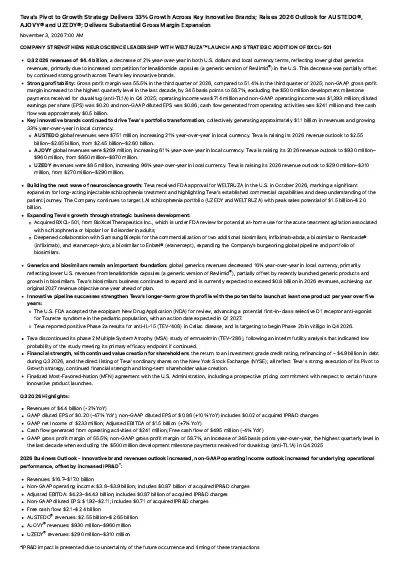
AUSTEDO, AJOVY, UZEDY, all delivering strong Q3 performance, and our innovative portfolio is up 33%. We're raising full-year guidance across all of these products.
Now, the importance of these products can be seen in our financials, and you'll see that our revenue is stronger, our margins and our free cash flow also become stronger. Now moving to the second pillar, step up innovation, you see that we have eight major milestone readouts this year, but also we've seen some good progress, and the approval of Weltruza was a significant moment for Teva as well as for patients suffering from schizophrenia.
We also have good progress in ecopipam, and we have FDA fast track designation for our anti-IL-15 candidate for celiac disease. Looking ahead, we have four additional potential submissions over the next 5 years.
With regard to an announcement we made earlier in the week, emraclidine, after an independent data monitoring committee met on a prespecified interim futility analysis, we have discontinued the Phase 2 study. It's worth pointing out there were no safety concerns.
Now while this outcome was not what I had hoped for, and I'm deeply, deeply disappointed for the patients we were hoping to serve and the physicians who helped us on this journey, I'm particularly proud of the teams and the effort we put into this program. What we have learned, we will take forward with even more determination.
Now, another change to our pipeline that happened before the earnings was with regard to BioXcel and the acquisition of BXCL501. This is an asset we think is going to further strengthen our neuroscience franchise and our psychiatric portfolio.
There's a big unmet medical need, we believe, in treating agitation at home, and we think this in the hands of Teva could really help these patients with this unmet need. Now moving on to sustain generics powerhouse, biosimilars, you'll see throughout the presentation, are becoming a significant growth driver for us now.
At Teva, in our generics business, we have 15 products on the market and 16 more in our pipeline, and more opportunities to expand this. Actually, earlier today, you may have seen a press release which showed we further strengthen our partnership with Samsung with two FDA-approved anti-TNF-alpha biosimilars.
On the final pillar, on capital allocation, with the latest S&P upgrade, Teva has now achieved investment-grade status across all three major rating agencies, reflecting the continued strength of our financial profile. We also, in this last quarter, refinanced $4.9 billion of senior notes, pleased to have done that.
Then with regard to ADR conversions to ordinary shares on the New York Stock Exchange, we've now opened up the opportunity for broader investor access to Teva. Now starting with what I think was the highlight of Q3 for us, which was the approval of Weltruza.
Now, this is a milestone for Teva, but more importantly, a milestone in regards to treating patients living with schizophrenia. Let's be clear, it starts with the patients.
Schizophrenia is a devastating disease, and every relapse can have a significant impact on patients and their family. With Weltruza, it brings a proven olanzapine efficacy in a once-monthly subcutaneous injectable with the opportunity to help patients stay on treatment and reduce relapses.
Weltruza is the first and only long-acting injectable with no loading dose, no oral supplementation, or post-injection monitoring. Because of this, we believe Weltruza can make a real difference for patients suffering from schizophrenia.
What is the opportunity? On the next slide, you can see it's significant.
With 2.2 million people who are diagnosed with schizophrenia in the U.S., approximately 1.7 million are treated, and approximately 20% of the prescription are for oral olanzapine. We all know that olanzapine has a well-established efficacy and known safety profile, and that is going to prove the strong foundation for Weltruza.
Also, I think we all agree that our commercial organization is very well positioned to succeed with Weltruza, building on the great work that has been done over the last 3 years with UZEDY, and I'll go into that in more detail later. Now when you combine these two products, we have a portfolio designed to address a broad spectrum of unmet needs with UZEDY and Weltruza, highly differentiated and yet complementary.
They're anchored in the two proven molecules of risperidone and olanzapine. Because of this, we have confidence in achieving peak sales of $1.5 to $2 billion.
Now let's move on to the financials. Now Q3 2026 reflects Teva's transition to a biopharma company.
Now, the facts are in the numbers here, let me walk you through that. Revenues declined 2%, but our gross margin grew to 58.7%, that's up 345 basis points.
Our EBITDA grew 7%, and our non-GAAP EPS was up 10%. Now remember way back in 2023 when I presented the first quarter as CEO and our gross margin was approximately 48%.
This really shows the substantial progress we've made in transitioning this company from a pure-play generics to a biopharma company. Now this isn't a one-quarter effect.
It reflects deliberate choices we have made to transition the business. We set out in 2023 to become a biopharma company, and these results show that that transformation is happening.
What I'd highlight is there is more to come. Now these results include IP R&D impact, and Eli will present and explain in a few minutes.
Now moving on to the next slide. Our total revenues are $4.4 billion.
Innovative was up 33% year-on-year, as I've mentioned. AUSTEDO was up 21% globally at $751 million.
UZEDY was up 96% at $85 million, and AJOVY was up 61% at $269 million. Generics were down 16%, and this was largely due to the lower contribution of generic REVLIMID.
Now let me go into a bit more detail. On to AUSTEDO.
AUSTEDO reached its $2.5 billion target 1 year ahead of schedule. Really, really proud of this, and congratulations to the team for making this happen.
Revenues in the U.S. were up to $727 million, up 21%, and the fundamentals remain strong.
U.S. TRx grew 18%, and milligram dispensed grew 23%.
Now given this strong momentum, we increase our outlook by $75 million at the midpoint, AUSTEDO will now be $2.55 billion to $2.65 billion. Congratulations to the team on that.
I would like to highlight that the opportunity for AUSTEDO remains strong. We see that the market growth that can remain.
New patients, with 85% of patients not treated, we see a strong opportunity to keep growing this product to greater than the $3 billion of peak sales, as we previously communicated. Now moving on to UZEDY.
UZEDY is the fastest-growing LAI for schizophrenia. Revenues grew 96% to $85 million in Q3, and the underlying demand remains strong, with TRx and NBRx up 62% year-over-year.
Now the excellent commercial execution is expanding the market, with UZEDY nearly doubling risperidone LAI share from 5% to 10%, and capturing approximately 83% of risperidone LAI. It is worth noting that if you remember back to 2025 Q3 and Q4, we did have some one-off negative impacts, it's worth keeping that in mind when you plan forward.
That said, we increase our outlook on UZEDY by $20 million at the midpoint, and now the range is $290 million to $310 million. It probably doesn't need pointing out, but I will, that this continued excellent execution gives us a solid foundation from which to launch Weltruza.
Now moving on to AJOVY. AJOVY continues to extend its global leadership in migraine.
Continue to outperform the injectable market and lead in many markets where we've launched. Global revenue reached $269 million, up 61% year-over-year, with strong momentum across many markets.
In the U.S., revenue grew 89%, while ex-U.S. momentum remains strong, supported by volume growth as well as market share gains.
Because of this strong momentum, we increase our outlook by $85 million at the midpoint, raising it to $930 million to $960 million. Now, I'd like to point out this doesn't happen by chance.
If you remember, when we started on this journey in 2023, nobody was talking about AJOVY, but we reinvigorated it. I think this reflects something broader about Teva.
We do things with intent, and we execute with intensity. That's why, looking beyond 2026, we see a path to greater than $1 billion of peak sales for AJOVY.
Now moving on to a couple of new products in our pipeline that I've touched upon earlier. Firstly, ecopipam.
This is a first-in-class opportunity for Tourette syndrome, combining compelling efficacy and favorable tolerability in a serious pediatric neurological disorder with limited treatment options. There are 100,000 pediatric patients who live with Tourette syndrome every year; 50,000 are treated, but unfortunately only 20% to 30% remain on therapy after 1 year.
We hope to help that and hope to help these patients and these children. Our next key milestone is obtaining regulatory approval, which we anticipate in Q1 2027.
Now moving on to the latest addition to our innovative pipeline is the asset that we acquired from BioXcel, which is BXCL501. Now this is expected to address another clear unmet need for patients experiencing acute agitation at home, expanding our patient focus in neuroscience and bringing potential benefits to nearly 7 million patients.
BXCL501 could be the first at-home treatment for acute agitation pending regulatory approval, adding another differentiated opportunity and significant value to our neuroscience portfolio. This also highlights another example of disciplined capital allocation, finding differentiated assets where Teva can add real value.
Now, my colleagues will go into a bit more detail on ecopipam and BXCL501 next week at our R&D Day. Now moving on to the next slide.
When we talk about growth and we talk about the impressive growth in Q3, it's worth pointing out that we have a decade-long runway of growth catalysts. As you can see here, we have a maturing pipeline that I will talk about in more detail next week.
As you look at 2030 and beyond, it really does get quite congested, this slide. That's a great, exciting opportunity for Teva and for potential investors.
Now moving on to the next slide, a slide which we've talked about for the last couple of years. Now we're starting to see some of these products actually come to the market.
Obviously, we've spoken about Weltruza. We've spoken about the near-term opportunity in Q1 for ecopipam.
Now we've added BioXcel BXCL501. We have a pipeline here that we are confident will deliver over $10 billion of sales for Teva going forward.
We'll give more detail on this at our R&D Day next week. Now moving on to the generics business.
Our generic powerhouse we're going to have is resilient beyond REVLIMID, which is exciting. Let me share the fundamentals that prove this.
If you take away generic REVLIMID, our global generics business grew 1%, with the U.S. down 3%, EU up 7%, and emerging markets down 4%.
Now, we expect our generics business to be flat to slightly up in 2026, but we continue to be positive about the long-term growth trajectory of this business, 1% to 2% over the long term. Now I remain very optimistic about the future of our generics business, and one of the main reasons for my confidence is the growth phase.
It's really around our rapidly expanding biosimilar portfolio and pipeline. Now if I move on to this, you will see this clearly on this slide.
It's one of the fastest-growing biosimilar businesses you have there. We set out to achieve $800 million of sales by 2027.
I'm in a position to tell you today that we're going to do that in 2026, a year ahead of schedule. At the same time, we're expanding our portfolio, from nine assets in 2024 to 15 today, and potentially 18 in 2027.
It's worth noting this is not simply about adding assets. We're deliberately shifting our portfolio towards biosimilars, an increasingly important growth driver for our generics business.
What's important, it's not just about the portfolio, it's how we're executing. As you can see, three out of the five U.S.
biosimilars are ranked number one, while in Europe, we're building leading positions across several important markets. If you go on to the next slide, we're going to continue on this journey, expanding our portfolio and bringing these biosimilars to markets both the U.S.
and Europe. As you can see here, we're at 31 already, but I've also realized that this slide is already out of date because of the deal we announced today with Samsung, it should be 32.
Apologies for that, but it does really reflect the speed we move at Teva. Based on this solid foundation of innovation and the portfolio transition of our generics business with biosimilars, I can move on to the next slide and say we are firmly on track to achieve our 2027 targets that we laid out back in 2023.
With that, I'm going to hand over to Eric.
Eric Hughes
Thank you, Richard. Looking at my first slide, I just want to review really quickly the progression of our innovative growth drivers.
This is led by a trio of neuroscience products with the approval of Weltruza, and now the hopeful approval in 2027 of ecopipam for Tourette's disease, and then finally our new drug, dexmedetomidine, that is being used for the treatment of agitation. We're looking for a PDUFA date in Q4 of this year.
Really a great spearhead leading with our neuroscience portfolio. Following on to that is our burgeoning innovative pipeline in immunology, leading off with TEV-'574, which we will be ending our Phase 3 study soon, with our last exacerbation hopefully around the end of this year.
We're also progressing duvakitug. It's obviously in Phase 3 at this point with ulcerative colitis and Crohn's disease.
We're also be initiating a hidradenitis suppurativa and fibrostenotic Crohn's disease with our partner Sanofi. Then finally, our anti-IL-15 program, where we had exciting new data this year in our proof-of-concept study in vitiligo and celiac disease.
A real engine of growth for our innovative drivers. On the next slide, though, the real bell of the ball today is Weltruza.
This is a fantastic product for patients with schizophrenia, building upon the known efficacy of olanzapine, but we really delivered on the label with no loading dose, no oral supplementation, and no post-injection monitoring. I just have to give a shout-out to the R&D team for doing such a great job in its development, and I appreciate that our data set was so well received by the FDA to give a label that really gives something that patients can use in the future.
Kudos to the team. On the next slide, I just want to really go over there's been a lot of momentum just since the last earnings call in Q2.
Since then, we've had the announcement of the priority review of ecopipam. We've had the submission of the IND for the hidradenitis suppurativa study for duvakitug.
We announced and shared some top-line data that showed clinically significant changes in a gluten challenge for celiac disease. We had presented our vitiligo data at the EADV conference in September.
We achieved the futility analysis for emraclidine. Unfortunately, that didn't turn out the way we wanted, but the team did a great job in executing the study, and we'll review the loads of data that we've produced to see how we'll bring that program forward in the future.
Really, the Weltruza was a big announcement on October 8th. Then finally, we presented at UEGW the duvakitug data on the maintenance data, how we've started the entire year bringing it full circle and presenting that great data for duvakitug.
Lots of momentum just in the last quarter, we're very proud of that work. If I go to the next slide, you can see we're marching down the catalysts that we had outlined at the very beginning of the year: duvakitug, ecopipam, anti-IL-15, TEV-'574, emraclidine.
Now we're adding Weltruza, and we'll be talking about TEV-'562 and dexmedetomidine in the future R&D meeting next week. Finally, I'm just going to end with the fact that I was going to be quick today because we'll be talking a lot more about some deep dives into our pipeline, some new programs and new data that we'll present next week on November 11th at our R&D Day.
I hope people can call in and listen to the webcast. If you need more details, just visit our website or write to us.
With that, I'm going to pass off to Eli Kalif.
Eli Kalif
Thank you, Eric, and good morning and good afternoon to everyone. I would like to start my review of Q3 2026 results with the following key messages.
First, sustaining innovative growth momentum. We expect it to continue to deliver strong product mix growth supported by disciplined commercial execution and focused investment while transforming to high-margin profile.
Second, continue to maintain credible path to 30% operating margin by 2027. Capture the full benefits of the transformation program, including structural cost savings, productivity improvement, and operating leverage from a more favorable gross and product mix while actively mitigating generic REVLIMID earnings erosion.
Lastly, execute a disciplined capital allocation strategy, preserve financial flexibility while prioritizing debt reduction and sustain execution on our financial policies, resulting in investment-grade profile, targeted business development investments with acceleration of innovative R&D and focus on shareholder return. Now starting with our Q3 GAAP performance on slide 30.
Before I discuss our Q3 results, let me briefly explain why we also reflected the IP R&D impact. IP R&D can result in significant upfront and milestone expenses related to investments in externally acquired or licensed pipeline assets.
Given the transaction-driven nature of this expenses, starting with Q3 2026, we present the impact of this transaction on our results to provide a clear and more comparable view of our underlying operating performance. Q3 revenue were approximately $4.4 billion, down 2% in U.S.
dollars and in local currency compared to Q3 2025. This decrease was largely driven by lower generic products, mainly generic REVLIMID, and was largely offset by continued strong growth of our key innovative products, AUSTEDO, AJOVY, and UZEDY.
GAAP net profit and profit per share were $233 million and 20 cents, respectively. Turning now to our non-GAAP performance.
Our non-GAAP gross margin in Q3 2026 was 58.7%, an increase of 245 basis points, reflecting the favorable mix of products with strong growth in our key innovative products, partially offset by lower revenue from generic products, mainly generic REVLIMID. GAAP operating margin was 31.7%, 282 basis points above Q3 last year.
This increase in operating margin was mainly due to a higher gross margin, partially offset by higher planned investments in sales and marketing to support our innovative growth and launch preparation for Weltruza, as well as by capital gain from the sale of property in Europe. Overall, we ended the quarter with a non-GAAP EPS of 86 cents, 10% higher compared to Q3 2025.
Our free cash flow in Q3 was in line with our expectations at $495 million, slightly below last year. In October 2026, we repaid approximately $1.8 billion of our debt maturities.
As of today, no amounts are outstanding under our revolving credit facility. To provide you with some additional color, our Q3 2025 year-to-date results included approximately $1 billion revenue and $730 million EBITDA contribution from our generic REVLIMID.
Our Q3 2025 results included $430 million revenue and $300 million EBITDA contribution from generic REVLIMID. Excluding this, our financial results year-to-date and for this quarter reflect a strong underlying performance.
Moving to the next slide. As a reminder, our operating margin expansion to 30% is driven by two structural elements.
The first is a portfolio shift towards higher-growth, higher-margin innovative products, and second are the Teva transformation programs. We continue to make solid progress with our year-to-date operating margin, reaching 28% on our updated 2026 guidance of 27.8% to 28.2%, all excluding for IP R&D expenses.
Looking ahead to 2027, we expect further 180 to 220 basis points of improvement, driven by the full expected impact of our transformation programs and continued innovative growth while compensating for generic REVLIMID erosion. This is the core of our financial transformation, moving from a company historically driven by generics to a biopharma company.
Moving to slide 32. Focused financial management has been an important source of cash creation for us, and importantly, it has allowed us to redirect capital towards higher-return opportunities.
From 2022 through 2026, improvements in net working capital generated approximately $1.3 billion of incremental cash, with additional approximately $160 million from lower interest expenses. Together, that represents roughly $1.5 billion of cash generation that we have been able to redeploy into the business, including accelerating our innovative pipeline and investing in our broader priorities.
Looking forward, we see the opportunity to continue this dynamic. Between 2027 to 2030, we expect to generate an additional of approximately $500 to $900 million from net working capital, together with approximately $1.4 to $1.6 billion from interest expense savings, bringing the cumulative opportunity to approximately $3.4 to $4 billion.
By the end of the 2030, we expect to reach negative net working capital as a percentage of revenue. Importantly, as the business grows, this become increasingly powerful.
We are freeing up capital and reinvesting it in higher rates of return while continuing to grow and create further capacity for investments. At the same time, we remain focused on maintaining the right balance sheet.
We have repaid approx $12 billion of debt since 2019 and remain on clear path for net debt to EBITDA 2x by the end of 2027. With approximately $2.7 billion expected free cash flow in 2027 compared with less than $1 billion of annual maturities from 2028 to 2030, and approximately $2.5 billion of free cash flow expected in 2030, we believe we have a significant financial flexibility to continue investing in our growth while maintaining appropriate leverage.
This is really a reinforcing cycle: disciplined financial management generates cash, that cash is reinvested into a higher-return growth opportunities, and as the business grows, we create even greater capacity to invest. Now turning to 2026 outlook on slide 33.
Based on our strong performance year-to-date and the visibility into the remainder of the year, we are raising our full-year revenue guidance range to $16.7 billion to $17 billion, which is an increase of $175 million to our midpoint. We're also updating our outlook range for operating profit, adjusted EBITDA, EPS, and free cash flow.
As Richard mentioned earlier, the acquisition of BXCL501 from BioXcel has now closed. Here is a reminder of the deal terms.
The agreement provides for $57.5 million upfront payment as well up to $67.5 million in potential contingent payments linked to the timing of expected FDA approval and certain sales milestones. Let me provide some color on our guidance assumptions, starting with the revenue.
First, our innovative portfolio continued to perform strongly across all three products: AUSTEDO, AJOVY, and UZEDY. We are increasing the full-year guidance for all the three products, with AUSTEDO now expected at $2.55 billion to $2.65 billion, AJOVY at $930 million to $960 million, and UZEDY at $290 to $310 million.
We expected our global generics revenue full year to be flat to slightly up in local currency compared to 2025, excluding the impact of generic REVLIMID and the divested Japan business. We continue to expect 2026 non-GAAP gross margin to be in the range of 54.5% to 55.5%.
We now expect 2026 operating income to be in the range of $3.8 billion to $3.9 billion, with an operating margin of 22.6% to 23.1%. Excluding IP R&D, this range will be between 27.8% to 28.2%.
Our operating expenses continue to reflect the deliberate investments we are making to support our growing innovative portfolio and biosimilars. Our guidance for operating income and adjusted EBITDA reflects this continued growth investments in OpEx, with adjusted EBITDA now expected to be in the range of $4 billion 23 to $4 billion 43.
Excluding IP R&D, this range will be between $5.1 billion to $5.3 billion. We continue to expect finance expenses to approximately $800 million and a tax rate in the range of 20% to 23%.
Our diluted EPS guidance is now $1.92 to $2.11, and we are also increasing our guidance for free cash flow to be in the range of $2.1 billion to $2.4 billion for the full year. Now let me provide you some additional thoughts on Q4.
For AUSTEDO, we continue to expect revenue in Q4 2026 to be down year-over-year due to expected changes in purchasing patterns and the pricing environment ahead of the IRA implementation in January. In addition, we are preparing for the Q4 launch of Weltruza.
Since the initial volume is expected to be largely samples or vouchers as we establish payer coverage, we continue to expect no major revenue contribution in Q4. Over the last several years, we have consistently delivered on our commitments and made significant progress across our key financial metrics.
Today we are not providing detailed 2027 guidance outlook, but looking ahead, we expect this momentum to continue, with a mid-single-digit growth on revenue CAGR from '23-'27. We outlined on slide 69 more comprehensive information about our financial trajectory.
Moving to the next slide on capital allocation. Over the last few years, we have made significant progress in strengthening our balance sheet.
This progress allowed us the financial flexibility to invest in our innovative portfolio and pipeline, evaluating value-accretive business development opportunities alongside with the optionality of returning capital to shareholders through buybacks, when appropriate. Lastly, I would like to briefly touch on our transition to a direct ordinary share listing on the New York Stock Exchange.
We believe this change is making Teva shares more accessible to a broader investor base, who are now able to buy ordinary shares directly in a seamless manner and strengthening our position in the U.S. capital markets.
Together with our recent return to investment-grade credit ratings from all three major rating agencies, this represents another important milestone in our financial transformation. We believe this transition reflects the momentum we are building through our Pivot to Growth strategy and further enhance our ability to invest for long-term growth and create shareholder value.
With that, I will now hand it back to Richard for his closing remarks.
Richard Francis
Thank you, Eli. In summary, Teva is now a more focused, high-growth biopharma company, and our Pivot to Growth strategy is delivering.
The growth engine of our innovative portfolio is accelerating. AUSTEDO, UZEDY, and AJOVY are growth drivers, and we're excited by the recent FDA approval of Weltruza.
In the near future, our incremental growth will come from the next generation of innovation. To conclude on the next slide, as we continue our journey, three things are clear.
In a pivotal year for Teva, we delivered as promised. Our pipeline is advancing with speed.
Our disciplined capital allocation is what sets us apart. To build on what Eric said, we're looking forward to seeing you at our R&D Day next week in New York City.
With that, I'll open the floor to questions.
Operator
Thank you. If you would like to ask a question, please press—
Christopher Stevo
Sorry, Elliot. Before you get the queue ready, I just wanted to remind people if you could try to limit yourself to one question and one follow-up, and if you have additional questions, we're happy to have you back in the queue and we'll answer as many as time permits.
Sorry, go ahead, Elliot.
Operator
Thank you. If you would like to ask a question, please press * followed by 1 on your telephone keypad.
If you would like to withdraw your question, please press * followed by 2. When preparing to ask your question, please ensure your device is unmuted locally.
As a reminder, if you are using a speakerphone, please remember to pick up your handset before asking your question. Our first question today comes from Umer Raffat with Evercore ISI.
Your line is open, please go ahead.
Hi, guys. Sorry, thanks for taking my question.
Umer here. I wanted to touch up on two things here.
First, the last slide has this interesting disclosure on a possible 57% to 58% gross margin in 2027. I believe that's a new disclosure, which is up quite nicely from the full-year '26 of about 55% gross margin.
My question is this: if AUSTEDO is flattish next year because of IRA implementation, can you speak to what enables that 200 to 300 bps in gross margin expansion, which is presumably not branded business-driven? Second, speaking of AUSTEDO more specifically, I just wanted to run some math with you.
First, we heard Gilead mention about a $1.5 billion in IRA impact to Biktarvy, which represents something between a quarter to a third of Biktarvy's Medicare exposure. Considering AUSTEDO's Medicare exposure is about $1.5 billion, is it reasonable to assume something like half a billion or so in IRA exposure for AUSTEDO into next year?
Thank you.
Richard Francis
Thanks, Umer. Thanks for the question.
I appreciate the fact that you looked through all of the slides, even in the appendix, thank you for that. I'll hand over to Eli to talk a bit about the gross margin.
I think one thing I'd say on a high level is, one, we did disclose the direction of travel with our gross margin back at our Capital Markets Day. I think what you're seeing is the fact that the transition to a biopharma company is accelerating that because our portfolio is transitioning at speed and at scale, combined with some of our efficiency drives.
I'll hand that to Eli to give a bit more context.
Eli Kalif
Thank you, Umer, for the question. We did mention in the past the 57% to 58%, and while keeping the 27% to 28% OpEx get us to the 30% OP.
That's just kind of a high level. What I will mention is the following: if you look on just this quarter, and we're actually going to be about 58%, you compare it to last year, the same quarter was a bit above 55%.
This is kind of a 360 basis points, and mainly coming from the innovative shift that we have on our revenue mix. What we're going to see next year, to remind everybody, we have the $700 million on transformation savings.
Around two-thirds of it is actually related to OpEx and we are going to actually utilize it and recognize it this year. The rest of the program is more kind of that related to our network optimization, which is going to impact our COGS.
If you think about us ending the year close to, I would say, on the higher range of 55.5%, you take 200 basis points to the midpoint of the 57% to 58%, kind of a 100 basis points going to manufacturing and optimization on our COGS and one and 100 basis points going to our innovative revenue shifts.
Richard Francis
Thanks, Eli. The one thing I'd say about that trajectory of gross margin upwards, it will just keep continuing.
It's just a question of by how much, but it will continue because of the transformation of our portfolio, because of the transformation of the launches we have coming up. Now to answer your second question, Umer, canny speaking, yes, you're right.
That's probably the first thing to say. Without getting into guidance, consistent with our past practices, we will provide guidance in '27 next year.
Yes, we have a high degree of confidence that AUSTEDO will achieve $2.5 billion next year and greater than $3 billion at peak. 2027 was always a year we planned for with strong fundamentals, offsetting the IRA impact, and so that's what gives us the confidence in that.
I'd say, just to give a broader context, what is really changed is the company is having a portfolio vibrant beyond AUSTEDO. Once again, I'm not giving guidance on '27, we expect Teva's revenues to grow again.
Beside UZEDY, AJOVY, we're now adding Weltruza and ecopipam, and then potentially maybe BXCL501. Our portfolio of innovation allows us to continue to grow beyond '27, in '27 and beyond.
That allows us to grow our margins. I think it's a good question.
Appreciate you asking, because it's multilayered. Fundamentally it comes back to the execution of the Pivot to Growth strategy, the execution of moving us to a biopharma company with a fast-growing innovative portfolio.
Thanks for the question, Umer.
Operator
We now turn to Douglas Tsao with H.C. Wainwright.
Your line is open, please go ahead.
Douglas Tsao
Hi, good morning. Thanks for taking the questions.
Maybe two questions on AUSTEDO and AJOVY. First, in terms of AUSTEDO, I noticed you've continued to have an acceleration in terms of the milligrams per patient.
I'm just curious, some of that is obviously just coming from natural migration to XR, but I'm curious, within the XR franchise alone, sort of how much continued traction have you had? I know patients are generally not getting to the 36.6 that was in the Phase 3 trial, and how much of a focus is it to sort of get patients ultimately to that level?
Then just in terms of AJOVY, where the franchise really renewed growth recently, I'm just curious, when you think about the prospects, what you're necessarily seeing in the U.S., it looks like you're doing better on a revenue standpoint per patient, sort of how you see share shaking out. You've definitely taken share from Aimovig over the long term, and how much growth will come from U.S.
versus ex-U.S.? Thank you.
Richard Francis
Okay. Firstly, thank you, I think, is the right word for the coverage, appreciate that.
Thank you for your questions. Let me try and pick them off.
Firstly, I'm going to start with AUSTEDO. You talked about the milligrams growth there, 23% in Q3.
How that has happened is a couple of things. Firstly, there was the launch of XR, but then there was also the launch of the ability to get a titration pack through prescription.
Because one of the things about AUSTEDO is you need to titrate up to the optimal dose to get efficacy. Having a titration pack prescribed and then having XR once a day just makes that process simpler.
That's what's really driven that. We haven't actively gone out there to drive conversion from BD to XR.
We've let the physician make that choice. Because of the fact that those two things were in place, we've seen that continually improve, which is good for the patients, because we want to have the patients on the most efficacious dose.
One of the challenges and opportunities with AUSTEDO is that people start to feel efficacy pretty quickly, but we want to make sure they go onto something which is most optimal for them, but that's down to the physician to use the titration pack and XR to help do that. That's the fundamental of that, and we see continued progression of that this year and going forward.
Now on to your question around AJOVY. AJOVY, I think, was around about the U.S.
performance and how strong that is, and then the rest of the world performance. Let me sort of talk you through the U.S.
performance first. U.S.
performance, and it goes back to what I said in my opening remarks, this is about a focused execution on delivering a strategy at a brand level: what do we want to do globally and what do we want to do locally, and what capabilities do we need to put around that, what resources, and what choices do we need to make. I think in the U.S., we've seen the work of the team there make decisions on making sure we have the right access at the right value.
When you do that, as well as the growing market share, then we have the ability to
Operator
Phone lines disconnected.
Richard Francis
Then with regard to the rest of the world, you have the opportunity, and as you've seen that, we continue to grow in Europe and international markets above market, significantly above market. Because of that, we grow in market share.
To do that, we continue to see the revenue grow. I think what this highlights, because I know this is an unusual situation, but with focus, capability, and the right resources and the right ambition and expectations, you can revitalize a brand, and I think we've seen that with AJOVY.
That's why we remain confident that it's going to exceed $1 billion in peak sales, which sounds obviously like a big number, particularly when we started our conversations nearly 4 years ago. Hope that answers your questions.
Thanks very much.
Operator
We now turn to Glen Santangelo with Barclays. Your line is open, please go ahead.
Glen Santangelo
Oh, yeah, thanks for taking my questions. Richard, just two things I wanted to hit on quickly.
When you were talking about sort of the biosimilar launch slide, you sort of commented how congested it's becoming. As I'm sure you're aware, you've seen a bunch of incremental litigation in the space.
For example, Janssen seeking a PI on Simponi, and Genentech bringing a suit on Xolair, and a lot of concern around Entyvio and on the launch timing there just sort of given the IP at Takeda. I'm just kind of curious how Teva thinks about navigating all that potential litigation, making the decision on whether to launch these products.
Because on that slide, seems like you have some incremental contribution coming in '27 from these drugs. Then secondly, I did want to ask about '27 related to ecopipam and BXL501.
I'm sure you're going to touch on this at the R&D Day next week, but I'm just kind of curious at a high level. Are you expecting any type of reasonable contribution from those two drugs in the second half of '27?
Thanks, and I'll stop there.
Richard Francis
Hi, Glen. Thanks for the questions.
On the biosimilar one with regard to litigation, yeah, that's pretty much the business we're in when it comes to generics and biosimilars. We want to bring these products to market and people want to litigate and stop us doing that.
It sort of is not a surprise to us. Obviously, we would like that not to be in place, but we strategically plan and we financially plan with realism.
When we think about our portfolio of 32 now, we take into account the puts and takes. I think when I started on this journey, I said to people who asked me, which is going to be the most successful biosimilar?
I said, I don't know, because there's too many variables: IP, litigation, launch timing, number of competitors, price erosion, etc. When you have a portfolio, you allow yourself to manage those risks in a more thoughtful way that allow you to continue to grow.
Because of that, I still feel very confident with the direction we're on with our biosimilar business. I think what's important noting now, we are reaching a certain momentum and scale that this is going to fundamentally change the portfolio of our generics business, and I think that's something for people to maybe double-click on and recognize.
I think that's one. The other thing I'd say on our biosimilar business is to some degree it doesn't follow all the traditional rules.
As I said, three out of the five of our biosimilars in the U.S. are number one.
We were not number one to the market. That just shows you it's not as straightforward as people think, and I like that.
The same in Europe. We come to Europe late in many instances, but we've also shown that we can be number one in those markets because of the capabilities and infrastructure we have in place.
I think biosimilars, you'll hear us talking more about it, but we're going to keep expanding that portfolio, and litigation will come and we will deal with that as and when it comes, but it won't derail us. Now on ecopipam and BXCL501, look, Dan, I've got to ensure you turn up next week, I can't tell you anything.
All I'll say, it's a good question and the right question, and we'll start to give you some insight into why we're excited about these two products. Whether we'll give you any guidance on that, you'll have to wait and see.
I'm glad you're starting to focus on those, because I think in our hands, as we've shown, we can really drive value. We've just had that conversation on AJOVY, but I think when you look at ecopipam with a significant unmet need and you look at BXCL501 with a significant unmet need in agitation, I think we're very excited about what we could do with those.
Apologies, but I'll see you in New York next week.
Glen Santangelo
No worries. Thanks, we'll see you next week.
Operator
Our next question comes from David Amsellem with Piper Sandler. Your line is open, please go ahead.
David Amsellem
Thanks. Actually, have a couple of ecopipam questions, more longer-term focused.
You didn't provide peak sales potential for the product in your slide unlike other products in the pipeline or recently approved. Maybe just a question on how you're thinking qualitatively about how impactful this product could be, how are you thinking about access dynamics, mix of Medicaid versus commercial, and how long you think it's going to take to get good access, any pricing analogues that you can help us with in terms of how to think about that.
Then do you think this is a product that could slot in ahead of the approved antipsychotics that are commonly used? I know that's a bunch, but it's obviously an important driver going forward.
Thanks.
Richard Francis
Thanks, David. Thanks for the question.
No, it's a really good question, and I'll give Eric a heads-up that let's let Eran talk about that third line moving ahead of antipsychotics. I think you've touched upon all the variables there that we're thinking about.
First off, there is the fact that we've got to think about what is the appropriate price for such an innovative product that's going to bring compelling efficacy and good tolerability and safety. We're doing a lot of work on that now, because obviously that is a very important factor in this equation.
That's another reason why we don't want to start talking about sales and peak sales, because we want to get that work done and we want to make sure that's as thorough as it can be. As we've said in the past, the pricing will reflect something of a rare, orphan nature where there's a significant unmet need in a pediatric population.
Second thing that comes down to then is access, and how do we want to approach access. Now, as we are very thoughtful about access and we think about the long-term value of a product and how you have to be thoughtful in what you do with regard to access around that.
We're working through that. With regard to Medicaid and commercial, the mix is a bit different here.
I think we're looking at more commercial plans on this product, which, as I've stated in the past, is a change for us because we spend a lot of our time dealing in Medicaid and Medicare. I think that's how I would think about it.
I'll hand over to Eric. What I would say is when I get to speak to physicians and when I actually get to speak to patients, and I've actually even come across some people who suffer from Tourette's, there is a clear opportunity for an efficacious and safe and well-tolerated product to move ahead of an antipsychotic.
Maybe I'll hand that to the Dr. Eran.
Eric Hughes
Thank you, Richard. I think that the value of ecopipam comes down to the data sets that we have generated to date.
There's two well-controlled studies, both in Phase 2 and Phase 3 now, one with a 30% reduction in the tic experienced for the patients and a 50% reduction in the relapse rate. Great data, but more importantly, the side effect profile was favorable, I think, where you saw very good tolerability, no metabolic effects, good activity for their tics, and no abnormal movement disorders.
When I think about how physicians might use this in the future, sure, they might step through what they do today with alpha-adrenergic receptor agonists, which is off-label, then they might go on to antipsychotics. I think when they've get used to what the profile is of ecopipam and understand both the efficacy and the safety profile, it will move up in that list of possibilities out there.
I think that long-term efficacy, remember, only about mid-20s do people stay on their therapies today, and our long-term follow-up, 66% of patients stay on the drug throughout the year. I think the profile, once physicians get used to it, it will move up in that armamentarium.
Richard Francis
Thanks, Eric. Thanks for that answer, and thanks for the question, David.
Operator
Our next question comes from Jason Gerberry with Bank of America. Your line is open, please go ahead.
Jason Gerberry
Morning. Thank you for taking my questions.
One question for Eric, just what does the timeline look like for Teva's efforts to advance a TL1A bispecific into the clinic? I know you guys have some efforts that have been ongoing preclinically.
Anything you can update there in terms of timeline? Then my follow-up question is just does the U.S.
government agreement exclude Teva from some of the generic tariff headline proposals, or I don't know what to call it exactly, but does the agreement provide an exemption from any generic tariff risk? Thanks.
Eric Hughes
I can start answer the question on the TL1A bispecific. I'll disappoint you right off the bat, I'm not going to tell you much because we have an R&D Day next week, and we may be talking about bispecific programs with our TL1A.
I would mention that we are one of the first in the TL1A space. We have a very potent, highly selective drug with low anti-drug antibodies in full Phase 3.
I think that our scientists are the experts in TL1A. We'll hear more about that next week.
Richard Francis
Jason, with regard to your question on generics and any agreement with the U.S. government, as they laid out, I think, some time ago, it's a 2-year timeframe they've put in place to come to some sort of agreement.
There's nothing has been concluded there. As you can imagine, a company like Teva is always at the table.
As and when we get more information, we'll let you know.
Operator
We now turn to Louise Chen with Scotiabank. Your line is open, please go ahead.
Louise Chen
Hi, thanks for taking my questions, and congratulations on the quarter. I wanted to ask you first what's your latest thinking on M&A and business development?
Then secondly, if you could talk about your R&D philosophy a little bit more and the efficiency at which you move products through your pipeline. Thank you.
Richard Francis
Hi, Louise. Thanks for the questions.
M&A, what we think about is efficient deployment of capital all the time. Obviously we're thinking about that a lot, and we have been thinking about that a lot the last few years, despite people thinking today wasn't going to come.
What I mean by today is an ever-improving balance sheet, investment grade, and as Eli's pointed out, an opportunity for the company to really generate some free cash. Obviously under our balance sheet, it's going to start to improve significantly.
Because of that, we were always planning for this day. Hopefully that's something that people will start to realize: we do plan long term for Teva, at Teva.
We start to think about what can be around the corner. Yes, we do think about more business development deals.
We think about potential M&A, but it has to be one that we feel that is good value, it drives the long-term value of the company, puts us on a sustainable footing to become a world-class biopharma company. I think hopefully you've seen with the deals we've done, we're very thoughtful about how we deploy capital externally and making sure we do things that will drive a good accretion short term as well as long term.
That's our philosophy. The balance sheet gives us a bit more flexibility, but our discipline will not change.
Now on the R&D philosophy, Eran, are you going to tell them anything?
Eric Hughes
I'll give them the headlines. How's that?
Thanks for the question, Louise. I think it's a pretty simple strategy and philosophy we have.
We'll talk about it more next week. It's really about using known science to increase your POS, speed and execution and shoe leather, not AI, and it's disciplined capital and using partnerships where you can increase your bandwidth and your funding.
It's straight-up simple, but you have to execute it.
Richard Francis
Thanks, Eric. Thanks, Louise.
Thank you for the question. Next question.
Operator
We now turn to Dennis Ding with Jefferies. Your line is open, please go ahead.
Dennis Ding
Hey, guys. Good morning.
Two questions if I may. One on Weltruza.
You framed the market as 2 million in the U.S. diagnosed and 20% on oral olanzapine, you're essentially implying the TAM is around 400,000.
How does the TAM change given many patients don't tolerate olanzapine because of weight gain, and then they eventually discontinue, and Weltruza likely will have a similar side effect profile? Where do you see Weltruza being realistically used?
I guess, in a way, I'm asking if you have an estimate for how many patients have shown efficacy on olanzapine, tolerate the weight gain, but are also showing evidence of noncompliance? That's question number one.
Then question number two, for biosimilars, can you please clarify again and confirm on slide 20 that you're looking to launch a biosimilar Simponi in the U.S. in 2027?
I'm just wondering how are you thinking about the litigation aspect here as a barrier for a U.S. launch?
The reason we ask is because the 4-day bench trial that J&J has against Bio-Thera starts March 2028, and I'm assuming your partner's bench trial will be scheduled around the same timeframe. Just help me reconcile the timing differences here, and if what you're implying is that you'll be aggressive in pursuing a settlement to ensure a 2027 U.S.
biosimilar Simponi launch. Thanks so much.
Richard Francis
Okay. Thanks, Dennis.
Thanks for the question. I will tag team the first one with Eric.
The way that we think about it is the reason why olanzapine commands such a large portion of the market in schizophrenia is because it is very efficacious and is seen as the gold standard when it comes to efficacy. While you've identified some of the metabolic challenges it has, when it comes to managing schizophrenia when patients have severe schizophrenia, efficacy is the number one priority.
That's why olanzapine has maintained that segment of the market. Obviously, when it comes to severe schizophrenia, compliance becomes key, and that's why we think Weltruza comes in.
In a way, we're not dealing with that side effects. They're already known, and people are picking olanzapine because the efficacy both the physician and the patient.
I'll let Eric give more context to that.
Eric Hughes
I'll add a little bit more color about that. Weltruza, its value is its known efficacy and its known safety profile.
As a physician, you're using something, but bringing something new to it with the LAI. So 20% of the market approximately already uses olanzapine.
That's how well known it is and how used they are of using it. Bringing that convenience and that hopefully added benefit of lower relapses and better adherence with an LAI is really the value proposition here.
I think that's really defined very easily for a physician to choose who should get it. I'd add that we've done the same thing with UZEDY in a crowded space of risperidone here, launching into a market for LAIs that really has no viable alternative at this point.
Richard Francis
Thank you, Eric. Then when you go on to the question you had on the biosimilar Simponi, when we talk about launch readiness, we talk about the ability to be able to launch.
We may not launch, and that depends on a number of factors. We always set ourselves up that we are in a position to launch if possible.
That's the way to think about it. Now obviously, IP litigation can go many different ways, but what I always insist upon is we are ready, if things do go the way we plan them or we hope for, that they do, that we are there to make sure this access is made available to patients.
Operator
Our next question comes from Dan Clark with Leerink Partners. Your line is open, please go ahead.
Dan Clark
Great. Thanks so much.
Good morning, everyone. Wanted to ask my first question on the AUSTEDO slide.
You mentioned there are new capabilities in place to support MFP effectuation next year. Can you just give some color on what those are and sort of how those might impact either sales or kind of price next year?
Then my second question, just a little more clarity on how you're thinking about the timing of Weltruza revenue next year. Should we think about that being more mid-year as you work to secure access, or any color you could provide there would be very helpful.
Thank you.
Richard Francis
Thanks, Dan. Thanks for the question.
Starting in reverse order, on Weltruza, revenue expectations are in the latter half of the year. Let me explain a bit why.
We launched in this quarter and this is all about making sure we get access and familiarity with the product both in the hospital formularies and with the physicians. Now, as you may be aware that we have the majority of our patients in Medicaid and Medicare, and so to get access to Weltruza, we have to get access on Medicaid formularies.
That is something which is limited by each plan. Some will do that at launch and some will do that at 6 months, 9 months, 12 months.
At 12 months, we'll have about 85% of Medicaid coverage. Access is one of the big limiting factors, and obviously then we have Medicare, but it's really Medicaid.
Now, the things we do on the impetus to make that happen is we have sampling and we have hospital formularies to make sure the hospital formularies have it on, but ultimately it comes down to that access. That means you're not going to see revenue of any particular value in the first half of next year.
As a lot of those states come on board, then we see the opportunity for physicians to start using Weltruza more broadly. That's why we say the second half of next year, and obviously that changes significantly with a full year in 2028.
That's how I would think about it. What we will do is make sure we update you all on some of the things I call the inputs or the leading metrics around TRx, around access, breadth of use by physicians, depth of use by physicians.
We feel very confident in where we're heading with Weltruza because of the things that Eric has mentioned around the product profile, the unmet medical need, and the fact that we have a really strong capability with UZEDY. Then on AUSTEDO, I think the question was around what capabilities have we brought to minimize the impact of the IRA and the effectuation of that.
It's really doing a bit more of the same. That we've been planning for this for some time, we're not suddenly walking into 2027 unprepared.
We've been preparing this for multiple years. As we said, on the Pivot to Growth strategy, in 2027, we knew this was going to happen.
Sorry, in '23 for '27, we knew this was going to happen. We've been building capability, building our strategy around this.
I think we're well placed. That goes down to many factors around how we manage the patient, how we manage specialty pharmacy, how we manage access, how we manage multiple parts of the patient journey.
Those were put in place some time ago. That gives us a level of confidence that we can keep growing this product to over $3 billion in time.
So '27 is just merely a stage on the journey for that. As I repeat, we always plan for 2027, and so in no way are we daunted by the challenge ahead of us.
Operator
We now turn to Joseph Thome with TD Cowen. Your line is open, please go ahead.
Joseph Thome
Hi there. Good morning, and thank you for taking my questions.
Maybe one on the commercial side first. Just as you're seeing about the LAIs, obviously one of the benefits can be time on therapy and increased compliance.
What are you seeing in terms of real-world UZEDY refill rates and kind of patient time on therapy, and has that matched your kind of expectations ahead of launch? Then maybe one on the pipeline.
We've seen a few celiac data sets this year. How is Teva balancing kind of speed to market versus competition and also signing off probably with the FDA on what endpoints they want in clinical trial success?
Thank you.
Richard Francis
Thanks for the question, Joe. On the compliance and adherence, I can't give you any sort of specifics to Weltruza.
What we see with the other long-actings in the market is there is increased, as you imagine, compliance and adherence. You go from having a daily pill or multiple pills to having injection once a month or in UZEDY's case once every 2 months, then obviously compliance and adherence increases significantly.
I think that is a benefit obviously for the patient and to realize that efficacy, but obviously for continuation of therapy. By the way, compliance and adherence, I'm sure is really important in schizophrenia, because every relapse you have actually damages the brain.
The effectiveness of the medication after that starts to slightly go down. You want to avoid anything.
Compliance and adherence are key, which is why, when you have a product like UZEDY that is easy to use, easy to administer, no loading dose, therapeutic blood levels within 24 hours, it gives you a significant lead because they want to have patients who comply. We see the same opportunity for Weltruza.
I don't have any details there. Maybe we'll look into that and see if we can find some data sets.
It seems to be very clear from what we've seen with UZEDY. Thank you for that question.
Now moving on to celiac in the pipeline, I'll offer that one to Eric to talk a bit about that and our approach to that.
Eric Hughes
Yes, and thanks for the question on celiac disease and the broader question around FDA and endpoints and speed to market. Our teams take advantage of all possible ways of speeding things up.
There's been a lot of change in the biosimilar space that we were part of the conversation very early on, and we've been part of the conversation with accelerating normal Phase 3 programs where you use one instead of two pivotal trials. We always look at every option, depending on what the science tells us.
With celiac disease, we are moving very quickly in that space with the data that we've generated recently in our proof-of-concept study. That's driving our conversation of how to design our Phase 2s and our Phase 3s, and we'll get into a little bit more of that next week.
We certainly have really honed in on what we're going to think those celiac design studies are going to be. At the same time, we're moving very quickly into vitiligo, which is very clear endpoint and pathway to registration.
Thanks for the question.
Christopher Stevo
Elliot, excuse me, I just have to apologize, we have time only for one more question. We can follow up with the sell-side analysts afterwards, as we've discussed before.
Please stay tuned and we can take any additional questions after the call. If we could have our last question, please, Elliot?
Operator
Of course. Our last question comes from Chris Schott with J.P.
Morgan. Your line is open, please go ahead.
Chris Schott
Great. Thanks so much for the question.
Maybe just a two-parter around how you're thinking about investment going forward. I guess when we look at R&D programs like the TSLP, IL-13, or maybe any other broader immunology-type programs you'd look at, would you look to partner these like you did with the TL1A, or do you feel like these are assets that Teva can now move forward on their own, given the broader kind of footprint, investment opportunity, etc., that you have on the branded side?
Maybe just a second part of that, I know you just had a futility with emraclidine. Would you take another bet like that of a kind of high-risk, high-return asset, or has the BD shift also moved towards more de-risked assets, given the evolution of the company?
Thanks so much.
Richard Francis
Thanks, Chris. Thanks for the question.
On the example on TSLP/IL-13, the way we think about it, and you'll hear a bit more about this next week at the R&D Day, is pretty simple. If we find science that works, we'll prosecute it aggressively and quickly, and we'll work out the money on the way, to speak.
What does that mean is we stay respectful of our commitment to create shareholder value and to be respectful of margins. At the same time, because of where we start from Teva from a gross margin point of view, we have more flexibility than most companies.
That's how we think about it. Do we need to partner financially with TSLP/IL-13?
We'll see how that plays out. We'll see how many indications that could go into.
We'll see how many people want to be part of that, whether that's financing or whether that's other companies. I think that just shows the optionalities we have at Teva to deal with products which have multiple indications in exciting areas.
That's one. On the second part, which is on not to forget my Eran,
Eric Hughes
really, is it a success on emraclidine?
Richard Francis
Oh, yes, does that stop us going after those maybe low probability of success assets going forward? Yes, I suppose is the simple answer to that.
Then the question would probably be, well, why did you do this one? When Eric and I came together back in 2023, we looked at it and thought, actually, the ability to actually get to this point we have today required very little capital.
We actually understood the science pretty well and thought, actually, this could have a chance. Because of that, we actually went forward and did it.
The capital allocation was a big part of it. There was no opportunity cost for doing this one, to speak.
Going forward, we don't see the need to do that. We want to focus on things which have a higher probability of success.
That is our R&D strategy, that is our BD strategy. That's how we think we can consistently give good returns to our investors over a long period of time by really being thoughtful about capital allocation and risk.
Thanks, Chris. Thanks for your question, and I think that's the last question.
I want to thank everybody for that interest in Teva and the continued interest in Teva, and I look forward to meeting many of you in New York at the R&D Day next week. Thanks very much.
Eric Hughes
Thank you, everyone.
Christopher Stevo
Thank you, Elliot.
Operator
Ladies and gentlemen, today's call has now concluded. We'd like to thank you for your participation.
You may now disconnect your lines.