BBB Foods Inc.
Q3 FY2026 · Earnings Call TranscriptNovember 3, 2026
Anthony Hatoum
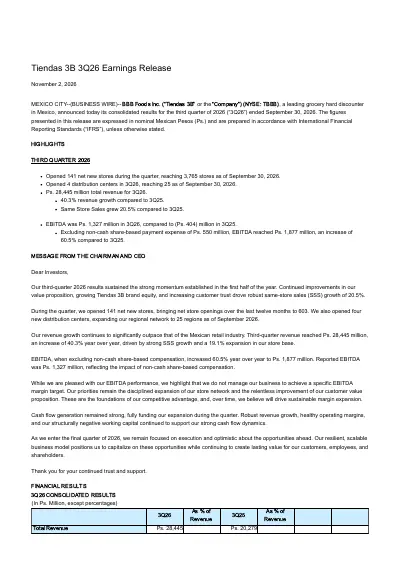
Good morning, and thank you for joining us today. I will begin with a review of our third quarter operating results, and will be followed by our CFO, Eduardo Pizzuto, who will discuss our financial results.
We will then conclude with a Q&A session. The strong momentum we demonstrated in the first half of the year continued into the third quarter, delivering another quarter of excellent results.
Let me highlight some of our key achievements. We opened 141 net new stores, bringing our total store count to 3,765.
Over the last 12 months, we opened 603 net new stores. We also opened 4 new distribution centers, expanding our network to 25 regions.
Same-store sales grew 20.5% year-over-year. Total revenue increased 40% to 28 billion pesos.
Reported EBITDA reached 1.3 billion pesos, while EBITDA excluding non-cash share-based compensation increased 60% to 1.9 billion pesos. Finally, operating cash flows for the first 9 months of the year reached 7.1 billion pesos, an increase of 128% over the same period last year.
Let's now take a closer look at our operational performance. During the third quarter, we opened 141 net new stores, bringing our year-to-date openings to 419 stores.
Over the last 12 months, we have opened 603 net new stores. Our real estate strategy remains unchanged: we continue to expand into new markets while increasing store density in our existing markets.
Our strong operating momentum translated into another quarter of exceptional revenue growth. Total revenue reached 28 billion pesos, an increase of 40% year-over-year.
Same-store sales grew 20.5%. The drivers of our same-store sales growth remain consistent: continuous improvements to our value proposition, growing brand recognition, and increasing customer trust.
Our same-store sales performance continues to significantly outperform the broader market. During the quarter, we maintained a gap of more than 21 percentage points versus ANTAD, while keeping our internal inflation very low.
I will now pass the microphone to Eduardo.
Eduardo Pizzuto
Thank you, Anthony. Good morning, everyone.
Sales expenses as a percentage of revenue decreased by 36 basis points year-over-year to 9.8% in the third quarter of 2026. Most of expense lines showed operating leverage, including labor.
Admin expenses, excluding share-based payment, decreased by 6 basis points year-over-year. While we continue our investment in talent, as well as expanding into new regions, strong top-line performance allowed for operational leverage generation.
With respect to share-based payment expense, these charges are non-cash and already reflected in our fully diluted share count. Additional details are available in the appendix of this earnings release, where we also provide projections for this non-cash expense.
EBITDA for the third quarter of 2026, excluding non-cash share-based payment expense, increased 60% to 1.9 billion pesos, driven by strong sales growth, improved gross margin, and operational efficiencies. The adjusted EBITDA margin increased by 83 basis points year-over-year.
As we don't manage this business to an EBITDA target. EBITDA will naturally continue to grow over time, driven by our disciplined execution.
Our business model generates strong operating cash flow through our structurally negative working capital model. As of September of 2026, adjusted negative working capital reached 10.8 billion pesos, compared to 7.8 billion in 2025, excluding IPO and follow-on proceeds.
This represents approximately 10.9% of total LTM revenue, also excluding IPO and follow-on proceeds. Our operating cash flows fully fund our organic expansion.
I will now turn the call back over to Anthony for some final remarks.
Anthony Hatoum
Thank you, Eduardo. We delivered an excellent first 9 months of 2026, driven by strong execution across our business.
Our business model continues to demonstrate its resilience, scalability, and its ability to self-fund our growth. Importantly, our growth is driven by 2 powerful engines: the continued expansion of our store network and sustained same-store sales growth, supported by an ever-improving value proposition for our customers.
Our newer store vintages are performing better than our previous vintages. They start with higher initial sales and their sales grow faster.
This momentum continues into our fourth quarter. If we look further ahead, we remain confident in the significant growth opportunities before us, and in our ability to continue executing with increasing efficiency.
Thank you for your continued interest in Tiendas 3B. We will now open the call for your questions.
Operator
Thank you. We will now conduct a Q&A session with Anthony Hatoum and Eduardo Pizzuto.
If you would like to ask a question, please press the raise your hand button, located at the bottom of your screen. We remind you that all lines have been placed on mute.
When it is your turn to ask a question, you will be given permission to speak. You will then be able to unmute yourself and ask your question.
Our first question comes from Andrew Ruben from Morgan Stanley. Please ask your question.
Andrew Ruben
Hi, thanks very much for the question, and congratulations on the quarter. Just checking in on the store openings, if we look at the pace so far this year, it looks like it's annualizing a bit below the guidance, but at the same time we've seen in recent years 4Q tends to be a heavier period for openings.
Given that, I'm curious how you're feeling about the 590 to 630 opening guidance for the year. Then related, is there anything we should consider about kind of a structural reason why you might see more openings in 4Q compared to the other quarters of the year?
Thank you.
Anthony Hatoum
Hi, Andrew. Thank you.
No, we're still well within guidance, and you're absolutely right. The fourth quarter tends to be a little bit heavier on store openings, and our pipeline looks very healthy at this stage.
No change in guidance.
Andrew Ruben
Thank you.
Operator
We can now go to Alejandro Fuchs from Itaú. Please state your question.
Alejandro Fuchs
Thank you, operator. Good morning, An--
Eduardo Pizzuto
Alejandro, you broke up. Can you hear us?
Alejandro Fuchs
Sorry, is this better?
Eduardo Pizzuto
Yes.
Alejandro Fuchs
Oh, sorry, thank you. No, just one quick question on competition.
Wanted to see if have you seen anything different the last couple of months, how maybe are you seeing the trends in the fourth quarter starting, anything that caught your attention? Thank you.
Anthony Hatoum
We haven't seen anything notable. From our own perspective, nothing has changed.
Still are gaining new customers and we still see a healthy trend in ticket size. We read what you read and we see people moving, and I think overall this is healthy for the market and for the consumer.
All healthy, all good from the competition point of view.
Alejandro Fuchs
Thank you, Anthony.
Operator
Our next question comes from Héctor Maya from Scotiabank. Please go ahead.
Héctor Maya
Hola, Anthony, Eduardo. Thank you for your time and congrats on the results.
I have two questions. First, how much did commercial margin help gross margins, and how should we think about it going forward?
Anthony Hatoum
Héctor, I don't know if you hear us, but you were breaking up a little bit. I heard your question is about commercial margin.
I would say that there is an expansion in commercial margin in this quarter, and as we've said many times before, margins go up a little bit, come down a little bit, but overall, the trend over a longer period of time is a healthy upward trend. In terms of other things that affected our numbers, I would say we've seen a lot of operating leverage this quarter, too, and that is also very healthy.
Net-net, everything is pointing in the right direction, and the fourth quarter just expect business as normal for us.
Héctor Maya
Thank you, sorry. Can you hear me here?
Anthony Hatoum
Much better. Thank you.
Héctor Maya
Sorry. Thank you for that.
The other question was about Mexico's corporate tax and how we should think about it down the road.
Eduardo Pizzuto
Hi, Héctor. Not sure if you're referring to this new law that limits deductions.
If that is the case, as of today, with information that we have today, this is a law that would mainly affect temporarily cash flows. As of today, we don't expect any changes for our plans for next year.
Of course, we will give you guidance on our next call, in which we will review Q4.
Héctor Maya
Thank you. Thank you very much, Anthony, Eduardo.
Operator
Next question comes from Bob Ford from Bank of America. Please go ahead.
Hey,
Bob Ford
thank you, and good morning, Anthony, Eduardo, Joaquín, and thanks for taking my questions. Just to follow up on Héctor's question with respect to commercial term improvements, I was curious, were those realized as a result of your price volume optimization processes strictly, or did volume-based rebates play a role at all in that improvement?
Then when you think about the improvements in transportation costs that you refer to, how should we think about capacity utilization in the network, and I'm just curious, what do you see driving the improvements in transportation costs?
Anthony Hatoum
Thanks, Bob. Very thoughtful questions.
Let me start with the last one. The world of transportation for us, let's say, is a world with a lot of potential going forward.
We've barely scratched the surface in what we can do to further optimize transportation costs. It's a very exciting topic for us, and you'll see a lot more happening in 2027 on that front.
In terms of commercial margins, it's a little bit of everything you mentioned, right? Of course, the main driver of improvement has always been scale.
As we continue to scale, everything improves, including rebates, as you mentioned. I would expect this to continue for the foreseeable future, and no changes in anything that we haven't seen in the past.
Bob Ford
No, great to hear. Just one follow-up, and that is going into year-end, how are you guys thinking about seasonal?
What's different in seasonal for you compared to prior years?
Anthony Hatoum
Big differences, we see none, but definitely there's a seasonal effect with end of year because, of course, seasonal products get sold in the month of November, December, and sometimes through January, too. There might be some timings in payments of rebates.
For sales that are done in December, you see the rebate in January. That's the only effect that is likely to be seen, and that's nothing new.
We've had it every single year for the last several years.
Bob Ford
In terms of your irrepetibles or things like that, very similar to prior years, nothing--
Anthony Hatoum
I would think so. With improvements again.
Improvements driven by scale, right? What I'm showing you this year in December is probably going to be much better than what we showed you last year in December.
Bob Ford
No, looking forward to it. Thank you so much, and congratulations on the quarter.
Anthony Hatoum
Sure thing. Thanks.
Operator
Our next question comes from Irma Sgarz from Goldman Sachs.
Irma Sgarz
Hi, thanks, Anthony and Eduardo, for answering the questions. I'm sorry, I wanted just go back to the gross margin with a bit more detail.
If you could just break down, I think a lot of analysts had expected some quarter-over-quarter or year-over-year pressure, or at least less expansion in that gross margin. I think that was a positive surprise, especially in the context of you building out four new distribution centers in this quarter.
Could you just provide a little bit more, you point to the commercial margin, whilst you do acknowledge the pressures from this build-out, just within that commercial margin, is there any sort of more breakdown that you can provide in terms of how much of that comes from better supplier terms compared to mix effects, compared to perhaps some other sort of pricing intelligence-related benefits or shrinkage-related benefits, just to sort of understand the different components, how much they weighed, and I assume that most of this is sustainable and that you can continue to build on it. Thank you.
Eduardo Pizzuto
Hi, Irma. Thank you for your question.
Anthony went over a little bit about the commercial margin, and I think the difference in this quarter is the fact that we opened 4 new DCs, and it did have an impact. If you look at it sequentially, it did have some pressure on margin.
If you look at versus a year ago, there's no doubt that the overall margin has expanded. What happened this quarter specifically with our logistics expenses is that, out of the 4 DCs that we opened, two of them opened in the early part of the quarter, in July.
Most of the pre-opening expenses happened in Q2. That's one part.
The second part is that we continue to get better at pre-opening expenses, we continue to get smarter on how we do the opening of distribution centers. Then the balance of that is overall transportation expenses continue to get better.
The older distribution centers that we opened, for instance, last year, they're doing their job, and they're becoming more efficient, everything is accretive. All in all, as we open more DCs, we become more efficient, and that helped out in the overall expenses, and that's the consequence you see on margins.
Irma Sgarz
Thank you.
Operator
Next question comes from Alvaro García from BTG Pactual. Please go ahead.
Alvaro García
Hey, Anthony, Eduardo, hope you're doing well. I have a multifaceted question here on the impact to same-store sales and average ticket from frozen.
We've been able to visit some stores recently, and it's pretty clear how dynamic that category has become. I guess my question is, one, first, where are we in the middle of sort of this rollout to increase freezer capacity for your entire store base?
Two, just I guess a broader question on sort of the identity of the store, Anthony. Where do you see the identity of the store?
It kind of felt a lot more like a convenience store than a grocery store in some of my more recent visits in how I saw some customers shopping for those specific categories, sort of that impulse element behind your business. I'd love to hear your thoughts on sort of that convenience versus grocery identity.
Thank you.
Anthony Hatoum
Hi, Alvaro. Let me start with the last one.
Convenience versus grocery store. No, we firmly believe that we're still a grocery store where the client comes mainly to fill up their pantry.
It's true that maybe in urban areas that you're more likely to visit if you visit stores in Mexico City that you might see a smaller component which is convenience-driven, and that's normal. We're definitely a lot of value for your money, grocery store, come do your pantry shopping with us.
In terms of categories, and you mentioned frozen, yes, it's one of the exciting categories that are naturally developing in 3B. We were the pioneers in Mexico in bringing high value for money frozen to the market.
It took a very long time to develop the category, and what you're seeing today is the result of many years of work and a natural evolution of this category. Similar to other categories which you didn't mention, which very normally, and that's what we do for a living, is improve every single product in our catalog and every year try to give you better value for your money.
Frozen is more visible because you see a capex in freezers, and I just remind everybody that we look at the ROIC of this capex very carefully, as we do with everything else in every single other investment. Frozen remains a growth category, and we have several others that are also growing quite fast and will continue to grow through 2027 if we do our job correctly.
There was another part to your question maybe, Alvaro, that I missed?
Alvaro García
I guess the only part, where are we in the rollout? I know that we're looking to sort of increase the number of freezers.
Obviously, the new stores come with the freezer set that you'd like, but I know you're looking to increase the number of freezers in some of your older stores. Where are we in that process, and any color there would be helpful.
Anthony Hatoum
Let me answer it generically by saying that refrigeration strategy is very dynamic. You'll see changes in our refrigeration approach in the next years.
It's not likely to stop. We're always looking to optimize everything in the store, including refrigeration, and we do it on many levels.
For example, we try to reduce refrigeration costs while offering you refrigerated goods, and that will result in physical changes in the store that shouldn't surprise anybody, because we're driving towards better ROICs on refrigerated goods. What you will see going forward is more changes in both refrigeration and frozen, but always driven by what I mentioned before: improve the ROIC, give better value to your customer.
Alvaro García
Wonderful. Thank you very much.
Eduardo Pizzuto
Thank you, Alvaro.
Operator
Our next question comes from Joseph Giordano from J.P. Morgan.
Please go ahead.
Joseph Giordano
Good morning, everyone. Good morning, Anthony and Eduardo.
Thanks for taking my question. I would like to explore three fronts here.
First, looking at this commercial margin, right, we understand there's lots of scale gains. If you could comment a little bit on how you're seeing maybe the price gap widening of 3B versus peers, which may help in this context this pantry loading and all these changes in journeys to the store.
The second one goes with part of your comments around the new stores ramping up faster than the history. My question to you is if we are actually seeing higher returns on those stores in the sense that eventually not just the capex is the same, but also the terminal sales, the sales at maturity is probably higher than what you had back in the past.
This growth profile, how the new categories like maybe frozen are already helping on this additional growth. Thank you very much.
Anthony Hatoum
Sure thing. Price gap, we haven't seen notable change.
The price gap remains, and it's steady. In this quarter, we haven't seen anything that jumps.
I would say that continues to be what it was in previous quarters. In terms of new store ramp-ups and higher ramp-ups, it's true that over time what we've seen is the store sales curve becoming steeper, and for all our stores, the maximum sales going up over time.
What we'll do is, in the next quarter or thereafter, we will update our spaghetti chart, which will clearly show that graphically to everybody. That trend continues, and again, it's driven by two things.
One is our brand is much better recognized today than it used to be, and that trend continues. Most important is the value proposition to customers, which is notably improving over time.
We are continuously offering our customer more value for money. In the categories that we have, like you mentioned frozen, what you find today in the freezer is much more relevant and more value for money than it was last year.
This keeps on driving what you see in same-store sales. It keeps on driving this curve, which you see steepening, starting higher, and reaching higher.
For the time being, this continues. Joe, did you have another question related to that?
Joseph Giordano
Sorry, Anthony, the last question, no, I think you responded at all. It's more about the private label helping the pantry loading, but you already answered that.
Thank you.
Anthony Hatoum
Thanks.
Operator
Next question comes from Vinicius Strano from UBS. Please go ahead.
Hi,
Vinicius Strano
Anthony, Eduardo, thanks for taking my question. Could you please break down same-store sales growth between traffic and ticket?
Within ticket, how do you see items per basket evolving, at what level items per basket mature stores are reaching, if you're seeing growth here as well? Any commentary around which categories are leading growth and how they're contributing to margins, any color on how mix might be helping margins as well?
These would be my questions. Thank you.
Eduardo Pizzuto
Hi, Vinicius. It's has been very consistent for the past quarters.
So 2/3 is coming from volume, which is the number of tickets and price per ticket, and the balance is price. Within price, the vast majority comes from mix, not from inflation, because remember our internal inflation is very, very low, actually close to zero.
That is where same-store sales are coming from. In terms of items per basket, yes, you can expect that we continue to see that number going up.
If you remember at IPO, we're talking about 2 to 3 items. Today, we're talking about a range of 4 to 5 items per transaction.
As Anthony mentioned earlier, as we continue to improve our value proposition, that number tends to go up. You had a third point that I couldn't hear properly.
Can you repeat that, the third question?
Vinicius Strano
The other question was just about which categories are leading growth, and if you could just comment around mix contributions to gross margins as well.
Eduardo Pizzuto
In terms of categories, when you look at the breakdown of categories, fundamentally, if you look at every item in our shelves have to have a very high rotation. Everything is contributing to growth.
Of course, we have had slightly newer categories like frozen or cosmetics, which are having an outstanding performance, but everything improves. Dairy, for instance, continues to have a very solid growth as part of same-store sales.
Then, did you ask about mix? Did you have an additional question?
Vinicius Strano
Yes, if you could just comment around mix contribution to gross margins as well.
Anthony Hatoum
There is no doubt that we're offering higher-priced, but even higher value for money products, so that might be contributing to mix in a positive way, as you're correctly asking. I would say, fundamentally, our focus is on getting existing customers to buy more from us, and we're seeing that happen on a continuous basis.
As you increase the value proposition to your customers, suddenly somebody who wasn't buying something, and that something could be in any category, and decides to buy it from you, that is extremely powerful. That's what I think is the main driver and will continue to drive what you're seeing today.
Vinicius Strano
Perfect. Thank you very much, Anthony and Eduardo.
Eduardo Pizzuto
Thank you.
Operator
Our next question comes from Antonio Hernández from Actinver.
Antonio Hernández
Hi, good morning. Congrats on your results.
Just a quick one regarding the new pilots that you have overall across your different stores. Any new highlight there, any pilot worth highlighting?
Thanks.
Anthony Hatoum
Look, at any point in time, there is about 60 to 80 pilots, let's call them that, or tests that are running in our stores. Some of them you'll pick on because they're very visible, like let's say fruits and vegetables or meats.
You physically see them, they take more space, they have special shelving or refrigeration. A whole bunch of them you won't necessarily pick on because they look like any other product.
We've never stopped piloting products, and we do it very aggressively and very consistently. Not all of them work, but those that work, you will see become part of the catalog.
We also maintain our discipline in number of SKUs, because we always question, when we do introduce a new product, which one should we drop across the board. Unless something is very, very different and unusual and unique, do we just add it on to our SKU count.
Our SKU count today remains very conservative at around 900 products. We've said before, we have the ability to increase this without changing anything in our operations or in our logistics to a significantly higher number.
We will maintain our very strict discipline in terms of very high value for money, very high rotation, and everything else, we're not that interested in offering.
Antonio Hernández
Perfect. Thanks a lot.
Our
Operator
next question comes from Federico Galassi from Rohatyn Group.
Federico Galassi
Hello, guys. Anthony, Eduardo, thank you for taking my questions and congrats for the results.
Two questions. The first one is you opened, let me know if I'm wrong, but you opened 4 distribution center this quarter.
If we see in one year, you open almost 10. The two questions are, how much efficient are this new distribution centers?
The second one, if you continue to have in mind that one distribution center is almost 150, 160 new stores? Thank you.
This is the first one.
Anthony Hatoum
Federico, yes, the number hasn't changed. It still serves roughly the same number of stores.
The operations of the warehouse in general have not changed, but of course, you're always optimizing your logistics. The optimization happens at two levels: one, internal operations, there's always room for improvement for shaving minutes of work in moving boxes and trying to drive down the cost of moving a box through your system, and that I don't think stops, right?
I did mention earlier that on the logistics front, there is significant opportunity going forward, and it's for us to make that happen. Now, the other real mechanical advantage of opening more distribution centers is compacting distances.
Every time we open a new distribution center, we're also reshuffling the stores so that the truck distances from warehouse to store become smaller, and that's a significant impact, and that happens every time we open a new distribution center. Yes, from that point of view, do expect continuous improvements over time as we get bigger.
Federico Galassi
Very clear, thank you. The second question is rough number, you have about 20% same-store sales in your measure, no, that is 2 years.
When we compare with ANTAD and other modern channels that this quarter was close to zero, the question is, I am assuming that you are gaining market share to the modern and traditional channel, but beyond that, you are seeing the new client that they are moving or shifting from big box to proximity, if we can call us as proximity? That's the question.
Thank you.
Anthony Hatoum
It's a very hard question to answer because from our perspective, we don't see the full picture. I can't tell you if anybody's losing market share or if the customer is really changing behavior, used to buy something somewhere else and moved to us.
I'm going to assume there is some of that, but I don't have any concrete data to share with you and saying this is happening exactly that way or this way. All I can tell you is that if the customer did not see more value in our offer, we wouldn't be seeing the numbers we're seeing.
Federico Galassi
Perfect. Thank you so much and congrats again for the results.
Operator
Next question comes from Alberto Vadia from Fruit Tree Capital.
Alberto Vadia
Good morning, Anthony and Eduardo. I have two questions.
One is regarding Yema, and we know it's a tiny part of the pie, but just where do you see it and if you could give us a quick update on it, and where you see it in 10 years? Our other question is regarding talent and culture.
A lot of times, when we talk about culture, talent, is the stock-based compensation, we're more curious of how you see talent development at the entry-level, the cashier, the person that stocking at the distribution center. That's it.
Thank you.
Anthony Hatoum
Look, we're firm believers that investing in talent is a high return on investment effort, and we will continue to do so. We pay maybe more than others attention to the HR and to the culture functions, and we believe that these have paid off in droves and have propelled us to where we are today and will propel us going forward to where we'd like to be.
It sounds philosophical, but we firmly believe that it's the team that makes the difference. We're investing in the team and will continue to do so at all levels, all the way from the cashier, as you mentioned, to the most senior person in the company.
You'll see that physically, and you'll see that in our numbers. In terms of Yema, it's a very exciting concept.
It's only 4 stores, as you mentioned correctly. It will continue to grow and it will grow at its own pace.
It is hitting a niche of the market that nobody seems to have been looking at, and the reception from customers has been exceptional. It will continue to grow, but we haven't guided, and we're unlikely to guide anytime soon as to where it can head to.
Very exciting, and we're very glad to have it.
Alberto Vadia
Thank you very much.
Operator
Next question comes from Guli Arshad.
Anthony Hatoum
Hi, Guli, we can't hear you.
Yes. Now you can, right?
Anthony Hatoum
Yes, absolutely. How are you?
Hey, Guli.
Very good. Congratulations on a great quarter.
I have basically two questions. First, how do you manage the scaling of your private label providers?
Related to that, do you have different private providers for different regions for the same product? That's the first question.
Anthony Hatoum
That's a good question. Let's start with that, Guli, because it's a very important question, and one that merits its own time.
Private labels, as play a strategic role in our growth, and this is where we offer the most value to our clients. Of course, when you're growing at the rates we're growing, you ask yourself, well, where do I have a product that is good 3 years from now?
If you're not asking that question today, you won't have it in 3 years. Basically, we very proactively manage the procurement side and make sure that, by the time we get to that 3-year point, everything is in place.
For example, in 2026, we're not talking about 2026. We're talking about '28 and '29 with all our suppliers.
That's the way the business has operated, and that also explains why this business has been able to grow at 30% plus per annum now for the last 12-plus years without experiencing any hiccups. It's the right strategy, and we'll continue the same way going forward.
In terms of, do we have two suppliers for one given product, there is no right or wrong answer here. It all depends on the product, and it all depends on the supplier.
Sometimes, for geographical reasons, you want to have two suppliers because the logistics make more sense. Sometimes for strategic reasons, you want to have two suppliers because you protect your supply base and you make sure that it's redundant if there is any risk of interruptions.
Really, it's on a product-by-product basis that we look at it and make decisions as to how many suppliers supply a given private label product.
You might have, for example, two two yogurt providers instead of one.
Anthony Hatoum
Exactly, that could happen.
There's
Anthony Hatoum
always a benefit in having longer runs with one supplier, but you always have to trade off, you have to include logistics, and you need to include growth capacity, and you need to include safety of supply.
Very good. My second question is really kind of a business school jargon, but I'm so impressed with your growth.
My question is, what do you think is your distinctive competence, as well as a differentiator, compared to your competition?
Anthony Hatoum
Yes, indeed. I do feel like I'm at business school.
Look, it might sound poetic here, but I really think that it's the team. With a better team, you can do great things.
I agree. Thank you.
Anthony Hatoum
Thank you, Guli.
Operator
Next question comes from Vanessa Quiroga from Eternal Capital Group.
Vanessa Quiroga
Hi, thank you. My question is regarding that tax reform that is currently in the process of being approved.
Can you comment on any potential impact on the effective tax rate that you're currently paying, both accounting and cash? Thanks.
Eduardo Pizzuto
Hi, Vanessa. We've addressed this earlier in the call today.
Basically, with information again, and I underscore that, with information that we have today, this is a law that will temporarily affect or mainly will temporarily affect our cash flows. Having said that, as of today, we have no plans to change our plans for next year.
For now, no changes with information that we have today. Of course, this is constantly under review, and so we need to see the final draft.
Then we will give you, of course, our guidance in our Q4 call. As of today, that's information we have.
Vanessa Quiroga
I see. Do you expect this to change your capital structure in the sense of preferring to raise debt, maybe, in order to manage better the cash flows, for instance?
No,
Anthony Hatoum
we don't think it has that kind of impact. It might shift cash flows on a temporary basis.
Again, let's hold off till Q4 and we'll have a much more concrete and better answer for you.
Vanessa Quiroga
Thank you very much.
Eduardo Pizzuto
Thank you, Vanessa.
Operator
We have not received any further questions. I would like to hand the call back over to Anthony Hatoum for his closing remarks.
Anthony Hatoum
I'd like to thank you very much for being with us today, for your continued support and your continued interest in our company. Thank you to the analysts that are covering us.
Thank you to the investors who trust us. Thank you to all our team for making all of this happen.
I look forward to talking to you on the next call. Thank you.
Operator
Thank you. You may now disconnect.