ThredUp Inc.
Q3 FY2026 · Earnings Call TranscriptNovember 4, 2026
Operator
At this time, I would like to turn the conference over to Lauren Frasch, Head of Investor Relations. Please go ahead.
Lauren Frasch
Good afternoon, and thank you for joining us on today's conference call to discuss ThredUp's financial results. With me are James Reinhart, ThredUp CEO and co-founder, and Sean Sobers, CFO.
We posted our press release and supplemental financial information on our investor relations website at ir.thredup.com. This call is being webcast on our IR website, and a replay of this call will be available on the site shortly.
Before we begin, I'd like to remind you that we will make forward-looking statements during the course of this call. Such statements are based on current expectations and assumptions that are subject to a number of risks and uncertainties.
Actual results could differ materially. Please refer to our earnings release, supplemental financial information, and our Forms 10-K and 10-Q for more information on these expectations, assumptions, and related risk factors.
We undertake no obligation to update any forward-looking statements. During this call, we will present both GAAP and non-GAAP financial measures.
A reconciliation of non-GAAP to GAAP measures is included in today's earnings press release and the supplemental financial information, which are distributed and available to the public through our investor relations website located at ir.thredup.com. Now, I'd like to turn the call over to James.
James?
James Reinhart
Good afternoon, everyone. I'm James Reinhart, CEO and co-founder of ThredUp.
Thank you for joining our third quarter 2026 earnings call. Today, I'll cover our Q3 results, ongoing innovation across the product experience, and what we're seeing in the broader demand environment.
Then Sean will take you through the financials and our outlook. We'll close with a question-and-answer session.
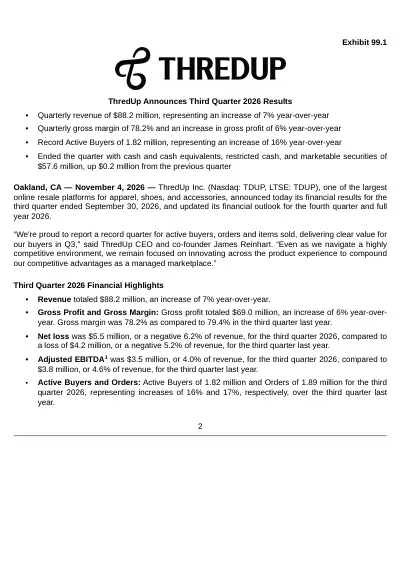
First, let me start with our Q3 results. Revenue in the third quarter was $88.2 million, up 7% year-over-year, and up 20% on a two-year average basis.
Gross margin was 78.2%. Adjusted EBITDA was $3.5 million, or 4% of revenue.
All were in line with our guidance. Underneath the financial results, customers bought more from us in Q3 than ever.
We shipped more items and drove more GMV in Q3 than any quarter in our history. GMV grew 20% year-over-year by selling 17% more items.
That growth rate is nearly three times our revenue growth, speaking to the considerable value we're delivering to buyers, and an important part of our current strategy to maintain steady buyer engagement. Active buyers on a trailing 12-month basis grew 16% to 1.8 million, and orders grew 17%.
However, as we look ahead, the key governor on our growth is how much of our top-line sales we can flow through our unit economics, given the demand environment. To help bridge record sales in Q3 with lower net revenue, we want to provide some incremental disclosure.
From Q4 2024 through Q2 2026, we delivered steady unit economic growth, with price paid per item rising from $19 to $21. Beginning in June, price paid retreated to $18 per item, and has remained there since, even as our premium mix expanded.
That reflects the promotions and pricing actions we took to convert price-sensitive shoppers in a more competitive environment. Zooming out, we believe that two things are true at the same time: over the short term, we see some willingness-to-pay headwinds, and our guidance reflects that.
I do not want to downplay the challenging operating environment, and our team is laser-focused on managing through this volatility. We also see substantial upside ahead, not just from the potential of recovering unit economics, but from the investments we are choosing to make right now, instead of flowing dollars to the near-term bottom line.
We are optimistic that when we look back at this time, we will see that the foundational seeds for our future growth were being planted right here in 2026. In terms of how the business is executing, I would like to start with what's continuing to work for us.
New customer acquisition and engagement remain robust. Q3 was another record for new buyers acquired, active buyers, orders, and sessions.
Customer acquisition costs remain attractive, as we continue to push into higher-quality channels, with Meta spend up 76% and Pinterest up 39% year-over-year in Q3. We're acquiring a more premium customer at higher levels than ever, and deprioritizing lower-LTV budget customers.
Our product experience keeps getting better, too. Conversion rate is up 13% year-over-year, and early customer retention, if we think about it as first to second order, is up 12% year-over-year.
We've accomplished this in part by ensuring great deals, but also by improving the browsing experience. In October, after almost a year of iteration, we launched the next generation of our quote 'lean-back' discovery experience for users on web and mobile web.
This is a personalized, infinitely scrollable feed that replaces our traditional carousels. Think TikTok-style, real-time personalization while shopping the long tail of second-hand products.
We think it could be a major breakthrough as it rolls out to mobile apps in advance of the peak holiday season. On the other side of the marketplace, supply has also never been stronger.
Clean Out kit requests were up 30% year-to-date through Q3, and we've welcomed a record number of sellers so far this year. It isn't just volume.
Premium continues to become a bigger share of bags processed, leading to brands like Vuori, Farm Rio, Tuckernuck, and Cotopaxi each growing more than 50% year-over-year on our platform. Overall, our premium Clean Out kits continue to grow steadily as a portion of our mix, and remain in the mid-teens as a percentage of our overall supply.
With more premium supply coming online, we are constantly probing to push our unit economics higher and return them to our pre-June 2026 levels. This can provide significant upside to the business as we look to sell tens of millions of items in 2027.
Now I'd like to comment on near-term demand. In my view, two things are at play: first, macro challenges remain for our most price-sensitive budget shoppers.
This is consistent with what we saw last quarter. Given more recent news that many larger retailers are flush with tariff refunds, we think the holiday period may be more competitive than we anticipated, and that deeper promotions may be required to maintain engagement.
Second, peer-to-peer fashion resale competition is growing rapidly. It shows up as a massive, unprecedented influx of competitive marketing spend and order subsidies.
We now estimate this could be as much as half a billion dollars in the second half of this year alone, plus shipping subsidies to support GMV growth. As expected, these dollars have eroded some buyer share, especially among our price-sensitive customers.
Fortunately, we have not observed any impact on our sellers. While we take this pressure seriously, we are taking the long-term view.
Interest in second-hand is accelerating, and other companies are paying for it. By our estimates, more money will be spent in the U.S.
this year encouraging people to buy and sell second-hand than we have spent in our lifetime. At the end of the day, we believe that three things are going to be true in the next year or two: the demand environment will eventually improve, our category is going to be bigger than we originally thought, and our differentiated, unique product offering will resonate with many more buyers and sellers.
Of course, we need to execute at a high level in this environment, and we are iterating around these challenges with specific tactics: first, differentiating our supply value proposition. As more people look to sell second-hand, we are capturing that awareness by emphasizing our premium service and our clear convenience advantage.
Our Clean Out model, where we do all the work for the seller, stands clear apart from a crowded field of undifferentiated peer-to-peer companies. Second, accelerating the shift in our buyer acquisition and retention mix.
We continue to move spend out of Google and into Meta and Pinterest, where lifetime values are higher and acquisition costs are stable. In Q3, Meta and Pinterest doubled their share of new customers versus a year ago.
On Meta, new customers grew 132%, while CAC fell 24%. Third, modernizing and improving the product experience.
With millions of unique items, helping new-to-second-hand customers find the right one quickly drives conversion and retention. Exact Match is live across our key categories, with over 20% of listed items now matched, customers find their size, quality, or price faster.
Lean-back discovery is already paying dividends here, with early improvements in engagement and conversion. Collectively, these moves help us build a more durable competitive advantage, rather than simply renting growth.
Marketing and order subsidies only get you so far. We believe that a best-in-class supply chain, smarter acquisition, and a better product experience are what win customers over time, and they're how we stay clearly differentiated, even when the market feels noisy today.
While we play some defense and iterate on our market positioning, we are also playing offense, investing in multiple areas we believe will define resale in 2027 and beyond. Each runs on assets we've spent more than a decade building.
We own the product and the resale infrastructure, and that lets us do things others can't easily replicate. First up is live selling.
We are all-in on live selling, and broadcasting directly from studios within our distribution centers. Our goal is to become the dominant enterprise reseller of second-hand live.
The live selling industry in the U.S. is growing rapidly, four times faster than the resale industry, according to eMarketer.
In late September, we launched our first live shows on Whatnot. By year-end, we expect to have dozens of hosts up to 10 studios streaming up to 18 hours a day across multiple live selling platforms.
A few early data points have increased our ambition: first, 75% of those customers who shopped ThredUp Live on Whatnot have never purchased on ThredUp. Second, comparing similar aged items sold between our core marketplace and Whatnot, the median live selling ASP runs 52% higher on Whatnot.
Also, buyers pay for shipping, there are fewer returns, and items can be fulfilled efficiently through our distribution infrastructure. All of this leads to superior unit economics.
We are hyperscaling into this market with significant investment of time and attention in Q4. Second, agentic commerce.
Here we have taken an assertive posture. AI agents are first-class shoppers on ThredUp.
Our bet is that agents can sift through millions of one-of-a-kind items far more efficiently than any person, and our managed supply gives them clean, structured data to work with. That could open ThredUp to a much larger part of our addressable market, shoppers who don't have the time or attention for the resale treasure hunt.
We're opening our catalog to agents on the AI platforms customers already use, and building a secure access layer that lets them act on a customer's behalf. We anticipate this will be a growing opportunity in 2027 and beyond.
Third, creator commerce for resale. The same styling, Exact Match, and similar search technology that powers our browsing experience is now being leveraged for creators.
We are calling this lean-back creator commerce. It lets any influencer or creator launch a second-hand affiliate storefront built automatically from their style profile, social feeds, and our inventory.
It's a set-it-and-forget-it program that could scale to thousands of creators, helping them earn passive income while we deliver compelling second-hand content to their audience. Our first dozen creators are live now, with a target of more than 100 by year-end.
Fourth, direct selling. Our direct selling offering, complementing our Clean Out program, is on a roughly $10 million GMV run rate, having launched widely in June.
There are now more than 200,000 high-quality listings available, with average listing prices more than double our core marketplace. In late August, we tempered growth to refine the shipping, cart, and checkout experience, and make sure that it complements our core business.
We remain ambitious with this channel, and we will be again stepping on the gas pedal as we head into the holiday selling season. Our infrastructure provides valuable differentiation in the form of returns management, trust and authentication, and customer service.
The goal remains gradual supply consolidation: Clean Out customers who sell some items elsewhere can now do all of it on ThredUp. Over time, we can become the one-stop shop for convenience, price maximization, and trust.
Stepping back, I want to close with an important reminder of the unique competitive advantages that we've built, because I believe it's at times like these that they end up underappreciated. First, our brand.
We have a brand loved by millions of customers. We see this primarily in the cohort data of our most established customers, who are shopping at ThredUp as much as ever.
In Q3, 70% of our revenue came from customers who were purchasing their eighth or more order from ThredUp. 35% of the revenue came from those purchasing their 50th or more order.
That is true customer stickiness. Second, our supply chain.
We've built a name-brand reverse logistics supply chain that is hard to replicate. Competitors have spent enormous sums this year, and our supply is stronger than ever.
As is true for any scaled marketplace where supply is the ultimate constraint, a robust and resilient supply chain remains foundational to long-term success. Third, our infrastructure.
Our purpose-built infrastructure is a key differentiator, providing the technological and logistical edge that underpins our long-term prospects. It's why, when new points of distribution become available, we can surge into them quickly.
Live selling straight from our distribution centers is just the most recent example. We process single-SKU apparel at industrial scale.
Advances in processing technology and AI keep extending that lead. Fourth, our data and our ability to move fast.
Our managed marketplace ingests millions of data points that sharpen acceptance, merchandising, photography, pricing, and marketing. This year, we leveraged this data to maintain strong engagement and conversion among more customers than ever.
That data is why we ship AI-driven products as fast as we do. Exact Match, our real-time personalization engine, and the lean-back discovery feed have all materially improved the customer experience this year.
Speed is now one of our most durable advantages, and we believe it will help us win in any shift to agentic commerce for resale. While consumer demand ebbs and flows, we believe that true long-term value creation and defensibility reside in our infrastructure.
Our scaled reverse logistics and single-SKU processing capabilities, built over the last 15 years, simply cannot be replicated with short-term capital. They are the moat of our managed marketplace and resale platform, and they become more valuable as second-hand goes mainstream, whether a buyer finds us on our site, in a live stream, through an agent, or through a partner.
In closing, having founded ThredUp more than 15 years ago, I've run this business through several cycles. Consumer health waxes and wanes, competitors enter and exit.
Meanwhile, our supply advantage grows, our infrastructure and data moat widens, and the network effects of our marketplace compound. Each time, ThredUp has come out stronger and more differentiated.
I believe this time will be no different, especially as the category is now growing faster than ever. Our guidance tells you about the dynamics at play in the next quarter, but our unique defensible assets and culture of innovation tell you about the next 10 years, and we remain bullish on that future.
Now I'll turn it over to Sean.
Sean Sobers
Thanks, James. I'll begin with an overview of our results, and follow up with guidance for the fourth quarter and full year of 2026.
I'll discuss non-GAAP results throughout my remarks. For the third quarter of 2026, revenue totaled $88.2 million, an increase of 7.4% year-over-year.
Our performance was primarily a result of growth in buyers and sessions, driven by new buyer acquisition and incremental promotional activity. We finished the quarter with a record 1.8 million active buyers for the trailing 12 months, up 16% over the same period last year, while we had 1.9 million orders in the third quarter, up 17% year-over-year.
For the third quarter of 2026, gross margin was 78.2%, a 120 basis point decrease versus the same quarter last year, as we leaned into promotions. As James discussed earlier, we saw our customer become incrementally more selective in Q3, requiring additional discounts to convert and pressuring revenue per item.
For the third quarter of 2026, GAAP net loss was $5.5 million, compared to GAAP net loss of $4.2 million in the same quarter last year. Adjusted EBITDA was $3.5 million, or 4% of revenue, for the third quarter of 2026, representing a 60 basis point decrease over the same quarter last year.
Turning to the balance sheet, we began the quarter with $57.4 million in cash and securities, and ended the quarter with $57.6 million. We invested $2 million in CapEx, and generated $200,000 in cash in Q3.
Turning to guidance, we're adjusting our Q4 outlook to reflect consumer headwinds, competitive pressure, and the highly promotional holiday environment. As James discussed, our fundamentals remain strong, with more buyers shopping with us more frequently, and purchasing more items than ever before.
However, willingness to pay has softened, and we expect to rely more heavily on promotions than originally planned, resulting in lower net revenue and pressure on our bottom line. In the fourth quarter, we now expect revenue in the range of $77 to $79 million, representing a 2% year-over-year decline at the midpoint, and an 8% two-year average growth rate.
Gross margin in the range of 76.5% to 77.5%. Adjusted EBITDA in the range of a negative 4% to negative 2% of revenue.
Basic weighted average shares outstanding of approximately 133 million shares. For the full year of 2026, we now expect revenue in the range of $337.7 to $339.7 million, reflecting 9% year-over-year growth at the midpoint, and a 14% two-year average growth rate.
Gross margin in the range of 78.5% to 78.7%. Adjusted EBITDA in the range of 2.4% to 2.8% of revenue.
Basic weighted average shares outstanding of approximately 131 million shares. Lastly, we continue to expect to be cash flow positive for the full year.
Now I'd like to provide a few preliminary thoughts around 2027. We are operating in a unique and challenging consumer environment, and our 2027 planning process currently assumes this landscape remains unchanged.
From where we stand today, our view of 2027 contemplates low single-digit revenue growth and flat adjusted EBITDA margins versus 2026, with continued cash generation. We'll provide a more detailed outlook on our Q4 earnings call in March.
Importantly, we stand behind our long-term growth and margin targets. The fundamentals of our business are strong, our consumer experience is the best it's ever been, and we continue to deliver significant value to our buyers.
Our priorities are clear: execute at a high level, manage expenses thoughtfully, and stay disciplined on share dilution. We remain confident that we will manage through this challenging time, and resume progress towards our long-term goals.
James and I are now ready for your questions. Operator, please open the line.
Operator
Thank you. We will now begin the question-and-answer session.
If you have dialed in and would like to ask a question, please press star one on your telephone keypad to raise your hand and join the queue. If you would like to withdraw your question, simply press star one again.
We'll take our first question from Ike Boruchow at Wells Fargo.
Ike Boruchow
Hey, guys. Two questions for me.
I guess the first is, it's the second guide-down in as many quarters. Understanding the macro is challenging and getting a little bit worse.
Just on the 4Q guide-down specifically, just what would you say is specifically the main driver there relative to 90 days ago? Then to that point, can you maybe talk about the exit rate on 3Q, just how much that kind of influenced your decision?
James Reinhart
Yeah. Hey, Ike.
It's James. I think the big change from last quarter, obviously, we did not want to guide down twice in a row, right?
Something materially changed, and that was the observability on the competitive environment. I think when we came into last quarter, we were seeing some of this end of July spend from competitors.
Then we really started to see through Q3 kind of the magnitude of that. Then, as we got into Q4, October, I think, consistent with what some others have said, was a little bit more challenging, I think, than we anticipated.
On top of that, we think retailers are going to be aggressive, based on what we saw in October around Q4. They're flush with tariff refunds.
When you kind of put all of those together, Ike, it sets up for us being concerned about holiday. ThredUp is not traditionally a strong holiday destination.
It's always our weakest quarter of the four. That's what's changed.
This competitive pressure, Ike, is just something we did not anticipate, and the quantum of the spend is frankly shocking, for reasons I can get into if you'd like, but that was really the driver.
Ike Boruchow
Got it.
James Reinhart
Then, follow-up for— Then on the exit— Oh, yeah.
Ike Boruchow
Go ahead, Ike.
James Reinhart
If you want on
Ike Boruchow
that.
James Reinhart
Go ahead. Go ahead.
Ike Boruchow
No, go ahead, Ike. [laughter]
James Reinhart
Oh, sorry. [laughter] I would say, yeah, the exit rate on Q3, I think, there was not a lot of signs where we were feeling momentum into Q4, towards the end of September.
Then I think October was, as I said, softer than we expected. We just think the setup in holiday is challenging.
If you remember, Ike, last quarter, we were really an early call and an early indicator of what we thought others were going to talk about as being a challenging environment. My guess is you're going to hear more of the same over the next few weeks.
We just get to be lucky enough to be the first to explain what we're seeing.
Ike Boruchow
Got it. Then, follow-up for you or Sean, I would love to understand a little bit more how you came to your initial thoughts on 2027 and if the plan you guys are laying out.
Then, if there's any shaping, maybe you could add to that as well. Thanks.
Sean Sobers
Ike, I think from a 2027 perspective, we looked at what we knew through the end of October, and kind of baked that in. Not expecting anything to get better from a macro or competitive standpoint, and knowing that Q4 will likely be a little challenging.
We've built out 2027 that way with no assumption around certainly getting better or getting worse. I think, as James talked on the call, all the initiatives that he talked about, it's so early days, we have just little pieces of that in the 2027 outlook, it's not material yet.
That's what I would say, just to think about that if you're going there on all the things that James talked about. Yeah.
Ike Boruchow
Got it. Thanks, guys.
Operator
We'll move next to Matt Koranda at Roth Capital.
Matt Koranda
Hey, guys, thanks. I guess, just maybe on the Q4 lower sales outlook, is there any way to isolate, I guess, how much of that downward revision comes from sort of the promotional pressure that you highlighted and, I guess, the need to compete with retailers who are going to be more promotional versus how much do you think you're just losing customers, whether longer-term or temporarily, to the peer-to-peer competitors that are subsidizing demand?
James Reinhart
Yeah. Hey, Matt.
I think that the peer-to-peer pressure, we estimate probably about $5 million in Q4. I think the macro and kind of the broader, I think retail holiday environment is the rest.
Matt, just to put that into context, these competitors in peer-to-peer are going to spend half a billion dollars at our estimate in the second half of the year to erode effectively $5 million in wallet share on the demand side, and to have zero impact on our supply. When we look at this, it seems, again, we take it very seriously and we're going to operate through it, but it seems wholly irrational around the spend.
We have competed against businesses like this for more than a decade. There have been peer-to-peer businesses that have come and gone.
None of them have really been able to drive durable unit economics and durable growth. I actually think, Matt, it speaks to the challenges in the business model.
If you'll indulge me for a minute, I just think these business models don't work in fashion resale in the U.S. You have low switching costs, you have low margin, it's a race to the bottom, and there are no network effects in these businesses because, if there were, companies wouldn't have to spend 50, 60, 70% of their revenue on marketing, right?
The whole point of building a network effects business is that you actually can scale that. What you see, and what you've seen consistently over the past 10 years, is the inability for that to actually scale.
The minute that these companies pull back on marketing, growth slows, churn ramps up. We built ThredUp very specifically to be different than these business models.
The idea was to invest in infrastructure, durable assets that actually can create a sustainable advantage. I just like to point out that we've never spent any money acquiring sellers.
We've obviously invested in infrastructure. Despite this half a billion dollars in spend, it's had zero impact on our supply chain.
I think supply is the most important thing in this market. It's a long way of saying, I don't get it in Q4.
We take it seriously. We're prepared for it to endure into 2027.
I'm pretty bullish that the category is growing faster, and our differentiation will ultimately win the day, even if it might be painful in the short term.
Matt Koranda
Okay. Appreciate that elaboration, James.
That makes sense. I guess, how should we think about how long the duration of spend could last from those competitors, I guess?
I'm not asking you to speak for them, but maybe just in the way that you guys pick it apart internally there. How do you think about how long that the spending blitz could last, and how do you sort of endure that over, I guess, the next few quarters into '27?
James Reinhart
Yeah. Our expectation is it's going to continue.
I think we acknowledge that these are smart companies with smart leaders. We've competed against smart leadership before.
The laws of physics remain. You have to move goods from one house to another.
When you're subsidizing shipping transactions and losing money on every order, at some point, it catches up with you. My perspective is this will endure for some time, and then eventually, there'll be some rationalization in the market.
I don't know if that'll be, in the next couple of quarters, Matt, or it'll take a year. We're certainly expecting to sort of iterate and operate our business around it.
I think all the initiatives that we spoke to are kind of moving the theater of battle to an area where we can be more competitive. We'll just continue to do that.
Then I would say just we also expect the macro to be challenging. Maybe after the election results, last night, things might improve.
We're certainly not counting on it in the '27 numbers.
Matt Koranda
Okay. Appreciate it, guys.
I'll leave it there.
Operator
We'll go next to Bobby Brooks at Northland Capital Markets.
Bobby Brooks
Hey, good afternoon, guys. Thank you for taking my question.
I just wanted to dive a little bit deeper into the live shopping strategy. It's really exciting to hear you really kind of I think hyperscaling into that was the word you used, James.
I was curious to hear a little bit more on how you select the products going in there. Does that change as you expand the number of shows?
I get that each session has a different item type that focuses on a different starting price point. How do you actually select the items that are going to go on the live stream?
James Reinhart
Yeah. Hey, Bobby.
I am very, very bullish now on live selling because what's really interesting about this market opportunity is that you're seeing customers move into live selling at really astonishing rates. Just on Whatnot, numbers out last month were you had 650,000 new customers joining every week.
What it says to me, Bobby, is this is a very big, fast-growing category. When I think about how do you compete in this category, one of the hardest things to do is to actually have access to supply to scale into this market, and we have all of that.
When I look at our unique advantages in live selling is we've got tremendous product. We've got all the right data to, how do you price it, merchandise it in a live selling format.
It gives me a lot of excitement around the ability to scale. You can do some simple math on hosts and hours and, revenue per hour, and get pretty excited about where we can take this business.
Then how we pick the product is, I think we've built technology on the back end, Bobby. For example, when we want to launch a denim show, we've got half a million pieces of denim coming in and out of our facility.
With a handful of clicks, we can assemble a denim show that has 200, 300, 500, 1,000 pieces of denim that we can immediately drop into a live format. I think it's again leveraging our infrastructure, the technology, a bunch of the work we've done with Exact Match and similar search, to really scale this very, very quickly.
That's what we're going to do or that's what we've been doing over the last month. If you watch this space for us, you'll see us invest in it pretty significantly.
Bobby Brooks
That's super helpful detail. Then, it seems you gave some really insightful stats on just the difference in buyer type, I think, and it was 60% were new to ThredUp.
James Reinhart
75% new. Yeah.
Bobby Brooks
Okay. Are you seeing those new folks that are buying through your Whatnot channel, do they then go and check out the website, and have you seen conversion rates there?
Are you speaking on anything there? Just wanted to kind of hear more just on those trends.
James Reinhart
Two things on that. One is, yes, these are all net new customers to ThredUp, and we're seeing some signs of customers understanding the brand, coming back.
The answer is yes, we're seeing some of it. It's also a very effective way to just build the brand, tell stories, provide some texture to our distribution center.
People love seeing our distribution centers. I think it actually helps build the brand on top of the customer acquisition piece, Bobby.
Then the other piece is that the unit economics are superior. In a live format, you're actually able to in many instances, charge more than we would be able to charge in the core business, given our ability to merchandise and tell stories.
I think there's really an opportunity here where it's a scalable channel, superior unit economics, and customer acquisition leverage. I think that having that all be together is what makes me pretty excited for how we roll this out.
Again, it is early, and we have to do all those things, and that will take some hard work and some solid execution.
Bobby Brooks
For sure. Just last one for me.
Something that stuck out there in your comments there was, you're actually seeing you're getting better pricing on items going through the Whatnot channel than you might just listing it on the website. Cuz that's super surprising to me, cuz it's when I think of some of the live selling that I'll check out, it's just usually really good deals going on or relatively something where the seller's like, 'Ah, I kind of wish I didn't sell it here because it went lower than what they were expecting.'
Is that kind of the opposite for you guys? Basically the reason you're able to do that is just all the data that you guys have in and kind of how you're looking at and going back into your answer in the first question.
I just wanted to make sure I'm hearing that right, cuz that's really impressive. That's
James Reinhart
What it is, think about the reason why you can get higher prices on some items relative to the core marketplace is, there's something about being able to see the product live. The host can talk about the handbag, they can talk about the denim.
I think it more mimics what secondhand or resale might look like in a consignment store, whereas online, you can only do so much. To me, I think it's a combination of being able to see the product.
Then also, the default experience for live selling is that customers pay for shipping. Customers are paying for shipping themselves, and once they buy one item, then they stick around to see what else they can bundle from that show.
The live selling dynamics are attractive in that sense, right? There isn't a race to the bottom on shipping or subsidies.
There are no coupon codes, right, Bobby? Those are the types of things that I think allow us to demand a higher price on a lot of the items.
Bobby Brooks
That makes perfect sense. Thank you.
Operator
We'll take our next question from Jonna Kim at TD Cowen Securities.
Gabriella Garr
Hi, this is Gabriella Carbone on for Jonna. Thanks for taking the question.
We have two. The first one is on promotions.
As you've leaned into promotions, what are you seeing from those customers after the initial purchase in terms of repeat behavior or additional engagement? Then as a follow-up, you have mentioned that premium mix continues to expand.
Can you talk a little bit more about what you're seeing from that premium customer base, and whether there's any difference in behavior from your broader customer base? Thanks so much.
James Reinhart
Hey, Gabriella. Yes, I think on the promotional piece, I think, generally speaking, it's not necessarily a first promotion, second promotion type of dynamic.
I would encourage you to think about it more of, broadly across the assortment, we have to be a little bit more promotional as items age. What we said on our last call is we really tried to protect discounting on our fresher inventory.
As the items get older, 45, 60, 90 days older, items that we used to be able to sell, for $20 out the door are items now that we can only sell for $17 or $18. That, I think, is the pressure that we're seeing.
We're trying to be disciplined with our fresh inventory to not discount that and so it is more on the aged assortment. Then on the second one, on the premium side or from our premium customers, yes, it's clear that our wealthier customers are doing much better.
You can see that in the repeat rates, how much they're spending. Yes, the pressure that we're seeing is more acute on that budget shopper.
I think that's going to continue for a little while. I think what we're trying to do from an acquisition and retention strategy, as well as a seller mix strategy, is move incrementally upmarket.
We're doing that kind of across the broader assortment of buyers and sellers.
Gabriella Garr
Thanks, appreciate the color.
Operator
We'll take our next question from Dylan Carden at William Blair.
Dylan Carden
Thanks. I'm curious.
You're having to discount, your version of discount. Is there not some offset here in more dynamic search?
You've been calling out kind of higher conversion for a couple quarters, and being able to flow more through and sell more units, or are you limited by kind of what you can get into the system to be able to do that?
James Reinhart
Hey, Dylan. We're selling more units than ever, but I think we've now hit a point where I think if we were to push unit volume even higher, and we've tested some of this, Dylan, I don't think there's a marginal benefit there.
I think the demand curve for the existing buyer base, willingness to pay, I think we've hit kind of a steady state. I think we don't see where if we were able to process 10% more items, as an example, that all of a sudden that could translate in a perfectly elastic way into 10% more demand.
We continue to kind of probe that, but I think right now, more broadly, we need to continue to build the buyer base before we ramp up supply even more aggressively.
Dylan Carden
Thanks. The level of visibility you have as to sort of which specific competitors are taking that $5 million, is that something you have high confidence in, or is that just sort of based on what you see their behavior?
I think there's sort of a free shipping initiative. Is that kind of how you're pinpointing it?
I guess, what caused that change in behavior, to the extent that you can speculate? You were asked the duration question, I guess maybe [laughter] I'll ask it again.
James Reinhart
[laughter]
Dylan Carden
How long that will last. Yeah.
James Reinhart
No, Dylan, I think we can look a little bit around where share is going. We definitely see our budget shopper clearly going more to Vinted.
We see some share going to Depop, which I think is slightly more elevated on a relative basis. You can't ignore that, when you are confronted with half a billion dollars in spend, that there's going to be some collateral damage.
Dylan, just to emphasize, that's more money than we've spent in our entire existence on marketing. The idea that that type of quantum would take out $5 million in share, to me, speaks to why it doesn't feel like the most efficient way to grow a business.
Again, we take it seriously, but if I had told you people were going to spend half a billion dollars, I think you would have expected more erosion. The final piece on that is, and then for it to have zero impact on our supply and the quality of our supply, I think, again, speaks to just the quality of our brand, the differentiation of the business model, and that stickiness of our customer base.
Sean Sobers
Dylan, the spend that these folks are making isn't really directed at ThredUp. It's essentially like we're caught in the crossfire, a little collateral damage on that front.
Dylan Carden
You don't think it's personal?
Sean Sobers
[laughter] Feels personal.
Dylan Carden
Ike asked, and I'm curious, is the 2% decline at the midpoint, is that exacerbated because, to your point, it is sort of your lowest volume quarter? When you're kind of shaping out '27, again, I appreciate we're in a low-visibility environment, would you expect to kind of remain in negative territory, you start lapping some of this?
I guess is sort of the question. Thanks.
James Reinhart
I think the acute nature of this spend, the current macro, and just holiday pressure, Dylan, I think is important because it is typically our slowest quarter. When I think about our customer base, the budget shopper, who has limited discretionary dollars around the holiday, I just think that, and again, this part of this is us trying to predict the future, we think there's going to be more pressure to shop holiday gifts, to buy new for that discretionary dollar.
That might mean that there's fewer dollars to shop used, because despite progress in people shopping used around the holiday, we talked about this in the holiday report, I still think it's not the norm. That's why we're sort of trying to provide as much clarity as we can around Q4 and what might happen.
Dylan Carden
Thank you.
Operator
That concludes our Q&A session. I will now turn the conference back over to James Reinhart for closing remarks.
James Reinhart
Thank you, everyone, for joining us on the call. Thank you, especially, to the ThredUp team for your hard work and specifically on continuing to innovate on behalf of the customer, and invent the future of resale.
I'm excited to be on that journey with you, and look forward to catching up with you on our next call. Thanks.
Operator
This concludes today's conference call. Thank you for your participation.
You may now disconnect.