Tempus AI, Inc.
Q3 FY2026 · Earnings Call TranscriptNovember 2, 2026
Operator
Hello, everyone. Thank you for joining us and welcome to Tempus' Q3 2026 financial results call.
After today's prepared remarks, we will host a question-and-answer session. If you'd like to ask a question, please press *1 to raise your hand.
To withdraw your question, press *1 again. I will now hand the conference over to Kendra Webster, VP of Investor Relations.
Please go ahead.
Kendra Webster
Thank you, Matt. Good morning and welcome to Tempus' third quarter 2026 conference call.
This morning, Tempus released results for the quarter ended September 30th, 2026. The press release, overview of the quarter, and our latest presentation are available on our IR website at investors.tempus.com.
Joining me today are Eric Lefkofsky, Founder and CEO of Tempus, and Jim Rogers, CFO. Before we begin, I would like to remind you that during this call, management will be making forward-looking statements that are subject to risks and uncertainties that could cause actual results to differ materially.
For a discussion of these risks, please refer to our 10-K and other subsequent filings with the SEC. During the call, we will discuss non-GAAP financial measures, which are not prepared in accordance with generally accepted accounting principles.
Definitions of these non-GAAP financial measures, along with reconciliations to the most directly comparable GAAP financial measures, are included in our earnings release, which is available on our IR page. I will now turn the call over to Eric.
Eric Lefkofsky
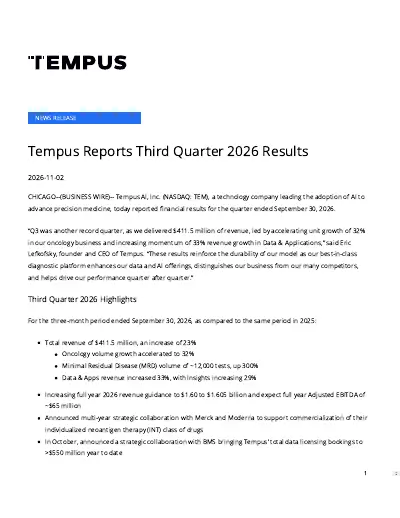
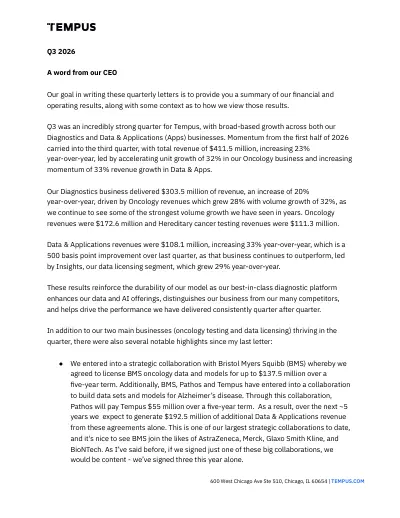
Q3 was an incredibly strong quarter for Tempus, with broad-based growth across both our diagnostics and data and applications businesses. Momentum from the first half of 2026 carried into the third quarter, with total revenue of $411.5 million, increasing 23% year-over-year, led by accelerating unit growth of 32% in our oncology business and increasing momentum of 33% revenue growth in data and apps.
Our diagnostics business delivered $303.5 million of revenue, an increase of 20% year-over-year, driven by oncology revenues, which grew 28% with volume growth of 32%, as we continue to see some of the strongest unit volume growth we have seen in years. Oncology revenues were $172.6 million, and hereditary cancer testing revenues were $111.3 million.
Data and apps revenues were $108.1 million, increasing 33% year-over-year, as that business continues to outperform, led by Insights, our data licensing segment, which grew 29%. These results reinforce the durability of our model as our best-in-class diagnostic platform enhances our data and AI offerings, distinguishes our business from our many competitors, and helps drive the performance we have delivered consistently, quarter after quarter.
There were also several notable highlights since our last quarterly call. We entered into a strategic collaboration with Bristol Myers Squibb, or BMS, whereby we agreed to license BMS oncology data and models for up to $137.5 million over a 5-year term.
Additionally, BMS, Pathos, and Tempus have entered into a collaboration to build datasets and models for Alzheimer's disease. Through this collaboration, Pathos is paying Tempus $55 million over a 5-year term.
As a result, over the next approximately 5 years, we expect to generate $192.5 million of additional data and applications revenue from these agreements alone. This is one of our largest strategic collaborations to date, and it's nice to see BMS join the likes of AstraZeneca, Merck, GlaxoSmithKline, and BioNTech.
As I've said before, if we signed just one of these big collaborations, we would be content. We've signed three this year alone.
We announced a multi-year strategic collaboration with Moderna and Merck to support the potential commercialization of their novel, first-in-class individualized neoantigen therapy, or INT, being evaluated in combination with Keytruda in patients with completed, resected stage IIb to IV melanoma and other cancer types. Given the exceptional response of the clinical trial data so far and the potential for this drug to be transformational, we are excited by the future of this program and thrilled to be partnering with Moderna and Merck.
We cleared regulatory review of our pending acquisition of Personalis, and a Personalis shareholder meeting to approve the transaction is scheduled for November 30th. We are more convinced than ever of the synergies between our combined companies.
We have been the exclusive distributor of Personalis' tumor-informed MRD assay, NeXT, since 2023, which we believe is a best-in-class assay given its ultra-sensitivity. MRD represents an estimated $20-plus billion market and is one of the fastest-growing segments in oncology diagnostics.
It is transformative for cancer care, allowing clinicians to detect disease recurrence earlier than traditional imaging, enabling more informed treatment decisions when cancer recurs. Bringing Personalis' testing portfolio under one roof will accelerate commercial adoption, round out our overall portfolio, and strengthen the multimodal data flywheel that continues to differentiate our business.
We generated $25.6 million in adjusted EBITDA and ended the quarter with $854.4 million in cash and marketable securities. We had long suspected that with gross profit dollar growth outpacing our investments, we would eventually turn the corner and be able to generate meaningful EBITDA.
This quarter, we made the turn. Despite our increasing investments in diagnostics, we have always been a tech company.
Our entire business model was built around the idea of collecting vast amounts of real-time, multimodal, de-identified data to both improve clinical decisions and enhance research. A decade later, those efforts have allowed us to amass more than 600 petabytes of rich data, adding more than 50 petabytes last quarter alone, along with the technology infrastructure that is connected to approximately 8,000 providers, enabling us to use that data to train models and generate insights.
The scale of our business and the breadth of our portfolio has allowed us to build a significant data moat. By compounding a decade of investment in our AI capabilities, we deliver solutions that grow more powerful with every patient touch point, cementing our position as an indispensable engine for healthcare innovation.
As the world gets hungrier for the benefits AI can deliver, namely allowing people to live longer and healthier lives, Tempus is uniquely positioned, as we have strategically amassed the data needed to power these models and the distribution platform to deliver them to patients. As a result of our financial performance this quarter, we are increasing guidance to $1.60 to $1.605 billion in 2026.
We continue to expect 2026 adjusted EBITDA to be approximately $65 million. With that, we will open it up to questions.
Operator
We will now begin the question-and-answer session. Please limit yourself to one question.
If you'd like to ask a question, please press *1 to raise your hand. To withdraw your question, press *1 again.
We ask that you pick up your handset when asking a question to allow for optimum sound quality. If you are muted locally, please remember to unmute your device.
Please stand by while we compile the Q&A roster. Your first question comes from the line of Kyle Mikson with Canaccord Genuity.
Kyle, your line is open. Please go ahead.
Kyle Mikson
Hey, guys. Thanks for the questions.
Congrats on the quarter. One question on hereditary.
You're hoping that returns to stable growth next year, but just given these proposed clinical lab fee schedule rates that factor in PAMA cuts, I'm just wondering how you're thinking about potential headwinds there, and then obviously you have ASP tailwinds on the oncology side. Maybe just talk about diagnostics outlook for '27.
Eric Lefkofsky
Hey, I can start. I think the overall hereditary business seems to be poised to do kind of much better as we move forward than it has over the last few quarters, in large part because it's both lapping excessive growth last year, which we've talked about, relative to some of the market dynamics where you had a big player in the market that was having some financial issues, a bunch of volume moved over, and so instead of kind of nice, even, whatever, near 15% growth year after year, you had this jump up to 30% growth that we're now lapping.
We've seen some good sign of that in September and October, where unit growth rates have returned to low double digits. We feel overall like that business is moving in a better direction, and that whatever macro headwind there is in terms of guidance is kind of small compared to the just massive unaddressed TAM relative to the fact that current guidelines and current reimbursement would cover about 70 million lives, and we run in the US, and we run something like 2 million tests a year.
I think we still have a very underpenetrated market. I suspect, as more and more literature comes out finding clear links between germline variants and diseases that can be prevented or managed earlier, you'll see this category continue to be stable and grow.
Jim can cover ASPs on the oncology side.
Jim Rogers
On ASPs for hereditary, just as a reminder, obviously hereditary cancer makes up the majority of that revenue, but we do have a small, but growing, rare business. We don't anticipate material impacts from PAMA on the hereditary cancer rates.
Then, we've long said that the hereditary rates for us will actually probably increase slightly over time as rare becomes a bigger kind of piece of the overall pie. That's the story on ASPs for hereditary.
Then on the oncology side, as we've talked about, given the expansion of our FDA approval to include kind of tumor-only for our xT test, that updated pricing will kick in on January 1st and allow us to move the remaining xT volume over. That gives us about $80 million of uplift in oncology ASP in 2027.
Then we still have xF kind of going through the FDA process, and once that kind of finalizes that process and hopefully gets approved, then there'll be even a larger increase as we migrate xF to the FDA-approved version of the assay. Lots of tailwind from an ASP expected on the oncology side beginning early in '27.
We don't anticipate much impact on that hereditary ASP.
Kyle Mikson
Perfect. Thanks, guys.
Operator
Your next question comes from the line of Sarah James with Cantor Fitzgerald. Sarah, your line is open.
Please go ahead.
Sarah James
Thank you. I was hoping you could talk a little bit about the headwinds and tailwinds in '27.
Can we assume if CGP volume holds in the low 20s and DNA might be closer to 30 than 25, and you've still got the incremental gross profit, 2/3 of it, even after Personalis being reinvested, can we get to the 25% long-term range? Thinking out further, once we get the benefit of xT and xF uplift, could '28 be a year above that 25% CAGR?
Eric Lefkofsky
We feel like a business at our size growing at 25% a year over a long term is incredibly healthy. We've always said we're more interested in long-term 25% growth than we are in kind of short-term 30% growth that then decelerates.
When you talk about a business that's going to do a few billion dollars in revenue that's growing at 25%, that means literally that every year you're adding $500 million or more of new revenue, and then that becomes $1 billion of new revenue and more and more. We're into the law of large numbers.
We're fortunate that our two main businesses, our oncology sequencing business is experiencing strong unit growth, about 32%, it's actually up from last quarter. It's got obviously rising ASPs, both because our solid tumor portfolio is about to be reimbursed at the ADLT rate, and then when you get into the later part of the year, should have FDA approval where you're going to get an even bigger step-up.
We've got really strong unit growth, rising ASPs, and our data business is performing even better in the aggregate at about 33% growth. Obviously we've announced a string of very big deals with Merck and BioNTech and now BMS.
Just really the core businesses are super strong. We have other businesses like hereditary growing slower, and so in the aggregate, we feel like this kind of 25%-plus growth rate is achievable and achievable long term.
Is it possible that you get into '27 or '28 and have moments where the business is growing significantly faster, either because of ASP lift or because the data business just is running really hot? Yes.
Even if it is, even if we deliver a quarter where the aggregate growth is materially higher, I will say the same thing, which is it's great, I'm glad, but at the end of the day, if you can sustain kind of 25% growth over a decade, over another decade, you will build a really large business, and we think we're building a really large business.
Sarah James
Thank you.
Operator
Your next question comes from the line of Mark Massaro with BTIG. Mark, your line is open.
Please go ahead.
Mark Massaro
Hey, guys. Thank you for taking the questions.
Nice continued growth in MRD. You're tracking about up 3,000 units per quarter.
Recognizing that only 15% of your sales force is selling today and the shareholder meeting is sort of around the corner after Thanksgiving, can you just give us a sense for once Personalis is in your portfolio, to what extent you plan to ungate and let the remaining 85% of reps sell the test? Is that something that we could expect in the first half of 2027, or are there other criteria you need to see later in the year?
Eric Lefkofsky
It's more a function of reimbursement than it is a function of closing the deal. We have to be sensitive that at the present moment when Personalis runs these tests, they lose money, and once we acquire them, we'll be in the same boat.
Granted, we are in this really nice place where, given the three categories they've got reimbursed form in 2026, they're in this rising ASP landscape where they're getting much closer to being break-even on an individual test basis. We think with some of the approvals coming, obviously think in categories like colorectal cancer, we think we'll turn that corner where on a per-test basis, they're generating basically positive gross profit.
That's the big unlock to really ramp up. Now, that said, we're still ramping now.
We're adding sales members to our team in the aggregate across all of our different assay categories, and we will in '27 dial up MRD's sales efforts. The big unlock, which I suspect will be, I don't know, could be mid-year, could be Q2, could be Q3, who knows, but somewhere, I suspect mid-year, you'll be in this boat where they will turn the corner and be kind of positive gross profit dollar contribution on a per-test basis, and then we'll feel much better about really starting to put the pedal to the metal.
I think over the latter half of '27 into '28, I would suspect growth will continue to be really strong.
Mark Massaro
Great.
Bradley Bowers
Thank you.
Operator
Your next caller comes from the line of Ryan MacDonald with Needham. Ryan, your line is open.
Please go ahead.
Ryan MacDonald
Thanks for taking my questions and congrats on a nice quarter. Eric and Jim, maybe to talk about the success you're seeing in the data business.
Obviously, amazing year so far with the 500- over $550 million of bookings throughout the year. I guess as you look at sort of maybe the state of the pipeline and maybe the seasonality of the business and sort of demand cycle, are you seeing any changes in terms of pull-forward of demand?
Then as we think about sort of the components of the pipeline, what's the mix that you're seeing sort of within oncology, neuro, cardiology, some of these other areas? Jim, how does this sort of make you feel about the level of visibility going into 2027, to sort of hit those 25% to 30% targets that you're looking for in the business?
Thanks.
Eric Lefkofsky
Jim, you want to take it?
Jim Rogers
Yeah. I'd say that the pipeline, we've been talking about this now for several quarters.
I'd say kind of towards the tail end of last year, we saw kind of an uptick in engagement with our biopharma partners. We started kind of commenting on it then, and I think you've kind of seen it play out in the deals that we've announced thus far this year.
The beauty of these deals are, as we kind of march our customers up from being kind of episodic purchasers to these large, strategic collaborations, it obviously just enhances the level of visibility that we have for that business. You're no longer trying to get deals signed.
You have them under contract for kind of 5, 6 years, very long-term deals that give us that visibility. As we enter '27, we feel like we're in a really strong position to see that growth, not only in '27, but '28 and '29, as well.
Eric Lefkofsky
I'll just jump in. I think the nice part about the data business that we've been able to build is our business 4 or 5 years ago was much more lumpy and episodic in terms of the way we did these deals.
Over the last half a decade, we really migrated people to long-term subscriptions where people are basically connecting to our Lens platform. They have access to the totality of our data.
They're able to, based on the level of subscription they sign up for, pick a certain number of files that they can download annually and do work with. More and more, as we've mentioned, they're now connecting that data to kind of private GPU clusters that we set up for them, where they can build models that they can keep in our environment to basically do a bunch of their AI modeling work.
It becomes much smoother, long term, sticky. We'll be going into 2027 in the strongest position we've been in for a long time.
We said that same thing going into '26.
Jim Rogers
One more thing that I'd add is one of the exciting things about the BMS collaboration is the work that we're doing in Alzheimer's. We've long talked about kind of expanding beyond oncology, although oncology drove most of the revenue to date.
The datasets that we've invested in over the last 10 years expand well beyond oncology in other disease areas, and seeing that demand pick up and expand beyond oncology is something we're really, really excited about.
Operator
Your next question comes from the line of Evie Koslosky with Goldman Sachs. Evie, your line is open.
Please go ahead.
Evie Koslosky
Great. Thanks so much for taking my questions.
Given the strength I think you mentioned in the AI modeling portion of the Insights business, how does this change the stickiness of the relationships with your customers? Then maybe touch on what percentage of the Insights data customers also utilize AI modeling, and then how you expect this to evolve into next year.
Eric Lefkofsky
I think the stickiness is essentially a function of how we've designed the data business. As I mentioned a second ago, if you go back, we started licensing data maybe, I don't know, roughly 6 or 7 years ago, something like that.
Back then, you would be like, "Oh, I want 1,000 files of cancer patients that look like this." We would de-identify that data, and then you would download that data into your environment.
We didn't know what you were doing with that data. We didn't know what kind of value you were getting from it.
We hoped that you would call back 6 months later, a year later, want more data, but it was very transactional. Over time, we basically said, "Look, we've built this very large environment.
We have something like 700 software engineers that have been working here for almost a decade. We built this very large multimodal technology environment to interrogate this kind of data."
We started saying to our clients, "Why don't you do that work in our environment? We've just invested way more in it than you have."
People began doing more and more of their analytic work, generating insights from the data in our Lens platform. Then over time, we moved to this kind of concept of, "Okay, we'll actually put all the data in Lens.
You can build cohorts of interest in Lens, pull down the data, just exact data you want, the exact patients you want, which typically have criteria that would almost match a trial based on inclusion/exclusion criteria. We're going very deep characteristics of a cohort.
Pull that data into a workspace within our environment, kind of either do your analytics or build models, and then you're off and running." Obviously that latter part of building models is new.
Used to be able to just kind of do analytics, and then kind of take the analytics out or download the files directly into your own environment. Now we're connecting Lens to 8 GPUs, 16 GPUs, 32 GPUs, some kind of cluster like that, typically in denominations of 8, where clients are signing up for 3 years of 32 GPUs or 3 years of 64 GPUs, and they're building models in our environment that either have to stay in our environment or you pay an egress fee to pull them out.
It's gone from not sticky to crazy sticky. In light of how people are using our data today, we just don't know how they would, in mass, get off unless somebody else builds the same set of products we built, which we don't see.
Evie Koslosky
Great, thank you.
Operator
Your next question comes from the line of Subbu Nambi with Guggenheim. Subbu, your line is open.
Please go ahead.
Subbu Nambi
Hey, guys. Good morning.
Thank you for taking my question. In your letter, you specifically call out strength in xF of order requisitions being up 25% year-over-year.
Could you give us any additional color on what is driving strength? Is there any specific indication, or academic setting, community setting, EMR integration, any reason?
Thank you.
Eric Lefkofsky
I'm happy to start. You have some kind of macro trends, which we've talked about a bit in the past, that are just driving in the aggregate some overall liquid volume.
One of them is the benefits of concurrent testing, especially for metastatic patients, is just high. There's just been a ton of literature over the past few years about driver mutations you can find from solid tumor profiling or liquid profiling that you have to do both to find all of them.
We've published on this as well, but it can be 10% to 20% of mutations that would be therapeutically relevant that you won't find if you only do solid tumor profiling or you only do liquid biopsies. You have this movement to kind of do both more often for later-stage patients that are at high risk of mortality.
Then you also have the benefits of kind of serial testing in certain indications where more and more it's becoming important to be changing therapies every 6 months or every year and getting another insight from a test. Liquid is just a beneficiary of that.
We've seen it, I think overall in the market. Guardant, who's a leader in that space, has posted really strong unit volume as well.
We just see this as kind of a near-term trend of really robust growth in liquid. Up until now, our growth rates have been relatively consistent.
Solid's been growing really strong, as has liquid, and we've historically called out that it's not meaningful to talk about the difference between the two of them. That's still the case for Q3.
Our solid portfolio grew really quickly. We did see a sign here in September, which we called out, that we saw this kind of uptick of, whatever, 300, 400 basis points.
If that continues into Q4, you will start to see the first signs of really differentiation between liquid and solid, where even with really strong growth rates in solid, liquid's outperforming. With that plus MRD, it could be a propellent for growth rates over the next several quarters.
Subbu Nambi
Perfect. Thank you so much, guys.
Operator
Your next question comes from the line of Dan Brennan with TD Cowen. Dan, your line is open.
Please go ahead.
Dan Brennan
Great, thank you. Thanks for the question.
Sorry for the voice here. Maybe just on EBITDA, nice print.
Consensus has margins expanding next year, I think to 7% and then 11% in '28. There's always this push and pull for diagnostic companies, how much you reinvest back in the business versus let it drop through.
I'm wondering, you've got that slide in the deck showing EBITDA like a line going up. This 7% and 11%, is that a reasonable ramp how you guys think about it?
Connected to that, I know you have the $2,600 realized oncology price that you also pointed to in the next few years to be meaningfully above what we have today. I'm just wondering how much of that increase in oncology pricing you guys would be inclined to drop through to the bottom line.
Thank you. You
Eric Lefkofsky
want me to start, Jim, you'll jump in?
Jim Rogers
I'm more than happy to start, and then you can jump in. I think our view on EBITDA kind of remains the same.
We're still relatively early days in a lot of the offerings, and so we've had this perspective of kind of reinvesting 2/3, or roughly 2/3, of any incremental gross profit dollars that we generate back in the business, and then letting 1/3 drop down to the bottom line. Obviously with Personalis coming on board, we were already going to invest a lot in MRD.
We will utilize some of that reinvestment dollars to absorb the burn from Personalis. Then after another couple of years, then that flips, right?
Then you're generating meaningful gross profit dollars such that you really only need to invest 1/3 and you can let kind of 2/3 drop down on the bottom line. We want to demonstrate that we continue to see leverage in the business, which we saw, obviously, a big step forward of that in the quarter, but we're not in a position where we want to maximize EBITDA in the short term, because we think the opportunity set across our entire portfolio is so large that that would be a poor choice given that where we're at our lifecycle.
Eric Lefkofsky
I was just going to add, obviously, kind of now you can start to see this really strong EBITDA trend line that is picking up, but Personalis, who, assuming that obviously closes here later in Q4, they're burning money, and so you have to look at both businesses as one. We'll have to absorb some of their losses.
Even absorbing their losses, we still expect improvements in EBITDA, and we're on a really nice trajectory where we've got to decide how to invest the strong gross profit dollar growth we're generating quarter after quarter.
Dan Brennan
Great, thank you.
Operator
Your last analyst question comes from the line of Dan Arias with Stifel. Dan, your line is open.
Please go ahead.
Dan Arias
Hi, guys. Thanks for the questions here.
Eric or Jim, within data, can you just maybe catch us up on where trials might land for the year on revenues or growth, and then what the outlook might be there in the context of where AI is helping the cause? Trial matching seems to be one of these areas where pharma folks are most encouraged about how things can get better with some of these newer capabilities.
Curious whether you see an inflection there in the next year or two. Thanks.
Eric Lefkofsky
We took our real-time or just-in-time clinical trial matching business, which we call TIME. We tried to build a marketplace for a while to see if small biotechs could load in their trials, and would this marketplace evolve.
We didn't see that growth, and so we pivoted the business, really about a year ago, maybe 18 months ago, to be more enterprise-focused on our largest enterprise data clients. We're fortunate now that this network, which spans north of 1,000 oncologists across the country and has this really robust platform to be able to identify patients that are a fit for a trial and get them on a trial, produces what pharma needs badly, which is enrollments.
We're a high generator of enrollments for pharma, and so it's a really nice asset, but I don't think it's going to scale into a $1 billion business. We had to essentially target it toward, hey, we're in these strategic partnerships with more and more large pharma clients, whether that's BMS or Merck or AstraZeneca, whatever, and these folks want and need help, and we're tightly integrated, and so our TIME network now is enterprise-focused, where you as a client have to come on, load on all or most of your oncology trials, and that's how the baskets are built.
We have a waitlist of folks now that want into that network, the kind of market dynamics have allowed that to become a really premium product. I suspect it will continue to grow nicely.
It's just not going to be a huge business. On the other side of our clinical trial matching business, our CRO business, as we mentioned years ago, we've been kind of deemphasizing some of the just pure CRO work, because there are other people that do that and do it well, and it is a business that is in significant flux relative to artificial intelligence and what that's going to mean for the administrative and the logistic components of a CRO.
You're obviously seeing a lot of these big frontier modeling companies do deals with big clin dev departments of big pharma trying to figure some of that out. We're fortunate that we don't play in that space, it's not important to us, and so, we'll let other people tackle that.
Operator
I'll now pass the call back to Kendra for additional Q&A.
Kendra Webster
Thank you, Matt. For the first time, we're pleased to answer questions submitted by retail investors through the Robinhood platform.
Our first question: Can you classify the opportunity for growth outside of oncology? Can you detail cardiology opportunities and other therapeutic areas of interest, like nephrology, immunology, and neurology?
Eric Lefkofsky
Obviously, as Jim mentioned a few minutes ago, one of the biggest benefits to the BMS deal is that it's our first really large deal outside oncology. All of a sudden, we're building a very large Alzheimer's dataset, it's a $55 million deal to generate a dataset of half a million patients with Alzheimer's and late-stage dementia, and so it's really exciting.
We've done smaller projects historically in data and apps to enter these new businesses, but this is really the first time someone's making a very large investment in real-world data with Tempus to build these kind of agentic platforms. We're excited, because we think it's the start of a whole new round of growth for our data business, and we suspect it's going to continue at scale.
On the diagnostics side, we obviously are big in oncology. We do a bit of neuropsych testing, we do some rare testing.
It's more a function of where is the reimbursement for these tests. We, like other companies, kind of have to follow where the reimbursement landscape goes before we can enter new categories.
We do have one of the broader portfolios today pan-disease, because we're in rare, we're in neuro, we do some cardio testing, obviously with big cancer portfolio. We touch a bunch of disease areas.
Kendra Webster
Our next question: If investor appetite for AI-related companies weakens, how confident are you that operating cash flow and existing liquidity can fund your growth plans and the Personalis acquisition?
Eric Lefkofsky
We're super confident. Jim, you want to jump in?
Jim Rogers
I'd say that the nice thing and part of the reason our business model is different is we're not overly reliant on one product line. We have a very strong diagnostics business.
Obviously, growth rates have been really strong in oncology. We're entering this period of kind of increasing ASPs pretty dramatically, almost $750 over the next couple of years, and a lot of those dollars can be used to kind of fund investments elsewhere.
Similarly, on the data side, as we continue to sign up kind of these long-term agreements with biopharma, again gives us that visibility over the next several years to kind of continued growth. Lastly, as we've mentioned on kind of previous calls, we're reinvesting heavily today, and certainly those investments are meant to drive long-term growth.
You can always scale that level of investment as necessary as well. To Eric's point, we're very confident in being able to deliver.
Kendra Webster
Our last retail question: Since data is the main input for diagnostics and using AI to interpret and generate an outcome based on the data, how can Tempus ensure that it has a growing inflow of patient data, and how can it ensure that it will have access to it in the future since it doesn't own the patient data?
Eric Lefkofsky
Our diagnostics business is important for the data business, no question. Obviously, we're fortunate that we are one of the largest sequencers of patients for next-generation sequencing in the world, and so we have a very broad portfolio from hereditary profiling to comprehensive genomic profiling when patients being treated, to MRD, and multiple diseases that we would suspect there's going to be a constant flow of new diagnostic data entering our platform.
That said, if you look at the 50 million patients or so within Tempus' dataset today, more than 80% of those patients are outside oncology, and even the patients within oncology, I think more than 80% we didn't sequence, right? They're basically patients where the data's coming in because we have many, many, many data partnerships with academic medical centers and community practitioners.
We have different products we offer where we get data as part of the product offering, in terms of closing care gaps or matching patients to clinical trials. We have a constant stream of data coming in from more than 8,000 providers, and so we've kind of over the last decade very intentionally tried to make sure that the pipes that bring data into our platform are highly diversified so that we never have to worry about is the data going to dry up.
Just as we have crossed this chasm where the business is generating really strong gross profit dollar growth and EBITDA, and will generate tons of cash flow, it's the same thing on the data side. We just have so much data flowing from so many directions that we've hedged that risk.
Kendra Webster
Thanks, Eric, and thank you all for joining our call this morning. Have a great week.
Operator
This concludes today's call. Thank you for attending.
You may now disconnect.