Land Securities Group PLC
Q2 FY2027 · Earnings Call TranscriptNovember 13, 2026
Mark Allan
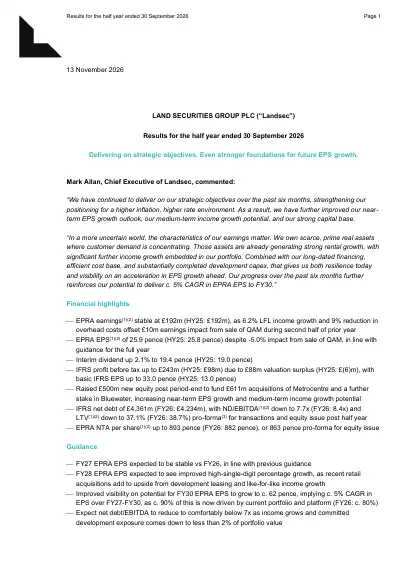
Ladies and gents, good morning and welcome to the presentation of Landsec's 2026 half-year results. The past six months have been another period of successful delivery against our strategic objectives.
We have further strengthened the quality of our best-in-class portfolio, delivered strong operational results, and continued to improve our risk profile. As a result, we have enhanced both our near-term EPS outlook and our medium-term income growth potential.
We have strengthened our sector-leading capital base. Our recent equity issue and major retail acquisitions add further to the high single-digit EPS growth we expect next year, and our momentum over the first half has reinforced our potential to deliver compound annual growth in EPS of around 5% through to FY30, with around 90% now derived from our current portfolio and platform.
On top of an existing income return at NTA of 6%, that means that we remain well placed to deliver an attractive low double-digit annual total return for shareholders. Over the last six months, we have continued to enhance our income growth potential.
Customer demand remains concentrated on the very best locations, and the scarcity of high-quality assets like ours, coupled with our market-leading operating platforms, meant that like-for-like income growth increased to 6.2%. Our recently completed London office developments are now almost full, adding £13 million of annual rent since May, and our capital recycling has contributed too, with a 280 basis point higher yield and materially higher income growth for the £633 million of assets we bought compared to the £338 million we sold.
As our entire portfolio is virtually full, this continues to apply upward pressure to rents, our reversionary potential has reached new highs for both office and for retail. Our strategic discipline means our top-line income growth will flow through to an acceleration in EPS growth.
Our average debt maturity of 8.1 years remains twice as long as the UK REIT sector average, combined with around 90% fixed rates, this means that our earnings are protected against volatility in interest rates. We have continued to reduce overhead costs, now down 29% in four years to their lowest level in over two decades, and our development exposure will be down to less than 2% of our portfolio value by year-end, with no plans to add meaningfully to this in the near term.
As a result of the clear actions that we've taken, we are well placed for a higher-inflation, higher-interest-rate environment. All of this is reflected in our financial results.
Our EPRA EPS was stable, in line with our full-year guidance, as the growth in earnings from our strong operational performance offset the 5% impact of the sale of Queen Anne's Mansions in the second half of last year. Shortly after the period end, we raised £500 million of new equity to fund the £611 million acquisition of Metrocentre and a further stake in Bluewater, two top-10 UK shopping centres.
This has improved our FY28 EPS growth and enhanced our medium-term income growth outlook, whilst alongside further disposals, it has helped reduce our LTV to 37.1% and net debt to EBITDA to 7.7 times. We expect that to reduce comfortably below 7 times, driven by the lease-up of our London office developments and continued like-for-like growth, our capital base remains strong.
As a result, we expect to deliver high single-digit EPS growth next year, with sustained growth beyond that, supporting continued growth in dividends. There continue to be two clear trends that support our positive outlook, and both look to have a long way to run.
Firstly, customer demand remains highly concentrated on the very best space. For offices, this reflects the need to attract and retain the best talent, who not only expect a high-quality building, but also a great place, with exciting amenities and efficient transport connectivity.
Our success in creating such places is reflected in the broad range of business demand that we see across our portfolio. For retail, this reflects a need for brands to maximize consumer reach efficiently, which we offer, given that we have 25% more footfall than any other UK retail platform and a consumer reach of nearly one-third of the UK population.
Secondly, new supply is highly constrained, as development viability has deteriorated in office and remains non-existent in retail. That's why for our portfolio, occupancy remains close to its two-decade high and ERVs continue to grow, up 2.9% over the six months.
In retail, the distinction between the very best space and the overall market continues to widen. The top 1% of all retail destinations in the UK provide brands with access to almost one-third of all in-store retail spend.
This is where close to 90% of our portfolio resides and where demand from brands is concentrated. The outcome of this is incredibly clear.
Over the past 4.5 years, sales growth across our portfolio has outperformed the UK average by some 24 percentage points. Curating the destinations consumers want attracts more of the best brands, which in turn drives more footfall, which then drives higher sales, and so on.
As such, brands continue to invest in fewer, bigger, better stores in our destinations. As these are now 98% full, rents are growing.
Our retail strategy is not predicated on the strength of the UK consumer; it is all about dominant locations increasing market share. In offices, it's a similar story.
We own 5 million square feet of offices, which is half of 1% of the total office space in the UK. Virtually all of this is located in the two most prized office locations in Europe: the West End and the City, including Bankside.
These are the locations where international business demand is concentrated, as these locations provide the very best access to global talent. As a result, office-based employment in London has grown at roughly 10 times the rate of the rest of the UK over the past four years.
Even within these prized locations, we are outperforming, as our 98% occupancy is well ahead of central London as a whole. As supply of new space remains modest due to the pressure on development economics, rents in our portfolio continue to rise.
In a world which continues to evolve rapidly, our unique edge is clear. We have two best-in-class portfolios, focused firmly at the very top end of the market where customer demand is strongest.
Both portfolios continue to materially outperform and deliver consistent income growth despite continued macro volatility. Both portfolios are also highly reversionary, with upside against current in-place income reaching new record highs.
For office, our reversionary potential has risen now to 20%, whilst for retail, uplifts on relattings and renewals have grown to 17%. Combined, these portfolios make up 92% of our income, which shows the high income growth embedded in our business.
At the same time, we have two market-leading operational platforms, which deliver gross-to-net margins that are around 400 basis points higher than our direct sector peers. This reflects the quality and scale of our platforms and means that more of our top-line income growth drops down to sustainable growth in earnings.
As I said a moment ago, these key trends look to have a long way to run. We have had another six months of strong operational performance.
In retail, we hit new records across all of our main leasing KPIs. We signed or are in solicitors' hands on £29 million of new leases, on average 12% ahead of ERV, a new high.
Uplifts on relattings and renewals are up to 17%, also a new high. Occupancy increased slightly to 97.8%, the highest level in over 20 years.
As a result, like-for-like net rental income was up 6.3%, again a new high. This strong performance reflects our success in creating the experience-led places that attract more consumers and brands, driving higher sales, such as Lefties, Inditex's latest brand, who just opened their first UK store in Liverpool.
Of their first four stores in the UK, three will be in our portfolio. As demand remains robust, we are on track against our target to deliver between 4.5% and 7% growth in income per year from our retail platform by FY30, driven by capturing the growing reversion in the portfolio, growing turnover rents and commercialization income, and selective capex investments in highly accretive smaller projects.
In office, leasing remained strong as well. We signed or are in solicitors' hands on £9 million of lettings, on average 7% ahead of ERV, which includes several new F&B lettings as we continue to build on the amenity offer in places such as Victoria.
The attraction of the place we have created here is reflected in the fact that retail and F&B sales are up 25% over the past three years. Occupancy reduced 90 basis points from the decade high that we reported in March, mostly reflecting lease expiries on our sole asset in Paddington towards the end of the period, but this has already improved since then, and at 98%, the portfolio remains virtually full.
Uplifts on relattings and renewals were 11%, combined with strong uplifts on rent reviews and growth in myo income, this resulted in 5.4% growth in like-for-like income. This was ahead of expectation, and reversion also continues to grow, with ERVs up 3.4%, tracking ahead of our full-year guidance.
Our reversionary potential is up to £50 million, and as customer demand remains strong, we now expect marginally higher like-for-like income growth over the next few years than we had previously envisaged. This strength in customer demand also extends to our London office developments.
We have made strong progress on leasing since our full-year results in May, our three recently completed projects are now 88% let or under offer, that's up from 54% back in May, principally leaving us two floors remaining at Timber Square, where we are seeing plenty of interest. Completion of our fourth scheme, Thirty High, has been delayed by up to six months due to an issue which arose during testing and commissioning.
This issue has since been resolved, and as we can still start fit-out works before the revised completion date, the impact on leasing is expected to be limited. As a result, we do not expect this to have a material impact on either total development costs or our full earnings guidance.
Thirty High is now 11% under offer, with good interest in the remaining space. Overall, ERVs increased 4.4%, and we continue to expect our projects to lease up within around 12 months of completion, this will drive strong earnings growth in FY28.
Turning now to capital allocation. We have had an active half-year, with around £1 billion of transactions, demonstrating excellent progress against our strategic objectives.
Since our strategy update in early 2025, we have now invested around £700 million in major retail, which means we are ahead of plan versus our target to invest £1 billion in three years. We expect to see further opportunities in the next 12 to 18 months.
Since our strategy update, we have also sold £1 billion of offices, non-core assets, and non-yielding pre-development assets, which means that we're on track against our target to sell around £3 billion of those assets over five years, and that's despite the prolonged slowdown in investment market activity in offices. Still, there continues to be investor demand for the right assets, and we expect to make further selective disposals over the next 6 to 12 months.
Our two main acquisitions were Metrocentre and a further 10% stake in Bluewater, taking our ownership stake there to 74%. Both are top-10 UK shopping centres by sales and offer attractive day-one income returns plus significant future growth potential.
For both, there is also a clear opportunity for us to add more value beyond the attractive in-price. At Metrocentre, the efficiency of our operating platform that is offered by our operating platform is expected to add around 40 basis points to the 7.9% income yield in the near term.
We have very clear asset management plans building on experiences elsewhere across the portfolio that will drive further growth from there. At Bluewater, simplifying the ownership structure from three to one co-investor improves operational flexibility, improves efficiency, and allows us to accelerate our growth plans.
With three of the top 10 and eight of the top 30 centres in the UK, our platform offer to brands is unquestionably market-leading. These acquisitions are building further on an already strong track record in major retail over recent years.
Far, we have delivered 14% income growth and a 15% unlevered IRR across the nearly £1 billion of acquisitions we've made over the past two to five years. This was not just driven by acquiring well, but also reflects the improvements that we've delivered since in terms of rightsizing store counts, introducing new brands, enhancing shopper appeal, and improving margins, all of which we see opportunities for at Metrocentre as well.
Since the start of the year, we've continued to recycle more capital out of assets which offered lower income and/or lower income growth. We have sold a 1970s office building where around one-third of the space will be vacated next year.
As this will require capex to relet and a prolonged period of elevated vacancy, the expected income yield on this over the next five years is modest, and the five-year income growth below inflation. We also sold a pre-development site in the City which generated a negative income return.
We are acting as the development manager for the purchaser, which generates fee income and allows us to retain and leverage valuable skills and expertise, but saves us committing £400 million of balance sheet capital ourselves. Lastly, we sold half a Mark: Ladies and gents, good morning and welcome to the presentation of Landsec's 2026 half-year results.
The past six months have been another period of successful delivery against our strategic objectives. We have further strengthened the quality of our best-in-class portfolio, delivered strong operational results, and continued to improve our risk profile.
As a result, we have enhanced both our near-term EPS outlook and our medium-term income growth potential. We have strengthened our sector-leading capital base.
Our recent equity issue and major retail acquisitions add further to the high single-digit EPS growth we expect next year, and our momentum over the first half has reinforced our potential to deliver compound annual growth in EPS of around 5% through to FY30, with around 90% now derived from our current portfolio and platform. On top of an existing income return at NTA of 6%, that means that we remain well placed to deliver an attractive low double-digit annual total return for shareholders.
Over the last six months, we have continued to enhance our income growth potential. Customer demand remains concentrated on the very best locations, and the scarcity of high-quality assets like ours, coupled with our market-leading operating platforms, meant that like-for-like income growth increased to 6.2%.
Our recently completed London office developments are now almost full, adding £13 million of annual rent since May, and our capital recycling has contributed too, with a 280 basis point higher yield and materially higher income growth for the £633 million of assets we bought compared to the £338 million we sold. As our entire portfolio is virtually full, this continues to apply upward pressure to rents, our reversionary potential has reached new highs for both office and for retail.
Our strategic discipline means our top-line income growth will flow through to an acceleration in EPS growth. Our average debt maturity of 8.1 years remains twice as long as the UK REIT sector average, combined with around 90% fixed rates, this means that our earnings are protected against volatility in interest rates.
We have continued to reduce overhead costs, now down 29% in four years to their lowest level in over two decades, and our development exposure will be down to less than 2% of our portfolio value by year-end, with no plans to add meaningfully to this in the near term. As a result of the clear actions that we've taken, we are well placed for a higher-inflation, higher-interest-rate environment.
All of this is reflected in our financial results. Our EPRA EPS was stable, in line with our full-year guidance, as the growth in earnings from our strong operational performance offset the 5% impact of the sale of Queen Anne's Mansions in the second half of last year.
Shortly after the period end, we raised £500 million of new equity to fund the £611 million acquisition of Metrocentre and a further stake in Bluewater, two top-10 UK shopping centres. This has improved our FY28 EPS growth and enhanced our medium-term income growth outlook, whilst alongside further disposals, it has helped reduce our LTV to 37.1% and net debt to EBITDA to 7.7 times.
We expect that to reduce comfortably below 7 times, driven by the lease-up of our London office developments and continued like-for-like growth, our capital base remains strong. As a result, we expect to deliver high single-digit EPS growth next year, with sustained growth beyond that, supporting continued growth in dividends.
There continue to be two clear trends that support our positive outlook, and both look to have a long way to run. Firstly, customer demand remains highly concentrated on the very best space.
For offices, this reflects the need to attract and retain the best talent, who not only expect a high-quality building, but also a great place, with exciting amenities and efficient transport connectivity. Our success in creating such places is reflected in the broad range of business demand that we see across our portfolio.
For retail, this reflects a need for brands to maximize consumer reach efficiently, which we offer, given that we have 25% more footfall than any other UK retail platform and a consumer reach of nearly one-third of the UK population. Secondly, new supply is highly constrained, as development viability has deteriorated in office and remains non-existent in retail.
That's why for our portfolio, occupancy remains close to its two-decade high and ERVs continue to grow, up 2.9% over the six months. In retail, the distinction between the very best space and the overall market continues to widen.
The top 1% of all retail destinations in the UK provide brands with access to almost one-third of all in-store retail spend. This is where close to 90% of our portfolio resides and where demand from brands is concentrated.
The outcome of this is incredibly clear. Over the past 4.5 years, sales growth across our portfolio has outperformed the UK average by some 24 percentage points.
Curating the destinations consumers want attracts more of the best brands, which in turn drives more footfall, which then drives higher sales, and so on. As such, brands continue to invest in fewer, bigger, better stores in our destinations.
As these are now 98% full, rents are growing. Our retail strategy is not predicated on the strength of the UK consumer; it is all about dominant locations increasing market share.
In offices, it's a similar story. We own 5 million square feet of offices, which is half of 1% of the total office space in the UK.
Virtually all of this is located in the two most prized office locations in Europe: the West End and the City, including Bankside. These are the locations where international business demand is concentrated, as these locations provide the very best access to global talent.
As a result, office-based employment in London has grown at roughly 10 times the rate of the rest of the UK over the past four years. Even within these prized locations, we are outperforming, as our 98% occupancy is well ahead of central London as a whole.
As supply of new space remains modest due to the pressure on development economics, rents in our portfolio continue to rise. In a world which continues to evolve rapidly, our unique edge is clear.
We have two best-in-class portfolios, focused firmly at the very top end of the market where customer demand is strongest. Both portfolios continue to materially outperform and deliver consistent income growth despite continued macro volatility.
Both portfolios are also highly reversionary, with upside against current in-place income reaching new record highs. For office, our reversionary potential has risen now to 20%, whilst for retail, uplifts on relattings and renewals have grown to 17%.
Combined, these portfolios make up 92% of our income, which shows the high income growth embedded in our business. At the same time, we have two market-leading operational platforms, which deliver gross-to-net margins that are around 400 basis points higher than our direct sector peers.
This reflects the quality and scale of our platforms and means that more of our top-line income growth drops down to sustainable growth in earnings. As I said a moment ago, these key trends look to have a long way to run.
We have had another six months of strong operational performance. In retail, we hit new records across all of our main leasing KPIs.
We signed or are in solicitors' hands on £29 million of new leases, on average 12% ahead of ERV, a new high. Uplifts on relattings and renewals are up to 17%, also a new high.
Occupancy increased slightly to 97.8%, the highest level in over 20 years. As a result, like-for-like net rental income was up 6.3%, again a new high.
This strong performance reflects our success in creating the experience-led places that attract more consumers and brands, driving higher sales, such as Lefties, Inditex's latest brand, who just opened their first UK store in Liverpool. Of their first four stores in the UK, three will be in our portfolio.
As demand remains robust, we are on track against our target to deliver between 4.5% and 7% growth in income per year from our retail platform by FY30, driven by capturing the growing reversion in the portfolio, growing turnover rents and commercialization income, and selective capex investments in highly accretive smaller projects. In office, leasing remained strong as well.
We signed or are in solicitors' hands on £9 million of lettings, on average 7% ahead of ERV, which includes several new F&B lettings as we continue to build on the amenity offer in places such as Victoria. The attraction of the place we have created here is reflected in the fact that retail and F&B sales are up 25% over the past three years.
Occupancy reduced 90 basis points from the decade high that we reported in March, mostly reflecting lease expiries on our sole asset in Paddington towards the end of the period, but this has already improved since then, and at 98%, the portfolio remains virtually full. Uplifts on relattings and renewals were 11%, combined with strong uplifts on rent reviews and growth in myo income, this resulted in 5.4% growth in like-for-like income.
This was ahead of expectation, and reversion also continues to grow, with ERVs up 3.4%, tracking ahead of our full-year guidance. Our reversionary potential is up to £50 million, and as customer demand remains strong, we now expect marginally higher like-for-like income growth over the next few years than we had previously envisaged.
This strength in customer demand also extends to our London office developments. We have made strong progress on leasing since our full-year results in May, our three recently completed projects are now 88% let or under offer, that's up from 54% back in May, principally leaving us two floors remaining at Timber Square, where we are seeing plenty of interest.
Completion of our fourth scheme, Thirty High, has been delayed by up to six months due to an issue which arose during testing and commissioning. This issue has since been resolved, and as we can still start fit-out works before the revised completion date, the impact on leasing is expected to be limited.
As a result, we do not expect this to have a material impact on either total development costs or our full earnings guidance. Thirty High is now 11% under offer, with good interest in the remaining space.
Overall, ERVs increased 4.4%, and we continue to expect our projects to lease up within around 12 months of completion, this will drive strong earnings growth in FY28. Turning now to capital allocation.
We have had an active half-year, with around £1 billion of transactions, demonstrating excellent progress against our strategic objectives. Since our strategy update in early 2025, we have now invested around £700 million in major retail, which means we are ahead of plan versus our target to invest £1 billion in three years.
We expect to see further opportunities in the next 12 to 18 months. Since our strategy update, we have also sold £1 billion of offices, non-core assets, and non-yielding pre-development assets, which means that we're on track against our target to sell around £3 billion of those assets over five years, and that's despite the prolonged slowdown in investment market activity in offices.
Still, there continues to be investor demand for the right assets, and we expect to make further selective disposals over the next 6 to 12 months. Our two main acquisitions were Metrocentre and a further 10% stake in Bluewater, taking our ownership stake there to 74%.
Both are top-10 UK shopping centres by sales and offer attractive day-one income returns plus significant future growth potential. For both, there is also a clear opportunity for us to add more value beyond the attractive in-price.
At Metrocentre, the efficiency of our operating platform that is offered by our operating platform is expected to add around 40 basis points to the 7.9% income yield in the near term. We have very clear asset management plans building on experiences elsewhere across the portfolio that will drive further growth from there.
At Bluewater, simplifying the ownership structure from three to one co-investor improves operational flexibility, improves efficiency, and allows us to accelerate our growth plans. With three of the top 10 and eight of the top 30 centres in the UK, our platform offer to brands is unquestionably market-leading.
These acquisitions are building further on an already strong track record in major retail over recent years. Far, we have delivered 14% income growth and a 15% unlevered IRR across the nearly £1 billion of acquisitions we've made over the past two to five years.
This was not just driven by acquiring well, but also reflects the improvements that we've delivered since in terms of rightsizing store counts, introducing new brands, enhancing shopper appeal, and improving margins, all of which we see opportunities for at Metrocentre as well. Since the start of the year, we've continued to recycle more capital out of assets which offered lower income and/or lower income growth.
We have sold a 1970s office building where around one-third of the space will be vacated next year. As this will require capex to relet and a prolonged period of elevated vacancy, the expected income yield on this over the next five years is modest, and the five-year income growth below inflation.
We also sold a pre-development site in the City which generated a negative income return. We are acting as the development manager for the purchaser, which generates fee income and allows us to retain and leverage valuable skills and expertise, but saves us committing £400 million of balance sheet capital ourselves.
Lastly, we sold half a dozen smaller assets which offered a decent yield, but limited growth. Together, these disposals release almost £340 million of capital and marginally improve EPS.
We continue to prioritize investment in retail, we are not planning to commit any meaningful capital to new development over the next 18 months. In London office, the outlook for rental growth remains strong, but as we have demonstrated again today, our existing portfolio is very well placed to capture this.
Given the much higher risk, returns on new office development in our view do not offer enough of a premium against the returns on our existing offices to justify selling these to fund the development of new ones. In residential, the long-term demand-supply imbalance is attractive, yet development viability remains challenged.
We have made good progress on improving viability at Finchley Road, having secured an improved planning consent, which reduces the level of affordable housing and community infrastructure levy, and we continue our constructive engagement with our public-sector partners to unlock viability improvements at Mayfield. We are mindful that the external environment continues to evolve, we will continue to invest time in seeking to bottom out whether or not these projects are capable of proceeding, but capex spend will remain very limited in the meantime.
Meanwhile, we've decided not to pursue the redevelopment of Lewisham, as returns are not sufficiently attractive and the opportunity cost of preserving development optionality was rising. Now that leasing in the existing retail centre is no longer being held back by the potential redevelopment, our focus will be on driving income.
If we are able to secure viable returns on our other schemes, lead times are such that the earliest start dates would likely be in 2028. As a result, our committed development exposure will come down to less than 2% of our portfolio by year-end.
This will likely stay at this level in the near future, and even over the longer term, it will remain well below where it has been historically. Although we will continue to invest in our existing portfolio to ensure that it remains best in class.
All this is based on our clear capital allocation framework, which looks at how our investment decisions contribute to income and EPS growth in the short term, and how they shift our portfolio mix, such that it can continue to deliver sustainable income and EPS growth for the longer term. Maintaining our strong balance sheet will always remain our first priority, and we continually monitor for changes in risk and return prospects, yet for now our priorities for the next 12 to 18 months are broadly unchanged.
We will aim to monetize more pre-development assets, as these generate no income and require significant capex to build out. We will also look to monetize further capital in offices, as the upside from recycling capital into major retail destinations at a roughly 200 basis points higher income yield and higher growth is meaningful.
As retail is clearly the most accretive opportunity for us, this is where we will continue to focus new investment. With that, I will now hand you over to Vanessa.
Vanessa Simms
Thank you, Mark, and good morning. Our financial results reflect our strong operational performance and progress against our strategic objectives.
Our EPRA EPS was stable, in line with our full-year guidance, with 6.2% like-for-like income growth and further overhead savings offsetting the impact from the sale of Queen Anne's Mansions. The external valuation of our portfolio was up 0.8%, driven by 2.9% growth in ERVs.
You'll find more detail on valuation movements in the appendix, but this meant NTA per share was up 1.2% over the half-year. Following our £500 million equity raise to fund the acquisitions of Metrocentre and Bluewater shortly after the period end, NTA per share was down 2.2% on a pro forma basis.
These transactions improved our near-term EPS growth, increased our medium-term income growth potential, and strengthened our balance sheet. As a result, our LTV is down to 37.1% and net debt to EBITDA is down to 7.7 times.
Together with record reversion across the retail and office portfolios, our progress over the last six months has created greater visibility on our future income growth. This will lead to an acceleration in EPS growth in FY28 and beyond, supporting continued growth in dividends.
Our performance over the past six months shows the upside coming through. Like-for-like net rental income growth increased to 6.2%, ahead of our full-year guidance, and rental uplifts on relattings and renewals reached a new high of 16%, as we secured strong uplifts on rent reviews in office whilst we also grew turnover rents in retail.
With reversion at new highs, there is still significant embedded upside in our portfolio beyond that. We've also continued to improve our operating margin, which was up 100 basis points and is now almost 200 basis points above the target that we set at our strategy update in February last year.
That puts our margins around 400 basis points above our direct office and retail peers, showing the value of our platform's quality and scale. As a result, we now expect full-year like-for-like net rental income growth to be at the upper end of our guidance, mainly due to higher-than-expected growth in offices.
We do not see any signs of a softening in leasing, the main reason our like-for-like growth for the half-year was higher than this is simply the timing differences over the average 6- and 12-month periods. We've also delivered further overhead efficiencies.
Costs were down 9% to £29 million, taking the reduction over the last four years to 29%. This reflects the sustained benefits of our technology investments over the last few years, which support the automation of business processes and unlock revenue opportunities through better data and insights.
As such, overhead costs remain at their lowest in more than 20 years. We expect overheads to stay around £60 million annually, with further savings offsetting inflation, top-line income growth will flow through to earnings efficiently.
This earnings growth is supported by a low-risk funding profile. Our 8.1-year average debt maturity is the longest in the UK REIT sector, at around twice the sector average, and almost 90% of our debt is fixed or hedged for a similar period.
We don't need to refinance any debt until 2029, and although our average cost of debt of 3.8% will likely rise over time, it will stay comfortably below our marginal cost of borrowing well beyond the next decade. Despite global bond yields rising since the results in May, the implied impact of higher rates on our expected average interest cost by FY30 is less than 20 basis points.
This illustrates the resilience of our earnings. You can see these benefits in EPS for the half-year.
Like-for-like income growth of £16 million added 2.2 pence to EPS, while £3 million of overhead savings added another 0.5 pence, and together they more than offset the like-for-like increase in finance costs of 1.1 pence. Year-on-year movements in other items reduced EPS by 0.6 pence, as the release of bad debt provisions was lower than last year and the receipt of surrender premiums was also lower, down to just £1 million each.
Essentially, all of our income was recurring rental income, with virtually no benefit from one-off receipts. Our underlying investment activity had a net impact of 0.4 pence, EPS was up 5.4% before the impact of the disposal of QAM, which is in line with our annual growth outlook to FY30.
Including QAM, EPS was stable, in line with our guidance for the full year. We have reiterated our guidance today, with underlying growth in FY27 expected to be offset by the 4% full-year impact from QAM.
As I said earlier, we expect like-for-like rental income growth to be at the upper end of our guidance, but the lower benefit from the one-off items that I referred to a minute ago and minor changes to the timing of disposals and development lettings broadly neutralize this. We said last month that our £500 million equity issue and major retail acquisitions would be neutral to EPS this year, but accretive in the first year of operation, and that remains the case.
As such, this will add further to the strong EPS growth that we expect in FY28, on top of the upside from leasing our London office developments and continued like-for-like growth. This means we now expect improved high single-digit percentage EPS growth in FY28, ahead of what we expected in May.
We've also strengthened our net debt to EBITDA as well. We view this as a more appropriate measure than LTV, as net debt to EBITDA is a true cash-on-cash measure, and it does not rely on inherently subjective valuations.
It also takes into account other factors that impact financial risk, such as development exposure and associated leasing risk. Following our part-equity-funded major retail acquisitions, net debt remains stable at £4.2 billion, but net debt to EBITDA has fallen to 7.7 times.
This still reflects over £400 million investment in Thirty High, which will complete in a few months, and is therefore not generating an EBITDA just yet. However, given the strong leasing progress on our recently completed developments, around 40% of our future benefit from leasing our pipeline shown on this chart is already signed or under offer.
Alongside capturing the growing reversion in our portfolio and releasing more capital from non-yielding pre-development assets, this means we're on track to see net debt to EBITDA reduced comfortably below 7 times, and as such our balance sheet remains strong. Our delivery against our strategic objectives over the last six months reinforces our EPS growth potential.
Despite volatile global interest rates, our progress has increased visibility on delivering 5% compound annual growth in EPS to 62 pence by FY30. The main driver of this is like-for-like income growth.
Over the last six months, the reversionary potential in our portfolio has increased further, this is up to 20% in offices now, and while uplifts in retail lettings and renewals have grown to 17%. Previously, we assumed around 4% growth in like-for-like income per annum, with retail slightly higher than that and office slightly lower, but given the increased reversion that we now expect, slightly higher growth in offices than we previously anticipated, lifting overall growth to around 4% to 5%.
ERVs on our recent developments have also grown further since May, adding to the earnings upside from leasing them. Our three recently completed projects are now 88% let or under offer, up from 54% in May, this is another area where visibility has improved.
Continuing to reduce capital employed in low- and non-yielding pre-development assets will add a further 1 pence through interest cost savings. While interest rates have risen since May, the impact is mitigated by our long-dated maturities and hedging profile, as I explained earlier.
The improved outlook for like-for-like income growth and higher expected income from development leasing fully offsets the expected increases in finance costs by FY30. In terms of capital recycling, we have delivered around 70% of the target investment into major retail that we outlined previously, this is a further area where visibility has improved.
All of this leaves us well placed to deliver on average 5% annual EPS growth to FY30. With around 90% of our growth coming from our existing portfolio and platform, which is up from 80% six months ago, we are even less reliant on investment market activity to deliver this.
With that, I'll hand you back to Mark.
Mark Allan
Great. Thank you, Vanessa.
I will now wrap up with what you can expect from us in the near future and where we see the differentiation and opportunity for Landsec before then moving to Q&A. Our primary focus on sustainable income and EPS growth provides absolute clarity, whilst our strategic progress over the past six months has further improved our positioning for a higher-inflation, higher-interest-rate environment.
We have enhanced our portfolio quality, our income growth potential, and our capital base, which has improved our risk profile and reinforced our attractive EPS growth outlook. Our focus is on maximizing the potential of our high-quality office and retail portfolios by driving continued like-for-like income growth and leasing up our latest office developments.
We will continue to supplement this growth by rotating capital out of offices into retail, where we see sufficient upside in doing so, and we will continue to focus on improving efficiency and maintaining our sector-leading balance sheet to ensure that this top-line growth flows through to earnings efficiently. All this means we have a unique opportunity.
We have created an irreplaceable portfolio of the UK's top retail destinations and the most prized office destinations in Europe, and we have built two operational platforms which are demonstrably market-leading. Customer demand remains concentrated on the very best assets, and supply of these is limited, two trends which are well established and have a long way to run.
This means the quality of our income is well underpinned. Growth in like-for-like rents is up, our occupancy remains close to a 20-year high, and rental uplifts are growing.
As a result, our embedded earnings growth is evident. Our portfolio reversion is up to a new high, our overhead costs are down to a two-decade low, and our clear capital allocation framework means that we remain disciplined about our investment decisions.
All of which is underpinned by our high financial resilience, with a 6% income return at NTA and high visibility on delivering around 5% per annum EPS growth. Given virtually all of this is driven by our existing portfolio and platform, the outlook for attractive total returns for shareholders is clear.
With that, I will now open up for questions. Hands are up very quickly.
As usual, we'll take them in the auditorium here first. I will start just there and then come down to the front row secondly, and then I'll move to the webcast and the online.
Bjorn Zietsman
Thanks. Bjorn Zietsman from Panmure Liberum.
A question on the office investment market. There seems to be a lot of stock coming available for sale over the next few years, and the market seems relatively subdued at this stage.
How do you expect yields to sort of move going forward, and how would that affect your disposal program if yields were to blow out?
Mark Allan
I think the first thing I would say about the office investment market is, I think if you'd have asked me at the start of this calendar year, what would the office investment market look like if rates were 50 basis points plus higher in 9 months or so's time, I think I'd have actually been more bearish than what seems to be playing out. I think the investment market is still active.
I think on both sides of the trade, people are looking to make deals work. That bid-offer spread is narrowing, actually I feel quite optimistic really about the ability of that investment market to continue to function.
The big thing that's happening, and I think this is concentrated on the best assets, these comments very specifically relate to the prime part of the market, is, yes, rates are going up, but also the rental growth and the embedded reversion in assets is also increasing. You saw in our valuation that that was essentially offset across the six months, and I would expect that to be broadly similar going forward.
For our plans, we will always look at what's the quality and the earnings we're selling, and what's the price attached to that rent roll, what is the quality of earnings where we feel we can redeploy, and how do those two compare in terms of day one and growth prospects. That will always determine our decisions.
We're not going to slavishly look at a value one way or the other; it'll be a case of, can we recycle capital in a way that is earnings-accretive and portfolio-quality-accretive?
Bjorn Zietsman
Then just a follow-up on the ERV growth. How much of that is being driven by an increase in incentives, or do you think incentives have been broadly stable over the past few years?
Mark Allan
Absolutely stable. Seen no shift in incentives at all, I think everything is going into headline.
I think they have been stable, I think they will remain at that level. The costs of just moving into new space for new occupiers in terms of fit-out and everything else are actually pretty elevated, I think ordinarily in this type of market you might have expected the incentive package to tighten, but I think just given the costs of moving are where they are, I think they're going to be staying around that 20% or so level in the new space.
Bjorn Zietsman
Perfect. Thank you.
Mark Allan
Great. Perhaps if we do Jonathan first, and then we'll come to Tom.
Jonathan Kownator
Thank you. Jonathan Kownator, Goldman Sachs.
Couple of questions. First one on your EPS growth, please.
What's the upside or downside to that when you look at your 2030 guidance? Is there a scenario where, given the strength that you see operationally, that could be higher, or is it all just absorbed by financing costs given also you have, yeah, pretty decent debt duration here?
It's the first question, please.
Mark Allan
Vanessa.
Vanessa Simms
I think I shared just earlier that with the elevation in rates from the May to our results today, we see about 20 basis points on the average cost of debt. Because we are quite well hedged or pretty well hedged, and we've got long duration of debt, we don't feel the impact of those rises as much as maybe some of our peers, and you do see therefore that that's quite a minimal amount that comes through and impacts FY30.
On the plus side, what you've seen from us I think over the last year or two is a real focus on driving operating margins, a focus on managing our cost base efficiently to more than offset that impact. On top of that, we're seeing great reversion coming through and that seems to be increasing, we feel pretty confident in delivering the outlook as it stands today.
Mark Allan
I think that's what I would just add to that in our, I stress generic terms, is compared to six months ago, we've got much clearer visibility on that 62 pence, with progress on development pipeline, progress on asset recycling, and what has been perhaps an unusually volatile period for rates, we've demonstrated our ability to withstand that. I think a lot will depend on the trajectory of rates, but we are unquestionably in a lower-risk position for that 62p now than we were six months ago, and I was pretty happy with where we were six months ago.
Jonathan Kownator
Thank you. Second question is around I guess development and preparing for the next cycle of growth to some extent.
For both office and residential at this stage, doesn't seem that the economics are stacking up too much for you. What does need to change for you to be more confident in relaunching growth there?
Is it just lower rates, or is there a risk that there is effectively a sort of too-low underwriting of rental growth, i.e., it's the big debate right now for anyone that wants to do development, how much rental growth is coming through both in office and residential, and how do you see the upside risk there? Thank you.
Mark Allan
You'll appreciate in any development appraisal, whichever sector you're looking at, there are a lot of moving parts within that, but I would say that the one that is probably the biggest impediment certainly on the residential projects at the moment is where rates sit. You tend to be operating with a lower net yield on cost in residential anyway because of the ability to capture growth annually, it's more of a real return.
I think it is primarily the rate environment. I think we feel pretty comfortable with where the build-cost picture is.
I think build-cost inflation, which was very significant a year or two ago, that's definitely moderated. We're very comfortable and confident on the occupier market.
We've always focused on benchmarking rents for those projects at a sensible level, and we've tended to underwrite rental growth around in line with inflation, it really comes down to our view of the rate environment. I think on the office side, the important thing for us has been to maintain the capability and expertise within our business.
I think that's why the deal to sell 55 Old Broad Street and retain development capability internally was so important, being the development manager there. I think going forward, we will continue to be active in development.
We won't be putting the level of balance sheet capital to work in development, and I would say at the moment I find it difficult to see a situation where the external environment would look such that we felt really ramping up commitment to office development with our balance sheet, certainly with capital partners maybe a way of doing it, but with our own balance sheet, we've said 5% total development is our ceiling on a long-term basis of the portfolio, and that we still see residential on a risk-adjusted basis as being a better place to deploy capital if we can make it work than office.
Jonathan Kownator
Since you've issued that strategy, obviously rental growth in office, I would say, has accelerated, right?
Mark Allan
I
Jonathan Kownator
appreciate that's the strategy and you want to stick to that, but how did the economics change and what kind of rental growth are you underwriting right now in office to maintain that strategy?
Mark Allan
We're seeing mid-single-digit growth within office, and we've made in the comments today that certainly on a like-for-like basis, we expect to see a slightly stronger growth than we had previously felt. I think office has certainly proven to be a little bit stronger than we were expecting.
I think that is largely as a fact if I go back 18 months, we probably were expecting new supply to be coming more on stream by now in the wider market, all more development starts. Elevated rates have kept that down.
Our view around office was always that not that we weren't confident in office, it's just that we felt we know with existing offices from time to time you get bigger vacancy, you get capex, those things coincide. I think in a REIT that's looking to deliver sustainable growth in income and earnings, you need to be careful about having too much of the portfolio embedded in that with that type of exposure.
That's why we want to reduce office exposure, and I think our decisions around development need to be seen in that context. For any office development now, you're having to form a view not on where rates are today, but as you're saying, how rents are going to grow and where is the market going to be in four or five years' time.
I personally find that a difficult thing to underwrite. To make developments stack up today, I think you would have to be underwriting high single-digit rental growth between now and a PC that's four or five years out, and that's quite a punchy underwrite, and if we do see that, we'll capture it, as we have done in this period, in the existing portfolio, why take the extra risk?
Jonathan Kownator
Clear. Thank you.
Tom Musson
Good morning, it's Tom Musson at Berenberg. Just on the retail business, clearly accelerating income growth coming through now over 6%, you're talking about having confidence in sustained growth and visibility.
Today you're also, though, maintaining the medium-term ambition for 4.5% to 7% like-for-like rental growth CAGR. What more do you need to see to either tighten that range or feel comfortable lifting the bottom end of that range for guidance, and is that something that you considered?
Mark Allan
I believe our guidance sits pretty much in the middle of that range, maybe slightly below the midpoint in terms of the range that we assume. Certainly everything we're pointing to suggests that if we continue to see this strength of demand and performance in the retail portfolio, there's probably upside risk to that.
There's a lot more variable income within there, a lot more turnover rents driving commercialization income. We've got a series of some relatively major capex investments into assets that are likely to start over the next 12 or so months that will be a key part of getting those completed and leased up and contributing to the FY30 picture.
It's probably those investments, we see them start, we see the agreements for leasing things in place for those, that is going to give us greater confidence on narrowing that range, but I think at 4.5% to 7%, top end of that range is clearly a level of growth that we would be delighted to see come through in a sustained way.
Tom Musson
Maybe a second one, just in the RNS statement, you mentioned up to £3 billion of assets you expect to come to market over the next couple of years. Can you offer any more color there, and can I check those are all in the UK, and would you consider non-UK assets?
Mark Allan
They are all in the UK, and the UK is where we are focused. They remain very much as we will have talked about in sort of previous results announcements.
They're effectively assets that we would judge as being held by people who are not natural long-term owners. Not all of those are going to meet our criteria.
As a reminder, our criteria is that the asset's got to be in a strong catchment, it's got to be dominant in the catchment, and we've got to be in full control of running the asset. Those are the criteria, it's a relatively high bar.
We've said no to quite a few things over the past 6 to 12 months, I'm sure we'll say no to some other things coming forward. If I look at what's in there and what might be coming forward, I think there will be some interesting opportunities, which is why we flagged on a 6 to 12-month view, I think we'll see a little bit more investment, which would mean that that remaining sliver in our bar, sort of waterfall chart through to FY30, I think in the next 6 to 12 months we should see that effectively come down to zero and all the growth be in assets we own.
Tom Musson
Thank you.
Mark Allan
Couple over this side first, and then we'll come over to this side.
Paul May
Hi there, it's Paul May from Barclays. I think I've got three questions.
What's the potential size of the opportunity in retail? I think since the strategic update that you gave, you've far exceeded your investment target, or more or less matched it, if not slightly exceeded it.
It sounds like there's a lot more opportunities that are coming over the next few years. What do you see as the potential for you in the total size that you could get to on the investment market?
Mark Allan
We've got roughly say £250 million, £300 million left to go, if you like, to hit the target we set ourselves at Feb last year, so as you say, we're certainly well ahead of that. These things are obviously quite binary.
You've seen the assets we've really bought have been Liverpool ONE and Metro, they've been two £500 million acquisitions, they're significant and there aren't that many of those out there. Whether I put this as a potential, I think in a perfect world, I think there might be one or two smaller acquisitions that are perhaps in smaller catchments, but have dominant positions, and we can bring our platform to bear.
If there was an opportunity to buy something else along the size of another Metro or Liverpool, I think that's something we would be delighted to see. I would say best case is that you might see us put another £750 million of investment into the sector.
We'd obviously only do that if we felt we could finance it in a way that kept the balance sheet in a strong position, but the guidance we're providing and what we're still comfortable with at this point is based on roughly another £250 million of recycling over the next 12 or so months.
Paul May
Just on that, you're now one of the poster children for using equity financing to fund growth, despite trading at a discount to reported or, as you said, subjective asset values. I assume equity remains a core funding source as the aforementioned retail opportunities come forward?
Mark Allan
The bar is high, but just as a reminder of what Metro delivered and how we would think about anything going forward, any source of capital, it was accretive to earnings near-term, it was accretive to growth outlook, and it was accretive to portfolio quality, whilst also strengthening the balance sheet. Those are the things we would look for, and of course equity would be something that we would consider, but only if that high bar is being cleared.
Paul May
You missed it improves liquidity of the shares as well.
Mark Allan
That's one for the markets to [chuckle].
Paul May
Also liked your definition, Vanessa, on net debt to EBITDA, and why it's more relevant and important than LTV. I don't think I could have written it better myself.
I assume the 7 times net debt to EBITDA is not a final target, and do you see the potential for this to further reduce towards US peers?
Vanessa Simms
I think we said actually six months ago that the 7 times wasn't necessarily a target, it was more an outcome of the strategy and the decisions we've made around to reduce capital employed in development and release capital from the sale of some of those development sites. Then on top of that, of course, a big contributor is the growth, the like-for-like growth on our portfolio, the growth in that EBITDA.
I think we're pretty comfortable that, as I pointed out today, that to come below 7 times is really an outcome of the decisions we've made, and it's something that we keep our focus on. I'm clearly a lot happier with it in that position than at the higher end.
Mark Allan
Just to put my non-sort of financial perspective on that, I think the way I think about that is we're on track, as we say in the statement, to be comfortably below 7 times as an outcome of leasing up the development program, capturing reversion, etc., with the EPS growth potential that we're showing. If we're a business that's 6 times, 6 point something times net debt to EBITDA, with an EPS growth profile of 5% per annum, we will need to think very carefully about taking leverage back up.
It would need to be additive to that return outlook, sufficiently additive to that return outlook, to justify taking on the marginal financial risk. I think it's another high bar, sorry, I'm overusing that phrase.
Paul May
Oh, I think it's an important thing as you say that actually the lower net debt to EBITDA is better for your equity rating, generally speaking if you look at US peers.
Nadir Rahman
Hi, good morning, it's Nadir Rahman from UBS. Couple of questions on the 90% FY30 EPS visibility.
Obviously your reversion has accelerated quite materially in the past few years, and now sits at 20% and 17% respectively for offices and retail. How much sensitivity is there in that 90% visibility on that reversion figure?
That's question one.
Mark Allan
Sorry, the 9- the 90% or the-
Nadir Rahman
Not 90, the 90% visibility you have.
Mark Allan
Oh, excuse me. Yes, sorry, yes.
The remaining 10% is the last little bit of capital recycling to do within that. There are no significant lease events where there's sort of significant vacancy risk within the portfolio over that time period.
Things are I think very well evenly distributed over the period. You've seen that the 20% reversion in office, I think we're highly confident in that, and there's a decent chance of seeing that growing, given where ERV growth is.
There's still time for leasing spreads on retail to expand further before we're lapping growing in-place rents. I think there's a high degree of confidence around that.
The cost base is where the cost base needs to be, the real variables as concerns FY30 that we have the least visibility on, is exactly what's the impact of rates, but we've done as much as we can to mitigate that with the low risk profile of the debt book that we have.
Nadir Rahman
Okay. Follow-up to that on the rates once you mentioned.
Had swap rates not moved out the way they did during the first half of the year, what would that 90% figure have looked like in terms of the visibility you have?
Mark Allan
Slightly higher.
Nadir Rahman
[Laughter] A way to quantify that?
Mark Allan
We said there's a 20 basis points hit to FY30 earnings as a result of the increase in rates, so that is, I think, going to be roughly £8 million, £9 million of earnings, so that would be on about 1.5%, let's say, of earnings out there, so that probably would have largely closed that 10% gap associated with recycling. Forgive me if my off the top of my head maths is wrong, but broadly speaking, I think that's going to be about right.
Sure.
Nadir Rahman
Third question from me. You mentioned platform efficiencies relating to the Metrocentre yield upside.
Are they simply overheads from overlapping headcounts, or is this a Landsec management of the asset where you're applying capex, and if so, how much would that be in order to achieve that yield upside?
Mark Allan
No investment required to achieve that 40 basis points. Largely it's property management and asset management services that we undertake in-house, and we're not going to be adding headcounts, that means effectively the margin that is going to external property managers and asset managers under the previous ownership structure no longer needs to be borne by the asset, effectively it's just bringing it on to our platform.
Then we'll see efficiencies longer term. We have a very established network of contractors providing a lot of the sort of front-line property management services.
I think we would expect to be able to deliver improved performance both in terms of customer experience, but also the costs associated with that. That will take a little bit further time.
Where investment is needed to drive returns is the asset management strategy, which is effectively reducing the 5% or so vacancy remaining in Metrocentre, which is concentrated in a particular part of the centre, and where we've got increasingly clear plans supported by brands that we will bring forward I think with good pace, but where I think we talked about £30 million or so of investment required to deliver what will be quite a significant upside in terms of rental income and asset quality.
Nadir Rahman
Very clear, thank you.
Mark Allan
We just got a question over here.
Ashnaa Vyas
Thank you. Ashnaa from Deutsche Numis.
I wanted to ask two questions. The first one on leasing of your developments, mainly Thirty High, just if you could talk about levels of interest, and if you could remind us what assumptions you have in your 62p guidance and if that's performing in line with your expectations?
Mark Allan
As said, 11% under offer at the moment, and I think if we looked at active discussions in place across that building, I think we're getting somewhere close to 90% where we could point to active interest that would underwrite that lease-up. It is a 30-story building, there's 27 office floors of roughly 10,000 square foot each, it's going to lease up in a different way to a Timber Square where you've got larger pre-lets to underpin at some of the income, but that doesn't give us the ability to move on ERVs as we get traction in the leasing process.
You've seen the ERVs are up again on the development pipeline, I think there's still more scope for that. We typically assume to have a building, we said for our pipeline in total on average about 12 months after PC, we're slightly ahead of that with the three other assets.
I think it will be slightly longer than 12 months given the number of discrete floors, and also the logistical challenges of having people come in and fitting out and elevator usage and all of that sort of complications that need to be managed, but within our FY30 assumptions, we'd be assuming that to be leased up in line with the net effective ERV that we disclosed here, which I think is £36 million for the asset. We're very comfortable with that, and if we see continued strength and growth in the market, there's obviously some potential to capture a little bit more than that as we move through the leasing.
Ashnaa Vyas
Thank you. Then the second question, just on the resi pipeline.
It's a bit further out, but you secured improved planning on Finchley Road. Do you think it's likely you can do something similar at Mayfield, and when do you need to make those decisions?
Mark Allan
It probably worth clarifying the different characteristics of the assets, because we're probably operating slightly less with fixed deadlines if you like on the remaining two projects. In Lewisham, the reason there was effectively a deadline was because of the opportunity cost associated with leasing.
Effectively, we were having to turn away people who wanted to invest in and occupy stores for 10 years within the centre, because we were trying to keep them vacant to preserve development optionality. When we couldn't see a clear route through, it was increasingly clear that we're looking at a few million pounds a year of cost of maintaining optionality, and we couldn't justify that any further.
That's not a case at O2 Finchley Road, where we're developing on effectively a cleared site and a surface car park. There is a clock ticking with respect to the start dates for the package of acceleration measures, but we've got a bit of flexibility with that at the moment.
At Mayfield, the land is owned in a JV where a 50% owner, and then should we take development forward, we would draw the land down from the JV and be 100% owner. Again, there's not a significant holding cost associated with that.
We've been in active discussions with our public-sector partners, Manchester City Council, Greater Manchester Combined Authority, for what package of policy measures might be available. There'll be different, London has different challenges to Manchester, but we're in good shape, those discussions are making progress.
What we're not going to be doing is committing significant capital to any project until we have the requisite certainty on level of returns. We're not quite there yet on either of the other two, but we're closer than we were six months ago.
Thank you. We've got perhaps one more question in the auditorium here, and then I will come to the- oh, we've got a question on the conference call.
Marios Pastou
Great. Thank you very much.
Marios Pastou here from Bernstein. I just have one follow-up on the Metrocentre acquisition.
Obviously you mentioned around kind of asset management potential and the vacancy that's within that asset. How are rents trending versus kind of market levels within the existing leases, and then do you foresee that growth being linear going forward, or would there be some required asset management that could see some vacancy and a bit of an income dip before you then start trending up again with that like-for-like growth?
Mark Allan
Generally speaking at Metro, because you've got existing vacancy and the previous owners and asset managers very sensibly concentrated the vacancy in one particular part of the shopping mall, the capex that we've underwritten is effectively dealing with repurposing and reformatting existing vacant space. There might be a little bit of moving brands around within that, but I think within the centre that are elsewhere that might move into newly created space, but I think such is that when we talk to brands, as you would expect, we talked to virtually all of the brands that we know well to find out how they were trading at Metro, and particularly how they were trading relative to Newcastle city centre.
That was our principal concern, was would we see one or two of the brands that weren't yet in Metro choose instead to be in the city centre? They're all trading typically 30% to 40% ahead in sales density terms.
I think where we move people around, we can be confident there'll be a pipeline of demand to come into any vacated space, I'm not expecting to see any significant sort of drop-down in income to deal with vacancy before stepping back up.
Marios Pastou
Thank you.
Mark Allan
I'm going to come I think onto the conference call. I think Adam Shapton, Green Street, I think there's a question, I'll come to the call.
Operator
Adam, your line is now open. Hi, Mark.
Adam Shapton
Hi, Vanessa. Thanks for taking the question.
Just a quick one on the office like-for-like, and specifically your comments about more tenants staying put that seems to have been across pretty tight market. Could you quantify the impact of that, maybe, I don't know, do you have your sort of recent retention rates versus history, and also what's the impact on your like-for-like of tenants staying put rather than having to do relattings with, I guess, capex and incentives and so on?
How much of a boost does that give to the office like-for-like?
Mark Allan
As you might expect, there's a relatively small number of leases that are coming up for renewal or end dates within any period, it will move around a little bit, but I would say of late, we've been running at around 90% retention, and I'd expect to be at quite a positive level going forward, just because of the costs associated with fit-out that you've alluded to. I think probably the stronger impact on like-for-like in the six-month period was outcomes of rent reviews, and I think that's where, because, certainly for inside the Act leases, there's a more inherent subjectivity to being able to judge exactly where a rent review will be settled, given other leasing evidence, but when we've had stronger rent review settlements, that then provides very helpful evidence across the rest of the portfolio, which obviously in most of our portfolio are co-located in locations of reasonable scale, I think it's probably what the rent review outturn say for like-for-like is probably the more important factor.
Adam Shapton
Yeah. Makes sense.
Just one other quick one, on that sample of retention, are tenants extending for a couple of years, are they signing renewals for 5, 10, 15 years? What was the theme there?
Mark Allan
Again, it will very much be a case-by-case basis, but I think if people are taking a decision to stay rather than go, I think that the tenor that they're looking at will typically be similar, because there will be investment required associated in all probability with the stay-put decision, and that'll be partly investment on the landlord's part, partly investment on the tenant's part. I would say sort of 5- to 10-year extension would not be an unreasonable assumption, but it will be case by case.
Adam Shapton
Right, thank you.
Mark Allan
Very good, thank you. I don't believe there are any-
Operator
We have a question from Aaron Guy with Citi.
Mark Allan
Oh, there is. Here we are.
Aaron, sorry, I was about to finish.
Operator
From Aaron Guy with Citi. Your line is open.
Aaron Guy
Hi there. Sorry, Mark, just one last one if I may.
Just on thinking about growth beyond 2028, and with the rent reversion that's embedded both in the office, retail portfolios, and the rent growth capture, and probably the capital value sort of capture growth that probably results in that, is there an opportunity to do JV with other partners who have much lower cost of capital at this point, in order to possibly go on a bit of a buying spree cross-sector, including I guess M&A as well, in order to access some of that potential latent value that's sitting in your and in other markets? Is that an opportunity, or is that something that's maybe JV structures more just sort of isolated individual assets sort of a non-core kind of structure, or could that be something that's more a core growth strategy beyond '28?
Mark Allan
I think as things stand at the moment, and the growth outlook of course that we've provided through to FY30 is based on largely the existing portfolio. We would always be open to working with partners to pursue growth, but I think our plan A would typically be to try and find ways to do it ourselves.
JV structures, I think, you're always aligned on day one, you're not necessarily aligned in year three or year five. We're a little bit cautious about those structures that can seem brilliant on day one, but can cause challenges later.
That's not to say we wouldn't do them, but it's probably a plan B or a plan C for accessing growth opportunities that we see, rather than plan A.
Aaron Guy
Understood. Vanessa, just one quick follow-up if I may.
How many more sort of years into the future should we continue to model overhead cost reductions?
Vanessa Simms
I think my expectation is there'll be around that sort of £60 million, low £60 millions for a few years, because I think our focus is on offsetting inflation with further savings. I think that you can see from the trajectory that we've made, and from the fact that we've invested quite a lot around technology over recent years, that's really helped support that reduction, and I think we should just expect sort of modest savings from here that really offset inflation.
It's a long-winded way of saying probably around £60 million is about right.
Aaron Guy
Great. Thank you.
Mark Allan
Great. I'll just check if there are any further questions on the telephone conference line.
Operator
We have no further questions.
Mark Allan
Cool, very good. No questions from the webcast.
Ladies and gents, that concludes this morning's presentation. Thank you for taking the time, both in person and online, to join us.
Have a good day.