Banca Mediolanum SpA
Q3 FY2026 · Earnings Call TranscriptNovember 10, 2026
Operator
Good day, and thank you for standing by. Welcome to Banca Mediolanum 9 months 2026 results conference call.
At this time, all participants are in a listen-only mode. After the speakers' presentation, there will be a question-and-answer session.
To enter the queue for questions, please press * 1 and 1 at any time. You will then hear an automated message advising your hand is raised.
To withdraw your question, please press * 1 and 1 again. Please be advised that today's conference is being recorded.
I will now like to hand the conference over to Alessandra Lanzone, Head of Investor Relations. Please go ahead, ma'am.
Alessandra Lanzone
Hello everyone, and thank you for being here today at the 9 months '26 results presentation. Before we begin, I would like to remind you that during the Q&A session, you're welcome to ask your questions in the language of the line you're calling from.
As usual, we will answer in Italian, but with a simultaneous English translation available. With that, I would like to hand this over to our CEO, Massimo Doris, together with our CFO, Angelo Lietti.
Massimo, over to you.
Massimo Doris
Thank you Alessandra, and good afternoon everyone, and thank you for joining us today. Few things have moved in a straight line in 2026.
Expectations on growth, inflation, and interest rates have shifted more than once. Energy prices and geopolitics have continued to move markets, often faster than fundamentals.
Yet, 9 months into the year, one thing has become increasingly clear: the consistency of our own direction. At the beginning of the year, we spoke about resilience.
At the half year, we showed how different parts of our business were contributing to growth. We also said we would keep investing in the strategic initiatives that will sustain that growth over time.
Today, we can see further evidence of that progress. Our customers have not stepped away.
They have continued to invest, to plan, and above all, to look beyond short-term market noise. They have continued to rely on their Family Bankers to help them do that.
What we see is not customers waiting for uncertainty to disappear before making decisions. They are making decisions despite it.
Uncertainty can change people's behavior, but good advice can change it for the better, helping customers remain focused on what really matters: their objectives, their families, and their financial future. Our results reflect this behavior.
This is not simply a story of managing uncertainty. It is a story of continuing to move forward through it.
With that, let us turn to the numbers. I'll begin with the economic and financial highlights on slide 4.
The clearest message from the first 9 months is the breadth of our performance. Let's start with the bottom line.
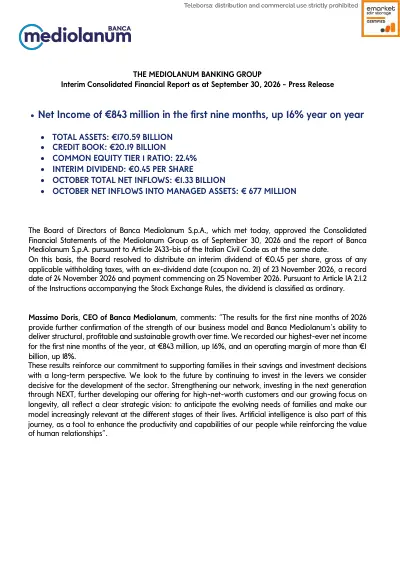
Net income reached €843.3 million, up 16% year-on-year. This is clearly a very strong result, marking our highest ever net income for the first 9 months of the year.
The figure I would particularly draw your attention to is the operating margin, because it gives us the clearest view of what the business itself is producing. Operating margin approached €1.06 billion, increasing by 18% compared to the same period last year, another 9-month record.
The contribution margin reached €1.76 billion, up 13%. These figures tell a straightforward story: our revenues are growing well ahead of costs, while we continue to invest in our future development.
In fact, net commission income reached €1.69 billion, increasing by 10% year-on-year. The main contribution came from recurring fees.
Management fees grew by 12%, supported by higher average managed assets, positive net inflows, and the contribution of market performance over the period. Net interest income reached approximately €724 million, up 24% compared with the first 9 months of 2025.
Behind that result is a larger, more cost-efficient funding base, with customer deposits continuing to provide stable funding. Growth in the credit book and active management of the securities portfolio are also supporting revenues.
This is not simply a question of where interest rates happen to be. Actively managing funding costs, liquidity, and the composition of our securities portfolio gives us flexibility as market conditions change.
As expected, year-on-year growth has gradually normalized from the particularly high levels recorded in the first half. The absolute contribution, however, remains very strong.
Let me now briefly address costs. Total costs increased by slightly over 6% year-on-year, well below revenue growth.
Some costs naturally increase with business volumes. What matters is that they support growth and create value, as they do in our case.
As a result, the cost-income ratio improved to 35.1%, compared with 37.6% at the end of last year. The ratio of acquisition costs to gross commissions stood at 36.2%.
The year-on-year increase primarily reflects higher commercial incentive costs, while the related revenues are not yet reflected in the ratio. Finally, the cost of risk remained contained at approximately 20 basis points, in line with our expectations and consistent with the continued good quality of our credit portfolio.
Now looking below the operating margin, non-recurring items came to almost €95 million, up 17%. In particular, performance fees crystallized at the end of September amounted to almost €90 million, compared with €63 million in the same period last year.
Of course, performance fees are welcome when markets and fund performance generate them, but they are not what defines the underlying strength of our results. Turning to slide 5, let's look at the main business results for the first 9 months.
Total net inflows exceeded €9.5 billion, jumping 17% compared with the same period last year. The third quarter was the strongest in our history for net inflows into managed assets.
An outstanding result in a summer quarter, not usually a season when we expect records to be broken, particularly in managed assets. It brought net inflows into managed assets for the first 9 months to €7.24 billion, 10% higher year-on-year.
As we pointed out before, with the support of their Family Bankers, customers continue to put their money to work rather than waiting on the sidelines for the perfect entry point. This is particularly important because the composition of our inflows supports the quality of our future revenues.
Managed asset inflows expand the base of recurring fees, deepen the relationship with customers, and give us greater visibility over the future development of the business. This is precisely where the value of advice becomes measurable.
Total assets at the end of September stood at €170.6 billion, increasing by 9% from the beginning of the year and by 13% compared with 9 months 2025. The credit book reached €20.2 billion, supported by new lending volumes of €3.16 billion during the first 9 months, 13% higher year-on-year.
Credit quality remained solid, with a net NPL ratio of 0.76%. We continue to approach lending as an integral part of the customer relationship, rather than a separate product.
Mortgages and other forms of household credit help us support customers through some of the most important decisions in their lives. Our general insurance business also continued to progress, with gross premiums approaching €197 million, up 12% year-on-year.
Protection is becoming increasingly relevant to our proposition. Helping customers grow their wealth is only part of our responsibility.
We must also help them protect that wealth, their income, and the people who depend on them. Investing, borrowing, saving, and protecting are not 4 separate conversations.
For a family, they are parts of the same financial life, and our model allows us to address them together. We have now seen the first indications from the final quarter, as in slide number 32.
October was another very strong month, with total net inflows of almost €1.33 billion, and managed asset net inflows of €677 million, bringing our first 10 months to €10.85 billion and €7.91 billion, respectively. This comes straight after the strongest quarter in our history.
A strong quarter followed by a strong month is not an isolated result. It is a pattern, and it is what we continue to see in the behavior of our customers and in the quality of our inflows.
Slide 6 sets out some of the indicators giving us visibility over future growth. During the first 9 months, we welcomed approximately 162,900 new customers, bringing our total customer base to 2,130,800.
Our Family Banker network at group level reached 7,290, an increase of 7% since the start of the year. The number of top-tier bankers managing portfolios of more than €50 million rose to 853, increasing 22% versus the beginning of the year, with total assets of €68.9 billion, an average asset per banker of approximately €81 million.
These figures matter because the growth of our network is not simply a question of adding more professionals. It is about attracting talented people, helping them become more productive, and giving them the tools to build deeper relationships with customers.
Growth in the network and growth in productivity must move together. Another important source of visibility is our intelligent investment strategy.
At the end of September, €6.5 billion, up 29% from the beginning of the year, were invested in money market funds with a gradual and planned transition towards equity funds over an average period of approximately 3 and a half years. In addition, looking at the last 2 lines of the table, slightly over €4 billion, 20% higher than the start of the year, is already contractually committed to move into mutual funds over the next 12 months through double chance deposits and installment plans.
These are not forecasts of what customers might do, but investment paths that they have already chosen. That gives us valuable visibility into future flows without having to predict the next market move.
Turning to slide 7, our capital position remains one of the group's defining strengths. The CET1 ratio stood at 22.4% at the end of September, maintaining a very significant buffer above regulatory requirements.
Please keep in mind that the CET1 ratio does not include the profit generated during the first 9 months of the year. The MREL-TREA ratio was 25.3%, while the leverage ratio stood at 8.4%.
For us, the value of a strong capital position lies in the flexibility it provides. It allows us to invest in the business, support growth, and remunerate shareholders, while preserving the prudence that has always characterized Banca Mediolanum.
Before moving on, let me say a few words about shareholder remuneration. In light of our strong performance and solid capital position, the board of directors has resolved to pay an interim dividend of 45 euro cents per share, to be paid on November 25th, for a total amount of approximately €333 million.
This represents an increase of 12.5% in our base interim dividend compared with last year. Let us now turn to Italy, and to the continued development of our Family Banker network.
At the end of September, the network reached 5,574 Family Bankers, with 528 professionals joining Banca Mediolanum during the first 9 months, a 56% increase compared with the same period last year, with 233 added through our NEXT program. What we are seeing is encouraging not only in terms of numbers, but also in terms of profile.
Professionals from different backgrounds and at different stages of their careers increasingly recognize that our model gives them the opportunity to develop their business built around long-term advisory relationships with customers. They are not joining a traditional bank with an advisory channel attached to it; they are joining a bank designed around advice.
The difference matters, and it means looking ahead, developing the next generation of advisors. This brings me to our banker consultant strategic program, as you can see in slide number 36.
At the end of October, 825 banker consultants were already active in the network, with a further 255 completing their Executive Master's program at our Corporate University. We therefore remain on track to get close to the milestone of 1,000 banker consultants by the end of 2026.
We now have increasingly clear evidence that these partnerships support higher productivity in managed asset inflows, customer acquisition, lending, and protection. The senior banker brings experience, judgment, and a trusted customer base; the banker consultant brings new skills, new energy, and a natural familiarity with more digital ways of working.
It is not a one-way transfer of knowledge. That combination is what makes NEXT much more than a recruitment program.
It supports productivity today, prepares the network for generational renewal, and helps us build relationships with the customers and families of tomorrow. Let us now turn to Spain on slide 30.
Our Spanish business continued to grow during the first 9 months, with progress across assets, customers, the network, and the credit book. Operating margin reached €49 million, while net income amounted to €48.3 million.
Total assets increased 14% since the start of the year to €17.65 billion, including over €14 billion in managed assets. Total net inflows were €1.62 billion, of which over €1.38 billion were directed into managed assets.
The credit book overcame €2 billion, up 15% since the beginning of the year, while the number of Family Bankers increased 4% to 1,716, and the customer base expanded to approximately 316,000, up 6%. We have always viewed the development of Spain over the long term.
We have invested to build scale, strengthen the platform, and increase our presence across the country. We are now seeing those investments reflected in a broader customer base, higher assets, and improving productivity.
Going back to Italy, let me now give you a brief update on our Grandi Patrimoni program, as illustrated in slide 37. At the end of September, we served approximately 4,600 customers with assets exceeding €2 million with us, representing total assets of around €21.6 billion.
This marks a 36% increase compared with the 2024 baseline before the program was launched. Growth in this segment continues to be supported by managed assets, reinforcing both the depth of the customer relationship and the recurring component of our revenues.
Grandi Patrimoni is not simply about the size of a customer's portfolio; it is about the complexity of the needs that come with it. These needs often span several generations within the same family: business assets, succession planning, investment banking requirements, and the need for more specialized advice.
That is the opportunity we see in this segment. I would now like to turn to page 38, or to a subject that goes well beyond the results of a single quarter: longevity.
At the half year, we said we would provide more detail on the program we are developing in this area. Let me begin with a very simple observation: not every long-term risk comes from markets; some come from living longer than we planned for.
Retirement income and savings may need to support 30 years or more, while healthcare and care-related needs may increase over time. This is precisely where advice proves its value, not in predicting the next market move, but in helping people prepare for the life ahead of them.
We already manage around €12 billion in pension plans, with annual recurring flows close to €950 million and growing. Please keep in mind that these plans have an average time horizon of over 25 years.
Our longevity program builds on these plans in a more structured and articulated way. It brings together retirement planning, TFR transfers, voluntary pension contributions, and regular investment plans, along with protection solutions within a single advisory framework.
Most importantly, starting early matters. Even relatively modest, though regular contributions become meaningful when given enough time, while delaying action can make the same objective more difficult and more expensive to achieve.
Longevity is also closely linked to the transfer of wealth between generations. Our Family Bankers are in a unique position to support this process because they often know not only the individual customer, but the family around them.
For us, longevity is not a campaign; it is a way of organizing conversations we have always considered fundamental: saving regularly, planning retirement, protecting income, and making wealth last for as long as it is needed. Finally, let me turn to everyone's favorite topic: AI.
If you look at slide 39, you can see that we are now moving from experimenting with AI to putting it to work across our business, with a very practical approach focused on our customers, our Family Bankers, and the head office. Let me focus for a moment on our network, where we are taking an important first step.
We just rolled out our in-app informative AI across the network, directly within the app our Family Bankers already use every day. Think of it as bringing everything a Family Banker needs to know about our business into one place: products, processes, commercial initiatives, and the many other aspects of their daily work, all immediately accessible through a single AI-powered environment.
This is only the beginning. Starting next year, new AI features will be gradually added to the Family Bankers app, connecting to the CRM to enable dynamic dashboards and support portfolio building.
From there, we will progressively extend its use across other areas of the advisory process, following the roadmap you can see on slide 39. We are integrating AI into the tools and processes our Family Bankers already work with.
The objective is very concrete: less time to look for information, better support in making decisions, and more time for customers. Ultimately, for us, AI is all about making people better at what they do.
It can make advice smarter and more efficient, while leaving more time for what technology cannot replace: the trusted relationship between the Family Banker and the customer. Let me now conclude with our outlook for the remainder of the year.
With 3 quarters behind us, we enter the final part of 2026 from a position of strength. More importantly, we now have more sources of growth working in our favor than we did at the beginning of the year: our customer base is larger, our network is larger and increasingly productive, managed asset inflows continue to support recurring revenues, our automatic investment solutions provide visibility on future flows, our funding base remains broad and efficient, and our capital position gives us considerable freedom of action.
Against this backdrop, our guidance for the full years 2026 and 2027 is confirmed or updated as follows: We expect net inflows into managed assets to exceed €9 billion, and for 2027, we expect higher volumes, assuming stable markets. We expect net interest income to grow by 20% compared to 2025.
For 2027, our outlook is to grow by about another 10%, assuming an average 3-month Euribor close to 3%. For 2026, we expect a cost-income ratio below 38%, with further improvement in 2027, and a cost of risk to remain at around 20 basis points.
We intend to increase the 2026 base dividend per share compared with the 80 euro cents base dividend paid with respect to 2025, subject, as always, to the relevant corporate approvals. These expectations reflect not only the strength of the first 9 months, but the breadth of the growth behind them.
In addition to this, please be aware that as at November 6th, accumulated performance fees not yet crystallized amounted to approximately €206 million. At the beginning of this presentation, I said that few things have moved in a straight line in 2026.
We know the world will not suddenly become simpler. We cannot control its course, but we can be very clear about our own direction.
Thank you for your time, and as always, for your continued trust and support.
Alessandra Lanzone
Thank you. We can now start the Q&A session.
Go ahead, please.
Operator
We can start now with a Q&A session. If you wish to ask a question, please dial * 1 and 1 on your pad, and then wait to be introduced.
To withdraw your question, dial once again * 1 and 1. First question comes from Alberto Villa, Intermonte.
Please, sir, go ahead.
Alberto Villa
Thank you so much for this opportunity and congratulations for your results. The third quarter seems really robust.
I have a few questions for you. Banking service fees, they've been quite solid in the third quarter as well.
I was wondering whether you expect this trend to keep going also in the fourth quarter. Maybe you already have a target for 2027, even though I believe it depends on how markets will perform.
Second question, if you can give us a guidance on operating costs for 2027 in terms of cost growth, if you can give us a guidance there on. Third question, distribution network growth.
You have already talked about this, you said there has been a very strong and robust growth in your network. Now clearly, this evolution exceeded your expectations, I believe.
Do you expect this growth to keep going as intense as it has been now till now? Do you believe the banking industry is favoring the growth of your network, or are you hiring also from other industries?
Then the fourth question relates to the tax rate, considering the budget law proposals. Do you have an idea of what can be the tax rate in 2027, and have you already simulated a possible impact, even though I understand this is rather difficult to be applied?
Then I have another question, sorry for having so many questions. The assumed extraordinary interim dividend, what are going to be the dividends you're going to apply this year to to calculate a possible additional dividend?
Massimo Doris
As far as banking service fees are concerned, indeed we expect them to keep on growing also in the fourth quarter, to be well robust. As for 2027, it is rather difficult to forecast how things are going to fare.
This year they have been influenced by autocallables and certificates that reached the strike price, and and therefore there was a an early repayment to clients. This freed up capital, and another certificate could be proposed to the same clients.
This thanks to markets that were on the uprise. Should this happen in 2027 as well, assuming that markets will keep on growing, then we can expect the same pace to continue.
Instead, should markets sort of slow down, we will have few autocallables, and less liquidity will be available to propose the same investment with the same amount of liquidity available. It really depends on how markets are going to fare.
Costs, operating costs for 2027: let me bring you back to cost to the cost-income ratio. The 2027 cost-income ratio we expect to be slightly better than in 2026.
This is where we have to focus. I I always joke saying that if by doubling costs I could increase my revenues on a threefold basis, I would do that very, very happily.
Let's focus on cost-income ratio. Then the network: I believe that this growth trend is going to keep on going because we have a very strong recruitment machine.
In recruitment, you see the results in a more forward-looking basis. It's not like the time deposit campaign or promotion, where you say we are going to have a 4% interest, and I see immediately the effects on of inflows.
When we instead work on recruitment, I start working today, and I start seeing the first effects in 7, 8 months, if if any, let's say 1 year. This is a well-oiled machine, and it will keep on working.
On the one side, we'll have new people being hired, being joining us, and I'm talking about full-fledged Family Bankers. Then we are also going to work on our banker consultants, because the senior bankers are still asking for having a banker consultant joining them, and those senior bankers that already have a banker consultant to have a second or a third one working with them.
Now the banking environment makes it well it's makes it easy to hire people from the other banks because there is much uncertainty with all these combinations and and things going around it, but it doesn't make a huge difference. 40% of our hires come from the banking and the insurance industry, and the residual 60% comes from other we hire from other industries on average.
As to the dividend and the tax rate, I'll hand it over to my CFO in a second. Let me talk about the dividend.
If they I know, special special dividend will depend on performance fees and how they will fare. If the performance fees are going to be robust, as it might be, by the end of the year they could go up a lot or they could decrease, but if they are going to be hefty, as it was the case in previous years, then we're going to consider a special dividend.
As far as the tax rate is concerned, I would like I would wait for the government to to make their own statements. ABI is now negotiating with the Parliament.
Our tax base is 50% Italy and 50% abroad, once the reform is going to be defined, then it will be easy to understand what the tax rate impact is going to be, because 50% of the reform is going to have an impact on our position. Thank you.
Operator
Thank you. Next question, please.
Next question, Giovanni Razzoli, Deutsche Bank. Go ahead, sir.
Giovanni Razzoli
Good afternoon to all of you. Thank you very much for your presentation.
I have two questions, short questions. I'd like to know more about your longevity program that you disclosed.
As always, you're always very proactive, also when it comes to initiatives with your clients. I was wondering whether you could elaborate on possible inflows coming from installment plans or pension plans.
Because there probably will be a reform where contributions to industry-based pension plans will be on a voluntary and free basis. I think that thanks to your Family Bankers, you would be able to attract a large portion of that business, unless the reform will be dropped or something happens to it.
This leg of your business, could it become, in the medium to long term, a more sizable leg and therefore further contribute to expanding your revenues? About that, could you give us some color on the margins you expect on pension-related products, maybe to see whether or not, compared to the average, if you were to compare yourself with a pension fund, where would you be positioned?
Then the contribution of certificates over the first 9 months of the year, so as to be able to make a projection for 2027 for banking fees, should everything be normalized?
Massimo Doris
Thank you. As far as the longevity program is concerned, it's a theme that we deal with and address when we meet Family Bankers, we always address it and we've done so on a number of occasions, and it also entails a number of meetings, a lot of meetings with our clients, always in compliance with our longevity program, so that we meet clients and we tell them about the benefits they would have when moving to a private pension plan rather than retaining their severance funds within the company, leaving them with the company.
Of course, having a supplementary pension is of fundamental importance, but of course there's a gap otherwise in your standard of living, the sooner you start with your pension plan, the better, or the sooner you will get to your targets. Then depending on what the state will give with tax incentives, for instance, when you move from a severance fund retained by the company to, instead, a pension scheme.
Then, of course, tax incentives, as I said. We've done some calculations, and we've worked with our clients on that, and simply transferring your severance fund to our policies, they end up with double the money at the end of the process.
Then if you add to that any voluntary contributions, figures are really outstanding at that point. What we expect here is that these €950 million, that's the threshold we got to so far, but we've only just started, we've only just launched this plan, my expectations are to see a sizable increase of that amount.
In the near future, this project should be the largest contributor to the €2 billion we saw before, €2.8 billion worth of installment plans that we saw on slide 6, page 6. Now it's €2.89 billion, and I am confident that going forward, now it's €950 million, nearly €2 billion installment plans and €950 [million?]
or so of pension schemes, I expect the contribution of pension schemes is going to grow, and as I said, in a sizable way going forward. Then margins: they are in line, product margins are in line with other products.
Investments in these products are more on the fixed income side compared to our usual mix, are more in bonds than we would normally have in our mix. As far as certificates are concerned, if I understood your question correctly, because I was listening to the colleagues, we placed about €1.9 billion of certificates, and €1 billion is autocallable, and the average commissions are, from beginning of the year, are about 6.5%.
I hope I answered your question. Otherwise, let me know.
Giovanni Razzoli
Yes, definitely. That's it.
One more thing, if I may, on pension funds, which you said that in installment plans you have €950 million, but is that the overall stocks or the inflows in 2026?
Massimo Doris
No, it's the inflows in 2026.
Giovanni Razzoli
In the first 9 months, you have €950 million worth of inflows, but it's the first 9 months of this year.
Massimo Doris
Exactly. €950 million per year of inflows going to pension schemes.
They are growing, they are constantly growing.
Giovanni Razzoli
Thank you so much for answering my question.
Massimo Doris
Thank you, Giovanni.
Operator
Next question. We have no other questions on the Italian call.
We will switch to English. Thank you.
To ask a question, please press * 1 and 1 on your telephone. We will now take our first question from the line of Zach Wurz from Autonomous Research.
Please go ahead.
Zach Wurz
Hi there. Good afternoon.
Thanks for taking my questions. I have three of them, please.
The first one's on the Spanish business. Managed asset inflows in Spain are broadly flat year-on-year despite continued growth in customers and advisors.
What would need to change for flows to reaccelerate in 2027, and where are you focusing investment now to achieve that? The second question is on recruitment.
You alluded to this previously, but can you talk a little bit more about how the experienced advisors you're attracting today compare with those you were hiring in previous years? Has the cost of attracting them changed, and how do they compare in terms of asset transfers and time to reach expected productivity?
Then lastly, just on AI development. On the advisor-facing AI tools, is the main opportunity to enable each banker to serve more customers or to deepen relationships with existing customers, and what metrics will you use to measure success there?
Thanks.
Massimo Doris
As far as total inflows are concerned, yes, you it's right. It's sort of flat in Spain, of course talking about the Spanish business compared to last year.
We should remember that in the last 2 years, Spain reported an awesome growth in its net inflows. You can see this on the slide, the lower chart.
We went from €700 million on average from 2020 to 2023, the average doubled to €1.4 billion in 2024, and we reached €2 billion in 2025. If this year we reach the same level as last year, we're still talking about a new base that is almost 3 times the level we had reached only 3 years ago.
I'm really very happy of the performance the Spanish business achieved. In recent years, the Spanish business really focused on improving the quality of the Spanish Family Bankers network.
Consider that in terms of sheer number, there was a limited growth, but this was because we recruited less, but we really focused on quality. The turnover really dropped, more than halved.
Productivity increased quite a lot. Now that we've reached this level, I expect to see the network growing, but I don't expect a very strong acceleration.
Let's say constant growth over the next 2 years to really consolidate all the work we have been doing until now. Now back to recruiting, this time in Italy.
Compared to Spain, where in the last 2 years we could actually recruit expert bankers from other banks—it was very rare in the past, but now it's getting easier, it's almost always almost a habit—in Italy, we have been recruiting bank bank employees for a long time. The cost of acquisition of these trained and expert people has not changed.
It goes from 2% to 2.5%, 3% if we take into consideration total assets, total inflows in managed assets. The cost of acquisition of these people has not changed.
Consider that they account for 20% of our recruitment. As far as recruitment is concerned, 30% is what we refer to bankers, there are 3% there 30% of bankers pay 3% of the asset under management they bring with them, others are paid less.
Then we have insurance agents, and then we have other people that are being hired or recruited from other sectors, other industries. These are all people who were who already had a job, and they have to quit their job, and they renounce their on their wages and salary to come in and attend the training course.
As far as artificial intelligence is concerned, and I'm talking about Family Bankers, I expect artificial intelligence to allow our Family Bankers to manage a higher number of clients, and to better leverage commercial opportunities. What I mean is that artificial intelligence should allow Family Bankers to identify commercial opportunities with their clients that are maybe not so clear right now, they are not immediately identifiable right now.
This is what I expect. Then of course, artificial intelligence is going to be provided also to our clients, so that they will have instruments not only to invest, but also to manage their money, to analyze how they spend their money.
They would have enhanced instruments, enhanced tools, more precise, with easier solutions and answers, and they might be put in a position to use it and also within the banking processes, so that we may become more efficient, we may become quicker, and we will see an increase in the business volume that is not accompanied by a proportional increase in the number of people, thanks to artificial intelligence. Thank you, Zach.
Next question, please.
Operator
Thank you. Our next question is from the line of Hubert Lam from Bank of America.
Please go ahead.
Hubert Lam
Hi, good afternoon. Thanks for taking my questions.
I've got two of them. Firstly on private markets.
Can you talk about growth of private market products on your platform? Suppose you expand more in the high net worth clients space through your Grandi Patrimoni initiative.
These are type of products that are likely to be more in demand. Can you talk about So can you talk about what's on offer today and in the future?
The second question is also on AI. Can you talk there's there's fears in the market on cash cash sweep on deposits from agentic AI.
Can you talk about risks around this for you? Thank you.
Massimo Doris
As far as private market products requests is or demand, it's almost equal to zero. It's almost non-existing.
As exception made for PIRs, what are they called? Alternative PIRs, and apart from individual savings plans and pension plans.
Through Grandi Patrimoni, we make available through ELTIFs, we provide private through ELTIFs, we provide private equity, private debt products. It's 4 products in all, with different features, and the demand, however, is very, very low.
I expect it over time to grow, but it's not a sector that we really push on. As far as artificial intelligence is concerned, and therefore agentic artificial intelligence, agents that could work for our clients to for cash sweeps to move liquidity where it's better rewarded, well, for the time being, we don't see any type well, any transaction of that kind, to say.
It may happen, yes, it may happen, but again, as we have our own clients who normally, of course, they talk to our Family Bankers, to our financial consultants, and beating how liquidity is remunerated with medium to long-term investments, it's easy to beat that, to say. I'm not concerned about that, honestly.
It should instead worry those who built their business on rewarding liquidity, on returns on liquidity. That could be, in that case they would have problems, but our business is something else.
Our business is based on investments, in in on assets under management, and so I'm not saying this is a non-issue, but for sure it's not a very important one for us. I'm not concerned from that perspective.
Thank you, Hubert. Next question, please.
Operator
Thank you. There are no further questions on the English line.
I would like to hand back over to the Italian line. Once again, if you wish to ask a question, press * 1 and 1 on your phone pad and wait to be introduced.
Thank you. Next question from Giovanni Razzoli, Deutsche Bank.
Giovanni Razzoli
Good afternoon. Just one clarification, because we're talking about pension schemes and it's really a characteristic of your equity story, and I am sure that you are going to be leaders, and we're going to get a lot of benefits.
Now with respect to the potential outlet market, severance packages correspond to €10 billion per year, and then we have €4.5 billion from employers in various sectors. We can talk about a €14 billion worth of overall market.
Is that right?
Massimo Doris
I've no idea, honestly. I cannot answer because I should really check this.
For the time being, I have no answer.
Giovanni Razzoli
Thank you.
Massimo Doris
Thank you, Giovanni. Next question.
Operator
There are no other questions on the Italian line. I hand it over to you, Mrs.
Lanzone, for the closing remarks.
Alessandra Lanzone
Let me thank you all for joining us in this 9-month call. We are going to come back at the beginning of February to talk about the year-end results.
Thank you. Good evening.
The conference is over. You can now disconnect.
Thank you for joining us.