TH International Limited
NNASDAQ:THCHQ1 FY2026 · Earnings Call TranscriptJune 9, 2026
Operator
Ladies and gentlemen, welcome to Tims China's first quarter 2026 earnings conference call. All participants will be in listen-only mode during management's prepared remarks, and there will be a question-and-answer session to follow.
Today's conference is being recorded. At this time, I'd like to turn the call over to Patty Yu, Tims China's Public and Media Relations Manager, for prepared remarks and introductions.
Please go ahead, Patty.
Patty Yu
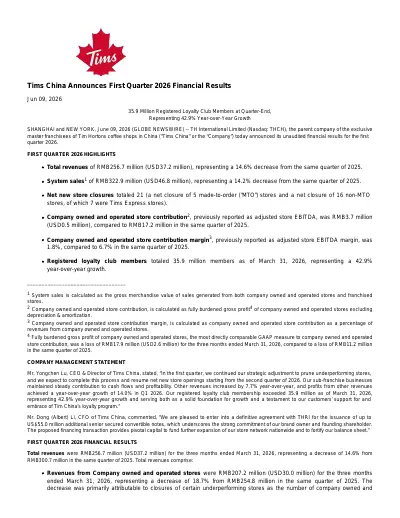
Hello, everyone, and thank you for joining us on today's call. TH International Limited announced its first quarter 2026 financial results earlier today.
A press release, as well as accompanying presentation which contains operational and financial highlights, are now available on the company's IR website at ir.timschina.com. Today, you will hear from Yongchen Lu, our CEO, Director; and Albert Li, our CFO.
After the company's prepared remarks, the management team will conduct a question-and-answer session. You will find the webcast of today's earnings call on our IR website.
Before we get started, I'd like to remind you that our earnings presentation and investor materials contain forward-looking statements, which are subject to future events and uncertainties. Statements that are not historical facts, including, but not limited to, statements about the company's beliefs and expectations, are forward-looking statements.
Forward-looking statements involve inherent risks and uncertainties, and our actual results may differ materially from those forward-looking statements. All forward-looking statements should be considered in conjunction with the cautionary statements in our earnings release and the risk factors included in our filings with the SEC.
This presentation also includes certain non-GAAP financial measures, which we believe can be helpful in evaluating our performance. However, those measures should not be considered substitutes for the comparable GAAP measures.
The accompanying reconciliation information related to those non-GAAP and GAAP measures can be found in our earnings press release issued earlier today. With that said, I would now like to turn it over to Yongchen Lu, our CEO, Director.
Please go ahead, Yongchen.
Yongchen Lu
Thank you, Patty. Good morning and good evening, everyone.
Thank you for joining us today. As the coffee industry entered a seasonal slowdown during the first quarter, the company proactively optimized its operating rhythm and moderately reduced discount-driven promotions, reallocating resources toward franchise system development and long-term brand building.
While certain short-term revenue indicators face pressure, core user quality continued to improve, in line with the company's strategic transition from prioritizing scale growth to prioritizing quality development. During the first quarter, we continued our strategic adjustment to prune underperforming stores, and we expect to complete this process and resume net new store openings starting from the second quarter of 2026.
On same-store sales growth, we experienced overall comparable transactions decline of 8.3% and an average comparable ticket size decline of 4.8%, which led to a negative 13.2% same-store sales growth for the system-wide stores in Q1. The decline was partly due to delivery aggregators backing down subsidies significantly, partly due to under-spend in our marketing spending and discount control.
Despite the temporary headwinds on top-line growth and fierce industry competition, we continue to witness strong performance of our 2024 and 2025 vintage stores, most of which were compact and make-to-order stores. With further optimized store CapEx spendings and enhanced store unit economics, our 2024 vintage year company-owned and operated stores generated store contribution margin of nearly 15% in 2025 full year and low teens in Q1 2026, and are expected to achieve a payback period within two to three years.
Our 2025 vintage year stores, which are still ramping up now, are expected to achieve similar unit economics, too. In the meantime, our company-owned and operated stores in tier-one cities, including Beijing, Shanghai, Guangzhou, and Shenzhen, and in those cities with 10-plus stores, generated over 10% and 7% store contribution margin in 2025, respectively, outperforming other tier cities with lower store density.
We'll continue adding density in existing cities to achieve higher economy of scale. Leveraging sub-franchise partnerships, new store were opened across multiple core cities and emerging markets, including Shanghai, Guangzhou, Shenzhen, Hangzhou, Beijing, Zhengzhou, Nantong, etc., in Q1 2026.
The company continued to expand across diversified locations, such as transportation hubs, office buildings, commercial complexes, and university campus, etc., further enhancing brand penetration and consumer reach. Since we launched our individual franchise business in December 2023, we have received over 10,500 applications, signing up for over 440 stores and successfully opening nearly 260 stores by the end of March 2026, showcasing continued market confidence in our franchise model.
We have witnessed reasonable returns for our franchised stores. For instance, our franchised stores at special channels, including railway stations, hospitals, and highway rest areas, generated store contribution margin of high teens in 2025 and are expected to achieve a payback period of approximately two years.
We'll accelerate opening franchised stores on those special channels. During the quarter, the company officially launched its 2026 nationwide franchise roadshow program, systematically communicating its brand strength, operational standards, and unit economic model to prospective franchise partners.
At the same time, the company introduced upgraded franchise support policies, including multi-store incentives, high revenue rebates, and opening support packages, further enhancing franchise attractiveness, attracting high-quality partners, and laying a solid foundation for long-term scalable expansion. In the meantime, our sub-franchise business contributed steady cash flows and profitability.
Other revenue increased by 7.7% year-over-year, and profits from other revenues achieved a year-over-year growth of 14% in Q1 2026. The first quarter marked a traditional seasonal slowdown for the coffee industry amid intensified market competition.
Against this backdrop, the company remained focused on improving operational quality and efficiency, making progress across product innovation, brand marketing, and loyal member engagement. During the first quarter of 2026, the company launched a total of 21 new products across categories, including 15 new beverage products and 6 new food items centered around seasonal occasions, health-conscious offerings, and localized flavors, with strong market response.
On the beverage side, the Cherry Series returned with strong consumer recognition, effectively driving traffic and repurchases. The company also introduced limited-time iced apple series beverage and the zero-sugar, zero-fat [lotus?]
series to further adjust seasonal and health-orientated demand. On the food side, the launch of the naan chicken bagel sandwich and the naan bagel further strengthened localized product innovation.
Among the new launches, the spring apple series delivered particularly strong performance, achieving the highest repurchase rate among all product series. In brand marketing and loyalty member engagement, the company focused on Chinese New Year social occasions and younger consumer segment through diversified cross-over collaborations.
Partnerships with the popular drama IP, The Vendetta of [An?] , [Ta 24 Ji?]
, Air Canada, and NetEase Cloud Music, enhanced brand awareness and member engagement and penetration among younger consumers. In Q1 2026, transacting members under the age of 30 accounted for nearly 50% of the total membership base.
In addition, through a customer acquisition partnership with Didi, the company successfully added approximately 4 million new members during the quarter, representing nearly threefold year-over-year growth. As of March 31st, 2026, our registered loyalty club members exceeded 35.9 million, reflecting a remarkable 42.9% year-over-year growth.
The average number of members per store has now surpassed 35,000, serving as a solid foundation for growth and a testament to our customers' support for and embrace of Tim Hortons' loyalty program. At this time, I would like to turn it over to our CFO, Albert Li, to discuss our first quarter 2026 financial performance in more detail.
Albert Li
Thank you, Yongchen. During the first quarter of 2026, our total revenues and system sales dropped by 14.6% and 14.2% year-over-year, respectively, which was primarily due to the closure of certain underperforming company-owned and operated stores and a decrease in same-store sales growth.
Our overall monthly average transacting customers reached 2.69 million during the first quarter of 2026, compared to 2.92 million in the same quarter of 2025. Digital orders as a percentage of total orders rose from 86.3% in the first quarter of 2025 to 87.5% in the first quarter of 2026.
We continued to enhance our digital capabilities to meet the growing demand for delivery and takeaway services. Total number of delivery orders increased by 10.2% year-over-year during the first quarter of 2026.
We are committed to improving our financial performance by refining store unit economics and boosting operational efficiencies at both store and corporate levels, setting the foundation for long-term sustainable growth. Specifically, through refinements in our supply chain capabilities and economies of scale, we managed to reduce Q1 2026 food and packaging costs as a percentage of revenues from company-owned and operated stores by 2.0 percentage points, from 30.4% in the first quarter of 2025 to 28.4% in the same quarter of 2026.
Rental and property management fees were RMB 47.2 million, US$6.8 million, for the three months ended March 31st, 2026, representing a decrease of 16.2% from RMB 56.3 million in the same quarter of 2025, which was in line with the revenue trend as the number of our company-owned and operated stores decreased from 569 as of March 31st, 2025, to 541 as of March 31st, 2026. Rental and property management fees as a percentage of revenues from company-owned and operated stores increased by 0.7 percentage points, from 22.1% in the first quarter of 2025 to 22.8% in the same quarter of 2026.
Payroll and employee benefit expenses were RMB 44.8 million, US$6.5 million, for the three months ended March 31st, 2026, representing a decrease of 10.4% from RMB 50.0 million in the same quarter of 2025, which was in line with the revenue trend. Payroll and employee benefit expenses as a percentage of revenues from company-owned and operated stores increased by 2.0 percentage points, from 19.6% in the first quarter of 2025 to 21.6% in the same quarter of 2026.
Delivery costs were RMB 27.3 million, US$4.0 million, for the three months ended March 31st, 2026, representing an increase of 1.0% from RMB 27.0 million in the same quarter of 2025, which was in line with the 8.9% increase in delivery orders from 4.5 million in the first quarter of 2025 to 4.9 million in the same quarter of 2026, partially offset by a reduction in average delivery cost per order. Delivery costs as a percentage of revenues from company-owned and operated stores increased by 2.6 percentage points, to 13.2% in the first quarter of 2026, compared to 10.6% in the same quarter of 2025, which was primarily due to delivery revenue as a percentage of total revenues from company-owned and operated stores increased from 53.1% in Q1 2025 to 65.1% in Q1 2026.
Other operating expenses were RMB 18.2 million, US$2.6 million, for the three months ended March 31st, 2026, representing an increase of 0.9% from RMB 18.0 million in the same quarter of 2025. Other operating expenses as a percentage of revenues from company-owned and operated stores increased by 1.7 percentage points, to 8.8% in the first quarter of 2026, compared to 7.1% in the same quarter of 2025.
Benefiting from our cost optimization measures and improved brand influence, our marketing expenses were RMB 9.8 million, US$1.4 million, in Q1 2026, representing a decrease of 43.7% from RMB 17.4 million in the same quarter of 2025. Marketing expenses as a percentage of total revenues decreased by 2.0 percentage points, from 5.8% in the first quarter of 2025 to 3.8% in the same quarter of 2026.
Our adjusted general and administrative expenses were RMB 43.4 million, US$6.3 million, in Q1 2026, representing a decrease of 7.9% from RMB 47.2 million in the same quarter of 2025, which was primarily due to a decrease in credit loss of accounts receivables and cost savings from professional and other service fees. Adjusted general and administrative expenses as a percentage of total revenues increased by 1.2 percentage points, from 15.7% in the first quarter of 2025 to 16.9% in the same quarter of 2026.
As a result of the foregoing, adjusted corporate EBITDA margin was negative 11.8% in the first quarter of 2026, compared to negative 9.8% in the same quarter of 2025. Turning to liquidity, as of March 31st, 2026, our total cash and cash equivalents, time deposits, and restricted cash were RMB 111.4 million, US$16.2 million, compared to RMB 129.7 million as of December 31st, 2025.
The change was primarily attributable to cash disbursements on business operations, partially offset by the drawdown of additional bank facilities. We are pleased to enter into a definitive agreement with THRI, our brand owner, for the issuance of up to US$55.0 million additional senior secured convertible notes, which underscores the strong commitment of our brand owner and founding shareholder.
The proposed financing transaction provides pivotal capital to fund further expansion of our store network nationwide and to fortify our balance sheet. Looking ahead, our near-term imperatives will be to deliver sustainable revenue growth, to further enhance supply chain capabilities and expand store-level profitability, to continuously optimize cost structure, to accelerate the expansion of our successful sub-franchising, and to achieve corporate EBITDA break-even.
With that, I will now turn it over to Yongchen for concluding remarks, followed by Q&A.
Yongchen Lu
Thank you, Albert. Before we turn to Q&A, I would like to take this opportunity to express my utmost gratitude to our customers, employees, business partners, and shareholders for your continuous support, dedication, and belief during the past seven years.
With the heartfelt passion in the Tim Hortons brand and strong confidence in the China market, we began our journey from the very first store at People's Square in Shanghai seven years ago. Together, we have now established an overwhelming community as one of China's top coffee brands, with over 35 million loyalty club members, a unique coffee plus freshly prepared healthy food business model offering the best value for quality products as an international coffee brand, differentiated and comprehensive store formats with over 1,000 stores in 93 cities, most of which are made-to-order stores with expected payback period between two to three years, and a unique advantage of offering franchise opportunities as an international coffee brand.
Today, China stood as the largest international market in Tim Hortons global system by number of stores, and Tims China has moved beyond its startup and exploration phase and entered a new stage of high-quality growth. Effective from June 15th, 2026, I am honored to take on a new role as Chairman, while I'll remain as actively engaged and committed to the company's long-term success as ever.
I'm excited to work with Mr. John Chen, our new CEO, who brings more than 25 years of extensive experience leading major consumer companies in China and across Asia, and with proven track record in brand building, consumer insight, business growth, and operational management to drive the next phase of growth for Tims China and to generate long-term value for our shareholders.
I will now turn the call over to Patty for today's Q&A session. Patty?
Patty Yu
Thank you, Yongchen. We will turn it over to Q&A and open it up for registered questions.
Let's begin with the first question. Operator, please go ahead.
Operator
Thank you. To ask a question via the telephone, please press star one one on your telephone keypad and wait for your name to be announced.
To withdraw your question, please press star one one again. To ask your question via the webcast, please type it into the Q&A box and click submit.
We will now take our first phone question, and the question comes from the line of Steve Silver of Argus Research Corporation. Please ask your question, Steve.
Your line is open.
Steve Silver
Thanks operator, and thanks for taking my questions. Same-store sales growth has been under pressure during Q1 both on comparable transactions as well as average comparable ticket sizes.
Considering the aggressive delivery aggregator subsidies since Q2 of last year, can you just discuss your current thinking on the same-store sales growth that you see for the rest of 2026?
Yongchen Lu
No, very good question, Steve. Thank you.
Actually, we have seen same-store sales recovering very well recently, especially for the past few weeks, after we launched several great marketing campaigns. I believe we'll have better same-store sales in the second quarter, and we expect much better for the rest of the year.
Steve Silver
Great. You've also cited 2024 and 2025 store trends for strong performance and maybe mid-teens store contribution margins.
More recently, you've talked about the special channel stores generating high-teens store contribution margins. Can you just talk about your expectations on store margin profiles moving forward?
Albert Li
Steve, I think I will take this question. On the overall I think profitability level for our company-owned stores, we would expect that the margin profile can be improved gradually and can be improved further from existing level.
I think, firstly, as Yongchen has mentioned, in terms of the recovery on same-store sales, and also, we have seen a very positive trend on the same-store sales in the second quarter. With the improvement on the same-store sales, definitely we are expecting higher revenues at the store level.
I think accordingly, in terms of the store labor costs, rental, and other operating costs, as a percentage of revenue will naturally go down, right? That's the first point.
I think, secondly, we are in the process of, I think, wrapping up in terms of pruning our underperforming stores. Which we expect it can be mostly completed within the year.
Definitely, we are expecting a higher percentage of higher-margin stores, I think including those 2025, 2024, and later vintage year stores, and also those special channel stores. The higher-margin stores will take a higher percentage of revenues on that.
I think, thirdly, I want to highlight on gross margin. As you can see, during the first quarter of 2026, even our top line is under pressure, we still improved our gross margin by 2.0 percentage points.
I think based on those initiatives on supply chain optimization, efforts, economy of scale, launching higher-margin products, and also in terms of optimizing the recipe for existing core product, I think that will all help us to continue improve our gross margin.
Yongchen Lu
I just want to add a point here. Our major problem for the early vintage stores are with the rent, because we opened a lot of larger format stores for brand building.
We can see the rent percentage of sales are very high for early vintage stores. If you look at the recent vintage of stores like 2024, 2025, and even other stores we opened this year in 2026, the rents are very reasonable, and they have teens store-level contribution margins.
I believe with the new CEO, John Chen, with his strong background in sales and marketing, under his leadership, I believe that the sales will improve further. That will also contribute even higher store contribution margin in the future.
Thank you.
Steve Silver
Great, that's helpful. One more if I may.
Could you talk a little bit about the current competitive landscape? You guys have talked about quite a bit about the competition on the coffee side.
More recently, it looks like some of the tea players in China have entered into the coffee business with some lower-priced offerings. I'm just curious as to whether you think that will have any impact on your business strategy.
Yongchen Lu
The tea players has been more aggressive in entering to the coffee sector than before and price very very low. That's exactly I want to highlight our differentiation point.
We are not only a coffee player, we offer coffee plus freshly prepared food, and that's very different from our peer coffee brand players and also the milk tea players. That's where we are very strong and very different.
That's why we are so much believe in our differentiated model for the future.
Steve Silver
Great. Thank you so much for that, and best of luck continuing to stabilize and return to top-line growth.
Yongchen Lu
Thank you, Steve.
Albert Li
Thank you, Steve.
Operator
Thank you for your question. As a reminder, to ask a question via the telephone, please press star one one on your telephone keypad.
To ask your question via the webcast, please type into the Q&A box and click submit. Once again, that's star one one for questions from the telephone line, and to type your questions in the Q&A box via the webcast and click submit.
Patty Yu
Operator, I don't see any question coming up.
Yongchen Lu
Yes, with that, thank you so much for your time, and let's discuss more next quarter. Thank you.
Operator
Thank you. That concludes today's conference call.
Thank you for your participation. You may now disconnect your lines.