TIC Solutions, Inc.
NNYSE:TICQ4 FY2025 · Earnings Call TranscriptMarch 12, 2026
Operator
Hello, and welcome to the TIC Solutions Fourth Quarter 2025 Earnings Conference Call. Currently, all participants are in a listen-only mode.
A question-and-answer session will follow the formal presentation. If anyone should require operator assistance during the conference, please press *0 on your telephone keypad.
As a reminder, this conference call is being recorded. I would now like to turn the call over to your host, Andrew Shen, Director of Investor Relations.
Thank you, you may begin.
Andrew Shen
Thank you, operator. Good morning, everyone, and thank you for joining the call.
Joining me this morning is Tal Pizzey, our Chief Executive Officer; Ben Heraud, our President and Chief Operating Officer; Kristin Schultes, our Chief Financial Officer; and Robbie Franklin, Executive Chairman. As disclosed in our earnings release, we would like to acknowledge the planned leadership transition we announced this morning.
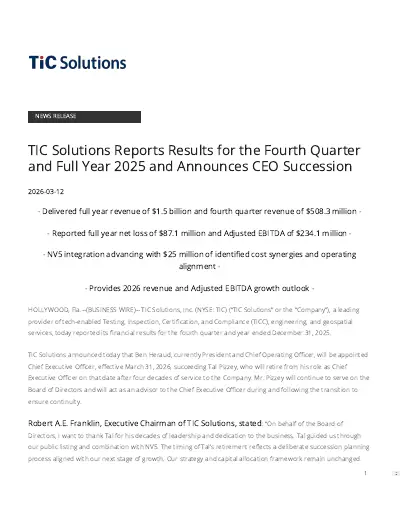
Ben Heraud has been appointed Chief Executive Officer effective March 31st, 2026, succeeding Tal Pizzey. Tal will continue to serve on our board of directors and act as an advisor to Ben through and following the transition to ensure continuity.
We will provide additional context during our prepared remarks. I would now like to remind you that certain statements in the company's earnings press release and on this call are forward-looking statements that are based on expectations, intentions, and projections regarding the company's future performance, anticipated events or trends, and other matters that are not historical facts.
These statements are not a guarantee of future performance and are subject to known and unknown risks, uncertainties, and other factors that could cause actual results to differ materially from those expressed or implied by such forward-looking statements. In our press release and filings with the SEC, we detailed material risks that may cause our future results to differ from our expectations.
Our statements are as of today, March 12th, 2026, and we undertake no obligation to update any forward-looking statements we may make, except as required by law. As a reminder, we have posted a presentation detailing our fourth quarter financial performance on the Investor Relations page of our website at ticsolutions.com.
Our comments today will also include non-GAAP financial measures and other key operating metrics. The required reconciliations of non-GAAP financial metrics can be found in our press release and in our presentation.
For the purpose of this call, we refer to our segments as Inspection and Mitigation, or I&M; Consulting Engineering, or CE; and Geospatial, or GEO. Any reference to combined results reflects a non-GAAP combined view of legacy Acuren and legacy NV5 for comparability.
More details on the calculations of the combined results are included in the presentation. Let me outline the flow of today's prepared remarks.
Tal will provide opening comments. Ben will review our operating priorities and segment performance.
Kristen will cover our financial results, integration progress, and our 2026 outlook. Robbie will conclude with strategic priorities and capital allocation.
It's now my pleasure to turn the call over to Tal.
Tal Pizzey
Thank you, Andrew. Good morning, everyone.
This morning, we announced a planned leadership transition that has been contemplated as part of our broader succession planning process. After nearly four decades with the business, including serving as Chief Executive Officer, I will be transitioning from the CEO role as I prepare for retirement.
I will continue to serve on the board and act as an advisor to Ben and his team to ensure a seamless transition. Since joining Acuren in 1987, it has been a privilege to help build this organization.
We entered the public markets and completed the combination with NV5 to create TIC Solutions, a $2 billion revenue company. Ben has been deeply involved in shaping the combined operating model since the NV5 combination closed in August.
He understands the platform, the culture, and the priorities ahead. I have full confidence in his leadership as the company moves into this next chapter.
With that, I will turn the call over to Ben.
Ben Heraud
Thank you, Tal. I'm excited to step into the CEO role on March 31st and to build on the strong foundation we have established across both legacy organizations.
Since joining TIC Solutions in August, my priority has been sharpening our commercial execution across the platform. That starts with aligning leadership around clear growth priorities, strengthening account management processes, and accelerating cross-segment collaboration.
We are driving greater consistency in pricing and utilization. Before joining TIC Solutions, I served as CEO of NV5, and previously as COO.
I joined NV5 through the acquisition of Enercon, a business I co-founded and spent more than a decade building and scaling engineering commissioning operations across global markets. That experience in building commercial teams, improving operating rigor, and driving prudent capital allocation informs how I approach this next chapter.
2025 marked an important step change for TIC Solutions. We completed the combination, rebranded, and established a scaled tech, engineering, and geospatial platform positioned for the next phase of growth.
On a combined basis, in 2025, we grew revenue approximately 4% to $2.1 billion, representing our highest combined full year revenue. We delivered approximately $312 million of adjusted EBITDA and 14.8% adjusted EBITDA margin for the full year.
We now operate at meaningful scale. With a diversified end market mix and a recurring revenue base anchored in compliance and essential services, that positions us well for durable growth.
We have an incredible opportunity ahead to expand margins and compound earnings through focused execution of our strategy. As we move into 2026, our priorities are clear.
First, we'll accelerate organic growth across the platform with a particular focus on cross-selling and deeper client engagement across our segments. We see a meaningful opportunity to expand share of wallet with key infrastructure, industrial, utilities, data center, and government clients by leveraging our combined capabilities.
Second, we are focused on strengthening organizational alignment and cultural cohesion across TIC so we retain our great talent and deploy our resources and capital to the highest return opportunities. Finally, we'll drive margin expansion through prudent cost management, service mix improvement, and utilization improvements as we scale.
We're beginning to see tangible cross-selling traction across the platform. For example, we're in late-stage negotiations on a multi-year bridge infrastructure engagement.
The scope brings together drone-based lidar mapping and modeling, engineering oversight and design review, rope access and inspection capabilities, allowing the client to execute a long-term inspection and maintenance solution. This is a good example of how we can serve as a multidiscipline provider across the asset lifecycle, which we believe is a differentiator in the market.
In this example, we expect opportunities to expand in scope over time, including additional inspection work and analytics services. This project is emblematic of the sizable market opportunity ahead for this integrated offering.
Our revenue base remains anchored in recurring and repeat compliance-driven inspection, engineering, and geospatial activity. We believe the diversified nature of our portfolio provides enhanced stability in performance and greater flexibility in capital allocation.
Diving into segment performance, CE continued to perform well. Activity in data centers, infrastructure engineering, building planning and design, and specialty services such as the development of digital twins remains healthy.
Results were supported by ongoing infrastructure investment and grid hardening and modernization programs. These programs are typically embedded within multi-year capital plans rather than short-cycle activity.
Data center revenue increased meaningfully year-over-year, reaching nearly $70 million in 2025, more than doubling versus the prior year. We continue to see strong momentum with line of sight to nearly $100 million of data center revenue supported by contracted backlog and programmatic client engagements.
Within data centers, our work spans building systems design, commissioning, and power-related scopes, including mechanical, electrical, fire protection, substation, peer review, and digital modeling services. Our mix reflects a broader life cycle position.
We support hyperscale and colocation clients from early-stage engineering and design through commissioning and operational optimization, increasing scope density per site and supporting repeat deployment across multi-phase campus relationships. We also recently secured a U.S.-based I&M engagement within the data center vertical, extending our inspection capabilities into the mission-critical space.
The scope involves radiographic testing of critical mechanical systems. The engagement demonstrates the applicability of our advanced NDT capabilities within the data center ecosystem.
We continue to deepen relationships with global hyperscale clients, and as we expand service spread within existing accounts, we expect to continue gaining market share. GEO delivered steady growth and strong margins, supported by utility demand, healthy fleet utilization, and increasing contribution from analytics and software services.
During the quarter, the federal funding lapse slowed certain procurement and approval processes, which affected timing of work in select programs. The impact was limited to award and approval pacing, and there were no material cancellations.
We expect execution timing and visibility to improve as we progress through the year. In February, we announced GEO Agent, our proprietary AI-enabled geospatial platform, and we expect to begin rolling it out to clients in the coming weeks.
GEO Agent is designed to integrate with clients' existing systems of record, and over time, it should improve processing efficiency, automate key workflows, and enable higher-value analytics. We expect it to support faster delivery times and incremental analytics services over time while operating within client environments and established workflows.
Year-end backlog within CE and GEO was $1.07 billion, up about 10% from approximately $970 million last year. In I&M, lower volumes were concentrated in the Gulf Coast, primarily due to LNG construction timing and slower chemical activity, along with a few site losses amid elevated competition.
Competitive intensity in the region remained elevated during 2025, and we stayed disciplined on pricing while tightening account coverage and improving staffing and resource deployment. LNG-related demand has increased globally, and we believe the impact in our second half results reflects timing between major construction phases rather than demand deterioration.
We have strengthened regional leadership in the Gulf Coast and made targeted leadership additions within Inspection and Mitigation to drive operating consistency, commercial focus, and improved resource deployment. We remain focused on margin quality, and we continue to pursue work that meets our margin thresholds.
We maintained pricing integrity even when competitors were more aggressive, and we will not trade long-term economics for short-term volume. Our embedded run-and-maintain programs and call-out activity grew in the year.
This recurring and repeat revenue base provides meaningful visibility and resiliency across cycles. This growth was offset by declines in the timing of and scale of outages and capital projects.
To strengthen execution, we refined the I&M operating model during the quarter by reorganizing the segment into economically meaningful operating regions with clear P&L ownership. We also streamlined support functions and improved indirect cost management to reduce duplication and improve coordination.
We are tightening utilization management, asset deployment, and cost oversight. On the commercial side, we are reinforcing structured account and pipeline management discipline across our largest customers, with compensation frameworks aligned to growth and renewal performance.
Collectively, these actions are intended to improve execution consistency and support margin progression in 2026. We plan to host an Investor Day in May to outline our longer-term growth strategy, margin trajectory, and capital allocation framework, including additional detail on our updated I&M operating framework.
Across TIC Solutions, this quarter's performance reinforces the benefits of scale and diversification in our business. We believe that this positions the company for continued growth and margin progression.
With that, I'll turn the call over to Kristin to review the financial details for the full year and fourth quarter 2025, provide an update on integration, and offer context for our 2026 outlook.
Kristin Schultes
Thank you, Ben, and congratulations. Good morning, everyone.
On a combined basis, full year revenue grew 4.4% on a constant currency basis, or 3.6% as reported, to $2.1 billion after FX headwinds in the year. Full year combined adjusted gross profit was $794 million, with adjusted gross margin of 37.6%, up 14 basis points.
In I&M, revenue was approximately $1.1 billion for 2025, roughly flat for the year, with growth in industrial, midstream, wind, and automotive offset by localized softness in the Gulf Coast. I&M full year adjusted gross margin was 27.8%, compared to 28.5% in the prior year.
On a combined basis, CE revenue was $714 million, up roughly 8% against 2024, lifted by infrastructure and data center tailwinds. CE's full year adjusted gross margin was 47.0%, up 150 basis points against 45.5% in the prior year, driven by data center growth and real estate transaction work.
On a combined basis, Geospatial revenue was $298 million, up roughly 6% against 2024, driven by strong commercial demand as well as broadening analytics and software sales. Geospatial's full year adjusted gross margin was 51.5%, compared to 53.6% in the prior year, driven by mix and utilization.
Now shifting to our fourth quarter results. Total revenue was $508 million, reflecting a full quarter of NV5 contribution.
On a combined basis, this was roughly flat year-over-year, with growth in CE and GEO offset by I&M. Adjusted gross profit for the quarter was $197 million, up 8% from the combined $183 million.
Adjusted gross margin was 38.8%, up 277 basis points from the combined margin of 36.0% in the prior year period. This performance represented margin expansion on a dollar and percentage basis across all three segments.
In I&M, revenue was $258 million in the fourth quarter, down 2%, driven by lower outage and capital project spending. Adjusted gross margin was 28.2% for the quarter, compared to 26.1% in the prior year period.
The over 200 basis point margin improvement reflects favorable mix, including higher call-out activity, as well as improved execution. On a combined basis, CE contributed fourth quarter revenue of $181 million, up 2%.
CE's adjusted gross margin was 46.9% in the quarter, up 150 basis points against 45.4% in the prior year period, driven by infrastructure and data center tailwinds. On a combined basis, GEO contributed fourth quarter revenue of $70 million, up 2%, with growth impacted due to the federal funding lapse.
GEO's adjusted gross margin of 57.2% in the quarter improved against 50.0% in the prior year period, reflecting favorable project mix and strong operational execution. The margin improvement in each of our three segments in the quarter demonstrates real momentum as we start 2026.
Adjusted SG&A for the quarter was $124 million, or 24.4% of revenue, reflecting the inclusion of NV5 operations, which carry a higher SG&A ratio. In the near term, we are attacking the elevated SG&A levels through the announced integration programs, as well as our commercial excellence initiatives.
Adjusted EBITDA for the fourth quarter was $76.4 million, representing an adjusted EBITDA margin of 15.0%, compared to $40.7 million in the prior year period. The full year combined adjusted EBITDA was $312 million, representing an adjusted EBITDA margin of 14.8%.
We improved cash conversion during the year, supported by lower DSO and tighter working capital management. Operating cash flow as reported for the year was $95 million, reflecting only a partial year contribution from NV5.
Capital expenditures for the full year totaled $34 million, or 2.2% of revenue. On a combined basis, CapEx was $56 million, or 2.7% of revenue, reflecting our low capital intensity and asset-light business.
Moving now to an overview of our balance sheet and capital resources. As of year-end, we had total liquidity of $551 million, including approximately $440 million of cash and cash equivalents, and $111 million of available capacity under our revolving credit facility.
Total term loan debt was approximately $1.6 billion. Our balance sheet is in a solid position, and we remain focused on generating free cash flow to achieve our long-term net leverage ratio target of below 3 times.
In October, we completed a $250 million private placement of 20.8 million shares of common stock and pre-funded warrants to an existing shareholder. The transaction strengthened our balance sheet and provided additional flexibility to fund growth opportunities and to deleverage.
Turning to integration. We transitioned to the execution phase of the integration program toward the end of the fourth quarter.
We remain on track to execute on the $25 million of cost synergies that we've committed to delivering. We anticipate roughly half of the annualized cost savings to be realized during 2026, and we expect to reach full synergy run rate by mid-2027.
To ensure disciplined execution, our integration management office has clear ownership across key functional work streams, with defined milestones to track delivery and cost capture, while ensuring operational stability. We are also focused on communication, incentive alignment, and cultural integration as we bring the organizations together.
Now turning to our outlook. For the full year 2026, we expect revenue in the range of $2.15 to $2.25 billion, and adjusted EBITDA in the range of $330 to $355 million.
At the midpoint, this implies approximately 4% revenue growth over our 2025 combined baseline of $2.1 billion. Meaningful year-over-year growth in adjusted EBITDA is expected to be driven by commercial focus and partial realization of our cost synergies, along with the operating model refinements in I&M that Ben discussed earlier.
By segment, on a combined basis, we expect growth in CE and GEO to outpace growth in I&M for the full year. Please note that our 2026 adjusted EBITDA guidance reflects an $8 million investment related to compensation alignment actions at NV5.
Specifically, we made a decision to reclassify the short-term incentive program at NV5 from stock-based compensation to cash compensation, which, all else equal, reduces adjusted EBITDA beginning in 2026, thus impacting our guidance framework. This important change reflects an integrated market-based compensation structure at TIC.
We are excited to announce this to our team, and we believe this will help retain and attract top talent as we continue to grow. We expect typical seasonality in 2026, consistent with the combined profile of our business.
First quarter adjusted EBITDA typically represents roughly 15% to 18% of full year EBITDA. In line with historical patterns, the first quarter is generally the lightest quarter of the year, and we expect activity levels and margins to improve with performance weighted towards the second and third quarters.
As you think about the first quarter, based on what we see today and our internal planning assumptions, we imply revenue in the range of $470 to $485 million, and adjusted EBITDA of $55 to $60 million. From a cash flow perspective, we expect healthy free cash flow conversion from adjusted EBITDA.
In 2026, we expect net interest expense of $95 to $105 million, cash taxes in the range of $20 to $30 million, and capital expenditures between $60 to $70 million. We also expect working capital to be a modest use of cash as we see growth this year.
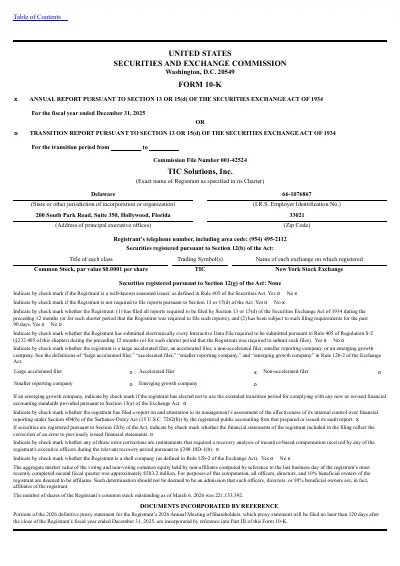
Taken together, these items frame our expected free cash flow generation for 2026. We are excited to be filing our first 10-K as a combined company.
I want to thank our teams across the organization for the care, commitment, and TIC-first mindset that they've demonstrated through this period of change. Many leaders within our businesses have taken on additional responsibilities to move this forward, and the integration momentum and progress we've made reflects the pride and ownership our teams bring to the table every day.
With that, I'll turn the call over to Robbie to discuss our long-term strategy and capital allocation priorities.
Robbie Franklin
Good morning, and thank you, Kristen. I also want to thank our investors for your continued engagement and support.
Before I outline our strategic priorities, I want to reiterate the board's confidence in Ben's leadership and thank Tal for his decades of service. With integration underway, TIC Solutions is a unified platform with meaningful scale across inspection, engineering, and geospatial analytics.
Our revenue base is anchored in non-discretionary maintenance, regulatory compliance, utility programs, and long-cycle investment across critical industries. We support our clients from planning and design through commissioning, maintenance, compliance, and asset optimization.
Our team combines field data collection with design, analysis, and digital capabilities that enhance reliability and reduce operational risk. Our capital allocation framework is disciplined.
We will prioritize deleveraging towards our long-term target, reinvest organically in the highest-return areas of our business, and pursue selective tuck-ins and larger acquisitions that enhance capability, geography, or technical depth at attractive returns. This week, our board authorized a $200 million share repurchase program, which we may use opportunistically based on market conditions.
With scale, diverse end markets, and resilient revenue characteristics, we believe TIC Solutions is positioned to compound earnings and cash flow over time. 2026 is a critical year for TIC Solutions.
We are laser focused on execution and delivering on the targets we have shared with the investor community. We are encouraged by our early results to start the year and have confidence in our team's ability to drive top- and bottom-line growth.
With that, I'll turn the call back to Ben to close our prepared remarks.
Ben Heraud
Thank you, Robbie. As we close, I want to frame where we are going.
2025 was a pivotal year for TIC Solutions. We successfully brought together two scaled organizations, strengthened the balance sheet, and advanced integration while continuing to deliver for our clients without disruption.
The structural tailwinds in our markets remain intact, including infrastructure reinvestment, grid modernization, increasing technical and regulatory complexity, and the continued expansion of mission-critical facilities. As we move into 2026, we are focused on accelerating growth by increasing share of wallet, expanding cross-selling across our segments, and scaling our account coverage, while strengthening how we work together and reinforcing a common culture.
That focus supports continued margin progression and cash generation while maintaining balance sheet strength, which will ultimately drive shareholder returns. I want to take a moment to recognize our teammates across TIC Solutions who have handled a period of significant change with discipline and focus while staying committed to delivering for our clients every day.
Thank you. With that, operator, we're ready to open the line for questions.
Operator
Thank you. We will now be conducting a question-and-answer session.
If you would like to ask a question, please press *1 on your telephone keypad. A confirmation tone will indicate your line is in the question queue.
You may press *2 to remove your question from the queue. For participants using speaker equipment, it may be necessary to pick up your handset before pressing the star keys.
One moment, please, while we poll for your questions. Our first questions come from the line of Chris Moore with CJS Securities.
Please proceed with your questions.
Good morning, this is Will on for Chris.
Kristin Schultes
Morning, Will. Good morning.
Can you talk a little bit more about the integration process in a little more detail? Are there specific milestones you're looking to reach in 2026?
Kristin Schultes
Thank you for the question. I will tell you that I am extremely proud of the team and the momentum that we have so far.
High degree of confidence in our ability to execute on this. Right now, I would tell you that some of our focus areas have been around communications and culture, which is incredibly important, especially during a leadership transition.
We're working through compensation studies and alignment and choosing systems implementation partners. If you think about our commitment of $25 million of savings and capturing half of that this year, think about that as roughly 60% headcount, and the rest non-headcount.
The team is meeting weekly on individual milestones, and on track or ahead of schedule.
That's super helpful, thank you. Then on the top line, can you talk more about the biggest potential synergies and go-to-market strategies?
What are you hearing from customers? Are there any cross-selling opportunities that you're seeing that you weren't thinking about initially?
Ben Heraud
Thanks. We touched on it on the call, but we have some really exciting developments and opportunities that are coming through the cross-selling program.
We've been really pleased with how the segments have been coming together and exploring ideas with their clients. We have a lot of white space between the businesses that create opportunity.
Just pointing to that recent win in Inspection and Mitigation within the data center space, that's really exciting. That's completely new to Inspection and Mitigation.
To be able to get that exposure to that market where we're seeing a lot of tailwinds is exciting. Then on the infrastructure side of things, where we're able to really service the full lifecycle of any kind of asset now with our capabilities from planning and design, consulting and engineering, and through I&M, is driving opportunity for us to service our clients in new ways.
We're seeing a lot of upside. It does take time to get these wins in play.
We've got to put these ideas in front of our clients and get it to a contract. Very pleased with the progress that we're seeing so far.
Thank you.
Operator
Thank you. Our next questions come from the line of Brian Biros with Thompson Research Group.
Please proceed with your questions.
Good morning, this is Chris calling in for Brian. A couple of questions on end markets.
It seems fair to say that some of the smaller exposure categories are the fastest growing. In your released and prepared comments, you called out significant organic growth in data centers, and we know that aerospace is another fast-growing end market.
Both of these, of course, are higher margin businesses. Where do you think these businesses could be in the next 12 to 24 months, and could they represent a double-digit percentage of sales?
Ben Heraud
In terms of organic growth, we've doubled the data center business over the last 12 months and we're continuing to be on track for continued significant growth. Related to that is power delivery and the demand that data centers are putting on the grid.
We're very, very well positioned to exploit that also with our technical capabilities in that space, along with infrastructure and general and the demand that we're seeing there. Some good end markets.
Data centers will continue to grow and outpace certain parts of the business, especially as we layer in new services and increase our revenue per megawatt.
Kristin Schultes
Chris, I would just add that one of the things we're really excited about with the combination of the businesses is the more diversified platform. Really we see all of our end markets as having tailwinds.
Yes, there are pockets of outsized or outpaced growth, but in general, we're really optimistic about all of our end markets.
Ben Heraud
Probably a good indicator of that is the backlog being up 10% year-on-year.
Fantastic. Thanks for the color.
Then can you talk a little bit about your expectations on the inspection side for the energy and oil end markets? I know they can be somewhat lumpy quarter to quarter with the chemical market pressure and how oil and gas is performing.
How should we think about that end market into 2026?
Ben Heraud
We have good visibility on the business. A very large percentage of it is planned outages and run-and-maintain.
Year-on-year, as we look at the number of sites that we're working on, it's similar. In a lot of cases, the contracts have a longer timeline, we have good visibility there.
Fantastic. Thank you for taking my questions.
Kristin Schultes
Thanks, Chris.
Operator
Thank you. Our next questions come from the line of Tomohiko Sano with J.P.
Morgan. Please proceed with your questions.
Tomohiko Sano
Hi, good morning, everyone. Good
Kristin Schultes
morning. Good
Ben Heraud
morning.
Tomohiko Sano
Thank you. Could you talk about the EBITDA margins in the latest 2026 guidance?
I see is lower than what was indicated in your prior outlook, given the considerations of the stock comp to cash comp. I get that, but what other reasons for this more cautious margin outlook compared to what you guided three months ago, please?
Kristin Schultes
Thank you. You're spot on.
The previous range was 15.5% to 16.5%, and that's been adjusted by the stock compensation investment that we've decided to make. We think that's best for the business on the long term and really drives the integration of the teams and provides market-based compensation for our teams.
We feel that that's the right decision. From there, we've given a nice framework for our 2026 guidance, both on revenue and adjusted EBITDA on a consolidated basis, demonstrating substantive growth on the top line as well as margin expansion coming from improved execution across all three segments, as well as the planned cost synergy realization.
Tomohiko Sano
Thank you. Follow up on CEO transitions.
Could you elaborate on the timing and rationale for this transition, and should we expect any changes in strategies or execution, please?
Robbie Franklin
It's Robbie. The transition was sort of contemplated from the onset when we even bought Acuren.
Tal's been in the business for a very long time, and we wanted to create an environment where he could execute and really have his fingerprints on what the combined TIC Solutions entity would look like. We had Ben, who was already CEO of NV5, knew the business, but we wanted to give him sort of the period to learn about Acuren and sort of the inspection side of the business.
In terms of timing, we feel like this is sort of the right transition time as we build sort of this unified culture. Pretty consistent with sort of our original thinking.
The board and the entire team is very supportive of sort of this path.
Tomohiko Sano
Thank you, Robbie. That's all for me.
Operator
Thank you. Our next questions come from the line of Alex Rygiel with Texas Capital.
Please proceed with your questions.
Alex Rygiel
Thank you very much. More broadly, can you address the current situation in the Middle East and the rise in oil prices and how that could impact your business or some of your customers' decisions?
Ben Heraud
The Middle East, it's a relatively small piece of our business, around 1%. It's relatively immaterial right now.
The impacts that we're seeing are minimal on the business there. As far as the price of oil and the impact on the business, we could see some additional work around pipelines.
It's good for our oil sands business. The refinery side of the business is relatively stable.
I mentioned earlier the good line of sight that we have with the run-and-maintain business, and right now the outlook looks good.
Alex Rygiel
Very helpful. Then, as it relates to revenue guidance, which suggests kind of 2% to 7% growth rate, can you talk about the primary variables that could cause this to be either kind of closer to the high end or the low end?
Kristin Schultes
Yeah. From a 2026 perspective on the top line, I would tell you we have a high degree of confidence in this, and it was a very thoughtful approach that we did to the budgeting process this year down to the division level and a bottom-up approach.
Given the tailwinds we have in our business, we feel very confident in our ability to deliver against that.
Alex Rygiel
Thank you.
Operator
Thank you. Our next questions come from the line of Harold Antor with Jefferies.
Please proceed with your questions.
Harold Antor
Good morning, this is Harold Antor on for Sean Moore. Quick question just on the pricing front, could you remind us of pricing historically, how it trended in the quarter, just given you were more disciplined and, as you focus on the margin profile, wanted to walk away from some businesses?
Then I guess, do you see that you guys are better positioned to be more aggressive on pricing just given you provide the full suite of products and services today versus mostly competitors who can't compete in offering? Thank you.
Ben Heraud
Mentioned some of the work that we've done around the organization of our Inspection and Mitigation business in the U.S. That has offered us an opportunity to be more competitive on our pricing and go after more of the work in that space.
A lot of the work that we price is more on a value proposition, fixed fee kind of work, and we continue to see good momentum there. I would also just point back to the backlog being up 10%, and the sales being very positive through the first part of this year already.
Just you mentioned the mix of work, and if we think of this opportunity to work through the lifecycle of an asset, we are very sticky with our clients. We have very strong relationships, and our ability to work through the entire lifecycle of an asset keeps us very sticky with those assets and clients.
Kristin Schultes
Harold, on the pricing, I think also I would just remind you to point back to our Q4 results. Gross margin dollars and percentage were up across all three of our segments.
We feel really good about that heading into 2026, and if you combine that with some of the operational initiatives under Ben's leadership, high degree of confidence.
Harold Antor
Yep. Then just to piggyback on an earlier question, Ben, I think you highlighted that you see line of sight to 100 million in data center revenue.
Just wanted to get a sense, is that a '27 event? Is that a '28 event?
Or is that a longer-term event? Just wanted to get a sense of the timing on that.
Ben Heraud
It's a '26 line of sight. We have a very strong backlog, particularly to that, and we have multi-year programs.
It's an extremely resource-constrained area of the business where we have very strong relationships with the hyperscalers. We see, over the next 12 months line of sight to those numbers.
Harold Antor
Thank you. If I could squeeze in one more, just on capital allocation, you guys did the buyback.
Should we be thinking more of the capital being deployed in buybacks, or do you expect to do a little bit more on the tuck-in side or any organic growth tech implementation of assets that you could provide a little bit more color on? That would be great.
Thank you, and that's all for me.
Robbie Franklin
On capital allocation, we have a robust tuck-in pipeline that we're going to continue to execute on. We thought as a board it was prudent to have the flexibility to have a buyback program in place given where market conditions are.
Frankly, there's no better acquisition than your own stock at the right levels. We have a very opportunistic view on how we approach buybacks, but there's no question we're continuing with tuck-in pipeline because it creates a more robust operating profile and allows us to new geographies and new service lines, which are critical to sort of our investment thesis.
Kristin Schultes
Harold, I would just add that on the tuck-in side that Robbie mentioned, I'm really proud of the team's ability to continue maintaining focus on the broader integration with the merger, but also remain focused on the importance of the small tuck-in strategy that we have that's been largely successful for us. We completed three small tuck-ins during the quarter, and the combined business together added 12 for the full year, and that's across all three segments.
We're excited to continue that into the new year.
Operator
Thank you. As a reminder, if you would like to ask a question, please press *1 on your telephone keypad.
Thank you. We have reached the end of our question-and-answer session.
I would now like to hand the call back over to Ben Heraud for any closing comments.
Ben Heraud
Thank you all for your questions. I just wanted to re-emphasize our strategic priorities to drive shareholder value.
One, we need to accelerate our organic growth, and we will. Two, we're going to strengthen our organizational alignment and cultural cohesion.
Three, drive margin expansion. Finally, I want to thank our investors for their continued support and partnership.
We look forward to updating you on our next quarter. Thank you all, and have a good day.
Operator
Thank you, ladies and gentlemen. This does now conclude today's teleconference.
We appreciate your participation. You may disconnect your lines at this time.
Enjoy the rest of your day.