Tilly's, Inc.
NNYSE:TLYSQ3 FY2026 · Earnings Call TranscriptDecember 3, 2025
Operator
Good afternoon, and welcome to Tilly's third quarter 2025 earnings conference call. All participants will be in a listen-only mode.
Should you need assistance, please signal a conference specialist by pressing the star key followed by 0. After today's presentation, there will be an opportunity to ask questions.
To ask a question, you may press star then 1 on a touch-tone phone. To withdraw your question, please press star then 2.
Please note this event is being recorded. I would now like to turn the conference over to Gar Jackson, Investor Relations.
Please go ahead.
Gar Jackson
Thank you, operator. Good afternoon, and welcome to the Tilly's fiscal 2025 third quarter earnings call.
Nate Smith, President and Chief Executive Officer, and Michael Henry, Executive Vice President and Chief Financial Officer, will discuss the company's business and operating results, and then host a Q&A session. For a copy of Tilly's earnings press release, please visit the Investor Relations section of the company's website at tillys.com.
From the same section shortly after the conclusion of the call, you will also be able to find a recorded replay of this call for the next 30 days. Certain forward-looking statements will be made during this call that reflect Tilly's judgment and analysis only as of today, December 3rd, 2025, and actual results may differ materially from current expectations based on various factors affecting Tilly's business.
Accordingly, you should not place undue reliance on these forward-looking statements. For a more thorough discussion of the risks and uncertainties associated with any forward-looking statements, please see the disclaimer regarding forward-looking statements that is included in our fiscal 2025 third quarter earnings release, which was furnished to the SEC today on Form 8-K, as well as our other filings with the SEC referenced in that disclaimer.
Today's call will be limited to 1 hour and will include a Q&A session after our prepared remarks. I will now turn the call over to Nate.
Nate Smith
Thank you, Gar, and good afternoon to everyone joining us today. I have now been with Tilly's for 3.5 months.
Having spent a good portion of my career on the brand side of the industry, I have always viewed Tilly's as a powerful retailer with a lot of opportunity, which is what attracted me to join the company. I've had the opportunity to get to know our team, familiarize myself with our processes, and participate in fiscal 2026 departmental budget meetings.
We have a highly experienced and talented team that is incredibly passionate about this business and is hyper-focused on efforts to get Tilly's back to a profitable and sustainable growth model. I've been impressed by the level of effort and commitment I've seen from our team not only since I've arrived, but also by how hard they worked to try to turn this business around prior to my arrival.
We believe we are now seeing green shoots of progress from those collective efforts. I'm very excited to announce that the third quarter of fiscal 2025 produced our first positive quarterly comparable net sales result since the fourth quarter of fiscal 2021, with positive comps in each month of the quarter and positive comps in stores for each week of the quarter.
Coming on the heels of a profitable second quarter, our third quarter performance gives us confidence that we have started to stabilize our business and are moving in the right direction. It is also worth mentioning that the positive sales trend in the third quarter has continued into the fourth quarter, with double-digit store comps and an accelerating sales trend overall in October and November compared to August and September.
We believe that these results are a direct byproduct of our strategic initiatives around merchandise assortment, inventory planning, marketing, and expense management, and our team's ability to execute them. We are very encouraged by our progress, yet still have a lot to accomplish to reach our goal of producing profitability on a consistent basis.
First and foremost, we must continue to grow sales in healthy ways. We plan to increase the sales penetration of our proprietary brands to approximately 40% on an annualized basis, an increase of approximately 3 points from our current year-to-date penetration, to seek to improve product exclusivity and control over logistics, pricing, and product margins.
Our customers have been choosing our proprietary brands to a greater extent this year than in the past, and we believe more opportunities exist. We must consistently remain on trend and produce a high-quality assortment to accomplish our goal.
While doing that, we will continue to source and support lifestyle-relevant third-party brands, which has always been at the core of our multibrand business and what our customers love about us. This is not expected to change.
We do not plan to over-index on proprietary brands to the detriment of our important third-party brand partners, but we believe there is a better balance to be found that can generate greater sales and product margins for us overall. Additionally, we are leaning heavily into social commerce, and we've already seen rapid growth in sales this year from our TikTok shop launched back in March.
As we aim to build stronger connections and consideration for Tilly's, it's important that we clearly understand who our customers are and how we think about building our merchandise assortments from them, for them. To that end, we recently completed an extensive consumer segmentation survey that defined six primary consumer profiles that currently exist in our customer demographics and drive a substantial majority of our business.
We serve a variety of consumer types, not just one, and we must carefully plan how our assortment choices speak to these consumer profiles to help them define their look and build greater following for Tilly's over longer periods of time. We must now work to operationalize our understanding of these consumer profiles into our assortment building and marketing processes to help us to continue to make progress towards improving our business.
We will continue to invest in exclusive opportunities to build awareness, consideration, and following for Tilly's. We have been very active in this regard recently, and plan to continue to be going forward.
For example, in late October, we launched a brand ambassador campaign featuring one of the original and most followed TikTok content creators, Loren Gray, who has over 50 million TikTok followers in addition to being an actor, singer, and Tilly's customer while growing up. We will be hosting a VIP customer experience with Loren in our Irvine Spectrum store this Saturday on December 6th.
We believe she is a great representation of our brand ethos of fostering self-confidence and mental wellness through expression of personal style. We also held an exclusive pop-up event in our Irvine Spectrum store in late October with Malibu Skye brand founder and CEO Tia McKenzie, which was live-streamed via TikTok.
We believe these impressive and successful young women align with our brand very well, and we're looking forward to seeing the impact that these kinds of engagements can have for us as we continue to evolve how we think about utilizing our marketing resources. On the operational side of things, we are in the process of both implementing and evaluating various technological upgrades that we believe will improve our performance going forward.
In September, we launched an AI-driven price optimization tool. Early indications are that this tool is leading to improved average unit retail selling prices with sharper, more surgical pricing decisions leading to improved product margins and sell-through rates.
In the second half of fiscal 2026, we plan to launch an AI-driven merchandise replenishment and allocation tool to improve inventory efficiency in our stores and online. We also plan to launch RFID in our stores to improve inventory accuracy, customer experience, and in-store efficiency.
Finally, we are exploring the use of agentic AI in our business and believe there are some exciting opportunities to improve operational efficiencies through automation in certain aspects of merchandise planning and allocation, distribution, store labor planning, and marketing campaign development. In closing, it's an exciting time to be here at Tilly's with ample opportunities to continue improving the business.
As I said before, the team has worked very hard to get to this point, yet we have so much more in front of us that can be accomplished to continue building upon the momentum we are currently seeing and the progress made thus far. I'm excited to be here, the team is enthusiastic, and I look forward to discussing our progress with you as time goes on.
I will now turn the call over to Mike to share the details about our third quarter operating results and our fourth quarter outlook.
Michael Henry
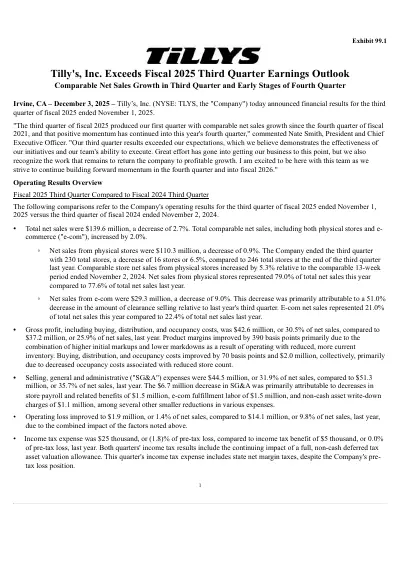
Thanks, Nate. Details of our third quarter operating results compared to last year's third quarter were as follows: Total net sales of $139.6 million decreased by 2.7%.
Comparable net sales for the 13-week period ended November 1, 2025, including both physical stores and e-com, increased by 2%, with an increase from physical stores of 5.3% and a decrease from e-com of 9%. Total net sales from physical stores decreased by 0.9%, primarily due to a 6.5% reduction in year-over-year store count.
Net sales from physical stores represented 79% of total net sales compared to 77.6% last year. The net sales decline online was primarily attributable to a 51% reduction in clearance sales compared to last year's third quarter, indicating a much healthier full-price quality of online sales this year.
E-com net sales represented 21% of total net sales compared to 22.4% last year. Gross margin, including buying, distribution, and occupancy expenses, was 30.5% of net sales, an improvement of 460 basis points compared to 25.9% of net sales last year.
Product margins improved by 390 basis points as a result of higher initial markups and lower total markdowns associated with operating with reduced and more current inventories than a year ago. Buying, distribution, and occupancy costs improved by 70 basis points and were reduced by $2 million in the aggregate, largely due to lower occupancy costs associated with our reduced store count.
Total SG&A expenses were $44.5 million, or 31.9% of net sales, a reduction of $6.7 million compared to $51.3 million, or 35.7% of net sales, last year. Primary SG&A reductions compared to last year's third quarter were attributable to store payroll and related benefits of $1.5 million, e-com fulfillment labor of $1.5 million, lower non-cash impairment charges of $1.1 million, and a variety of smaller reductions across several line items.
Pretax loss improved to $1.4 million, or 1% of net sales, compared to $12.9 million, or 9% of net sales, last year. Income tax expense was $25,000, a negative 1.8% tax rate, compared to an income tax benefit of $5,000 last year and near zero tax rate.
Both years include the continuing impact of a full non-cash valuation allowance on our deferred tax assets. This quarter's income tax expense, despite our pretax loss position, was attributable to state net margin taxes.
Net loss improved to $1.4 million, or 5 cents per share, compared to $12.9 million, or 43 cents per share, last year, representing an improvement of $11.5 million, or 38 cents per share, versus last year's third quarter. Turning to our balance sheet, we ended the third quarter with total liquidity of $100.7 million, comprised of cash of $39.1 million and available undrawn borrowing capacity of $61.6 million under our asset-backed credit facility.
Net inventories decreased by 12.8% compared to the end of the third quarter last year. Total year-to-date capital expenditures for the first three quarters were $3.4 million compared to $6.7 million last year.
Turning to the fourth quarter of fiscal 2025, fiscal November marked our fourth consecutive month of comparable net sales growth. Through December 2, 2025, quarter-to-date comparable net sales increased by 6.7% relative to the comparable period ended December 3, 2024, including comparable net sales growth of 9.3% from Thanksgiving Day through yesterday.
Based on current and historical trends, we currently expect the following for our fiscal 2025 fourth quarter operating results: Total net sales to be in the range of approximately $146 million to $151 million, translating to a comparable net sales increase of 4% to 8%, respectively. We currently expect to generate product margin improvements of approximately 300 to 350 basis points compared to last year's fourth quarter.
SG&A to be approximately $50 to $51 million before factoring in any potential non-cash store asset impairment charges which may arise. Pretax loss and net loss to be in the range of approximately $5.6 million to $3.5 million, respectively, with a near-zero effective income tax rate due to the continuing impact of the previously disclosed full non-cash valuation allowance on our deferred tax assets.
Loss per share to be in the range of 19 cents to 12 cents, respectively, compared to a loss per share of 45 cents in last year's fourth quarter, with estimated weighted average shares of approximately 30.1 million. We currently expect to close seven stores near the end of the fourth quarter to bring our total store count to 223 at the end of the fiscal year, a net decrease of 17 stores, or 7.1%, from the end of fiscal 2024.
The actual number of store closures may still increase by fiscal year-end depending on the outcome of remaining store lease negotiations. In closing, we're encouraged by the forward momentum we've been building during fiscal 2025, as evidenced by our sequential improvement in quarterly comparable net sales trends since the end of fiscal 2024 into positive territory for the third and fourth quarters of 2025.
We believe we're on the right path to continue delivering improvements relative to the prior year in the fourth quarter and on into fiscal 2026. Operator, we'll now go to our Q&A session.
Operator
Thank you. We will now begin the question-and-answer session.
To ask a question, you may press star then 1 on your touch-tone phone. If you are using a speakerphone, please pick up your handset before pressing the keys.
If at any time your question has been addressed and you would like to withdraw your question, please press star then 2. The first question will come from Matt Koranda with Roth Capital.
Please go ahead.
Matthew Butler Koranda
Hey, guys. Good afternoon, and congrats on the return to positive comps.
I guess let's start there. What I wanted to hear a little bit more on was how much do you attribute to the better assortment that you're holding versus sort of the different marketing posture that you've been talking about for a quarter or so?
Maybe just unpack what you think the key drivers were to the return to positive comps. Then the acceleration into the fourth quarter, wanted to hear more about what may be enabling that, because given, I guess, the product gross margin guide, it doesn't look like it's heavily promotion-driven.
Just wanted to hear a little bit more on what's driving the recent acceleration.
Nate Smith
Thanks, Matt. I think to your question of what components are driving the positive comps, I truly feel it's a combination of both the assortment and the marketing.
I would say our head merchant and his team have done a really great job bringing in third-party brands that are trend-relevant, and then obviously mixing that in with proprietary brands in collections that really resonate with our customers. I have to give equal weight to our marketing team.
They've done a really great job promoting Tilly's and what we stand for. I would say, I would call it 50/50.
Michael Henry
Then I'll add in here, Matt, on your question about the acceleration into the fourth quarter. It definitely has not been promotionally driven.
Generally speaking, product margins in the fourth quarter are the lowest of the fiscal year because of the Black Friday promos and deals around Christmas that occur. However, that's always been the case in the fourth quarter, and as we noted, we're anticipating improving our product margins by 300 to 350 basis points for the quarter.
We just did 390 improvement in Q3. We've been on this path of improving our product margins all through last year and this year.
If you'll recall, our fiscal '23 product margins were the lowest in company history, and so that was certainly a focus of ours of starting the pathway towards improvement during 2024 to start regaining some of that lost ground on product margin, and we've certainly accelerated that this year, and particularly these last couple of quarters, which I think, again, speaks to the quality of the merchandise assortment, the brands we've been building in, all the work the merchant teams had done to improve our business.
Matthew Butler Koranda
That's good to hear. Then maybe just a little bit more on the composition of the improving comp.
Are you seeing positive traffic embedded in that positive accelerating comp that you're talking about? I guess how much is in ticket as well?
I was just curious sort of the decomposition of that.
Michael Henry
Sure. It's mostly driven by an improvement in conversion rate, improvement in average sale value, and an increase in transaction count.
Traffic has been roughly flat quarter-to-date in the fourth quarter. We did have positive store traffic on Black Friday itself, but quarter-to-date through yesterday we're sitting just slightly below flat, -0.4%.
It's really been a 6% to 7% increase in each of our conversion rate, our average sale transaction value, and transaction count.
Matthew Butler Koranda
Okay. All right, helpful, Mike.
Thank you. I wanted to hear a bit more on the private brand penetration that you're talking about.
It sounds like you're ratcheting up the targeted percentage of revenue that may be coming from private label. How soon can you get to the penetration you're talking about?
I guess why are you confident that that's the right approach? This seems like the environment where maybe you have a bit of a trade-down, consumers looking for value, they may be looking to trade in a private label for now, but then if the environment shifts, there's maybe some risk to the inventory strategy.
Just wanted to hear a little bit more about sort of why you think it's the right way to proceed.
Nate Smith
I think I can start and then Mike, maybe you've got some thoughts. We have seen really strong sell-through on our proprietary brands year-to-date, we've seen that trend continue.
I think the expansion we're doing, Matt, is really I don't want to call it ever so slight, but I don't think it'll be noticed at the store level. It will happen over time, I would say over the next 3 to 5 months.
I don't think it's a dramatic shift in our business, but I think the team has really seen, and we have seen, really great sell-through and seen our proprietary brands resonate with our consumers.
Michael Henry
I'd just say, I think our merchant teams have done a really solid job in developing Rescue, RSQ, our number one brand. Has been our number one brand for the last couple of years, and they've continued to grow it.
I think we've done a good job of being on-trend with good quality product overall. Our year-to-date private label penetration is just under 37%, we're talking about moving it 3 points, as Nate noted in his prepared remarks.
There are actually weeks right now where we're already north of 40%, quite honestly. We're talking on an annualized basis.
It does fluctuate through the year up and down depending on the season, but it doesn't seem like a far stretch for us to go ahead and increase that by a couple percentage points. That's also some of the impact that you're seeing into the improvement in product margins as well.
As private label increases, generally speaking, product margins will go along with it.
Matthew Butler Koranda
That's helpful. For context, I guess, what have you said publicly, guys, on sort of the margin spread between your private label versus third-party brands, and how should we be factoring that into sort of the margin improvement over time?
Michael Henry
We haven't really given any details because it's different by product category, you'd have to get a lot more granular, which obviously we don't want to do that in a public setting like this.
Matthew Butler Koranda
Fair enough. Then I guess one of the other things you mentioned was the e-com headwinds in the quarter were really driven by less clearance selling.
Remind us when we started the newer strategy in the e-com channel in terms of just fewer clearances. When do we lap that, and potentially I guess that becomes a bit less of a drag on the top line go forward?
Michael Henry
It's been an effort of ours all year long, really entering this fiscal year. You'll recall we had much higher inventory level than we would have liked exiting last back-to-school and going into the holiday season.
Certainly had a very disappointing holiday quarter last year, and so we had to work our way out of inventory early this year through discounting as well as jobbing some things out to get rid of what didn't work. As you'll know having followed us as long as you have, once products have lived their healthy life in stores and have been through reg price selling, first markdown, and then clearance, we tend to transfer things back to online.
Online over the history of our company has proven more effective at working through clearance items than stores. We want the latest and greatest to be sitting in stores in the physical space, as well as online, but online has generally proven to be a little more efficient at handling clearance business.
There was too much of it last year, just quite frankly. That was really the driver of the negative on the online comp in Q3.
There's still a meaningful reduction in the percentage of clearance business this year in the fourth quarter compared to last year, and that will continue to be something that will go up against through the first quarter, especially given how much clearance we were doing at the time.
Matthew Butler Koranda
Okay. All right, that makes sense, Mike.
Thanks for the context. Then I guess just maybe one or two more, but on SG&A, it looks like really good control on the SG&A expense, and pretty notable store payroll reduction, some pretty notable fulfillment reductions as well, I guess.
How sustainable are those on a go-forward basis? How should we be thinking about maybe some operating leverage in the model go forward if the positive comp momentum sustains?
Michael Henry
The leverage will really come from improved sales per square foot productivity in stores. That's ultimately what we need.
We're trying to be as thoughtfully sharp on our store payroll usage as we can, and in the third quarter in particular, our stores used, on average, 7% fewer hours than they did a year ago while producing a positive comp. That's a tremendous effort, great deal of improved efficiency there.
It's something that we pay strict attention to every single week all year long. It's a constant battle, trying to be as efficient as we can, trying to project individual store volumes as tightly as we can to make sure that we're putting our best effort at being as efficient as possible.
That's going to continue. Assuming that we continue to deliver improving comps and improved productivity, some of the raw dollars will continue to go up.
We're going to continue to have minimum wage increases in certain jurisdictions. Those are pretty constant these days; every year we have another round of them.
We're doing everything we can to be as sharp as we can from an efficiency standpoint, and our store teams have just done a fantastic job in that regard, if you ask me.
Matthew Butler Koranda
Yeah. Great.
Maybe just last one, I'll make it two-pronged and leave it for whoever else wants to pick up the Q&A here. On the capital allocation and footprint front, one, store posture seems like, are we done with store closures for the near term or is there more we could do heading into next year to kind of right-size the fleet?
Then on the RFID implementation that you guys mentioned, just curious, is there incremental cost associated with that heading into next fiscal year, I guess, or even in the near term? Just wanted to hear a little bit more about how that may impact capital expense going forward.
Michael Henry
Yeah. We noted that we have seven store closures coming up towards the end of the fourth quarter.
There's still some more that could happen depending on the outcome of remaining lease negotiations here in the last couple months. We've been taking action on stores as we can at natural lease expiration or as available lease kick-out clauses come up that we can execute.
That's going to continue. If a store is not acceptably profitable and we can't get the lease structure reset to be more reflective of where our current reality is, we're going to have to close stores as those opportunities present themselves.
That's been a consistent effort of ours for the last few years, but I think this year you've seen more closures than at any time in the company's history previously. Just so happens there've been quite a number of stores coming up that were not acceptably profitable or cash generating, and we've been getting rid of them as we have the opportunity to do so.
Then on RFID, not a major spend there that would move the dial as you look at the total business. These technology investments that we're talking about have been in the works for some time.
We've already initiated some of the preliminary work this year, some of that spend is already in this year, and there will be some that'll be added into next year, but not in a way that should create any meaningful expense increase that you'd notice.
Matthew Butler Koranda
Okay. All right, I'll leave it there, guys.
Great job. Thanks.
Michael Henry
Thank you. That
Operator
concludes our question-and-answer session. I would like to turn the conference back over to Nate Smith for any closing remarks.
Nate Smith
Thank you for joining us today. We look forward to sharing our fiscal 2025 fourth quarter results with you in mid-March of 2026.
Have a good evening.
Operator
The conference has now concluded. Thank you for attending today's presentation.
You may now disconnect.