TMC the metals company Inc.
NNASDAQ:TMCQ4 FY2025 · Earnings Call TranscriptMarch 27, 2026
Operator
Thank you for standing by. Welcome to The Metals Company fourth quarter 2025 corporate update conference call.
At this time, all participants are in a listen-only mode. After the speakers' presentation, there will be a question-and-answer session.
To ask a question during this session, you will need to press *11 on your telephone. You will then hear an automated message advising your hand is raised.
To withdraw your question, please press *11 again. Please be advised that today's conference is being recorded.
I would now like to hand the conference over to your speaker today, Craig Shesky. Please go ahead, sir.
Craig Shesky
Thank you very much. Please note that during this call, certain statements made by the company will be forward-looking and based on management's beliefs and assumptions from information available at this time.
These statements are subject to known and unknown risks and uncertainties, many of which may be beyond our control. Additionally, please note that the company's actual results may differ materially from those anticipated, and except as required by law, we undertake no obligation to update any forward-looking statement.
Our remarks today may also include non-GAAP financial measures, including with respect to free cash flows. Additional details regarding these non-GAAP financial measures, including reconciliations to the most directly comparable GAAP financial measures, can be found in our slide deck being used with this call.
You are welcome to follow along with our slide deck, or if joining us by phone, you can access it at any time at investors.metals.co. I'd now like to turn the call over to our Chairman and CEO, Gerard Barron.
Gerard, please go ahead.
Gerard Barron
Thank you, Craig, and apologies to those on the line, we were a few minutes late. We were waiting for a wire to cross the line.
But [unclear] but a welcome to you all. Before we get to the path forward, I'd like to take a moment to reflect on our journey over the last year.
One year ago, to the day, in our fourth quarter earnings call, we announced a regulatory pivot that fundamentally changed our company's destiny. Instead of the uncertainty and gridlock of the ISA, we chose the certainty and clarity of the U.S.
regulatory regime, built upon a long-established legal framework under DSHMRA, and catalyzed by the political will of this administration. In April, this political will was made evident by President Trump's executive order, Unleashing America's Offshore Critical Minerals and Resources, which marked America's return to leadership in deep seabed minerals.
Some of the directives in this EO have already been delivered, including the modernization [unclear] and of the NOAA [unclear] signaled that the [unclear] further evidenced by [unclear] announced in the second [unclear] among others [unclear] new economic [unclear] assessment [unclear] present value for [unclear] billion dollars [unclear] mineral resource [unclear] by [unclear]
Craig Shesky
Gerard, sorry to interrupt. Your line is cutting in and out.
Gerard Barron
One moment. [unclear] the roadmap for [unclear] In 2026, we focused on accelerated execution, starting with permitting.
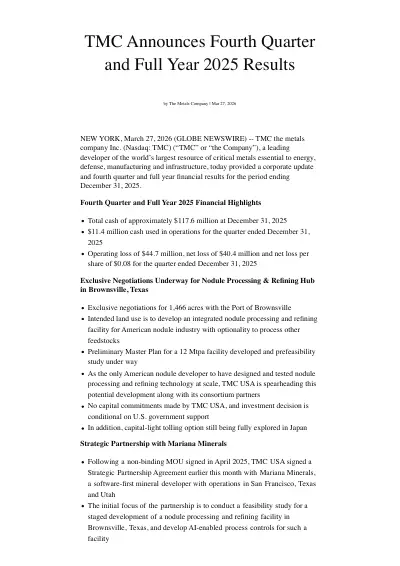
Our consolidated application submitted to NOAA in January this year has been deemed substantially compliant, and we expect our permit to be granted in less than one year from today. This permitting clarity also provides confidence to us and our partners to get building in anticipation of commercial production.
Offshore, we have reached commercial agreement on key terms with our long-term strategic partner, Allseas, and continue to progress the engineering work for the long lead items for our forthcoming production system, and we expect this agreement to be finalized in the coming days. Onshore, it's also clear that the U.S.
wants to dominate the onshore processing and refining polymetallic nodules, establishing a counter to China's stranglehold on the production of critical minerals. To do that will require support from the government itself, [unclear] requisite for [unclear] is a [unclear] I'm pleased to share [unclear] at the Port of [unclear] Texas, and have also reached agreement with our partner, Mariana Minerals, to progress the feasibility work as part of the TMC owners team, but more on this shortly.
Since day one, we knew success would depend on building a bench of exceptional partners, and with the expertise to tackle complex challenges and the conviction to back a new industry. As this chart shows, we've brought together a strong group of experienced partners across the value chain, each bringing a unique skill set to our vision of reimagining the metals and mining sector.
What's changed and what matters is momentum. Many of our existing partners have deepened their commitments, reinforcing their belief in the long-term opportunity.
We're also welcoming new partners who share our belief that this industry will be built in the United States. That growing alignment is a clear validation of where this industry is heading.
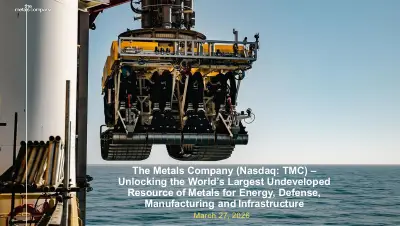
As I mentioned earlier, we've agreed key commercial terms with Allseas to complete the development and operate the Hidden Gem offshore system, the first-ever commercial nodule collection system. The continued strategic alliance, which will be memorized in the coming days, brings together Allseas' decades of offshore execution expertise with our proven resource, environmental, and processing platform into a single integrated system, designed for a nominal capacity of 3 million wet tons per annum using the Hidden Gem, two collector vehicles, and a vessel to transfer nodules to bulk carriers for shipment to shore.
Allseas are currently working on key long lead items, like the riser, our launch and recovery systems, and the umbilical. We look forward to signing this definitive agreement in the coming days and continue to progress toward system commissioning still targeted for Q4 2027.
One of the key actions outlined in last year's executive order was the directive for various government agencies to identify potential sources of financial support for this industry. In order to unlock government support for onshore processing, there are a few boxes we must tick, including a site-specific plan and feasibility studies.
To that end, back in December last year, we secured an exclusive right over a potential lease option in the Port of Brownsville, Texas, near where plans have been recently announced by this administration for the first new U.S. oil refinery in decades, underscoring the broader momentum behind strengthening American industrial capacity.
We've developed a preliminary master plan, and a pre-feasibility study is already underway for a 12 million ton per annum nodule industrial park. Of course, existing capital-light tolling options are still available to us, and will not be committing any capital at this time.
I'm certainly excited about what a domestic nodule processing hub can mean for both new partnerships and for our project economics. Processed domestically, our nodule resource could single-handedly solve the American supply chain dependency across four key metals.
As I mentioned, one of the requirements to unlocking funding is the preparation of a feasibility study for a processing plant at a specific site. To that end, we're adding a new strategic partner to our bench in Mariana Minerals.
Mariana CEO, Turner Caldwell, seen here speaking at last year's Strategy Day, is someone we know well from his time at Tesla, where he headed up global battery metal supply. The Mariana team are pioneers of AI and software approaches to project development and metallurgical processing, and have demonstrated their ability to fast-track project execution, which enabled Tesla to build its lithium plant in Texas in less than two years.
The Mariana team will be joining as part of the TMC owners team, and we already enjoy a good working relationship with their team. Mariana's approach is core to how cutting-edge businesses like SpaceX and others operate.
With AI, we think they can move even faster and believe their innovative model offers a faster, more modern approach to re-industrialization. Subject to further definitive agreements, we look forward to exploring how their systems could reduce permitting and construction timelines for a domestic plant, while reducing opex and [unclear] increasing recovery of payable metals.
In fact, right after this call, our executive team will convene in Texas with the Mariana team for the next week to progress this mission-critical work, which is also a prerequisite for certain U.S. involvement.
I'm also pleased to share that in April, just days away, The Metals Royalty Company will begin trading on the NASDAQ under the ticker TMCR. A quick refresher: formed with the goal of onshoring critical minerals production in the U.S., TMCR has a 2% gross royalty on our NORI area, resulting from an agreement we signed with Low Carbon Royalties in 2023.
We retain the right to repurchase up to 75% of that royalty over time at a capped return, which could potentially reduce the royalty to just 0.5 of 1%. TMC also maintains a 25% equity stake in TMCR.
Many TMCR faces will be familiar to our followers, including current and former board members, Michael Hess and Brian Paes-Braga. With their backing and a strong team behind them, we see TMCR as a strategic vehicle which can potentially provide future options for capital and sizable project finance.
I'd now like to turn the call over to Craig to discuss some industry updates, our regulatory path ahead, and our financials.
Craig Shesky
Thanks, Gerard. One quick note that we shared actually in recent weeks on our social accounts: we recently joined the Defense Industrial Base Consortium, DIBC, [unclear] partnership within the Department of War's [unclear] expansion and investment prioritization directorate [unclear] of our capabilities.
This initiative gives the government the tools that need by [unclear] commercial solutions that can help close supply chain vulnerabilities and strengthen the defense industrial base. Of course, critical minerals and seabed are focus for the U.S.
and allies, and over the past year, we've seen investors and operators effectively vote with their feet, gravitating toward regulatory frameworks that offer clarity and a credible path to commercialization. While the ISA remains in gridlock, the U.S.
has emerged as a leading jurisdiction, and certain allies are relying upon the U.S. and certain areas of expertise to develop seabed resources.
This shift is being echoed at the government level, while in March, the U.S. and Japan announced a new Critical Minerals Action Plan with an explicit focus on accelerating cooperation on commercially viable deep-sea mining.
Against this backdrop, we remain the only seabed mineral developer with SEC-compliant mineral reserves, which is the clearest definition of commercial viability, positioning us at the forefront of this emergent industry. In January, NOAA finalized revisions to accelerate permitting under the Deep Seabed Hard Mineral Resources Act, introducing a consolidated application process that meaningfully streamlines the path to commercial recovery.
TMC moved quickly to take advantage of that clarity, submitting the first consolidated application under this new framework. This application expands our expected commercial recovery area from 25,000 square kilometers to approximately 65,000 square kilometers, and is designed to significantly reduce permitting timelines.
Importantly, it reflects the strength of our technical readiness and our ability to meet NOAA requirements for commercial-scale operations. We see this as a clear signal that the U.S.
regulatory path is active, predictable, and capable of supporting responsible development. Now with more than 10 applications in the system, it is evident that the broader industry is aligning around the U.S.
framework. The last time we updated you, we were progressing systematically through the NOAA permitting pathway, and that remains the case today, even under this new consolidated path.
With the consolidated application now active under NOAA's new rule, we have greater clarity on the process ahead and a clear line of sight on the key milestones required for final approval. Our experience over the last year, particularly through NOAA's review of our exploration licenses, has provided valuable insight into the process and expectations for both TMC USA and NOAA.
We announced on March 9th that we passed the first of these milestones, with NOAA determining our application to be substantially compliant, and the next potential milestone being full compliance. Based on this progress and what we've learned, we now expect the grant of our commercial recovery permit within the next 12 months.
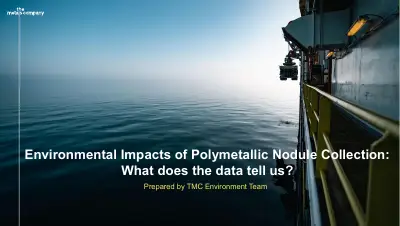
Now, to get to this point, it's taken over $700 million and hundreds of research days at sea, and we are now nearing the completion of our environmental impact statement, and our EIA is complete. Informed by the largest environmental dataset in history, over a petabyte in size, this comprehensive document reflects 15 years of scientific research conducted alongside leading institutions and demonstrates our ability to responsibly collect nodules using modern systems designed to maximize efficiency while minimizing environmental impact.
Put simply, better science leads to better design, and better design leads to better environmental impacts. For those with a keen eye on our social media, you may have noticed that we've begun sharing key findings from our EIA publicly during a new video series, highlighting how our data addresses environmental concerns and how innovation has reduced our environmental footprint.
I encourage you all to check this out, and you can click on the PDF of this posted on our website to get to those videos directly, or we encourage you to follow TMC on our social accounts, including Twitter and LinkedIn. We look forward to our EIS being made available for public comment soon, as per NOAA's transparent and accountable process.
As many of and there may be some on the call who were with us in the room, we published a pre-feasibility study and an initial assessment alongside our Strategy Day in New York last August. Covering our first production area, the PFS documented world-first reserves for a nodule project, demonstrating clear commercial viability.
Our initial assessments covered everything else that you see in royal blue amongst our contract areas on this page. Keep in mind that neither of these comprehensive studies, which were signed off by multiple independent qualified persons, cover additional ground over which we now have priority right through the U.S.
process. This is represented in the lighter gray on this page.
Given the proximity of these areas to those covered in our published technical studies, we do believe that these areas support significant exploration upside. At current metal prices, shifting to project economics, it's clear that these projects are incredibly valuable.
If you combine the $5.5 billion net present value of our pre-feasibility study and the $18.1 billion NPV for the initial assessment, you arrive at a total estimated resource of $23.6 billion. Over the life of both projects on an undiscounted basis, the studies outline revenue of approximately $369 billion, EBITDA in excess of $200 billion, and a position in the first quartile of the cost curve, as laid out in our PFS.
However, despite the clear value of this high-quality and abundant resource and our expected low-cost positioning, our valuation does remain below of comparable peer developers and explorers. On the left side of this page, you'll see a TMC valuation example where we're trading at about 8% of our underlying net present value, well below peer averages for explorers and developers and certainly below the average of nearly one-times NAV for nickel and copper producers.
As we march toward clear permitting path and commercial production, we are looking forward to a significant re-rating in this valuation story. On to liquidity, TMC reported year-end 2025 cash balance of $117.6 million, and we expect at month-end for March 31st, 2026, to report approximately $110 million in cash.
TMC liquidity, defined as cash plus borrowing capacity on our unsecured credit facility, stood at $162 million at year-end 2025, and is approximately 150 more and is expected to be approximately $154 million around month-end March 31st, 2026. This means we have no imminent need to raise funds in the public markets.
As discussed in our last several quarterly conference calls, however, we are filing a new Form S-3 shelf registration statement in conjunction with our upcoming 10-K as a matter of good corporate housekeeping. We do intend, at some point in the future, to refresh our ATM.
However, there has been no ATM use by the company since April of 2025. On to our financial results: in the fourth quarter of 2025, TMC reported a net loss of $40.4 million, or 8 cents per share, compared to a net loss of $16.1 million, or 4 cents per share, for the same period 2024.
The net loss for the fourth quarter of 2025 included exploration and evaluation expenses of $10.6 million versus $8.3 million in the fourth quarter of 2024, general and administrative expenses, or G&A, of $34.1 million versus $8.1 million G&A in the comparable quarter last year, and a credit of $4.3 million from other non-operating items versus a credit of $0.3 million from other non-operating items in Q4 2024. Exploration and evaluation expenses increased by $2.3 million in the fourth quarter of 2025 compared to the same period in 2024, primarily resulting from an increase in share-based compensation due to accelerated amortization of awards granted in the third quarter of 2025, partially offset by lower mining, technological, and process development costs resulting from decreased engineering work.
G&A expenses increased by $26 million in the fourth quarter of 2025 compared to the same period in 2024, reflecting an increase in share-based compensation due to the accelerated amortization of awards granted to directors and officers in the third quarter of 2025, and an increase in legal, consulting, and personnel costs. Other non-operating items that reduced the net loss in Q4 2025 included higher interest income generated from our increased cash balances, and a gain resulting from the dilution of our ownership interest in the Metal Royalty Company, The Metals Royalty Company, as it completed a private placement to third parties at a price well in excess of book value.
On free cash flow, the free cash outflow for the fourth quarter of 2025 was 150 excuse me, was $11.5 million compared to $13.8 million for the fourth quarter of 2024. Net cash used in operating activities was $11.4 million compared to $13.8 million for the fourth quarter of 2024, primarily due to lower personnel and environmental payments, coupled with the interest earned on the higher cash balance in 2025, and partially offset by higher legal payments.
Focusing on the full-year basis for the cash flow, on a full-year basis, free cash outflow for 2025 was $43.1 million compared to $44 million in 2024. Net cash used in operating activities was $42.9 million compared to $43.5 million in 2024, reflecting lower environmental and mining technological payments, and interest earned on the higher cash balance in 2025, partially offset by higher underutilization fees paid on the unsecured credit facilities, timing of payment on regulatory fees, and higher legal payments.
Free cash flow is a non-GAAP measure, and I would point you to the non-GAAP reconciliation included in this slide deck. We believe that our cash on hand will be sufficient to meet our working capital and capital expenditure requirements for at least the next 12 months from today.
Looking at the balance sheet over the course of 2025, there was a significant increase in the cash balance as the following funds were received: $85.2 million from the Korea Zinc investment, $41.2 million from other registered direct offerings, including the Hess family investment, $14.8 million from ATM use, and $27 million from the exercise of various stock options and warrants. A portion of these proceeds was used to repay the $7.5 million Allseas working capital loan, along with other outstanding interest thereon, as well as a $4.3 million draw on the ERAS Capital unsecured credit facility.
Our accounts payable and accrued liabilities as at December 31st, 2025, was $46 million and includes $34 million owed to Allseas for various services provided, the majority of which can be settled in equity. The $131 million increase in royalty liability was the result of the change in fair value following the company's release of two economic studies in August 2025, which increased the value of the NORI project.
The significant increase in the warrant liability over 2025 was due to the increase in the fair value of private warrants, which reflected the significant increase in our share price. With that, operator, we'd now like to open the call up for some Q&A.
Operator
Thank you. As a reminder, to ask a question, please press *11 on your telephone and wait for your name to be announced.
To withdraw your question, please press *11 again. We ask that you please limit yourself to one question and two follow-ups.
One moment for our first question. Our first question will come from the line of Heiko Ihle with H.C.
Wainwright. Your line is open.
Please go ahead.
Heiko Ihle
Hey there. Can you guys hear me all right?
Good morning.
Craig Shesky
Good morning, Heiko. Yes, we can.
Gerard Barron
Good morning, Heiko, yeah.
Heiko Ihle
I'm very intrigued by those negotiations for the nodule processing and refining hub in Brownsville, obviously given recent geopolitical risk factors that have just been going up quite a bit and just in general uncertainties that are going on. I think this might be quite interesting.
Couple of things on that. Can you walk us through what you see on an impact with the shipping expenses if this Brownsville hub goes ahead?
Maybe quantify it?
Gerard Barron
Sure. Look, there are many exciting options about bringing materials straight to the U.S., and shipping is one of them.
Energy cost, of course, is another, because the biggest import into our cost base when we process nodules is energy. We applaud this administration for realizing that abundant energy leads to prosperity.
There's no better example of that than the U.S. compared to some other markets.
It's our estimate that you can actually process nodules cheaper in the site where we've located, Brownsville, Texas, compared to China or Indonesia or Japan because of energy cost. Shipping is also better as well.
It does mean having to bring them through the Panama Canal. The site we've chosen does have some deepwater berths available to it.
They won't take the biggest ships that are available and that we'd like to use, but in time we think they can. No firm numbers, but improvements to be made.
Heiko Ihle
Yeah. Okay.
Fair. Then, I know it's early, but you may not even have all these answers yet.
Can you walk me through key permits and timelines you think we need to build all this infrastructure, please?
Craig Shesky
It's important to note, Heiko, too. What we're beginning here is site-specific feasibility work.
At the same time, what I can say is that the particular site we're looking at does have many permits
Heiko Ihle
already.
Craig Shesky
We continue to have a very positive discussions with Governor Abbott's office in Texas and other agencies there. It's important to note a lot of this is going to be, for a prerequisite of us making plans and moving forward, going to be dependent on some of the support we get at the federal level.
Really the key permit here is the grant of a commercial recovery permit by NOAA. Certainly when we're talking to various agencies and cabinet departments, it is that permit that would unlock, we think, a lot of the support and potential investment for a facility like this.
One of the reasons I think that you're seeing TMC engage in some of this work on feasibility, as well as alongside our partner Allseas, progress engineering work and beginning to think about ordering these long lead-time items, is due to our confidence in the grant of that commercial recovery permit in a timely manner.
Heiko Ihle
Fair enough. Okay.
I'll get back in queue. Thank you very much.
Operator
Thank you. One moment for our next question.
Our next question will come from the line of Matthew O'Keefe with Cantor Fitzgerald. Your line is open.
Please go ahead.
Matthew O'Keefe
Thanks, operator. Morning, gents.
Just a question. I want to follow up on Heiko's Texas question there.
You are working on a feasibility study there. It sounds like Mariana is going to be a part of that.
What's the timing on getting that done, and will we get to see sort of the results of that?
Gerard Barron
Sure. Certainly Mariana will be playing an important role as part of our owner's team.
We already have Hatch working on the refresh of the PFS, which is based on bringing all those numbers to a Brownsville site. That'll be ready very soon.
We also anticipate well before the end of the year having, I guess in the old language, a BFS on what we're planning to put on the ground in Texas. The date that has been talked about is end of October, and so not far away.
We certainly expect Hatch and others to be involved in that as well.
Matthew O'Keefe
Okay. That's a good group.
Then, is that going to be a hydromet facility, or are you going to look at an option of doing sort of the RKEF front end like you're going to be doing in Japan?
Gerard Barron
That's the exciting part. In fact, since Dr.
Jeffrey Donald joined our group and pivoted us back to more of a pyro front end, that's where we've been building lots of expertise on how we get raw nodules into those intermediate products. The plan is to build the pyro in Brownsville, if we were to go down that pathway.
We're very fortunate that we have an amazing technical partner in Japan that we continue to have a great working relationship with. Boy, a nickel processing plant hasn't been built in 80 years yet here in America, yet the demand for nickel is going at an increasing clip.
We know it's needed to make every ton of stainless steel. We know it's used in superalloys.
We know it's used across AI and data centers and military uses and electrification. The uses and the demand for it is going up, yet we import 100% of our nickel.
Something's not kind of a fit there, Matt. There's an opportunity, I guess, and we just see that this might be that moment where the administration says, "Yeah, we want to fix that problem."
Matthew O'Keefe
No, for sure. That's why I was kind of asking.
It seems like a pretty exciting turn and would love to see the numbers on that. More on that just switching it off the processing back to the recovery.
You said you're sort of getting long lead-time items, I assuming for Hidden Gem and then that whole process. Assuming you get your permit within 12 months, what would you anticipate the timing to get Hidden Gem back on the water, and do you foresee it being as is or with additional collector capacity?
Gerard Barron
We are still standing by our guidance of commissioning Q4 next year. We've elected to run with a two-collector model, but that basically gives us the opportunity to get out on the water, I guess that'll be early '28.
We'll kick off with one collector in production, but we'll soon move to a second collector being in production as well. As you well know, we have a production boat that is production-ready now, just on a production number that's not high enough.
We want to see a higher production number, because the more tons you amortize over the cost of the floating steel above, the better the economics. I think we proved in 2022 that we can do this reliably at commercial scale.
Now it's about making money.
Craig Shesky
It's important to note, Matt, too, the connective tissue for the ramp-up offshore, but then also what the potential processing and refining plans might be onshore. Certainly this administration wants to be able to say, "If we can bring this back domestically," it's helpful to be able to do it during this administration.
The way you do that is ramp up in relatively bite-sized amounts, starting, let's say, with production capacity that could handle nodules coming from a vessel like the Hidden Gem, which has 3 million tons per annum nominal capacity. Kind of matching as best we can ramp-up for both the offshore production and then having a home for the processing or refining of those nodules is certainly part of the work that we and our team of engineers are doing in the coming months.
Matthew O'Keefe
Right. If I may just ask one more question on the permitting process, not so much the process, you've made that pretty clear.
Under the NOAA process, there is an additional piece of ground that wasn't covered by the initial assessment, that you've added. I'm just curious sort of why and what your plans are for that.
Can you really do any work on that in the near term? Is it infringing on anyone else's claims that might be under the previous regime?
Gerard Barron
Look, it was just a natural fit. It was fitting between two blocks that we had hold over.
At the end of the day, we will while we're out there, continue to take observations of that. I guess what we'll aim to prove, it's a continuous piece of ground, and it doesn't require any particular environmental work done on it.
We imagine that once production starts out there, that there'll be more collaboration between some of the license holders as well. I think, no doubt, there'll be some people that end up, being granted licenses who don't have production vessels or who want help getting their applications through the permitting process.
As we probably know more about that than anyone on this planet. We're certainly getting a lot of inbound into how we might be willing to collaborate with some players.
We see this as pre-production. I think we want to see more people in production out there.
What I'm pretty certain no one's planning to do is to put plans for a processing plant on the ground anywhere. I see a lot of applicants starting to talk about them being successful at moving to the first phase.
We know from that journey, there's a lot of road left in front of them, and we'll be here to help them and maybe supply services to them along the way. In the meantime, to fully explore just how committed this administration is to bringing a processing plant so we can bring nodules straight to the USA.
Matthew O'Keefe
No, that makes sense. Thanks very much.
Gerard Barron
Thanks, Matt.
Craig Shesky
I think we're going to, Michelle, take a few questions potentially from our chat. There's a question from Yakov Stefanski: we mentioned government supports are needed for the U.S.-based processing plant, and can we clarify what type of support this means, financial, permitting, or otherwise?
It's a good question, and I think the answer is all of the above. Certainly, as we noted earlier, progressing the commercial recovery permit is the most important prerequisite.
We also, of course, would rely upon both at the federal, state, and local levels what we think are very supportive administrations to help really make some of these plans a reality. Again, the prerequisite for a lot of this work is site-specific feasibility work.
Ensuring that we get that right and are doing it at a place like the Port of Brownsville, where we have truly everything that we need to stand up a potential nodule ecosystem, that's going to be critical in our decision to push forward on this. We do have really the unique ability with this resource of maintaining capital-light options for the processing.
It's not like most ore bodies where you have no choice but to build processing and refining close to where the ore body is. We have flexibility here in the nature of this nodule resource and that you can collect them and ship them really north, south, east, or west.
It's the desire of this administration to change the game and kind of release themselves from the stranglehold that China has had on the critical metals. To do that, as Gerard noted, it's not just a TMC story.
We have the resource and we have the capability to help do this, but we're making all of these decisions obviously with the benefit of our shareholders in mind and making sure that we are not pushing forward on anything without a very non-dilutive financing plan that we expect would be supported by the government, assuming that we would want to take the next step. There is another question here from Jameson Aaron: to what extent are your systems being designed or evaluated for dual-use capabilities with U.S.
defense or autonomous underwater operations? Gerard, maybe if you want to weigh in a bit on that too, but it is a good point to raise that we saw a piece from CNN and Mongabay over the last few weeks that traveled pretty far, noting the fact that Chinese ambitions in the space are focused offshore very much on that dual-use capability between some of the military uses for the stuff that they're working on, along with deep-sea mining.
One of the interesting things that we're looking at on the onshore side is the fact that the flow sheets that we and Hatch and now Mariana are developing and working through certainly are the types of things that could lead to processing and refining capabilities that aren't just limited to nodules over the long term. Gerard, not sure if you have any other color on that point.
Gerard Barron
Look, I think there are some exciting areas for collaboration, and I would not rule them out.
Craig Shesky
I see one more question on the Hidden Gem. Looking at sort of the investment or acquisition of a second vessel like the Hidden Gem, what would be the plan before that?
Who might manufacture it? Who would the partners be on that front?
Gerard Barron
Taking a converted drillship and making it fit for picking up nodules proved to be a pretty efficient move. There's an abundance of those vessels.
I saw Transocean recently scrapped four of them for quite cheap money. That's an option.
We do have inbound inquiry from people who have vessels that would like to use them. Of course, the vessel is the first step.
The operator is the important one. Just to be clear, Allseas want to operate more vessels in the CCZ, and we want them to operate more vessels for us in this area.
Obviously there are efficiencies in having similar-type vessels from a parts and administration perspective. Stand by.
Craig Shesky
Operator, any other questions on the phone line?
Operator
I'm showing no further questions on the phone lines.
Craig Shesky
Gerard, perhaps over to you.
Gerard Barron
Thank you, everyone. We've got a lot of very long-term shareholders who have been supporting us since our go-public in 2021 and, of course, before that, when we were DeepGreen.
It's exciting to see the direction the business is heading. It was exciting to report some of those updates today.
It's frustrating not being able to give more regular updates, but we have to be very sensitive in how we message that to the team and our partners. Thank you for an enormous heavy lift from everyone who works at TMC.
It's a very dedicated, hardworking team, and it's a honor to work alongside you all. To our shareholders, thank you for being there and coming with us on this journey.
Look forward to keeping you updated as updates become available. Over and out.
Operator
Thank you. This concludes today's conference call.
Thank you for participating and you may now disconnect. Everyone, have a great day.