TransMedics Group, Inc.
Q3 FY2026 · Earnings Call TranscriptNovember 5, 2026
Operator
Good afternoon, and welcome to TransMedics Third Quarter 2026 Earnings Conference Call. At this time, all participants are in a listen-only mode.
We will be facilitating a question-and-answer session towards the end of today's call. As a reminder, this call is being recorded for replay purposes.
I would now like to turn the call over to Hannah Jeffery from The Gilmartin Group for a few introductory comments.
Hannah Jeffery
Thanks, operator. Good afternoon, and welcome to TransMedics' Third Quarter 2026 Earnings Call.
I am joined by our President and CEO, Waleed Hassanein, and our CFO, Fernando Araujo. During this call, we will make forward-looking statements, which are based on how we see things today and are subject to various assumptions.
As described in our SEC filings, actual results may differ materially due to risks and uncertainties. Our conference call remarks will also include both GAAP and non-GAAP financial results.
Reconciliations between GAAP and non-GAAP measures, along with information regarding our use of forward-looking statements, can be found in today's press release and in the presentation slides available on our website. With that, I'll hand the call over to Waleed.
Waleed Hassanein
Thank you, Hannah. Good afternoon, everyone, and thank you for joining TransMedics Third Quarter 2026 Earnings Call.
I'm delighted to be joined today by Fernando Araujo, our new Chief Financial Officer, who will review our third quarter financial results in detail later on this call. TransMedics has built one-of-a-kind transplant business, founded on five fundamental—five foundational assets that are extremely difficult to replicate.
At the core is our transformative OCS technology platform, amplified by our clinical organ procurement and donor screening services, and enabled by our vertically integrated logistics network and NOP digital assets. Together, they form a single integrated platform with one purpose: to increase the number of organ transplants and improve outcomes for patients worldwide.
Our goal is crystal clear: to be the trusted partner to every stakeholder in organ transplantation committed to growing transplant volumes, maximizing efficiency, and improving post-transplant clinical outcomes. We are very proud of what we've built, but we are not standing still.
We firmly believe our best innings are still ahead, and this conviction is why we continue to invest in innovation-driven growth across technology, services, and digital transformation of the transplant ecosystem. I will update you on the progress of these initiatives shortly.
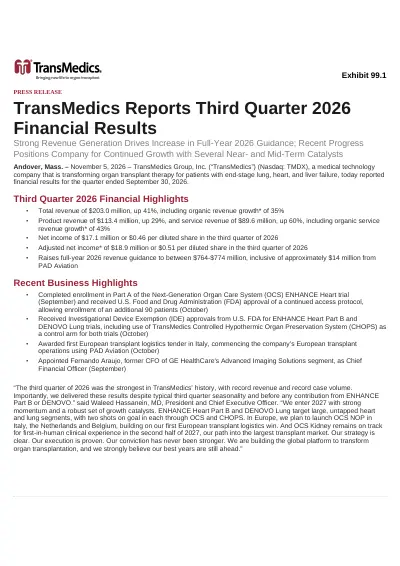
Turning to 3Q results: The third quarter of 2026 was the strongest in TransMedics's history for both revenue and case volume. Third quarter highlights include: total revenue of approximately $203 million, up approximately 41% year-over-year; transplant product revenue of $113 million, up approximately 29% year-over-year; and transplant service revenue of roughly $79 million, up approximately 44% year-over-year.
Despite typical third quarter seasonality, OCS liver and heart case volume grew both year-over-year and sequentially, modestly surpassing the all-time high levels we set in the second quarter of 2026. As our near- and mid-term growth initiatives begin contributing to case volumes, we fully expect product revenue growth to accelerate further and converge with our service growth rates.
TransMedics transplant logistics generated approximately $41 million in revenue, up approximately 50% year-over-year. We supported approximately 86% of NOP missions requiring air transport using our own fleet.
This is consistent with our second quarter performance and meeting our steady-state goal of managing more than 80% of our NOP missions. We ended the quarter with approximately $493 million in cash and cash equivalents.
Looking at our third quarter results, we are especially proud of our record revenue performance, which was driven primarily by market share gains in liver and heart and strong clinical service revenue. Again, we delivered this growth despite typical third quarter seasonality and lower overall US deceased donor volume that was down 6% in 3Q 2026.
Importantly, we achieved these results with no incremental contribution yet from ENHANCE part B or De Novo. We also drove product service margin expansion and generated approximately $20 million in cash.
Beyond this strong financial performance, we also successfully advanced several of our near- and mid-term growth initiatives. Let me start with the heart, where we're working to further expand OCS adoption in the existing indication and expand into new indications in the United States.
Our ENHANCE Heart Part A program was designed to demonstrate the safety and effectiveness of our OCS Heart 2.0 enhancements and a new proprietary perfusion solution within our current OCS heart indications, which covers extended criteria DBD and DCD donor hearts. We completed enrollment of 175 patients in September, and in October, FDA approved a continued access protocol, or CAP, allowing us to enroll an additional 90 patients in the CAP protocol.
We expect CAP enrollment to begin in late fourth quarter 2026 or early first quarter 2027. ENHANCE Heart Part B is designed to open an entirely new indication for TransMedics, focusing on DBD donor hearts preserved within roughly 4 hours of preservation.
This segment represented approximately 2,200 hearts transplanted in 2025. In late October, FDA approved our IDE protocol amendment to include the TransMedics controlled hypothermic organ preservation system, or CHOPS, as the control arm.
That gives us two shots at goal in this segment: OCS Heart and the TransMedics CHOPS, with the potential to offer the market two distinct options at different price points. Part B is designed to enroll approximately 600 patients: 400 on OCS and 200 on CHOPS.
Participating centers are now completing their internal IRB processes, and we expect Part B to be a major catalyst for our heart business beginning in the first quarter of 2027. Next is expanding adoption of OCS in the lung transplant market, which we believe could be a sleeping giant for TransMedics business.
Our De Novo lung program leverages our Gen 2.0 OCS lung enhancement, and again, a new proprietary perfusion solution to generate data that we believe will catalyze a large untapped US lung transplant market of approximately 3,500 transplants annually, the vast majority of which use no form of machine perfusion today. In late October, FDA also approved our IDE protocol amendment to include CHOPS as the De Novo control arm.
Together, OCS Lung and TransMedics CHOPS represent a significant opportunity to transform this market. De Novo is designed to enroll approximately 450 patients: 300 on OCS and 150 on CHOPS.
As with ENHANCE, centers are completing their IRB processes, and we expect De Novo to be a major catalyst for our lung business beginning in the first quarter of 2027. Taken together, ENHANCE Heart and De Novo Lung give us access to conservatively estimated 2,000 to 5,000 incremental US heart and lung cases annually, materially expanding our US addressable market.
In addition, data from these programs will also help catalyze heart and lung transplant adoption internationally. Beyond our clinical programs, we continued to make progress expanding OCS NOP and transplant logistics in Europe.
Tamer and our European commercial team have made significant strides, and are preparing to launch OCS NOP in Italy, Netherlands, and Belgium in H1 2027. They're also in active discussion with several additional European countries about expansion beyond these initial markets.
This groundwork supported strong European performance in the third quarter of 2026. Importantly, I'm delighted to report that in October, our PAD Aviation business won TransMedics's first European transplant logistics tender in Italy's Emilia-Romagna region.
This is a strategic first step towards our vision of a dedicated pan-European transplant logistics network modeled on what we have built in the United States. With significant need and established budget for transplant logistics across Europe, we see logistics as a powerful entry point for OCS NOP in the many countries where we are actively engaged.
We expect OCS NOP and European transplant logistics together to become another growth catalyst for TransMedics in 2027. Meanwhile, we remain laser-focused on OCS Kidney, our entry into the largest transplant market segment, with what we believe will be the first portable normothermic oxygenated kidney perfusion system.
In the US, approximately 21,000 deceased donor kidneys are transplanted each year, and approximately 9,000 more go unused, in part due to prolonged ischemic time. This is the single largest addressable transplant segment available to us in the US and globally.
We are building OCS Kidney on our next-gen 3.0 platform, which is designed to add meaningful scale and operating leverage across our business. OCS Kidney development is progressing well, and we remain on track for the first in man clinical experience in the second half of 2027.
From there, we expect OCS Kidney to become another major growth catalyst for TransMedics beginning in late 2027 and into 2028. Finally, turning to the US transplant and OPO modernization initiative led by HHS and CMS: On October 30th, CMS released its final rule on OPO certification.
The key highlights were: CMS affirmed the outcome-based three-tier performance framework and that it will be applied on a DSA by DSA basis. CMS allowed for OPOs, for the first time, to hold multiple DSAs, with CMS formalizing when a DSA opens for competition and how successor OPOs are selected.
In addition, CMS removed the historical requirements that an organization must have operated as an OPO between 2002 and 2005 to qualify to become an OPO. This opens the door for new entities to become OPOs.
However, CMS deferred finalization of a pathway for new OPOs to further rulemaking process. CMS also stipulated that designation period may be shortened or extended, and CMS may directly assign a DSA when time doesn't allow for a full competitive process.
Bottom line is, based on our review, we see nothing in the final rule that would prevent TransMedics business from progressing as planned, as we do it every day. Meanwhile, we are actively collaborating with approximately 20 OPOs across the United States to help them improve donor organ utilization and meet CMS performance tier metrics.
We remain committed to supporting every OPO in meeting or exceeding these metrics, because doing so ultimately means saving more American lives. Turning to guidance: Given our strong year-to-date performance, and balanced against the timing of our new program contributing to early 2027 rather than the fourth quarter, we are raising our full year 2026 revenue guidance to a range of $764 million to $774 million, inclusive of approximately $14 million from PAD Aviation, representing growth of approximately 26% to 28% over 2025.
Importantly, this range assumes no meaningful incremental revenue from ENHANCE Part B or De Novo in the fourth quarter. Fernando will detail the guidance update in his section of today's call.
In summary, over the past 4 years, TransMedics has consistently turned strategic investments into both rapid top-line growth and strong bottom-line performance. We are a growth company at our core, leading bold, far-reaching innovations across our OCS technology platform, our clinical and logistics services, and the digital transformation of the entire transplant ecosystem.
The progress we made on our growth initiatives in 2026 gives us the confidence that our best years are still ahead. TransMedics is once again well positioned to lead the next wave of innovation in organ transplant worldwide in 2027 and beyond.
With that, I will turn the call over to Fernando to review our third quarter financial results in detail. Fernando?
Fernando Araujo
Thank you, Waleed. Good afternoon, everybody.
As this is my first call with the company, I want to reiterate my excitement at joining TransMedics at such an important stage in the company's growth. What drew me here is our differentiated technology, strong market position, and multiple growth catalysts, a combination that provides us with a significant opportunity to scale the business, expand operating leverage, and drive long-term shareholder value.
My focus will be on partnering with the team to execute these growth opportunities with financial discipline while advancing our mission to transform transplant care. Now, turning to TransMedics third quarter performance: The third quarter delivered strong revenue growth and stable gross margin, reflecting the underlying strength of the business, alongside planned strategic investments in R&D and infrastructure to support our next phase of growth.
Total revenue was $203 million, up 41% year-over-year, including organic revenue of $194 million, up 35% year-over-year, making this the highest quarterly revenue in our history. US transplant revenue was approximately $186 million, up 34% year-over-year and 1% sequentially.
By organ, liver contributed with approximately $150 million, heart approximately $33 million, and lung approximately $2 million. International revenue was approximately $6.6 million, up 82% year-over-year, reflecting continued progress as we expand our presence in Europe.
Product revenue was $113 million, up 29% year-over-year and 2% sequentially, led by liver and heart. Despite typical third quarter transplant seasonality, liver and heart case volumes grew modestly both year-over-year and sequentially, building on the all-time high we set in the second quarter.
We expect product revenue growth to accelerate as our near- and mid-term growth initiatives begin contributing to case volumes. Service revenue was $90 million, up 60% year-over-year and 14% sequentially.
Service revenue included $9.4 million of revenue generated from PAD Aviation charter services. Excluding PAD, service revenue was up approximately 42% year-over-year.
The growth in service was driven by higher NOP adoption, primarily around liver and heart, and continuing improvements in logistics, market share gains, and pricing adjustments to offset higher fuel cost. The gross margin was 58.5%, down approximately 40 basis points year-over-year.
It's important to note that the gross margin decrease reflects a channel mix shift in the quarter. Service revenue, which carries a lower margin than product revenue, rose to 44% of the total revenue, and PAD Aviation diluted gross margin by 260 basis points.
Excluding PAD, gross margin was 61.1%, up approximately 230 basis points year-over-year. As PAD is integrated into our business, we expect to see improved margins moving forward.
Looking at the margin drivers of our respective channels, product gross margin was 79.2%, up 50 basis points year-over-year. This improvement was driven by process improvement related to reduced scrap and cycle count.
Service margins improved 440 basis points to 32.2%, driven by logistics efficiencies resulting from pricing improvements across both service and logistics operations, productivity gains from reduced supplemental lift utilization, lower ground transportation cost per mission, and improved leverage of fixed operating cost as volume increased. It is worth noting that we do expect some normalization in service margin in the fourth quarter, while remaining above historical levels.
We plan to keep working these same levers as part of our operational strategy, improving efficiency across NOP and in manufacturing, while next-generation OCS and OCS Kidney are designed to cost less to build and run. Adjusted operating expenses were $89.8 million, up 47% year-over-year and 3% sequentially.
The year-over-year increase was driven by planned investments in OCS Kidney, next-generation OCS, and our ENHANCE and De Novo clinical programs, as well as increased headcount to support our development activities, ongoing expansion plans, and infrastructure investments, including our US headquarters and the addition of PAD Aviation. The sequential increase was primarily related to the addition of PAD.
Excluding these investments, operating expenses declined sequentially, demonstrating continued discipline across our cost base. Adjusted R&D was $29.2 million, up 91% year-over-year, primarily reflecting investment in the strategic growth programs.
Adjusted SG&A was $60.6 million, up 32% year-over-year and 9% sequentially. The year-over-year increase reflects planned investments in the NOP network, IT infrastructure, international expansion, and in our Somerville headquarters.
Adjusted income from operations was $28.9 million, representing an adjusted operating margin of 14.2%, highlighting our strong top-line results and our planned increase in strategic investments. Adjusted net income was $18.9 million, and adjusted diluted earnings per share was 51 cents.
Now, for modeling purposes, interest expense was $7.3 million in the quarter, including approximately $3.9 million related to the finance lease for our new Somerville headquarters. For the full year, we expect total interest expense of approximately $29 million, including approximately $15.4 million related to our new headquarters, partially offset by approximately $11 million of interest income.
Our adjusted effective tax rate was 23.8% in the quarter, and we expect it to end at this level for the full year. Our diluted weighted average shares were approximately 40.8 million in third quarter, and we expect the share count to remain at the similar levels for the full year.
We ended the quarter with $493 million in cash and cash equivalents, an increase of $20 million sequentially. Approximately $18 million in restricted cash, primarily related to our headquarters lease, is reported separately.
Now, turning to our 2026 outlook: As Waleed noted, we're raising our full year 2026 revenue guidance from a range of $737 million to $757 million to a new range of $764 million to $774 million, representing growth of 26% to 28% compared to 2025. This revenue guidance is inclusive of approximately $14 million for the full year from PAD Aviation.
Excluding the contributions from PAD Aviation, our updated revenue expectations of between $750 million to $760 million represents growth of 24% to 26% year-over-year. In terms of operating margin, we remain confident in the previously communicated full year adjusted operating margin range of 12.5% to 14%.
As a reminder, this range primarily reflects the accelerated investments in our OCS Kidney program, which is critical strategic growth driver for the business. Looking ahead, we expect gross margin to remain around current levels in the near to mid-term as we continue to invest in R&D and in the international expansion.
At the same time, the operational improvements we are driving in manufacturing and across the NOP, along with disciplined management of our broader cost base, give us the capacity to keep investing in R&D and new technology without losing sight of profitability. Over the long term, we expect those investments to pay off.
Greater scale and utilization across our international platform, together with the efficiencies designed into OCS Kidney and next-generation OCS, should support a higher, sustainable gross margin profile with potential to further improvement. To close, on our capital allocation, priorities remain focused on long-term value creation: supporting innovation across our technology and clinical pipeline, strengthening our NOP and international platform, and building the systems and infrastructure required to support scale.
With that, I'll turn the call over to Waleed for his closing remarks.
Waleed Hassanein
Thank you, Fernando. In summary, the third quarter was the strongest in TransMedics's history.
Recorded revenue of approximately $203 million, up 41% year-over-year, record case volume and margin expansion in both of our product and service businesses, and we delivered all of this before any incremental contribution yet from ENHANCE Heart Part B and De Novo Lung. We enter 2027 with strong momentum and a robust set of growth catalysts.
ENHANCE Heart Part B and De Novo Lung target large, untapped heart and lung segments, with two shots on goal in each through OCS and CHOPS. In Europe, we plan to launch OCS NOP in Italy, the Netherlands, and Belgium, building on our first European transplant logistics win achieved in October of this year.
OCS Kidney remains on track for first-in-human clinical experience in the second half of 2027, our path into the largest transplant market. Again, our strategy is crystal clear.
Our execution is proven. Our conviction has never been stronger.
We are building the global platform to transform organ transplantation, and we strongly believe our best years are still ahead. With that, I will turn the call over to the operator for questions.
Operator?
Operator
Thank you. We will now begin the question-and-answer session.
If you would like to ask a question, please press star then the number one on your telephone keypad to raise your hand and join the queue. If you would like to withdraw your question, simply press star one again.
Your first question comes from Bill Plovanic with Canaccord. Your line is open.
Bill Plovanic
Hey, it's Zachary on for Bill. Thank you for taking the question, and congrats on the quarter.
I want to start with expanding into Europe. Obviously, American investors might not have a lot of visibility into what those operations look like.
Can you take a second and talk about the cadence of tenders you might get with these markets that you're going into moving forward, and just what maybe reimbursement and operations might look like, how NOP is different over there versus in the US? Thank you.
Waleed Hassanein
Zach, that's a very important question, but it's a very complex and will require significant amount of time to address it in detail. However, to highlight, all the geographies that we are actively engaged with has some level of reimbursement for the product and the service, and definitely for the logistics.
Reimbursement comes first before we engage in any of these geographies. We believe that from a clinical demand, Europe, as we always said, is a mirror image of the US, which effectively nearly double our total addressable market, and it's a critical market for organ transplantation.
What's unique about Europe is transplant logistics is well established, budgets has been well established, and the access to PAD Aviation enables us to compete and, as we've proven, successfully in these tenders. I'll leave it here.
We are confident in the strategy. We see transplant logistics as a unique attribute of the European market entry strategy, given the pre-existing budgets for logistics, but at the end of the day, it has to also be supported with revenue growth from OCS and NOP.
In all the geographies we're actively engaged with, OCS and NOP type services are reimbursed. Next question, operator?
Operator
The next question is Ryan Daniels with William Blair. Your line is open.
Ryan Daniels
Hello, this is Matthew Mardula on for Ryan. Thank you so much for taking the questions, and congrats on a really strong quarter.
Regarding the strong organic revenue growth seen in the third quarter, why do you think TransMedics wasn't as impacted by the traditional seasonality seen this quarter? I know you discussed how industry volume was down and how you took market share, but just given the really strong organic revenue growth, what caused those market share gains, especially this quarter?
Then lastly, kind of given that Q3 performance, should we still think of seasonality in Q3 the same as before, or do you have more of that ability to offset that enough?
Waleed Hassanein
Thank you for the question. I think the—the what—what blunted the seasonality impact in this quarter is the—the healthy adoption and market share gains that we've gained in all market segments for heart and and liver, both DBD and DCD.
This is really a result of—of the experience, both experiencing the—the benefits of NOP, but also in the case of the heart, the contribution of the ENHANCE Part A catalyzed that adoption. Also, the—the participation of the OPO program that were supporting many OPOs in the country to help help them salvage more organs and transplant more organs.
That's why we we weathered the storm this quarter. As far as going forward, I think with the success of Part B, ENHANCE Part B, and De Novo, we might be able to blunt the seasonality, but the the reality is there was seasonality in Q3 in in August this year, but the success of our team, NOP team, and taking market share, both in DBD and DCD for heart and and liver, helped us blunt that.
I I don't want to guess. I think the success of Part B, ENHANCE, and De Novo could help us blunt that going forward, but Q3 is there is always seasonality during the summertime.
Ryan Daniels
Great. I know you talked about the OPO final rule, and I might have missed this, but do you plan to apply to become an OPO?
If you do plan to apply, how does that kind of non-profit requirement for OPOs determine the ultimate structure? Then if you're not planning to apply, kind of what's the reasoning behind that?
Thank you so much.
Waleed Hassanein
This is all speculation. We can't apply to something when we don't know what the rules are.
CMS has not announced the rules yet, all they stated is any new entities wishing to become an OPO will have to wait for a new rulemaking process. We will have to wait for that rulemaking statement, and we'll see what the conditions are before we decide whether or not it makes sense for us to apply or not.
Operator
Your next question comes from Young Li with Jefferies. Your line is open.
Young Li
All right, great. Thanks for taking the question.
Wanted to follow up on the trials and CHOPS economics. Can you maybe just talk a little bit more about if you're charging for using CHOPS with the trials, the level that you might charge, and how much of a premium it would be priced versus other cold systems?
Waleed Hassanein
Young, thank you for the question. We are focusing on the clinical impacts of these programs.
We are not focusing on the commercial impacts of these programs yet. Our top priority right now is to initiate these programs because of the significant potential value that the patients would experience using these programs.
The bottom line is we are not going to discuss any of the pricing or any of that. It's way too premature.
We need to get the programs started, we need to get the data flowing, and when CHOPS is 510(k)'d in the US, we can talk in detail about the commercial rollout of CHOPS. Until then, the priority is getting the clinical programs initiated, getting the clinical value to the transplant patient, utilizing more organs, and gaining the confidence in the two options that are available for heart and lung transplants.
Young Li
All right, great. Thanks a lot.
I guess to follow up on the EU question, are you able to size the tender that you won in Italy, how big could that be for you? Is it a multi-year tender, or it's just one?
Waleed Hassanein
It's a multi-year tender. Again, we are going through the process right now of finalizing that.
Again, everything we are going to be involved with in Europe going forward is going to be a multi-year tendering process, especially in Italy, is going to be region by region. The goal is the aggregates of these different regions will be several millions, if not tens of millions of dollars annually, but we just won the first of hopefully out of many.
We're excited about this important first step, and the reason why we engaged is it has the significant potential of growing our revenue in Italy. We're excited about that, and hopefully, we will win additional tenders.
There are several tenders coming up in late in the fall and early in the winter.
Young Li
Thank you.
Operator
Your next question comes from Allen Gong with J.P. Morgan.
Your line is open.
Allen Gong
Hi, this is Henry on for Allen. Thanks for taking our questions.
Just a couple from us, and I'll ask them both upfront. Obviously, a strong quarter, a good, strong beat, but when we look at the guidance, it was raised a bit lower than that beat.
Can you talk about any conservatism or just the philosophy behind the guide? Then second question, we've seen a little bit of softness maybe in the fourth quarter, October, flight trends.
Can you just talk about what you're seeing and any trends there from your side? Thank you.
Waleed Hassanein
Thank you. On the first part of the question, our philosophy in guidance has always been to be conservative.
Q4, obviously, we have the holiday season coming up. We don't know what, if any, seasonality might happen.
We're also being conservative in not factoring in any meaningful contribution from ENHANCE Part B or De Novo. That's why our guidance is what it is.
On the second question, listen, again, as I've stated many times, the flight trend is an indicator. It's not the be-all end-all.
The flights are down in October. It's a fact.
We still have November and December. We've seen similar trends in Q3.
It's difficult for me to predict the full quarter based on a couple of weeks' worth of softness in flight. Also, as you can see in Q3 results, we had more car transports in Q3 than aviation.
Again, we need to weigh all that into our guidance, and not just read the tea leaves based on a couple of quarters of soft flights and conclude what the quarter would look like. We believe we achieved that balance of conservatism in the guidance we stated.
Operator
Your next question comes from Chris Pasquale with Barclays. Your line is open.
Chris Pasquale
Thanks. Waleed, I want to make sure that we understand how ENHANCE Part A impacted your results.
175-patient study, how much of that activity took place in the third quarter, and what percentage of those cases do you think were really incremental to the business versus procedures that TransMedics likely would have been involved in anyway?
Waleed Hassanein
Chris, thank you for the question. We've always stated that ENHANCE Part A we don't consider as incremental, because these are the indications we have.
However, the excitement about the outcomes that were seen by the transplanting surgeons certainly helped increase our adoption in Q3. There's no equivocality about it.
Many of the transplant programs are commenting anecdotally about how these hearts are coming out of the device looking better, recovering quicker, less edema, all the potential benefits that we had hoped that we would replicate in the clinic from what we've seen in the preclinical phase. We have a high degree of confidence that Part A, albeit the same indication, but it helped deeper adoption in the same indication, because transplant programs were excited to see the enhancements in Part A.
Chris Pasquale
That's helpful. Then maybe one for Fernando.
Congratulations on the new role. Would love any directional commentary you can provide at this time on R&D spending and how that's going to trend as we get into '27.
Stepped up a lot this year, and that's before Part B gets going, it's before De Novo, before kidney moves into first-in-human testing. As we think about just sort of what the budget looks like for all the programs you guys have going on next year, does that need to move meaningfully higher, or have you front-loaded some of that expense here this year?
Fernando Araujo
Yeah. No, thank you.
Thank you for the question. Like I said in the prepared remarks, we expect the R&D to be fairly stable at this level for the foreseeable future here, meaning for the next few quarters.
That said, we are in the middle of our budget process, and obviously, we're going to be able to refine the overview and provide a better detail as we get to the fourth quarter earnings and provide a full year guidance for 2027. We expect that we are stable at this level that we are, at least for the next few quarters, and then we will see what is up next in terms of new technology that the team really want to pursue, and we will make sure that we have the financial capability to really support that while maintaining, which is very important, the profitability at the levels that we anticipate here.
Chris Pasquale
Great, thank you.
Operator
Your next question comes from Josh Jennings with TD Cowen. Your line is open.
Josh Jennings
Hi. Good afternoon, Waleed.
Thanks for taking the questions. Hoping to just circle back on ENHANCE Part A, and just wanted to get an update on just timing of filing and potential approval for the next-gen OCS Heart system for the current indication.
Then you gave some positive feedback in your answer to Chris around heart transplant surgeons' feedback, but would love to hear your team's kind of response to that feedback and your optimism that this next-generation OCS Heart can enable day-only heart transplant surgeries.
Waleed Hassanein
Thank you, Josh, for the question. I think as always, it's a very loaded question, Josh.
I want to be cautious until the final results of the trial is read out. Everything I stated is anecdote.
I was trying to address Chris's question, how confident are we that the contribution of heart market share gain was from ENHANCE Part A, and that was what I was trying to address. However, I've always stated when a trial enrolls ahead of schedule, that gives us good signals, and this portion of the trial enrolled even faster than the DCD heart enrolled, with much higher number of patients.
We are cautiously optimistic. We need to wait for the follow-up period to be concluded, and the plan is to be filing the PMA amendment for the existing indication based on Part A sometime in '27.
Obviously, it will be up to the FDA to review the material and issue their opinion on the matter. We are cautiously optimistic, Josh, and we hope to be able to submit for a PMA indication in 2027.
Josh Jennings
Excellent. Maybe one follow-up just on the CHOPS and maybe an update on the 510(k) filing and clearance timeline, and just remind us how you could launch CHOPS outside of ENHANCE Part B and De Novo.
Thanks so much, Waleed.
Waleed Hassanein
Thank you, Josh. As we've always stated, our commitment to FDA was to ensure that CHOPS is 510(k) 510(k)'d independently of the trial, and we are going to deliver on that commitment to FDA.
We right now believe the second half of '27 is the target timeline where we may receive that 510(k) decision, given that we are prioritizing H1 to getting the device ready for the rigorous 510(k) review process, and we still are holding ourselves to that timeline. Yes, the answer is yes.
There's possibility that we will have CHOPS 510(k) approved in 2027 before ENHANCE Part B is completed. In fact, that's what FDA would love to see us deliver on.
Depending on timing of filing ENHANCE Part A PMA amendment or PMA supplement, we might have that as well before year end of 2027. We have to wait and see.
Josh Jennings
Appreciate that.
Operator
Your next question comes from Samantha Munos with Piper Sandler. Your line is open.
Samantha Munos
Hey, thanks for taking our question, and congrats on a great quarter. I guess first, could you talk about what you're seeing competitively in the market?
It looks like you gained a good amount of share in liver and heart this quarter. Then maybe could you provide more color in terms of whether you're going deeper into accounts, or is it gaining new accounts?
Waleed Hassanein
Thank you, Sam, for the question. As I've stated before, it's really difficult for me to comment on competition.
I think that question should be saved for the competition. My focus is to make sure that every quarter our team is making progress, taking market share, and growing our top line.
I think Q3 met that expectation, and we're working hard on Q4 and into 2027. We need to, as I stated before, we need to be extremely confident and comfortable to operate in a very, very crowded market today, and that's why we lead with innovation, and we're constantly challenging the status quo and any potential competitor based on innovation.
We were willing to put our innovation and our technology and our services against anybody to continue to be in that leadership position. I guess that's the answers on the status of the competition.
Samantha Munos
Great. Thank you.
Then just one more on the CMS's recent final rule. It looks like they're placing greater scrutiny on transport-related adverse events.
Just wondering if you could talk kind of what you see for those in the market and whether there's an opportunity for TransMedics to differentiate itself based on the reliability of its NOP network.
Waleed Hassanein
Oh, thank you, Sam. I think the examples that CMS are focusing on are the traditional examples that we've seen for many, many years: some kidneys that are shipped on commercial flights, they might not make it on time or they might end up in the wrong aircraft, that kind of stuff.
For us, it is crystal clear, and CMS knows it, and everybody in the field of organ transplant knows it, that having the vertical integration of transplant logistics gives us the highest degree of reliability that we can give back to the transplant community, whether it's an OPO or a transplant center, because we can track the organ from the minute it leaves the donor body until it arrives to the recipient. Not us tracking it, but also we developed the digital ecosystem to enable the full transparent tracking of the organ by the accepting transplant program and the OPO staff that were involved in that particular organ.
There's no doubt in my mind that we deliver the best transplant logistics service on planet Earth. The key for us is to continue to innovate, continue to drive more market share, and hopefully, help many of the OPOs to deliver more organs and utilize more organs for transplantation.
Samantha Munos
Thank you.
Operator
Your next question comes from Suraj Kalia with Oppenheimer. Your line is open.
Suraj Kalia
Waleed, can you hear me all right?
Waleed Hassanein
I can hear you just fine, Suraj.
Suraj Kalia
Gentlemen, congrats on a great quarter. Waleed, a couple of quick questions.
There are a gazillion calls going on at the same time. As part of IDE approval for ENHANCE B, were there any protocol amendments mandated, that's part A, and part B of my question, Waleed, would love to get your comments on the REUP procedure.
There's always something new that people keep bringing up. Any of your comments and thoughts of REUP versus NRP and how we should think about it moving forward would be greatly appreciated.
Gentlemen, congrats again.
Waleed Hassanein
Thank you, Suraj. We appreciate it.
On the first part of the question, mandated protocol amendments by FDA, the answer is no. We made proposals to the protocol, the FDA reviewed it, and they allowed it.
There's no FDA-mandated protocol changes. Related to REUP, I think our position on REUP, like many others, and I think Farhan gave a very data-driven presentation that actually raised a lot of question about the validity of the REUP procedure.
He did that in our symposium at the ISHLT. I'll leave it at that, and again, I point to our great results in Q3, where we took market share, both in DBD and DCD heart, and also remind the audience that REUP is only used in one center in the United States.
Our position on REUP is well stated in public presentation that was data-driven from Farhan, our head of cardiothoracic team, at the ISHLT.
Operator
Your next question comes from David Rescott with Baird. Your line is open.
David Rescott
Great. Thanks for taking my questions, and congrats on the results here.
Just one from us, and I guess it's a two-parter, maybe you can count it as two. I think you commented on this US TMA OPO modernization act or that's going on, and we've seen some other things I think recently.
There's this new DCD rule I think that's coming into effect in November, and then on the kidney side, you had the Kidney Care National Plan that came out a couple of weeks ago. Curious as to what your thoughts are, if at all, on both of those, and then more of a high-level question on this topic, more related to how you see kind of the political landscape or just this broader policy environment playing out today versus what it kind of looked like a couple of years ago, and where you foresee that going, I guess, over the next couple of years, of course, as you continue to expand and drive data and adoption of the technology.
Thanks.
Waleed Hassanein
Thank you, David. That's a very complex set of comments/questions.
Let me start by the biggest and most impactful one, which is the HHS Kidney Care National Plan that was issued in October 2026. In that plan, HHS clearly stated that their goal is to increase kidney transplantation by approximately 2,000 kidneys per year, which they estimate in that report that will have an economic benefit per transplant of approximately $4.7 million per transplant.
You multiply 2,000 kidneys by $4.7 million, you end up with $9.4 billion implied value of each year's added to the transplant patient, or each kidney added or 2,000 kidneys added for the transplant population, which amounts to $200 billion of projected economic benefits through 2040. That's based off of 2,000 kidneys added.
As I highlighted, and the data is crystal clear on it, last year, there was about 9,000 kidney discarded only for ischemic time. There's only one device that we are aware of that could reduce ischemic time and, frankly, eliminate ischemia during preservation and making more kidneys available for transplant, which is the OCS Kidney when it becomes available.
We see these initiatives as highly complementary, highly focused on what OCS and NOP and TransMedics do well, which is maximize donor organ utilization for transplant, increase efficiency, and improve post-transplant clinical outcomes. We do all of the above.
The same thing applies for DCD ruling. The DCD ruling, it pretty much we saw some cowboyish behavior that came into the system.
What HRSA and CMS are trying to do is to just put protocols in place to maximize patient safety and maximize utilization of organs. Again, we stand by the utilization rate of OCS in DCD and DBD population to be the highest ever recorded in the history of organ transplant, north of 94% or 95%.
We're not afraid of these initiatives. We're not afraid of the initiatives of even CMS's final rule.
We do not see any of these things as negative or detrimental. We see it all as complementary, and we see TransMedics's role is to be supportive to all stakeholders in the field: OPOs, transplant centers, and regulators, to ensure that we are delivering the best organ transplant care to American patients in the US.
We're inspired by what's going on. I'm not going to comment on the political environment.
The issue around organ transplantation has always been bipartisan from day one. Both administrations, both types of political views have supported organ transplantation.
We'll leave it at that.
Operator
Your next question comes from Tom Stephan with Stifel. Your line is open.
Tom Stephan
Great. Hey, guys.
Thanks for taking the questions. Apologies if this has been asked, just jumping between calls.
Wanted to ask a bit on trends and the base business guidance. If I look at October flights, and then maybe take the typical November and December declines in the US transplant market relative to October, you're getting to OCS vols maybe down sequentially in the fourth quarter versus the third quarter.
Yet based on the core business guide for revenues and your service revenue commentary, it sounds like you do expect product revenue to be up sequentially in 4Q, correct me if I'm wrong there. For that, I think it's roughly $198 million midpoint guide implied for 4Q on total revs in the base biz.
I guess, Waleed, what gives you the confidence in hitting that number when it seems like trends in 4Q maybe are tracking down sequentially and not up?
Waleed Hassanein
Tom, thank you for the question. I think your characterization that Q4 second half of Q4 usually goes down is I don't think it's accurate.
I think the opposite is true. We see significant up-ramp in the second half of Q4 for a variety of different reasons.
We expect to see the same here. Yes, October was clearly a soft month, but again, I'm not willing to give up on the quarter just of a couple of weeks of slowness in October.
From our track record, from our history, from our performance, usually the last 6 to 8 weeks and 6 to 7 weeks in Q4 is usually a significant recovery for a variety of different reasons. What gives us the confidence is our track record.
What gives us the confidence is we're living this day in and day out, and we're not just looking at trends in the rearview mirror, and also all the catalysts that are coming up in front of us in this remainder of Q4 and exiting the year.
Fernando Araujo
Tom, just maybe adding, I think you probably referenced that you were jumping calls, you probably didn't hear Waleed answer a similar question before. What is important to highlight on top of what he already highlighted here is the fact that just taking the flight data might not be necessarily all-comprehensive.
There is clear evidence that we're doing really good progress on other terms of transportation as well, including ground. Just wanted to make sure that you have confidence, or we have done a pretty good job in making sure that we have confidence in this guidance.
We believe we are guiding truly conservatively in the way we're thinking about the sequential progress between third quarter and fourth quarter.
Tom Stephan
Got it. Super fair.
Might have to check back on that OPTN data. All makes sense.
Then quick follow-up just on op margins next year in 2027. I think Street ex-PAD has been modeling positive year-over-year op margin expansion next year.
Maybe talk about kind of your level of comfort in that with the base business posting operating margin accretion in '27, given all the initiatives that I think clearly have some nice momentum. Then as a tack-on, it'd be great if you can help us with what the PAD impact in '27 from a margin standpoint might look like, how will that business's op margin maybe compare to the base business?
Thanks, guys.
Fernando Araujo
Tom, first of all, there is a few of your questions that truly getting to the '27 guidance, which I'm going to defer to our fourth quarter earnings, where I'm going to be able to provide a more detailed understanding of the business. I'm not going to comment on the PAD performance in 2027.
I'm going to wait for when we get to the call in fourth quarter, like I said. What I would say to you is to your question related to the margin, I think it's safe to say, and it was part of my prepared remarks, we feel very strong about the way the progression of the business is going from a gross margin standpoint, and we believe that with the productivity programs that we have in place, both for product and service, we'll be able to hit those numbers and continue to drive continued progress, and which is what we're going to keep using for margin leverage, as well as continue to do a fairly good job in making sure that we fund the business on the R&D side of the house.
Hopefully, it answers your question for today, and like I said, I'm looking forward to being able to refine the models, which we're working through right now as relates to the budget, and we'll guide at a more detailed level in February.
Tom Stephan
Super fair. Great color.
Congrats on the progress.
Fernando Araujo
Thank you.
Operator
Your next question comes from Mike Matson with Needham & Company. Your line is open.
Mike Matson
Thanks for taking my questions. Just want to ask one on the kidney trial.
I don't know if you're able to talk about how you expect to design the trial, but my understanding is the standard of care there's hypothermic perfusion. Is that what you'd likely be using as your control?
Then, how do you sort of avoid the same issue you had with the heart and lung trials where the competitors didn't want you using their devices for the trial? Thanks.
Waleed Hassanein
Thanks, Mike. We are at least a year away from discussing the detail on the kidney trial design.
We still have long ways to go. It's way too premature to start talking about the kidney trial design.
However, related to the control arm, the control arm is the standard of care, as you said, it's cold perfusion. It's been in the market for 25 years.
We don't expect the same reaction, given that this technology is not in the hands of the transplant programs, it's in the hands of the organ procurement organizations. They manage it broadly.
We don't expect the same dynamic here as a highly concentrated call points for heart and lung that we've experienced here with the controlled hypothermic storage. We have long ways to go before we can share the detail of the design of the kidney trial, and obviously, we will do that in the first half of 2027.
Mike Matson
Great. Thank you.
Operator
Your next question comes from Daniel Markowitz with Evercore ISI. Your line is open.
Daniel Markowitz
Guys, thanks for taking my question. I wanted to know, following the final OPO rule, how are you thinking about timing of potential decertifications and transitions?
Could those handovers create further near-term disruption to donor activity before we see the benefits of reform come through? I guess overall, just wondering how you expect this dynamic to impact the more near term, call it 2027, and then in the longer term beyond 2027 as well.
Thank you.
Waleed Hassanein
Thank you, Daniel. It's very hard.
Obviously, nobody knows what the impact is. From reading the CMS final rule, I think actually CMS is being very thoughtful about this and trying to minimize the disruption.
They're extending the runway from the timeline perspective. They're opening the door for many of the OPOs, if you're Tier 2, to merge even before the decertification process takes place.
They're giving a lot of runway for Tier 2s. My own perception is this is going to be a lot more controlled, and we hope that it doesn't result in any disruption in the national volume, given that it's already done.
The final rule has come out, CMS is not changing their mind, unless something happens during the challenge process, we don't expect much to change.
Operator
That concludes our Q&A session. I will now turn the conference back over to Waleed Hassanein for any closing remarks.
Waleed Hassanein
Thank you, operator. We thank you all very much for taking the time to be with us tonight, and we wish you all happy holidays, and we will meet again early next year.
Thank you very much. Have a good evening.
Operator
This concludes today's call. Thank you for your participation.
You may now disconnect and have a wonderful rest of your day.