Trend Micro Incorporated
Q3 FY2026 · Earnings Call TranscriptNovember 12, 2026
Kevin Simzer
Hi, everyone. My name is Kevin Simzer and I'm the Chief Operating Officer for Trend Micro.
I'm here to give you a Q3 2026 earnings update from a business perspective. I tell you, we live in very interesting times and you cannot help but be excited about the opportunity in front of us all relative to AI.
There's also a potential downside, and that downside is that threat actors have also aggressively adopted AI, and they are discovering vulnerabilities in existing enterprises today at an alarming rate. In fact, we are seeing the number of CVEs that have been discovered is growing exponentially.
Even when patches are available—and patches are not keeping up, but even when patches are available, customers do not have the time to actually deploy those patches. The gap between those unresolved vulnerabilities is growing.
All you have to do is look in the media, whether it's the vulnerabilities that were discovered around PHP, that open-source piece of software that's visible in 70% of Internet-facing websites, or maybe it's the Binance cryptocurrency hot wallet Bitcoin being stolen, or maybe even in Japan, you saw where GMO was particularly exposed and got so far as asking for help from the Japan government. We are both helping GMO and working with the Japanese government right now.
Now, back in December 2025, we laid out a multi-year strategy to transform the business. We really wanted clearer business units, we wanted to execute more globally, and we wanted to really focus in on these areas driving ARR growth.
We're in the middle of that transformation and we're very pleased to report that momentum is building. You saw that with Mahendra's update: net sales up 9% year-over-year, ARR momentum is building, up 6% year-over-year, and substantial improvement on that operating margin now sitting at 18%.
We have these three pillars that we're driving towards. The pillars are Trend AI, that's our offering in and around the enterprise segment—net sales up 12% year-over-year, ARR was up 8% year-over-year.
That has increased every quarter this year. Momentum is building and it's building on the back of success we're seeing with adoption of our Vision One platform, up 37% year-over-year.
In Trend Life, we had a nice quarter, some good growth, and most importantly, it was driven by success we're getting in our digital life protection. The ARR for that up 37%.
We're seeing customers expand and and end up taking on more capabilities from us. Then finally, we're making investments in incubation areas that we think are going to fuel our growth in the medium and long term.
Total company ARR sat at the end of Q3 at $1.76 billion, up 6%. Like I said earlier, Trend AI at $1.3 billion, that's up 8% year-over-year; and Trend Life at $463 million, that's up 1% year-over-year.
If we look at it from a pro forma P&L standpoint, really pleased. We had the top-line performance, so that was that was strong and within our plans, so that was nice to see.
We dramatically improved our overall cost of goods sold, so that was nice to see how we manage those cloud expenses and AI expenses really nicely. Then every one of the operating expenses—sales and marketing, research and development, and G&A—improved quarter-over-quarter.
All that netting out to 18% operating margin, 19% if you exclude our incubation. Now, let's go through each of the three pillars.
The first one being Trend AI, and that is all on the back of growth in our Vision One platform. This is our industry-leading AI security platform.
It's comprised of 11 modules and we're fixated on attaching to our existing installed base customers and landing new logos. We're seeing the Vision One platform adoption growing very nicely.
Really close to $800 million U.S. now.
That's up plus 37% year-over-year. Really nice to see the growth.
We're at 58% of our enterprise customers now use Vision One. We know that once they use Vision One, they stay.
Our Vision One GRR sitting at 87%. Our Vision One NRR, how we expand with those existing customers, up at 119%.
They're adopting more of our platform as well along the way. If we look at the regional perspective from an ARR, Vision One ARR in particular, we're seeing it's it's universal across all regions, where each region is participating to this Vision One growth.
The the chart on the right really shows by country the amount of ARR. The number one country is the U.S.
and it was up 20%, and in Japan, up 53%, and Germany up four 40%. Really seeing participation across the globe, which is nice to see.
One other element that I'm not sure everybody realizes, but that is cyber services. We have a set of cyber services that we can attach to our Vision One.
It provides things like managed detection and response or AI-powered red teaming. All of these both augment the platform itself and provide some necessary and useful services to our enterprise customers.
We're seeing that growth continue year-over-year, up to $88 million now. That's up 25% year-over-year.
We now have 13% more customers attached to services. Finally, the power of the platform, you really see it here.
We've said this time and time again. As customers adopt more and more solutions, we see the retention rate of that customer increase.
We also see the ARR impact increase. Finally, if we look ahead, we're really seeing a strong pipeline for Q4 and beyond, up at $1.2 billion.
We've already demonstrated that we're seeing the results of those investments that we started in the first half of this year. They're paying dividends.
We're starting to see the momentum build on the top line. We saw that with the ARR growth from Q1 to Q2, Q3, and and going into Q4.
We're seeing the ARR continue to grow. Next up is Trend Life.
Certainly the story in and around Trend Life has everything to do with protecting consumers with our digital life protection. You can see that red box on the bottom, $141 million, up 37% year-over-year.
Some incredible growth. That's because customers are adopting a wider set of capabilities from us.
We're seeing that ARPU from those consumer customers up 9% year-over-year. Some nice growth.
You're going to see more from us in and around SOHO. If you think about these small office, home office companies, we we have a lot of them as customers today and they're particularly vulnerable in around AI.
They don't have the cybersecurity knowledge or capabilities in-house and they really need some support in a very, very, very capable way that's going to work with their businesses. You're going to see us doing more in and around SOHO.
Finally, to round it out, we continue to make investments in VicOne. That's our business that specifically targets the automotive industry as well as robotics.
We're making great headway there with cementing deals with both auto manufacturers and robotic companies. Then with Magna, this is offering a set of AI systems integration and consulting, building out sovereign AI data centers for customers around the globe.
We have many MOUs underway and very pleased in Q3 that we actually signed three deals. We're finally starting to see the results of that year's worth of effort to get things off the ground.
Some really bright spots ahead in and around Magna. All that to say, we're an AI-native operations company and we feel like with our pillars that we have today that we're in a very good spot.
Thank you.
Mahendra Negi
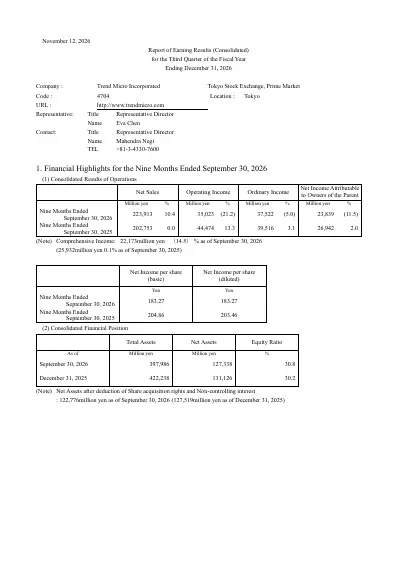
I would like to use the PowerPoint slide to explain the results. This is the Q3 results: 9% growth in net sales and operating profit, and down 17%.
In the second quarter, there was a decrease in the operating profit, and we have caused some concerns among the investors. We are making some upfront investments and the profitability should improve in the second half, but there were still some concerns.
Looking at these numbers, I hope that some of those concerns will be resolved. At the bottom, you can see the results without FX impact, 3% increase in net sales, and Trend AI ARR growing at 8%.
This is the core focus for us now. Operating profit margin, as you can see on the slide, there were some fluctuations in the share prices and the compensation is tied to the share price.
Excluding that, because share price is up, the effective operating margin is 19%. As I said before, we have Trend AI ARR, 4% from the beginning of this year, and it's growing steadily, and it's above 8%.
In the fourth quarter, we expect this to go up further. Another information in the small font at the bottom, the numbers have changed slightly.
The products from the small, medium companies have been removed, but this is adjusted, there's no problem in comparing this in year-on-year. This is the ARR by region.
Europe and the Americas double-digit growth. Americas was trending a little bit lower, but we are seeing some improvements in this area.
Cash flows: It is down because of lower operating profit, but the other big factor is AWS cloud services. On a regular basis, we need to post this in accounting.
Depending on the timing of payment, the cash flow can be affected, and that is another factor behind these numbers. Headcounts, you can see the trend here.
What's happening behind is for this fiscal year, the environment has been changing very rapidly and the organization has to be reorganized to be more flexible in our response. This is why we have seen reduction in the headcount, and further headcount reduction and alignment of headcount is expected in the fourth quarter.
We believe it will be from 6,500 to below 6,200. We're not reducing headcount on purpose, but by introducing AI into the company, the organization of the company changes and productivity improves, and this is why we see the lower headcount.
Costs, as you can see on the slide, in the previous quarter, we had cloud-related, this was ¥12.7 billion, and that's a similar, it looks similar, but I just talked about AWS earlier. We're paying for cloud, and AWS also gives us credits.
When we receive the credit, this is offset against the cost. This is why we have a [unclear], so that is offset.
When you add it back, basically, this cost is flat. In the fourth quarter, we believe that the cost will increase slightly.
As we said in the second quarter on this call, we will not see a rapid increase like this going forward. Revenue will continue to increase and the cloud usage will increase in line, but this is basically in line with that growth.
Selling expenses, again, 30 billion, ¥33 billion. In the second and first quarter, we have a bonus payment which is tied to the performance, and that is absent in the third quarter.
We now have 119 fewer people, and the the return, the benefit of the cost of that is also included, and this is why a highlight. Taking a look at this quarter, we have had this record-high quarterly revenue, and also Trend AI ARR is still growing.
I would like to have some message on this IR Day. Every day we every year we had the IR Day on December.
However, starting from this year, we decided not to have IR Day. According in the current roadmap to 2028, we are providing numbers up until 2028, but we're not going to extend it.
The reason why we have reached this decision is because we created a third-a-year roadmap. Because to reduce the volatility in our stock price due to our quarterly performance, but we found that that to be limited.
At the same time, our business operating environment is changing rapidly, it has become very difficult to have a longer-term forecast. We thought that probably giving you this IR Day or the three-year roadmap would not be credible.
Instead of having IR Day, we are going to provide you with a single-year guidance. Of course, we will be explaining to the analysts and investors through this quarterly earnings result call.
About our our business strategy, no changes to the full-year forecast at the moment. As I have mentioned earlier, there is a one-off severance severance and other expenses, but other than those items, the things are progressing as we had anticipated.
That's all from me. Thank you.
Henderson
This is Henderson, JPMorgan. I have two questions.
First is about ARR growth rate. Trend Life, this quarter's same event, but 8% ARR, I think this is a very good progress.
In the fourth quarter, what is the outlook for the short term, and to what extent do you think to accelerate this? Do you think you can achieve double-digit growth in the next fiscal year?
ARR growth for the short term and for the next year, that's my first question.
Mahendra Negi
Thank you. I would like to respond first, and then if Kevin has anything to add.
We would like to refrain from commenting about next fiscal year because we'd like to provide full explanation when we talk about the full next fiscal year. Q4 should be better than Q3, but as far as the numbers go, we'd like to refrain from talking about specific numbers.
Henderson
Understood. Do you feel that there is a possibility that you can accelerate more than Q3?
Mahendra Negi
Trend AI, yes, as far as Trend AI, that's true. As Kevin commented earlier, looking at the recent situations, we believe that AI ARR growth in the fourth quarter should improve.
We have to wait until the end of the quarter to see, but that is our outlook. Thank you.
Henderson
What about the drivers behind this? You mentioned Vision One, but if you look at it by region, I think the ARR, net increase is seen in the U.S.
as well. Is Europe and the other region the main drivers then?
Japan is not really contributing that much, that's my impression. Can you please break this down by region?
Kevin Simzer
Maybe I can jump in, and Mahendra, you can add any color that you want to. From a regional perspective, we are seeing universal adoption of our Vision One platform globally.
We are getting success in all four of our regions. If you go back and look at one of the charts that I presented, I gave a regional view, and on the side of that chart there was by country, and you'll see that the top four countries that are driving ARR growth for Vision One, that that table is sorted by the size of their ARR.
Then the number one is the U.S. The number two growing area is Japan at plus 58%.
The number three is Germany, and the number four is Brazil. Our some of our big regions all across the globe have really driven a lot of the success with Vision One, but I want to finish with we're getting success with Vision One globally in every region.
Henderson
My second question is about mid-to- sorry, you conducted an IR Day on a daily basis, on an annual basis, but now to this fiscal year, and looking at your growth investment, up to 2028, OP margin, 29% to 31%, this target seems to be quite difficult to achieve. Have you made any changes in terms of this outlook?
Do you have anything to comment?
Mahendra Negi
At the moment, we are maintaining this target. As I said before, we have upfront investments, and also, as the environment continues to change, we want to be able to respond quickly.
Therefore, we will cover the situation where we talk about the numbers three years down the line, and that will tie us, restrict us in some ways. Up to 2028, this is a goal target, and ups and downs in terms of achieving this, but we'll maintain this target.
Henderson
Up to 2028, you have several KPIs, for example, sales, GP margin, OP margin. Now, what about OP margin?
Do you still believe that this is achievable?
Mahendra Negi
As long as revenue continues to grow, yes, we believe that it's achievable as well. That is our outlook.
Thank you. That's all for me for now.
Operator
Thank you very much. Next person, let me unmute you.
Kikuchi
From SMBC Nikko Securities, my name is Kikuchi. I have two questions as well.
First is this is a kind of follow-up to the Mr. Henderson's question.
In your material on page 14, page 13, the current award to 2028, you decided not to extend. Not to extend means 2029 and 2030, you're not going to be extending into 2029 or 2030.
Is that what you mean? Or does it mean that you're not going to maintain this?
Mahendra Negi
Well, 2029 and 2030, we're not going to provide that numbers. We think that as far as this target for 2028, we believe that those are the achievable numbers.
On the other hand, as I have commented today, it's very difficult to forecast what's going to happen in three years. Using the company's resources and create a three-year plan and do this IR.
On the other hand, if we do not achieve accordingly our target, then the stock price will come down. In that respect, this three-year plan is not effective, so that's the reason why we decided not to do this.
Kikuchi
I just understand. I wanted to check with you with this awarding.
My second question is that in your second quarter earnings result, you talked about this AI token cost has increased and cloud cost has increased, cost has increased as well. AI token cost and cloud cost, well, I don't understand this to the fullest, but the AWS credit, it has increased temporarily, but it has come back.
Did you say that? I just want to check that.
What happened to the AI token cost?
Mahendra Negi
Maybe I didn't explain good. What I wanted to say is that the cloud cost seems to decrease.
However, in the third quarter, the major point is that $11 million credit, well, credit means so it will be an offset of a payment that we are making to the AWS. If we achieve this amount to the AWS and we receive this credit, and if we use that credit, and then there will be a decrease in the cost, and that is happening.
So $11 million is about ¥1.7 billion. If you sort of add them back, then it's going to be flat.
The token cost, we created that slide for the six months, we are planning to create another one in six months. The token cost has decreased because the revenue goes up, but the other is flat.
Kevin Simzer
Yeah. I think you did a nice job of explaining the dynamics around the cloud cost.
There was a one-time credit that we received in Q3, and that offset some of our cloud costs. Overall, we're seeing, as the business scales, we made some investments in the first half of the year in order to really enable sovereign clouds to be deployed in many countries, and as the revenue grows in those countries, it offsets those infrastructure investments that we've been making.
We feel like it's it's normalizing now as we go into Q4 and set ourselves up for next year.
Kikuchi
Thank you very much. Let me double check.
AI token cost and so that is included under this cloud cost?
Mahendra Negi
Yes, exactly.
Kikuchi
In the second quarter, the reason why the cloud cost has increased is because of this AI token cost, and as usage goes up, the payment to the AWS has increased.
Mahendra Negi
Is that okay? We are using the AWS's facilities.
That token, not token cost, but token consumption is increasing, so that's the reason why the payment amount is increasing. Also with AWS and Google, too, but this time around, we have received the credit from AWS.
Kikuchi
I see. The one that is offset, $11 million, or the ¥1.7 million yen is what you mentioned, but so in the case of a third quarter, in the normalized state, it's going to be flat as you from the second quarter, is that what you're saying?
Mahendra Negi
Exactly.
Kikuchi
The token cost, this is something that I want to understand. The token cost has increased temporarily in the second quarter, that was what you have explained, but you are trying to suppress that.
In the middle of the second, excuse me, in the middle of the third quarter is where you start to control it, it's not fully implemented, but can we expect that it's going to further come down in the fourth quarter?
Mahendra Negi
The the cost per token is decreasing. In the six-months slide, per $1 sales, this per token is decreasing, but the token consumption is increasing, and that's the reason why the cost is increasing.
In case of second quarter, as we are doing the front-end investment, we are investing into this sovereign-related area. We are buying the cloud capacity if this is being used, and then that's going to be a fixed cost, and as the revenue goes up, our profitability will improve.
In case of a third quarter, this front-end data center usage utilization is improving, and internal use is improving as well, these are just factors. Fourth quarter, of course, top line is going to grow.
However, in case of a profit margin, it's not going to be compressed. Understood.
Kikuchi
As absolute amount, the fourth quarter, in page 11 of your material, the one that is offset with the credit will return. The one that increases with usage, the cloud cost is going to go up, but the token cost will come down a little bit, is that what you are saying?
Mahendra Negi
Token cost will come down, but how much the token will be consumed is difficult to anticipate. The total process is that the cloud cost, the second the fourth quarter amount is going to be bigger than that of the second quarter.
Kikuchi
Understood.
Kevin Simzer
The only other the only other thing I would add to Mahendra's comment around the AI token costs specifically, we live in a very dynamic world with respect to AI, and at the start of the year, we signed a strategic agreement with Anthropic, and we've been using Claude quite heavily internally. That's one level of AI token costs, and we've gotten a better handle on how we how we leverage Anthropic for internal use.
The other thing that we've done is we've selected Nemotron, an open-source AI LLM, as our platform of choice for, inside our inside Vision One. That doesn't have the same level of token cost.
We've been working our way through this throughout the year, and that's why the AI token costs are starting to come down as we start to move and leverage this open-source platform.
Kikuchi
Understood. Thank you very much.
One more thing, AWS's credit, you mentioned that that is offset some cost, but that's only going to happen in the third quarter, not to repeat that in any other quarters? That's true for this current fiscal year because this is a mechanism to get the credit for the payments that we have made to AWS, this is one-off.
Mahendra Negi
Can we expect that this is going to happen sometime in sometime every year? Now, this is a three-year plan, how much we achieve, how much we paid, and we received the credit.
If we use more AWS and then we might receive more.
Kikuchi
Understood. Thank you.
Thank you very much. That's all.
Operator
Thank you. I would like to unmute the next person who is raising their hand.
Tanaka
This is Tanaka, BofA Securities. Can you hear me?
Yes, I can. Thank you.
My question, the first question about headcount. You are increasing the efficiency of headcount through the use of AI.
In the second quarter, severance payments were paid out. I would like to understand how much of that is included.
Was it actually posted in the first quarter? In the past, there did say a severance payments.
If you go headcount reduction, which quarter did you do that in? Until the end of the year, you will lose 7,300 people, how much would you have to pay in the fourth quarter, for example?
Mahendra Negi
We have to pay the attrition is paying this to some extent. Headcount-related cost in the second quarter to third quarter is lower.
About half of this is related to bonus, and one-time cost. There are some smaller amounts, but this is a total ¥1 billion.
We did this in the second quarter because accounting rules, a company makes the decision independently on the future reorganization, we communicate to the employee and at that point we can post it in the accounting. It would take some time before the employees actually leave the organization, they may take some paid leave, for example.
There is sometimes a difference of one quarter to another. Third quarter, 119 people, but actually, this was paid out in the second quarter in terms of severance.
Similarly, we expect similar thing to happen in the fourth quarter as well. If we have 300 people, this is about three times the size.
We expect approximately ¥4 billion.
Tanaka
Understood. You use AI to streamline, and the in the fourth quarter, you will see headcount reduction.
In the next fiscal year, do you maintain the same number of people, or will you reduce more?
Mahendra Negi
Organization reorganization last year is a year of transformation, and reorganization is part of this transformation, which is more or less completed. Therefore, in the fourth quarter, once this is completed, we will try to do fundamental this year as well, the same thing will not happen again.
Some level of attrition will continue, I don't think that we will see a big reduction in this.
Tanaka
Understood. Trend AI ARR, that's my next question.
Slight improvement, they're just above 8%. I'm sorry, I have not done the calculations yet.
Vision One ratio is increasing and you mentioned that there's going to be acceleration in the fourth quarter to some extent. Can does this compared to Q2 results region-wise, I've not been able to check that yet, I'm sorry.
In the United States, my sense is that the growth rate is actually slowing down. Is that not the fact?
In terms of momentum, which geographical areas are accelerating versus decelerating, can you please explain?
Kevin Simzer
Let me start and Mahendra, you can jump in. Trend AI overall is our top-line growth engine, that that's for sure.
The growth is coming from that Vision One platform. Thank you for recognizing that the ratio, the amount of Vision One as a percentage of the total ARR has increased dramatically.
Trend AI at $1.3 billion total ARR, up 6%, and Vision One specifically at almost $800 million, it has easily passed the halfway point which we were which we were shooting for, and growing at 37% year-over-year. We see that as our big growth engine and that will continue.
From a momentum standpoint, in Q1, Trend AI, sorry, Vision One Trend AI Vision One ARR was at 2%. In Q2, it was at 4%.
In Q3, it was at 6% sorry, 8%. We continue to build on that Vision One ARR growth.
As Mahendra said, we're really pushing hard to try to hit double digits. Whether we can do it in Q4, not quite sure, but we are pushing hard for it to be bigger than what it is in Q3.
Vision One momentum growth will continue. From a regional standpoint, we are getting regional participation, all regions have contributed to that Vision One growth.
In the U.S., because you highlighted the U.S., we did see Vision One ARR growth of 20% year-over-year, so that's what we're fixated on.
Tanaka
Thank you very much. That's for me for now.
Operator
Thank you. Now, I would like to invite the next person to ask question.
Could you unmute, Anno-san? Can you hear me?
Yes.
Earlier about the credit, you mentioned that if you use big, then you get this discount, all the credit, and then with that, that that quarter's usage volume has decreased, is that what you said?
Mahendra Negi
In the three-year plan, there is a commitment, and if you shoot up this commitment, and then AWS will give us a credit. It's like if you achieve the mileage, then you can get something.
It's this credit is not given out every year. You have actually used more than the the three-year committed amount, and that's the reason why Amazon has given you the credit?
Yes.
A very simple question, excluding the FX, ARR is growing 8% and three months revenue is growing 3% on page 4. ARR is this annualized thing of that three months until September, right?
What's why the difference? The three months, because I don't think there is that much difference, why?
Did you sort of did this last-minute sales at the end of September?
Mahendra Negi
No. ARR calculation, in our accounting, they are winning after deferred income.
There is a slight difference between those two. The last day of the quarter, say that if there is a $100 revenue in this annual contract, that ARR, you are composed 100, but in case of a net sale, nothing will be posted.
Another thing is that out of our revenue, the subscription, 100% that is deployed, but the application we have where and there are some that you can post on that spot. ARR, it's just the annual subscription only.
Because of this difference, and it is going to be closer. This this quarter or next quarter, there may be some difference, especially we are tend to oppose a lot of revenue at the end of the quarter.
The good thing about the deferred income, but actually, ARR is focused on the 12 months at the very end. There is a difference.
Even if this is a three months, but you tend to see the focus concentration at the end of the month, when you are growing, then that difference sort of becomes wider. Understood.
My last question, by region, there are some new business that you are developing, even if that is dragging down the profit, will that contribute in the fourth quarter? Or will that be released in the next fiscal year and then that will be push up the revenue from the next year, is that what's going to happen?
Kevin, can you take this question?
Kevin Simzer
I'm not sure if you are referring to my chart where I talked about cyber services, but that chart was meant to describe a set of a set of services that we attach to Vision One. We're doing quite well at attaching it and it does offer some incremental capabilities on top of Vision One in order to help organizations that maybe don't have the skills within their own company to be able to operate the system.
Those cyber services are interesting in that they are not very people-intensive. They tend to be automated workflow, AI-generated services that we offer up.
We're not envisioning a lot of of people-related expenses as a result of those. There are people involved, but the people expenses are not the big part of of that service offering.
I hope I answered your question.
There may be some difference with our understanding. What you're developing right now, and then next fiscal year, is it that you're going to see the massive amount of new product lineups to become available next year, is that what you are saying?
Mahendra Negi
Overall, in the past, at the time of application development, we make it into asset. Then And then if that is released one or two years ago, then that will become our asset.
In case of SaaS, that's not the case. We just put onto asset for one month worth.
What we are developing right now, the customer will buy in a month's time. That's the mechanism.
We are heavily investing right now and to launch something next fiscal year. That's what happened in the past, but that is no longer the case.
You are launching every month, but the revenue is not growing. Why is that the case?
ARR is growing, but not the revenue. Why it's only 3%, is that your question?
Yes. AI is showing slightly higher growth, and then Trend Life is lower.
There are some that is decreasing. Because the Vision One is growing, but the legacy businesses are declining.
This legacy is going to continue declining, and we would like to try and shift them over to the Vision One as much as possible. The legacy is dragging, the ARR is actually growing more than 10%, is that what you're saying?
Yes, understood. Thank you very much.
Understood, thank you.
Akihiko Habara
This is Habara speaking. There might be some misunderstanding, let me add some comments.
This total revenue, the 3% growth, and the Trend AI ARR growth is 8%. This is the total the Trend AI's growth rate to the total sales.
What we are seeing showing is here, this is the Trend AI's revenue. It's I think it's the Trend AI revenue is plus 5%.
It's 3% decline, but due to technical deferring timing, there might be slight difference. If you compare percent and then that will be very close.
What you should be comparing is this number. Understood fully, thank you.
Operator
Any other questions? Any other questions?
Yes, I think there is someone raising the hand. Actually, three people have their hands up.
I would like to unmute your microphone.
Sato
This is Sato, Jefferies Securities. Can you hear me?
Yes. I joined halfway through, if this was already covered, I'm sorry, but please let me ask you a question.
Net sales and ARR, page 23, we can see the net sales by region by brand, by business. U.S.
is really growing, but Japan was flat. This is a concern.
There is so much cybersecurity so many cybersecurity incidents in Japan. I'm wondering if the number will improve in the next quarter, or maybe next fiscal year.
Otsuka Shokai is impressive, and when I interview them, they say, yes, CrowdStrike is selling a lot, but Trend Micro is not mentioned a lot. I also hear comments in the industry that you're losing your market share.
Cybersecurity issues are happening in Japan, this is tailwind for Trend Micro. What are the plans for Japan?
We have high expectations for what you do in Japan. When do we see the recovery of ARR growth of ARR in Japan?
Can we expect that for the fourth quarter? Kevin?
Kevin Simzer
Thanks, Sato-san. I don't know when you specifically joined and whether you saw my charts at all, but in my charts, I had a regional view of how we're doing.
I was commenting in that chart on how with Trend AI, we are really fixated on landing and expanding with our Vision One platform. I was showing in that chart that we're getting success with that growth of Vision One right across the globe.
On the right-hand side of that chart is a table, and it shows by country. The U.S.
is the largest Vision One ARR that we have, and it was growing nicely at 20%. Japan was number two, it's the second-largest region that we have, and that's growing at 53%.
We are getting success in Japan in the area—yes, thanks Habara-san, this is the chart. We are getting success in the area that we've been driving towards, which is growth of Vision One within the Japan market.
We think that we believe that as more and more of our Japanese customers adopt Vision One, we will start to see growth overall within the region.
Sato
The numbers that we see on the slide, you mean that the legacy is shrinking, in total it looks flat, but Vision One that you want to grow is actually growing, is that the correct interpretation?
Kevin Simzer
Yes, that's correct. That's correct, Sato-san.
Thank you.
Mahendra Negi
Legacy business, we have point products, single-point solutions, which is not aligned with the era of AI. This is actually the backlash of our past success, to speak.
That is why we want customers to migrate to Vision One as quick as possible.
Sato
Thank you, that's very clear, and I feel better now.
Operator
Thank you very much. The next person, let me unmute you.
Yuri
Good evening. My name is Yuri from Morgan Stanley.
The line that is shown is different from mine, but I have a one detail question. This month, you have announced that you're going to be offering free of charge of the ¥1.2 billion worth of cyber license.
I just want to know how that would impact your top line. Can you please explain that?
Mahendra Negi
That's the free of charge license, so that is going to be posted as expenses in P&L, there's none. What is happening is that so if the customer wants to shift from a legacy to Vision and if they don't have the budget, and then we can provide a free of charge license.
Then where that cost will be incurred, we did not oppose a revenue for the one that we usually would process our revenue. It's a kind of a free trial.
This is a respective dealing with this and we did that, this will be up to end of the day will be processed as net sales.
Yuri
Only I have a follow-up the questions. You're not posting either top at net sales or the expenses.
Say that cloud usage or the token usage, will neither of those are increasing, what's going to happen?
Mahendra Negi
At that time, that will be depending on case-by-case, but say that if the cloud expenses incurred and then which means that the customer is using pretty much, and after that period is over, then that will be posted as revenue, it's going to be the front-end investment. The reason why why we can't say how much it is going to be is case-by-case, I won't be able to give you the specific number, Yuri-san.
Yuri
I talked up. At the moment, we're not expecting to see any major impact to happen on the fourth quarter.
For the current fiscal year's guidance, you won't impact? Exactly.
Thank you very much. Understood, that's all for me.
Thank you.
Operator
Okay. I will unmute the next person with a question.
Can you hear me? Yes, please go ahead.
Watanabe
Mitsubishi UFJ Morgan Stanley, Watanabe. I would like to ask two questions.
First question, Trend Life, Asia-Pacific. Earlier, I think consumer, even before that, consumer is small against AI, I was not particularly concerned, but Asia-Pacific is showing tremendous growth.
Now, Trend Life, Asia-Pacific, what is happening? What is the driver behind this growth?
That's my first question.
Kevin Simzer
For Trend Life specifically, the big growth that we're getting is in the consumer part of the segment. We've introduced some new capabilities that go beyond endpoint protection.
We've got some really innovative technology that we've incorporated that really protect the entire digital life experience. That includes things like anti-scam capabilities that we've built into the platform.
That offering is is sold in a in a package, and we've been selling to consumers in Japan and rest of world, and that package is a premium package, and we're getting very good success in customers adopting it. For Trend Life, it's in this area called digital life protection, and that has been growing very, very nicely in the adoption of it.
Watanabe
Was this introduced at different times at different geographical areas, or did you roll it out everywhere at the same time?
Kevin Simzer
We we did roll it out globally. We introduced the capabilities and we rolled it out globally.
As it takes a little bit of time in retail channels for it to show up, but we did roll it out globally. We are getting success right across the globe.
It's also been quite helpful for us introducing it into some new markets. In particular, in Japan, which is our largest market for Trend Life, and in the U.S.
and Australia, New Zealand are second and third, it's launched everywhere.
Watanabe
Thank you. Another question, headcount, I'd like to get confirmation.
I think you said that it will be 6,200, that's 400. The difference is 400, not 300.
Which is correct?
Mahendra Negi
Let's see. Until the end of the quarter, somewhere between 300 and 400.
Watanabe
You say that it will go below 6,200. Is that not true?
Mahendra Negi
There is a possibility that it will go below 6,200. I see.
Watanabe
Understood. Thank you.
Operator
Thank you very much. I'm going to unmute the next person.
Unidentified Speaker 2
Thank you very much for giving me this opportunity. I am from CLSA Securities.
I have three questions. First, about Trend AI ARR net increase, I just want to know the reason why that happened.
Q-on-Q, it's 2.5% growth, and $1.2 billion Trend AI's ARR. Is it because that there is a stronger momentum of cost acquisition than you serve?
Are they living active in our So are they is is it because of the migration from the legacy, or is it because of the new customers? I just want to know this.
Growth of the NRR, can we expect this to extend into the next quarter and the next year?
Kevin Simzer
Great question, Moriyama-san. Yes, we are seeing a lot of success in our Vision One adoption and in particular with both our GRR and our NRR metrics.
Thank you for pointing out that you spotted the momentum that we're building, that the ARR has, in fact, been increasing every every quarter this year. We're really pleased with that.
What I what I can say is what I opened my presentation with, and we talked about, this wonderful opportunity called AI, and that's the exciting part. Also, we need to realize that threat actors are also adopting AI, and we've seen a dramatic increase in the number of publicly disclosed breaches around the globe.
You saw them recently in Japan where there have been, more breaches year-to-date than there have been all of last year. We're we're seeing AI's good parts, but also the threat actors are leveraging it.
One of the things in our Vision One platform is that we have the ability to actually virtually patch, we can protect an organization that might not be able to patch their infrastructure. They've identified a vulnerability, they know it exists, they cannot patch it just yet, and we have a virtual patching capability.
We're seeing a lot of success with that, some good momentum, and that will continue in Q4 and next year because customers are overwhelmed and they're just unable to patch everything.
Unidentified Speaker 2
I have a clarification question. For user acquisition question, if that is the case of the user acquisition and then a migration from legacy Cloud One versus the new acquisition, which is has a stronger momentum?
Kevin Simzer
We're getting growth. The Vision One ARR growth is happening because of both of those two use cases.
We're migrating existing customers from point products and legacy offerings onto the Vision One platform, but we're also landing landing new business and new opportunities with Vision One. It's both use cases.
It's both scenarios.
Unidentified Speaker 2
Understood, thank you so much. My second question about the token cost, you mentioned that it is increasing.
Going forward, is the is the is it possible to go kind of other a price changes are you thinking of because the token is increasing? Are you not thinking about that because that you don't want to lose against your peers in a competition?
If there is any chances that you're going to increase your prices, will that happen in anytime in year 2027?
Kevin Simzer
We we constantly look at making sure that we are pricing the value that we're offering fairly, but also market-competitively. There's a couple of different things within your question.
One is we try to manage our costs as best as possible. That's the one one dimension of of that question.
I commented earlier that, we are increasingly adopting open-source LLMs, and that will in fact have a reduction in our overall token expense. It's not it's not zero, but it does reduce it.
We manage our costs. The second thing is from a market competitive standpoint, and we're always looking at that.
We have increased prices in the past and we will continue to look at that including going into 2027 as the infrastructure expense, is well understood.
Mahendra Negi
May I add some comments? As of the second quarter, as Jim mentioned, there are two items under this cloud customer is linked to the net sales, and another one is a kind of a front-end investment like a data center and the training and the redundant deployment development.
The one that is linked to the net sales, it will grow going forward as Kevin mentioned earlier. One is competition environment, how we are going to pricing, we are going to be very flexible for that.
For this upfront investment, this quarter, because the because it is improved, the profitability improved, and the internal training is improving. Using an open-source, it can come down, and this is something that we can expect to happen next year as well.
Unidentified Speaker 2
My third question, you mentioned about this ¥1.2 billion credit of support. This would not be decided yet, but existing users say that they would like to add some function in this platform.
This is occurring, can they use this credit offering?
Mahendra Negi
That will be the detailed terms of this case of the contract. There are some scenario where they can use, some they cannot.
What we think is that we would like to support for those customers who are in trouble, they need to do something, but they don't have budget, those are the kind of customers we serve first. The terms and conditions of the deals will be different from one to one, we will not be able to apply a uniform kind of condition to everyone.
Understood, thank you very much.
Operator
Thank you very much. There are still three hands up.
Let me double check. Two of them were the persons who have asked questions already.
If you're asking the question for the second time, if that is the case, please keep your hands up. Now, let me unmute the next person.
Henderson
This is Henderson, JPMorgan. One quick question.
You are involved in the GMO incident and you are working together with that government, and I think there's been discussion about active cyber defense. which suggests that you have been helping the government and that you are officially recognized by the Japanese government for the sovereign cybersecurity.
As much as you can share, can you please tell us to what extent you're involved in that GMO case? I'm interested in the capability of your services.
Mahendra Negi
We have to apologize, but we cannot really comment about our engagement with a specific customer.
Henderson
Understood. Thank you.
That's all for me.
Operator
Thank you very much. Then moving over to the next person.
Sato
This is Sato again. I have two quick questions.
This fiscal year, we have made investments and the profitability has decreased to 14 14 or 15%. Next fiscal year, are you going to go back to this steady-state mode?
In other words, 25% of margin was set in the mid-term, can we expect that the operating margin to go back to the previous fiscal year level, or are you continue to do this heavy investment? It's going to be the next fiscal year's story, you are trying to figure it out, but 2026, you started out the year with you are going to have investment year.
I just want to know, are you going to see the end to this investment?
Mahendra Negi
As we have mentioned, next year and year after that, while there is a changing environment, we won't be able to comment what's going to happen. We would like to explain about that when we announce our forecast for the next fiscal year.
In 2028, what we are going to do is to improve the profitability, but there might be some timing difference. In cybersecurity, it's not something you need to invest.
Our customer we want to help our customers, and then at the time, we will think about profitability. If the sales to customers appreciate our services, then if we can get more business from them and increase the top line, that will be very nice for us.
Sato
Understood. Because the environment changes drastically, your company is trying to fix to adapt to that, and you're going to provide the services for those people who might need help, and there might be some difference from your plan, is that what you are saying?
Yes. That's the reason why we are going to be giving you update on the quarterly earnings call.
I thought that 15 billion is quite a big amount, but is there any one-off item to push up? My understanding is that this AWS credit portion is added onto that, but did you make a comment about that?
Because $11 million. So, ¥1.8 billion.
If you add them back, then it's going to be the same level to the second quarter. Understood.
Thank you. Thank you, that's all for me.
Thank you.