Teekay Tankers Ltd.
Q3 FY2026 · Earnings Call TranscriptNovember 12, 2026
Operator
Welcome to the Teekay Group Third Quarter 2026 Earnings Results Conference Call. During the call, all participants will be in a listen-only mode.
Afterwards, you will be invited to participate in a question-and-answer session. At this time, if you have a question, participants will be asked to press *1 to register for a question.
For assistance during the call, please press *0 on your touch-tone phone. As a reminder, this call is being recorded.
Now, for opening remarks and introductions, I would like to turn the call over to the company. Please go ahead.
Before we begin, I would like to direct all participants to our website at www.teekay.com, where you will find a copy of the Teekay Group's Third Quarter 2026 Earnings presentation. Kenneth will review this presentation during today's conference call.
Please allow me to remind you that our discussion today contains forward-looking statements. Actual results may differ materially from results projected by those forward-looking statements.
Additional information concerning factors that could cause actual results to materially differ from those in the forward-looking statements is contained in the Third Quarter 2026 Teekay Group Earnings presentation available on our website. I will now turn the call over to Kenneth Hvid, Teekay Corporation's and Teekay Tankers' President and CEO, to begin.
Kenneth Hvid
Thank you, Ed. Hello, everyone, and thank you very much for joining us today for the Teekay Group's Third Quarter 2026 Earnings Conference Call.
Joining me on the call today for the Q&A session are Brody Speers, Teekay Corporation's and Teekay Tankers' CFO; Ryan Hamilton, our VP, Finance and Corporate Development; and Christian Waldegrave, our Director of Research. Starting on slide 3 of the presentation, we will cover Teekay Tankers' recent highlights.
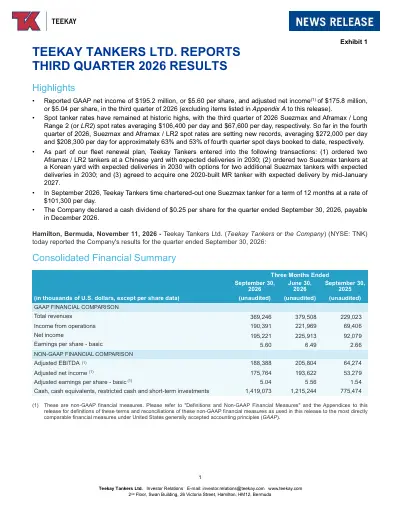
Teekay Tankers delivered another exceptionally strong quarter, reporting third quarter 2026 GAAP net income of $195 million or $5.60 per share, and adjusted net income of $176 million or $5.04 per share. To further highlight the strength in our results so far this year, for the first three quarters of 2026, Teekay Tankers' adjusted net income was nearly half a billion dollars, which is in line with our record-setting full-year result set back in 2023.
Our exceptional results were underpinned by our significant operating leverage to the strong spot market and strong operating performance. Spot tanker rates during the third quarter averaged $106,400 per day and $67,600 per day for our Suezmax and Aframax/LR2 fleets, respectively.
Combined with a low free cash flow breakeven, Teekay Tankers generated approximately $179 million in free cash flow from operations, which increased our cash position to over $1.4 billion with no debt as of quarter-end. For the first three quarters of 2026, we have generated free cash flows of over $520 million.
The fourth-quarter-to-date bookings have materially increased and look to set a new record. We have secured spot rates of $272,000 per day and $208,300 per day for our Suezmax and Aframax/LR2 fleets, respectively, with approximately 63% and 53% of spot days booked.
This puts Teekay Tankers on track to report record earnings for the fourth quarter and full year. I'll go over the market in more detail in the following slides.
We continue to execute on our fleet renewal strategy through measured acquisitions. Since reporting last quarter's results, we have entered into newbuild contracts for two Chinese-built LR2 vessels and two Korean-built Suezmax tankers, with options for two more Suezmaxes, all for delivery in 2030.
Along with our previously announced Suezmax tanker newbuildings, Teekay Tankers now has a total of six vessels on order delivering in mid-2027 through 2030. In addition, Teekay Tankers has acquired one 2020-built MR tanker for approximately $49 million, which expands our footprint into an adjacent sector where we have an ownership history and where we can leverage our integrated model.
Lastly, Teekay Tankers has declared its regular fixed quarterly dividend of 25 cents per share for the third quarter. Over the past several years, Teekay Tankers has supplemented its fixed quarterly dividend with annual special dividends that have been announced as part of the first quarter earnings in May of each year.
For the 2026 year, the Teekay Tankers Board of Directors expects to consider a special dividend in conjunction with the announcement of our fourth quarter and annual results of 2026, which are expected to be released in February of 2027. Moving to slide 4, we look at recent developments in the spot tanker market.
Spot tanker rates in the third quarter of 2026 were near the record levels experienced in the second quarter, with Teekay Tankers achieving average mid-sized tanker rates of around $87,000 per day. However, rates surged in the early part of the fourth quarter to new record highs, with mid-sized tanker rates averaging well over $200,000 per day quarter-to-date.
These record rates have been driven by a combination of elevated refinery margins, resilient global oil demand, low refined product inventories, and ongoing geopolitical disruptions that have increased transportation requirements. Turning to slide 5, we highlight the supportive oil market dynamics, which have helped facilitate record high spot tanker rates.
A combination of rising crude oil exports from the Atlantic Basin since the start of the year coupled with more recent recovery in supply of the Middle East Gulf has pushed global crude oil trade volumes back above pre-war levels in recent weeks, boosting crude tanker demand. In contrast, refined product export volumes remained below pre-war levels due to a combination of Ukrainian attacks on Russian refineries and a slower recovery in CPP volumes out of the Middle East Gulf compared to crude.
This has led to tight product market and unprecedented crack spreads, which have incentivized refiners to maximize throughput, supporting crude trade volumes and sustaining demand for tanker transportation despite higher freight costs. However, we should note that refining margins over the past month have decreased from record levels, which is one of the reasons why freight rates have now moderated from the very high levels seen in September and October, though they remain at historically high levels.
Looking ahead, tanker demand in the medium term will largely depend on how the geopolitical factors currently impacting crude oil trade patterns develop in the coming quarters, particularly regarding the conflict between the U.S. and Iran.
However, we believe that the need to rebuild depleted oil inventories should support tanker demand once oil supply normalizes. Turning to slide 6, we provide an update on the Strait of Hormuz and Red Sea disruptions and their impacts on voyage distances and trade efficiency.
The recovery in crude oil exports from the Middle East Gulf, which has relied on increased use of ship-to-ship transfer operations and alternative routes that bypass the Strait of Hormuz, as shown on the slide, has extended voyage durations and reduced effective vessel availability since the start of Q3. In addition, an increase in attacks on ships transporting Saudi Arabian crude oil in the Red Sea has led to the redirection of oil flows from the port of Yanbu northbound via the Suez Canal and SUMED pipeline, rather than flowing south via the Bab-el-Mandeb Strait, which stretches the fleet as it adds about 30 days to the voyage length.
These changes have benefited the VLCC market the most, but there's been spillover into the mid-size segments as charterers have increasingly used smaller tanker classes to move cargoes long-haul, as shown by the chart on the right of the slide. At the same time, growing crude oil movements from the Atlantic to the Pacific and strong arbitrage economics have increased ton-mile demand across multiple tanker segments.
While freight markets have started to moderate from recent peak levels as vessel positioning normalizes and supply chains adjust, we believe that underlying market conditions will continue to be supported by seasonal factors, ongoing trade inefficiencies, and geopolitical uncertainty, though perhaps not at the extreme levels of September and October. Turning to slide 7, we look at medium-term tanker supply fundamentals.
Tanker deliveries are projected to accelerate over the next 3 years as the current tanker order book delivers. However, the order book, which is currently equivalent to around 25% of the fleet in the mid-size segments, is largely offset by an aging fleet with 22% of the fleet already older than 20 years of age and a further 20% reaching age 20 by 2030.
We believe the eventual removal of these older vessels should help in reducing the impact of rising tanker deliveries in the coming years. Net fleet supply may also be impacted by developments in the shadow fleet of tankers and whether these vessels will be permanently excluded from non-sanctioned trades or will return to regular trading.
We believe that the scope for shadow vessels returning to the legitimate fleet is very limited, particularly for older vessels with around 70% of the sanctioned tanker fleet over 20 years of age. These vessels have been operating outside of mainstream channels for many years with little regulatory oversight and will therefore have very high barriers to clear in terms of maintenance and vetting before they could be brought back into regular trading and with no guarantee that they would be accepted by charterers and terminals.
Turning to slide 8, we continue to create value and have significant financial strength and optionality. This includes, first, our ability to generate significant free cash flow with a low free cash flow breakeven.
With the majority of our vessels trading in the spot market, we generated nearly $15 of free cash flow per share for the first 9 months of 2026. Further, with weighted average fourth-quarter-to-date rates booked of $236,000 per day, more than 30 times our free cash flow breakeven, we're positioned to generate exceptional cash flow in what is shaping up to be a record quarter and year for the company.
Second, we are executing on our fleet renewal strategy by selling older vessels in today's high asset price environment and recycling that capital to acquire more modern vessels in a disciplined manner. Since the beginning of the year, we've sold four vessels for $211 million with combined gains of $78 million and acquired or committed to 10 modern vessels for approximately $716 million, which includes six newbuildings delivering in mid-2027 through 2030.
These transactions have lowered our average fleet age while maintaining significant operating leverage to the strong tanker market. Third, we have significant investment capacity even after our remaining committed newbuild payments.
This allows us to incrementally progress our fleet renewal requirements while being patient for larger transactions in the future at more attractive entry points. The tanker shipping industry is capital intensive, cyclical, and increasingly dynamic, and we believe having significant investment capacity provides financial flexibility to pursue opportunities swiftly when the timing is right.
While the near-term tanker market will remain sensitive to geopolitical developments, Teekay Tankers enters the fourth quarter from a position of exceptional strength. With record rates booked to date, a low cash flow breakeven, a debt-free balance sheet, and significant investment capacity, we're well positioned to deliver record results in 2026, continue renewing our fleet, and create long-term value for our shareholders.
With that, operator, we're now available to take questions.
Operator
Thank you. If you're dialed in via the telephone and would like to ask a question, please signal by pressing *1 on your telephone keypad.
If you're using a speakerphone, please make sure your mute function is turned off to allow your signal to reach our equipment. Again, you can press *1 to ask a question.
We will now go to your first question, coming from the line of Jon Chappell with Evercore ISI.
Jon Chappell
Thank you. Good morning.
Kenneth, this slide 8, the strategic fleet renewal, is exactly where I wanted to start, and you laid it out pretty nicely here. Sold four vessels, obviously older, for $211 million, and acquired four ex-the-newbuildings for less than that.
It seems like there's still this incredible arb opportunity in a market like this, for obvious reasons. You still have 20-plus vessels, I think, that were built 2011 or before.
How do you balance taking advantage of this—again, I hate to use the same words—incredible arbitrage opportunity to monetize older assets that may not last versus generating cash with those assets in this market?
Kenneth Hvid
I think that's exactly the right question to ask any tanker company with certainly those of us with a fleet profile that we have today, Jon. Clearly, that factors into exactly all of the decisions we're making at the moment.
As you point out, you could today probably sell a 18-year-old Suezmax tanker and go out and buy a brand-new one delivering in four years, right? That's the incredible arb that you're talking about.
What we're also seeing is that we have the strongest front end of the curve that we've ever experienced in the tanker history. Of course, that's what you are factoring in.
What we are seeing is on some of these very high prompt values is, of course, it's about having the ship in the right position for the right voyage where you can clip a couple of voyages and generate extremely high cash flows. That's what you're seeing when we see some of the reported numbers on the secondhand value.
It will always be a balancing act between trying to cash-convert, if you wish, some of the run-up that we've had in the asset values on these older vessels and see how much of that we can secure, realizing that that's exactly the reason why the values of the old assets are so high. That is because the prompt spot rates are generating so much cash flow.
All the time we were trying to figure out, do we think we can get one, two voyages in, make what clearly will be a lot of cash flow, but also arguably and expectedly a lower sale price three, six, or nine months down the road. That's basically taking the positions that we're all trying to balance out here.
Jon Chappell
You mentioned the four-year timeframe for delivery, and you have these new 2030 deliveries that you just announced today. Should we take that as an indication that you'll continue to recycle potentially some of the olders to eventually be offset with those newbuilds, or are those kind of viewed completely independent transactions?
Kenneth Hvid
No, I I think that's that's right. When we look at our fleet profile, we we have a number of our shares our our ships that will reach the age of of of 20.
We don't have any current plans of trading them beyond 20, and they're going to reach that over over the next two, three years. We know that we will be selling ships.
We're just trying to to pick the best best time to do that. Some of that capital will obviously be recycled into renewing the the fleet, and the pace of it we can we can kind of slow down and and speed up on on on that, depending on on what our market view is.
We will for sure be selling more ships in in in the coming 12 months. That I'd be very surprised if if we don't do that.
It's it's going to be very active, right, buying and buying and selling and and spot chartering out. We will we may be looking at at time charters at at some point as well.
It's I think it's it's the whole playbook that that that's being brought in for for the next number of of quarters here.
Jon Chappell
Okay. Final one, if you'll forgive me.
I missed the last call, I get a bonus one today. The MR, obviously it's just one, and you had MRs in your recent past, but it is a little bit outside of the core knitting and scale that you have with the mid-size crude carriers.
Was that just a one-off opportunity that was kind of too good to pass up, or could we expect some of this cash recycling and potential asset value arb to be focused more on product tanker going forward?
Kenneth Hvid
I think it's a good ship we bought at a good price, which we're happy with. We think we can create some value around it.
Secondly, I think, as we've talked about a little bit in the past, if we were to expand the sandbox, the adjacencies here, what are they? Where do we feel that we as a company can add the most value with our integrated model?
I think we've certainly always viewed it that way that MRs, being more operationally intensive, is probably the segment that lends itself the best to our operating model. I think having a larger sandbox that we can play in on especially as it comes to acquiring ships on the water, I think that's where we saw relative better value, to be honest, on an on-the-water MR compared to on-the-water Aframaxes or Suezmaxes for the time being.
That can change, but the reason why we bought this one, I think, was more to build back the capability to really operate MRs again. When you don't do it, you don't have your DOC in place.
Now we're putting that in place, we get seafarers on board, and that means that if we see opportunities in the product space in the future, we'll be able to act on them more swiftly. I think it's more an option we're creating.
It's more starting to exercise a muscle that we haven't exercised for a decade here. I wouldn't read more into it for now.
We have no stated plans of building a big position in MRs, but if we see the right opportunity, we will go for it.
Jon Chappell
Great. All right.
Thank you for the time, Kenneth. I appreciate it.
Kenneth Hvid
Thanks, Jon.
Operator
Your next question will come from the line of Omar Nokta with Clarksons Securities.
Omar Nokta
Thank you. Hi, Kenneth.
Thanks for the update. Just wanted to maybe follow up just to touch on your latest comments regarding the MRs in response to Jon's question.
I was just thinking about it, it's been 10 years since you've had an MR. You've got this one.
I guess, just kind of thinking about your comments about looking to recycle some of the older Suezmaxes and Aframaxes and potentially redeploy them in newbuildings, I guess, is the thought, as you think about Teekay from here, it's recycling your core business and just modernizing it? Then this MR potential and expanding in that product segment, as you get your feet wet, as you were kind of maybe highlighting, just building it out, is the thought maybe to use your existing cash, balance sheet overall and maybe invest in that segment for growth?
Or would you see yourself scaling out of the mid-sized vessels that are older and maybe redeploying those proceeds into the MRs?
Kenneth Hvid
No, first of all, I would say our Aframax, Suezmax sectors are still absolute core for us. I would say this is more a reflection of that we have a larger balance sheet.
We're keen on continuing to try and find assets where we feel we can generate the most return. We believe that by having three strings to play on here, we increase that optionality and in terms of finding opportunities.
It's more that. I think it's a reflection of that I think we've said in previous calls that our total fleet size today is probably at the lower end of where we want it to be as an integrated company.
This gives us flexibility to rebuild the scale of the fleet and at the same time trying to deploy capital where we think we have the best chance on making the best return. As we all know, that changes rapidly with movement in asset prices and underlying markets.
Opportunities come and go in these segments, and having an additional segment, we just think will create more optionality for us. Given the incredible strength we have on the balance sheet that we built over the last couple of years, we're obviously very excited about having basically a larger market to play in.
Omar Nokta
Now certainly. I guess maybe as you think of, it is just one MR, and so to kind of rebuild that expertise per se, do you think kind of in the interim as you look to acquire assets along the way, is in-chartering going to be something more substantial in this segment as we look ahead here over the next couple of quarters as you perhaps expand your footprint in product?
Or MR?
Kenneth Hvid
I don't think so. At the moment, as we look at the market, historically we've been in-charterers, out-charterers, we've kind of done it all.
At the moment, I don't think our focus would be on in-chartering to honest. We'll probably more look for opportunities where we can buy good assets and maybe out-charter them.
We haven't exactly decided how we're going to operate. Obviously, it's not a big spot fleet to have one tanker.
We may be looking for time-charter opportunities there as we go along and until we get a bit more scale. Again, we're doing this because it's a capability we want to build and we want to create the optionality.
Omar Nokta
Thank you. Makes sense.
The final one, then I'll pass it back. Maybe just on the special dividend, you highlighted in the presentation the board's going to evaluate in February, after 2026 results.
Is this something, as we think of it, because you normally declare it in May following 1Q results, should we view this as just the idea of a special dividend is now brought forward by 3 months, or is this kind of a step-out or additive to beyond what you've done in the past?
Kenneth Hvid
No, I think it's just a more natural closure of the year. I think over the years we've had the quarterly and we've had one annual special.
We discussed with the board, it makes more sense to tie it to the full-year result as opposed to coming out with it after Q1 in our view. We're just moving it forward, there's nothing more to it than that.
Omar Nokta
Okay. All right.
Thank you, Kenneth. I'll turn it over.
Kenneth Hvid
Appreciate it.
Operator
Your next question comes from the line of Ken Hoexter with Bank of America.
Adam Roszkowski
Hi, this is Adam Roszkowski on for Ken Hoexter. Thanks for taking our questions.
Maybe just one on geopolitical thoughts and US-Iran conflicts. If there is a move towards resolution, how are you thinking about the net impact of tanker demand from rebuilding inventories versus the kind of ton-mile impact of shorter routes from that standpoint?
Any thoughts there? Thanks.
Kenneth Hvid
I'll let Christian speak to that.
Christian Waldegrave
I think obviously, first of all, it's still a very volatile situation. We're still seeing attacks daily in the Hormuz region, and we're still seeing attacks from the Houthis on Saudi oil infrastructure.
I think we're a ways away from a resolution to the US-Iran situation. If there was a peace deal, there's two sides to it.
On one hand, you wouldn't need to be doing the sort of shuttle movements out of Hormuz anymore. The oil could flow more freely.
It would be a bit of a more efficient system. At the same time, I think there's quite a big desire to get both crude oil and refined products out of the Middle East if the war was to be resolved.
I think you would get OPEC producers pretty quickly ramping up production on top of the expected non-OPEC volumes that are coming on next year. Like you said, I think if that creates a bit of a softer oil price environment, there is a big need to replenish oil inventories as well, which have been depleted through the course of the year.
I think you would lose a bit of the inefficiency that's been propping up the market the last little while, but you would probably gain more volume. Like I said, I think that need to replenish oil inventories could be quite a nice tailwind once this situation is resolved in the Middle East.
Adam Roszkowski
I guess just WTI falling about 20 bucks over this past couple weeks, are you seeing any of that kind of replenishment need happening now? Just thoughts on maybe damage done to refinery capacity in the Middle East and maybe longer-term, near-term ramifications from that standpoint?
Christian Waldegrave
In terms of the fall in oil prices, I don't think we're seeing it yet translate into a lot of stock building. What I would say is Chinese crude oil imports have gone back above 10 million barrels a day or close to 10 million barrels a day as of last month.
I think that's a sign the Chinese especially are quite price-sensitive. I think it's a positive sign that they're starting to import more oil again.
Certainly if oil falls more, I think you'll see an acceleration of different countries and refiners looking to replenish those inventories. In terms of the refinery damage in the Middle East, yeah, I think that's one reason why the products exports out of the Middle East have lagged the crude.
I think there is progress on that front. I read recently the Sitra refinery in Bahrain is on the verge of getting back up to 100%.
It'll be a little bit of a slower climb back for the refined products out of the Middle East than it is for the crude. My understanding is that those repairs are underway.
As those volumes come back, it's going to really help the product market, especially given that a lot of ships have migrated over to the dirty trades during the course of the year. I think that product market could be well set up once those volumes from the Middle East return.
Adam Roszkowski
Got it. Thank you.
Operator
It appears there are no additional questions at this time. I'll turn it back to the company for your closing remarks.
Kenneth Hvid
Thank you very much to everyone who dialed in today. We look forward to reporting back to you on our full year 2026 results when we report in February.
Thank you.
Operator
This concludes today's call. Thank you for your participation.
You may now disconnect.