Travel Leisure Co.
Q3 FY2026 · Earnings Call TranscriptOctober 27, 2026
Operator
Greetings and welcome to the Travel + Leisure third quarter 2026 earnings call. At this time, all participants are in a listen-only mode.
A question-and-answer session will follow the formal presentation. You may be placed into question queue at any time by pressing star, one on your telephone keypad, and we ask you please ask one question, one follow-up, then return to the queue.
As a reminder, this conference is being recorded. If anyone should require operator assistance, please press star, zero on your telephone keypad.
It's now my pleasure to turn the call over to Andrew Burns, Vice President, Investor Relations. Please go ahead, Andrew.
Andrew Burns
Thank you, Kevin. Good morning, everyone.
Before we begin, I'd like to remind you that our discussion today will include forward-looking statements. Actual results could differ materially from those indicated in the forward-looking statements, and the forward-looking statements made today are effective only as today.
We undertake no obligation to publicly update or revise these estimates. The factors that could cause actual results to differ are discussed in our SEC filings and in our press release accompanying this earnings call.
You can also find a reconciliation of non-GAAP financial measures discussed in today's call in the earnings press release available on our Investor Relations website. Please note that all references to EBITDA, net income, earnings per share, and free cash flow made during this call are on an adjusted basis, as disclosed in our earnings press release.
Additionally, all references to earnings per share are on a diluted basis. This morning, Michael Brown, our President and Chief Executive Officer, will provide an overview of our results and our longer-term growth strategy.
Then Erik Hoag, our Chief Financial Officer, will provide greater detail on our results, capital allocation strategy, and outlook for 2026. Following our prepared remarks, we'll open the call up for questions.
Finally, all comparisons today are to the same period of the prior year, unless specifically stated. With that, I'll turn the call over to Mike.
Michael Brown
Good morning, and thank you for joining us. Travel + Leisure delivered another strong quarter, extending the momentum we built throughout the year.
Our owners continue to prioritize travel, demand remains healthy, and we are translating that strength into growth in earnings and cash flow. More broadly, this quarter shows how the actions we have taken over the last several years are improving the quality of the enterprise.
The core business is growing, our multi-brand platform is scaling, and our acquisitions and portfolio actions are expanding both our earnings power and long-term revenue potential. Quarter after quarter, our results validate that strategy, and that compounding impact on our financial results is evident.
From 2024 to the midpoint of our 2026 guidance, we expect to grow EBITDA by 16% and earnings per share by 33%. From a profitability standpoint, we are generating industry-leading EBITDA margins of approximately 25%, while making meaningful investments in our long-term growth strategies.
On the capital allocation front, since 2024, we have increased our annual dividend by 20%, reduced our common shares outstanding by 10%, and made two strategic acquisitions for approximately $350 million. We've done all this while maintaining our leverage ratio at around 3.3 times, which is the lowest leverage ratio of our peers.
The durability of our model and the free cash flow it generates gives us a distinct advantage. We can invest in growth, pursue strategic acquisitions, and return meaningful capital to shareholders at the same time.
Each dollar has a clear purpose: strengthening the company and increasing per-share value. Our results over the last 24 months demonstrate the power of that approach.
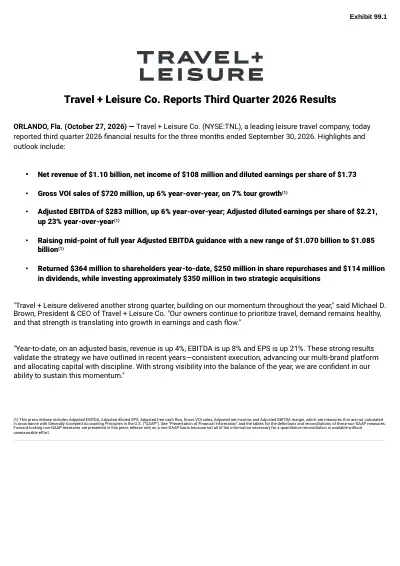
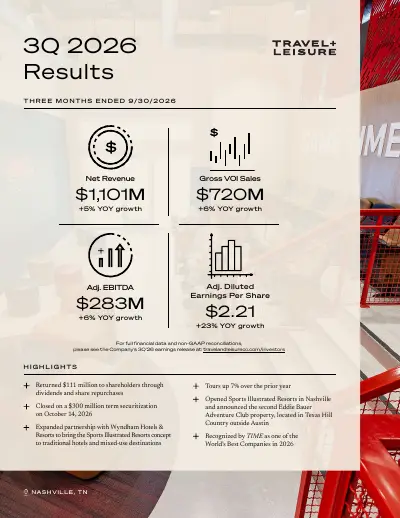
For the quarter, we generated revenue of $1.1 billion, EBITDA of $283 million, and earnings per share of $2.21. Gross VOI sales were up 6% year over year, driven by strong execution and the initial contribution from recent acquisitions.
Tours increased 7%, led by new owner tours, reflecting healthy top-of-funnel demand. Volume per guest on an organic basis was up low single digits and within our guidance range, reflecting consistent execution across our sales and marketing teams.
Reported volume per guest of $3,286 was down 1% year over year, reflecting the mix impact from recent acquisitions. On the consumer front, the indicators we track remain healthy.
While we continue to monitor the broader consumer environment, our owners continue to make travel a priority. Guest surveys and industry data show our owners plan to take one more trip over the next 12 months than the average US traveler.
That commitment is also reflected in our bookings, which point to continued momentum through the holiday season. Owner travel behavior, including booking windows, length of stay, and distance traveled to our resorts, all are stable.
We are also seeing positive underlying portfolio trends in our consumer financing business, which Erik will address in more detail later in the call. I'd now like to provide an update on our recent acquisitions, which are already providing immediate accretion to our overall financial performance.
We closed the Spinnaker Resorts acquisition ahead of schedule on August the 1st, and integration across both acquired businesses is progressing well. Our integration approach is straightforward: preserve the local strengths that made these businesses attractive while embracing best practices.
We are quickly deploying our technology and commercial capabilities and expect to be able to realize the full cost benefits of this integration within the first 12 months. We are also investing in the acquired resorts to enhance the guest experience and add more options for our owners.
I've spent significant time with the leaders and associates across both businesses in recent weeks and have visited nearly every resort. Those interactions have only strengthened my confidence in the strategic fit of these acquisitions.
Moving past the near-term integration and cost synergy realization, these two acquisitions grow our owner base by over 100,000 owners. In November, we will begin selling Club Wyndham points at select properties alongside their existing product suite.
In these early months, we will test and methodically optimize our offerings to appeal to the existing owner base. I see a meaningful long-term opportunity to expand sales across the acquired businesses by bringing our points-based product and expanded resort network to their owner bases.
Another growth initiative for us is our multi-brand strategy, which is moving from proof of concept to a scaled platform. This strategy allows us to reach new consumer segments, geographies, and vacation experiences, while leveraging our established technology and operating infrastructure.
Each brand is progressing along its maturity curve, from Margaritaville Vacation Club and Accor Vacation Club, which are generating outsized growth, to Eddie Bauer Club and Sports Illustrated Resorts, which are earlier in their commercialization. Each brand broadens our growth opportunities without meaningfully increasing complexity or capital intensity.
During the quarter, we continued to see strong momentum across the portfolio. Margaritaville Vacation Club is on pace to deliver more than $175 million of gross VOI sales this year.
Accor Vacation Club is approaching $50 million in annual gross VOI sales in only its third year of operation. Eddie Bauer Adventure Club continues to expand with the announcement of its second resort in the Hill Country outside of Austin, Texas.
With cabins, geodomes, hiking trails, and outdoor activities, it brings the brand to life through an immersive outdoor experience. The resort is scheduled to open by next summer.
Sports Illustrated Resorts reached an important milestone with the opening of the Nashville resort, and the early response has been encouraging. To date, we've announced four Sports Illustrated Resorts, and we are closing in on our first $1 million sales month.
Earlier this month, we announced the expansion of our partnership with Wyndham Hotels & Resorts to bring the Sports Illustrated concept to traditional hotels and mixed-use destinations. Together, we see an opportunity to create immersive, year-round destinations in college towns and major urban markets featuring distinctive programming, premier sporting events, and unique guest experiences.
With this expanded partnership, I believe that we will be able to enter more markets and scale Sports Illustrated Resorts even faster. Our multi-brand strategy is doing exactly what we intended it to do: expanding our addressable market, creating new growth avenues, and demonstrating the power of the Travel + Leisure platform.
What began as a collection of individual opportunities is increasingly becoming a meaningful contributor to our long-term growth algorithm. As a reminder, we expect these new brands to be approximately 10% of our total sales mix this year and continue to grow as a percent of the mix in the years ahead.
In closing, we've spent the last several years proving the resilience of our model. In 2026, we are showing how much more the platform can become.
Since raising our full-year outlook last quarter, we've achieved the high end of our third quarter EBITDA guidance, completed two acquisitions, and continued to scale our multi-brand growth platform. This quarter, we are raising the midpoint of our gross VOI sales and EBITDA guidance once again.
Overall, we are delivering results, widening our growth runway, and improving the quality of the enterprise. We are doing it with the financial discipline our shareholders expect.
With that, I'll turn the call over to Erik. Erik?
Erik Hoag
Thanks, Mike, and good morning, everyone. I'll start with our third quarter results, then cover vacation ownership, our acquired businesses, travel and membership, capital allocation and the balance sheet, and finally, our outlook.
Third quarter revenue grew 5% to $1.1 billion, and EBITDA increased 6% with 20 basis points of EBITDA margin expansion. Net income grew 16%, and earnings per share of $2.21 increased 23% over last year.
This third quarter progression mirrors the consistent performance we've delivered all year. Through the first three quarters, revenue is up 4%, EBITDA is up 8%, net income is up 15%, and EPS is up 21%, compounding growth across the P&L, consistent with how the business is designed to perform over time, high-quality earnings growth that converts into cash and per-share value.
Third quarter vacation ownership segment revenue was $953 million, and segment EBITDA was $250 million. Gross VOI sales increased 6% year over year, on top of 13% VOI sales growth we reported in Q3 last year.
As Mike referenced earlier, we generated healthy year-over-year tour and VPG growth on an organic basis. On a reported basis, including acquisitions, tours increased 7%, while volume per guest of $3,286 was down 1% year over year.
With Spinnaker Resorts closing ahead of schedule, it contributed more to the quarter than forecast, resulting in higher tour flow growth and greater VPG dilution. New owners represented 33% of gross VOI sales during the quarter, consistent with our targeted mix of approximately one-third new owners and two-thirds existing owners.
We believe this balance supports current sales productivity while building the customer base for future upgrade opportunities. In our consumer finance business, credit performance continued to improve during the quarter.
The underlying profile of new originations remains strong, with weighted average FICO scores above 740 and average down payment percentages approaching the mid-20s. In our portfolio, the loan loss provision rate declined approximately 150 basis points year over year, reflecting lower overall percent of sales financed.
Separately, delinquency and default performance has continued to exceed our expectations, giving us confidence to improve our full-year provision outlook from approximately 21% to closer to 20%. On the M&A front, we closed Spinnaker Resorts on August 1st, the third quarter reflects a partial period of ownership.
Together, YAS Vacations and Spinnaker Resorts contributed approximately $21 million of gross VOI sales and $7 million of EBITDA, tracking to our 2026 accretion guidance of $15 million to $20 million. The early performance and progress on integration we are making supports the financial thesis we outlined when the transactions were announced: immediate earnings accretion, high-quality resorts and owners, identifiable cost synergies, and financed receivables that fit directly into our securitization model.
Turning to travel and membership, segment revenue was $150 million, and EBITDA was $51 million. Results were in line with our expectations and continue to reflect the ongoing mix shift from higher-margin exchange activity to travel clubs.
At the same time, we've taken actions to better align our cost structure with the economics of the business, including greater use of shared enterprise capabilities. These actions are expected to generate approximately $16 million in annualized savings, with the majority of the benefit realized in 2027.
Moving to the balance sheet, we ended the quarter with net leverage of 3.3 times and over $900 million of available liquidity, providing ample flexibility within our capital allocation framework. Subsequent to quarter end, we completed our third ABS transaction of the year.
Across our three transactions in 2026, we've raised $925 million, all at a 98% advance rate. That consistent execution remains an important part of our free cash flow model, allowing us to efficiently monetize receivables and recycle capital back into the business.
While benchmark rates have moved higher, our ABS spreads remain attractive, reflecting continued investor demand for our receivables. Moving to capital allocation, which continues to be one of our highest priorities.
Through the third quarter, we've returned $364 million to shareholders through dividends and share repurchases, and deployed approximately $350 million towards acquisitions. Share repurchases are up 18% year over year, and we increased our dividend by 7%.
We've done all of this while maintaining a strong balance sheet and significant financial flexibility. We expect return on invested capital to remain in the high-20s this year, well above our cost of capital.
That return discipline is central to how we evaluate organic investment, acquisitions, and share repurchases. At current valuation levels, we believe repurchasing our own shares represents a highly attractive use of capital relative to the alternatives available to us.
Since the spin, we've reduced share count by approximately 40%. As we look ahead, the portfolio actions we completed this year create meaningful incremental cash opportunities in 2027.
Through the resort optimization initiative, we were able to strengthen our balance sheet and operating performance while reducing the capital intensity of the business. By retiring 17 lower-demand properties, we're creating opportunities to monetize the associated real estate for owners, of which we are the largest.
Additionally, our acquisitions had receivables that we expect to generate an additional $80 million of cash when securitized. Combined with the underlying free cash flow generation of the business, these actions should provide additional capacity for share repurchases in 2027, while maintaining our leverage and liquidity guardrails.
Turning to our outlook, which we raised last quarter. With nine months behind us and high visibility into the balance of the year, we are narrowing our full-year gross VOI sales and EBITDA guidance to the top end of the range and increasing our earnings per share guidance.
For the full year, we expect gross VOI sales in the range of $2.625 to $2.675 billion, volume per guest of $3,325 to $3,375, and EBITDA of $1.07 to $1.085 billion. Additional guidance assumptions include a full-year adjusted tax rate of approximately 28%, free cash flow conversion of roughly half of EBITDA, and earnings per share growth to be a low-20s percent.
When we issued guidance back in February, our initial range was above consensus expectations. Since then, we've outperformed on several fronts.
We raised our core VOI sales and VPG outlook, raised the midpoint of our EBITDA guidance twice, added accretion from two acquisitions, and lowered our loan loss provision and tax rate assumptions. That progression reflects the strength of our model and demonstrates our financial and operating discipline that converts growth into cash and compounds per-share value.
In closing, we're exiting the third quarter with the core business growing, credit improving, our acquired businesses performing well, and a stronger resort portfolio. What really matters most is how we translate that into long-term shareholder value.
Our goal is straightforward: grow earnings, convert those earnings into cash, invest the cash where returns exceed our cost of capital, and return excess capital through dividends and share repurchases when we believe our shares offer an attractive return. Over time, that's how we grow free cash flow, compound per-share value, and create durable value for our shareholders.
With that, I'll turn the call back over to Kevin for questions.
Operator
Thank you. We'll now be conducting a question-and-answer session.
If you'd like to be placed in the question queue, please press star, one on your telephone keypad. A confirmation tone will indicate your line is in the question queue.
You may press star, two if you'd like to remove your question from the queue. As a reminder, we ask you please ask one question, one follow-up, then return to the queue.
Our first question today is coming from Stephen Grambling from Morgan Stanley. Your line is now live.
Stephen Grambling
Hey. Thank you for taking the questions.
Just to start, there was a release about one of your competitors this morning maybe on a little bit of a weaker trend line. I'm just curious if, one, you're seeing any kind of change over the course of the quarter in terms of conversion rates and dynamics between existing and new owners?
Then also, any changes in the competitive dynamics as you think about your sales people and, the costs to keep people, some of the better people in the system, as there's maybe a change in the competitive landscape?
Michael Brown
Good morning, Stephen. Short answer on both is no, we're not seeing any impact.
If you look at our VO performance throughout the quarter, there was a lot of consistency. No changes as we came to the close of the quarter and now that we're well into October, no modulation whatsoever to our performance, which as Erik methodically laid out there has been extremely strong and shows a lot of strength in our core vacation ownership business.
As it relates to talent movement, no, we're not seeing impact as it relates to talent movement. The industry is always reflected constant movement amongst the peers, but, a, as you can see from our performance, it's not impacting us, and, b, I think culturally, our consistent line of success, our clear strategic outlook is one of the best retention components you can have.
All of that really leads to no consumer trend changes throughout the quarter and into October, and no impact as it relates to talent movement. Clearly, that's showing through in our results.
Stephen Grambling
Great. If I can sneak one follow-up, maybe unrelated.
You talked about having increased cash, while holding leverage next year. Just curious, and maybe I missed this on some of the opening remarks, but as we think about some of the building blocks to next year, any major changes that we should be thinking about between VPG and tour flow, thinking through kind of the moving parts between the recent acquisitions, as well as the ramp in Sports Illustrated and some of the other brands?
Thanks.
Erik Hoag
Sure, Stephen. Big picture, as I think about 2027, we still see our 6% to 8% gross VOI sales and mid-single digit EBITDA growth algorithm intact.
The tailwinds, as we start the budget process, and not getting too far ahead of the process, but tailwinds would certainly be the full-year contribution from our acquisitions. We do expect further improvement in the loan loss provision as well as some G&A efficiencies.
I think that those benefits will be partially offset by higher ABS funding costs, a modest margin headwind as we continue to invest in our new brands. Right now, no change in the underlying framework, and we'll provide more on that when we get to February.
Associated with incremental free cash flow in 2027, our long-term target remains roughly 50% free cash flow conversion from EBITDA. We see, let's call it, $150 million of incremental liquidity next year, with roughly half of that coming from the acquired receivables that we've talked about, and the other half coming from the resort optimization initiative.
We're targeting 2027, although some of those real estate proceeds could certainly extend into 2028. That gives us additional capacity to return capital.
As I mentioned in my prepared remarks, at current valuations, buybacks are very compelling.
Operator
Thank you. Next question today is coming from David Katz from Jefferies.
Your line is now live. Hi.
David Katz
This may be a premature follow-up to the prior answer. My question is, how do you think longer-term, at some future date about what your algo could become?
Appreciate Michael's comments about the incremental brand sales opportunities. Are these intended to accelerate your algo over time, or should we think about you in the context of where you are today?
Michael Brown
I would suggest that our current outlook where related to VOI and EBITDA doesn't change. What it does is broaden our platform as a brand, as some of our core brands continue to mature and get larger in scale, growing at 6% to 8% at $2.5 billion, $2.6 this year, becomes more and more challenging in its marketing reach.
What these new brands are providing us: Margaritaville, Accor, Eddie Bauer, Sports Illustrated, is a new marketing platform to widen top of funnel. Take Sports Illustrated this month that will likely hit the million dollar mark.
Every single one of those, at least as far as I'm aware, is a new owner. These new brands give us that next leg up to keep our long-term algorithm of new owners combined with owner upgrades to drive these mid-20s margins, a realistic outlook that has clear visibility.
I would say it's more about maintaining the algo with broadening our marketing universe as opposed to digging deeper and deeper into a singular approach.
David Katz
Understood. As my follow-up, with respect to the provision, it's possible that I missed it, but I wanted to just understand sort of how or why that is happening.
Is that circumstantial, or is that something that you're strategically driving?
Erik Hoag
Sure, David. The provision, as I mentioned, is down in the third quarter 150 basis points year over year, and that's the third consecutive quarterly year-over-year decline.
In the quarter, we benefited from lower percentage of sales financed, but more than anything, the underlying credit trends also continue to improve. Early stage delinquencies were relatively stable at 5.1% between the second quarter and the third quarter, and that's typically where we would expect a seasonal uptick in delinquencies moving from 2Q to 3Q.
We are now expecting the full-year loan loss provision to be closer to 20% versus 2021 versus the 21%. Frankly, the default and delinquency trends that we're experiencing, I think, give us confidence that not only will 2026 be lower than 2025, but 2027 will be lower than 2026.
The three things that we've been pretty methodical about talking about in terms of the actions: number one is a focus on point of sale underwriting. We continue to talk about FICO scores that remain in the seven in the mid-700s and increasing down payment rates.
The second thing is new owner engagements, and this is really trying to get our new owners on vacation and getting that first vacation booked. Then the third thing is a very proactive approach to improving our servicing and collections efforts.
This is better technology, broader outreach, more auto pay. Are they actions that we're deliberately taking and driving outcomes?
The answer is yes.
Operator
Thank you. Next question is coming from Chris Woronka from Deutsche Bank.
Your line is now live.
Chris Woronka
Hey, good morning, guys. Thanks for taking the questions.
Michael or Erik, I certainly appreciate the kind of mechanics of how the earlier closings of the acquisition of Spinnaker in Q3 impacted your reported VPG. I guess, a question would be, over time, do you guys see an opportunity to kind of close that gap versus your, I guess, legacy VPG?
How should we think about the timing and potential cadence of that? Then I have a follow-up.
Thanks.
Michael Brown
The short answer to that, Chris, is yes. We acquired a business in early Q3 and we're looking closely at what the opportunities are going to be.
Interestingly enough, the VPGs on the acquired businesses are about where we were as an enterprise pre-COVID. You've seen how we've been able to grow those VPGs over time to where they are today from the low 2000s to the low 3000s, low 3000s, 3, 3,250, 3,3 3,350.
There is clearly opportunity there. We're not going to rush to get there because we're evaluating resort upgrades, broadening the usage system, and then more importantly, the point system is a new concept, we will want to train up right on that.
Absolutely, there's an opportunity to close the gap. We're evaluating the way they sell, and components that they have that have made them successful until now, and maybe there's some things we can incorporate.
Ultimately, it's a great starting point. We see lots of opportunity to grow that business over time.
We're focused right now on a world-class integration, ensure that we realize the cost synergies very promptly, and as we start in 2027, we'll get a full-year realization of the sales opportunity. VPG is one of the many opportunities we see with these acquisitions, and feel more confident in October of them than we did even when we made the purchases in July.
Chris Woronka
Okay. Thanks Michael.
That's super helpful. Then, my follow-up is, it's a question you're pretty familiar with, comes up pretty much every quarter.
Anything new that you're thinking about on the travel club and membership piece? Reason I ask is, obviously, I think from an industry perspective, we're seeing a pretty decent M&A backdrop despite higher rates.
I'm just kind of curious whether there's any movement on things that might be afoot that you're considering there? Thanks.
Erik Hoag
Yeah. Hey, Chris.
It's Erik. The T&M business is an important contributor to consolidated EBITDA and cash flow.
It helps fund enterprise growth, shareholder returns. We remain open to alternatives, and we'll evaluate opportunities when a transaction could unlock greater shareholder value than continued ownership.
In the meantime, we are going to try to inflect the revenue curve. We are going to continue to be focused associated with the cost structure of that business, ensure that we're getting every last drop of EBITDA and cash flow out of it.
Operator
Thank you. Next question is coming from Ben Chaiken from Mizuho.
Your line is now live.
Ben Chaiken
Hey. Good morning.
Thanks for taking the questions. There was a lot of very helpful commentary in the prepared remarks.
I think I caught that you mentioned, Erik, I believe $16 million of cost saves primarily for '27. This is separate from the portfolio streamlining, correct?
Because I think the latter is more maintenance fees, if I'm not mistaken. Assuming this is correct, maybe what prompt this opportunity to the surface?
Then one follow-up. Thanks.
Erik Hoag
Yeah. Yes, we took out $16 million worth of cost in the travel and membership business during the third quarter.
More than anything, Ben, this is to further align the cost structure with the revenue trend of the business, fully incorporated into the mid-single digit expectation on sort of the core business algorithm for 2027.
Ben Chaiken
Okay. That's helpful.
Then, now that you have YAS and Spinnaker both closed, how are you thinking about the upgrade penetration across those 100,000-plus owners? Meaning in deals you've done in the past of this size, what percentage upgrade over time in broad strokes?
How are you framing the opportunity to those customers? Or how do you think someone in their shoes thinks about the opportunity?
Thanks.
Michael Brown
Ben, unquestionably, their ownership are going to see a number of opportunities. I mentioned them, but let me share a little bit more finitely what those are, is we are evaluating right now where to put capital into their resorts to upgrade the components of incredible assets, oceanfront Maui, oceanfront or waterfront in Hilton Head, multiple resorts there, all places that we don't have locations today.
Our goal is to improve the quality of the resorts, things that have been requested by the ownership base for some time. Introduce a points-based product, which was under consideration under one of them and wasn't used by the other.
As we know in the industry, that creates tons of flexibility for the owner base. We're surveying the owners as we speak to get their feedback.
We'll launch our first sales opportunity in November this year. We're not going to go global.
We'll focus on a few select sites, get feedback, and then adjust from there so that as we go into 2027 and we've fully integrated our systems to allow sort of ease of transaction, we'll begin deploying that across the enterprise. Sort of to get to the fundamental question you ask is, we've seen these businesses come together across the industry over time, seen businesses get acquired over time.
I'd be very disappointed if in the next several years we weren't doubling the size of these businesses, both on the top and the bottom line. We already have a great degree of confidence we're going to realize the cost savings within the 12-month window.
As we get to the first quarter call of next year, we will have a significant amount of water under the bridge on how our first sales efforts are going and what has taken hold with both our Club Wyndham owner bases, as well as the acquired Spinnaker and YAS businesses.
Operator
Thank you. Our next question today is coming from Ian Zaffino from Oppenheimer.
Your line is now live.
Ian Zaffino
Hi, guys. Thank you very much.
Just wanted to get into the T&M membership count. Looks like it stabilized this quarter.
Any color there? I know there's an acquisition.
How do we kind of think about that, where we are now and then also going forward? Thanks.
Michael Brown
The affiliate member base is relatively stable. As you look at travel and membership over time, the story remains familiar.
There's nothing unique in 2026 compared to prior years. Simply that as consolidation has occurred over the last decade in this space, clubs have gotten bigger, and owners are tending to stay within their club more, which means, although member count remains consistent, transaction propensity is declining year on year.
Our team's making a number of modifications to increase optionality for those members and to reduce friction in transactions. I won't say a lot, but noticeable investment into the exchange platform to allow self-service booking in 2027, similar to what we've been able to realize with Club Wyndham, WorldMark, and our apps that we've deployed internally, which have greatly reduced friction in search and book.
Ian Zaffino
Okay. Then, maybe if we just stay on this maybe walk down to the EBITDA line.
Anything you could do there to maybe stabilize EBITDA, or should we just continue to expect the performance we're seeing now continue, that high single-digit kind of decline? Thanks.
Michael Brown
Let me start, and then I'll pass it over to Erik here. The long and the short of the exchange business is what I just mentioned around the consolidation of the industry and, therefore, more and more members staying within their clubs to transact, which is understandable.
I think what we've been trying to do very aggressively is reshape the business to provide a cost structure that's very aligned to the top-line decline, the way you're looking at it, Ian. Then, as well, keep investing in the business to provide better service to the affiliate members.
The better the service, the more likely they are to transact. Simply because the top line's been declining for structural reasons doesn't mean that we're not investing back in the business to create greater optionality for those affiliate members who do want to transact.
Erik maybe add a few other comments about the way we're looking at T&M.
Erik Hoag
Yeah. Ian, your question associated with what else we can do on the expense line, during the third quarter, we did go through a cost program that impacted roughly 300 300 employees.
We will continue to have a heavy focus associated with what we can do to drive efficiency while that business has got its top-line headwind challenges.
Operator
Thank you. Next question today is coming from Trey Bowers from Wells Fargo.
Your line is now live.
Hi, this is Nick on for Trey. I just had a question around new owner trends.
It seems like that kind of drove the tour growth this quarter. I was just kind of curious, I'm assuming most of that is coming from the new brands, and I know you talked to how each of these brands, Margaritaville, Accor, Eddie Bauer, Sports Illustrated, they're all at different points in their life cycle.
I guess, how long do you think of a tail you have on growing new owner tours? How that plays out with NOG over time?
Thank you.
Michael Brown
Thank you for the question. Everything we're doing around extending our brands is about ensuring a long-term outlook on maintaining, first of all, new owner tour growth, as well as new owner transactions in the range that we said we want to be in the 30s.
Our new owner tour growth is up nearly 10%, around 8%. With the acquisitions, which are tend to be more new owner mix, with brands just coming out of the ground, Sports Illustrated, totally immaterial to our bottom-line results and metrics, but that'll change in three to four years.
We are planting the seeds for the crops to grow in a few years, beyond what they are today. If you look at this year's results, we have invested in new owner tours, I just mentioned 8%.
We've invested in these new brands that it's slightly compressed margins to just running our core Club Wyndham and WorldMark brands. We've been able to do that while growing EBITDA 8%, gross VOI 6%, and increase margins in the process by nearly 100 basis points.
Every one of the calls, there's these areas that intuitively would say there's pressure. When you look at this year in totality, investing in brands, investing in new owner tours, investing in AI, investing in technology, yet, maintaining our algorithm, and growing margins, and improving provisions, and the ability to acquire two businesses.
I know I expanded a simple question into something more, but the much shorter answer is we can absolutely continue to grow new owner tours and new owner transactions with the strategy that we've employed.
Thank you.
Operator
Thank you. Next question today is coming from Michael Hirsh from JPMorgan.
Your line is now live.
Michael Hirsh
Hi there. Thank you for taking my questions.
On the third quarter, could you speak to which geographies or segments of your portfolio outperformed and which underperformed your expectations?
Michael Brown
It's a extremely fair question, and an extremely mundane answer. The mundane answer is we didn't have weakness in any particular region.
We didn't see softness in any particular region. Our core business, our biggest destination, Orlando and Las Vegas, performed very well.
The new brand, we opened Nashville, and overnight from when we opened, we saw more tours. You look at our owner metrics as far as how they booked, how long they booked, all of that, no noticeable change.
I think the one statistic that a little caught me off guard is people are driving an extra 40 mi to our resorts from the average, which is totally insignificant, but, obviously with all the macro news and uncertainty going on, our strong quarter, you look for where cracks could be and we didn't see them by geography, by FICO. Portfolio remains strong, it's the right question.
We just didn't see any indications from our consumer that weakness is showing up either geographically or metric-wise. I think Erik's going to add one other.
Erik Hoag
Michael, just when you zoom out on the quarter for us here at TNL, it was just another exceptional quarter. Tour flow was up 7%, gross VOI sales are up 6%, total revenue up 5%, adjusted EBITDA plus 6%, and then compounding down the P&L from there: 16% adjusted net income, earnings per share up 23%.
Our spend on buyback this year is up 18%. I think if we wanted to talk about one metric that we didn't get deep into on today's call, which is volume per guest, which was down 1% year over year, but if you really decompose performance in volume per guest or VPG, organic VPG was up low single digits and within our guide range.
We were able to accelerate the closing date associated with our Spinnaker Resorts acquisition, and by doing that, we generated more revenue, more EBITDA, more earnings, more tours, but slightly more VPG dilution. I say that only because we're approaching the end of the call, and it's been a fantastic third quarter for us.
We're super excited and encouraged by closing out the year.
Michael Hirsh
Thank you. Just a quick follow-up, if I could.
It sounds like the integration of your recent acquisitions are going well. Is there a pipeline for more deals like Spinnaker and YAS?
What sort of deals would you take a look at at this point?
Michael Brown
It's safe to say that we'll evaluate any opportunities that come our way, both on the VO side and the travel and membership side. We've consistently done that since we became public.
It ultimately comes down to can a deal be a strategic fit, and can it be financially accretive? The two deals we did are checking both of those boxes.
Maybe if I answer it a little differently, our aperture is really opened. It's not just about acquiring traditional VO companies.
Not afraid to do that, obviously, with our acquisitions in Q3, but also willing to generate new brands with high brand recognition that bring with it an affinity database. It's safe to say that Accor, Margaritaville, Sports Illustrated, and Eddie Bauer are all world-renowned names with existing databases that bring a lifestyle experience for leisure travel.
It's not only about acquisition, it's also about the possibility that's now available to us to grow our brands that help top-of-funnel marketing to ultimately get back to the earlier question about our visibility to grow new owners for the long term.
Operator
Thank you. We have reached the end of our question-and-answer session.
I'd like to turn the floor back over for any further or closing comments.
Michael Brown
Thanks, everyone, once again for joining us today. I'm proud of what our global team of associates has been able to achieve this year.
We've delivered outstanding performance in our core business with compounding growth across the P&L. We've acquired two businesses, optimized our resort portfolio, and scaled our multi-brand strategy, all while returning meaningful capital to shareholders and preserving balance sheet flexibility.
These actions improve the quality of the enterprise and position us for sustained growth and shareholder value creation. Erik and I look forward to seeing you at upcoming conferences and eventually on our next call in February.
Have a great day, everyone.
Operator
Thank you. That does conclude today's teleconference.
You may disconnect your line at this time and have a wonderful day. We thank you for your participation today.