Tutor Perini Corporation
Q3 FY2026 · Earnings Call TranscriptNovember 4, 2026
Operator
[As a?] reminder, this conference call is being recorded for replay purposes.
I'll now turn the conference over to your host for today, Mr. Jorge Casado, Senior Vice President of Investor Relations.
Please proceed.
Jorge Casado
Hello, and thank you all for joining us. With us today are Gary Smalley, CEO and President, and Ryan Soroka, Executive Vice President and CFO.
Before we discuss our results, I will remind everyone that during this call, we will be making forward-looking statements, which are based on management's current assessment of existing trends and information. There is an inherent risk that our actual results could differ materially.
You can find our disclosures about risk factors that could contribute to such differences in our Form 10-Q, which we are filing today, and in our Form 10-K, which was filed on February 26th, 2026. The company assumes no obligation to update forward-looking statements, whether due to new information, future events, or otherwise, other than as required by law.
In addition, during today's call, management will be referring to certain non-GAAP financial measures. You can find information and a reconciliation of these non-GAAP financial measures in our earnings release and in our Form 10-Q, both of which can be found in the Investors section of our website.
Thank you, and with that, I will turn the call over to Gary Smalley.
Gary Smalley
Thanks, Jorge. Hello, everyone, and thank you for spending time with us today.
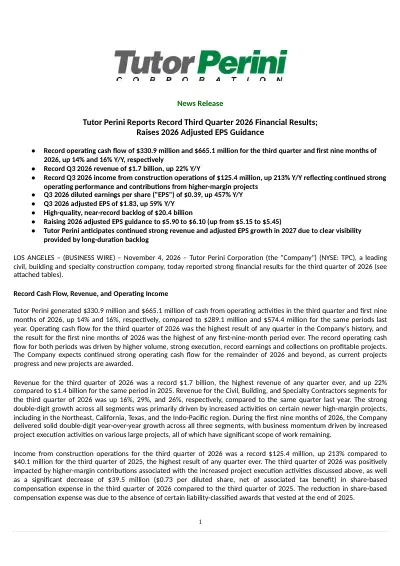
We delivered another quarter of outstanding results that featured record operating cash flow, revenue, operating income, and earnings. Our consistent execution and continued backlog growth give us tremendous confidence and visibility into our ability to continue creating value for shareholders over the near and long term.
This marked our seventh consecutive quarter reporting outstanding results. Our operating cash flow for the third quarter and the first nine months of 2026 was up 14% and 16% year-over-year, respectively, each setting new all-time records, with the third quarter result of $331 million representing the largest of any quarter ever.
Our record cash flow this year has been driven by higher volume, strong execution, record earnings, and collections on various large projects that are very profitable. Our third quarter revenue was a record $1.7 billion, up 22% year-over-year, driven by contributions from various projects, most of which are in the early stages with significant scope of work remaining.
As a result of our strong revenue growth and project execution, we generated record operating income of $125 million, which more than tripled compared to the same quarter last year. We produced 39 cents of GAAP earnings per share and $1.83 of adjusted earnings per share, up 457% and 59%, respectively, compared to the third quarter last year.
Ryan will delve into the details of our financial results shortly. Our operating margins were also outstanding.
Our Civil segment's third quarter operating margin was a solid 14%. Our Building segment's operating margin was also strong at 5%, with operating income that was nearly double that of the third quarter of last year.
Our Specialty Contractors operating margin was 3.5% for the third quarter, up 130 basis points compared to the prior-quarter margin, and reflecting the continued margin expansion we have anticipated this year. We believe that the Specialty segment's margin will continue to improve as its electrical and mechanical work ramps up on several of our large civil and building segment projects.
Overall, we are extremely pleased with the continued upward trajectory of our business and the substantial revenue, earnings, margins, and cash we are generating from our growing and profitable backlog. Let's turn to the details of our third quarter new awards and backlog.
We booked an impressive $2.2 billion of new awards and contract adjustments, a solid book-to-burn of 1.3x, and finished the quarter with a near-record backlog of $20.4 billion. The largest additions to backlog included $1 billion of additional work for a Civil segment project that includes a substantial amount of electrical and mechanical work to be performed by the Specialty Contractors segment; $577 million of new awards for several federal government projects for Perini Management Services; $145 million of new awards and additional funding for various military facility projects in the Indo-Pacific region for Black Construction; $126 million for various bridge projects in the Midwest for Lunda Construction; $108 million of additional funding for the Choctaw Casino & Resort - Pocola renovation and expansion project in Oklahoma; and $89 million of additional funding for several mass transit projects in California.
As a reminder, our strong backlog, which includes nine megaprojects totaling $16 billion of awarded value, with significantly improved contractual terms that we have won over the past few years, continues to provide us with excellent visibility for future revenue, earnings, and cash flow over the next several years. We expect that our backlog will continue to drive impressive revenue and earnings growth, solid profitability, and strong cash flow in 2027 and beyond.
We continue to have numerous significant project bidding opportunities, particularly in the Indo-Pacific region, as well as in California, the Midwest, the Northeast, and the Mid-Atlantic. Our massive pipeline of more than $200 billion in potential project opportunities over the next 3 to 4 years is broad geographically and diverse across end markets, and about three times larger than the pipeline we had just a couple of years ago.
We expect that many of these opportunities will bid over the next year or two, and are confident that we are well-positioned to win our fair share of them. We remain highly selective and disciplined in our approach to bidding and winning new projects, with our key objective being to maximize shareholder value.
Our focus remains on bidding projects conservatively so that our project budgets reflect safe costs, adequate contingency, higher margins, and favorable contractual terms that balance risks between us and our customers. We continue to see limited competition across the markets for the larger fixed-price projects, which should help us win important and profitable contracts that will enable us to further grow our revenue and earnings and expand our margins.
Now I'll review some of the specific bidding opportunities we are targeting this year and over the next couple of years. In the Indo-Pacific region, Black Construction continues to pursue more than $4.6 billion of federal opportunities, including major wharf, harbor, military, and aviation projects across Guam, Palau, Yap, Wake Island, and Tinian.
In fact, we have submitted bids for three large projects in the region valued at nearly $1 billion, for which we are awaiting the customer's decision. In the U.S., we plan to bid on several multi-billion-dollar infrastructure projects, including the initial contract for the Sepulveda Transit Corridor program in Southern California, a program believed to be valued at approximately $12 billion and expected to be awarded under multiple contracts, as well as the Merced to Madera segment of the California High-Speed Rail project.
We also have, in Southern California, the $4 billion Southeast Gateway, the $2 billion Eastside Transit Corridor Phase 2, and the $1.5 billion C Line Extension to Torrance projects. On the East Coast, we will pursue the $3 billion Hudson Tunnel systems and fit-out project in New York, the $3 billion Newark Liberty International Airport Terminal B project in New Jersey, and the $1.2 billion Newark Bay Bridge project.
Late next year or the following year, we expect to bid on the second phase of the multi-billion-dollar Midtown Bus Terminal replacement project in New York, the phase that will demolish the existing bus terminal and build its permanent replacement. Around the same time, we also plan to pursue a multi-billion-dollar opportunity in Maryland for which we previously bid and had been selected in 2022, but the project did not move forward at that time.
We're also targeting various new large healthcare, hospitality, and gaming opportunities, mostly in California and the Southwest. In addition to these numerous sizable pursuits, we continue to have certain Building segment projects currently in the preconstruction phase that are anticipated to advance to the construction phase later this year and over the next two years.
Our massive pipeline of prospective opportunities, together with our experience and other competitive strengths, give us confidence in our ability to drive backlog growth over the medium to longer term as we continue to focus on earnings growth, margin expansion, strong free cash generation, quality, and safety. We are confident that these opportunities, along with our existing backlog, will provide the catalyst for continued enhancement of shareholder value.
Finally, let's turn to our outlook and guidance. As I mentioned earlier, we are extremely pleased with the financial results we have delivered thus far this year, results that were well ahead of our expectations.
We continue to benefit from strong customer demand and favorable macroeconomic tailwinds. Our business is resilient through economic cycles and changes in the political environment, and we remain confident that our future is bright, with the expectation for continued strong revenue and earnings growth.
Because of the favorable outlook and our record financial results to date, driven by stronger than expected execution of our backlog and mitigation of previously identified project risks, we are raising our 2026 adjusted EPS guidance to the range of $5.90 to $6.10 per share, up from the previous range of $5.15 to $5.45. Importantly, our guidance continues to factor in contingency for unknown or unexpected outcomes and developments this year.
We also continue to expect strong operating cash generation for the remainder of 2026 and beyond due to increasing project execution activities on our newer megaprojects and the anticipated resolution of remaining legacy disputes. Looking to 2027 and based on our outlook and assessment of the current market, we continue to anticipate double-digit revenue and earnings growth as construction activities advance on many of our newer large projects in backlog.
Thank you, and with that, I will turn the call over to Ryan to discuss the details of our financial results.
Ryan Soroka
Thanks, Gary. Good day, everyone.
I'll review our results for the third quarter, then provide commentary on our balance sheet and the assumptions related to our increased 2026 guidance. All comparative references will be against the third quarter of last year unless otherwise stated.
As Gary mentioned, we generated $331 million of operating cash in the third quarter, up 14%, which set a new record as the highest result of any quarter ever. For the first nine months of 2026, operating cash flow was $665 million, up 16% compared to the first nine months of 2025, and the highest of any first nine months ever.
The record cash flow was driven by higher revenue, outstanding project execution, record earnings, and collections on various large projects that are very profitable, as well as effective working capital management, with only a negligible amount attributable to collections from legacy dispute resolutions. We expect to continue generating solid cash flow this year and beyond, with most of our cash to be sourced from organic operations and occasionally enhanced by cash collected from dispute resolutions.
Revenue for the third quarter of 2026 was a record $1.7 billion, up 22% and the highest of any quarter ever, with the growth primarily due to increased project execution activities on certain higher-margin projects, including in the Northeast, California, Texas, and the Indo-Pacific region. Civil segment revenue was $894 million, the segment's highest quarterly revenue ever and up 16%, with the growth driven by increased project execution activities on the Midtown Bus Terminal Phase 1 project, the Manhattan Tunnel, the Manhattan Jail, the Kensico-Eastview Connection Tunnel, the Honolulu Rail project, and the Apra Harbor Waterfront Repairs project in Guam, all of which have substantial scope of work remaining.
Building segment revenue was $541 million, up 29%, primarily due to increased activities on the Brooklyn and Manhattan jail projects in New York, as well as on three large healthcare projects and a hospitality and gaming project in California. All of our major civil and building segment projects continue to run very smoothly.
Specialty segment revenue was $286 million, up 26%, with the segment's growth continuing to be primarily driven by increased activities on various electrical and mechanical projects in New York and Texas. The strong revenue growth helped to drive our third quarter operating income to a record $125 million, up 213% year-over-year.
Civil segment operating income was $125 million, up 26% compared to $99 million. The Civil segment continues to execute well and, once again, delivered a healthy segment operating margin of 14%, up from 12.9% in the third quarter of last year, and running well within the 12% to 15% range we expect for the segment.
Building segment operating income was $27 million, up 88% compared to $14 million, with the strong increase driven by contributions from certain newer, higher-margin projects in New York and California with substantial scope of work remaining. Segment's operating margin was 5%, up nicely compared to 3.4% in the third quarter of last year, and also running well within the 3% to 6% margin range we expect for the segment.
Specialty Contractors segment operating income was $10 million for the third quarter, up 64% compared to $6 million for the same quarter last year. The Specialty segment's operating margin was 3.5% this quarter, up from 2.7% in the third quarter last year.
We are pleased with the Specialty segment's continued margin expansion this year, which has been primarily driven by contributions related to the increased volume on the New York and Texas electrical and mechanical projects that I mentioned earlier. We expect to see further margin expansion as we continue toward our goal of eventually sustaining specialty margins in the 5% to 8% range.
Corporate G&A expense for the third quarter of 2026 was $37 million compared to $80 million last year, with the decrease largely due to a $40 million reduction in share-based compensation expense this year as some of the liability-classified awards that previously caused elevated share-based compensation expense vested at the end of 2025. As a reminder, most, but not all, of the remaining liability-classified awards will vest at the end of this year, next year, we expect that our share-based compensation expense will be significantly reduced compared to this year.
Other income was $16 million for the third quarter of 2026 compared to $7 million last year, with the increase primarily due to higher interest income earned on larger cash balances this year compared to last year. Interest expense for the third quarter was $7 million compared to $14 million last year, primarily due to the successful refinancing of our senior notes that we completed in July, which reduced the coupon rate of our senior notes from 11.875% to 6.625% and will save us $21 million in interest expense annually.
We are now in a net interest income position and expect this trend to continue. We recorded two significant non-operating adjustments in the third quarter of 2026 that we previously signaled would occur in the second half of this year.
First, a $51 million loss on the extinguishment of debt tied to the recent successful refinancing we completed in early July, of which $16 million was non-cash; and second, a non-cash $34 million charge associated with the settlement of our former pension plan obligations. We terminated our pension plan because we wanted to eliminate future cash contributions and ongoing administrative expenses.
Income tax expense for the quarter was $11 million, with a corresponding effective tax rate of 22.7% for the period, compared to $15 million last year with a corresponding effective tax rate of 44.6% in that period. The lower effective tax rate this year is mostly attributable to the lower non-deductible share-based compensation expenses estimated for 2026 relative to 2025.
Net income attributable to Tutor Perini for the third quarter of 2026 was $21 million, or 39 cents of GAAP earnings per share, up more than five times compared to $4 million, or 7 cents of GAAP earnings per share, in the third quarter of last year. Excluding the impacts of share-based compensation expense, the loss on extinguishment of debt, and the pension settlement charge, net of all the associated tax benefits, adjusted net income attributable to Tutor Perini for the third quarter of 2026 was $98 million, or $1.83 of adjusted earnings per share, compared to $62 million, or $1.15 of adjusted earnings per share, in the same quarter last year.
This was a 59% improvement in our adjusted EPS compared to last year's third quarter, reflecting the high-margin contributions and operational excellence we continue to see as we execute our project's backlog. Now I'll address the balance sheet.
Our total debt stood at $404 million at the end of the third quarter. We ended the quarter with cash and cash equivalents exceeding total debt by $707 million, a very robust net cash position and $425 million better than we were one year ago.
Our cash available for general corporate purposes was $504 million at the end of the third quarter of 2026, up 150% compared to the year-ago level. In addition, our cost and estimated earnings in excess of billings, or CIE, as of September 30th, 2026, was $767 million, the lowest balance since the end of 2014, and a decline of 9% compared to $848 million as of September 30th, 2025, reflecting our significant continued progress in resolving and collecting on reduced number of disputed matters.
Our balance sheet has continued to strengthen throughout this year, and our sizable net cash position provides us with tremendous flexibility to allocate our capital efficiently and strategically. Lastly, let me update you on our latest assumptions related to our increased 2026 guidance.
G&A expense for 2026 is expected to be between $380 million and $400 million. Depreciation and amortization expense is anticipated to be approximately $45 million in 2026, with depreciation at $43 million and amortization at $2 million.
Interest expense for 2026 is now expected to be between $40 million and $42 million, of which about $3 million will be non-cash. Our effective income tax rate for 2026 is expected to be approximately 26% to 29%.
We now anticipate noncontrolling interests to be between $65 million and $75 million. We expect approximately 54 million weighted average diluted shares outstanding for 2026.
Capital expenditures are anticipated to be approximately $125 million to $135 million, with the majority of the CapEx in 2026, or approximately $75 million to $85 million, being owner-funded for large equipment items on certain large new projects. Thank you, and with that, I'll turn the call back over to Gary.
Gary Smalley
Thanks, Ryan. To summarize, we delivered record financial results for the third quarter and through the first nine months of 2026, highlighted by the largest quarterly and first nine months of operating cash flow ever; record revenue that reflected strong double-digit growth; record operating income that was more than triple last year's third quarter results; solid segment operating margins; very strong earnings; and continued backlog growth.
As I mentioned earlier, this was the seventh consecutive quarter that we have reported extraordinary financial results. Our near-record backlog, together with the $200 billion-plus pipeline of project opportunities, provides us with great confidence in our ability to deliver double-digit revenue and earnings growth and continued strong cash flow in 2027 and beyond.
Our business trajectory has been and continues to be fantastic, and our results this year reflect strong operational performance and the excellent revenue, earnings, and cash flow potential embedded in our backlog. Given our country's multi-decade history of underinvesting in its infrastructure, a trend that has finally begun to reverse in recent years, we expect that strong customer demand, favorable macroeconomic tailwinds, and solid public and private customer funding will persist and continue to support an abundance of bidding opportunities well into the future.
We firmly believe that Tutor Perini offers a compelling value proposition for investors, especially when you consider our record financial and operating performance to date, our near-record backlog, the massive pipeline of bidding opportunities over the next several years that should sustain our long-term success, and the recent significant pullback in valuations across the stock market. We are confident in our future trajectory, which we believe will be propelled by the outstanding earnings and cash flow potential embedded in our backlog, and we expect to continue benefiting from generational investment opportunities to refresh and modernize the U.S.
infrastructure. Thank you, and with that, I will turn the call over to the operator for your questions.
Operator
Thank you. We will now be conducting a question-and-answer session.
If you'd like to ask a question, please press *1 on your telephone keypad. A confirmation tone will indicate your line is in the question queue.
You may press *2 if you'd like to remove your question from the queue. For participants using speaker equipment, it may be necessary to pick up your handset before pressing the star keys.
One moment, please, while we poll for questions. Our first question is from Adam Thalhimer with Thompson and Davis and Company.
Please proceed with your question.
Adam Thalhimer
Hey, guys, congrats on the strong Q3.
Gary Smalley
Thank you, Adam.
Ryan Soroka
Thank you.
Adam Thalhimer
Want to start off with data centers. I know you won two small jobs earlier this year.
I'm just curious how much of a focus is that area for you going forward.
Gary Smalley
Thank you, Adam. Look, you're right.
We booked a couple projects, about $70 million. If you look at the backlog that we have that's data center-related and that is not, it's 0.2% of our backlog as of the end of September.
Very negligible. However, having said that, we'll continue to look for selective and opportunistic opportunities.
We have talented resources. There's a shortage of electricians to do the data center work.
The demand sometimes comes our way, as it did with these projects, and there are a few more that appear that they might be in the pipeline. Look, with the just immense pipeline, I mentioned the $200 billion-plus of opportunities, and the traditional infrastructure opportunities that we're used to pursuing and that we excel in, data centers is not going to be a focus for us.
Can we do the work? Sure, we can do the work.
Why should we, with all the opportunities we have in front of us in the more traditional work?
Adam Thalhimer
Got it. Okay.
Then you said double-digit revenue growth next year. I'm curious, as you look out to revenue next year, how much of that sales is already in your Q3 ending backlog?
Gary Smalley
Really a lot. I won't give you an exact percentage, but what we'll say, more than 3/4.
That's a very high percentage in our industry. In fact, I would say that if I look back at 2026, when we put the budget together for 2026, that was probably the highest level of certainty that I had seen in backlog in my career, and I've been doing this for 35 years in the industry.
And 2027 is going to be similar in that we're going to have a very strong opportunity just to execute the work that we have and have this double-digit growth. Just a matter of how high of double-digit growth we have from our opinion, because we think we have this visibility because of these huge awards that we booked in recent years, and that's going to go on for some time still.
Some of that work has not fully kicked in, hasn't fully ramped up. As that continues to ramp up, and the work that is already ramped up continues to produce revenue, margins, and cash, then it's only going to improve from here.
Adam Thalhimer
Last one for me. Operating segment-level operating margins have been great this year, particularly in civil and in building.
Curious if you think that there is additional improvement possible over the next couple of years.
Gary Smalley
Yes, there absolutely is. In fact, there could be improvement.
I'm looking for improvement for 2027, really. We've talked internally.
We've guided in the past certain margin ranges for the various segments. I'll give you an example with civil segment.
We've been guiding 12% to 15% for the last few years. Going back a few more years ago, it was 8% to 10%, but we lifted that up as we saw the change in landscape, where we were getting work with better terms and the competition was diminishing.
As I look forward, we're what, 14%, I think, year-to-date right now in civil. I think that as we go forward, I see upward pressure on that.
We've talked recently about maybe we shift that margin up a little bit, but I'd really rather wait a quarter or so just to make sure. I see a very good chance that in the short term, and as well as the medium term, that we're going to see margin elevation not just for civil, but for the others as well.
Building, it really depends more on a mix of things. Specialty, you can see that we really improved the margins again this quarter.
What, about 3.5% and up, what, 50% or something like that from the second quarter. That is a little short still where we want to be in the 5% to 8% range.
I will tell you that the work that we're executing in specialty right now, that the newer work, it exceeds or at least meets that range. We're very comfortable with the new work that we're generating.
The reason the margins are not quite where we need them to be is because we still have some legacy things, really more minor on the specialty side that come trickling through that we continue to settle. Sometimes, where we settle that, sometimes it's at a profit, sometimes it's not.
It's never material. It does put a little bit downward pressure on the margins.
As those legacy items continue to rotate off, we'll continue to see margin expansion in specialty and get into that 5% to 8% range sometime in 2027.
Adam Thalhimer
Cool. Good color.
Thanks, guys.
Gary Smalley
Thank you.
Ryan Soroka
Thank you.
Operator
Our next question is from Min Cho with Texas Capital Securities. Please proceed with your question.
Min Cho
Great. Thank you so much, and congratulations on a really good quarter here.
My first question has to do with the value of your bids outstanding that are awaiting awards, I think. Gary, you mentioned it's about a billion for Black Construction, but just curious how much you have out there across all of your businesses.
Gary Smalley
I mentioned Black. I said it was, as you mentioned, almost a billion.
Just to put it in perspective, we have two in the region that we think we're well-positioned for, and they're about $200 million each, and then we have another one that's just a little short of $600 million that also we feel that we're well-positioned for. In addition to that, we've talked for some time, a couple years now, about work that we have in preconstruction on the building side, and that work, usually there's about a 97% to 99% likelihood that it manifests itself into backlog going forward.
We have over the next, call it 12 to 15 months, we have another 3/4 of a billion dollars, roughly, in that type of work that we would expect to make its way to backlog. Then there are other things here and there, and some of the other business units, but not to that magnitude.
Somewhere around $2 billion of things that, at any point in time, could result in backlog, especially the Black work, because that's been outstanding for some months, and we were hoping by now that we'd hear positive news on those things. We'll continue to be patient.
Things are moving in the right direction, and this will just make things even better when it hopefully comes our way.
Min Cho
Excellent. I know that Black Construction is a very important part of your business, tends to be smaller, but very high margin.
Can you talk a little bit about the capacity that you have there? If you do win these awards, are you able to kind of schedule work?
I know that you were talking about growing this business, just any update on the progress in terms of adding headcount there?
Gary Smalley
Yes. We're in a constant recruiting mode along a variety of fronts, including there.
Right now, we have capacity. Of the $4.6 billion of opportunity that we've talked about coming up in the next couple years or so, with a billion of that pending, we could probably hold right now $3 billion of that work or $3.5 billion, maybe.
We are looking at putting more talent in Black. We have some things in the works.
In some cases, it's internal talent that would be moving there. We're real excited about what Black offers.
It is just a phenomenal operation. The $4.6 billion, that's only going to grow.
The only reason it might not, when we report in the future, maybe you won't hear it growing, because things will be going into backlog and it will be coming out of the pursuits, but there are going to be more and more pursuits.
Min Cho
Excellent. Then just a quick question for Ryan.
Obviously, again, your operating margins have been very strong across all of your segments. When you look at just even the fourth quarter, should we expect margins, especially on the civil side, to come down a little bit due to seasonality, or could we actually see it maintained kind of third quarter levels or even be up just based on the timing of the projects lapping?
Ryan Soroka
Look, from a forecast perspective, obviously there is seasonality, and then you think about the particularly strong winter that's expected with El Niño, I think there's a little bit of headwind there. At the same time, I think there's still opportunity to continue to perform.
If I'm trying to look at it sequentially, I think Q3 is a good barometer for Q4, and that could tick up or tick down just based on some of the impacts that we've talked about.
Min Cho
Perfect. Thank you.
Ryan Soroka
Thank you.
Gary Smalley
Thank you, Min.
Operator
Our next question is from Michael Dudas with Vertical Research Partners. Please proceed with your question.
Michael Dudas
Good afternoon, and well done, gentlemen.
Gary Smalley
Thank you, Mike.
Ryan Soroka
Thank you, Mike.
Michael Dudas
Gary, you booked $16 billion in seven or eight large projects in an environment where the pipeline was much, much lower than it is today. As you look out the next 3 to 4 years, can you get a sense of how we can scope that given the limited competition and how confident and selective you are on some of these major bids that you've cited and some others I'm sure going to come out over the next 6 to 18 months?
Gary Smalley
Mike, we're confident we're going to get our share of what's out there. We think more than our share.
There was a stretch when we booked that $16 billion, that's made up of nine projects, and I think it was something like we won 9 out of 12. I don't expect the same type of hit rate.
When you start to get the work, you can be a little bit more greedy in how you approach things. We bid this work at high margins, and then as time went on, higher margins and still higher margins, and that's really our approach.
We expect that we won't win every one of them, but look, we're well-positioned for a few very large programs that are coming out, and some are accelerating beyond what we had expected. We feel really good about building the backlog from here and building it in a profitable way.
Michael Dudas
Very helpful. Then, Ryan, you've been generating it's a cash flow machine that you got you're driving over there.
How is that going to help bid I assume that you're going to be sole-sourcing many of these bidding projects with surety support, etc., given your very strong financial profile? Many of these larger projects, I guess Gary or can talk about that you'll be won't be needing joint venture partners unless there's some technical aspect that you may want to pursue?
Ryan Soroka
That's certainly the intent. Obviously, with the cash balance, but at $1.1 billion as we sit here as of the end of September, that was certainly the intent is having that strength going into those bids and certainly approaching it to the extent that we can from a sole-source perspective.
From our perspective, that's a pretty good return, keeping that noncontrolling interest in-house.
Michael Dudas
Said. Thanks, gentlemen.
Ryan Soroka
Thank you, Mike.
Operator
Our next question is from Liam Burke with B. Riley Securities.
Please proceed with your question.
Liam Burke
Thank you. Good evening, Gary, Ryan, Jorge.
Ryan Soroka
Hi, Liam. How are you doing?
Liam Burke
Good, thank you. Could we get some color on preconstruction activity?
You talked about it in previous quarters being pretty elevated. Has that past preconstruction activity rolled into backlog, or is that something we could anticipate for 2027?
Gary Smalley
Liam. The preconstruction activity, if you go back two, maybe 2.5 years, something like that, over that period of time, when we first started talking about preconstruction activities, we put about $3 billion of that work into backlog.
I'll say that every prospect that was in preconstruction turned into backlog other than those that are still pending. As I commented a few minutes ago, we still expect probably about 3/4 of a billion, $750 million roughly, over the next year to 15 months, and maybe year, 15 months, 18 months, something like that, that should come into backlog as well from preconstruction activities.
Now, what we're seeing also is now starting to see more opportunities of things going into preconstruction, we'll start to replenish that a little bit. We've been working down a $4 billion, $4.5 billion amount for some time with little dribs and drabs going into preconstruction.
I think we'll see more going into preconstruction, after this 12, 15, 18-month period, we'll still have things that will be going into backlog from preconstruction. The pipeline continues there too.
Liam Burke
Great, thank you. Getting back to specialty contracting, you talked about a little bit of external work, but very profitable work that you're doing for projects for civil.
Is there a capacity challenge that you see based on your opportunity pipelines?
Gary Smalley
No, look, there are some shortages of electricians around the country in certain pockets, but we are very good with that right now. We are not facing any shortages there, and we don't anticipate having those issues.
At the same time, we're always trying to manage to make sure that we stay ahead of the curve. With the work that we have, you're right, it's very profitable, the work that we have in-house that is supporting primarily civil projects, but also building projects, and then in some cases, third parties as well.
Everything that has been awarded in the last 2, 3 years is performing extremely well.
Liam Burke
Great. Thank you.
Gary Smalley
Thank you.
Ryan Soroka
Thank you.
Operator
Our next question is from Steven Fisher with UBS. Please proceed with your question.
Steven Fisher
Thanks. Good afternoon.
Just wanted to ask you about the Black Construction work. Sounds like some of that activity has been sort of in process for a while.
Any particular uncertainties, is it perhaps federal budget or anything that's holding that up? Then I guess, similarly, on the civil side, curious what you're hearing from transportation agencies about kind of funding situation and whether uncertainties there about policy maybe kind of holding up any or elongating the awards process?
Gary Smalley
First part of your question, well, there's a lot of work there. The biggest amount of work that's pending right now, there's some environmental reviews that need to be completed, and then that will allow those projects or this large particular project to be awarded.
That region, the Indo-Pacific region, is a very important part of our company and a growing part, as following us over the past few years. It's even more important to the country, to the United States.
The defense, Pacific Deterrence Initiative, and working with the federal government in this part of the world, these programs are not going to be derailed. They won't be defunded in any way, and it is something that both sides of the aisle agree upon the importance of it.
There may be some delays, what we're seeing from time to time, and sometimes it takes government a while to make a decision, but this work is going to proceed. As I mentioned just a few minutes ago, there's going to be more of it than the $4.6 billion we're tracking right now.
Then on the second part of your question, could you repeat that again?
Steven Fisher
Just on the civil side, what you're hearing from transportation agencies in terms of any particular uncertainties around funding and highway policy, etc., that may be holding up awards.
Gary Smalley
There's nothing holding up awards right now. Most of what we're doing, most of funding is coming from the state and local level, and that's full steam ahead.
On the federal side of things, what we have read, what we've heard is that there appears to be some momentum, and maybe that momentum will increase based on the results of the midterms for a new transportation bill and additional funding. We are in great shape if there is no more federal funding, but expecting that there will be some more, it's going to really just add to the outstanding position we have in the backlog that we currently have.
We have not factored that into guidance in consideration of when we talk about 2027 and double-digit growth. We're not assuming any additional funding coming from the feds, but I would expect that, to be quite honest with you, and that should be another positive as we look at 2027 and beyond.
Steven Fisher
Great. Then just with the backlog that you have today, you mentioned earlier that you're still ramping up on some of these programs, just curious if there's any way to frame kind of when you think you'd hit a peak level of burn just to kind of gauge when we might be able to start thinking about having some visibility to taking in some of the contingencies that you have.
Do you think you'd still be ramping through all of 2027 and maybe you're not even going to hit kind of a full burn rate on these until 2028? Just curious how to kind of frame the duration of this ramp.
Gary Smalley
I think if you look at what we currently have in backlog, then I would say that the peak is probably somewhere in 2028, maybe the latter part of 2028, something like that. Keep in mind that when you come off the peak, you just don't fall to nothing from the peak.
It starts to wind down. After the peak, if we were not to book anything else, after the peak is still going to be very good times for us.
Certainly between now and then, we're going to be booking other work, and that work is going to be profitable, and it's going to replace some of the work that burns off as well. I wouldn't say that 2028 would be a peak for the company that we would never be able to grow from.
I'm just saying that based on the work that we have right now. I would say we're going to continue to grow beyond 2028 also.
There're just too many opportunities, and we're well-positioned, well-positioned on too many of them for us not to continue to grow.
Steven Fisher
Thanks, Gary.
Gary Smalley
Thank you, Steve.
Operator
We have reached the end of the question-and-answer session. I would like to turn the floor back over to Gary Smalley for closing comments.
Gary Smalley
Thank you, everyone, for your interest and participation today. We look forward to continuing to deliver shareholder value, strong shareholder value, and also reporting an eighth consecutive quarter of outstanding results when we speak to you again next time.
We're really excited about where this company is. We've come a long way over the last few years.
A lot of you have been with us for a long time and waited for this story to develop. We appreciate your patience, and you can see the good things coming together now.
I keep saying that this is just the tip of the iceberg, or make comments, there are a lot more good quarters to come. I really believe that as we continue to have this wonderful visibility into our future work, and we continue to even surpass our high expectations.
We hope to continue to create value and to demonstrate that your faith, confidence, and patience with us was the right thing. Thank you again, and we'll talk to you soon.
Operator
This concludes today's teleconference. You may disconnect your lines at this time.
Thank you for your participation.