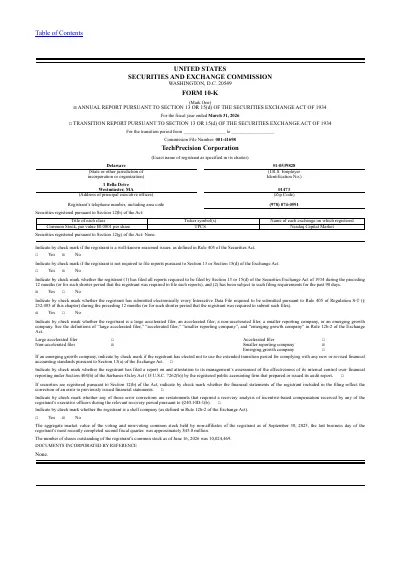
TechPrecision Corporation
NNASDAQ:TPCSQ4 FY2026 · Earnings Call TranscriptJune 22, 2026
Operator
Greetings, and welcome to the TechPrecision Corporation Fiscal 2026 Fourth Quarter Earnings Call. At this time, all participants are in listen-only mode.
As a reminder, this conference is being recorded. It is now my pleasure to introduce your host, Mr.
Brett Maas, Managing Director of Hayden IR. Thank you, sir.
You may begin.
Brett Maas
Thank you. On the call today is Alex Shen, Chief Executive Officer, and Phillip Podgorski, Chief Financial Officer.
Before we begin, I'd like to remind our listeners that management's remarks may contain forward-looking statements which are subject to risks and uncertainties, and management may make additional forward-looking statements in response to your questions. Therefore, the company claims the protection of the safe harbor for forward-looking statements as contained in the Private Securities Litigation Reform Act of 1995.
Actual results may differ from those discussed today, and therefore, we refer you to a more detailed discussion of risks and uncertainties in the company's financial filings with the SEC. In addition, projections as to the company's future performance represents management's estimates as of today, June 22nd, 2026.
TechPrecision assumes no obligation to revise or update these forward-looking statements. With that out of the way, I'd like to turn the call over to Alex Shen, Chief Executive Officer, to provide opening remarks.
Alex, the floor is yours.
Alex Shen
Brett, thank you. Good afternoon to everyone, and thank you for joining us.
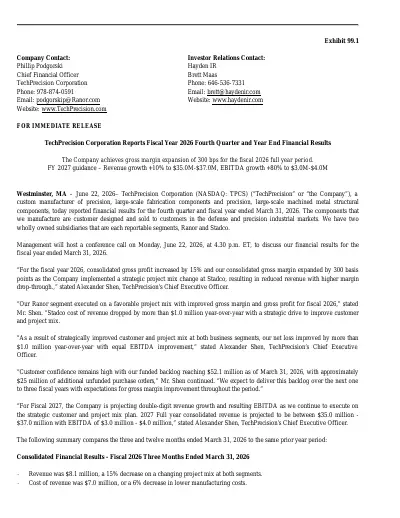
Fiscal year 2026 fourth quarter consolidated revenue was $8.1 million or 15% lower when compared to $9.5 million in the fiscal year 2025 fourth quarter. Consolidated gross profit totaled $1.1 million or 47% lower when compared to the fourth quarter of fiscal 2025, primarily due to lower revenue and resulting margin drop-through at Stadco.
Fourth quarter Stadco revenue was $4.2 million with gross profit of $28,000. Two factors drove the low gross profit: 1, delays in receiving customer-furnished materials; 2, delays in customer analysis and disposition of non-conformances.
We are actively working with our customers to shorten the delays to improve our throughput. Fiscal year 2026 fourth quarter Ranor revenue was $3.9 million with gross profit of $1.1 million or 16% lower when compared with the prior year fourth quarter results.
We continue to strategically improve both our customer and project mix towards gross margin expansion at Stadco. We remain highly focused on aggressive daily cash management, a critical piece of risk mitigation.
We continue to manage and control expenses, capital expenditures, customer advances, progress billings, and final invoicing at shipment. Our tactical execution focus and success enables us to continuously re-secure strategic customer confidence at both segments.
Our Ranor segment continues to execute and install new equipment funded by the $24 million-plus in grants from our U.S. Navy submarine programs-related customers.
This sustained cadence of new equipment procurement, delivery, and installation will enable a reliable, robust, and resilient manufacturing capacity dedicated to submarine programs. At both Stadco and Ranor, our customers have expressed their strong confidence as we continue to maintain on-time delivery of quality components.
This delivery performance is leading both Stadco and Ranor to new quoting opportunities in air defense and submarine defense sectors with the same customers that already know and trust our capabilities. Both subsidiaries are continuing to experience meaningful new capture of business awards from these same customers, adding to our strong $52 million backlog.
This $52 million backlog only includes the funded portions of customer purchase orders, with an additional approximately $25 million additional of unfunded purchase orders. We expect to deliver this $52 million backlog over the course of the next one to three fiscal years with gross margin expansion.
With that said, we are providing guidance for fiscal year 2027. The company is projecting 2027 full year revenue to be $35 million to $37 million.
We are projecting EBITDA to be $3 million to $4 million. Now I will turn the call over to our Chief Financial Officer, Phillip Podgorski, to continue with the review of our fourth quarter and 12-months ended fiscal 2026 results.
Phil?
Phillip Podgorski
Thank you, Alex, and good afternoon, everyone. As Alex just mentioned, for our fiscal 2026 fourth quarter, consolidated revenue decreased by 15% to $8.1 million compared to $9.5 million for the same period a year ago on lower revenue at both Ranor and Stadco segments.
Consolidated cost of revenue decreased by 6% or $400,000. Consolidated gross profit decreased by $1 million in Q4 2026 to $1.1 million, primarily due to lower revenue at both Ranor and Stadco.
Consolidated SG&A decreased by 24% to $1.3 million, primarily on a decrease in professional fees and services. Interest expense decreased by 25% due to lower interest incurred on our loans and lower amortization of debt issuance costs.
Our net income was $400,000 for the fourth quarter or 4 cents per share on a basic and fully diluted basis. For the 12 months ended March 31, 2026, consolidated revenue finished up at $31.6 million or 7% lower on a different mix in customer projects at both segments.
Consolidated cost of revenue was $26.7 million or $3 million lower than the same period a year ago on lower revenue and improved strategic customer and project mix. As noted, our improved strategic customer and project mix resulted in increased gross profit of $600,000 or 300 basis point improvement.
SG&A decreased by 7% as lower professional fees and office costs more than offset higher compensation and benefits. Consolidated operating loss for the 12 months ended March 31, 2026, was $1.1 million and decreased year-over-year by 51%, primarily due to higher gross margin and lower SG&A cost, as noted before.
Interest expense decreased by 10% on lower interest incurred on debt and lower amortization of debt issuance costs. Net loss was $1.6 million or 17 cents per share on a basic and fully diluted basis.
Moving on to our financial position, we continue to actively manage our cash flow, as Alex mentioned. Net cash provided by operating and investment activities totaled $900,000 for the 12 months ended March 31, 2026.
Net cash used in financing activities totaled $600,000, primarily to pay down principal under our revolver and term loans. Our debt was $6.9 million as of March 31, 2026, compared to $7.4 million on March 31, 2025.
Cash on March 31, 2025 was $431,000 compared to $195,000 on March 31, 2025. Now let's dive a little deeper into the segment performance for the fiscal quarter, Q4.
For Ranor, fourth quarter revenue was down by $800,000 year-over-year or 16%, primarily driven by delays in receiving customer-furnished materials. The revenue decline resulted in $1.1 million of gross profit for the quarter.
Stadco Q4 fiscal 2026 revenue decreased by $700,000 compared to the same period last year, primarily as we implemented a strategic project mix change at Stadco. Stadco experienced Q4 year-over-year gross margin decline as gross profit decreased by $800,000, mainly due to customer-related delays on 1, customer-furnished material, and on 2, customer analysis and dispositioning of non-conformances, as Alex mentioned.
As Alex mentioned, we continue to actively work with our customers to reduce the wait times and improve throughput. With that, I will now turn it back over to Alex.
Alex Shen
Thank you, Phil. In closing, for those on the call who may not be very familiar with our company, TechPrecision is a custom manufacturer of precision, large-scale fabricated components and precision, large-scale machined metal structural components.
These components that we manufacture are custom designed. We sell to customers in two main industry sectors: defense and precision industrial markets, predominantly defense.
We do most of our work in industries that are highly sensitive to confidentiality, which preclude us from speaking publicly about many things that a company not operating in TechPrecision's specific environment might discuss. Please understand there are real limits as to what we can discuss, and sometimes those limits do change.
TechPrecision is proud and honored to serve the United States defense industry, specifically naval submarine manufacturing through our Ranor subsidiary and military aircraft manufacturing through our Stadco subsidiary. We aim to secure and maintain enduring partnerships with our customers.
As noted earlier, the total of completely funded grant money of more than $24 million from our U.S. Navy submarine programs reflects this strong partnership.
This commitment represents more than 50% of TechPrecision's market cap. Overall, at both Ranor and Stadco, we continue to see meaningful opportunities in the defense sector as evidenced by the strength of our backlog.
We're very encouraged by the prospects for growing our revenue and increasing profitability in future quarters. We are showing progress.
We have more work to do, especially with our Stadco subsidiary to get into the black. We are targeting to build and sustain a positive trend.
Operator, please open the line for Q&A.
Operator
Certainly. At this time, we will be conducting a question-and-answer session.
If you would like to ask a question, please press *1 on your telephone keypad. A confirmation tone will indicate your line is in the question queue.
You may press *2 if you would like to remove your question from the queue. For participants using speaker equipment, it may be necessary to pick up your handset before pressing the star keys.
One moment, please, while we poll for questions. The first question for today is from Ross Taylor with ARS Investment Partners.
Ross Taylor
Thank you very much. First, gentlemen, congratulations on getting to where you can actually and are willing to give guidance.
I think that's a huge step, something you guys have never done in the past. Let's focus on EBITDA.
What was '26 EBITDA? I haven't seen your filings yet, haven't been able to pull that out.
What was your EBITDA in '26?
Phillip Podgorski
It was $1.6 million, 1644 to be exact, Ross. Okay.
Ross Taylor
You're expecting to basically take that to $3 to $4 million, you're looking at 10, 11, 10 to 17% top-line growth and basically doubling or perhaps better than doubling the EBITDA next year.
Phillip Podgorski
That's correct. Okay.
Ross Taylor
Running down with some of the uses, you pay down, you said, a little over $600,000 in debt. You have about $6.9 million in long-term debt.
Would you anticipate that this increase in EBITDA would allow you to make a more meaningful dent on that debt outstanding in turn in the current fiscal year '27?
Phillip Podgorski
I think it'll be a combination of investment in equipment as well as paying down the debt. It's critical to invest in Stadco.
Alex Shen
Absolutely.
Phillip Podgorski
It'll make the organization a bit more efficient. We'll have additional throughput as well.
Combination of both, Ross. Okay.
Then
Ross Taylor
looking at this, in the past, Alex, you said you've never failed in a turnaround, but Stadco is clearly been to use one of my father's, who's flew in two wars, phrases, it's been an aileron roll on take-off. It's not worked at all.
We've probably sunk well over $20 million in both purchase price and losses into it. Have you thought about why did that happen?
Alex Shen
Absolutely. Yes, we have.
Ross Taylor
Can you educate us on why that happened and why it's taken so long to get it fixed or getting it fixed? Cuz it's not fixed yet.
Alex Shen
It's not fixed yet. We do see positive sustained improvement that is still not reaching where we can start trending in the black.
It is positive. That's one thing.
We've alluded to a little bit in our introductions and in our prepared script. Phil and I both talked about a strategic mix change.
The mix change, part of what was detrimental to us and causing us to go the wrong way was the mix was a combination of one-offs as well as repeat parts. Those are generalizations, but with one-offs, where we don't think that they'll ever repeat again, they are first basically very difficult to understand and estimate correctly.
We should make that an exception and not do them as part of what we always do. It's a little bit difficult to do that when we're scrambling for revenue and part of it also once we have that type of purchase orders that were still not done executing and those will turn into legacy anchors that drag us down.
We've learned our lesson. We're changing the mix.
We've been working hard at changing the mix quarter-over-quarter, month-over-month for the all of fiscal year 2026, and we see decent results, not good enough yet. That alone is not going to bring us to profitability or break-even, but that definitely is a sea change in how this strategic mix is now tilted towards repeat parts on repeat programs and programs of record with the United States government.
I hope that's clear on that one piece. Phil?
Phillip Podgorski
If I could add to that, Alex. Ross, to answer your question a little bit further, some of the things that have been holding us back, I hate to keep using the word legacy, right?
Upon acquisition of this organization and as we were moving through, we did discover that there were a number of contracts that were priced wrong. They were priced with de-escalation on price, amidst a market that was escalating.
You had asked the question at one other time, how many more of these do we have? Right now we have two.
I'm going to answer it directly. We have two that are remaining.
That's it.
Ross Taylor
Okay.
Phillip Podgorski
We've gone through specifically this year and either renegotiated with repricing, new terms, new Ts and Cs. We have two that are hanging out there.
They're at their last leg, right? It will carry into fiscal 2027, both of them.
We're committed to getting those done, completed, and off. From then, it is all new focus.
This is where we talk about the strategic mix, strategic with a sense of repeat products. If we're doing first articles because we do want to expand the product, right, the number of items with existing customers, primarily, but they're going to be priced right at the beginning.
Right? We've been saddled with these legacy.
We're nearing that end.
Ross Taylor
Okay. I think of you in Stadco having two Ross
Alex Shen
Sorry, Ross. Could I just finish off the answer to the question?
It was in three parts. The first part was really the characterization of one-off versus repeat parts.
Ross Taylor
Sure. Yeah.
Alex Shen
With that, from Phil's standpoint, he was seeing mostly it's very, very difficult to price the one-offs to be anywhere close to reality. If we pay more attention and get out of those and really concentrate and change our mix strategically, it helps us do a much better job and a much more successfully profitable job at pricing if we just concentrate on the ones that are repeat parts that are actually deployed in the field for defense work.
It's one-off versus repeat parts, that's one thing. The next thing was very closely related to that, but separate, is pricing.
The third piece that we also alluded to a little bit on the usage of cash is aged equipment. How are we going to deploy that?
Are we going to pay off debt? Are we going to incur some more debt and spend it on CapEx?
That's the three pieces: strategic mix change, pricing, and aged equipment replacements.
Ross Taylor
I want to get back to the idea of equipment and the like, because obviously the Navy has pumped a lot of money into its supplier network to allow it to operate with the most modern equipment, the most effective level. It strikes me we think of you having two primary programs at Stadco, one of which is Boeing's F-15EX and derivatives thereof, and the other is the CH-53K.
Do either of those two programs right now, are they turning a profit operationally?
Phillip Podgorski
Yes.
Ross Taylor
Okay. The problem you have is in one specific program.
Alex Shen
There's still
Ross Taylor
You mentioned you have two contracts that have to run through. From what I've watched in pattern and analysis and the like, I'm assuming that problem is with Sikorsky and the CH-53K.
I could be wrong, but that's where it appears to me to be. You have these two programs, two products that you need to run through.
I assume that when you get that done, the next round, the next batch you run should be profitable. Is that a correct assumption?
Phillip Podgorski
That is not a correct assumption.
Ross Taylor
No.
Phillip Podgorski
No. We have other customers at Stadco as well.
Some of them, again, have, again, legacy contracts that go back quite far.
Ross Taylor
So
Alex Shen
I see. I think, Ross, just to be a little bit more open than usual, and I'm going to sustain this in the future as well.
Phil sees it from his pattern recognition and actually looking at when we break it down by the project, when we break it down by the customer, but also when we break it down specifically into the sub-projects, right? We've done a lot of work with those two customers that I'm not supposed to mention by name.
Ross Taylor
And Yeah. You didn't.
Alex Shen
the key is that we have gotten them to the point where there are repeat parts and pricing is finally in the correct place, and we intend to hold the line and advance it from there. I hope that gives you a bit more color.
Ross Taylor
Yeah. You've said that company-wide about 90% of your business is sole-source?
Alex Shen
I would try to modify what you just said, single-sourced or sole-sourced. Sorry, there's legal connotations with
Ross Taylor
Yeah, there are differences.
Alex Shen
Yep.
Ross Taylor
Sole is only you can do it. Single is only you are doing it.
Alex Shen
Yes, generally speaking, correct. Yeah.
Ross Taylor
You're looking at this with so much of your business being something you do uniquely, one would think that you should be able to get a reasonable profit, and the fact that it does not help your suppliers for you to not be able to make a reasonable profit. I have to say I do hope And if you have other smaller contracts that aren't in these two things, it would strike me as, once again, one needs to be able to operate at a reasonable profit.
Is, by the end of this current fiscal year, the '27 fiscal year, are you saying that you do not think that you'll be able to be making a reasonable profit in both of these programs? If so, what's it going to take to get there?
In I didn't
Phillip Podgorski
in the two programs that you had mentioned earlier, the names that we're not supposed to mention
Ross Taylor
Yeah. The ones we don't talk about, right.
Phillip Podgorski
That's right. In fiscal 2027, they will be making a profit, yes.
Ross Taylor
Both those programs will make a profit in fiscal '27?
Phillip Podgorski
That's correct.
Ross Taylor
That's a huge improvement.
Phillip Podgorski
It is. Huge strides have been made.
Yeah.
Ross Taylor
Here's a question. You've seen at times and you're seeing it on the Ranor side, but these companies that you're working with, Boeing's, Sikorsky, RTX, whatever, they have the ability to help their suppliers, not just through contracts, but also through supplying capital.
You see this with some of your competitors and some of your peers, where they come in and they supply capital with the idea of getting either first dibs on production or whatever. Why are you not seeing that in this area?
I know they like the F-15EX right now. You're seeing there's some talk about them not only producing over 200 for the air defense version, but replacing over 200 aircraft that are currently in the F-15 E versions with the EXs.
You're talking about a program that could have a 500-aircraft run inside the US Air Force, but to get there, you can't do it doing 24 a year. You got to get up to 50 to 70 or more I think 70 or more a year.
To do that, you need to invest capital, I would assume. That investing of capital, which is not much for them, but might be huge for you, pays huge dividends because if they can increase the production rate by threefold, which I believe they should be able, nothing else there coming off the F-18.
F/A-18 run has stopped, there's an assembly line in St. Louis, I think, that might be empty.
It just strikes me as, what's it going to take to get them to approach their business the same way the Navy and General Dynamics and the like have approached the submarine business?
Phillip Podgorski
What I can say is, and I'll let Alex chime in afterwards, is that Boeing and Sikorsky have certainly recognized the need to invest in their supplier base. Again, the names I shouldn't be mentioning.
Sorry, Alex.
Ross Taylor
The companies we don't talk about. It's okay.
Yeah.
Phillip Podgorski
Yep. A slip on mine.
They have recognized the need to invest, and to the point is it going to happen now? Is it not going to happen?
Time will tell. Certainly, conversations have been had, right?
They understand our position. We've already initiated these conversations months ago, right?
Can't say that we're ahead, but we certainly know that there is demand for what our talent, our technology, our capability is. In order to get the throughput that they're looking for, they need to invest or we need to find another way to get it.
Alex?
Alex Shen
That's a good opener for me. Being a little bit more blunt and not talking about specifics and specific customer names, there has been no hesitation whatsoever on our part to aggressively pursue CapEx opportunities in the form of grants.
We don't have the money, and that is clear. If you would like more capacity, we have the know-how, we have the desire, and we have the knowledge to execute.
I guess it's very clear that we're waiting for customer responses, and we've been very aggressive in requesting CapEx assistance in the form of grants. We've gone directly to the customers' highest levels as well as really the armed forces side of the program management from the government side.
Mhm. Yep.
It's slow, it's not reflected yet. It took Ranor years and years and years before we were recognized enough for a CapEx grant through the US Navy through Electric Boat.
Ross Taylor
They did get there. As I said, if you're looking at getting rid of these roadblocks, it's going to take these companies investing in, or the government.
Someone has to invest in building out the
Alex Shen
The industrial base.
Ross Taylor
the industrial base, cuz it doesn't work And as I said, when you look at the numbers, you realize you don't need 300 to 500 aircraft in 15 years, you need them in 5 years, 7 years. To do that, it's going to take investments, and obviously you can execute it.
Lastly, on this EBITDA number, you're looking at basically getting an EBITDA ratio in and around let's say 10%, a little bit better, in fiscal '27. Is that something that we should see as a stepping stone moving higher as we push forward, both because we should see more aircraft particularly, we should see a ramp in submarines going forward, and we should see a ramp also in at least one of those two programs that we don't talk about?
Phillip Podgorski
I think that the
Alex Shen
Go ahead, Phil.
Phillip Podgorski
Yes, I think the answer to that is, let's get to the 2027 number. The roadmap further would suggest what you had indicated, all right?
Certainly, the SG&A profile that we have, the infrastructure that we have, doesn't need to expand other than the equipment at the same pace. You should see a higher drop-through.
Let's execute on 2027, I think, first.
Ross Taylor
Executing on '27 will be fantastic. As I said, congratulations on getting to where you're comfortable issuing guidance, and thank you for being a little more open in the conversation.
As I said, I think that, it strikes me as '27 is the year this should actually turn a corner, and given where the stock is priced, that should leave a lot of upside pushing forward, particularly if you can start to generate positive EBITDA and better revenue numbers so that the market isn't afraid that I get too many calls, people worrying about whether you can get a bank accord, and I'm comfortable that your bank will find a way to finance you until you get further around the corner. Thank you.
Phillip Podgorski
Thanks, Ross.
Alex Shen
Thank you.
Operator
We have reached the end of the question-and-answer session, and I will now turn the call over to Alex for closing remarks.
Alex Shen
Thank you, everyone. Have a great day.
Operator
This concludes today's conference, and you may disconnect your lines at this time. Thank you for your participation.